Fusion vs Fission
Fission/Fusion
Better Lesson credit R.Meisner w/add-ins RMohler
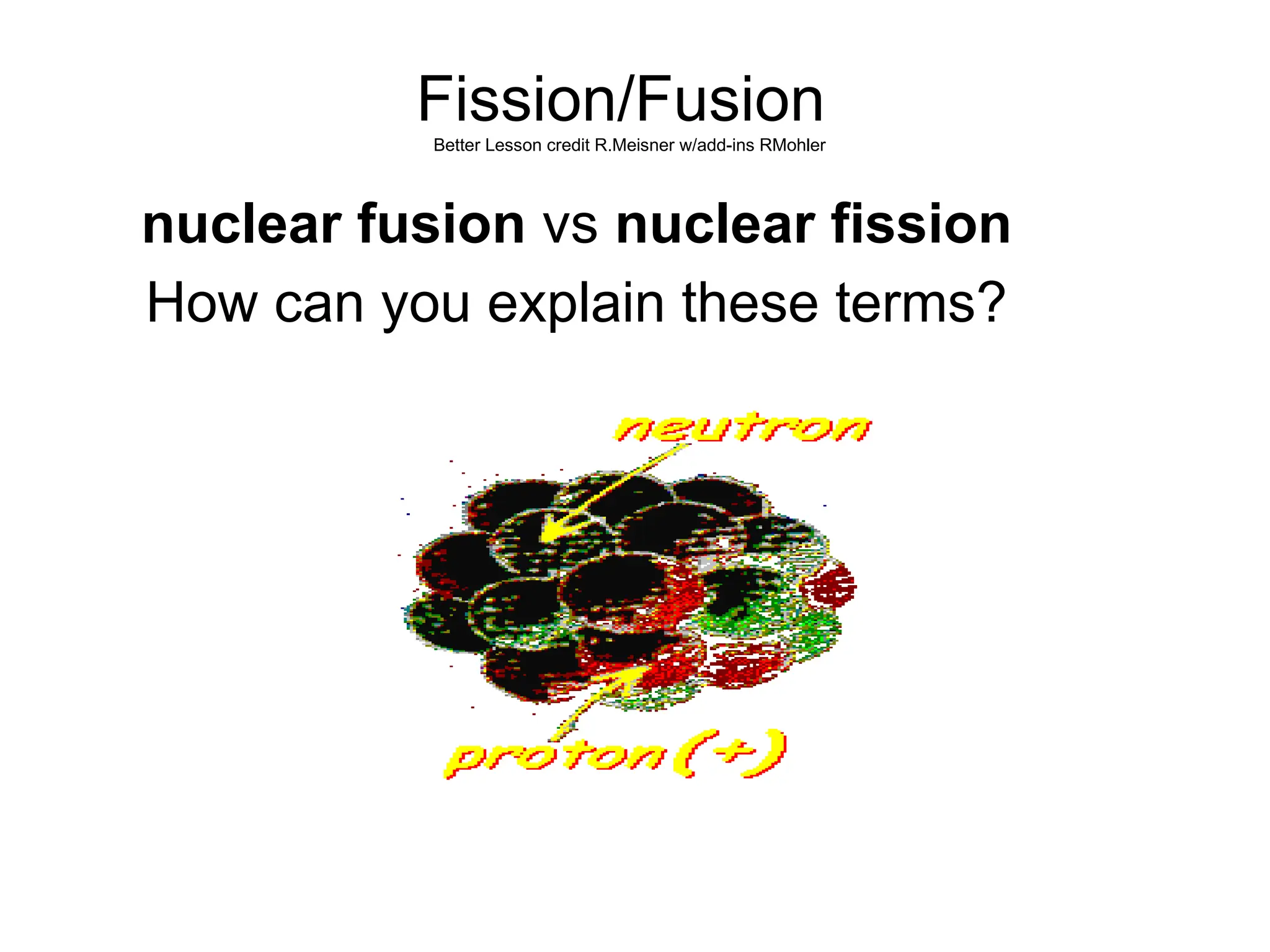
nuclear fusion vs nuclear fission
How can you explain these terms?
Nuclear Reactions
- Reactions involving changes in the
nucleus of atoms
- Nuclear reactions release MUCH
MORE energy then chemical reactions
(which deal with electrons only)
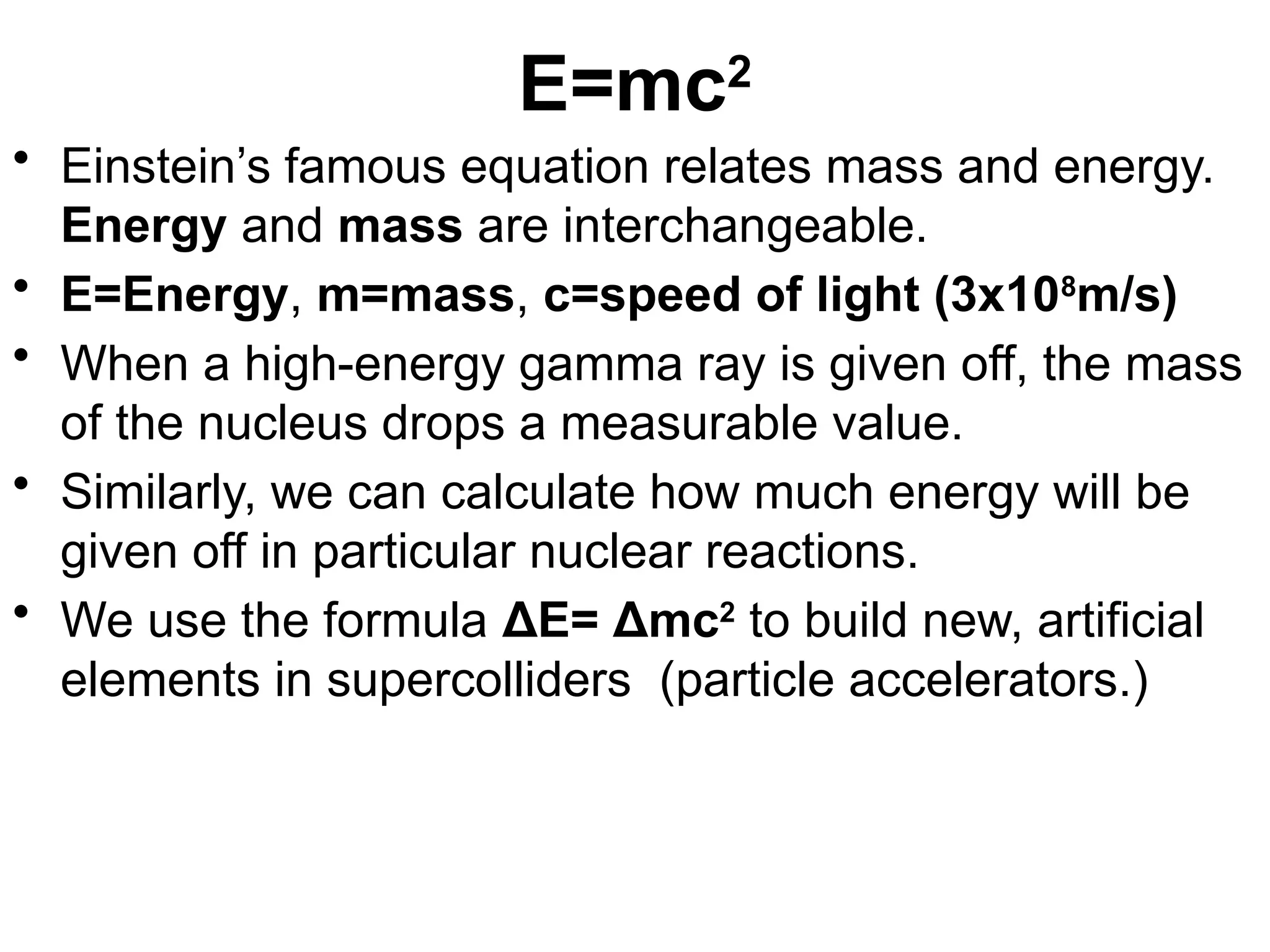
E=mc2
• Einstein’s famous equation relates mass and energy.
Energy and mass are interchangeable.
• E=Energy, m=mass, c=speed of light (3x10⁸
m/s)
• When a high-energy gamma ray is given off, the mass
of the nucleus drops a measurable value.
• Similarly, we can calculate how much energy will be
given off in particular nuclear reactions.
• We use the formula ΔE= Δmc2
to build new, artificial
elements in supercolliders (particle accelerators.)
Nuclear Fission
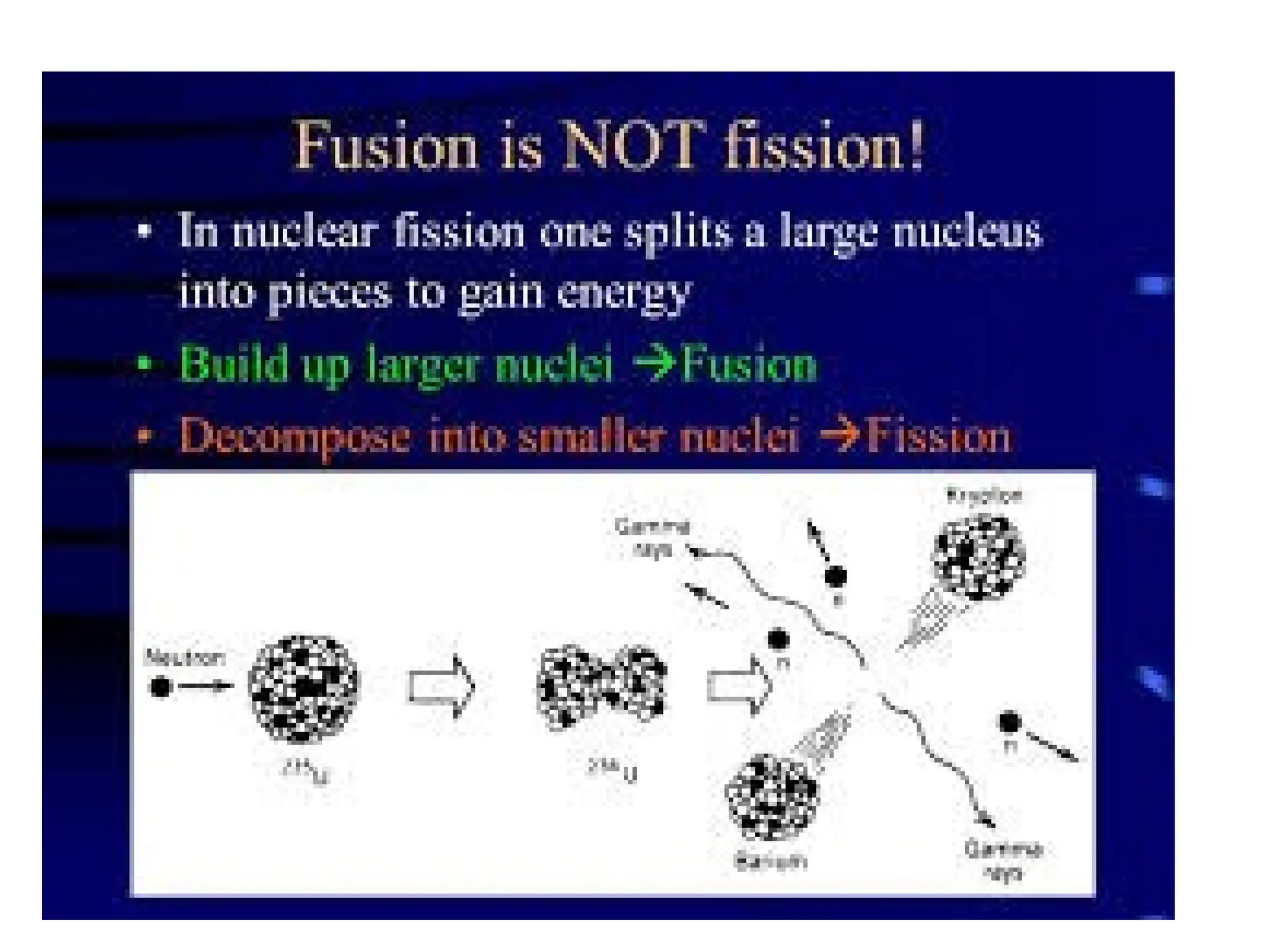
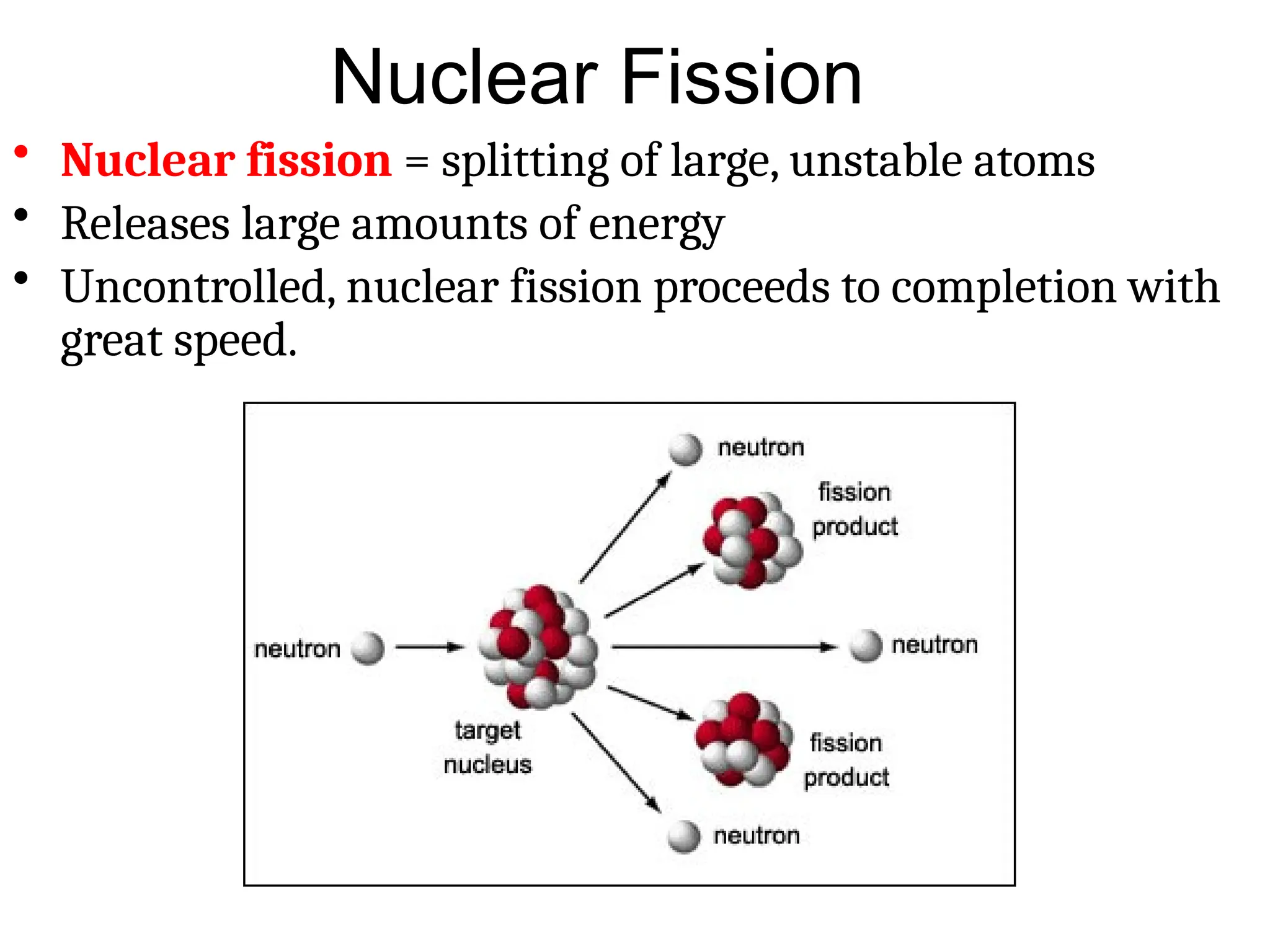
• Nuclear fission = splitting of large, unstable atoms
• Releases large amounts of energy
• Uncontrolled, nuclear fission proceeds to completion with
great speed.
Nuclear Fission
• Used in nuclear weapons and
power plants (U-235)
• In a nuclear weapon, two half-
spheres of fissionable material are
compressed together with
conventional explosives, creating
the critical mass.
• In order to harness nuclear fission
to create useable electricity, the
process is slowed down with
control rods…
Fission Reactor Power Plants
(do not need to copy this
• In each reactor, heat is
generated when high-energy
neutrons slow down in collisions
with the moderator.
• Pressurized Steam
Reactor:Steam is produced and
drives turbines, creating
electricity.
• Reactor fuel must be
fissionable, usually weapons-
grade uranium or plutonium.
• Moderators become highly
radioactivity (dirty).
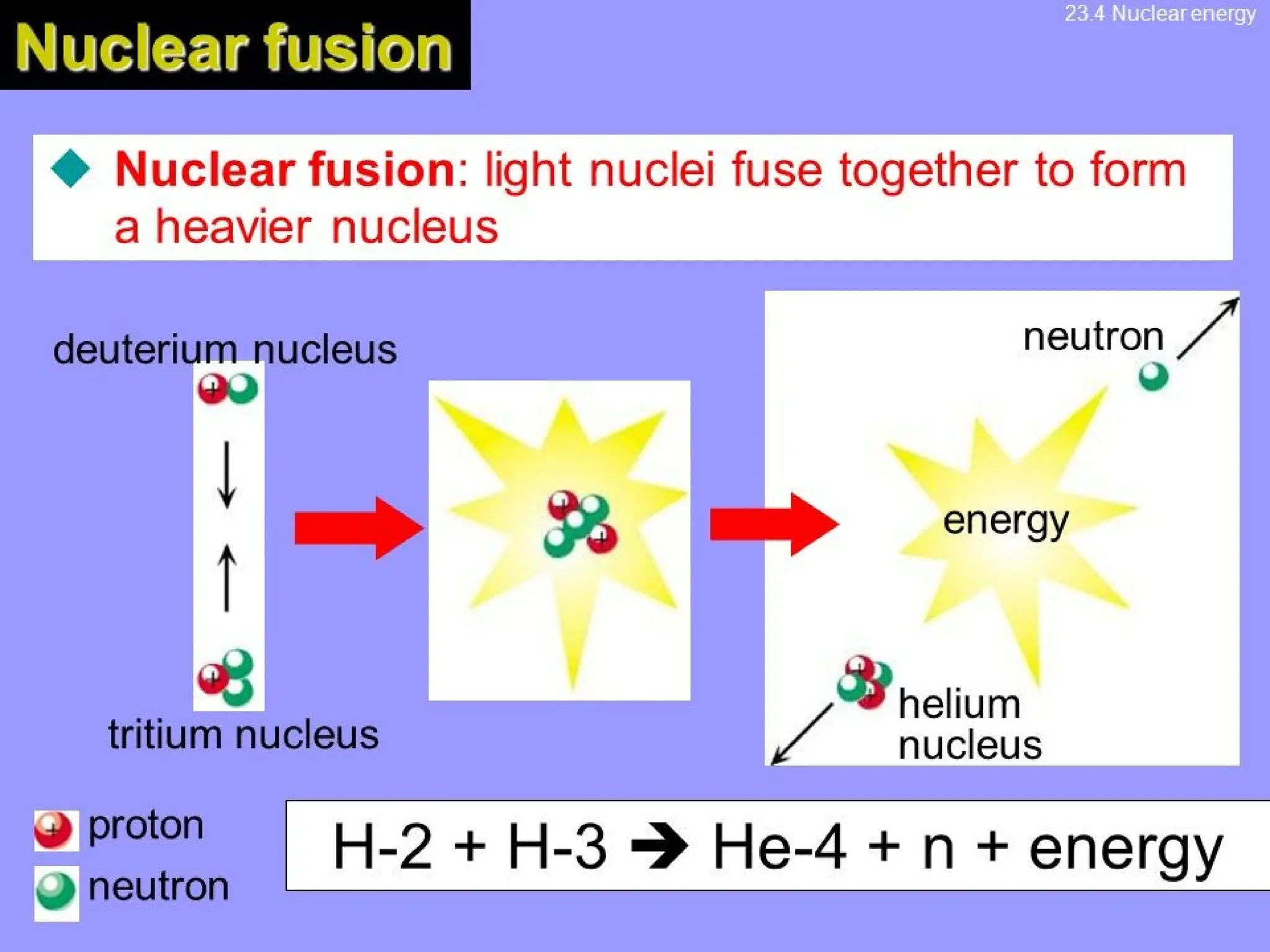
Nuclear Fusion
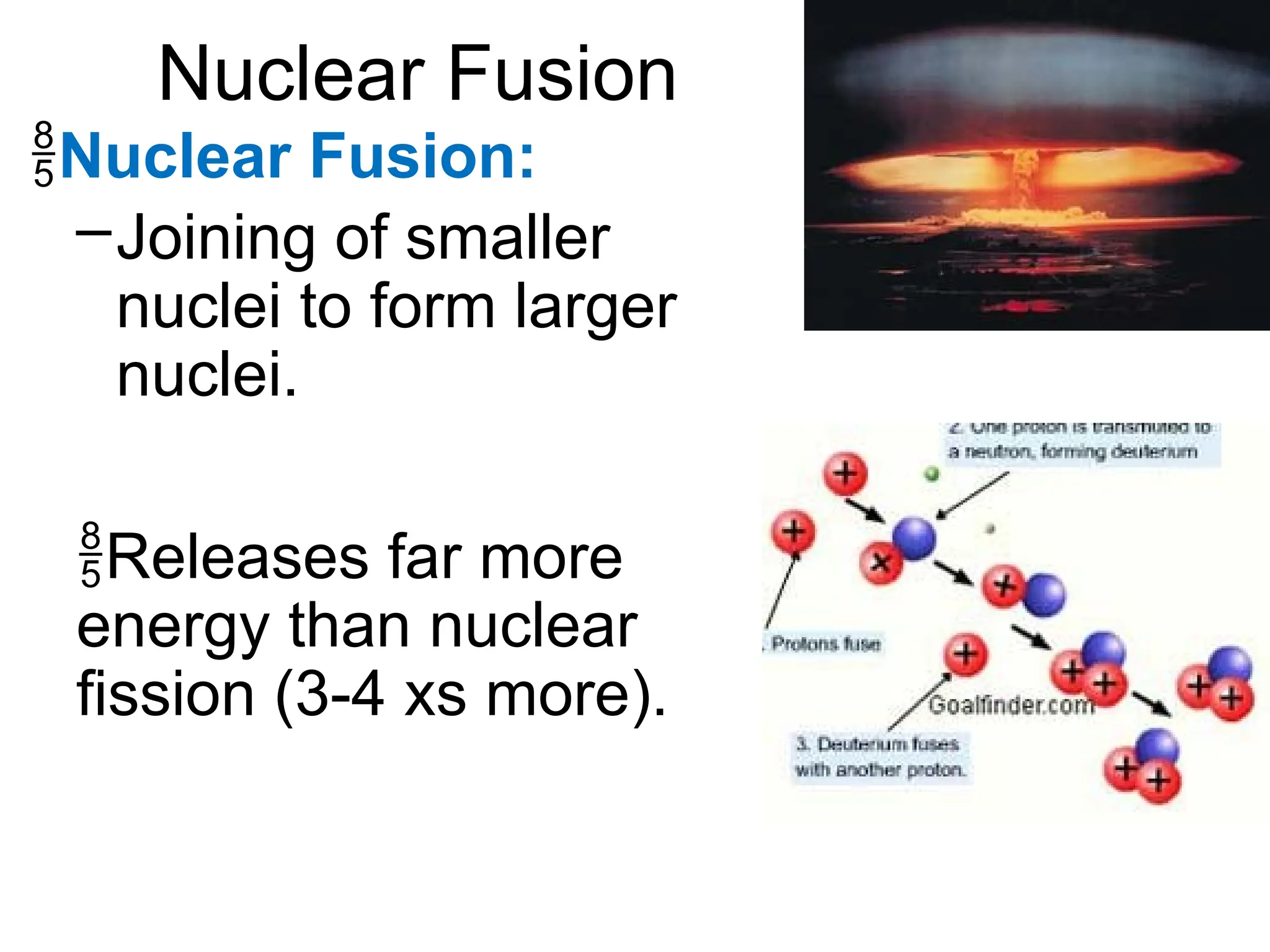
Nuclear Fusion:
–Joining of smaller
nuclei to form larger
nuclei.
Releases far more
energy than nuclear
fission (3-4 xs more).
Nuclear Fusion
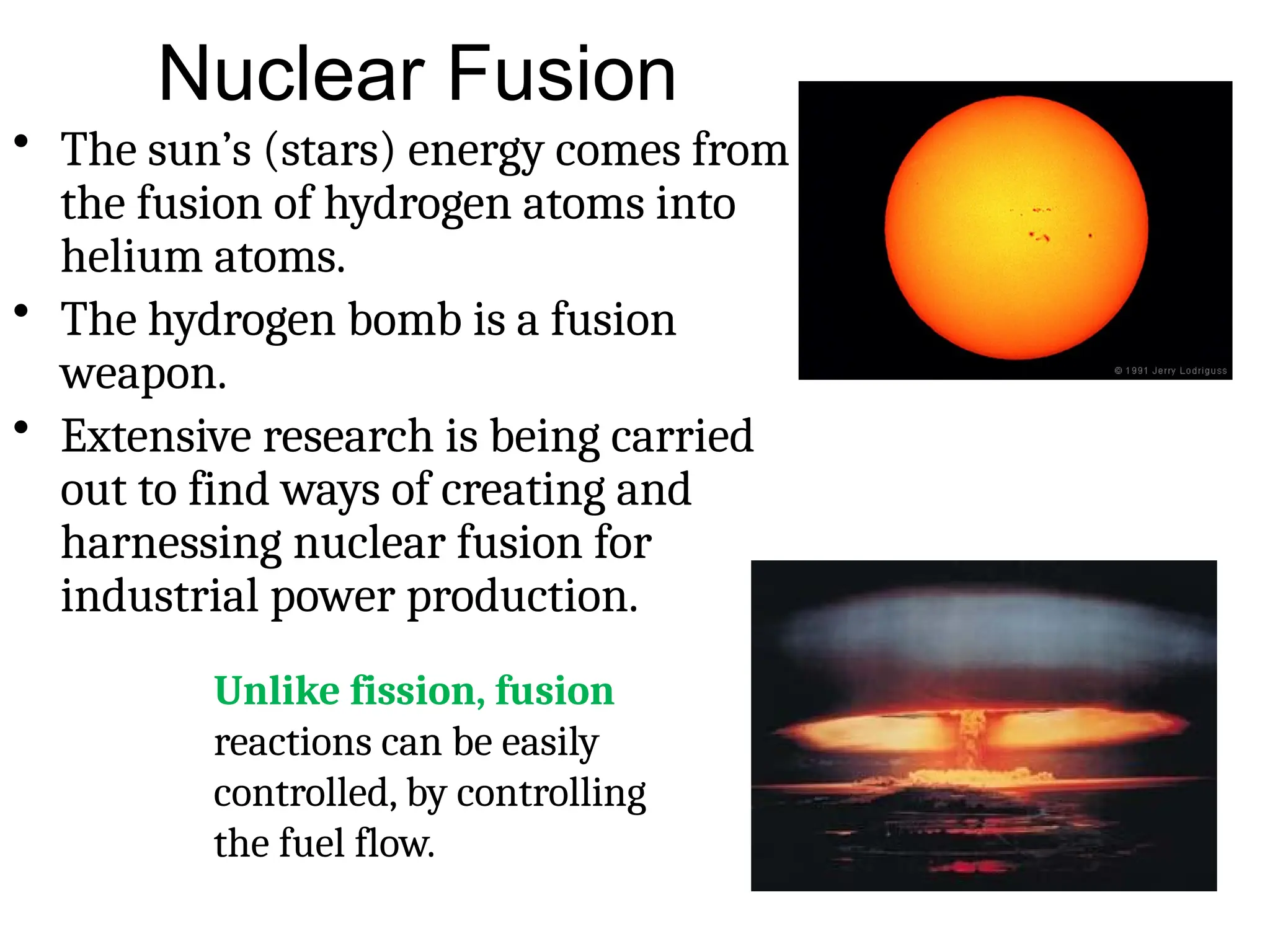
• The sun’s (stars) energy comes from
the fusion of hydrogen atoms into
helium atoms.
• The hydrogen bomb is a fusion
weapon.
• Extensive research is being carried
out to find ways of creating and
harnessing nuclear fusion for
industrial power production.
Unlike fission, fusion
reactions can be easily
controlled, by controlling
the fuel flow.
Modeling Fusion reactions
(like what happens in the sun).
• marshmallow= hydrogen nucleus (1 proton)
• pipe cleaner/spaghetti = gamma ray
• What element does one marshmallow
represent?
• Take two marshmallows and fuse together
using the energy of your hands (like the sun
with high temperature and pressure).
• What element have you produced?
• What’s happening…
• At the same time that you fuse the atoms
together they release energy as a gamma ray.
Take a piece of pipe-cleaner/spaghetti and put on
your table. This is energy of the gamma ray.
• Make two more helium atoms (with four more
marshmallows, making sure to release gamma
rays)
• Now smash together your three helium nuclei. In
what is called the “triple-alpha process”. What is
this called (fission or fusion)?
• What new element did you produce?
• Eat your final atom

half-life-fission-vs-fusion-nuclear-reaction.pptx

  • 1.
  • 2.
    Fission/Fusion Better Lesson creditR.Meisner w/add-ins RMohler nuclear fusion vs nuclear fission How can you explain these terms?
  • 6.
    Nuclear Reactions - Reactionsinvolving changes in the nucleus of atoms - Nuclear reactions release MUCH MORE energy then chemical reactions (which deal with electrons only)
  • 7.
    E=mc2 • Einstein’s famousequation relates mass and energy. Energy and mass are interchangeable. • E=Energy, m=mass, c=speed of light (3x10⁸ m/s) • When a high-energy gamma ray is given off, the mass of the nucleus drops a measurable value. • Similarly, we can calculate how much energy will be given off in particular nuclear reactions. • We use the formula ΔE= Δmc2 to build new, artificial elements in supercolliders (particle accelerators.)
  • 8.
    Nuclear Fission • Nuclearfission = splitting of large, unstable atoms • Releases large amounts of energy • Uncontrolled, nuclear fission proceeds to completion with great speed.
  • 9.
    Nuclear Fission • Usedin nuclear weapons and power plants (U-235) • In a nuclear weapon, two half- spheres of fissionable material are compressed together with conventional explosives, creating the critical mass. • In order to harness nuclear fission to create useable electricity, the process is slowed down with control rods…
  • 10.
    Fission Reactor PowerPlants (do not need to copy this • In each reactor, heat is generated when high-energy neutrons slow down in collisions with the moderator. • Pressurized Steam Reactor:Steam is produced and drives turbines, creating electricity. • Reactor fuel must be fissionable, usually weapons- grade uranium or plutonium. • Moderators become highly radioactivity (dirty).
  • 11.
    Nuclear Fusion Nuclear Fusion: –Joiningof smaller nuclei to form larger nuclei. Releases far more energy than nuclear fission (3-4 xs more).
  • 12.
    Nuclear Fusion • Thesun’s (stars) energy comes from the fusion of hydrogen atoms into helium atoms. • The hydrogen bomb is a fusion weapon. • Extensive research is being carried out to find ways of creating and harnessing nuclear fusion for industrial power production. Unlike fission, fusion reactions can be easily controlled, by controlling the fuel flow.
  • 13.
    Modeling Fusion reactions (likewhat happens in the sun). • marshmallow= hydrogen nucleus (1 proton) • pipe cleaner/spaghetti = gamma ray • What element does one marshmallow represent? • Take two marshmallows and fuse together using the energy of your hands (like the sun with high temperature and pressure). • What element have you produced?
  • 14.
    • What’s happening… •At the same time that you fuse the atoms together they release energy as a gamma ray. Take a piece of pipe-cleaner/spaghetti and put on your table. This is energy of the gamma ray. • Make two more helium atoms (with four more marshmallows, making sure to release gamma rays) • Now smash together your three helium nuclei. In what is called the “triple-alpha process”. What is this called (fission or fusion)? • What new element did you produce? • Eat your final atom