19©
29th
November 2017
SECTOR FEATURE
Dr Nafis Alam
is an associate
professor of
finance at
Henley Business
School of the University of Reading
and Lokesh Gupta is attached to
RM Applications as the head of
consulting. They can be contacted at
n.alam@henley.edu.my and lokesh@
rma.com.my respectively.
Halal has turned into a brand and is
being accepted globally. The Halal
industry, which is valued at about
US$560 billion a year, serves to meet
the needs of Halal-conscious clients and
is growing at an estimated annual rate
of 20%. The global Halal products and
services sector is growing at 8% year-
on-year and currently valued at US$3.2
trillion (excluding Islamic finance)
which is expected to reach US$12.14
trillion by 2024, according to Hexa
Research.
Drivers for the Halal industry
The importance of religion, as well
as fulfilling religious obligations, is
the foremost driver for the increase in
demand for Halal products and services.
The second driver of the industry’s
growth is a sizeable and growing Muslim
population. According to Pew Research
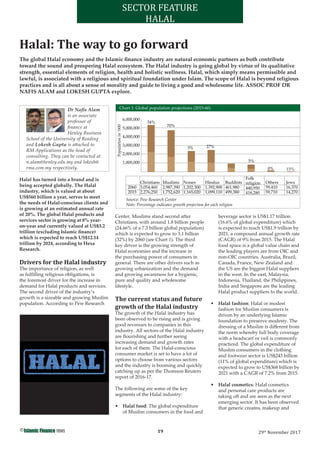
Center, Muslims stand second after
Christians, with around 1.8 billion people
(24.66% of a 7.3 billion global population)
which is expected to grow to 3.1 billion
(32%) by 2060 (see Chart 1). The third
key driver is the growing strength of
Halal economies and the increase in
the purchasing power of consumers in
general. There are other drivers such as
growing urbanization and the demand
and growing awareness for a hygienic,
pure and quality and wholesome
lifestyle.
The current status and future
growth of the Halal industry
The growth of the Halal industry has
been observed to be rising and is giving
good revenues to companies in this
industry. All sectors of the Halal industry
are flourishing and further seeing
increasing demand and growth rates
for each of them. The Halal-conscious
consumer market is set to have a lot of
options to choose from various sectors
and the industry is booming and quickly
catching up as per the Thomson Reuters
report of 2016-17.
The following are some of the key
segments of the Halal industry:
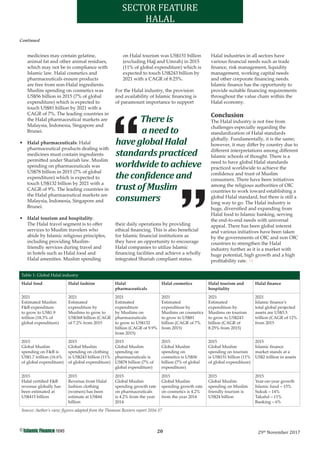
• Halal food: The global expenditure
of Muslim consumers in the food and
beverage sector is US$1.17 trillion
(16.6% of global expenditure) which
is expected to reach US$1.9 trillion by
2021, a compound annual growth rate
(CAGR) of 9% from 2015. The Halal
food space is a global value chain and
the leading players are from OIC and
non-OIC countries. Australia, Brazil,
Canada, France, New Zealand and
the US are the biggest Halal suppliers
in the west. In the east, Malaysia,
Indonesia, Thailand, the Philippines,
India and Singapore are the leading
Halal product suppliers to the world.
• Halal fashion: Halal or modest
fashion for Muslim consumers is
driven by an underlying Islamic
foundation to preserve modesty. The
dressing of a Muslim is different from
the norm whereby full body coverage
with a headscarf or veil is commonly
practiced. The global expenditure of
Muslim consumers in the clothing
and footwear sector is US$243 billion
(11% of global expenditure) which is
expected to grow to US$368 billion by
2021 with a CAGR of 7.2% from 2015.
• Halal cosmetics: Halal cosmetics
and personal care products are
taking off and are seen as the next
emerging sector. It has been observed
that generic creams, makeup and
Halal: The way to go forward
The global Halal economy and the Islamic finance industry are natural economic partners as both contribute
toward the sound and prospering Halal ecosystem. The Halal industry is going global by virtue of its qualitative
strength, essential elements of religion, health and holistic wellness. Halal, which simply means permissible and
lawful, is associated with a religious and spiritual foundation under Islam. The scope of Halal is beyond religious
practices and is all about a sense of morality and guide to living a good and wholesome life. ASSOC PROF DR
NAFIS ALAM and LOKESH GUPTA explore.
HALAL
Chart 1: Global population projections (2015-60)
Source: Pew Research Center
Note: Percentage indicates growth projection for each religion
6,000,000
5,000,000
4,000,000
3,000,000
2,000,000
1,000,000
Populationin‘000
34%
70%
3% 27%
5%
0% 15%
Christians
3,054,460
2,276,250
2060
2015
Muslims
2,987,390
1,752,620
Nones
1,202,300
1,165,020
Hindus
1,392,900
1,099,110
Buddists
461,980
499,380
Folk
religion
440,950
418,280
Others
59,410
59,710
Jews
16,370
14,270
20©
29th
November 2017
SECTOR FEATURE
HALAL
medicines may contain gelatine,
animal fat and other animal residues,
which may not be in compliance with
Islamic law. Halal cosmetics and
pharmaceuticals ensure products
are free from non-Halal ingredients.
Muslim spending on cosmetics was
US$56 billion in 2015 (7% of global
expenditure) which is expected to
touch US$81 billion by 2021 with a
CAGR of 7%. The leading countries in
the Halal pharmaceutical markets are
Malaysia, Indonesia, Singapore and
Brunei.
• Halal pharmaceuticals: Halal
pharmaceutical products dealing with
medicines must contain ingredients
permitted under Shariah law. Muslim
spending on pharmaceuticals was
US$78 billion in 2015 (7% of global
expenditure) which is expected to
touch US$132 billion by 2021 with a
CAGR of 9%. The leading countries in
the Halal pharmaceutical markets are
Malaysia, Indonesia, Singapore and
Brunei.
• Halal tourism and hospitality:
The Halal travel segment is to offer
services to Muslim travelers who
abide by Islamic religious principles,
including providing Muslim-
friendly services during travel and
in hotels such as Halal food and
Halal amenities. Muslim spending
on Halal tourism was US$151 billion
(excluding Hajj and Umrah) in 2015
(11% of global expenditure) which is
expected to touch US$243 billion by
2021 with a CAGR of 8.25%.
For the Halal industry, the provision
and availability of Islamic financing is
of paramount importance to support
their daily operations by providing
ethical financing. This is also beneficial
for Islamic financial institutions as
they have an opportunity to encourage
Halal companies to utilize Islamic
financing facilities and achieve a wholly
integrated Shariah compliant status.
Halal industries in all sectors have
various financial needs such as trade
finance, risk management, liquidity
management, working capital needs
and other corporate financing needs.
Islamic finance has the opportunity to
provide suitable financing requirements
throughout the value chain within the
Halal economy.
Conclusion
The Halal industry is not free from
challenges especially regarding the
standardization of Halal standards
globally. Fundamentally, it is the same;
however, it may differ by country due to
different interpretations among different
Islamic schools of thought. There is a
need to have global Halal standards
practiced worldwide to achieve the
confidence and trust of Muslim
consumers. There have been initiatives
among the religious authorities of OIC
countries to work toward establishing a
global Halal standard, but there is still a
long way to go. The Halal industry is
huge, diversified and expanding from
Halal food to Islamic banking, serving
the end-to-end needs with universal
appeal. There has been global interest
and various initiatives have been taken
by the governments of OIC and non OIC
countries to strengthen the Halal
industry further as it is a market with
huge potential, high growth and a high
profitability rate.
Continued
There is
a need to
have global Halal
standards practiced
worldwide to achieve
the con idence and
trust of Muslim
consumers
Table 1: Global Halal industry
Halal food Halal fashion Halal
pharmaceuticals
Halal cosmetics Halal tourism and
hospitality
Halal finance
2021
Estimated Muslim
F&B expenditure
to grow to US$1.9
trillion (18.3% of
global expenditure)
2021
Estimated
expenditure by
Muslims to grow to
US$368 billion (CAGR
of 7.2% from 2015
2021
Estimated
expenditure
by Muslims on
pharmaceuticals
to grow to US$132
billion (CAGR of 9.9%
from 2015)
2021
Estimated
expenditure by
Muslims on cosmetics
to grow to US$81
billion (CAGR of 7%
from 2015)
2021
Estimated
expenditure by
Muslims on tourism
to grow to US$243
billion (CAGR of
8.25% from 2015)
2021
Islamic finance's
total global projected
assets are US$3.5
trillion (CAGR of 12%
from 2015
2015
Global Muslim
spending on F&B is
US$1.7 trillion (16.6%
of global expenditure)
2015
Global Muslim
spending on clothing
is US$243 billion (11%
of global expenditure)
2015
Global Muslim
spending on
pharmaceuticals is
US$78 billion (7% of
global expenditure)
2015
Global Muslim
spending on
cosmetics is US$56
billion (7% of global
expenditure)
2015
Global Muslim
spending on tourism
is US$151 billion (11%
of global expenditure)
2015
Islamic finance
market stands at a
US$2 trillion in assets
2015
Halal certified F&B
revenue globally has
been estimated at
US$415 billion
2015
Revenue from Halal
fashion clothing
(women) has been
estimate at US$44
billion
2015
Global Muslim
spending growth rate
on pharmaceuticals
is 4.2% from the year
2014
2015
Global Muslim
spending growth rate
on cosmetics is 4.2%
from the year 2014
2015
Global Muslim
spending on Muslim
friendly tourism is
US$24 billion
2015
Year-on-year growth
Islamic fund – 15%
Sukuk – 14%
Takaful – 11%
Banking – 6%
Source: Author’s view; figures adapted from the Thomson Reuters report 2016-17

Halal: The way to go forward

  • 1.
    19© 29th November 2017 SECTOR FEATURE DrNafis Alam is an associate professor of finance at Henley Business School of the University of Reading and Lokesh Gupta is attached to RM Applications as the head of consulting. They can be contacted at n.alam@henley.edu.my and lokesh@ rma.com.my respectively. Halal has turned into a brand and is being accepted globally. The Halal industry, which is valued at about US$560 billion a year, serves to meet the needs of Halal-conscious clients and is growing at an estimated annual rate of 20%. The global Halal products and services sector is growing at 8% year- on-year and currently valued at US$3.2 trillion (excluding Islamic finance) which is expected to reach US$12.14 trillion by 2024, according to Hexa Research. Drivers for the Halal industry The importance of religion, as well as fulfilling religious obligations, is the foremost driver for the increase in demand for Halal products and services. The second driver of the industry’s growth is a sizeable and growing Muslim population. According to Pew Research Center, Muslims stand second after Christians, with around 1.8 billion people (24.66% of a 7.3 billion global population) which is expected to grow to 3.1 billion (32%) by 2060 (see Chart 1). The third key driver is the growing strength of Halal economies and the increase in the purchasing power of consumers in general. There are other drivers such as growing urbanization and the demand and growing awareness for a hygienic, pure and quality and wholesome lifestyle. The current status and future growth of the Halal industry The growth of the Halal industry has been observed to be rising and is giving good revenues to companies in this industry. All sectors of the Halal industry are flourishing and further seeing increasing demand and growth rates for each of them. The Halal-conscious consumer market is set to have a lot of options to choose from various sectors and the industry is booming and quickly catching up as per the Thomson Reuters report of 2016-17. The following are some of the key segments of the Halal industry: • Halal food: The global expenditure of Muslim consumers in the food and beverage sector is US$1.17 trillion (16.6% of global expenditure) which is expected to reach US$1.9 trillion by 2021, a compound annual growth rate (CAGR) of 9% from 2015. The Halal food space is a global value chain and the leading players are from OIC and non-OIC countries. Australia, Brazil, Canada, France, New Zealand and the US are the biggest Halal suppliers in the west. In the east, Malaysia, Indonesia, Thailand, the Philippines, India and Singapore are the leading Halal product suppliers to the world. • Halal fashion: Halal or modest fashion for Muslim consumers is driven by an underlying Islamic foundation to preserve modesty. The dressing of a Muslim is different from the norm whereby full body coverage with a headscarf or veil is commonly practiced. The global expenditure of Muslim consumers in the clothing and footwear sector is US$243 billion (11% of global expenditure) which is expected to grow to US$368 billion by 2021 with a CAGR of 7.2% from 2015. • Halal cosmetics: Halal cosmetics and personal care products are taking off and are seen as the next emerging sector. It has been observed that generic creams, makeup and Halal: The way to go forward The global Halal economy and the Islamic finance industry are natural economic partners as both contribute toward the sound and prospering Halal ecosystem. The Halal industry is going global by virtue of its qualitative strength, essential elements of religion, health and holistic wellness. Halal, which simply means permissible and lawful, is associated with a religious and spiritual foundation under Islam. The scope of Halal is beyond religious practices and is all about a sense of morality and guide to living a good and wholesome life. ASSOC PROF DR NAFIS ALAM and LOKESH GUPTA explore. HALAL Chart 1: Global population projections (2015-60) Source: Pew Research Center Note: Percentage indicates growth projection for each religion 6,000,000 5,000,000 4,000,000 3,000,000 2,000,000 1,000,000 Populationin‘000 34% 70% 3% 27% 5% 0% 15% Christians 3,054,460 2,276,250 2060 2015 Muslims 2,987,390 1,752,620 Nones 1,202,300 1,165,020 Hindus 1,392,900 1,099,110 Buddists 461,980 499,380 Folk religion 440,950 418,280 Others 59,410 59,710 Jews 16,370 14,270
  • 2.
    20© 29th November 2017 SECTOR FEATURE HALAL medicinesmay contain gelatine, animal fat and other animal residues, which may not be in compliance with Islamic law. Halal cosmetics and pharmaceuticals ensure products are free from non-Halal ingredients. Muslim spending on cosmetics was US$56 billion in 2015 (7% of global expenditure) which is expected to touch US$81 billion by 2021 with a CAGR of 7%. The leading countries in the Halal pharmaceutical markets are Malaysia, Indonesia, Singapore and Brunei. • Halal pharmaceuticals: Halal pharmaceutical products dealing with medicines must contain ingredients permitted under Shariah law. Muslim spending on pharmaceuticals was US$78 billion in 2015 (7% of global expenditure) which is expected to touch US$132 billion by 2021 with a CAGR of 9%. The leading countries in the Halal pharmaceutical markets are Malaysia, Indonesia, Singapore and Brunei. • Halal tourism and hospitality: The Halal travel segment is to offer services to Muslim travelers who abide by Islamic religious principles, including providing Muslim- friendly services during travel and in hotels such as Halal food and Halal amenities. Muslim spending on Halal tourism was US$151 billion (excluding Hajj and Umrah) in 2015 (11% of global expenditure) which is expected to touch US$243 billion by 2021 with a CAGR of 8.25%. For the Halal industry, the provision and availability of Islamic financing is of paramount importance to support their daily operations by providing ethical financing. This is also beneficial for Islamic financial institutions as they have an opportunity to encourage Halal companies to utilize Islamic financing facilities and achieve a wholly integrated Shariah compliant status. Halal industries in all sectors have various financial needs such as trade finance, risk management, liquidity management, working capital needs and other corporate financing needs. Islamic finance has the opportunity to provide suitable financing requirements throughout the value chain within the Halal economy. Conclusion The Halal industry is not free from challenges especially regarding the standardization of Halal standards globally. Fundamentally, it is the same; however, it may differ by country due to different interpretations among different Islamic schools of thought. There is a need to have global Halal standards practiced worldwide to achieve the confidence and trust of Muslim consumers. There have been initiatives among the religious authorities of OIC countries to work toward establishing a global Halal standard, but there is still a long way to go. The Halal industry is huge, diversified and expanding from Halal food to Islamic banking, serving the end-to-end needs with universal appeal. There has been global interest and various initiatives have been taken by the governments of OIC and non OIC countries to strengthen the Halal industry further as it is a market with huge potential, high growth and a high profitability rate. Continued There is a need to have global Halal standards practiced worldwide to achieve the con idence and trust of Muslim consumers Table 1: Global Halal industry Halal food Halal fashion Halal pharmaceuticals Halal cosmetics Halal tourism and hospitality Halal finance 2021 Estimated Muslim F&B expenditure to grow to US$1.9 trillion (18.3% of global expenditure) 2021 Estimated expenditure by Muslims to grow to US$368 billion (CAGR of 7.2% from 2015 2021 Estimated expenditure by Muslims on pharmaceuticals to grow to US$132 billion (CAGR of 9.9% from 2015) 2021 Estimated expenditure by Muslims on cosmetics to grow to US$81 billion (CAGR of 7% from 2015) 2021 Estimated expenditure by Muslims on tourism to grow to US$243 billion (CAGR of 8.25% from 2015) 2021 Islamic finance's total global projected assets are US$3.5 trillion (CAGR of 12% from 2015 2015 Global Muslim spending on F&B is US$1.7 trillion (16.6% of global expenditure) 2015 Global Muslim spending on clothing is US$243 billion (11% of global expenditure) 2015 Global Muslim spending on pharmaceuticals is US$78 billion (7% of global expenditure) 2015 Global Muslim spending on cosmetics is US$56 billion (7% of global expenditure) 2015 Global Muslim spending on tourism is US$151 billion (11% of global expenditure) 2015 Islamic finance market stands at a US$2 trillion in assets 2015 Halal certified F&B revenue globally has been estimated at US$415 billion 2015 Revenue from Halal fashion clothing (women) has been estimate at US$44 billion 2015 Global Muslim spending growth rate on pharmaceuticals is 4.2% from the year 2014 2015 Global Muslim spending growth rate on cosmetics is 4.2% from the year 2014 2015 Global Muslim spending on Muslim friendly tourism is US$24 billion 2015 Year-on-year growth Islamic fund – 15% Sukuk – 14% Takaful – 11% Banking – 6% Source: Author’s view; figures adapted from the Thomson Reuters report 2016-17