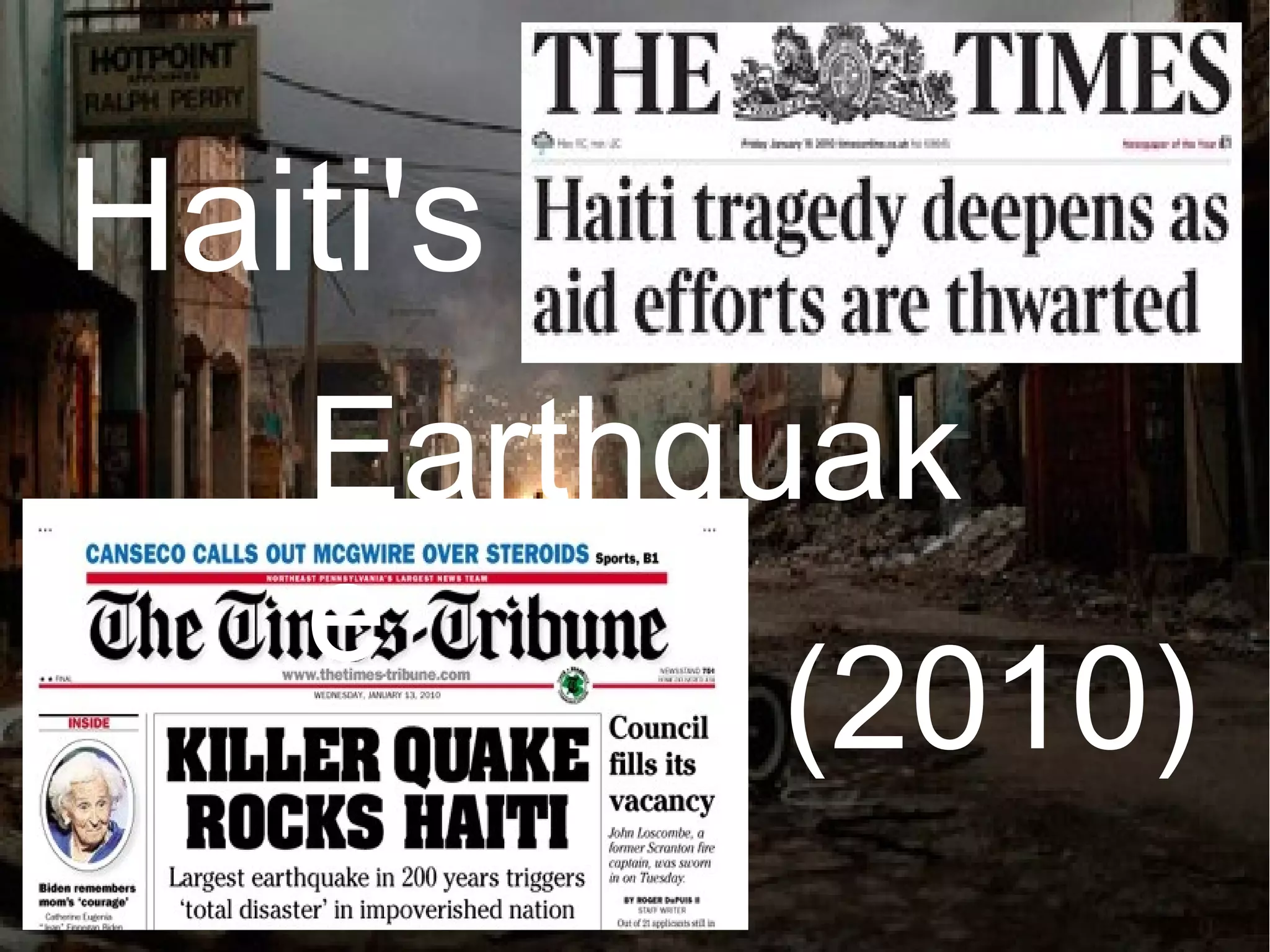
Earthquak
e
(2010)
Haiti's
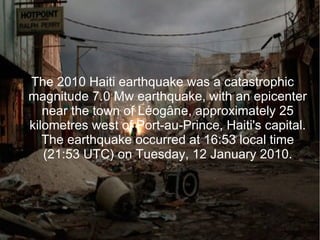
The 2010 Haiti earthquake was a catastrophic
magnitude 7.0 Mw earthquake, with an epicenter
near the town of Léogâne, approximately 25
kilometres west of Port-au-Prince, Haiti's capital.
The earthquake occurred at 16:53 local time
(21:53 UTC) on Tuesday, 12 January 2010.
1. Science helps us predict1. Science helps us predict
hazardshazards
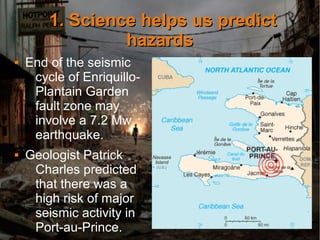
 End of the seismic
cycle of Enriquillo-
Plantain Garden
fault zone may
involve a 7.2 Mw
earthquake.
 Geologist Patrick
Charles predicted
that there was a
high risk of major
seismic activity in
Port-au-Prince.
2. Knowing hazard risk can
help people make decisions
 American geologists published a study in 2008
which concluded that Prince, who had not
suffered an earthquake of great intensity since
1751, could face a 7.2 magnitude earthquake.
However, they could not say exactly when the
earthquake would occur tomorrow or in 30
years.
 The forecast is made by measuring the amount
of accumulated tension in a particular fault,
then extrapolating the amount of energy that
would be released eventually.
3. Linkages exist between3. Linkages exist between
natural hazardsnatural hazards
 On 24 January USGS reported that there had
been 52 aftershocks measuring 4.5 or greater
since 12 January quake.
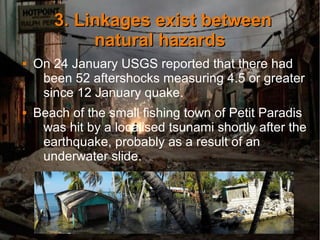
 Beach of the small fishing town of Petit Paradis
was hit by a localised tsunami shortly after the
earthquake, probably as a result of an
underwater slide.
Humans can turn disastrousHumans can turn disastrous
events into catastrophesevents into catastrophes
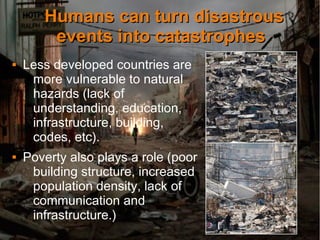
 Less developed countries are
more vulnerable to natural
hazards (lack of
understanding, education,
infrastructure, building,
codes, etc).
 Poverty also plays a role (poor
building structure, increased
population density, lack of
communication and
infrastructure.)
5. Consequences of hazards
can be minimized
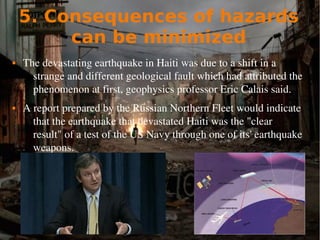
 The devastating earthquake in Haiti was due to a shift in a 
strange and different geological fault which had attributed the 
phenomenon at first, geophysics professor Eric Calais said.
 A report prepared by the Russian Northern Fleet would indicate 
that the earthquake that devastated Haiti was the "clear 
result" of a test of the US Navy through one of its' earthquake 
weapons.
By:
 Carazo Cabello, Laura.
 Conde Ponte, Ana.

Haiti earthquake

  • 1.
  • 2.
    The 2010 Haitiearthquake was a catastrophic magnitude 7.0 Mw earthquake, with an epicenter near the town of Léogâne, approximately 25 kilometres west of Port-au-Prince, Haiti's capital. The earthquake occurred at 16:53 local time (21:53 UTC) on Tuesday, 12 January 2010.
  • 3.
    1. Science helpsus predict1. Science helps us predict hazardshazards  End of the seismic cycle of Enriquillo- Plantain Garden fault zone may involve a 7.2 Mw earthquake.  Geologist Patrick Charles predicted that there was a high risk of major seismic activity in Port-au-Prince.
  • 4.
    2. Knowing hazardrisk can help people make decisions  American geologists published a study in 2008 which concluded that Prince, who had not suffered an earthquake of great intensity since 1751, could face a 7.2 magnitude earthquake. However, they could not say exactly when the earthquake would occur tomorrow or in 30 years.  The forecast is made by measuring the amount of accumulated tension in a particular fault, then extrapolating the amount of energy that would be released eventually.
  • 5.
    3. Linkages existbetween3. Linkages exist between natural hazardsnatural hazards  On 24 January USGS reported that there had been 52 aftershocks measuring 4.5 or greater since 12 January quake.  Beach of the small fishing town of Petit Paradis was hit by a localised tsunami shortly after the earthquake, probably as a result of an underwater slide.
  • 6.
    Humans can turndisastrousHumans can turn disastrous events into catastrophesevents into catastrophes  Less developed countries are more vulnerable to natural hazards (lack of understanding, education, infrastructure, building, codes, etc).  Poverty also plays a role (poor building structure, increased population density, lack of communication and infrastructure.)
  • 7.
    5. Consequences ofhazards can be minimized  The devastating earthquake in Haiti was due to a shift in a  strange and different geological fault which had attributed the  phenomenon at first, geophysics professor Eric Calais said.  A report prepared by the Russian Northern Fleet would indicate  that the earthquake that devastated Haiti was the "clear  result" of a test of the US Navy through one of its' earthquake  weapons.
  • 8.