B E T H A N I H A E R I N G
W A L D E N U N I V E R S I T Y
T H E B E G I N N I N G R E A D E R - E D U C 6 7 0 6 - R 3
Literate Environment Analysis
Analysis Research
 Everyone has a ―Literacy
Autobiography‖
 ―All people have experiences that shape
how they view themselves as literate
people‖ (Laureate Education Inc., 2010a)
 To get students invested in
learning, you have to get to know
their interests.
 Teachers need to find out about
students‘:
 Background
 Culture
 Interests
 Who they are as a person (Laureate
Education Inc., 2010b)
 Reading inventories can
determine students‘
cognitive and non-
cognitive
achievements/feelings in
reading.
 There are two types of
inventories:
 One used by the teacher in the
classroom
 Less formal
 Published inventories
 More formal
Getting to Know Literacy Learners
 How to…
 Talk to your students about their literacy autobiographies
 How they feel about reading, what experiences they have
had, what they like to read about?
 ―Me Stew‖
 Have students bring ―ingredients‖ that represent them as people
and make a recipe for themselves.
 Have Classroom Experts
 Identify students in the class that have a lot of knowledge about
certain topics and let those students teach the class.
Analysis Research
 Selecting text for students goes
further than just picking out an
informational or narrative book.
 The choosing the correct text for
students and for the purpose of
reading is vital for successful
reading experiences.
 Teachers need to expose students
more informational text.
 Students need to know how to navigate
through informational text.
 Informational text is increasingly used
year after year in education.
 Students need to know informational
text for real life learning, therefore
early exposure is crucial.
 The ―Literacy Matrix‖ (Laureate
Education Inc., 2010c) separates
texts by narrative and
informational text, then by
linguistic and semiotic, and
finally by text difficulty
 Text difficulty is categorized by:
 Readability
 Length of text
 Text structure
 Size of print
 Visual support
(Laureate Education Inc., 2010c)
Selecting Text
Analysis Research
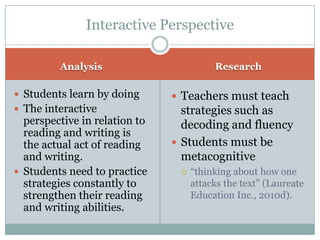
 Students learn by doing
 The interactive
perspective in relation to
reading and writing is
the actual act of reading
and writing.
 Students need to practice
strategies constantly to
strengthen their reading
and writing abilities.
 Teachers must teach
strategies such as
decoding and fluency
 Students must be
metacognitive
 ―thinking about how one
attacks the text‖ (Laureate
Education Inc., 2010d).
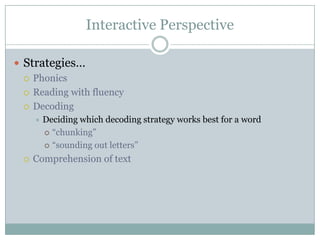
Interactive Perspective
 Strategies…
 Phonics
 Reading with fluency
 Decoding
 Deciding which decoding strategy works best for a word
 ―chunking‖
 ―sounding out letters‖
 Comprehension of text
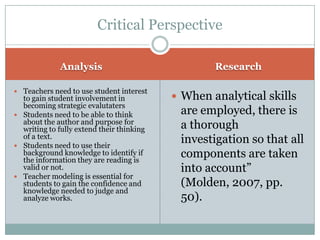
Analysis Research
 Teachers need to use student interest
to gain student involvement in
becoming strategic evalutaters
 Students need to be able to think
about the author and purpose for
writing to fully extend their thinking
of a text.
 Students need to use their
background knowledge to identify if
the information they are reading is
valid or not.
 Teacher modeling is essential for
students to gain the confidence and
knowledge needed to judge and
analyze works.
 When analytical skills
are employed, there is
a thorough
investigation so that all
components are taken
into account‖
(Molden, 2007, pp.
50).
Critical Perspective
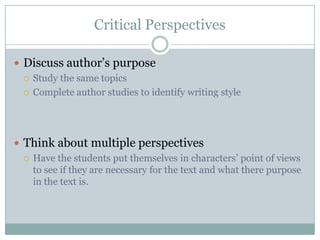
Critical Perspectives
 Discuss author‘s purpose
 Study the same topics
 Complete author studies to identify writing style
 Think about multiple perspectives
 Have the students put themselves in characters‘ point of views
to see if they are necessary for the text and what there purpose
in the text is.
Analysis Research
 Students need a chance to
make connections to text.
 They need a chance to
think about their feelings
and experiences as they
relate to text they are
reading.
 Teachers should provide
opportunities for students
to respond to text in an
assortment of ways.
 ―Many researchers identify
‗making connections‘ as a
strategy necessary for
meaning constructivism‖
(Clyde, 2003, pp.158).
 ―For students to become
engaged lifelong readers
they must be affected on
personal and emotional
levels‖ (Laureate Education
Inc., 2010d).
Responsive Perspective
 Strategies…
 Character Comparison Chart
 Have different students think about two assigned characters and
how their interactions affect the story
 Response Journals
 Can use prompts for writing
or
 Allows students to freely write about the story
 Double Entry Journal
 Explore different books that students are reading
 Helps strengthen comprehension
References
 Clyde, J. A. (2003). Stepping inside the story world: The subtext strategy—a tool for connecting
and comprehending. The Reading Teacher, 57(2), 150–160.
 Laureate Education, Inc. (Producer). (2010a). Literacy autobiographies [Video webcast]. Retrieved from :
https://class.waldenu.edu/webapps/portal/frameset.jsp?tab_tab_group_id=_2_1&url=%2Fwebapps%2Fbla
ckboard%2Fexecute%2Flauncher%3Ftype%3DCourse%26id%3D_2823070_1%26url%3D
 Laureate Education, Inc. (Producer). (2010b). Getting to know your students [Video webcast]. Retrieved from :
https://class.waldenu.edu/webapps/portal/frameset.jsp?tab_tab_group_id=_2_1&url=%2Fwebapps%2Fbla
ckboard%2Fexecute%2Flauncher%3Ftype%3DCourse%26id%3D_2823070_1%26url%3D
 Laureate Education, Inc. (Producer). (2010c). Analyzing and selecting text[Video webcast]. Retrieved from :
https://class.waldenu.edu/webapps/portal/frameset.jsp?tab_tab_group_id=_2_1&url=%2Fwebapps%2Fbla
ckboard%2Fexecute%2Flauncher%3Ftype%3DCourse%26id%3D_2823070_1%26url%3D
 Laureate Education, Inc. (Producer). (2010d). Response perspective [Video webcast]. Retrieved from
https://class.waldenu.edu/webapps/portal/frameset.jsp?tab_tab_group_id=_2_1&url=%2F
webapps%2Fblackboard%2Fexecute%2Flauncher%3Ftype%3DCourse%26id%3D_2823
070_1%26url%3D
 Laureate Education, Inc. (Producer). (2010e). Reading and writing connection[Video webcast]. Retrieved from
https://class.waldenu.edu/webapps/portal/frameset.jsp?tab_tab_group_id=_2_1&url=%2F
webapps%2Fblackboard%2Fexecute%2Flauncher%3Ftype%3DCourse%26id%3D_2823
070_1%26url%3D
 Molden, K. (2007). Critical literacy, the right answer for the reading classroom: Strategies to move beyond
comprehension for reading improvement. Reading Improvement, 44(1), 50–56

Literate Environment Analysis

  • 1.
    B E TH A N I H A E R I N G W A L D E N U N I V E R S I T Y T H E B E G I N N I N G R E A D E R - E D U C 6 7 0 6 - R 3 Literate Environment Analysis
  • 2.
    Analysis Research  Everyonehas a ―Literacy Autobiography‖  ―All people have experiences that shape how they view themselves as literate people‖ (Laureate Education Inc., 2010a)  To get students invested in learning, you have to get to know their interests.  Teachers need to find out about students‘:  Background  Culture  Interests  Who they are as a person (Laureate Education Inc., 2010b)  Reading inventories can determine students‘ cognitive and non- cognitive achievements/feelings in reading.  There are two types of inventories:  One used by the teacher in the classroom  Less formal  Published inventories  More formal Getting to Know Literacy Learners
  • 3.
    Getting to KnowLiteracy Learners  How to…  Talk to your students about their literacy autobiographies  How they feel about reading, what experiences they have had, what they like to read about?  ―Me Stew‖  Have students bring ―ingredients‖ that represent them as people and make a recipe for themselves.  Have Classroom Experts  Identify students in the class that have a lot of knowledge about certain topics and let those students teach the class.
  • 4.
    Analysis Research  Selectingtext for students goes further than just picking out an informational or narrative book.  The choosing the correct text for students and for the purpose of reading is vital for successful reading experiences.  Teachers need to expose students more informational text.  Students need to know how to navigate through informational text.  Informational text is increasingly used year after year in education.  Students need to know informational text for real life learning, therefore early exposure is crucial.  The ―Literacy Matrix‖ (Laureate Education Inc., 2010c) separates texts by narrative and informational text, then by linguistic and semiotic, and finally by text difficulty  Text difficulty is categorized by:  Readability  Length of text  Text structure  Size of print  Visual support (Laureate Education Inc., 2010c) Selecting Text
  • 5.
    Analysis Research  Studentslearn by doing  The interactive perspective in relation to reading and writing is the actual act of reading and writing.  Students need to practice strategies constantly to strengthen their reading and writing abilities.  Teachers must teach strategies such as decoding and fluency  Students must be metacognitive  ―thinking about how one attacks the text‖ (Laureate Education Inc., 2010d). Interactive Perspective
  • 6.
    Interactive Perspective  Strategies… Phonics  Reading with fluency  Decoding  Deciding which decoding strategy works best for a word  ―chunking‖  ―sounding out letters‖  Comprehension of text
  • 7.
    Analysis Research  Teachersneed to use student interest to gain student involvement in becoming strategic evalutaters  Students need to be able to think about the author and purpose for writing to fully extend their thinking of a text.  Students need to use their background knowledge to identify if the information they are reading is valid or not.  Teacher modeling is essential for students to gain the confidence and knowledge needed to judge and analyze works.  When analytical skills are employed, there is a thorough investigation so that all components are taken into account‖ (Molden, 2007, pp. 50). Critical Perspective
  • 8.
    Critical Perspectives  Discussauthor‘s purpose  Study the same topics  Complete author studies to identify writing style  Think about multiple perspectives  Have the students put themselves in characters‘ point of views to see if they are necessary for the text and what there purpose in the text is.
  • 9.
    Analysis Research  Studentsneed a chance to make connections to text.  They need a chance to think about their feelings and experiences as they relate to text they are reading.  Teachers should provide opportunities for students to respond to text in an assortment of ways.  ―Many researchers identify ‗making connections‘ as a strategy necessary for meaning constructivism‖ (Clyde, 2003, pp.158).  ―For students to become engaged lifelong readers they must be affected on personal and emotional levels‖ (Laureate Education Inc., 2010d). Responsive Perspective
  • 10.
    Responsive Perspective  Strategies… Character Comparison Chart  Have different students think about two assigned characters and how their interactions affect the story  Response Journals  Can use prompts for writing or  Allows students to freely write about the story  Double Entry Journal  Explore different books that students are reading  Helps strengthen comprehension
  • 11.
    References  Clyde, J.A. (2003). Stepping inside the story world: The subtext strategy—a tool for connecting and comprehending. The Reading Teacher, 57(2), 150–160.  Laureate Education, Inc. (Producer). (2010a). Literacy autobiographies [Video webcast]. Retrieved from : https://class.waldenu.edu/webapps/portal/frameset.jsp?tab_tab_group_id=_2_1&url=%2Fwebapps%2Fbla ckboard%2Fexecute%2Flauncher%3Ftype%3DCourse%26id%3D_2823070_1%26url%3D  Laureate Education, Inc. (Producer). (2010b). Getting to know your students [Video webcast]. Retrieved from : https://class.waldenu.edu/webapps/portal/frameset.jsp?tab_tab_group_id=_2_1&url=%2Fwebapps%2Fbla ckboard%2Fexecute%2Flauncher%3Ftype%3DCourse%26id%3D_2823070_1%26url%3D  Laureate Education, Inc. (Producer). (2010c). Analyzing and selecting text[Video webcast]. Retrieved from : https://class.waldenu.edu/webapps/portal/frameset.jsp?tab_tab_group_id=_2_1&url=%2Fwebapps%2Fbla ckboard%2Fexecute%2Flauncher%3Ftype%3DCourse%26id%3D_2823070_1%26url%3D  Laureate Education, Inc. (Producer). (2010d). Response perspective [Video webcast]. Retrieved from https://class.waldenu.edu/webapps/portal/frameset.jsp?tab_tab_group_id=_2_1&url=%2F webapps%2Fblackboard%2Fexecute%2Flauncher%3Ftype%3DCourse%26id%3D_2823 070_1%26url%3D  Laureate Education, Inc. (Producer). (2010e). Reading and writing connection[Video webcast]. Retrieved from https://class.waldenu.edu/webapps/portal/frameset.jsp?tab_tab_group_id=_2_1&url=%2F webapps%2Fblackboard%2Fexecute%2Flauncher%3Ftype%3DCourse%26id%3D_2823 070_1%26url%3D  Molden, K. (2007). Critical literacy, the right answer for the reading classroom: Strategies to move beyond comprehension for reading improvement. Reading Improvement, 44(1), 50–56