Jacqueline Hancock
          Walden University

EDUC 6706 The Beginning Reader PreK-3
         Mrs. Cindee Easton
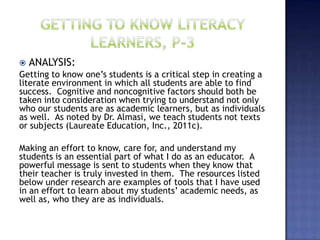
   ANALYSIS:
Getting to know one’s students is a critical step in creating a
literate environment in which all students are able to find
success. Cognitive and noncognitive factors should both be
taken into consideration when trying to understand not only
who our students are as academic learners, but as individuals
as well. As noted by Dr. Almasi, we teach students not texts
or subjects (Laureate Education, Inc., 2011c).

Making an effort to know, care for, and understand my
students is an essential part of what I do as an educator. A
powerful message is sent to students when they know that
their teacher is truly invested in them. The resources listed
below under research are examples of tools that I have used
in an effort to learn about my students’ academic needs, as
well as, who they are as individuals.
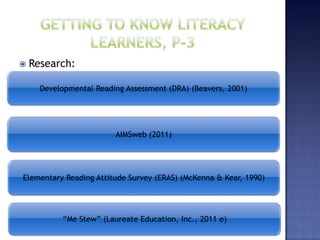
   Research:

      Developmental Reading Assessment (DRA) (Beavers, 2001)


                         AIMSweb (2011)


Elementary Reading Attitude Survey (ERAS) (McKenna & Kear, 1990)


           “Me Stew” (Laureate Education, Inc., 2011 e)
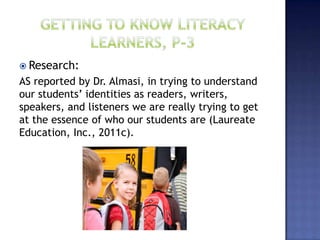
 Research:
AS reported by Dr. Almasi, in trying to understand
our students’ identities as readers, writers,
speakers, and listeners we are really trying to get
at the essence of who our students are (Laureate
Education, Inc., 2011c).
 Analysis:
Matching students to text is a critical component
of literacy instruction. When choosing text it is
important to consider three important text
factors: genre, text structure, and text features
(Tompkins, 2010). In addition to these text
factors, it is necessary to take into consideration
students’ background knowledge and experiences
and the level of interest or motivation that
students may have for reading a given text.
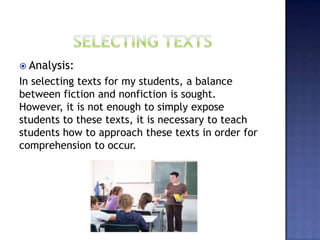
 Analysis:
In selecting texts for my students, a balance
between fiction and nonfiction is sought.
However, it is not enough to simply expose
students to these texts, it is necessary to teach
students how to approach these texts in order for
comprehension to occur.
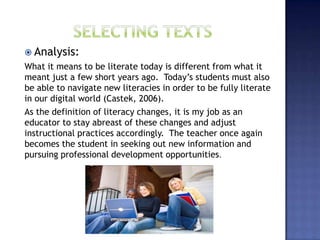
 Analysis:
What it means to be literate today is different from what it
meant just a few short years ago. Today’s students must also
be able to navigate new literacies in order to be fully literate
in our digital world (Castek, 2006).
As the definition of literacy changes, it is my job as an
educator to stay abreast of these changes and adjust
instructional practices accordingly. The teacher once again
becomes the student in seeking out new information and
pursuing professional development opportunities.
 Research:
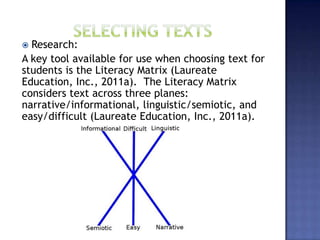
A key tool available for use when choosing text for
students is the Literacy Matrix (Laureate
Education, Inc., 2011a). The Literacy Matrix
considers text across three planes:
narrative/informational, linguistic/semiotic, and
easy/difficult (Laureate Education, Inc., 2011a).
 Research:
New literacies are defined as “the new skills,
strategies, and dispositions that are required
to successfully identify important questions,
locate information, engage in critical
evaluation, synthesize information, and
communicate on the Internet” (Castek, 2006
p.715).
 Analysis:
The Framework for Literacy Instruction guide
(Walden University, 2012) presents three perspectives
for consideration when planning for instruction, the
first of which is the interactive perspective. The
interactive perspective focuses on the “how to” of
reading.
As an educator of primary age students, this
perspective encompasses much of what I do on a
daily basis and influences the learning objectives and
outcomes that are designed for my students.
 Analysis:
Instructional practices that I have used within my
classroom in teaching students the “how to” of
reading include many of those listed in Tompkins
(2010) compendium of instructional procedures:

*Guided Reading              *Choral Reading
*Mini-lessons                *K-W-L Charts
*Making Words                *Running Records
*Reading Logs                *Think-Alouds
*Shared Reading              *Word Sorts
 Research:
The interactive perspective addresses the five
pillars (Laureate Education, Inc., 2011f) of
phonemic awareness, alphabetic principle,
comprehension, vocabulary, and fluency.
The goal of the interactive perspective is to
teach our students how to become literate
learners who are ultimately able to successfully
address text on their own (Laureate Education,
Inc., 2011d).
  Analysis
In attending to the interactive perspective, it is
important to distinguish between the terms strategy
and skill.
Strategies are defined as “deliberate, goal-directed
attempts to control and modify the reader’s efforts to
decode text, understand words, and construct meaning
of text”, while skills are defined as “automatic actions
that result in decoding and comprehension with speed,
efficiency, and fluency” (Afflerbach, Pearson, & Paris,
2008 p.368).
Within the literate environment that I have created for
my students, opportunities for practice are provided;
the goal being for strategy to become skill.
 Analysis:
The two remaining perspectives from the Framework
for Literacy Instruction guide (Walden University, 2012)
are the critical and response perspectives.
In reflecting upon the framework, it becomes apparent
that it is necessary to incorporate all three perspectives
into the classroom in order to provide a balanced
literate environment for today’s young literacy
learners.
 Analysis:
I have found the interactive read-aloud
approach (Tompkins, 2010) to be an effective
way of introducing and sharing text with
students. This particular approach provides
students with opportunities to share their
thoughts, ideas, and connections to a given
text.
The abilities of young literacy learners to
respond and connect to texts in powerful ways
should not be underestimated.
 Research:                 Research:
The critical perspective   The response perspec-
focuses on giving          tive aims to elicit a
students opportunities     personal/emotional
to be analytical in        response from the
evaluating text            reader (Laureate
(Laureate Education,       Education, Inc., 2011g).
Inc., 2011b).
 Research:
Rosenblatt (1986) argued that the phrase interaction
with text was not sufficient in seeking to define the
relationship between text and reader, but rather that a
transaction should occur that leaves the reader
somehow changed from having encountered a
meaningful text (as cited in Probst, 1987).
References
Afflerbach, P., Pearson, P. D., & Paris, S. G. (2008). Clarifying differences between reading skills and reading
         strategies. The Reading Teacher, 61(5), 364-373. doi: 10.1598/RT.61.5.1
AIMSweb. (2011). Retrieved from http://www.aimsweb.com/
Beavers, J. (2001). Developmental reading assessment. Upper Saddle River, NJ: Celebration Press/Pearson.
Caskek, J., Bevans-Mangelson, J., & Goldstone, B. (2006) Reading adventures online: Five ways to introduce th
         new literacies of the Internet through children’s literature. The Reading Teacher, 59(7), 714-728.
         Retrieved from
         http://web.ebscohost.com.ezp.waldenulibrary.org/ehost/pdfviewer/pdfviewer?sid=55059564-f555-4683-
         a3fc-04229a0d0a41%40sessionmgr11&vid=2&hid=12
Laureate Education, Inc. (Producer). (2011a). Analyzing and Selecting Text [Video]. In The Beginning Reader,
         PreK-3. Retrieved from
         https://class.waldenu.edu/webapps/portal/frameset.jsp?tab_tab_group_id=_2_1&url=%2Fwebapps%2Fblac
         kboard%2Fexecute%2Flauncher%3Ftype%3DCourse%26id%3D_1340064_1%26url%3D.
Laureate Education, Inc. (Producer). (2011b). Critical Perspective [Video]. In The Beginning Reader, PreK-3.
         Retrieved from
         http://class.waldenu.edu/webapps/portal/frameset.jsp?tab_tab_group_id=_2_1&url=%2Fwebapps%2Fblack
         board%2Fexecute%2Flauncher%3Ftype%3DCourse%26id%3D_1340064_1%26url%3D.
Laureate Education, Inc. (Producer). (2011c). Getting to Know Your Students [Video]. In The Beginning Reader,
         PreK-3. Retrieved from
         https://class.waldenu.edu/webapps/portal/frameset.jsp?tab_tab_group_id=_2_1&url=%2Fwebapps%2Fblac
         kboard%2Fexecute%2Flauncher%3Ftype%3DCourse%26id%3D_1340064_1%26url%3D
Laureate Education, Inc. (Producer). (2011d). Interactive Perspective: Strategic Processing [Video]. In The
         Beginning Reader, PreK-3. Retrieved from
         https://class.waldenu.edu/webapps/portal/frameset.jsp?tab_tab_group_id=_2_1&url=%2Fwebapps%2Fblac
         kboard%2Fexecute%2Flauncher%3Ftype%3DCourse%26id%3D_1340064_1%26url%3D.
Laureate Education, Inc. (Producer). (2011e). Literacy Autobiographies [Video]. In The Beginning Reader, PreK-3.
         Retrieved from
         http://https://class.waldenu.edu/webapps/portal/frameset.jsp?tab_tab_group_id=_2_1&url=%2Fwebapps%
         2Fblackboard%2Fexecute%2Flauncher%3Ftype%3DCourse%26id%3D_1340064_1%26url%3D
Laureate Education, Inc. (Producer). (2011f). The Beginning Reader [Video]. In The Beginning Reader, PreK-3.
         Retrieved from
         https://class.waldenu.edu/webapps/portal/frameset.jsp?tab_tab_group_id=_2_1&url=%2Fwebapps%2Fblac
         kboard%2Fexecute%2Flauncher%3Ftype%3DCourse%26id%3D_1340064_1%26url%3D
Laureate Education, Inc. (Producer). (2011g). Response Perspective [Video]. In The Beginning Reader PreK-3.
         Retrieved from
         http://class.waldenu.edu/webapps/portal/frameset.jsp?tab_tab_group_id=_2_1&url=%2Fwebapps%2Fblack
         board%2Fexecute%2Flauncher%3Ftype%3DCourse%26id%3D_1340064_1%26url%3D.
McKenna, M. C., & Kear, D. J. (1990). Measuring attitude toward reading: A new tool tor teachers. Reading
         Teacher, 43(9), 626-639. Retrieved from
         http://web.ebscohost.com.ezp.waldenulibrary.org/ehost/pdfviewer/pdfviewer?sid=fe9e12eb-8fad-4a53-
         8820-e283ea1d70bf%40sessionmgr4&vid=2&hid=7
Probst, R. E. (1987). Transactional theory in the teaching of literature. Resources in Education, 21(12). Retrieved
         from http://web.ebscohost.com.ezp.waldenulibrary.org/ehost/detail?sid=c45aecdd-78f5-4f3f-
         8175eff0c885495e%40sessionmgr14&vid=1&hid=24&bdata=JnNpdGU9ZWhvc3QtbGl2ZSZzY29wZT1z
         aXRl#db=eric&AN=ED284274
Tompkins, G. E. (2010). Literacy for the 21st century: A balanced approach (5th ed.). Boston, MA: Allyn & Bacon.
Walden University. (2012). Framework for Literacy Instruction. Retrieved June 28, 2012 from
         http://class.waldenu.edu/webapps/portal/frameset.jsp?tab_tab_group_id=_2_1&url=%2Fwebapps%2Fblack
         board%2Fexecute%2Flauncher%3Ftype%3DCourse%26id%3D_551764_1%26url%3D.

Literate Environment Analysis

  • 1.
    Jacqueline Hancock Walden University EDUC 6706 The Beginning Reader PreK-3 Mrs. Cindee Easton
  • 2.
    ANALYSIS: Getting to know one’s students is a critical step in creating a literate environment in which all students are able to find success. Cognitive and noncognitive factors should both be taken into consideration when trying to understand not only who our students are as academic learners, but as individuals as well. As noted by Dr. Almasi, we teach students not texts or subjects (Laureate Education, Inc., 2011c). Making an effort to know, care for, and understand my students is an essential part of what I do as an educator. A powerful message is sent to students when they know that their teacher is truly invested in them. The resources listed below under research are examples of tools that I have used in an effort to learn about my students’ academic needs, as well as, who they are as individuals.
  • 3.
    Research: Developmental Reading Assessment (DRA) (Beavers, 2001) AIMSweb (2011) Elementary Reading Attitude Survey (ERAS) (McKenna & Kear, 1990) “Me Stew” (Laureate Education, Inc., 2011 e)
  • 4.
     Research: AS reportedby Dr. Almasi, in trying to understand our students’ identities as readers, writers, speakers, and listeners we are really trying to get at the essence of who our students are (Laureate Education, Inc., 2011c).
  • 5.
     Analysis: Matching studentsto text is a critical component of literacy instruction. When choosing text it is important to consider three important text factors: genre, text structure, and text features (Tompkins, 2010). In addition to these text factors, it is necessary to take into consideration students’ background knowledge and experiences and the level of interest or motivation that students may have for reading a given text.
  • 6.
     Analysis: In selectingtexts for my students, a balance between fiction and nonfiction is sought. However, it is not enough to simply expose students to these texts, it is necessary to teach students how to approach these texts in order for comprehension to occur.
  • 7.
     Analysis: What itmeans to be literate today is different from what it meant just a few short years ago. Today’s students must also be able to navigate new literacies in order to be fully literate in our digital world (Castek, 2006). As the definition of literacy changes, it is my job as an educator to stay abreast of these changes and adjust instructional practices accordingly. The teacher once again becomes the student in seeking out new information and pursuing professional development opportunities.
  • 8.
     Research: A keytool available for use when choosing text for students is the Literacy Matrix (Laureate Education, Inc., 2011a). The Literacy Matrix considers text across three planes: narrative/informational, linguistic/semiotic, and easy/difficult (Laureate Education, Inc., 2011a).
  • 9.
     Research: New literaciesare defined as “the new skills, strategies, and dispositions that are required to successfully identify important questions, locate information, engage in critical evaluation, synthesize information, and communicate on the Internet” (Castek, 2006 p.715).
  • 10.
     Analysis: The Frameworkfor Literacy Instruction guide (Walden University, 2012) presents three perspectives for consideration when planning for instruction, the first of which is the interactive perspective. The interactive perspective focuses on the “how to” of reading. As an educator of primary age students, this perspective encompasses much of what I do on a daily basis and influences the learning objectives and outcomes that are designed for my students.
  • 11.
     Analysis: Instructional practicesthat I have used within my classroom in teaching students the “how to” of reading include many of those listed in Tompkins (2010) compendium of instructional procedures: *Guided Reading *Choral Reading *Mini-lessons *K-W-L Charts *Making Words *Running Records *Reading Logs *Think-Alouds *Shared Reading *Word Sorts
  • 12.
     Research: The interactiveperspective addresses the five pillars (Laureate Education, Inc., 2011f) of phonemic awareness, alphabetic principle, comprehension, vocabulary, and fluency. The goal of the interactive perspective is to teach our students how to become literate learners who are ultimately able to successfully address text on their own (Laureate Education, Inc., 2011d).
  • 13.
     Analysis Inattending to the interactive perspective, it is important to distinguish between the terms strategy and skill. Strategies are defined as “deliberate, goal-directed attempts to control and modify the reader’s efforts to decode text, understand words, and construct meaning of text”, while skills are defined as “automatic actions that result in decoding and comprehension with speed, efficiency, and fluency” (Afflerbach, Pearson, & Paris, 2008 p.368). Within the literate environment that I have created for my students, opportunities for practice are provided; the goal being for strategy to become skill.
  • 14.
     Analysis: The tworemaining perspectives from the Framework for Literacy Instruction guide (Walden University, 2012) are the critical and response perspectives. In reflecting upon the framework, it becomes apparent that it is necessary to incorporate all three perspectives into the classroom in order to provide a balanced literate environment for today’s young literacy learners.
  • 15.
     Analysis: I havefound the interactive read-aloud approach (Tompkins, 2010) to be an effective way of introducing and sharing text with students. This particular approach provides students with opportunities to share their thoughts, ideas, and connections to a given text. The abilities of young literacy learners to respond and connect to texts in powerful ways should not be underestimated.
  • 16.
     Research:  Research: The critical perspective The response perspec- focuses on giving tive aims to elicit a students opportunities personal/emotional to be analytical in response from the evaluating text reader (Laureate (Laureate Education, Education, Inc., 2011g). Inc., 2011b).
  • 17.
     Research: Rosenblatt (1986)argued that the phrase interaction with text was not sufficient in seeking to define the relationship between text and reader, but rather that a transaction should occur that leaves the reader somehow changed from having encountered a meaningful text (as cited in Probst, 1987).
  • 18.
    References Afflerbach, P., Pearson,P. D., & Paris, S. G. (2008). Clarifying differences between reading skills and reading strategies. The Reading Teacher, 61(5), 364-373. doi: 10.1598/RT.61.5.1 AIMSweb. (2011). Retrieved from http://www.aimsweb.com/ Beavers, J. (2001). Developmental reading assessment. Upper Saddle River, NJ: Celebration Press/Pearson. Caskek, J., Bevans-Mangelson, J., & Goldstone, B. (2006) Reading adventures online: Five ways to introduce th new literacies of the Internet through children’s literature. The Reading Teacher, 59(7), 714-728. Retrieved from http://web.ebscohost.com.ezp.waldenulibrary.org/ehost/pdfviewer/pdfviewer?sid=55059564-f555-4683- a3fc-04229a0d0a41%40sessionmgr11&vid=2&hid=12 Laureate Education, Inc. (Producer). (2011a). Analyzing and Selecting Text [Video]. In The Beginning Reader, PreK-3. Retrieved from https://class.waldenu.edu/webapps/portal/frameset.jsp?tab_tab_group_id=_2_1&url=%2Fwebapps%2Fblac kboard%2Fexecute%2Flauncher%3Ftype%3DCourse%26id%3D_1340064_1%26url%3D. Laureate Education, Inc. (Producer). (2011b). Critical Perspective [Video]. In The Beginning Reader, PreK-3. Retrieved from http://class.waldenu.edu/webapps/portal/frameset.jsp?tab_tab_group_id=_2_1&url=%2Fwebapps%2Fblack board%2Fexecute%2Flauncher%3Ftype%3DCourse%26id%3D_1340064_1%26url%3D. Laureate Education, Inc. (Producer). (2011c). Getting to Know Your Students [Video]. In The Beginning Reader, PreK-3. Retrieved from https://class.waldenu.edu/webapps/portal/frameset.jsp?tab_tab_group_id=_2_1&url=%2Fwebapps%2Fblac kboard%2Fexecute%2Flauncher%3Ftype%3DCourse%26id%3D_1340064_1%26url%3D Laureate Education, Inc. (Producer). (2011d). Interactive Perspective: Strategic Processing [Video]. In The Beginning Reader, PreK-3. Retrieved from https://class.waldenu.edu/webapps/portal/frameset.jsp?tab_tab_group_id=_2_1&url=%2Fwebapps%2Fblac kboard%2Fexecute%2Flauncher%3Ftype%3DCourse%26id%3D_1340064_1%26url%3D. Laureate Education, Inc. (Producer). (2011e). Literacy Autobiographies [Video]. In The Beginning Reader, PreK-3. Retrieved from http://https://class.waldenu.edu/webapps/portal/frameset.jsp?tab_tab_group_id=_2_1&url=%2Fwebapps% 2Fblackboard%2Fexecute%2Flauncher%3Ftype%3DCourse%26id%3D_1340064_1%26url%3D Laureate Education, Inc. (Producer). (2011f). The Beginning Reader [Video]. In The Beginning Reader, PreK-3. Retrieved from https://class.waldenu.edu/webapps/portal/frameset.jsp?tab_tab_group_id=_2_1&url=%2Fwebapps%2Fblac kboard%2Fexecute%2Flauncher%3Ftype%3DCourse%26id%3D_1340064_1%26url%3D Laureate Education, Inc. (Producer). (2011g). Response Perspective [Video]. In The Beginning Reader PreK-3. Retrieved from http://class.waldenu.edu/webapps/portal/frameset.jsp?tab_tab_group_id=_2_1&url=%2Fwebapps%2Fblack board%2Fexecute%2Flauncher%3Ftype%3DCourse%26id%3D_1340064_1%26url%3D. McKenna, M. C., & Kear, D. J. (1990). Measuring attitude toward reading: A new tool tor teachers. Reading Teacher, 43(9), 626-639. Retrieved from http://web.ebscohost.com.ezp.waldenulibrary.org/ehost/pdfviewer/pdfviewer?sid=fe9e12eb-8fad-4a53- 8820-e283ea1d70bf%40sessionmgr4&vid=2&hid=7 Probst, R. E. (1987). Transactional theory in the teaching of literature. Resources in Education, 21(12). Retrieved from http://web.ebscohost.com.ezp.waldenulibrary.org/ehost/detail?sid=c45aecdd-78f5-4f3f- 8175eff0c885495e%40sessionmgr14&vid=1&hid=24&bdata=JnNpdGU9ZWhvc3QtbGl2ZSZzY29wZT1z aXRl#db=eric&AN=ED284274 Tompkins, G. E. (2010). Literacy for the 21st century: A balanced approach (5th ed.). Boston, MA: Allyn & Bacon. Walden University. (2012). Framework for Literacy Instruction. Retrieved June 28, 2012 from http://class.waldenu.edu/webapps/portal/frameset.jsp?tab_tab_group_id=_2_1&url=%2Fwebapps%2Fblack board%2Fexecute%2Flauncher%3Ftype%3DCourse%26id%3D_551764_1%26url%3D.