HADOOP/HIVE
GENERAL INTRODUCTION
Presented By
www.kellytechno.com
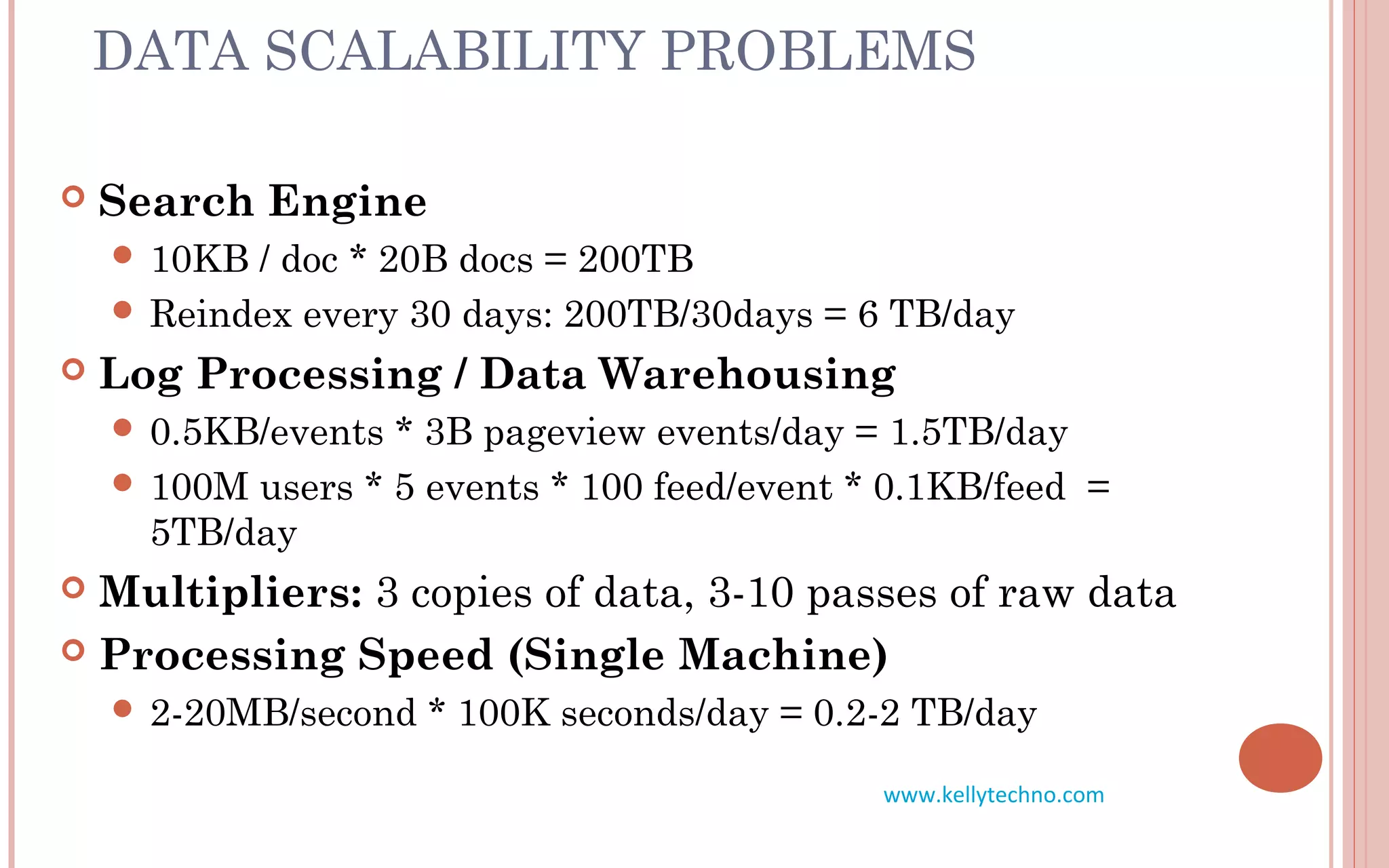
DATA SCALABILITY PROBLEMS
 Search Engine
 10KB / doc * 20B docs = 200TB
 Reindex every 30 days: 200TB/30days = 6 TB/day
 Log Processing / Data Warehousing
 0.5KB/events * 3B pageview events/day = 1.5TB/day
 100M users * 5 events * 100 feed/event * 0.1KB/feed =
5TB/day
 Multipliers: 3 copies of data, 3-10 passes of raw data
 Processing Speed (Single Machine)
 2-20MB/second * 100K seconds/day = 0.2-2 TB/day
www.kellytechno.com
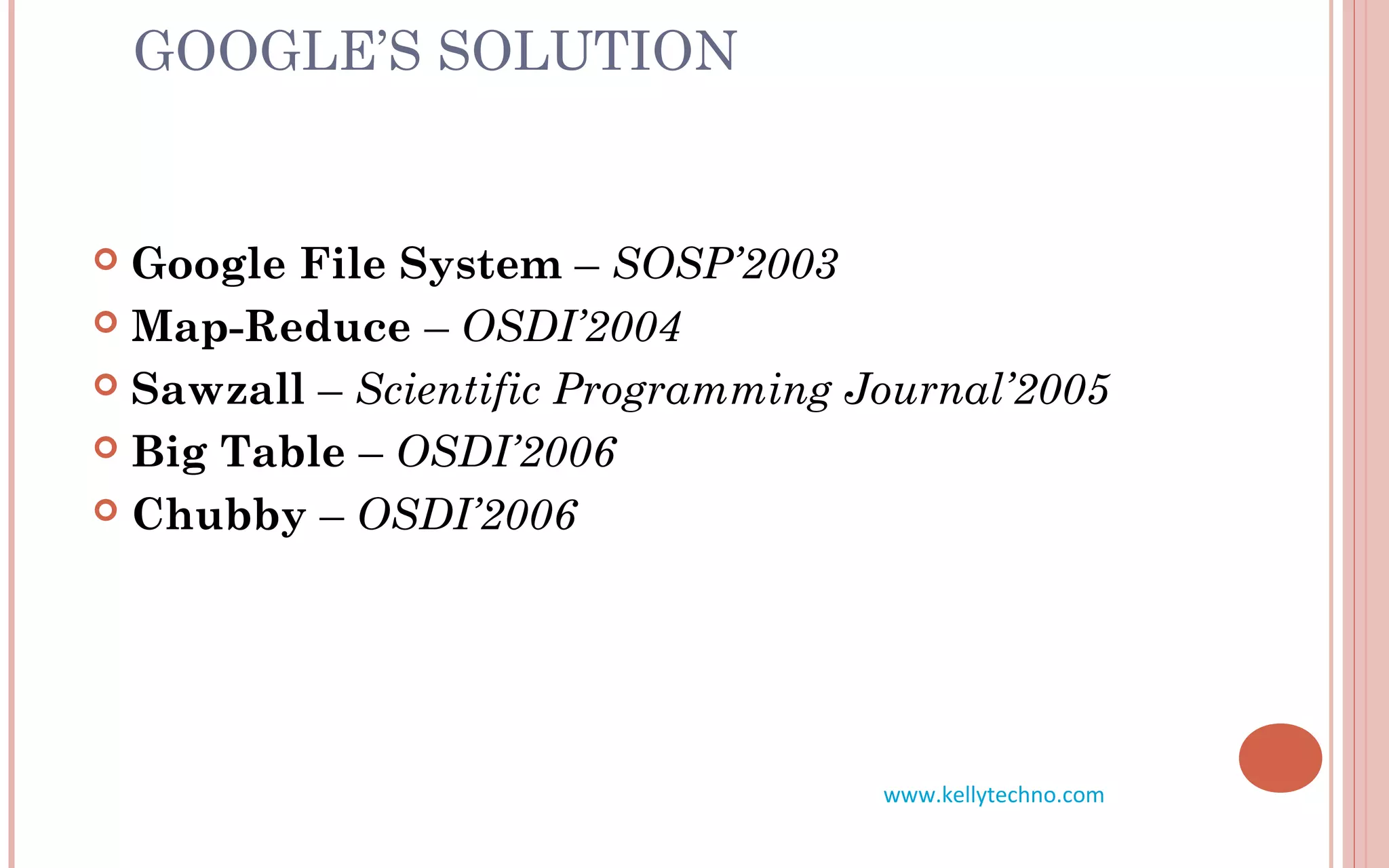
GOOGLE’S SOLUTION
 Google File System – SOSP’2003
 Map-Reduce – OSDI’2004
 Sawzall – Scientific Programming Journal’2005
 Big Table – OSDI’2006
 Chubby – OSDI’2006
www.kellytechno.com
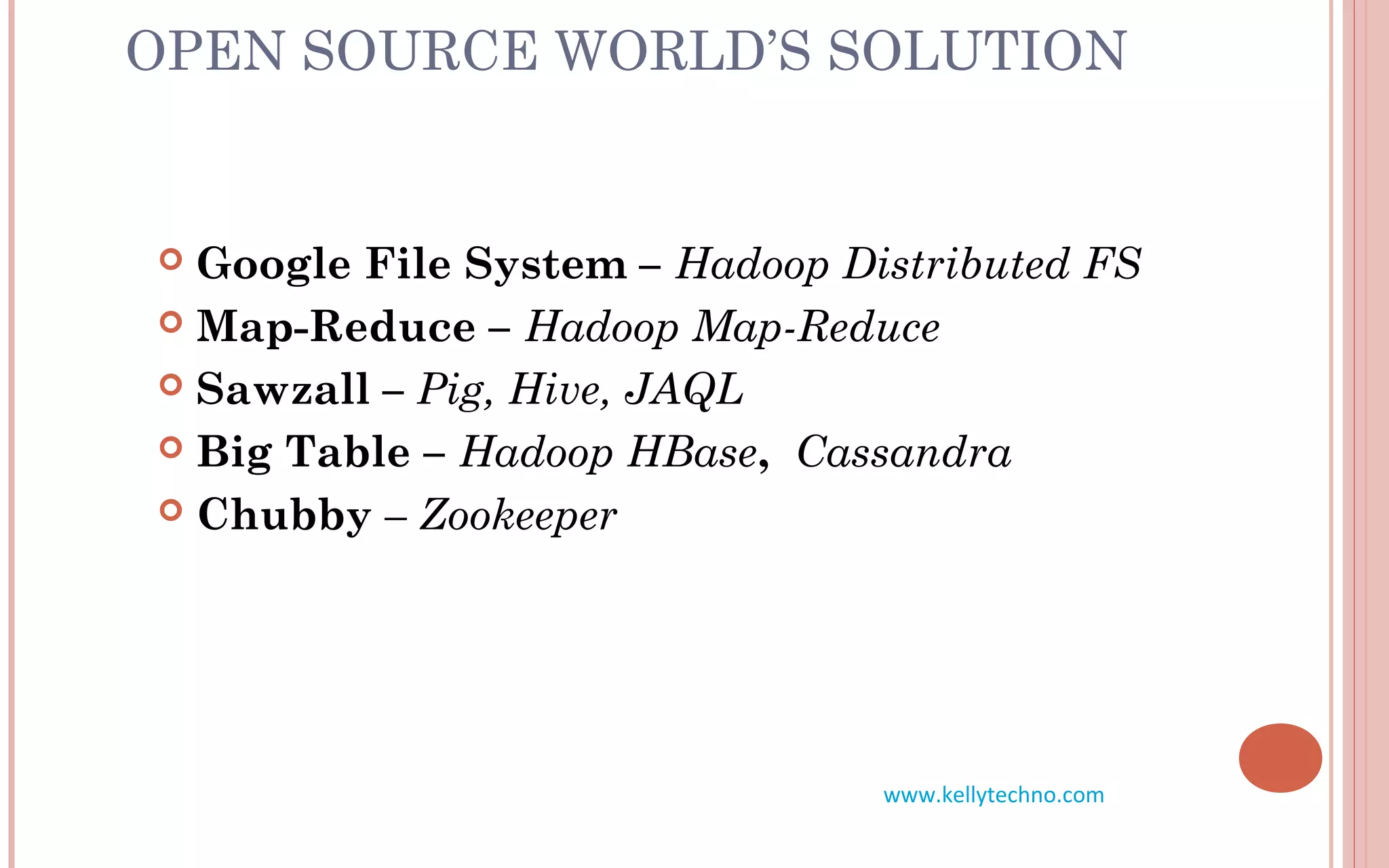
OPEN SOURCE WORLD’S SOLUTION
 Google File System – Hadoop Distributed FS
 Map-Reduce – Hadoop Map-Reduce
 Sawzall – Pig, Hive, JAQL
 Big Table – Hadoop HBase, Cassandra
 Chubby – Zookeeper
www.kellytechno.com
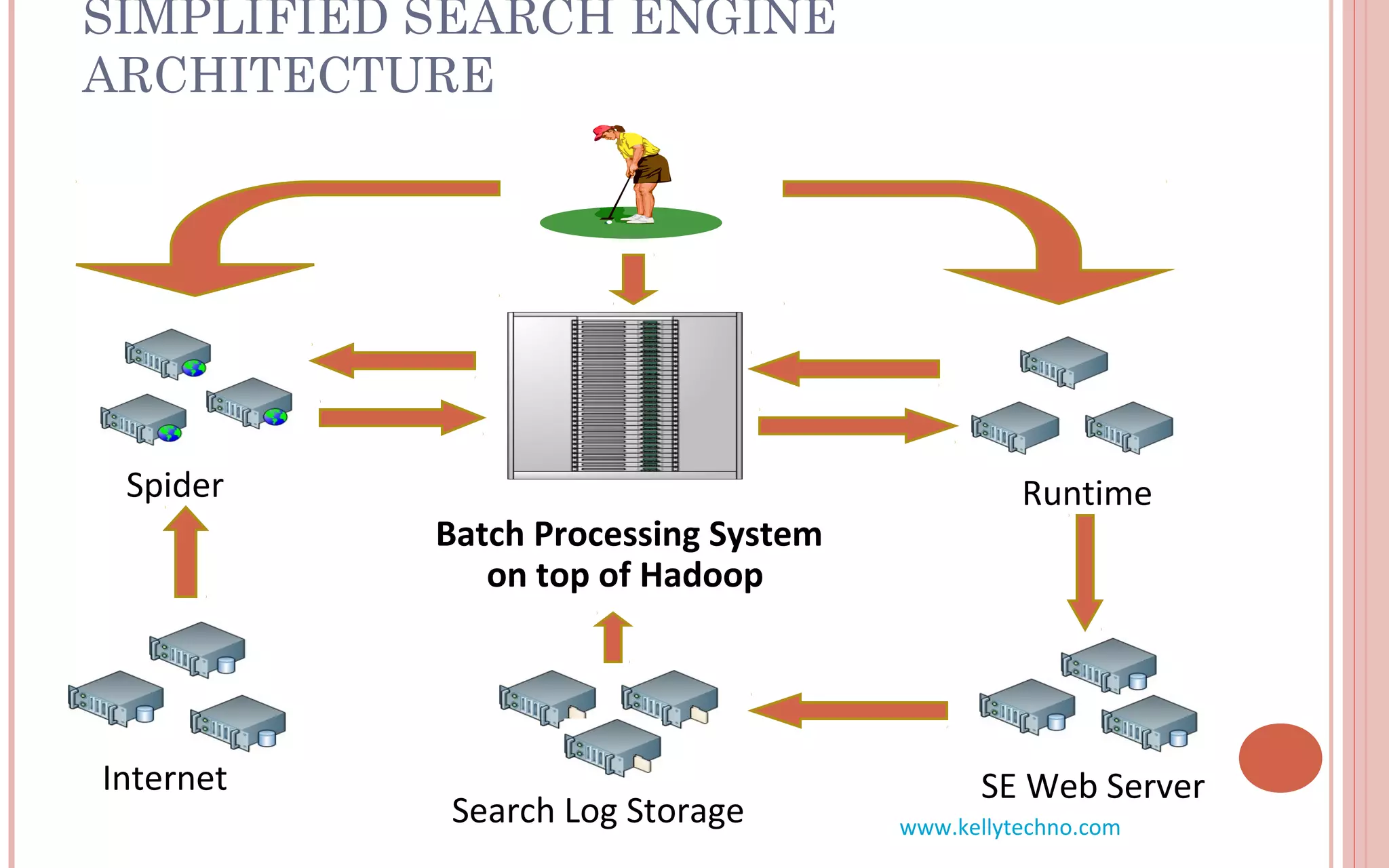
SIMPLIFIED SEARCH ENGINE
ARCHITECTURE
Spider Runtime
Batch Processing System
on top of Hadoop
SE Web Server
Search Log Storage
Internet
www.kellytechno.com
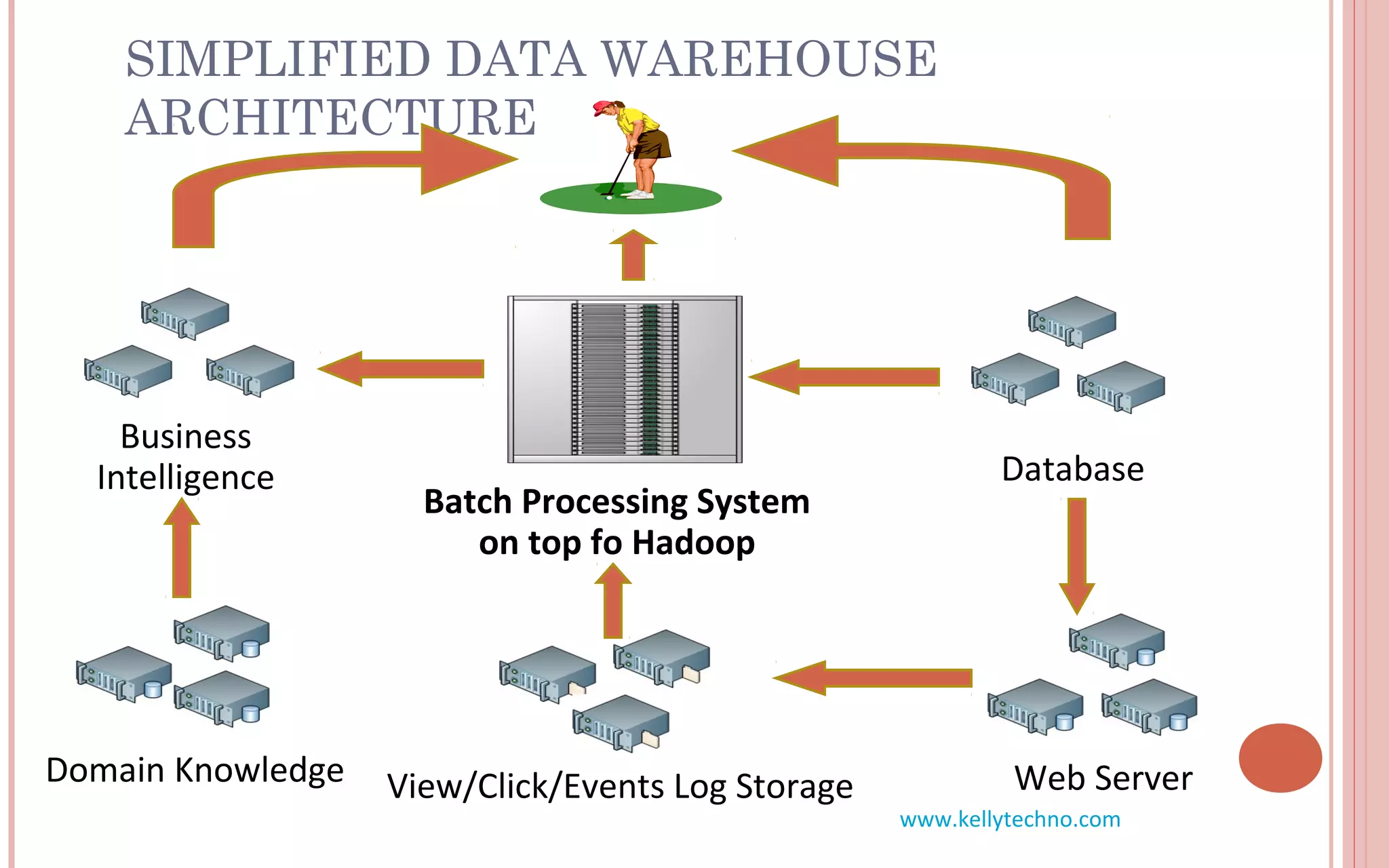
SIMPLIFIED DATA WAREHOUSE
ARCHITECTURE
Database
Batch Processing System
on top fo Hadoop
Web ServerView/Click/Events Log Storage
Business
Intelligence
Domain Knowledge
www.kellytechno.com
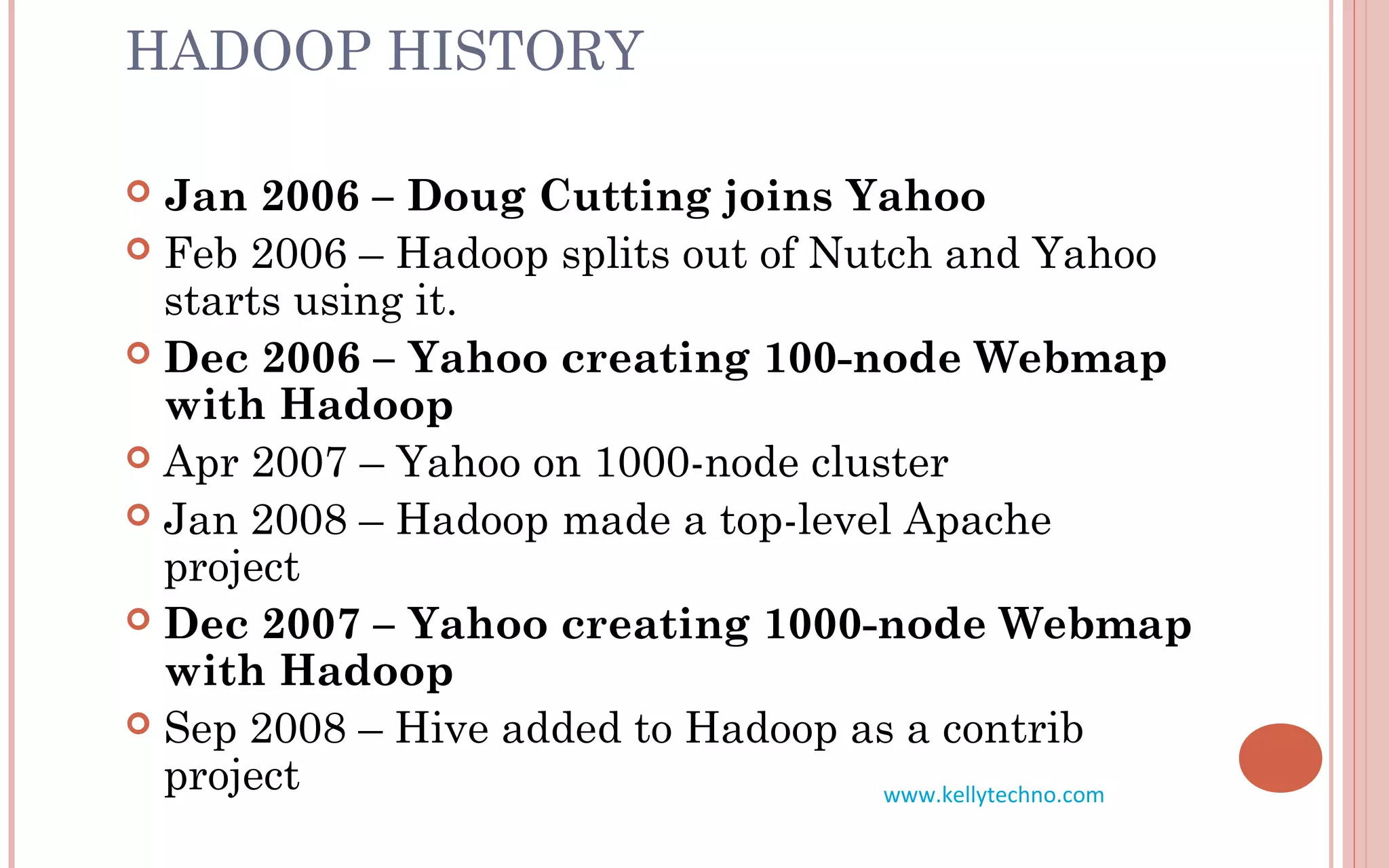
HADOOP HISTORY
 Jan 2006 – Doug Cutting joins Yahoo
 Feb 2006 – Hadoop splits out of Nutch and Yahoo
starts using it.
 Dec 2006 – Yahoo creating 100-node Webmap
with Hadoop
 Apr 2007 – Yahoo on 1000-node cluster
 Jan 2008 – Hadoop made a top-level Apache
project
 Dec 2007 – Yahoo creating 1000-node Webmap
with Hadoop
 Sep 2008 – Hive added to Hadoop as a contrib
project www.kellytechno.com
HADOOP INTRODUCTION
Open Source Apache Project
http://hadoop.apache.org/
 Book:
http://oreilly.com/catalog/9780596521998/index.html
Written in Java
Does work with other languages
Runs on
Linux, Windows and more
Commodity hardware with high failure rate
www.kellytechno.com
CURRENT STATUS OF HADOOP
Largest Cluster
2000 nodes (8 cores, 4TB disk)
Used by 40+ companies /
universities over the world
Yahoo, Facebook, etc
Cloud Computing Donation from Google and
IBM
Startup focusing on providing
services for hadoop
Cloudera
www.kellytechno.com
HADOOP COMPONENTS
Hadoop Distributed File System
(HDFS)
Hadoop Map-Reduce
Contributes
Hadoop Streaming
Pig / JAQL / Hive
HBase
Hama / Mahout
www.kellytechno.com
Hadoop Distributed File System
www.kellytechno.com
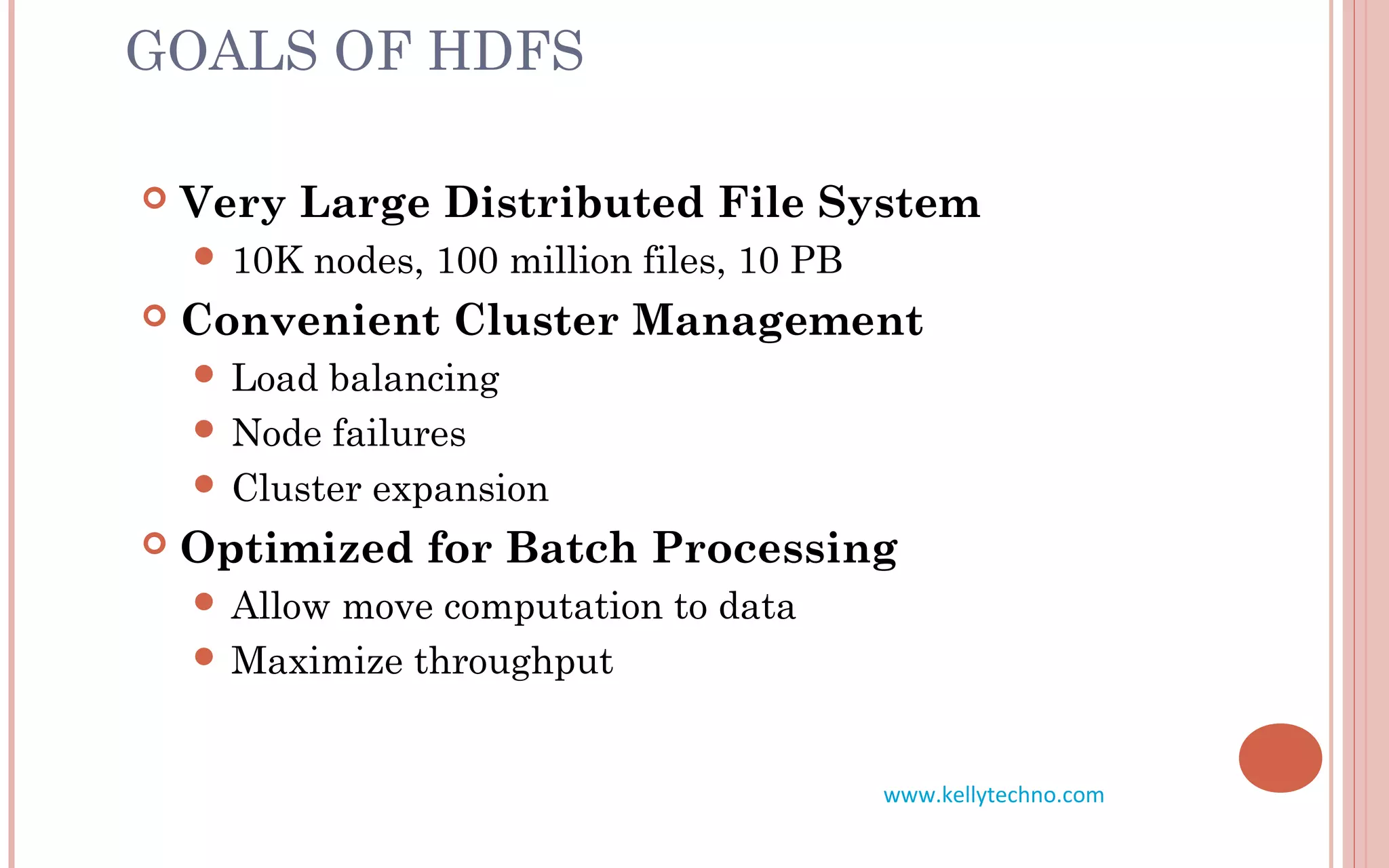
GOALS OF HDFS
 Very Large Distributed File System
 10K nodes, 100 million files, 10 PB
 Convenient Cluster Management
 Load balancing
 Node failures
 Cluster expansion
 Optimized for Batch Processing
 Allow move computation to data
 Maximize throughput
www.kellytechno.com
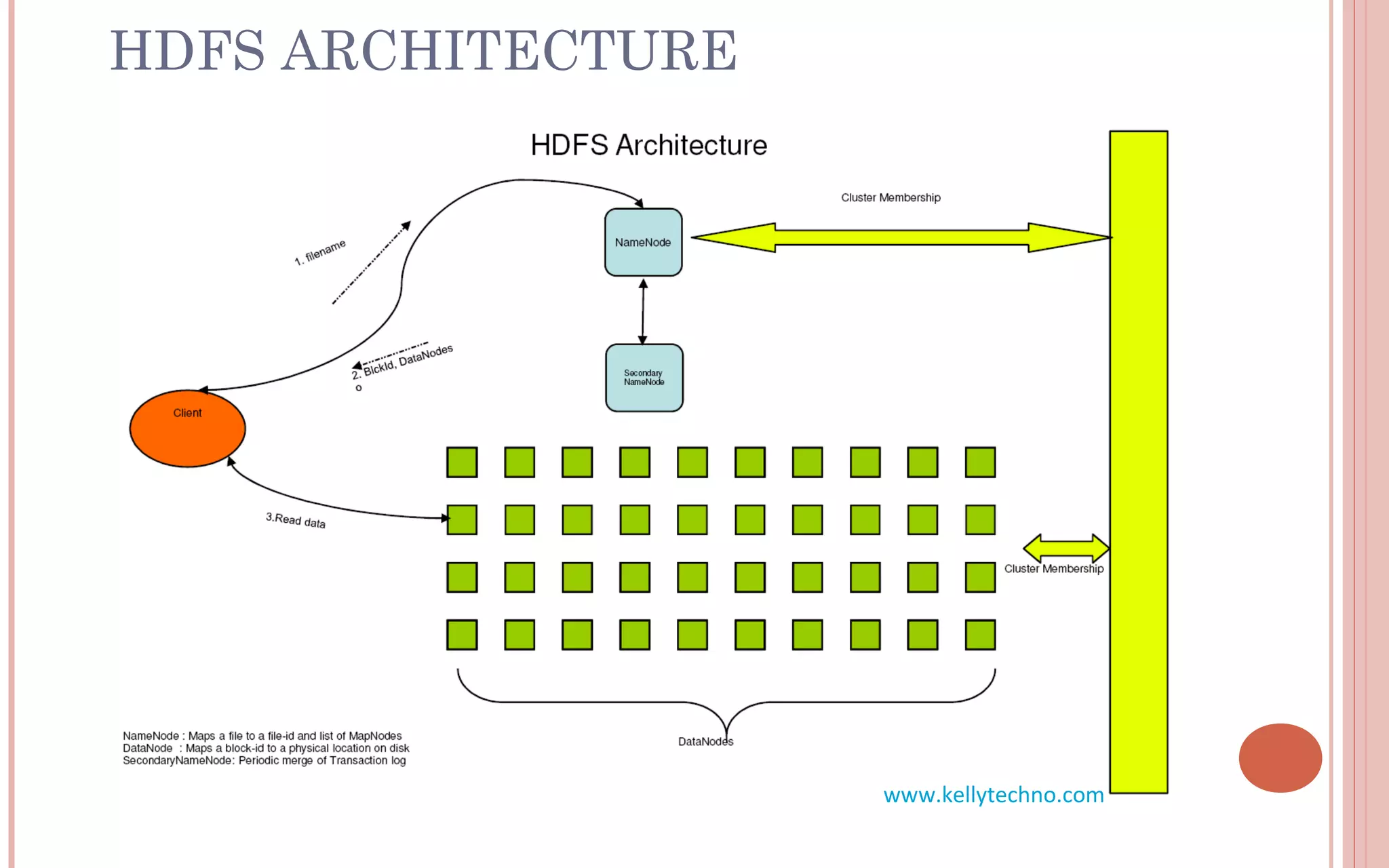
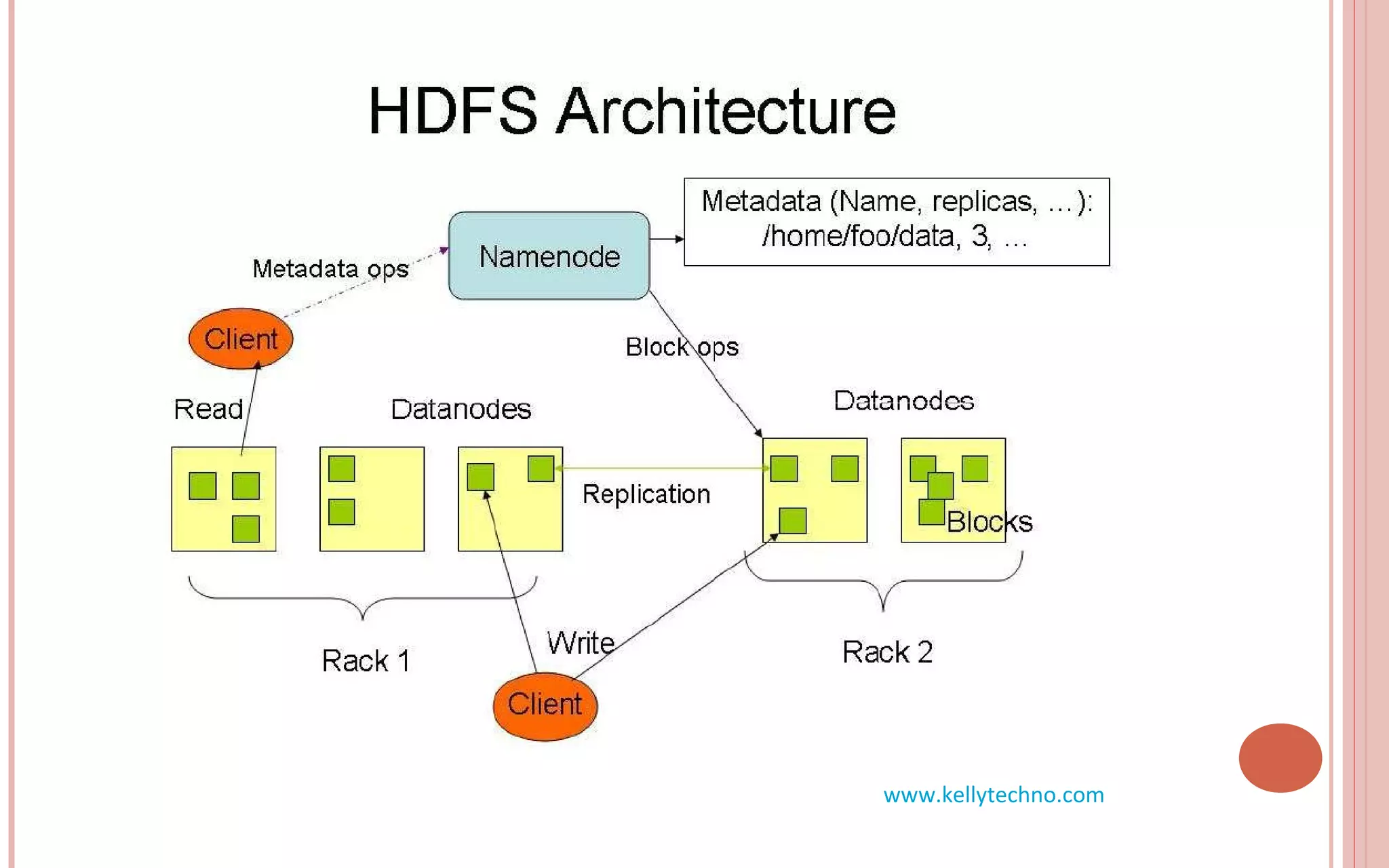
HDFS ARCHITECTURE
www.kellytechno.com
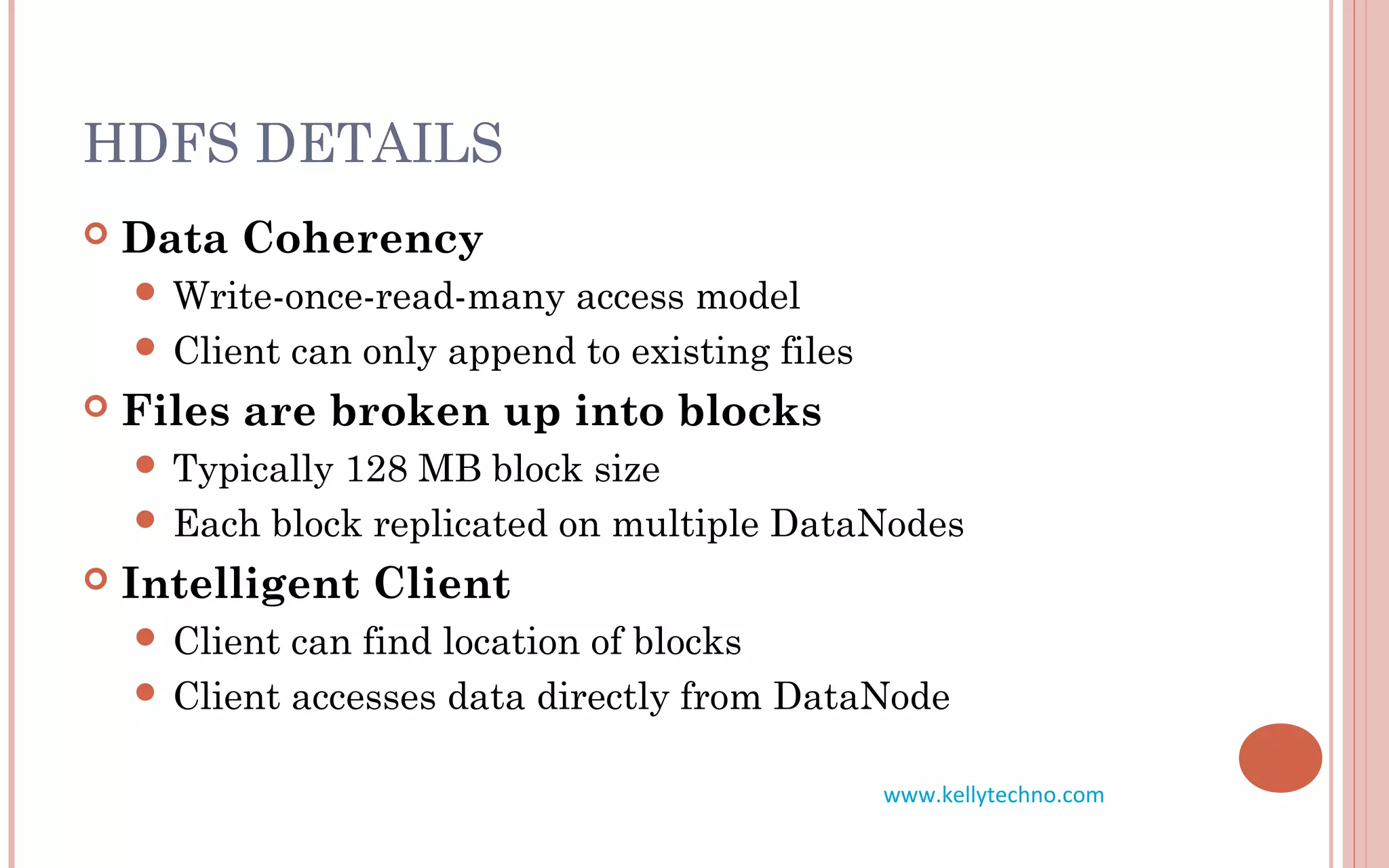
HDFS DETAILS
 Data Coherency
 Write-once-read-many access model
 Client can only append to existing files
 Files are broken up into blocks
 Typically 128 MB block size
 Each block replicated on multiple DataNodes
 Intelligent Client
 Client can find location of blocks
 Client accesses data directly from DataNode
www.kellytechno.com
www.kellytechno.com
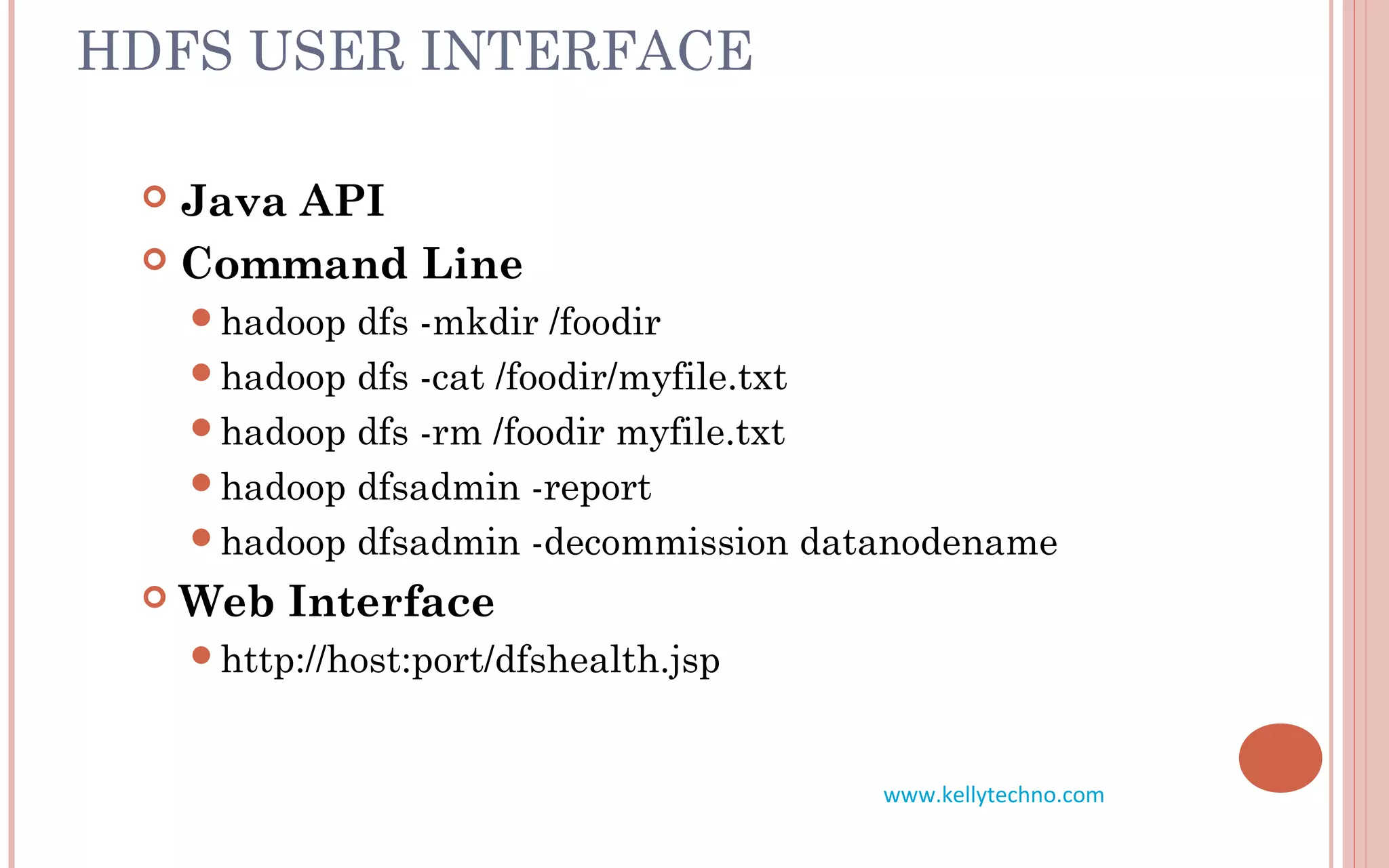
HDFS USER INTERFACE
 Java API
 Command Line
hadoop dfs -mkdir /foodir
hadoop dfs -cat /foodir/myfile.txt
hadoop dfs -rm /foodir myfile.txt
hadoop dfsadmin -report
hadoop dfsadmin -decommission datanodename
 Web Interface
http://host:port/dfshealth.jsp
www.kellytechno.com
MORE ABOUT HDFS
 http://hadoop.apache.org/core/docs/current/hdfs_desig
n.html
 Hadoop FileSystem API
HDFS
Local File System
Kosmos File System (KFS)
Amazon S3 File System
www.kellytechno.com
Hadoop Map-Reduce and
Hadoop Streaming
www.kellytechno.com
HADOOP MAP-REDUCE
INTRODUCTION
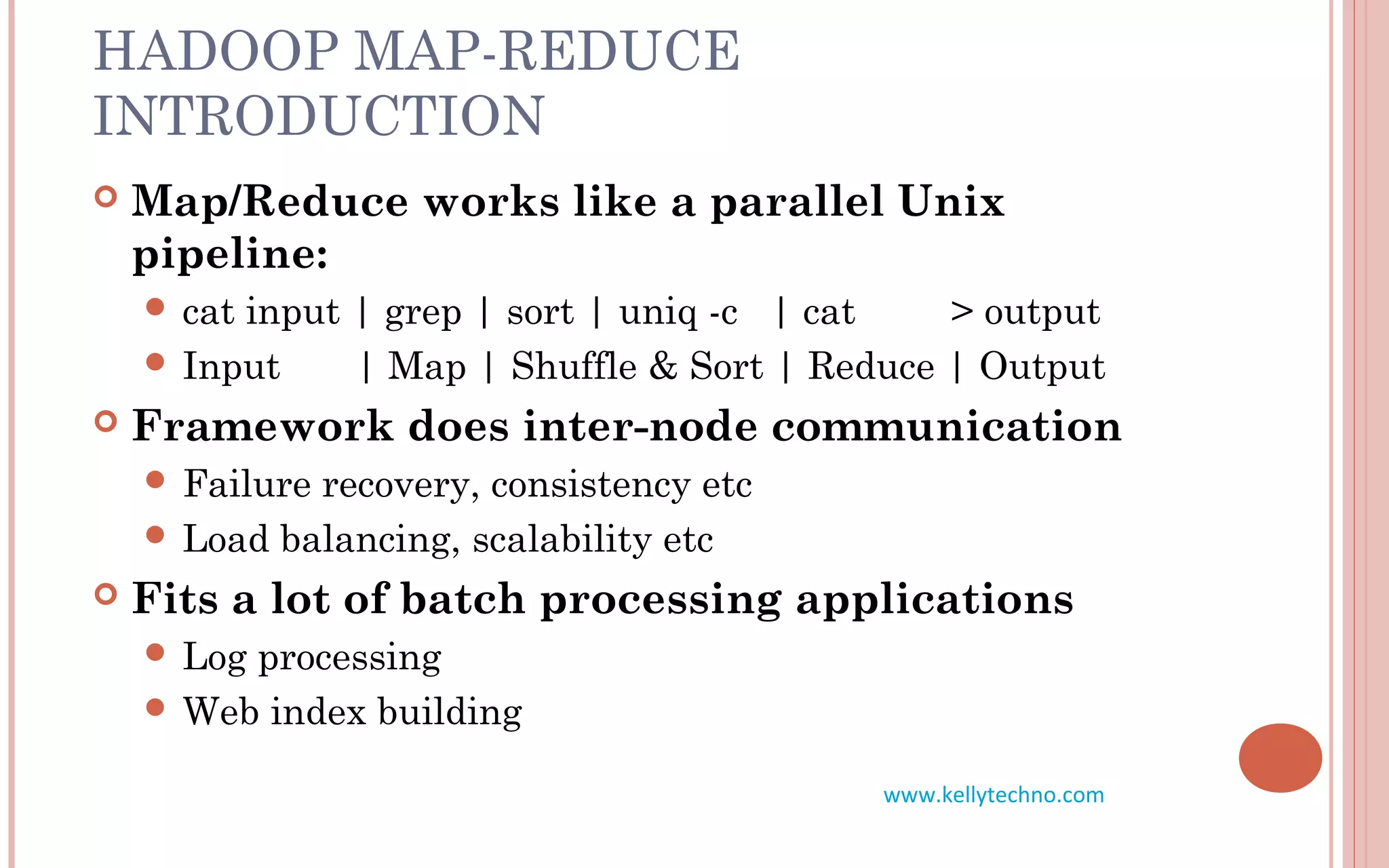
 Map/Reduce works like a parallel Unix
pipeline:
 cat input | grep | sort | uniq -c | cat > output
 Input | Map | Shuffle & Sort | Reduce | Output
 Framework does inter-node communication
 Failure recovery, consistency etc
 Load balancing, scalability etc
 Fits a lot of batch processing applications
 Log processing
 Web index building
www.kellytechno.com
www.kellytechno.com
Machine 2
Machine 1
<k1, v1>
<k2, v2>
<k3, v3>
<k4, v4>
<k5, v5>
<k6, v6>
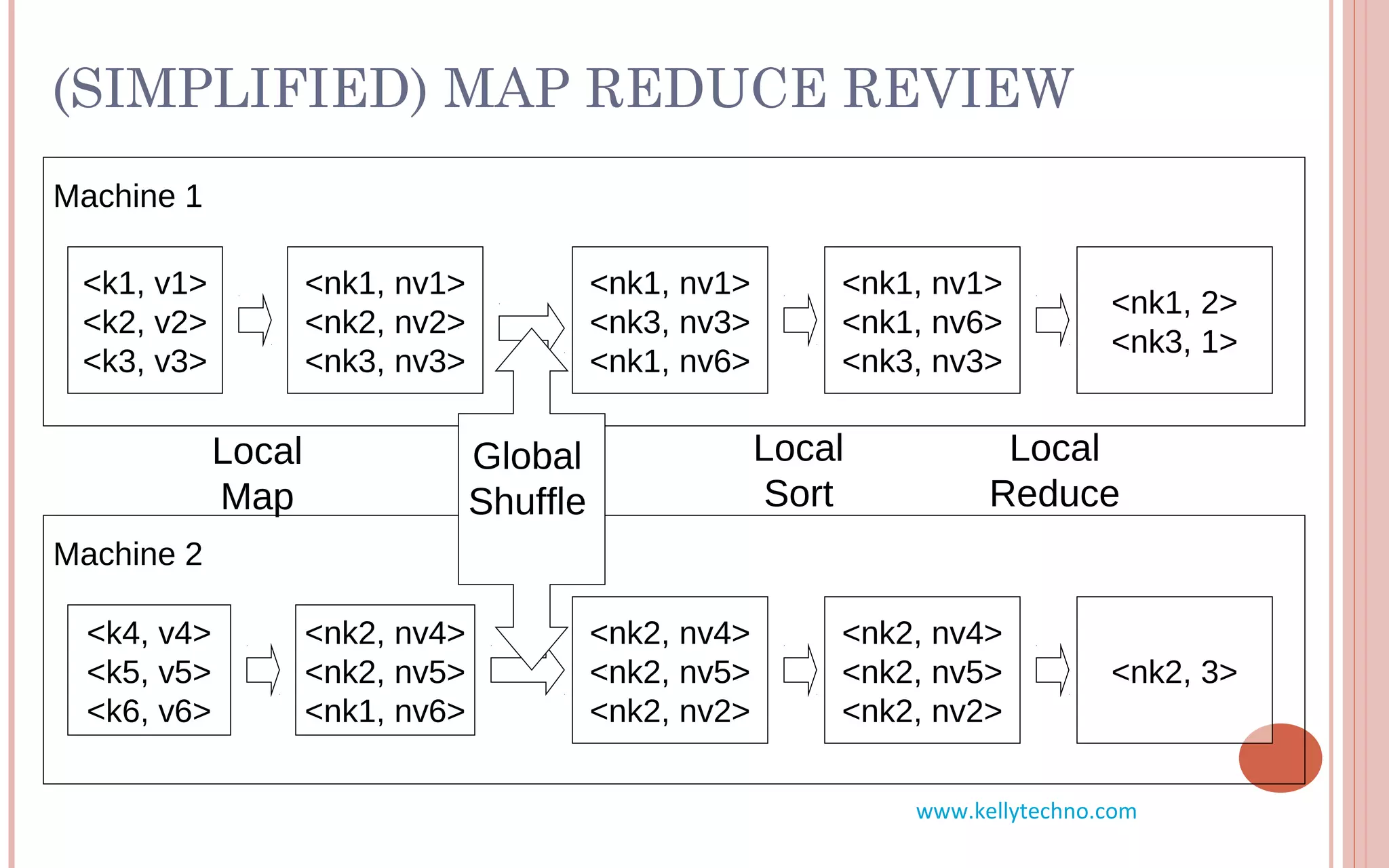
(SIMPLIFIED) MAP REDUCE REVIEW
<nk1, nv1>
<nk2, nv2>
<nk3, nv3>
<nk2, nv4>
<nk2, nv5>
<nk1, nv6>
Local
Map
<nk2, nv4>
<nk2, nv5>
<nk2, nv2>
<nk1, nv1>
<nk3, nv3>
<nk1, nv6>
Global
Shuffle
<nk1, nv1>
<nk1, nv6>
<nk3, nv3>
<nk2, nv4>
<nk2, nv5>
<nk2, nv2>
Local
Sort
<nk2, 3>
<nk1, 2>
<nk3, 1>
Local
Reduce
www.kellytechno.com
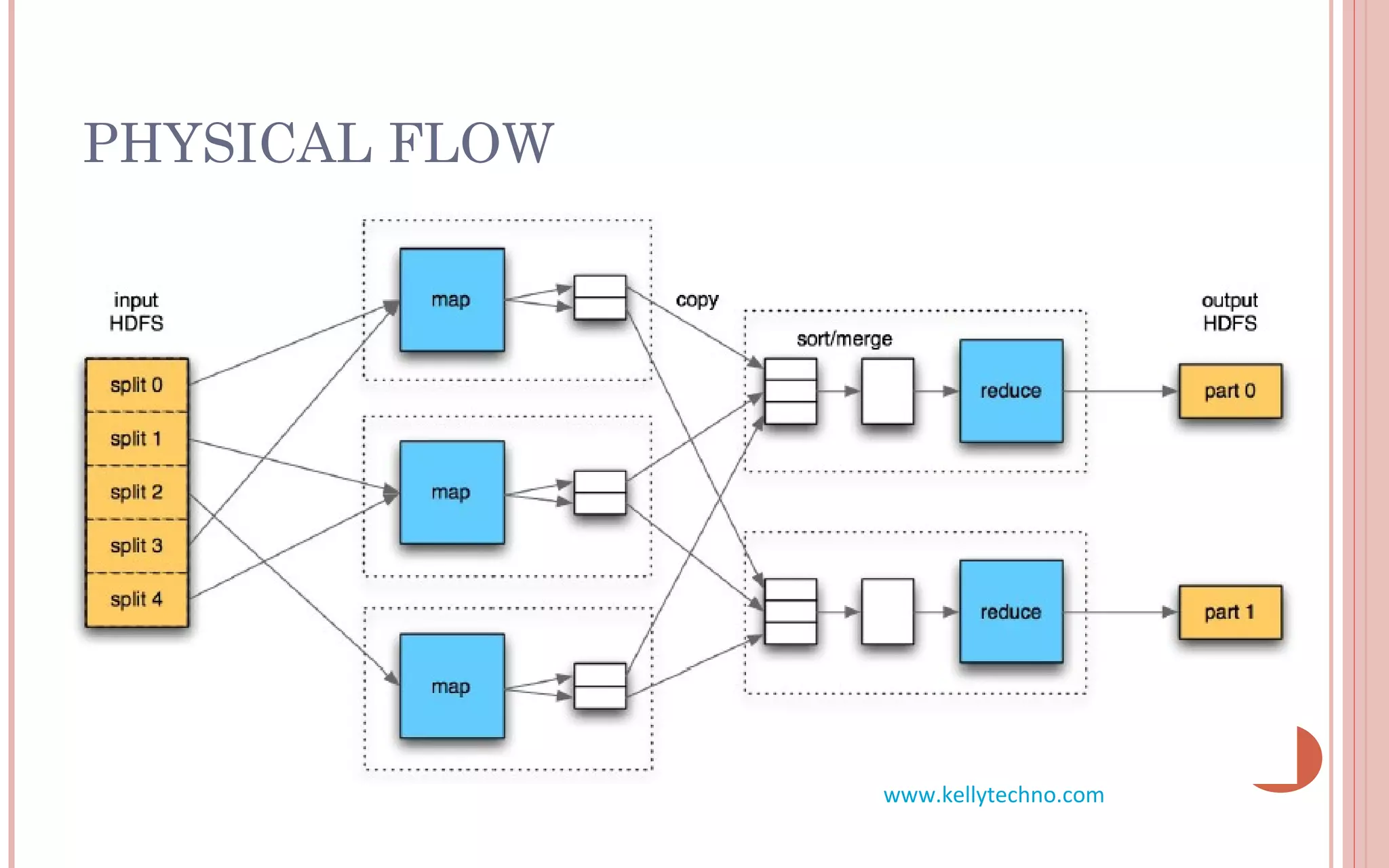
PHYSICAL FLOW
www.kellytechno.com
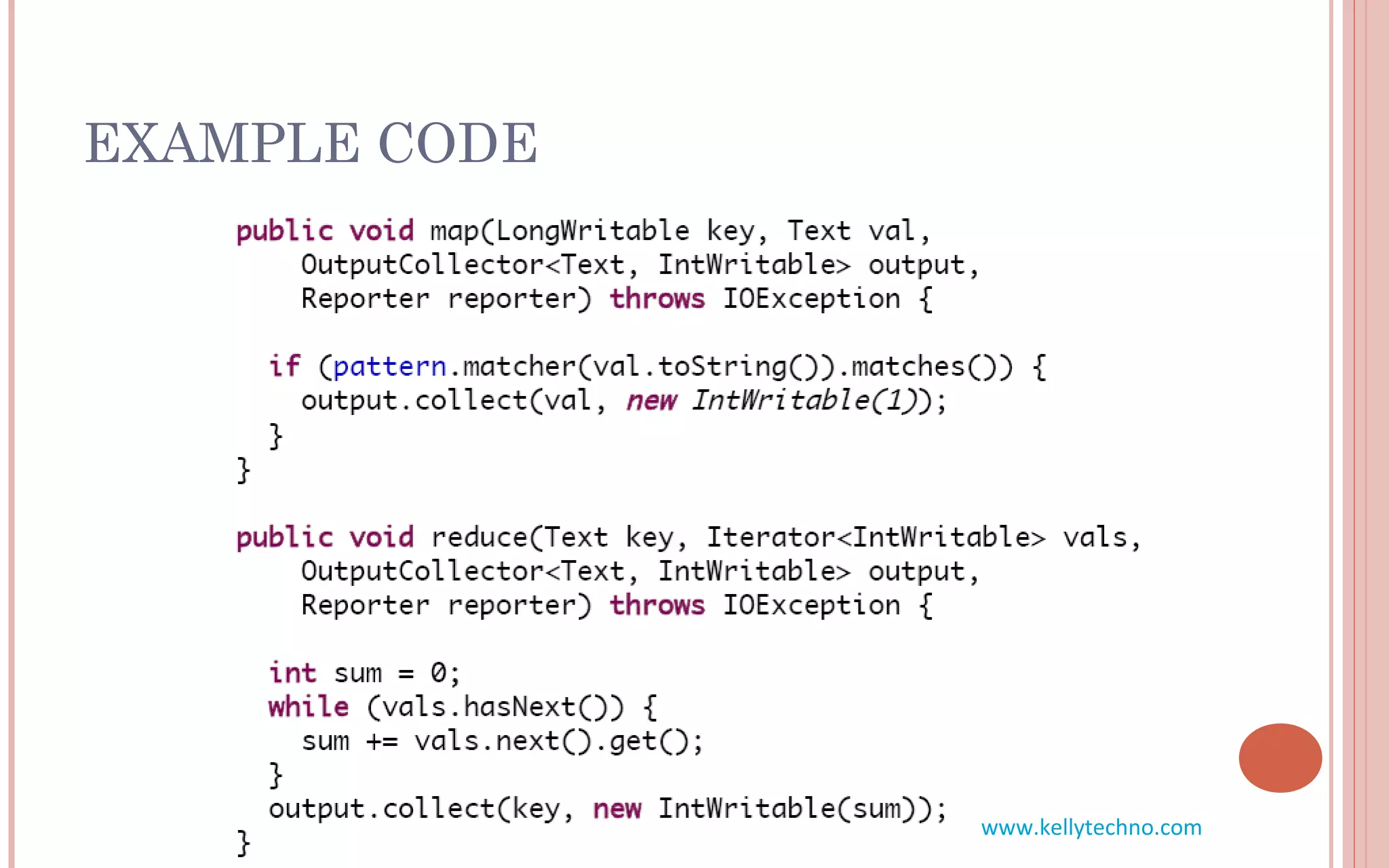
EXAMPLE CODE
www.kellytechno.com
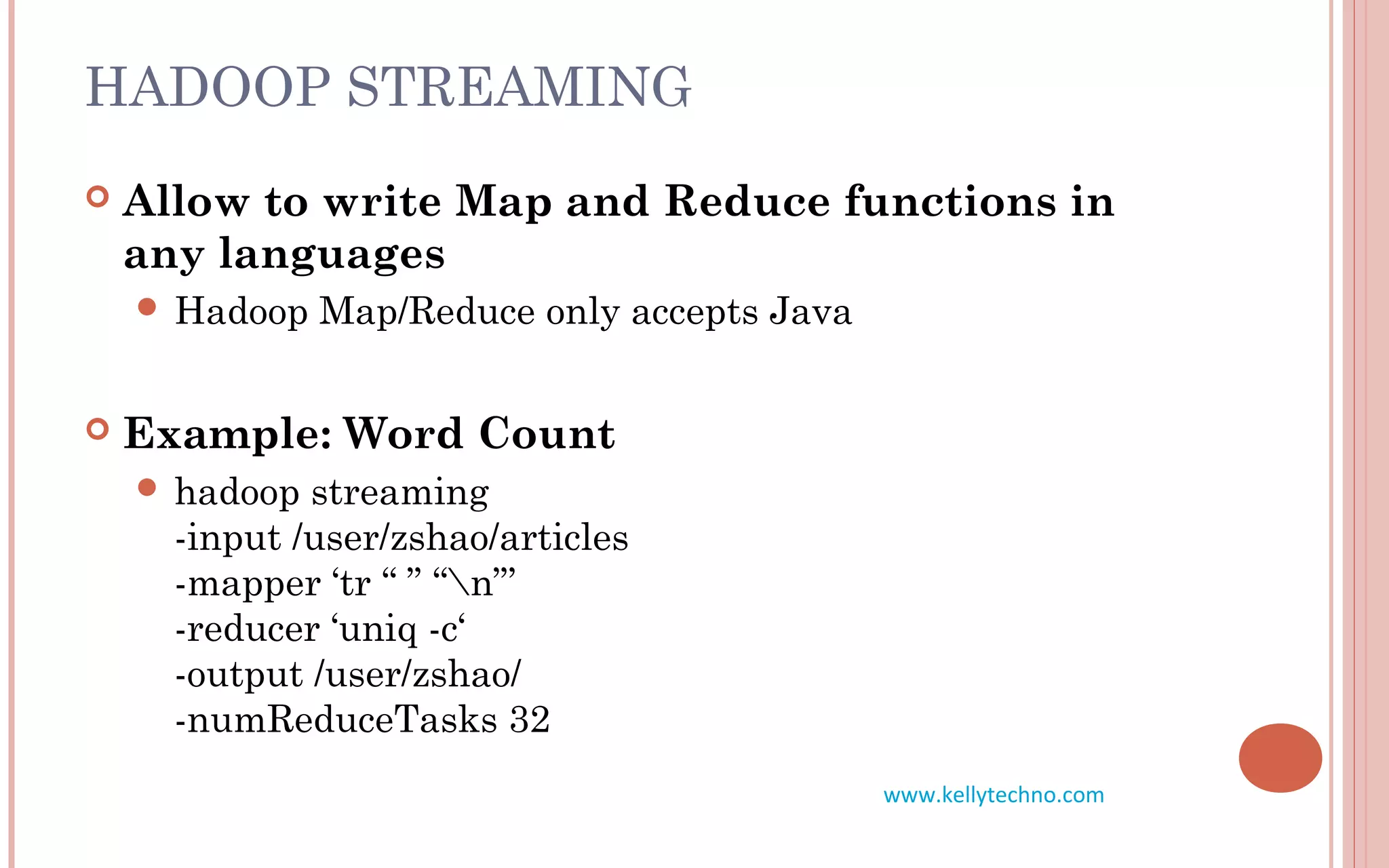
HADOOP STREAMING
 Allow to write Map and Reduce functions in
any languages
 Hadoop Map/Reduce only accepts Java
 Example: Word Count
 hadoop streaming
-input /user/zshao/articles
-mapper ‘tr “ ” “n”’
-reducer ‘uniq -c‘
-output /user/zshao/
-numReduceTasks 32
www.kellytechno.com
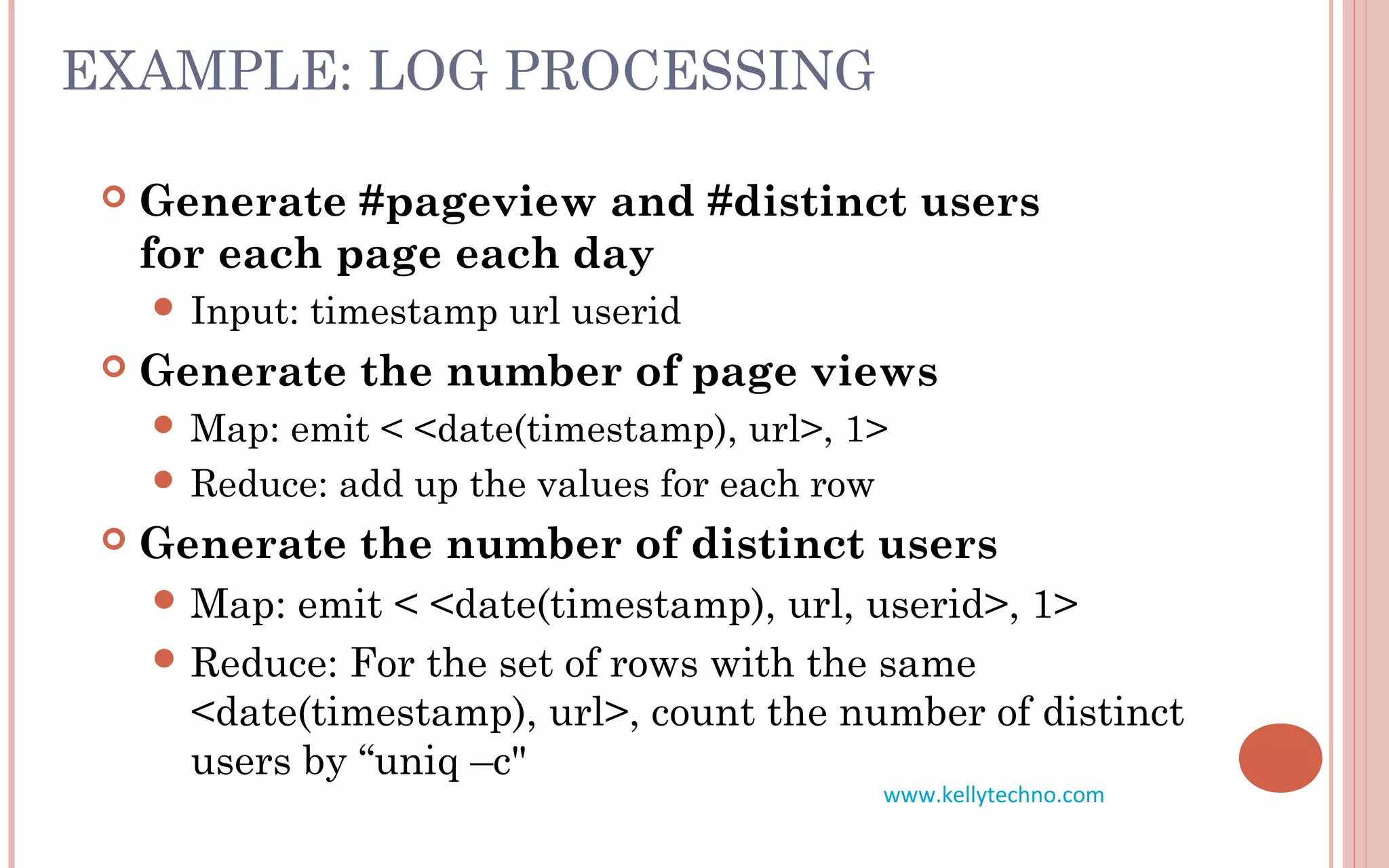
EXAMPLE: LOG PROCESSING
 Generate #pageview and #distinct users
for each page each day
 Input: timestamp url userid
 Generate the number of page views
 Map: emit < <date(timestamp), url>, 1>
 Reduce: add up the values for each row
 Generate the number of distinct users
 Map: emit < <date(timestamp), url, userid>, 1>
 Reduce: For the set of rows with the same
<date(timestamp), url>, count the number of distinct
users by “uniq –c"
www.kellytechno.com
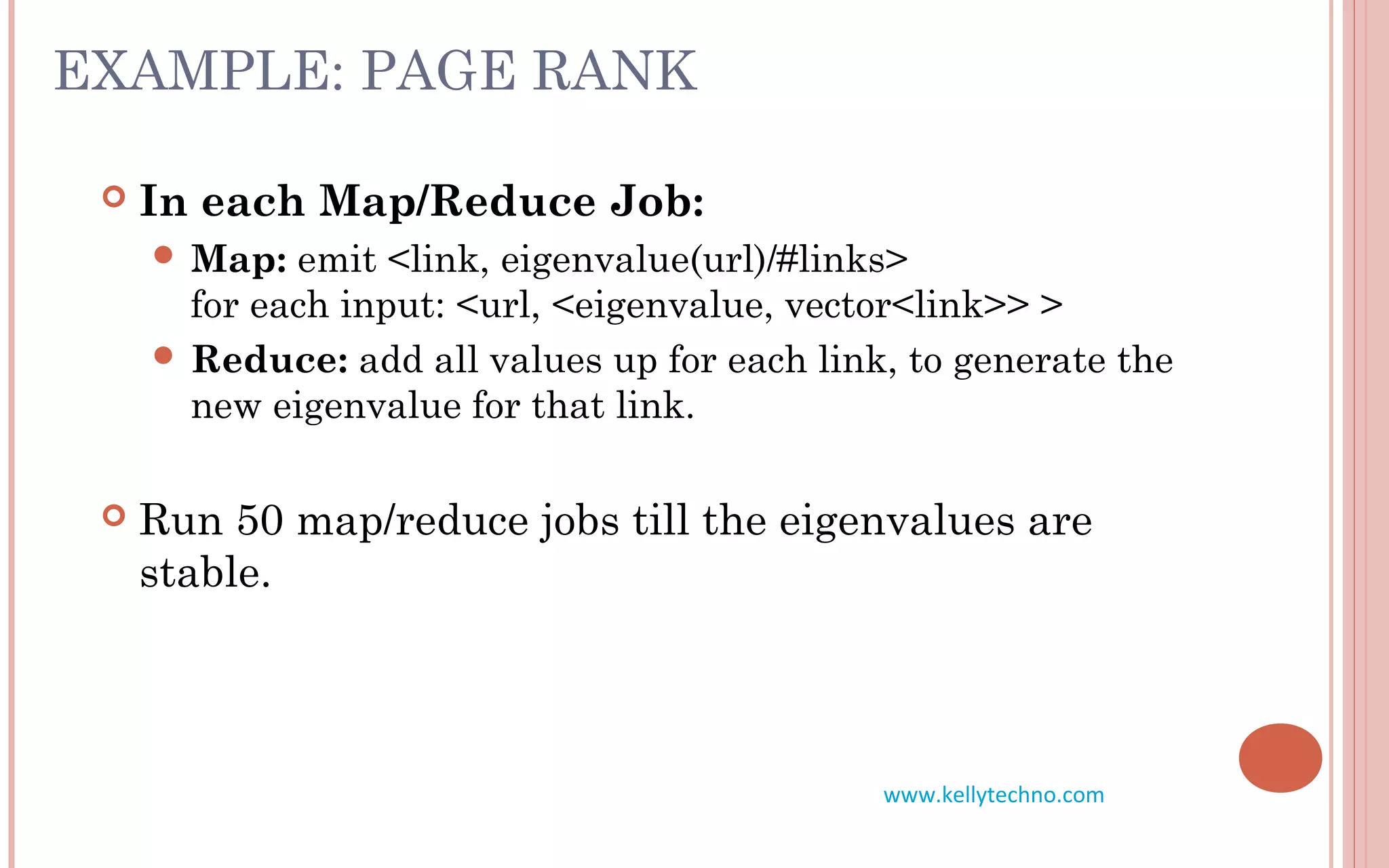
EXAMPLE: PAGE RANK
 In each Map/Reduce Job:
 Map: emit <link, eigenvalue(url)/#links>
for each input: <url, <eigenvalue, vector<link>> >
 Reduce: add all values up for each link, to generate the
new eigenvalue for that link.
 Run 50 map/reduce jobs till the eigenvalues are
stable.
www.kellytechno.com
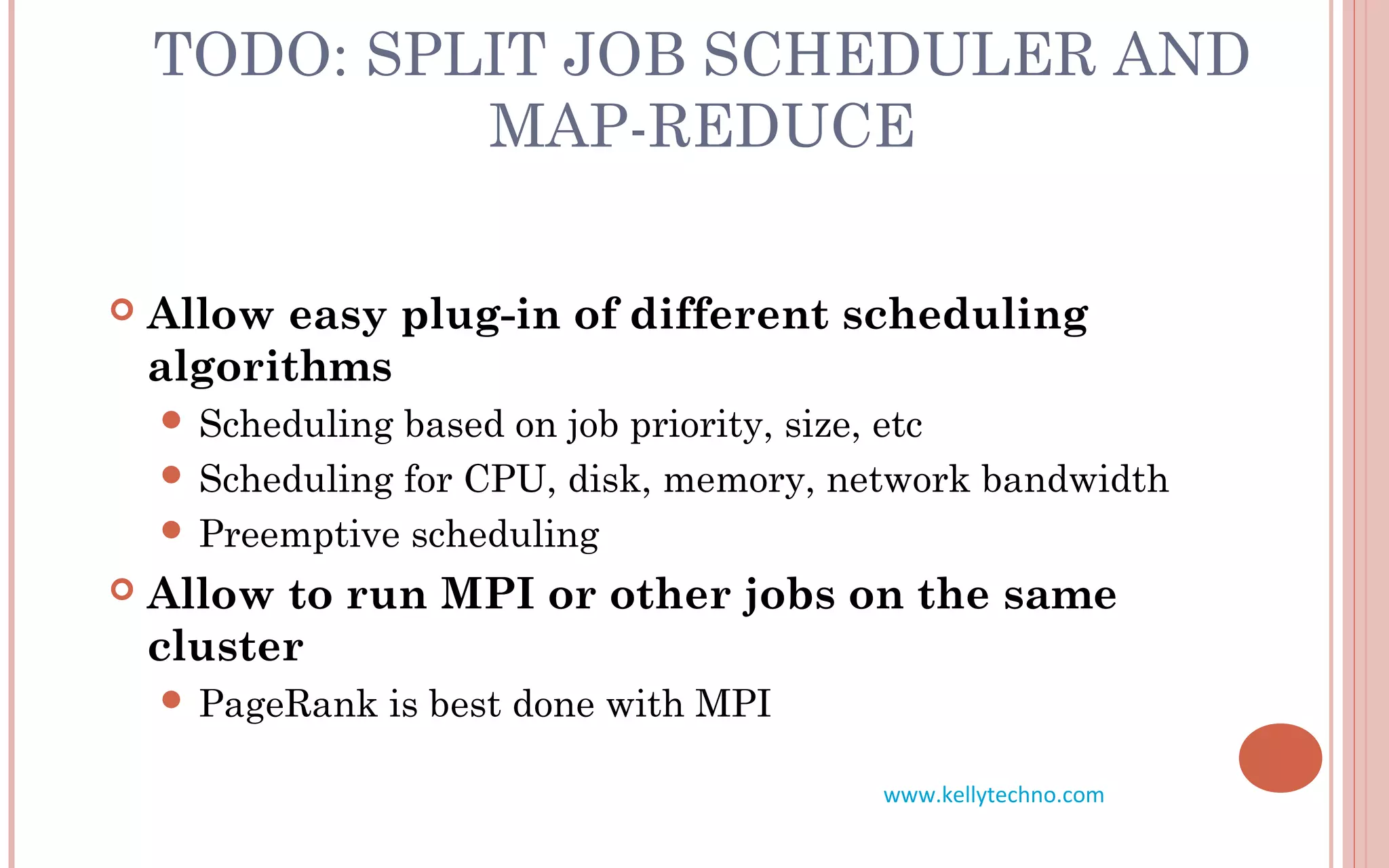
TODO: SPLIT JOB SCHEDULER AND
MAP-REDUCE
 Allow easy plug-in of different scheduling
algorithms
 Scheduling based on job priority, size, etc
 Scheduling for CPU, disk, memory, network bandwidth
 Preemptive scheduling
 Allow to run MPI or other jobs on the same
cluster
 PageRank is best done with MPI
www.kellytechno.com
Sender Receiver
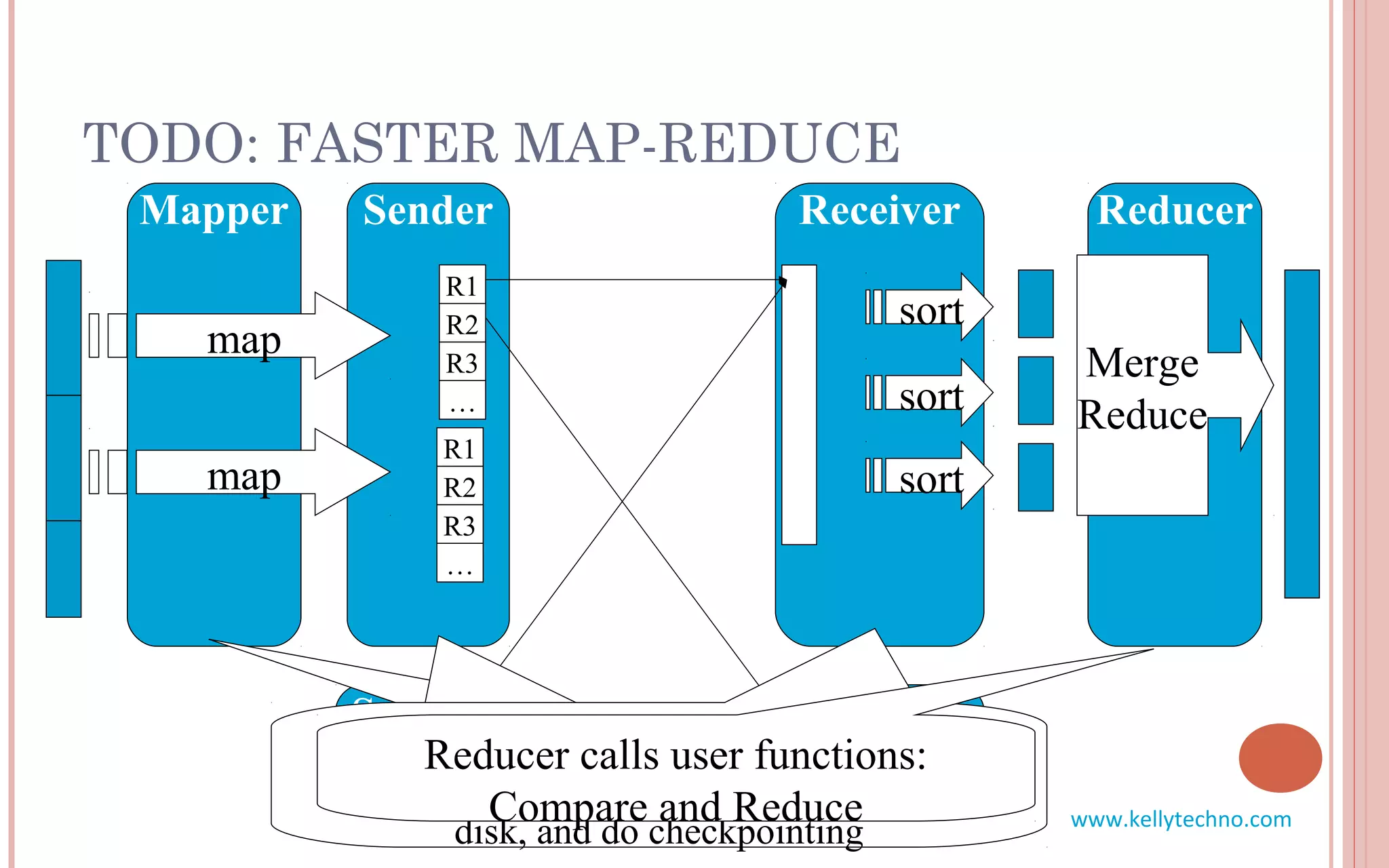
TODO: FASTER MAP-REDUCE
Mapper Receiver
sort
Sender
R1
R2
R3
…
R1
R2
R3
…
sort
Reducer
sort
Merge
Reduce
map
map
Mapper calls user functions: Map
and Partition
Sender does flow controlReceiver merge N flows into 1, call user
function Compare to sort, dump buffer to
disk, and do checkpointing
Reducer calls user functions:
Compare and Reduce www.kellytechno.com
Hive - SQL on top of Hadoop
www.kellytechno.com
MAP-REDUCE AND SQL
Map-Reduce is scalable
SQL has a huge user base
SQL is easy to code
Solution: Combine SQL and Map-
Reduce
Hive on top of Hadoop (open source)
Aster Data (proprietary)
Green Plum (proprietary)
www.kellytechno.com
HIVE
A database/data warehouse on top of
Hadoop
Rich data types (structs, lists and maps)
Efficient implementations of SQL filters, joins
and group-by’s on top of map reduce
Allow users to access Hive data
without using Hive
Link:
 http://svn.apache.org/repos/asf/hadoop/hive/trunk/
www.kellytechno.com
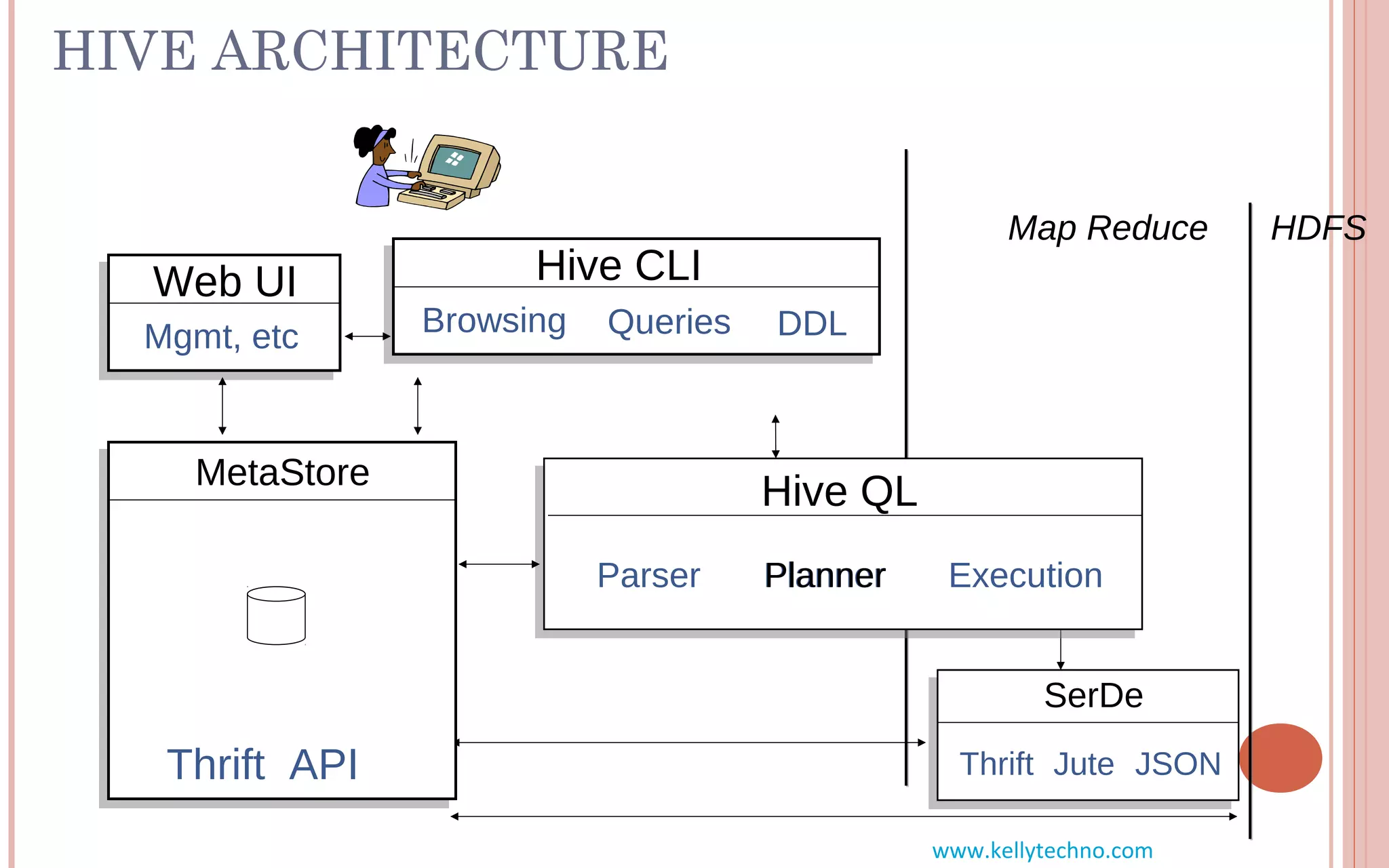
HIVE ARCHITECTURE
HDFS
Hive CLI
DDLQueriesBrowsing
Map Reduce
SerDe
Thrift Jute JSONThrift API
MetaStore
Web UI
Mgmt, etc
Hive QL
Planner ExecutionParser Planner
www.kellytechno.com
HIVE QL – JOIN
• SQL:
INSERT INTO TABLE pv_users
SELECT pv.pageid, u.age
FROM page_view pv JOIN user u ON (pv.userid = u.userid);
page
id
useri
d
time
1 111 9:08:0
1
2 111 9:08:1
3
1 222 9:08:1
4
user
id
age gender
111 25 female
222 32 male
page
id
age
1 25
2 25
1 32
X =
page_view
user
pv_users
www.kellytechno.com
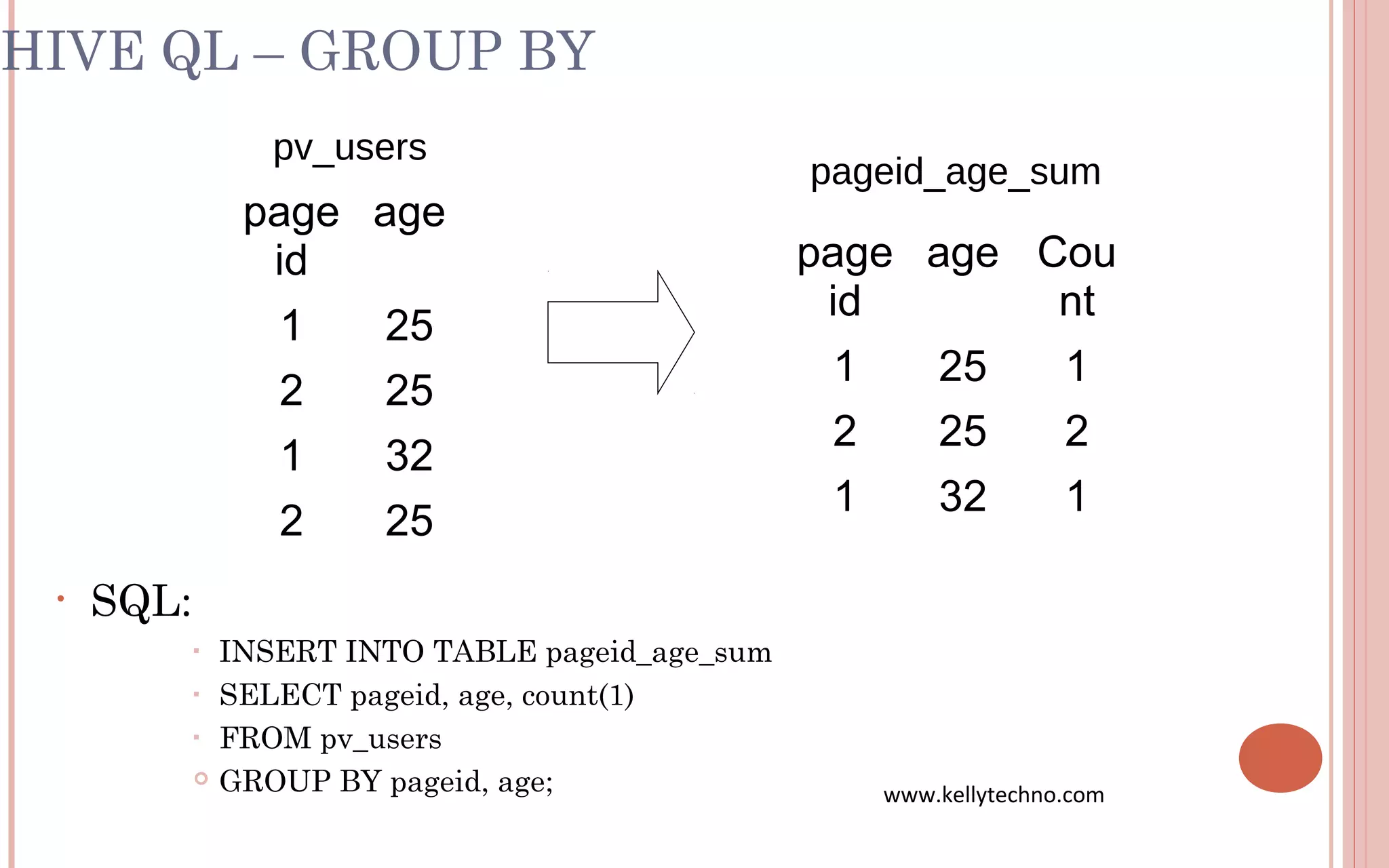
HIVE QL – GROUP BY
• SQL:
▪ INSERT INTO TABLE pageid_age_sum
▪ SELECT pageid, age, count(1)
▪ FROM pv_users
 GROUP BY pageid, age;
page
id
age
1 25
2 25
1 32
2 25
pv_users
page
id
age Cou
nt
1 25 1
2 25 2
1 32 1
pageid_age_sum
www.kellytechno.com
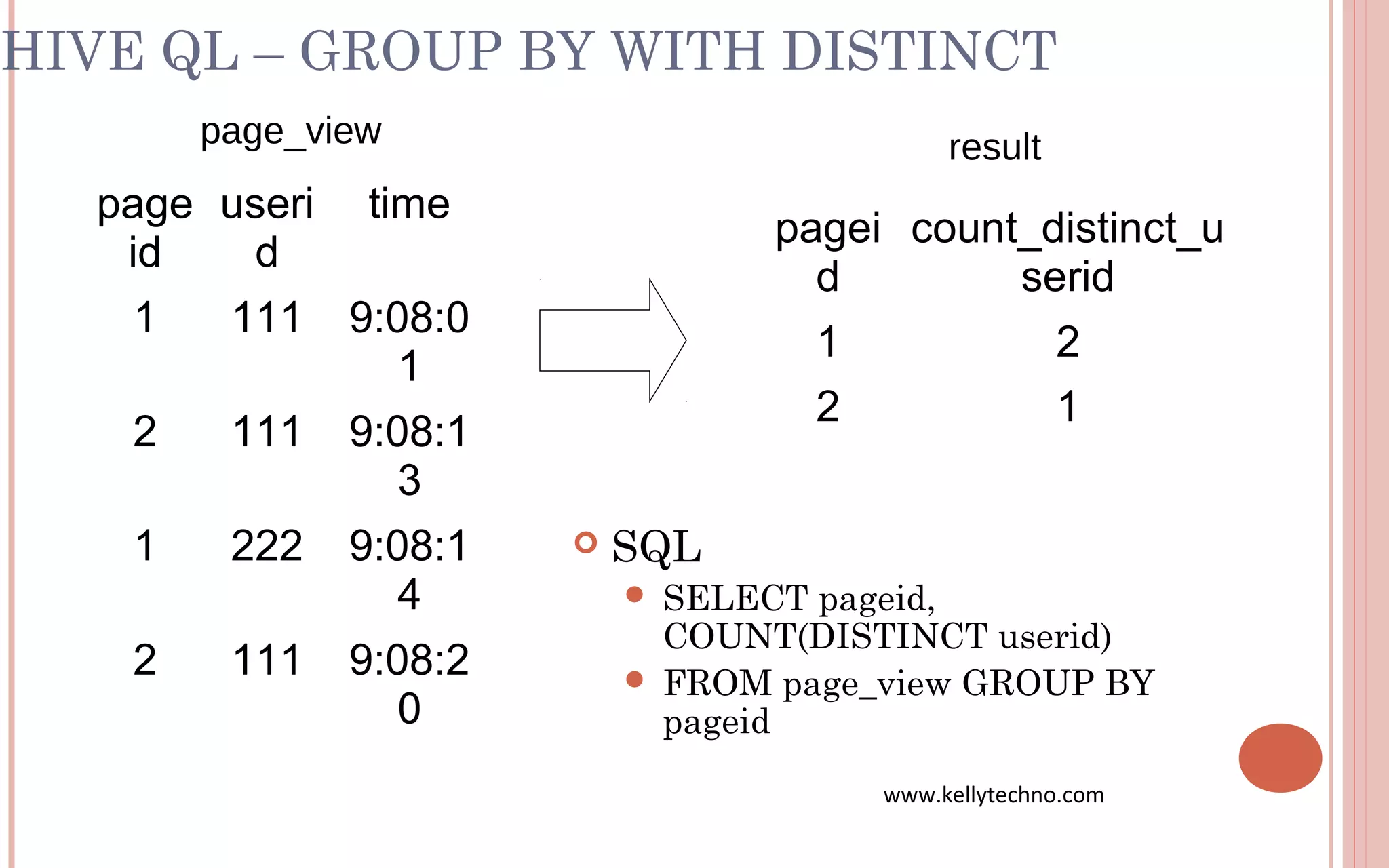
HIVE QL – GROUP BY WITH DISTINCT
 SQL
 SELECT pageid,
COUNT(DISTINCT userid)
 FROM page_view GROUP BY
pageid
page
id
useri
d
time
1 111 9:08:0
1
2 111 9:08:1
3
1 222 9:08:1
4
2 111 9:08:2
0
page_view
pagei
d
count_distinct_u
serid
1 2
2 1
result
www.kellytechno.com
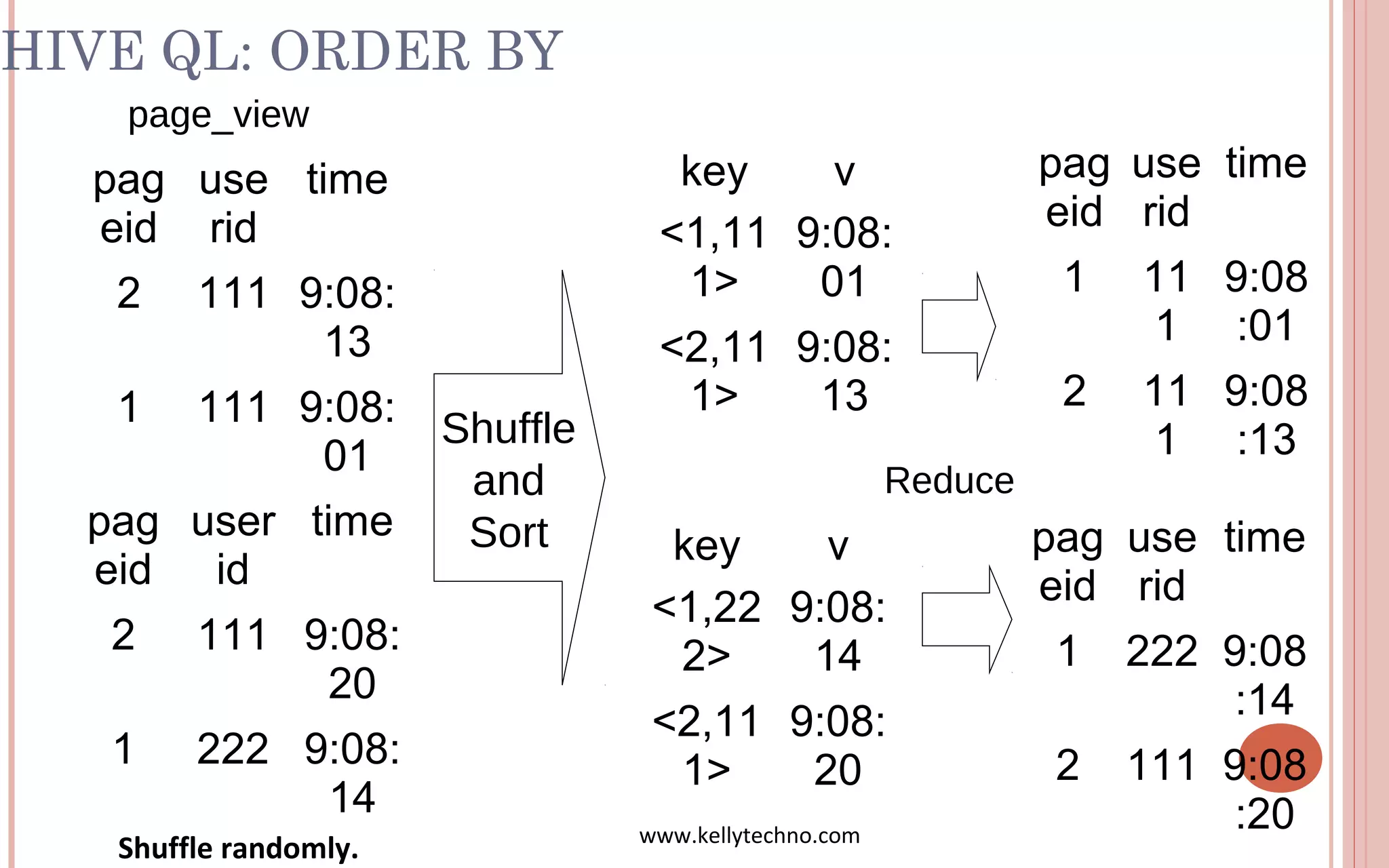
HIVE QL: ORDER BY
page_view
Shuffle
and
Sort
Reduce
pag
eid
use
rid
time
2 111 9:08:
13
1 111 9:08:
01
pag
eid
user
id
time
2 111 9:08:
20
1 222 9:08:
14
key v
<1,11
1>
9:08:
01
<2,11
1>
9:08:
13
key v
<1,22
2>
9:08:
14
<2,11
1>
9:08:
20
pag
eid
use
rid
time
1 11
1
9:08
:01
2 11
1
9:08
:13
pag
eid
use
rid
time
1 222 9:08
:14
2 111 9:08
:20
Shuffle randomly. www.kellytechno.com
Hive Optimizations
Efficient Execution of SQL on top of
Map-Reduce
www.kellytechno.com
Machine 2
Machine 1
<k1, v1>
<k2, v2>
<k3, v3>
<k4, v4>
<k5, v5>
<k6, v6>
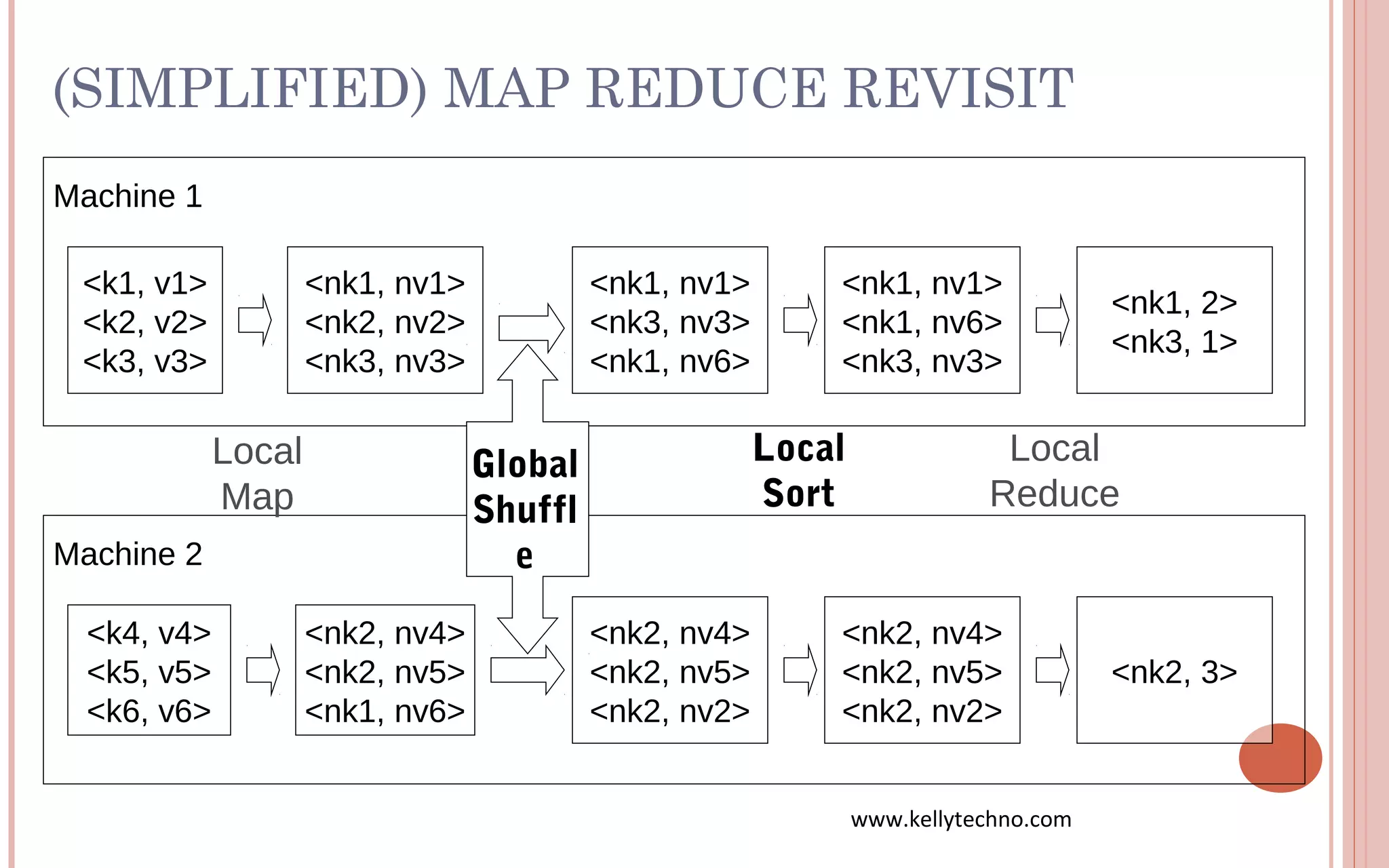
(SIMPLIFIED) MAP REDUCE REVISIT
<nk1, nv1>
<nk2, nv2>
<nk3, nv3>
<nk2, nv4>
<nk2, nv5>
<nk1, nv6>
Local
Map
<nk2, nv4>
<nk2, nv5>
<nk2, nv2>
<nk1, nv1>
<nk3, nv3>
<nk1, nv6>
Global
Shuffl
e
<nk1, nv1>
<nk1, nv6>
<nk3, nv3>
<nk2, nv4>
<nk2, nv5>
<nk2, nv2>
Local
Sort
<nk2, 3>
<nk1, 2>
<nk3, 1>
Local
Reduce
www.kellytechno.com
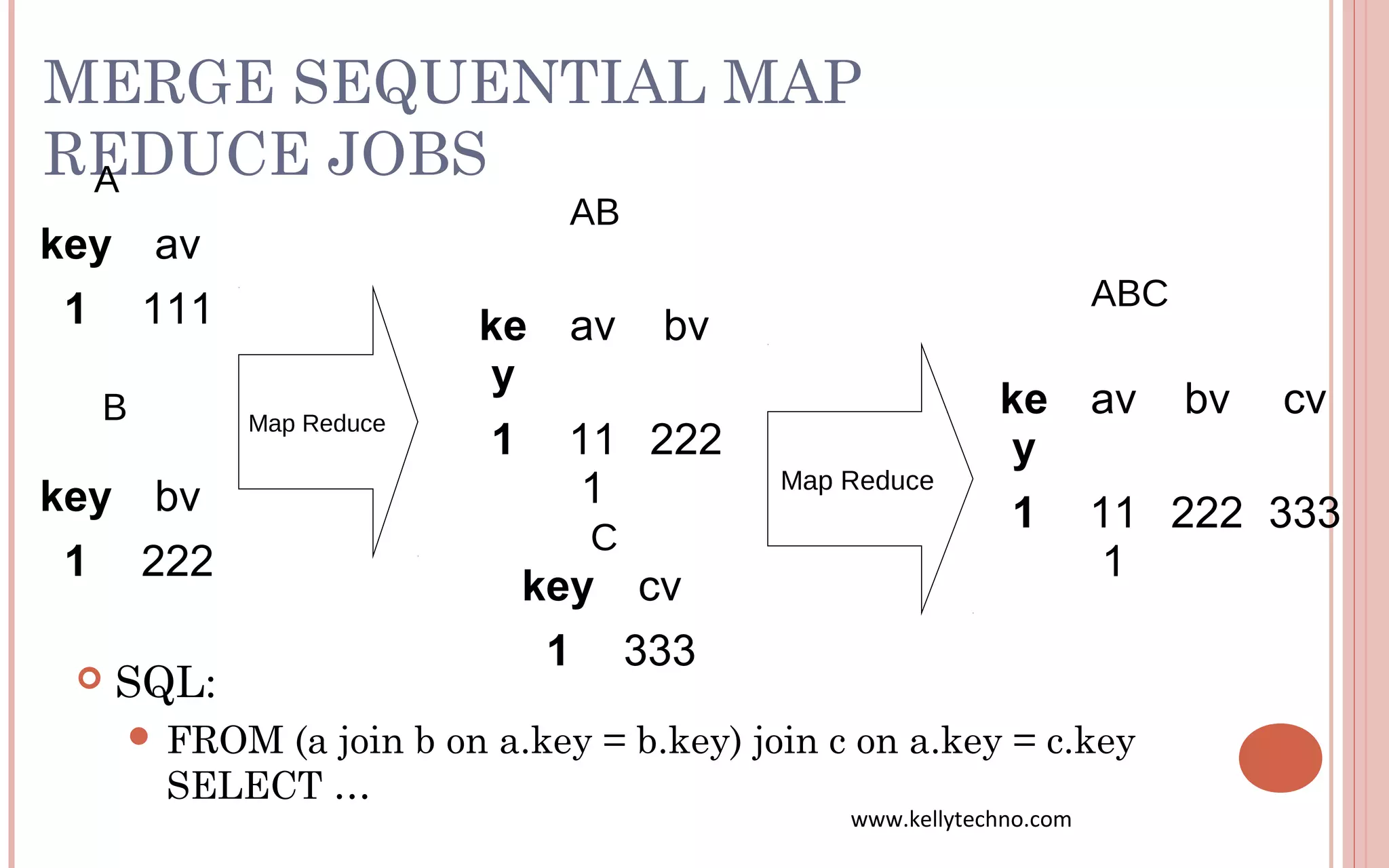
MERGE SEQUENTIAL MAP
REDUCE JOBS
 SQL:
 FROM (a join b on a.key = b.key) join c on a.key = c.key
SELECT …
ke
y
av bv
1 11
1
222
key av
1 111
A
Map Reduce
key bv
1 222
B
key cv
1 333
C
AB
Map Reduce
ke
y
av bv cv
1 11
1
222 333
ABC
www.kellytechno.com
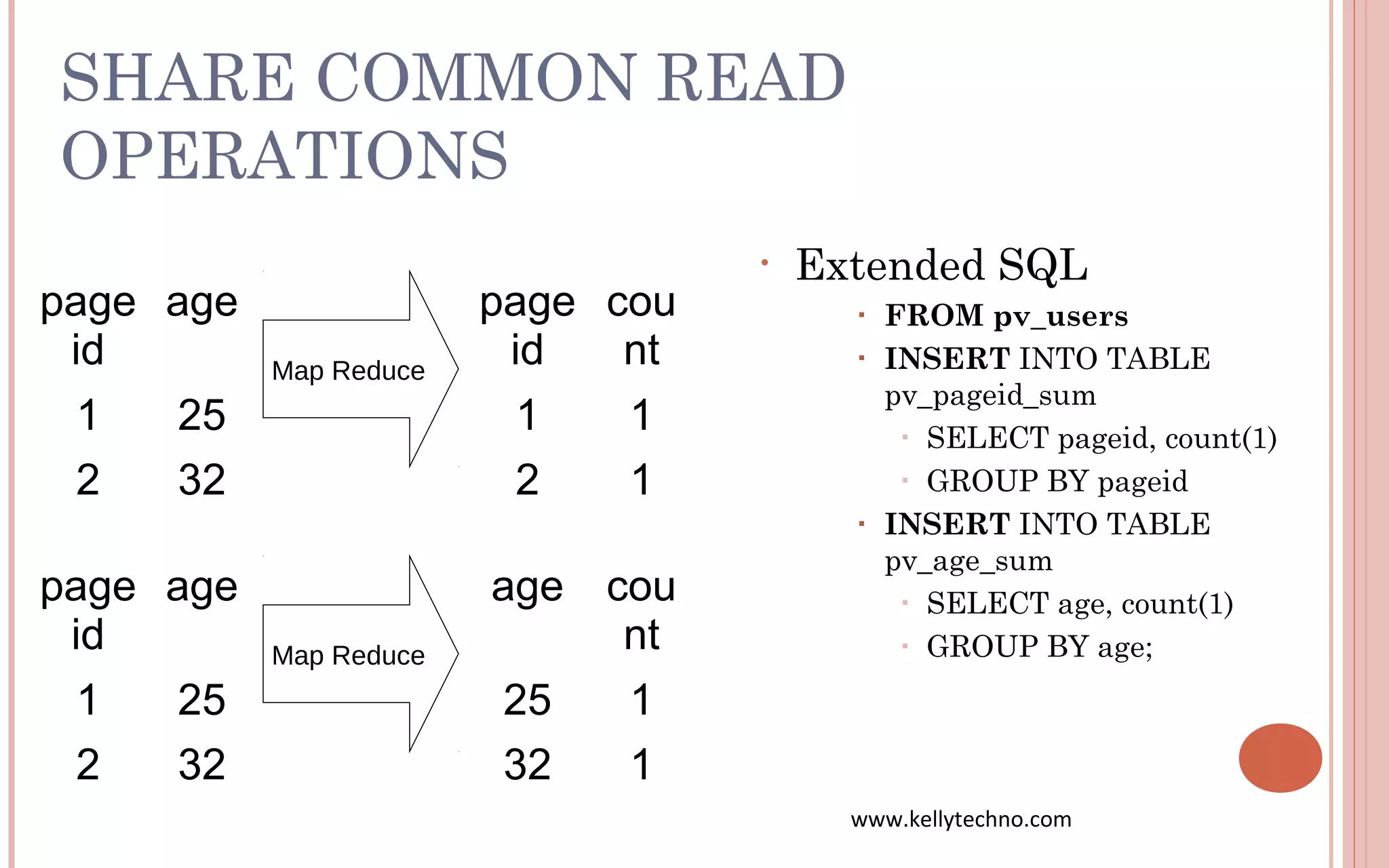
SHARE COMMON READ
OPERATIONS
• Extended SQL
▪ FROM pv_users
▪ INSERT INTO TABLE
pv_pageid_sum
▪ SELECT pageid, count(1)
▪ GROUP BY pageid
▪ INSERT INTO TABLE
pv_age_sum
▪ SELECT age, count(1)
▪ GROUP BY age;
page
id
age
1 25
2 32
Map Reduce
page
id
cou
nt
1 1
2 1
page
id
age
1 25
2 32
Map Reduce
age cou
nt
25 1
32 1
www.kellytechno.com
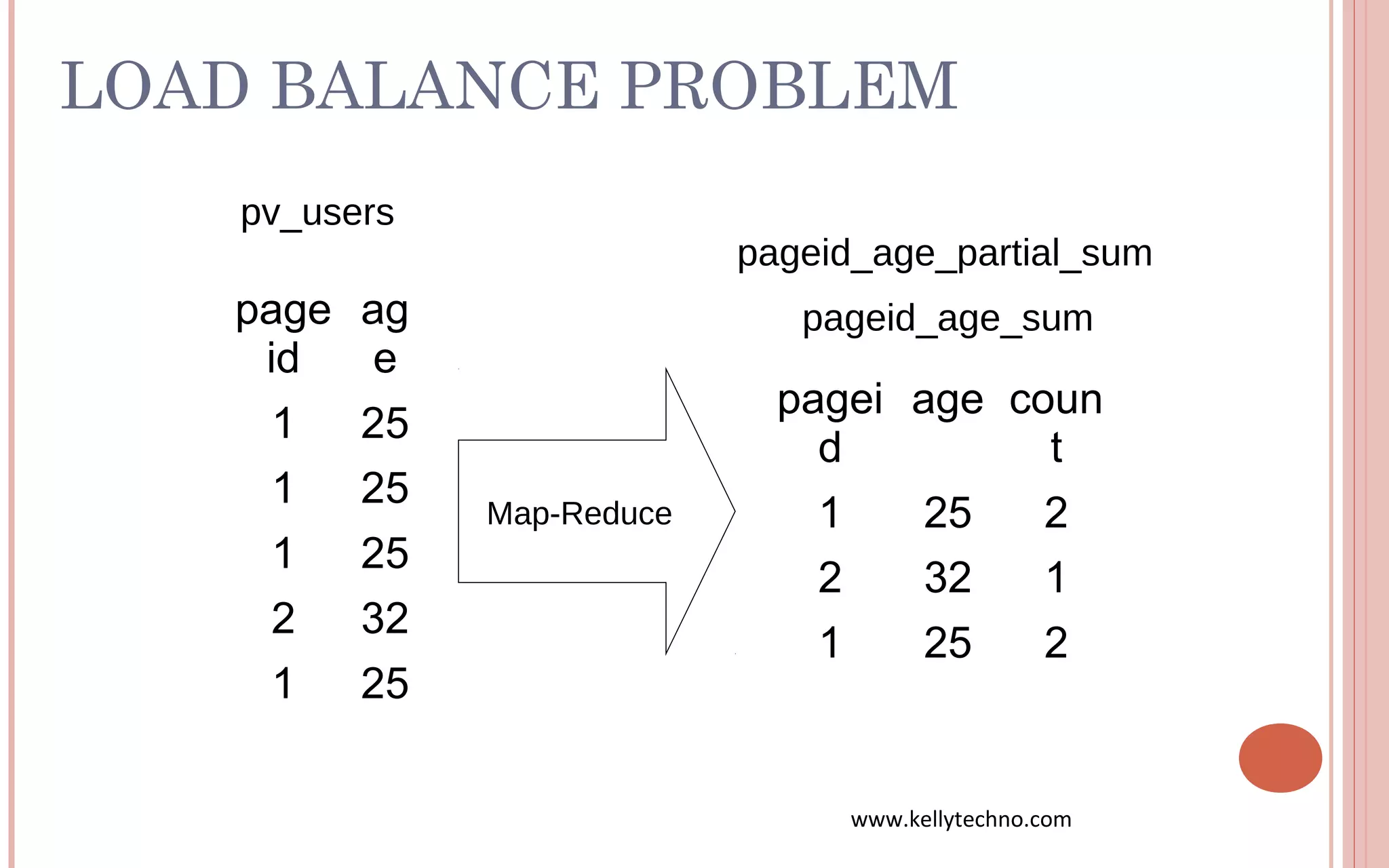
LOAD BALANCE PROBLEM
page
id
ag
e
1 25
1 25
1 25
2 32
1 25
pv_users
pageid_age_sum
Map-Reduce
pagei
d
age coun
t
1 25 2
2 32 1
1 25 2
pageid_age_partial_sum
www.kellytechno.com
Machine 2
Machine 1
<k1, v1>
<k2, v2>
<k3, v3>
<k4, v4>
<k5, v5>
<k6, v6>
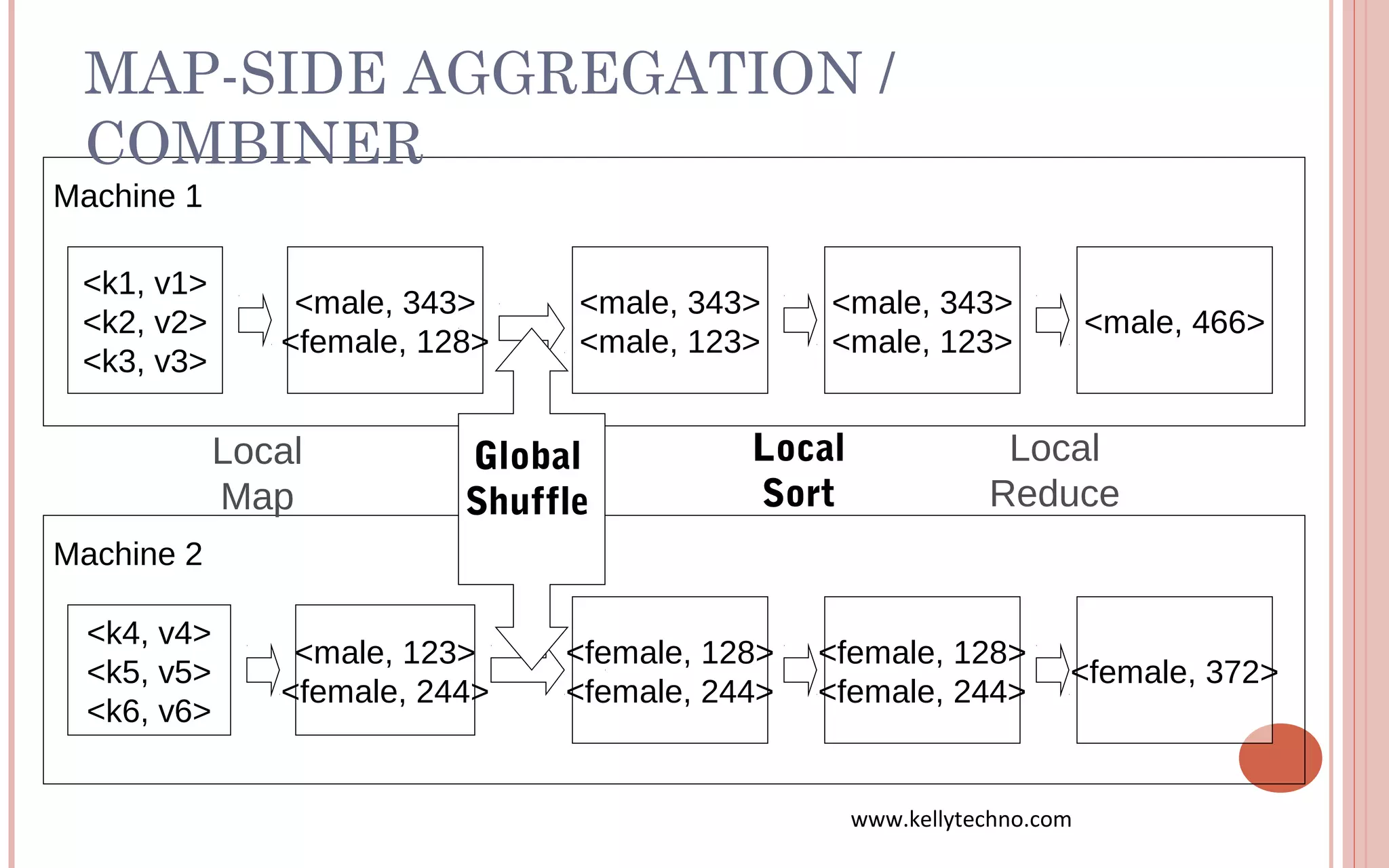
MAP-SIDE AGGREGATION /
COMBINER
<male, 343>
<female, 128>
<male, 123>
<female, 244>
Local
Map
<female, 128>
<female, 244>
<male, 343>
<male, 123>
Global
Shuffle
<male, 343>
<male, 123>
<female, 128>
<female, 244>
Local
Sort
<female, 372>
<male, 466>
Local
Reduce
www.kellytechno.com
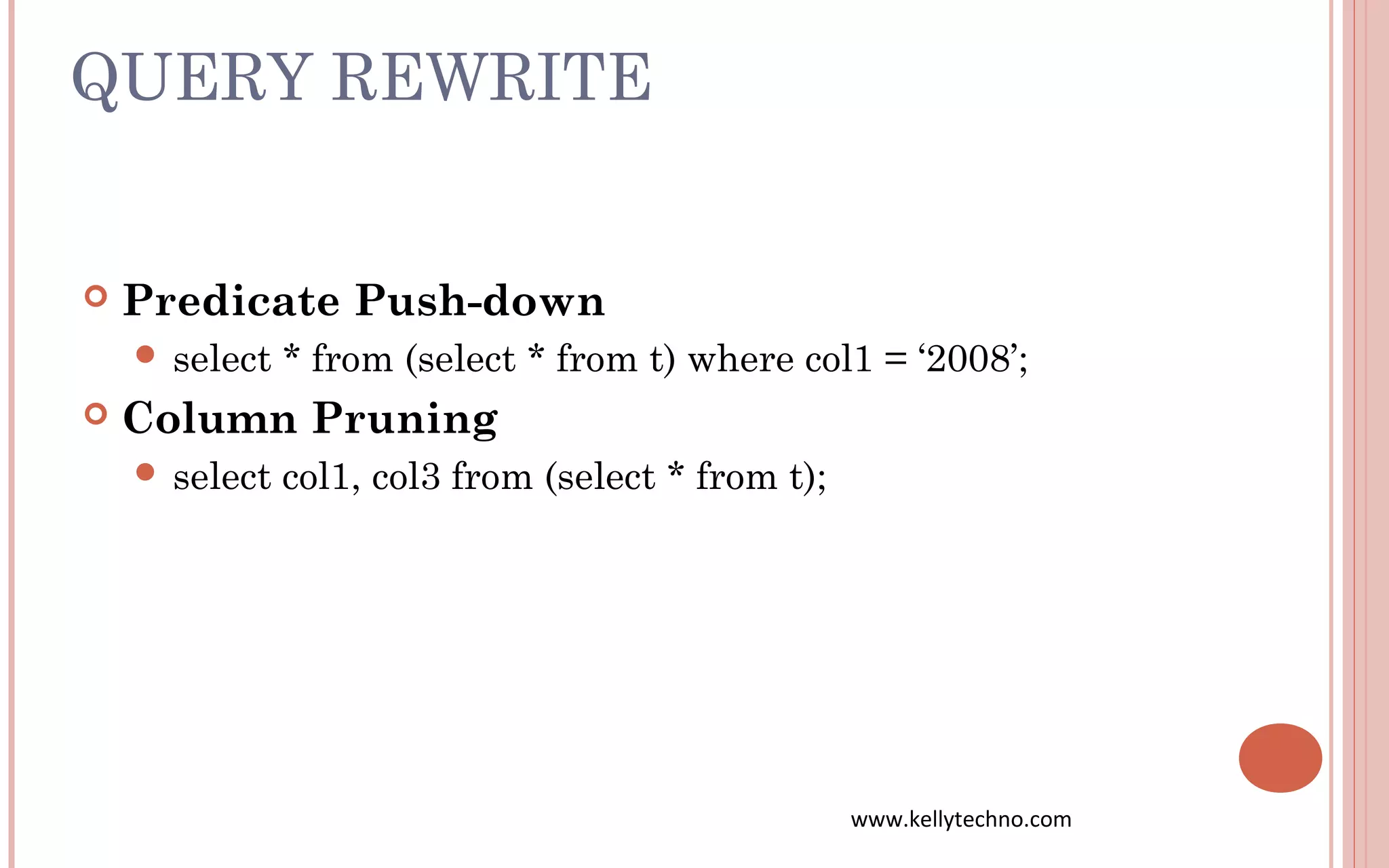
QUERY REWRITE
 Predicate Push-down
 select * from (select * from t) where col1 = ‘2008’;
 Column Pruning
 select col1, col3 from (select * from t);
www.kellytechno.com
TODO: COLUMN-BASED STORAGE
AND MAP-SIDE JOIN
url page quality IP
http://a.com/ 90 65.1.2.3
http://b.com/ 20 68.9.0.81
http://c.com/ 68 11.3.85.1
url clicked viewed
http://a.com/ 12 145
http://b.com/ 45 383
http://c.com/ 23 67
www.kellytechno.com
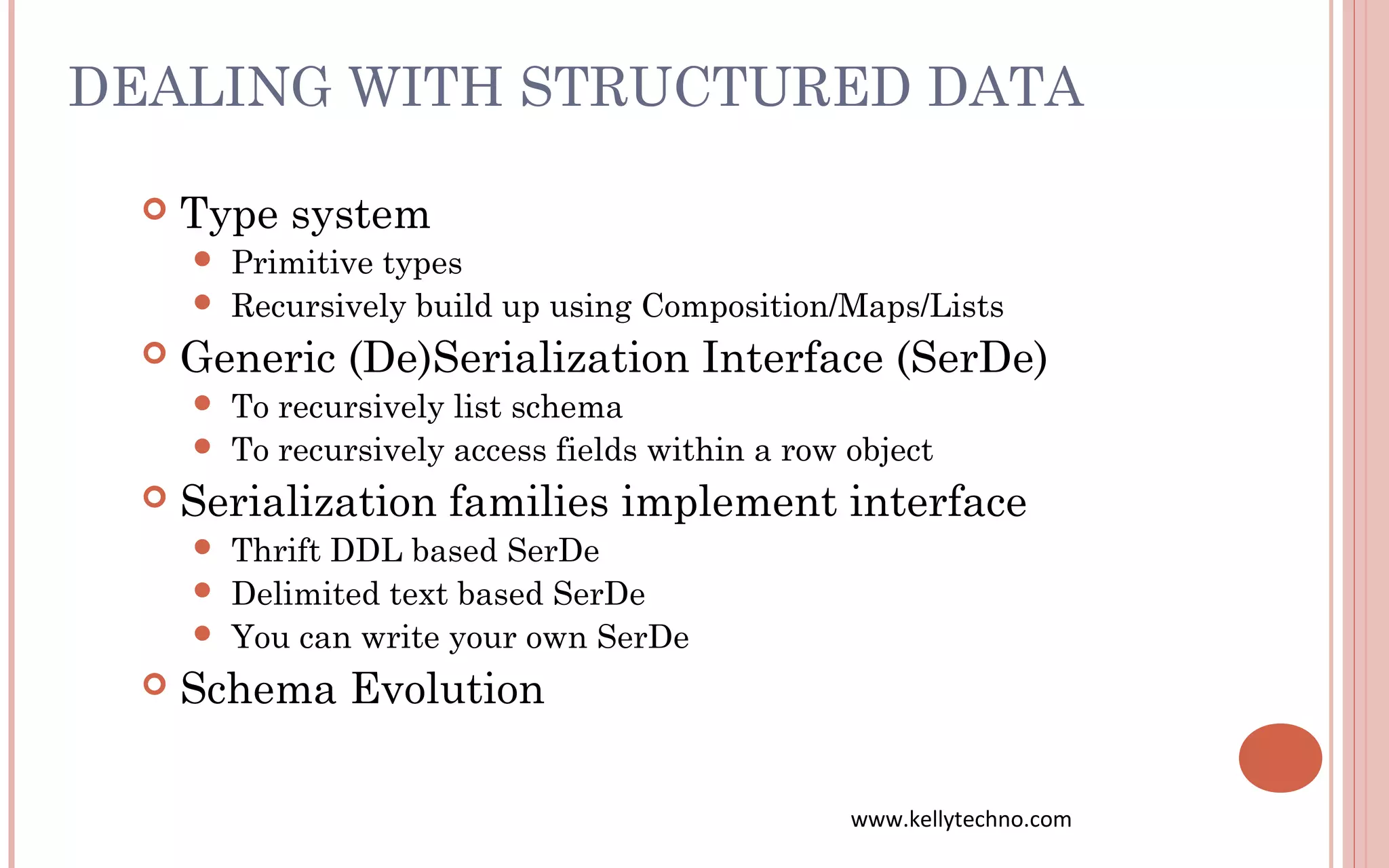
DEALING WITH STRUCTURED DATA
 Type system
 Primitive types
 Recursively build up using Composition/Maps/Lists
 Generic (De)Serialization Interface (SerDe)
 To recursively list schema
 To recursively access fields within a row object
 Serialization families implement interface
 Thrift DDL based SerDe
 Delimited text based SerDe
 You can write your own SerDe
 Schema Evolution
www.kellytechno.com
HIVE CLI
 DDL:
 create table/drop table/rename table
 alter table add column
 Browsing:
 show tables
 describe table
 cat table
 Loading Data
 Queries
www.kellytechno.com
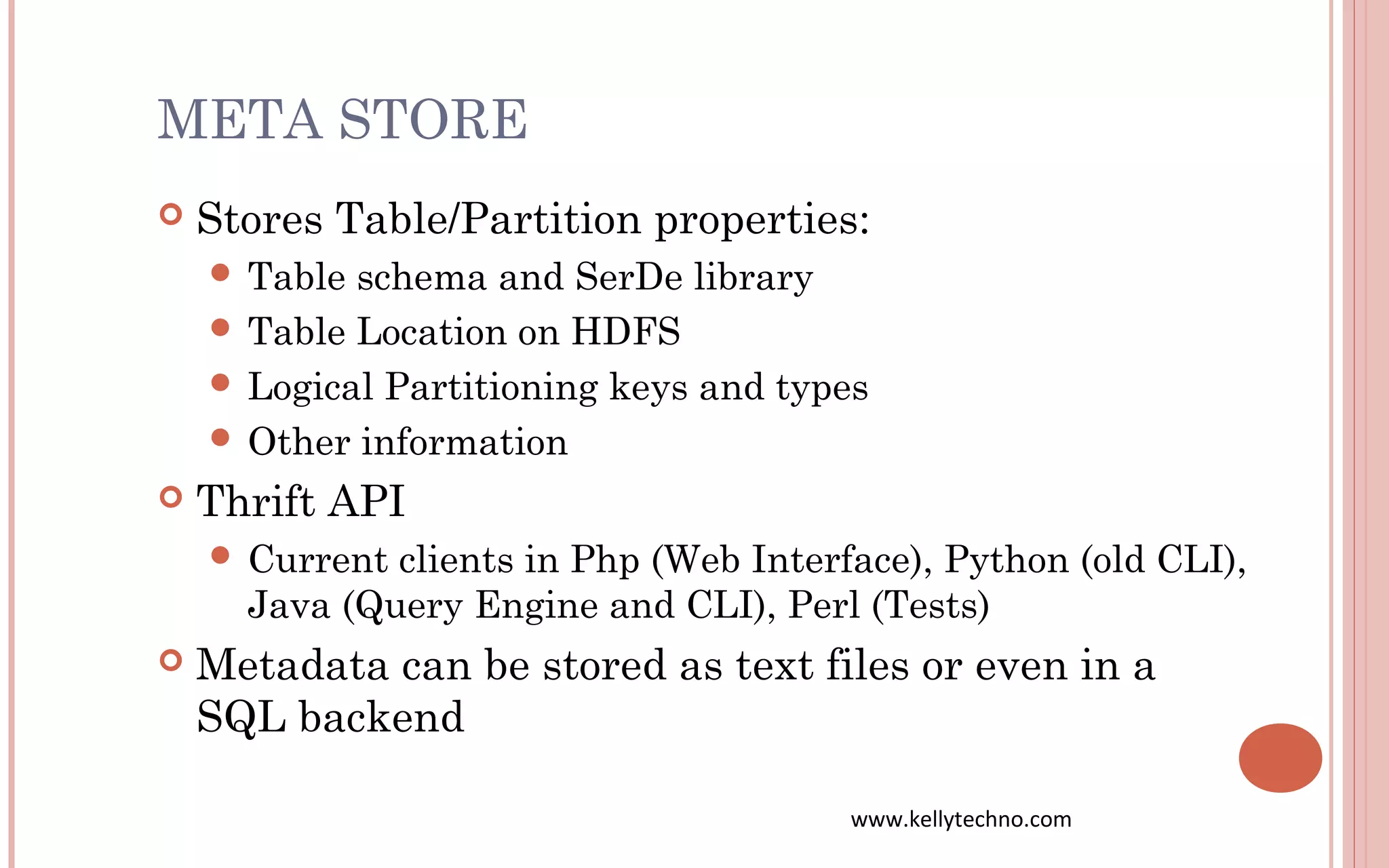
META STORE
 Stores Table/Partition properties:
 Table schema and SerDe library
 Table Location on HDFS
 Logical Partitioning keys and types
 Other information
 Thrift API
 Current clients in Php (Web Interface), Python (old CLI),
Java (Query Engine and CLI), Perl (Tests)
 Metadata can be stored as text files or even in a
SQL backend
www.kellytechno.com
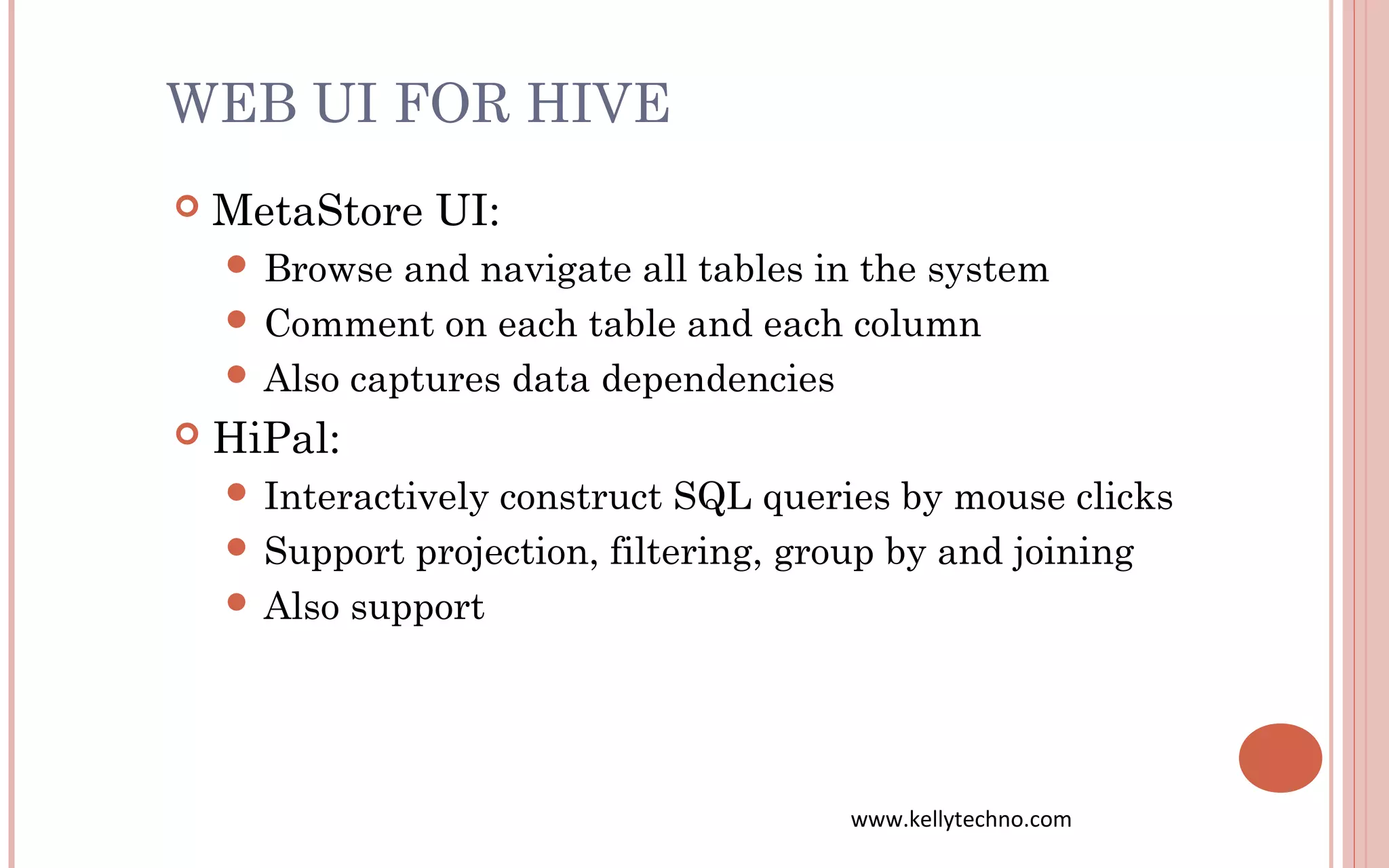
WEB UI FOR HIVE
 MetaStore UI:
 Browse and navigate all tables in the system
 Comment on each table and each column
 Also captures data dependencies
 HiPal:
 Interactively construct SQL queries by mouse clicks
 Support projection, filtering, group by and joining
 Also support
www.kellytechno.com
HIVE QUERY LANGUAGE
 Philosophy
 SQL
 Map-Reduce with custom scripts (hadoop streaming)
 Query Operators
 Projections
 Equi-joins
 Group by
 Sampling
 Order By
www.kellytechno.com
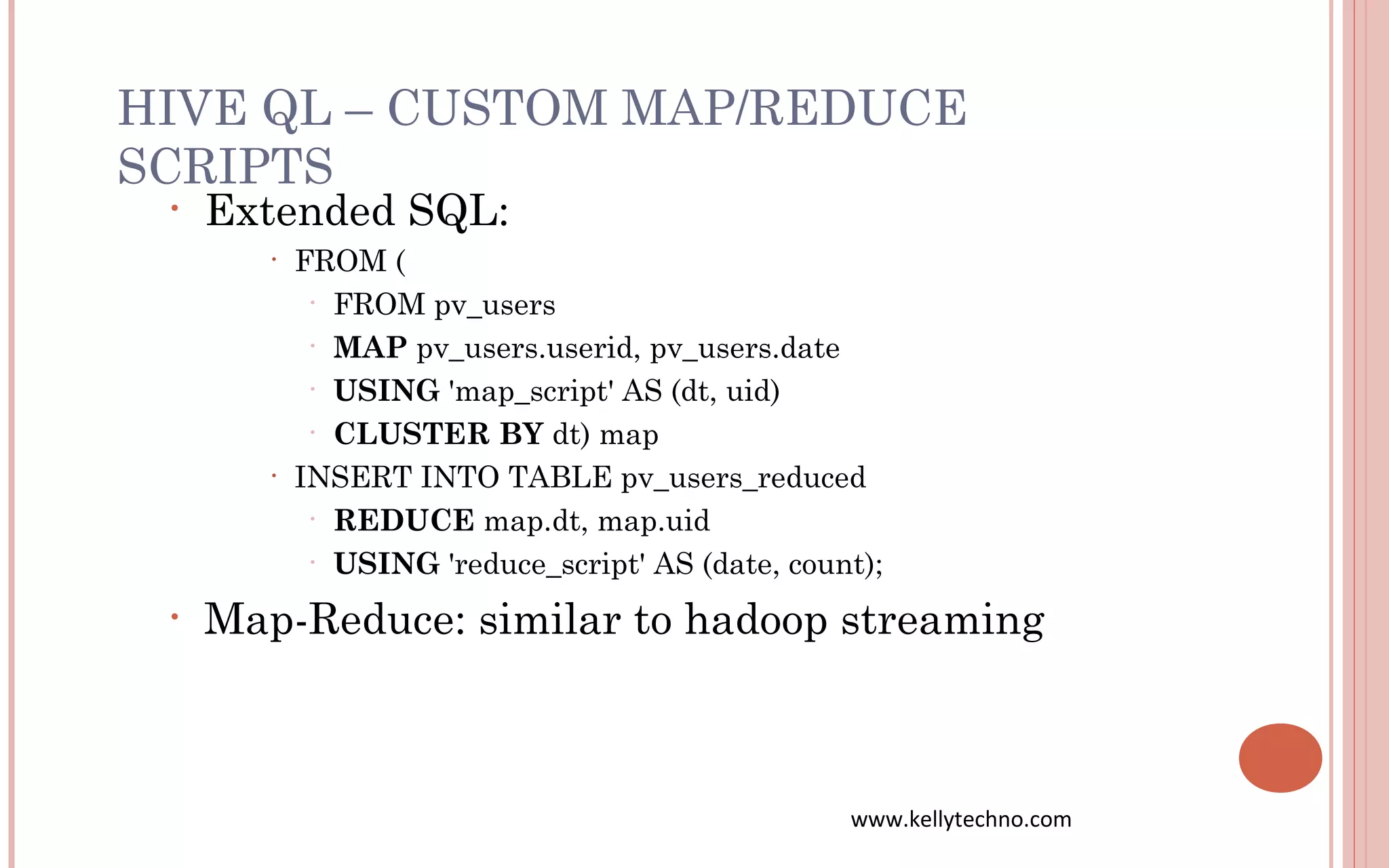
HIVE QL – CUSTOM MAP/REDUCE
SCRIPTS
• Extended SQL:
• FROM (
• FROM pv_users
• MAP pv_users.userid, pv_users.date
• USING 'map_script' AS (dt, uid)
• CLUSTER BY dt) map
• INSERT INTO TABLE pv_users_reduced
• REDUCE map.dt, map.uid
• USING 'reduce_script' AS (date, count);
• Map-Reduce: similar to hadoop streaming
www.kellytechno.com
Hadoop institutes in hyderabad

Hadoop institutes in hyderabad

  • 1.
  • 2.
    DATA SCALABILITY PROBLEMS Search Engine  10KB / doc * 20B docs = 200TB  Reindex every 30 days: 200TB/30days = 6 TB/day  Log Processing / Data Warehousing  0.5KB/events * 3B pageview events/day = 1.5TB/day  100M users * 5 events * 100 feed/event * 0.1KB/feed = 5TB/day  Multipliers: 3 copies of data, 3-10 passes of raw data  Processing Speed (Single Machine)  2-20MB/second * 100K seconds/day = 0.2-2 TB/day www.kellytechno.com
  • 3.
    GOOGLE’S SOLUTION  GoogleFile System – SOSP’2003  Map-Reduce – OSDI’2004  Sawzall – Scientific Programming Journal’2005  Big Table – OSDI’2006  Chubby – OSDI’2006 www.kellytechno.com
  • 4.
    OPEN SOURCE WORLD’SSOLUTION  Google File System – Hadoop Distributed FS  Map-Reduce – Hadoop Map-Reduce  Sawzall – Pig, Hive, JAQL  Big Table – Hadoop HBase, Cassandra  Chubby – Zookeeper www.kellytechno.com
  • 5.
    SIMPLIFIED SEARCH ENGINE ARCHITECTURE SpiderRuntime Batch Processing System on top of Hadoop SE Web Server Search Log Storage Internet www.kellytechno.com
  • 6.
    SIMPLIFIED DATA WAREHOUSE ARCHITECTURE Database BatchProcessing System on top fo Hadoop Web ServerView/Click/Events Log Storage Business Intelligence Domain Knowledge www.kellytechno.com
  • 7.
    HADOOP HISTORY  Jan2006 – Doug Cutting joins Yahoo  Feb 2006 – Hadoop splits out of Nutch and Yahoo starts using it.  Dec 2006 – Yahoo creating 100-node Webmap with Hadoop  Apr 2007 – Yahoo on 1000-node cluster  Jan 2008 – Hadoop made a top-level Apache project  Dec 2007 – Yahoo creating 1000-node Webmap with Hadoop  Sep 2008 – Hive added to Hadoop as a contrib project www.kellytechno.com
  • 8.
    HADOOP INTRODUCTION Open SourceApache Project http://hadoop.apache.org/  Book: http://oreilly.com/catalog/9780596521998/index.html Written in Java Does work with other languages Runs on Linux, Windows and more Commodity hardware with high failure rate www.kellytechno.com
  • 9.
    CURRENT STATUS OFHADOOP Largest Cluster 2000 nodes (8 cores, 4TB disk) Used by 40+ companies / universities over the world Yahoo, Facebook, etc Cloud Computing Donation from Google and IBM Startup focusing on providing services for hadoop Cloudera www.kellytechno.com
  • 10.
    HADOOP COMPONENTS Hadoop DistributedFile System (HDFS) Hadoop Map-Reduce Contributes Hadoop Streaming Pig / JAQL / Hive HBase Hama / Mahout www.kellytechno.com
  • 11.
    Hadoop Distributed FileSystem www.kellytechno.com
  • 12.
    GOALS OF HDFS Very Large Distributed File System  10K nodes, 100 million files, 10 PB  Convenient Cluster Management  Load balancing  Node failures  Cluster expansion  Optimized for Batch Processing  Allow move computation to data  Maximize throughput www.kellytechno.com
  • 13.
  • 14.
    HDFS DETAILS  DataCoherency  Write-once-read-many access model  Client can only append to existing files  Files are broken up into blocks  Typically 128 MB block size  Each block replicated on multiple DataNodes  Intelligent Client  Client can find location of blocks  Client accesses data directly from DataNode www.kellytechno.com
  • 15.
  • 16.
    HDFS USER INTERFACE Java API  Command Line hadoop dfs -mkdir /foodir hadoop dfs -cat /foodir/myfile.txt hadoop dfs -rm /foodir myfile.txt hadoop dfsadmin -report hadoop dfsadmin -decommission datanodename  Web Interface http://host:port/dfshealth.jsp www.kellytechno.com
  • 17.
    MORE ABOUT HDFS http://hadoop.apache.org/core/docs/current/hdfs_desig n.html  Hadoop FileSystem API HDFS Local File System Kosmos File System (KFS) Amazon S3 File System www.kellytechno.com
  • 18.
    Hadoop Map-Reduce and HadoopStreaming www.kellytechno.com
  • 19.
    HADOOP MAP-REDUCE INTRODUCTION  Map/Reduceworks like a parallel Unix pipeline:  cat input | grep | sort | uniq -c | cat > output  Input | Map | Shuffle & Sort | Reduce | Output  Framework does inter-node communication  Failure recovery, consistency etc  Load balancing, scalability etc  Fits a lot of batch processing applications  Log processing  Web index building www.kellytechno.com
  • 20.
  • 21.
    Machine 2 Machine 1 <k1,v1> <k2, v2> <k3, v3> <k4, v4> <k5, v5> <k6, v6> (SIMPLIFIED) MAP REDUCE REVIEW <nk1, nv1> <nk2, nv2> <nk3, nv3> <nk2, nv4> <nk2, nv5> <nk1, nv6> Local Map <nk2, nv4> <nk2, nv5> <nk2, nv2> <nk1, nv1> <nk3, nv3> <nk1, nv6> Global Shuffle <nk1, nv1> <nk1, nv6> <nk3, nv3> <nk2, nv4> <nk2, nv5> <nk2, nv2> Local Sort <nk2, 3> <nk1, 2> <nk3, 1> Local Reduce www.kellytechno.com
  • 22.
  • 23.
  • 24.
    HADOOP STREAMING  Allowto write Map and Reduce functions in any languages  Hadoop Map/Reduce only accepts Java  Example: Word Count  hadoop streaming -input /user/zshao/articles -mapper ‘tr “ ” “n”’ -reducer ‘uniq -c‘ -output /user/zshao/ -numReduceTasks 32 www.kellytechno.com
  • 25.
    EXAMPLE: LOG PROCESSING Generate #pageview and #distinct users for each page each day  Input: timestamp url userid  Generate the number of page views  Map: emit < <date(timestamp), url>, 1>  Reduce: add up the values for each row  Generate the number of distinct users  Map: emit < <date(timestamp), url, userid>, 1>  Reduce: For the set of rows with the same <date(timestamp), url>, count the number of distinct users by “uniq –c" www.kellytechno.com
  • 26.
    EXAMPLE: PAGE RANK In each Map/Reduce Job:  Map: emit <link, eigenvalue(url)/#links> for each input: <url, <eigenvalue, vector<link>> >  Reduce: add all values up for each link, to generate the new eigenvalue for that link.  Run 50 map/reduce jobs till the eigenvalues are stable. www.kellytechno.com
  • 27.
    TODO: SPLIT JOBSCHEDULER AND MAP-REDUCE  Allow easy plug-in of different scheduling algorithms  Scheduling based on job priority, size, etc  Scheduling for CPU, disk, memory, network bandwidth  Preemptive scheduling  Allow to run MPI or other jobs on the same cluster  PageRank is best done with MPI www.kellytechno.com
  • 28.
    Sender Receiver TODO: FASTERMAP-REDUCE Mapper Receiver sort Sender R1 R2 R3 … R1 R2 R3 … sort Reducer sort Merge Reduce map map Mapper calls user functions: Map and Partition Sender does flow controlReceiver merge N flows into 1, call user function Compare to sort, dump buffer to disk, and do checkpointing Reducer calls user functions: Compare and Reduce www.kellytechno.com
  • 29.
    Hive - SQLon top of Hadoop www.kellytechno.com
  • 30.
    MAP-REDUCE AND SQL Map-Reduceis scalable SQL has a huge user base SQL is easy to code Solution: Combine SQL and Map- Reduce Hive on top of Hadoop (open source) Aster Data (proprietary) Green Plum (proprietary) www.kellytechno.com
  • 31.
    HIVE A database/data warehouseon top of Hadoop Rich data types (structs, lists and maps) Efficient implementations of SQL filters, joins and group-by’s on top of map reduce Allow users to access Hive data without using Hive Link:  http://svn.apache.org/repos/asf/hadoop/hive/trunk/ www.kellytechno.com
  • 32.
    HIVE ARCHITECTURE HDFS Hive CLI DDLQueriesBrowsing MapReduce SerDe Thrift Jute JSONThrift API MetaStore Web UI Mgmt, etc Hive QL Planner ExecutionParser Planner www.kellytechno.com
  • 33.
    HIVE QL –JOIN • SQL: INSERT INTO TABLE pv_users SELECT pv.pageid, u.age FROM page_view pv JOIN user u ON (pv.userid = u.userid); page id useri d time 1 111 9:08:0 1 2 111 9:08:1 3 1 222 9:08:1 4 user id age gender 111 25 female 222 32 male page id age 1 25 2 25 1 32 X = page_view user pv_users www.kellytechno.com
  • 34.
    HIVE QL –GROUP BY • SQL: ▪ INSERT INTO TABLE pageid_age_sum ▪ SELECT pageid, age, count(1) ▪ FROM pv_users  GROUP BY pageid, age; page id age 1 25 2 25 1 32 2 25 pv_users page id age Cou nt 1 25 1 2 25 2 1 32 1 pageid_age_sum www.kellytechno.com
  • 35.
    HIVE QL –GROUP BY WITH DISTINCT  SQL  SELECT pageid, COUNT(DISTINCT userid)  FROM page_view GROUP BY pageid page id useri d time 1 111 9:08:0 1 2 111 9:08:1 3 1 222 9:08:1 4 2 111 9:08:2 0 page_view pagei d count_distinct_u serid 1 2 2 1 result www.kellytechno.com
  • 36.
    HIVE QL: ORDERBY page_view Shuffle and Sort Reduce pag eid use rid time 2 111 9:08: 13 1 111 9:08: 01 pag eid user id time 2 111 9:08: 20 1 222 9:08: 14 key v <1,11 1> 9:08: 01 <2,11 1> 9:08: 13 key v <1,22 2> 9:08: 14 <2,11 1> 9:08: 20 pag eid use rid time 1 11 1 9:08 :01 2 11 1 9:08 :13 pag eid use rid time 1 222 9:08 :14 2 111 9:08 :20 Shuffle randomly. www.kellytechno.com
  • 37.
    Hive Optimizations Efficient Executionof SQL on top of Map-Reduce www.kellytechno.com
  • 38.
    Machine 2 Machine 1 <k1,v1> <k2, v2> <k3, v3> <k4, v4> <k5, v5> <k6, v6> (SIMPLIFIED) MAP REDUCE REVISIT <nk1, nv1> <nk2, nv2> <nk3, nv3> <nk2, nv4> <nk2, nv5> <nk1, nv6> Local Map <nk2, nv4> <nk2, nv5> <nk2, nv2> <nk1, nv1> <nk3, nv3> <nk1, nv6> Global Shuffl e <nk1, nv1> <nk1, nv6> <nk3, nv3> <nk2, nv4> <nk2, nv5> <nk2, nv2> Local Sort <nk2, 3> <nk1, 2> <nk3, 1> Local Reduce www.kellytechno.com
  • 39.
    MERGE SEQUENTIAL MAP REDUCEJOBS  SQL:  FROM (a join b on a.key = b.key) join c on a.key = c.key SELECT … ke y av bv 1 11 1 222 key av 1 111 A Map Reduce key bv 1 222 B key cv 1 333 C AB Map Reduce ke y av bv cv 1 11 1 222 333 ABC www.kellytechno.com
  • 40.
    SHARE COMMON READ OPERATIONS •Extended SQL ▪ FROM pv_users ▪ INSERT INTO TABLE pv_pageid_sum ▪ SELECT pageid, count(1) ▪ GROUP BY pageid ▪ INSERT INTO TABLE pv_age_sum ▪ SELECT age, count(1) ▪ GROUP BY age; page id age 1 25 2 32 Map Reduce page id cou nt 1 1 2 1 page id age 1 25 2 32 Map Reduce age cou nt 25 1 32 1 www.kellytechno.com
  • 41.
    LOAD BALANCE PROBLEM page id ag e 125 1 25 1 25 2 32 1 25 pv_users pageid_age_sum Map-Reduce pagei d age coun t 1 25 2 2 32 1 1 25 2 pageid_age_partial_sum www.kellytechno.com
  • 42.
    Machine 2 Machine 1 <k1,v1> <k2, v2> <k3, v3> <k4, v4> <k5, v5> <k6, v6> MAP-SIDE AGGREGATION / COMBINER <male, 343> <female, 128> <male, 123> <female, 244> Local Map <female, 128> <female, 244> <male, 343> <male, 123> Global Shuffle <male, 343> <male, 123> <female, 128> <female, 244> Local Sort <female, 372> <male, 466> Local Reduce www.kellytechno.com
  • 43.
    QUERY REWRITE  PredicatePush-down  select * from (select * from t) where col1 = ‘2008’;  Column Pruning  select col1, col3 from (select * from t); www.kellytechno.com
  • 44.
    TODO: COLUMN-BASED STORAGE ANDMAP-SIDE JOIN url page quality IP http://a.com/ 90 65.1.2.3 http://b.com/ 20 68.9.0.81 http://c.com/ 68 11.3.85.1 url clicked viewed http://a.com/ 12 145 http://b.com/ 45 383 http://c.com/ 23 67 www.kellytechno.com
  • 45.
    DEALING WITH STRUCTUREDDATA  Type system  Primitive types  Recursively build up using Composition/Maps/Lists  Generic (De)Serialization Interface (SerDe)  To recursively list schema  To recursively access fields within a row object  Serialization families implement interface  Thrift DDL based SerDe  Delimited text based SerDe  You can write your own SerDe  Schema Evolution www.kellytechno.com
  • 46.
    HIVE CLI  DDL: create table/drop table/rename table  alter table add column  Browsing:  show tables  describe table  cat table  Loading Data  Queries www.kellytechno.com
  • 47.
    META STORE  StoresTable/Partition properties:  Table schema and SerDe library  Table Location on HDFS  Logical Partitioning keys and types  Other information  Thrift API  Current clients in Php (Web Interface), Python (old CLI), Java (Query Engine and CLI), Perl (Tests)  Metadata can be stored as text files or even in a SQL backend www.kellytechno.com
  • 48.
    WEB UI FORHIVE  MetaStore UI:  Browse and navigate all tables in the system  Comment on each table and each column  Also captures data dependencies  HiPal:  Interactively construct SQL queries by mouse clicks  Support projection, filtering, group by and joining  Also support www.kellytechno.com
  • 49.
    HIVE QUERY LANGUAGE Philosophy  SQL  Map-Reduce with custom scripts (hadoop streaming)  Query Operators  Projections  Equi-joins  Group by  Sampling  Order By www.kellytechno.com
  • 50.
    HIVE QL –CUSTOM MAP/REDUCE SCRIPTS • Extended SQL: • FROM ( • FROM pv_users • MAP pv_users.userid, pv_users.date • USING 'map_script' AS (dt, uid) • CLUSTER BY dt) map • INSERT INTO TABLE pv_users_reduced • REDUCE map.dt, map.uid • USING 'reduce_script' AS (date, count); • Map-Reduce: similar to hadoop streaming www.kellytechno.com

Editor's Notes

  • #6 # Duplicate Implementation of common algorithms and infrastructure (cluster management, load balancing etc) # Unable to easily join the data from different parts of the system, which limits the speed of innovation # Not easy to change the number of machines in different clusters to achieve the best utilization, Not easy to add more machines # High operational / management costs
  • #13 Very Large Distributed File System 10K nodes, 100 million files, 10 PB Assumes Commodity Hardware Files are replicated to handle hardware failure Detect failures and recovers from them Optimized for Batch Processing Data locations exposed so that computations can move to where data resides Provides very high aggregate bandwidth
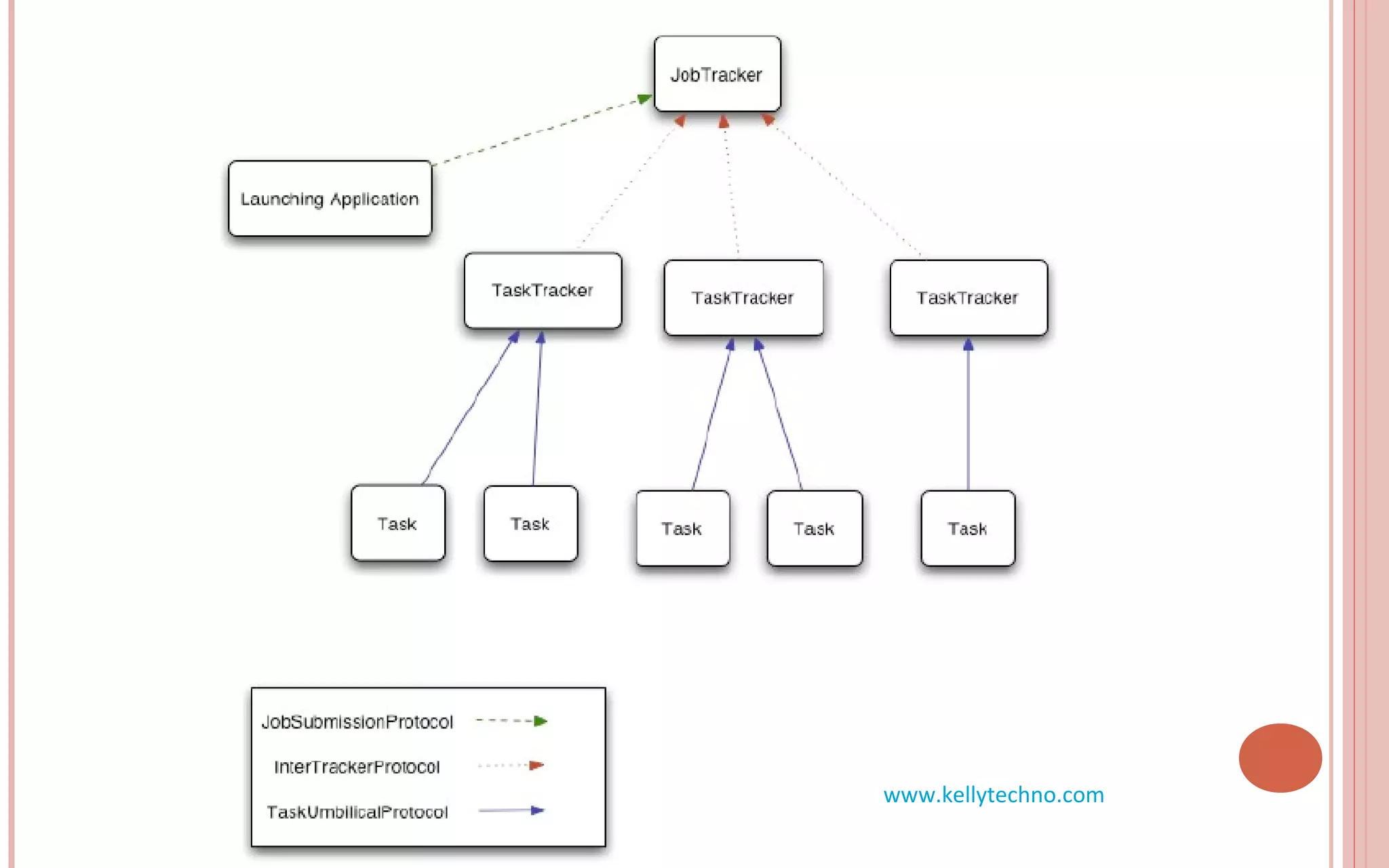
  • #14 Name node: single point of failure, so we have secondary name node. Secondary name node: read transaction log from name node, and upload FSImage to name node. Single name node avoids metadata conflict etc. Data node: easy to join and leave cluster. Heartbeat protocol.
  • #16 Block placement policy Block balancing Block replication on node failure
  • #22 We assume there are only 2 mappers and 2 reducers. Each machine runs 1 mapper and 1 reducer.