MAKING, HACKING,
ANDTHE LIBERAL ARTS
Rosemary Arneson
University of MaryWashington
June 29, 2014
• Public liberal arts university
• Enrollment: 4500 undergraduate,
500 graduate
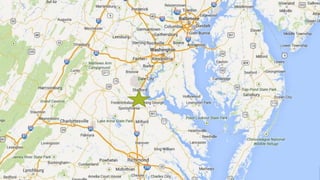
• Main campus in Fredericksburg,
additional campuses in Stafford and
Dahlgren
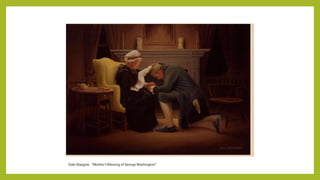
Dale Glasgow. “Mother’s Blessing of George Washington”
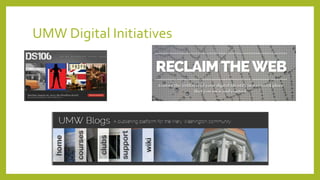
UMW Digital Initiatives
THE UMW THINKLAB
• Collaborative effort between the Library,
the Division of Teaching and Learning
Technologies, and the College of
Education
• DTLT and COE supplied equipment and
expertise
• The Library provided the space
• We scrounged tables and chairs, and IT
had an extra screen lying around
• We didn’t have a committee, and we
didn’t ask permission
Why the Library?
• We had the space
• Library is neutral territory
• Library is open nights and weekends
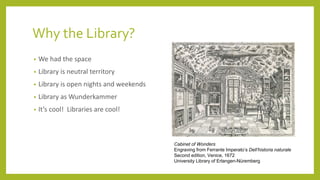
• Library as Wunderkammer
• It’s cool! Libraries are cool!
Cabinet of Wonders
Engraving from Ferrante Imperato’s Dell’historia naturale
Second edition, Venice, 1672
University Library of Erlangen-Nüremberg
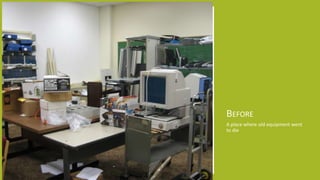
A place where old equipment went
to die
BEFORE
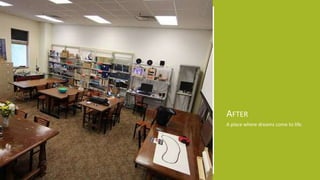
A place where dreams come to life.
AFTER
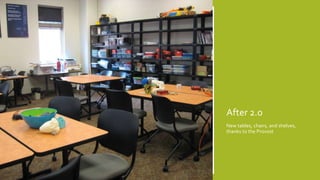
New tables, chairs, and shelves,
thanks to the Provost
After 2.0
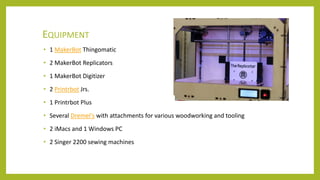
EQUIPMENT
• 1 MakerBot Thingomatic
• 2 MakerBot Replicators
• 1 MakerBot Digitizer
• 2 Printrbot Jrs.
• 1 Printrbot Plus
• Several Dremel's with attachments for various woodworking and tooling
• 2 iMacs and 1 Windows PC
• 2 Singer 2200 sewing machines
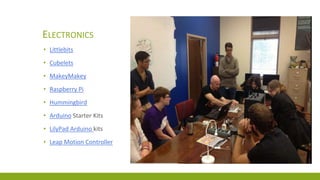
ELECTRONICS
• Littlebits
• Cubelets
• MakeyMakey
• Raspberry Pi
• Hummingbird
• Arduino Starter Kits
• LilyPad Arduino kits
• Leap Motion Controller
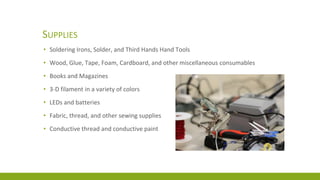
SUPPLIES
• Soldering Irons, Solder, and Third Hands Hand Tools
• Wood, Glue, Tape, Foam, Cardboard, and other miscellaneous consumables
• Books and Magazines
• 3-D filament in a variety of colors
• LEDs and batteries
• Fabric, thread, and other sewing supplies
• Conductive thread and conductive paint
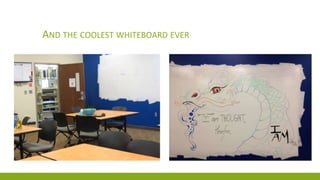
AND THE COOLEST WHITEBOARD EVER
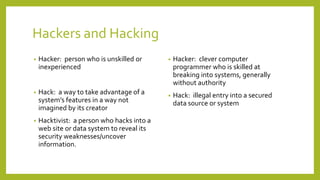
Hackers and Hacking
• Hacker: person who is unskilled or
inexperienced
• Hack: a way to take advantage of a
system’s features in a way not
imagined by its creator
• Hacktivist: a person who hacks into a
web site or data system to reveal its
security weaknesses/uncover
information.
• Hacker: clever computer
programmer who is skilled at
breaking into systems, generally
without authority
• Hack: illegal entry into a secured
data source or system
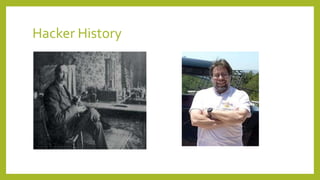
Hacker History
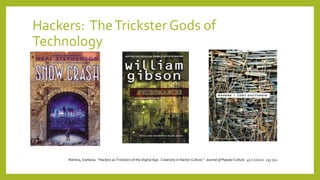
Hackers: TheTrickster Gods of
Technology
Nikitina, Svetlana. “Hackers as Tricksters of the Digital Age: Creativity in Hacker Culture.” Journal of Popular Culture. 45:1 (2012): 133-152.
Makers and Making
• Combination of hobbyists and
professionals
• Make it yourself instead of buying it
• Gadgets, crafts, open source
software, fashion, cooking
• Home grown food
• Reaction to consumer culture
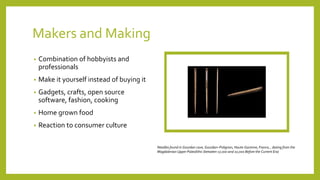
Needles found in Gourdan cave, Gourdan–Polignan, Haute-Garonne, France, , dating from the
Magdalenian Upper Paleolithic (between 17,000 and 10,000 Before the Current Era)
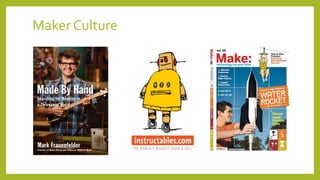
Maker Culture
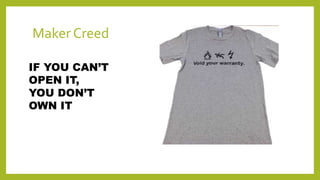
Maker Creed
IF YOU CAN’T
OPEN IT,
YOU DON’T
OWN IT
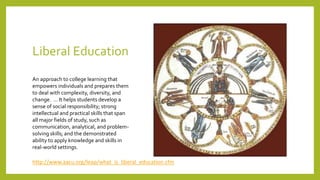
Liberal Education
An approach to college learning that
empowers individuals and prepares them
to deal with complexity, diversity, and
change. … It helps students develop a
sense of social responsibility; strong
intellectual and practical skills that span
all major fields of study, such as
communication, analytical, and problem-
solving skills; and the demonstrated
ability to apply knowledge and skills in
real-world settings.
http://www.aacu.org/leap/what_is_liberal_education.cfm
Hacking + Making = Bricolage
• Claude Lévi-Strauss: The Savage Mind
“In our own time the 'bricoleur' is still someone who works
with his hands and uses devious means [des moyens détournés,
indirect or roundabout means] compared to those of a
craftsman.”
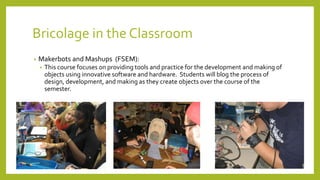
Bricolage in the Classroom
• Makerbots and Mashups (FSEM):
• This course focuses on providing tools and practice for the development and making of
objects using innovative software and hardware. Students will blog the process of
design, development, and making as they create objects over the course of the
semester.
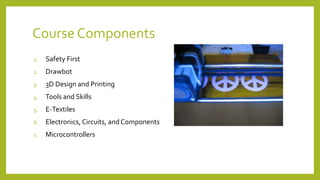
Course Components
1. Safety First
2. Drawbot
3. 3D Design and Printing
4. Tools and Skills
5. E-Textiles
6. Electronics, Circuits, and Components
7. Microcontrollers
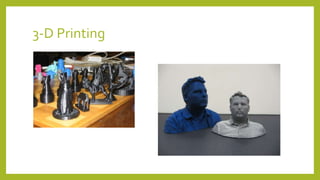
3-D Printing
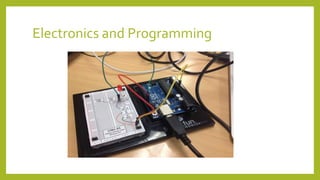
Electronics and Programming
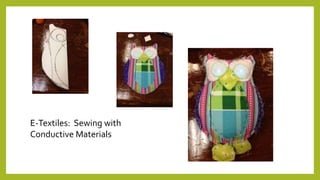
E-Textiles: Sewing with
Conductive Materials
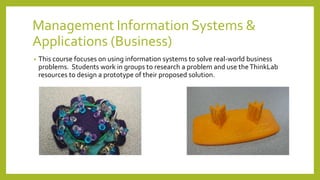
Management Information Systems &
Applications (Business)
• This course focuses on using information systems to solve real-world business
problems. Students work in groups to research a problem and use theThinkLab
resources to design a prototype of their proposed solution.
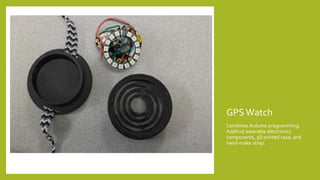
GPSWatch
Combines Arduino programming,
Adafruit wearable electronics
components, 3D printed case, and
hand-make strap.
Scientific Inquiry (Education)
• Planning and instructional skills for teaching science in the elementary classroom.
• Provides students training and practice in using an assortment of developmentally
appropriate teaching methods for elementary level science.
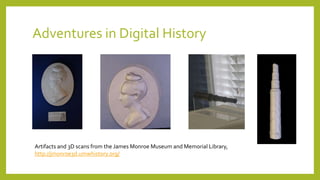
Adventures in Digital History
Artifacts and 3D scans from the James Monroe Museum and Memorial Library,
http://jmonroe3d.umwhistory.org/
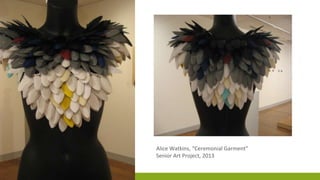
Alice Watkins, “Ceremonial Garment”
Senior Art Project, 2013
Student Learning in theThinkLab
• Peers and collaboration matter
• “Collaborating with other students was really important in creating projects. It was
difficult to remember each detail about each program and what to download, so it
helped to work with other people.”
• Time,Trial and Error, and the Role of Persistence
• “I have spent countless hours trying to get this thing to work and I have become
incredibly frustrated over it. I finished my chess piece after about 15 hours of working on
it and it didn’t even turn out the way I wanted it to.”
• Failure is a Part of Learning
• I failed so much at this, but after learning from my mistakes, I was able to fix and
understand my Arduino. My take away is that failure is part of learning.”
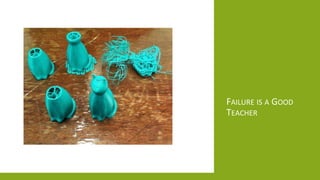
FAILURE IS A GOOD
TEACHER
Next Steps
• 200 level course?
• Using theThinkLab as a lab space for Digital Studies programs
• Better connection with Computer Science faculty
• 3D scanning for Historic Preservation and Museum Studies
• Reaching out to the Maker community
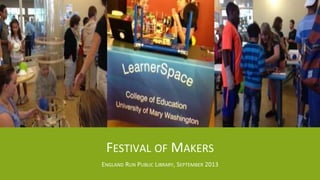
FESTIVAL OF MAKERS
ENGLAND RUN PUBLIC LIBRARY, SEPTEMBER 2013
Rosemary Arneson University of Mary Washington
University Librarian rarneso3@umw.edu

Making, Hacking, and the Liberal Arts

  • 1.
    MAKING, HACKING, ANDTHE LIBERALARTS Rosemary Arneson University of MaryWashington June 29, 2014
  • 3.
    • Public liberalarts university • Enrollment: 4500 undergraduate, 500 graduate • Main campus in Fredericksburg, additional campuses in Stafford and Dahlgren
  • 4.
    Dale Glasgow. “Mother’sBlessing of George Washington”
  • 5.
  • 7.
    THE UMW THINKLAB •Collaborative effort between the Library, the Division of Teaching and Learning Technologies, and the College of Education • DTLT and COE supplied equipment and expertise • The Library provided the space • We scrounged tables and chairs, and IT had an extra screen lying around • We didn’t have a committee, and we didn’t ask permission
  • 8.
    Why the Library? •We had the space • Library is neutral territory • Library is open nights and weekends • Library as Wunderkammer • It’s cool! Libraries are cool! Cabinet of Wonders Engraving from Ferrante Imperato’s Dell’historia naturale Second edition, Venice, 1672 University Library of Erlangen-Nüremberg
  • 10.
    A place whereold equipment went to die BEFORE
  • 11.
    A place wheredreams come to life. AFTER
  • 12.
    New tables, chairs,and shelves, thanks to the Provost After 2.0
  • 13.
    EQUIPMENT • 1 MakerBotThingomatic • 2 MakerBot Replicators • 1 MakerBot Digitizer • 2 Printrbot Jrs. • 1 Printrbot Plus • Several Dremel's with attachments for various woodworking and tooling • 2 iMacs and 1 Windows PC • 2 Singer 2200 sewing machines
  • 14.
    ELECTRONICS • Littlebits • Cubelets •MakeyMakey • Raspberry Pi • Hummingbird • Arduino Starter Kits • LilyPad Arduino kits • Leap Motion Controller
  • 15.
    SUPPLIES • Soldering Irons,Solder, and Third Hands Hand Tools • Wood, Glue, Tape, Foam, Cardboard, and other miscellaneous consumables • Books and Magazines • 3-D filament in a variety of colors • LEDs and batteries • Fabric, thread, and other sewing supplies • Conductive thread and conductive paint
  • 16.
    AND THE COOLESTWHITEBOARD EVER
  • 17.
    Hackers and Hacking •Hacker: person who is unskilled or inexperienced • Hack: a way to take advantage of a system’s features in a way not imagined by its creator • Hacktivist: a person who hacks into a web site or data system to reveal its security weaknesses/uncover information. • Hacker: clever computer programmer who is skilled at breaking into systems, generally without authority • Hack: illegal entry into a secured data source or system
  • 18.
  • 19.
    Hackers: TheTrickster Godsof Technology Nikitina, Svetlana. “Hackers as Tricksters of the Digital Age: Creativity in Hacker Culture.” Journal of Popular Culture. 45:1 (2012): 133-152.
  • 20.
    Makers and Making •Combination of hobbyists and professionals • Make it yourself instead of buying it • Gadgets, crafts, open source software, fashion, cooking • Home grown food • Reaction to consumer culture Needles found in Gourdan cave, Gourdan–Polignan, Haute-Garonne, France, , dating from the Magdalenian Upper Paleolithic (between 17,000 and 10,000 Before the Current Era)
  • 21.
  • 22.
    Maker Creed IF YOUCAN’T OPEN IT, YOU DON’T OWN IT
  • 23.
    Liberal Education An approachto college learning that empowers individuals and prepares them to deal with complexity, diversity, and change. … It helps students develop a sense of social responsibility; strong intellectual and practical skills that span all major fields of study, such as communication, analytical, and problem- solving skills; and the demonstrated ability to apply knowledge and skills in real-world settings. http://www.aacu.org/leap/what_is_liberal_education.cfm
  • 24.
    Hacking + Making= Bricolage • Claude Lévi-Strauss: The Savage Mind “In our own time the 'bricoleur' is still someone who works with his hands and uses devious means [des moyens détournés, indirect or roundabout means] compared to those of a craftsman.”
  • 25.
    Bricolage in theClassroom • Makerbots and Mashups (FSEM): • This course focuses on providing tools and practice for the development and making of objects using innovative software and hardware. Students will blog the process of design, development, and making as they create objects over the course of the semester.
  • 26.
    Course Components 1. SafetyFirst 2. Drawbot 3. 3D Design and Printing 4. Tools and Skills 5. E-Textiles 6. Electronics, Circuits, and Components 7. Microcontrollers
  • 27.
  • 28.
  • 29.
  • 30.
    Management Information Systems& Applications (Business) • This course focuses on using information systems to solve real-world business problems. Students work in groups to research a problem and use theThinkLab resources to design a prototype of their proposed solution.
  • 31.
    GPSWatch Combines Arduino programming, Adafruitwearable electronics components, 3D printed case, and hand-make strap.
  • 32.
    Scientific Inquiry (Education) •Planning and instructional skills for teaching science in the elementary classroom. • Provides students training and practice in using an assortment of developmentally appropriate teaching methods for elementary level science.
  • 33.
    Adventures in DigitalHistory Artifacts and 3D scans from the James Monroe Museum and Memorial Library, http://jmonroe3d.umwhistory.org/
  • 34.
    Alice Watkins, “CeremonialGarment” Senior Art Project, 2013
  • 35.
    Student Learning intheThinkLab • Peers and collaboration matter • “Collaborating with other students was really important in creating projects. It was difficult to remember each detail about each program and what to download, so it helped to work with other people.” • Time,Trial and Error, and the Role of Persistence • “I have spent countless hours trying to get this thing to work and I have become incredibly frustrated over it. I finished my chess piece after about 15 hours of working on it and it didn’t even turn out the way I wanted it to.” • Failure is a Part of Learning • I failed so much at this, but after learning from my mistakes, I was able to fix and understand my Arduino. My take away is that failure is part of learning.”
  • 36.
    FAILURE IS AGOOD TEACHER
  • 37.
    Next Steps • 200level course? • Using theThinkLab as a lab space for Digital Studies programs • Better connection with Computer Science faculty • 3D scanning for Historic Preservation and Museum Studies • Reaching out to the Maker community
  • 38.
    FESTIVAL OF MAKERS ENGLANDRUN PUBLIC LIBRARY, SEPTEMBER 2013
  • 39.
    Rosemary Arneson Universityof Mary Washington University Librarian rarneso3@umw.edu