Ahamad Suhail bin Abdul Malick

          4 Kempas

        Lew Quo Ming
        Wong Joon Kit
        Thee Kyle Ler
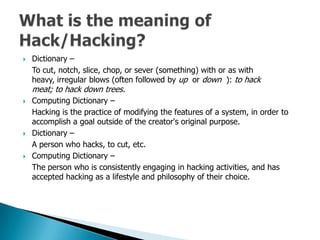
   Dictionary –
    To cut, notch, slice, chop, or sever (something) with or as with
    heavy, irregular blows (often followed by up or down ): to hack
    meat; to hack down trees.
   Computing Dictionary –
    Hacking is the practice of modifying the features of a system, in order to
    accomplish a goal outside of the creator's original purpose.
   Dictionary –
    A person who hacks, to cut, etc.
   Computing Dictionary –
    The person who is consistently engaging in hacking activities, and has
    accepted hacking as a lifestyle and philosophy of their choice.
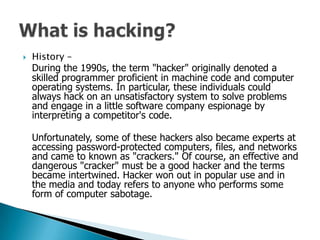
   History –
    During the 1990s, the term "hacker" originally denoted a
    skilled programmer proficient in machine code and computer
    operating systems. In particular, these individuals could
    always hack on an unsatisfactory system to solve problems
    and engage in a little software company espionage by
    interpreting a competitor's code.

    Unfortunately, some of these hackers also became experts at
    accessing password-protected computers, files, and networks
    and came to known as "crackers." Of course, an effective and
    dangerous "cracker" must be a good hacker and the terms
    became intertwined. Hacker won out in popular use and in
    the media and today refers to anyone who performs some
    form of computer sabotage.
   Hack                                 Crack
    A hacker is a person who is           A cracker is a hacker who uses
    proficient with computers             their proficiency for personal
    and/or programming to an              gains outside of the law. EX:
    elite level where they know all       stealing data, changing bank
    of the in's and out's of a            accounts, distributing viruses
    system.                               etc.
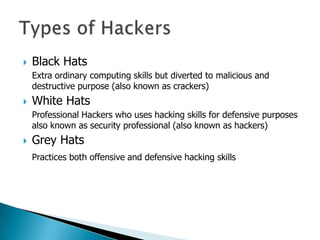
   Black Hats
    Extra ordinary computing skills but diverted to malicious and
    destructive purpose (also known as crackers)
   White Hats
    Professional Hackers who uses hacking skills for defensive purposes
    also known as security professional (also known as hackers)
   Grey Hats
    Practices both offensive and defensive hacking skills
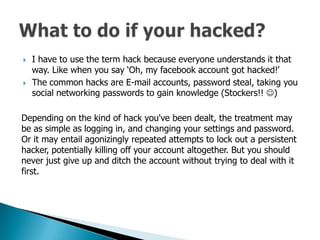
   I have to use the term hack because everyone understands it that
    way. Like when you say ‘Oh, my facebook account got hacked!’
   The common hacks are E-mail accounts, password steal, taking you
    social networking passwords to gain knowledge (Stockers!! )

Depending on the kind of hack you've been dealt, the treatment may
be as simple as logging in, and changing your settings and password.
Or it may entail agonizingly repeated attempts to lock out a persistent
hacker, potentially killing off your account altogether. But you should
never just give up and ditch the account without trying to deal with it
first.
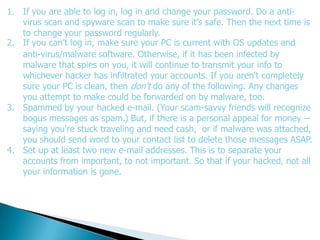
1. If you are able to log in, log in and change your password. Do a anti-
   virus scan and spyware scan to make sure it’s safe. Then the next time is
   to change your password regularly.
2. If you can’t log in, make sure your PC is current with OS updates and
   anti-virus/malware software. Otherwise, if it has been infected by
   malware that spies on you, it will continue to transmit your info to
   whichever hacker has infiltrated your accounts. If you aren't completely
   sure your PC is clean, then don't do any of the following. Any changes
   you attempt to make could be forwarded on by malware, too.
3. Spammed by your hacked e-mail. (Your scam-savvy friends will recognize
   bogus messages as spam.) But, if there is a personal appeal for money --
   saying you're stuck traveling and need cash, or if malware was attached,
   you should send word to your contact list to delete those messages ASAP.
4. Set up at least two new e-mail addresses. This is to separate your
   accounts from important, to not important. So that if your hacked, not all
   your information is gone.
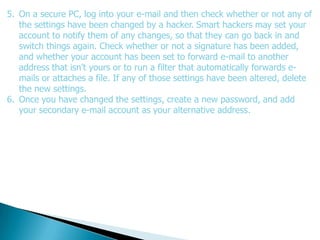
5. On a secure PC, log into your e-mail and then check whether or not any of
   the settings have been changed by a hacker. Smart hackers may set your
   account to notify them of any changes, so that they can go back in and
   switch things again. Check whether or not a signature has been added,
   and whether your account has been set to forward e-mail to another
   address that isn't yours or to run a filter that automatically forwards e-
   mails or attaches a file. If any of those settings have been altered, delete
   the new settings.
6. Once you have changed the settings, create a new password, and add
   your secondary e-mail account as your alternative address.
Hacking does not mean using your computing
  skills to do bad. Society have forgotten the
   difference between crackers and hackers.

   Learning skills of hacking is only for the
                 greater good.

                    The End
   http://compnetworking.about.com/od/networksecurityprivacy/f/what-is-
    hacking.htm
   http://whatishacking.org/
   http://whatismyipaddress.com/hacking
   http://dictionary.reference.com/browse/hacker?s=t
   http://wiki.answers.com/Q/What_is_the_difference_between_hacking_and_crackin
    g
   http://answers.yahoo.com/question/index?qid=20071206182542AA3JzNy
   http://www.huffingtonpost.co.uk/eva-blumdumontet/29c3-hacking-
    politics_b_2512573.html
   http://answers.yahoo.com/question/index?qid=20110801131429AAFTktO
   http://www.cs.berkeley.edu/~bh/hacker.html
   http://www.ehow.com/about_4673738_why-do-people-hack.html
   http://venturebeat.com/2011/12/28/anonymous-stratfor-hack-10-things-to-
    know/
   http://www.slideshare.net/TerroWhite/ethical-hacking-and-it-security-training
   http://www.switched.com/2011/02/24/what-to-do-email-account-hacked/

Hacking

  • 1.
    Ahamad Suhail binAbdul Malick 4 Kempas Lew Quo Ming Wong Joon Kit Thee Kyle Ler
  • 2.
    Dictionary – To cut, notch, slice, chop, or sever (something) with or as with heavy, irregular blows (often followed by up or down ): to hack meat; to hack down trees.  Computing Dictionary – Hacking is the practice of modifying the features of a system, in order to accomplish a goal outside of the creator's original purpose.  Dictionary – A person who hacks, to cut, etc.  Computing Dictionary – The person who is consistently engaging in hacking activities, and has accepted hacking as a lifestyle and philosophy of their choice.
  • 3.
    History – During the 1990s, the term "hacker" originally denoted a skilled programmer proficient in machine code and computer operating systems. In particular, these individuals could always hack on an unsatisfactory system to solve problems and engage in a little software company espionage by interpreting a competitor's code. Unfortunately, some of these hackers also became experts at accessing password-protected computers, files, and networks and came to known as "crackers." Of course, an effective and dangerous "cracker" must be a good hacker and the terms became intertwined. Hacker won out in popular use and in the media and today refers to anyone who performs some form of computer sabotage.
  • 4.
    Hack  Crack A hacker is a person who is A cracker is a hacker who uses proficient with computers their proficiency for personal and/or programming to an gains outside of the law. EX: elite level where they know all stealing data, changing bank of the in's and out's of a accounts, distributing viruses system. etc.
  • 5.
    Black Hats Extra ordinary computing skills but diverted to malicious and destructive purpose (also known as crackers)  White Hats Professional Hackers who uses hacking skills for defensive purposes also known as security professional (also known as hackers)  Grey Hats Practices both offensive and defensive hacking skills
  • 6.
    I have to use the term hack because everyone understands it that way. Like when you say ‘Oh, my facebook account got hacked!’  The common hacks are E-mail accounts, password steal, taking you social networking passwords to gain knowledge (Stockers!! ) Depending on the kind of hack you've been dealt, the treatment may be as simple as logging in, and changing your settings and password. Or it may entail agonizingly repeated attempts to lock out a persistent hacker, potentially killing off your account altogether. But you should never just give up and ditch the account without trying to deal with it first.
  • 7.
    1. If youare able to log in, log in and change your password. Do a anti- virus scan and spyware scan to make sure it’s safe. Then the next time is to change your password regularly. 2. If you can’t log in, make sure your PC is current with OS updates and anti-virus/malware software. Otherwise, if it has been infected by malware that spies on you, it will continue to transmit your info to whichever hacker has infiltrated your accounts. If you aren't completely sure your PC is clean, then don't do any of the following. Any changes you attempt to make could be forwarded on by malware, too. 3. Spammed by your hacked e-mail. (Your scam-savvy friends will recognize bogus messages as spam.) But, if there is a personal appeal for money -- saying you're stuck traveling and need cash, or if malware was attached, you should send word to your contact list to delete those messages ASAP. 4. Set up at least two new e-mail addresses. This is to separate your accounts from important, to not important. So that if your hacked, not all your information is gone.
  • 8.
    5. On asecure PC, log into your e-mail and then check whether or not any of the settings have been changed by a hacker. Smart hackers may set your account to notify them of any changes, so that they can go back in and switch things again. Check whether or not a signature has been added, and whether your account has been set to forward e-mail to another address that isn't yours or to run a filter that automatically forwards e- mails or attaches a file. If any of those settings have been altered, delete the new settings. 6. Once you have changed the settings, create a new password, and add your secondary e-mail account as your alternative address.
  • 9.
    Hacking does notmean using your computing skills to do bad. Society have forgotten the difference between crackers and hackers. Learning skills of hacking is only for the greater good. The End
  • 10.
    http://compnetworking.about.com/od/networksecurityprivacy/f/what-is- hacking.htm  http://whatishacking.org/  http://whatismyipaddress.com/hacking  http://dictionary.reference.com/browse/hacker?s=t  http://wiki.answers.com/Q/What_is_the_difference_between_hacking_and_crackin g  http://answers.yahoo.com/question/index?qid=20071206182542AA3JzNy  http://www.huffingtonpost.co.uk/eva-blumdumontet/29c3-hacking- politics_b_2512573.html  http://answers.yahoo.com/question/index?qid=20110801131429AAFTktO  http://www.cs.berkeley.edu/~bh/hacker.html  http://www.ehow.com/about_4673738_why-do-people-hack.html  http://venturebeat.com/2011/12/28/anonymous-stratfor-hack-10-things-to- know/  http://www.slideshare.net/TerroWhite/ethical-hacking-and-it-security-training  http://www.switched.com/2011/02/24/what-to-do-email-account-hacked/