WORK OPTIONS FOR FOREIGN STUDENTS Mark B. Rhoads, Esquire  Helen L. Konrad, Esquire Phone:  (804) 775-3824  Phone:  (804) 775-3825 Email:  [email_address]   Email:  [email_address] McCandlish Holton PC  Website:  www.lawmh.com
VISA CATEGORIES FOR STUDENTS F-1 – Foreign students attending academic    college or university J-1 – “Exchange visitor” or trainee often used for graduate students, medical residents, etc. Dependent Visas  – Students whose parents are in the U.S. on a work visa such as H-1B (H-4), L-1 (L -2), E Visa, etc.
PRE-GRADUATION WORK  (F-1) On-campus employment Curricular Practical Training (CPT)  – Integral part of established program (work/study) Optional Practical Training (OPT)  – 12 months of OPT for F-1; use during degree program or after graduation Economic Hardship  – Extreme, unforeseen economic hardship such as loss of parents, currency crisis, political unrest Designated International Organizations  – Certain organizations are permitted to hire F-1 students for work experience (United Nations, IMF, World Bank, etc.) Volunteer  – Almost  never  an option
POST-GRADUATION EMPLOYMENT Employers like qualities of international students - - smart, independent, motivated Employers do not understand visas Students must understand the immigration process, and be able to explain
TYPICAL POST- COMPLETION EMPLOYMENT PATH F-1 - Optional Practical Training (12 or 29 months) or J-1 – Academic Training (18 or 36 months) then H-1B – Most common work visa (6 years of work eligibility)
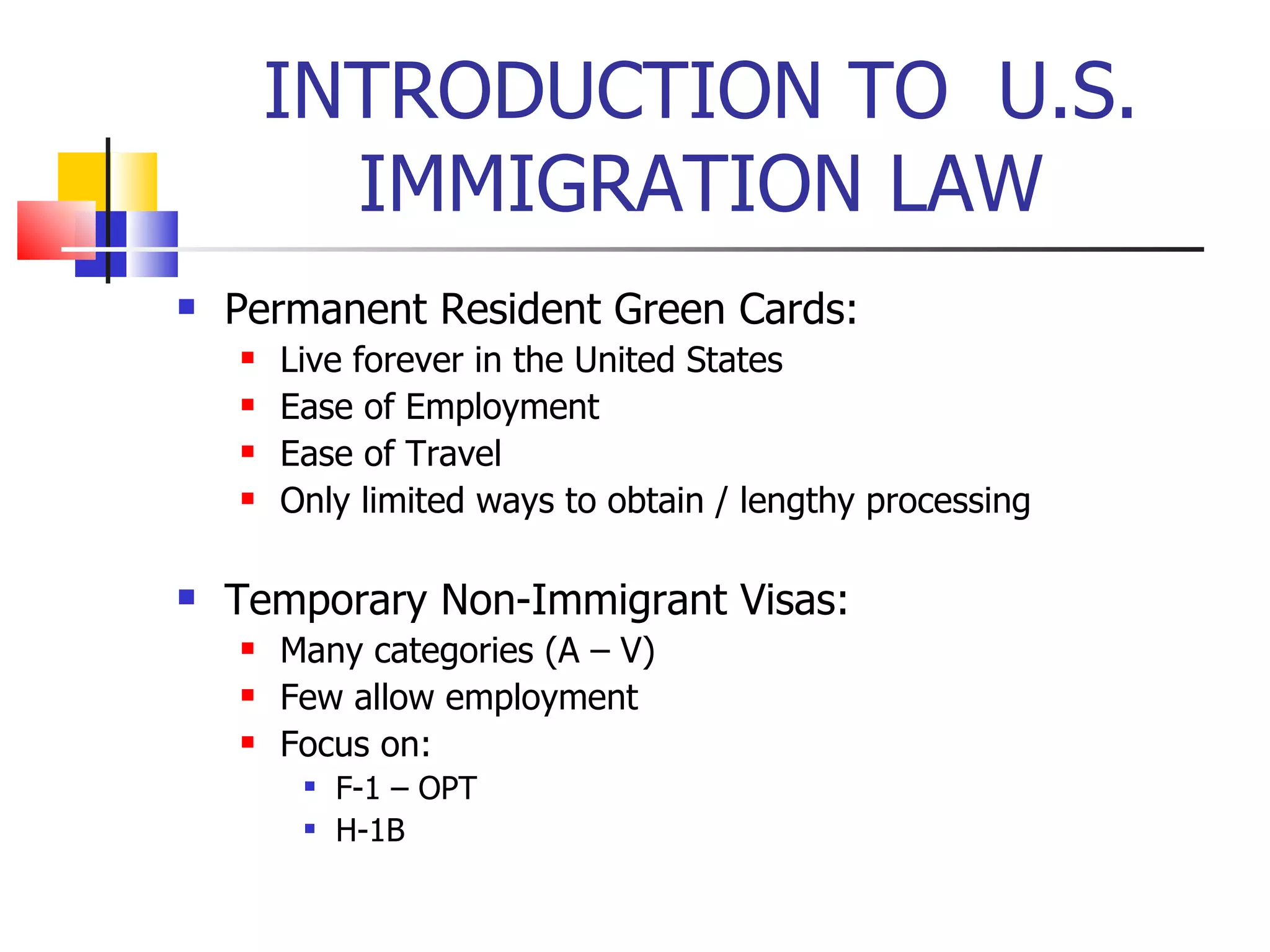
INTRODUCTION TO  U.S. IMMIGRATION LAW Permanent Resident Green Cards: Live forever in the United States Ease of Employment Ease of Travel Only limited ways to obtain / lengthy processing Temporary Non-Immigrant Visas: Many categories (A – V) Few allow employment Focus on: F-1 – OPT H-1B
EMPLOYER CONCERNS Cost Timing Obligations and Responsibilities
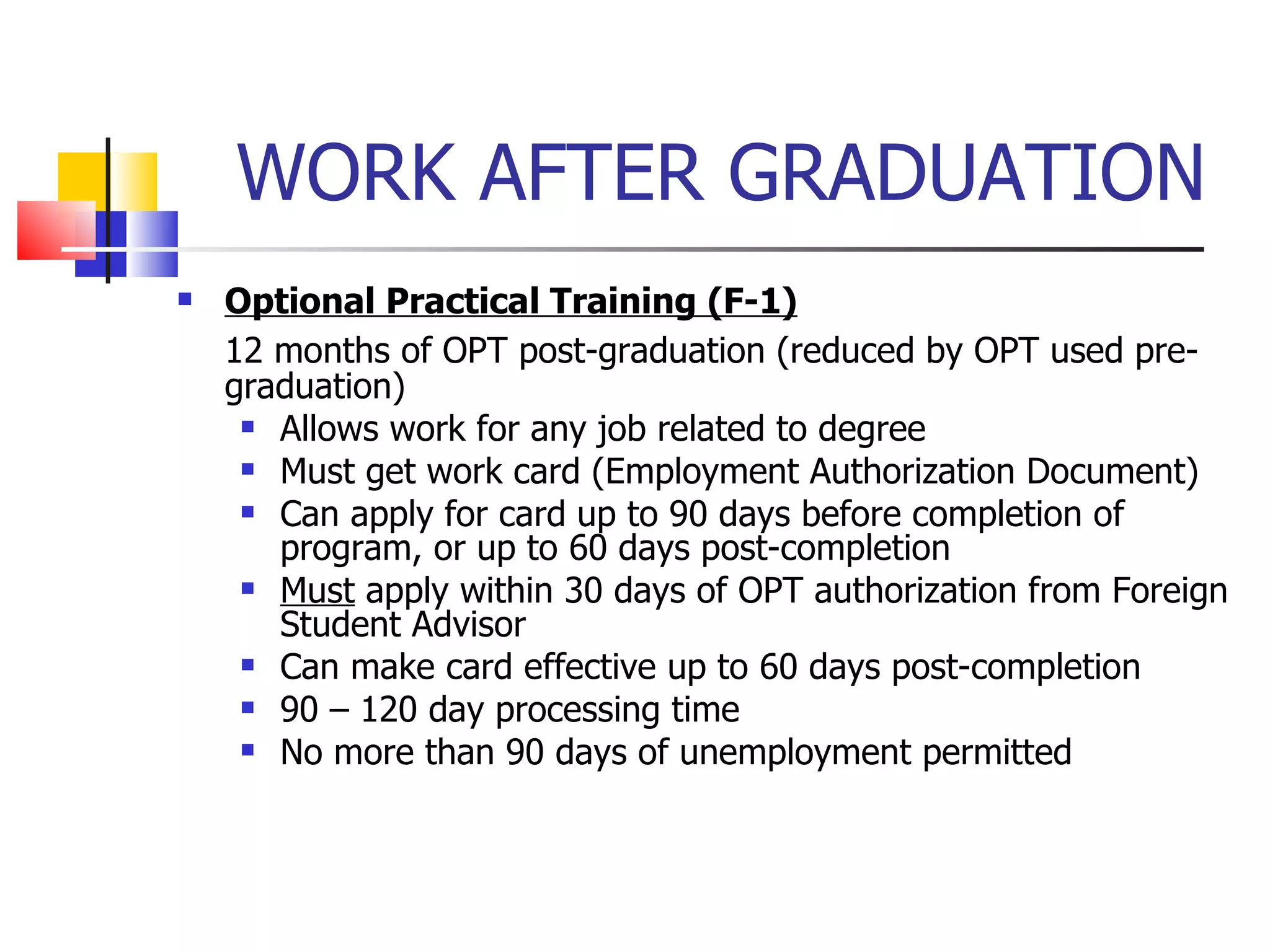
WORK AFTER GRADUATION Optional Practical Training (F-1) 12 months of OPT post-graduation (reduced by OPT used pre-graduation) Allows work for any job related to degree Must get work card (Employment Authorization Document) Can apply for card up to 90 days before completion of program, or up to 60 days post-completion Must  apply within 30 days of OPT authorization from Foreign Student Advisor Can make card effective up to 60 days post-completion 90 – 120 day processing time No more than 90 days of unemployment permitted
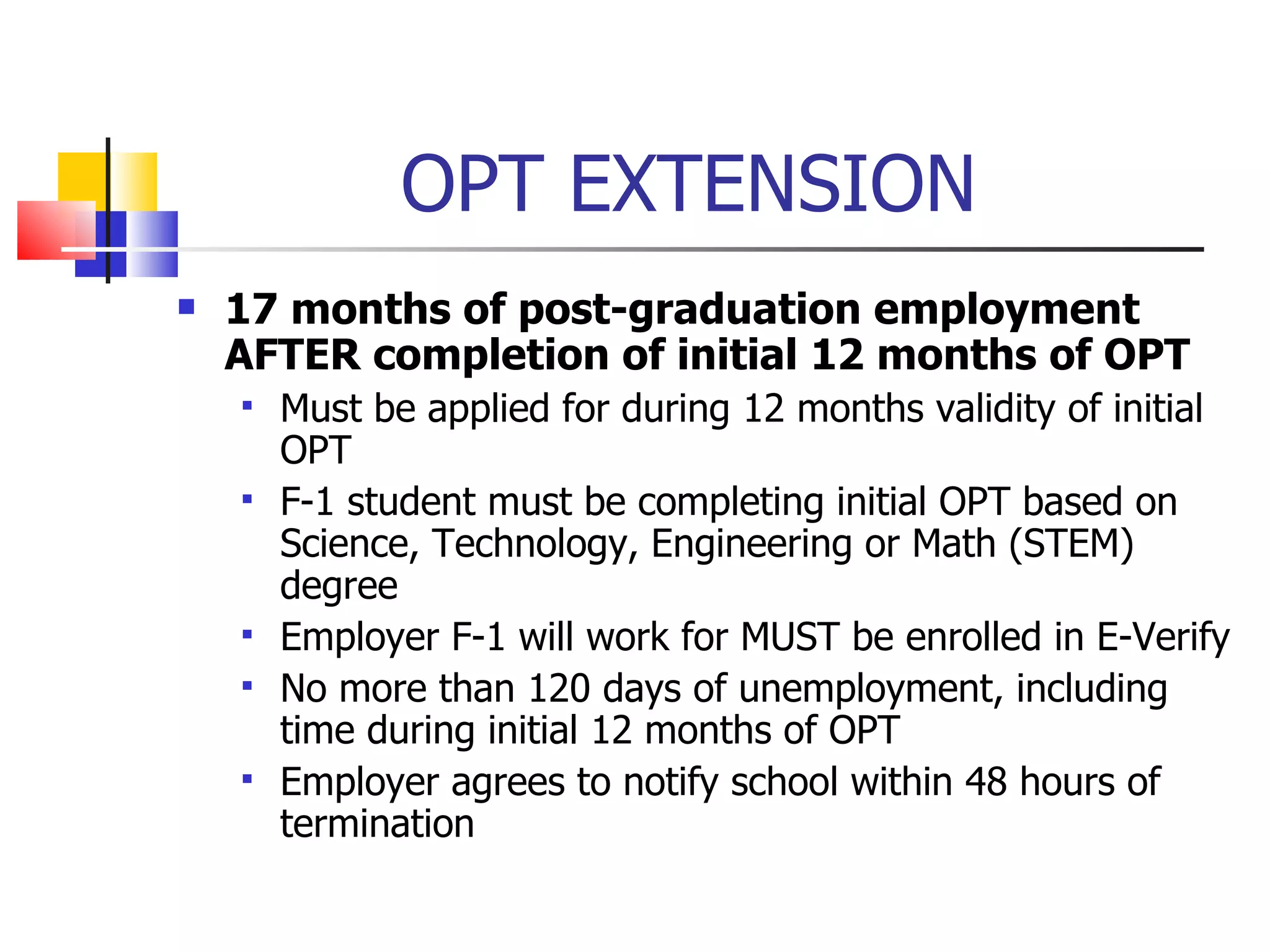
OPT EXTENSION  17 months of post-graduation employment AFTER completion of initial 12 months of OPT Must be applied for during 12 months validity of initial OPT F-1 student must be completing initial OPT based on Science, Technology, Engineering or Math (STEM) degree Employer F-1 will work for MUST be enrolled in E-Verify No more than 120 days of unemployment, including time during initial 12 months of OPT Employer agrees to notify school within 48 hours of termination
E-VERIFY Web based system for verifying work authorization Required for employers seeking 17 month STEM extension Required for companies which have federal contracts or subcontracts For others, it is voluntary
TRAVEL ON OPT ANY  travel by an F-1 student is risky because you  MUST  show intent to return to home country If you choose to travel, you will need Endorsed I-20 Valid Visa Employment Authorization Document (EAD) Employment letter Absence of  ANY  presents additional risk Travel after applying for H-1B is not advised
WORK AFTER GRADUATION  H-1B – Most Common Work Visa Employer must “sponsor” (offer a job that requires a degree) Applicant must have degree Degree must relate to the job No need to advertise for U.S. workers
H-1B ISSUES Duration   3 years initially 3 year extension 6 year maximum Scope of H-1B Authorization Can only work for this employer, doing what was described on the petition in the location described on the petition Change Employer   New employer must file new petition But can begin working as soon as new petition is filed without waiting for approval
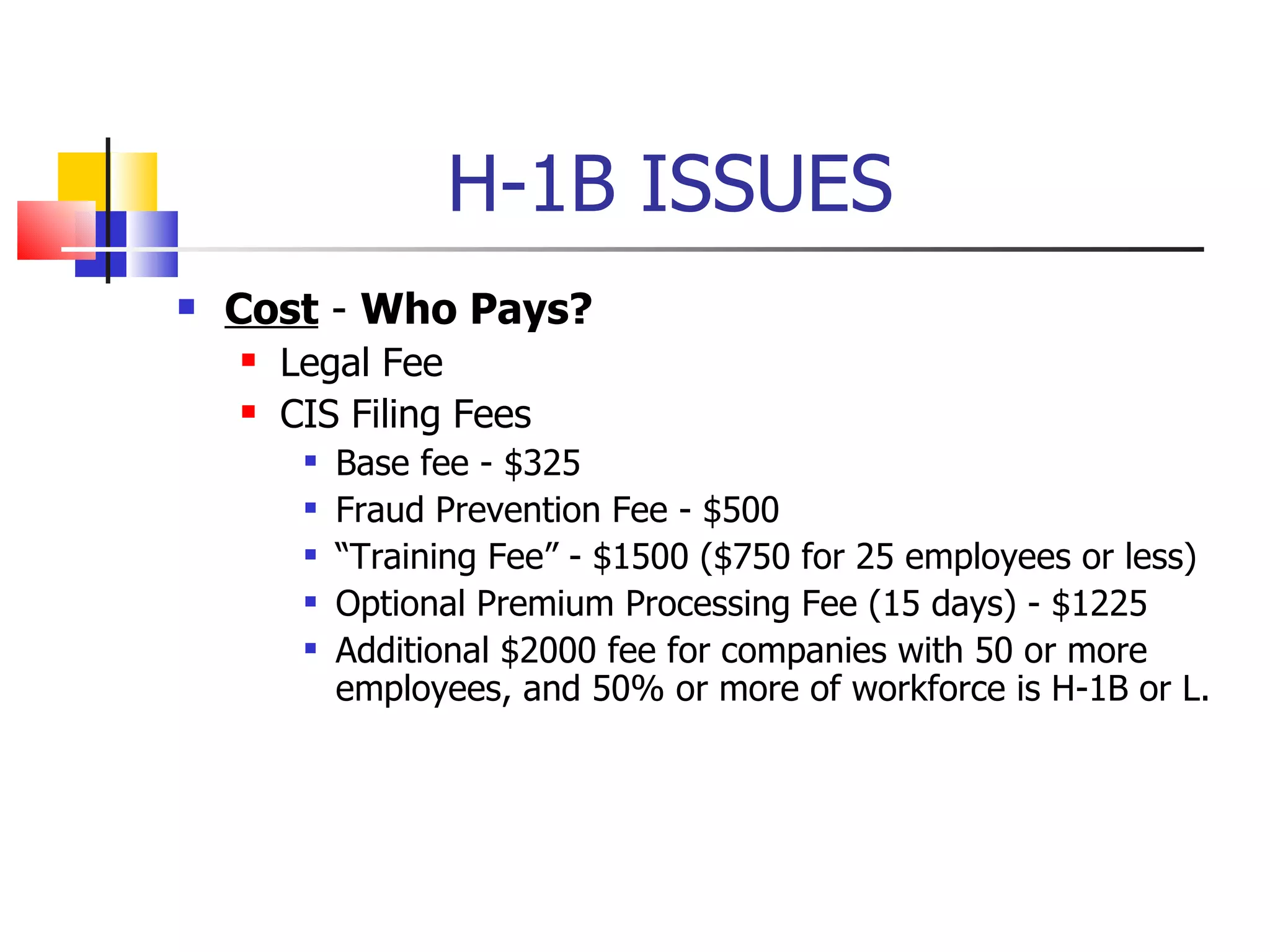
H-1B ISSUES Cost  -  Who Pays? Legal Fee CIS Filing Fees Base fee - $325 Fraud Prevention Fee - $500 “ Training Fee” - $1500 ($750 for 25 employees or less) Optional Premium Processing Fee (15 days) - $1225 Additional $2000 fee for companies with 50 or more employees, and 50% or more of workforce is H-1B or L.
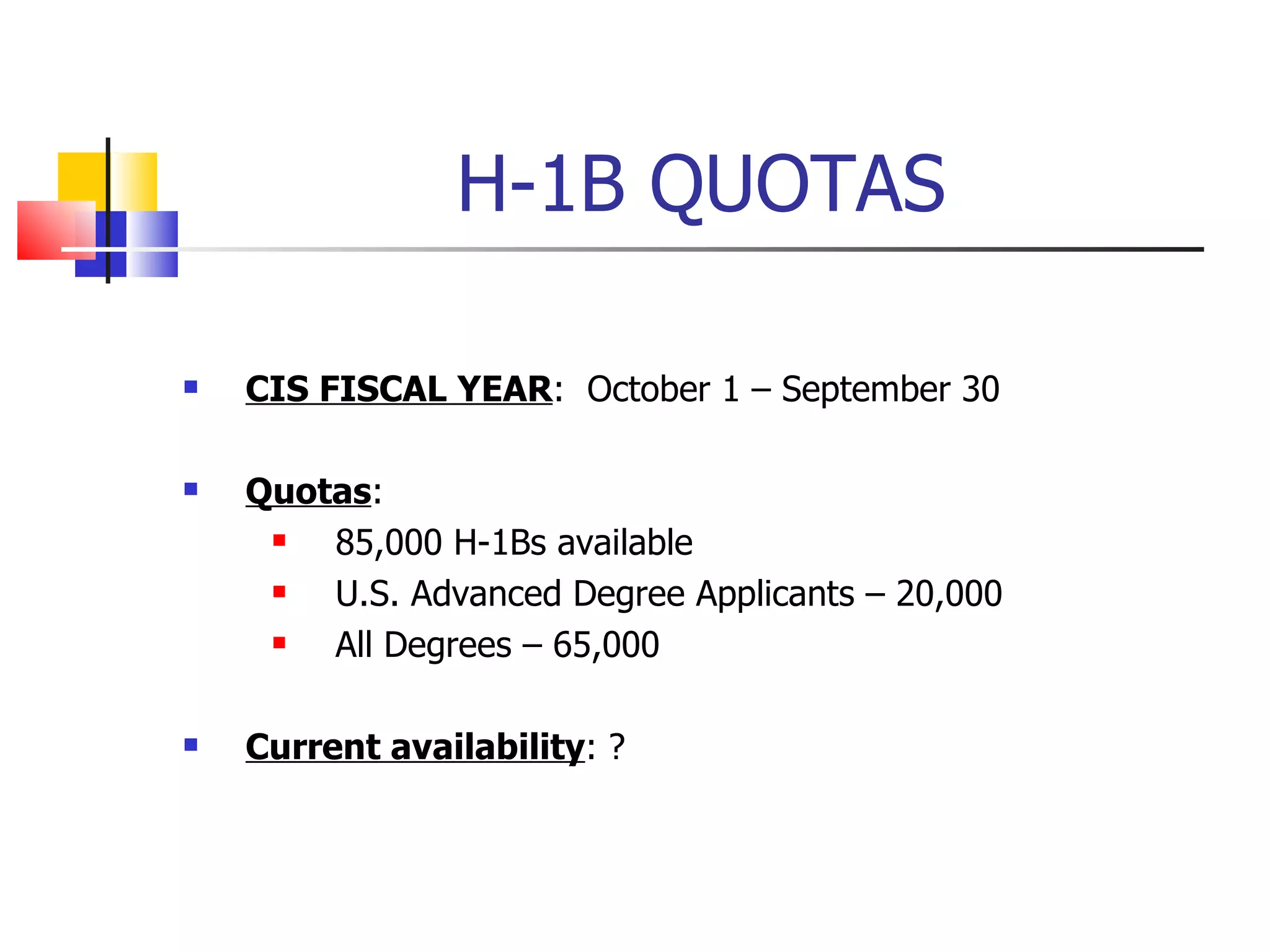
H-1B QUOTAS CIS FISCAL YEAR :  October 1 – September 30 Quotas : 85,000 H-1Bs available U.S. Advanced Degree Applicants – 20,000 All Degrees – 65,000 Current availability : ?
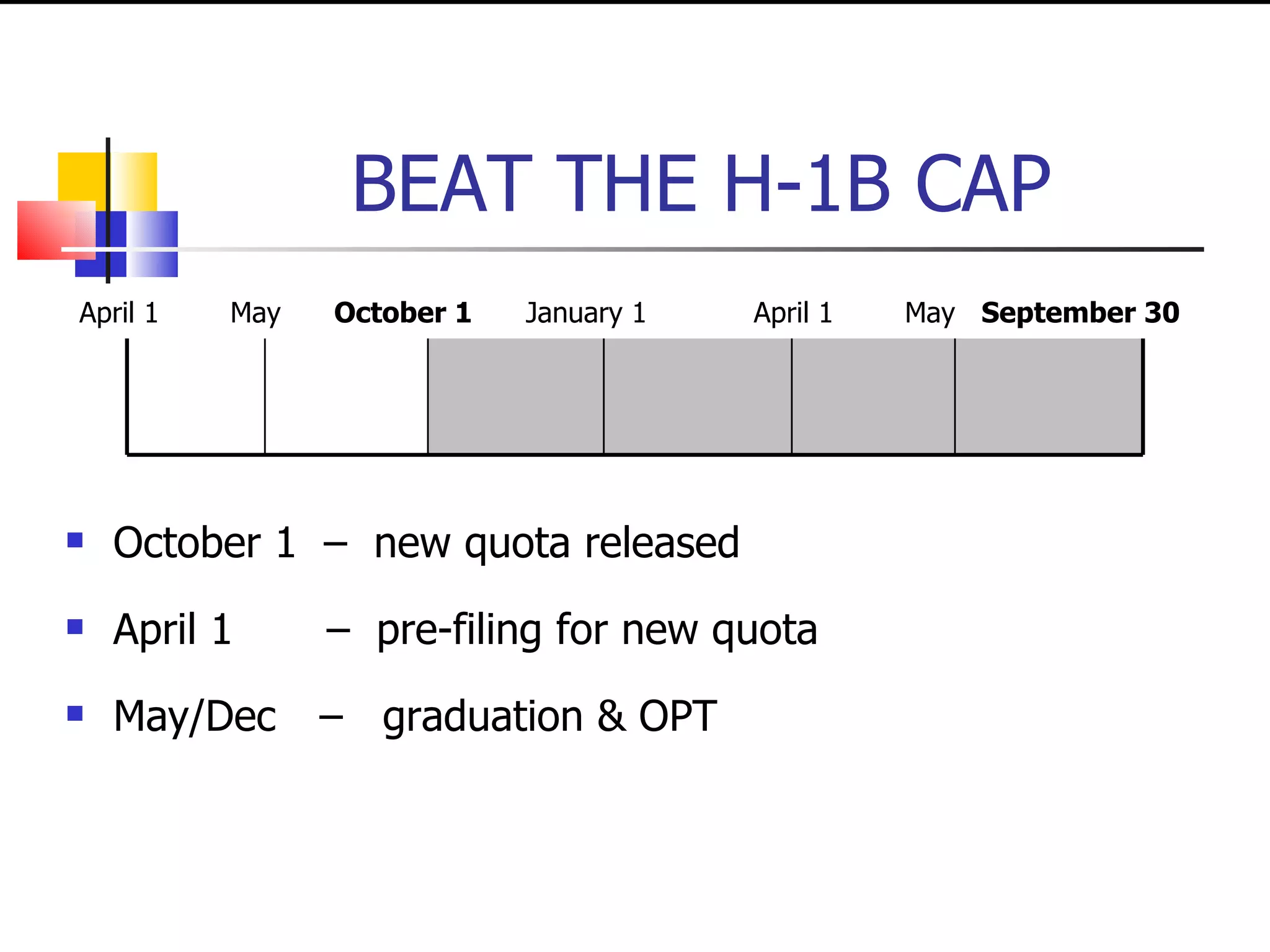
BEAT THE H-1B CAP October 1  –  new quota released April 1  –  pre-filing for new quota May/Dec –  graduation & OPT April 1  May  October 1   January 1  April 1  May  September 30
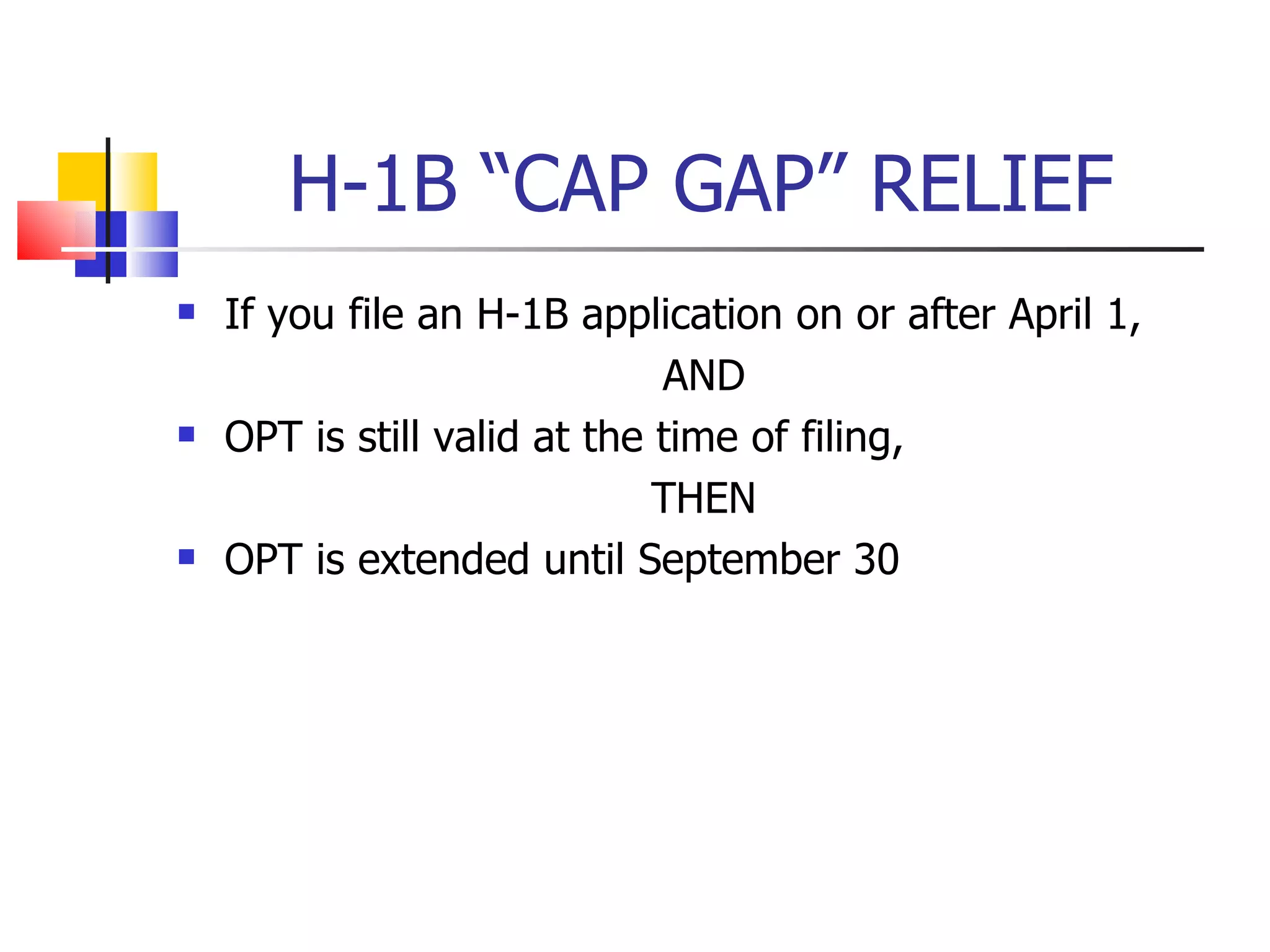
H-1B “CAP GAP” RELIEF If you file an H-1B application on or after April 1,  AND OPT is still valid at the time of filing, THEN OPT is extended until September 30
H-1B EXEMPT ORGANIZATIONS Universities Non-profit organizations affiliated with universities (such as research facilities or hospitals) Non-profit research organizations, engaged primarily in basic or applied research Governmental research organizations
H-1B ALTERNATIVES Canada, Mexico, Chile, Singapore, Australia L-1 Manager / Executive / Specialized Knowledge. Work overseas for one year; now working for affiliate in United States E treaty investor/trader (not China, India) working for companies owned by citizens of your country in the United States Re-enroll in full-time study (F-1 or J-1) Other possible options are very limited (O-1, Q, J-1). Consult qualified immigration specialist
GREEN CARD Limited Ways to Obtain Family Relationships Lottery Employment/Special Skills EB-1 – Extraordinary / Outstanding / Multi-national EB-2 - Advance Degree / Exceptional EB-3 - Bachelor’s Degree/ Skilled worker PERM Processing – lengthy Must maintain non-immigrant status
EXTEND H-1B BEYOND 6 YEARS Normal length of H-1B – 6 years Can Extend for the following: Recapture time outside the U.S. Green card pending at least 1 year – can extend H-1B in 1 year increments Approved I-140, but no quota number to adjust - - 3 year extension
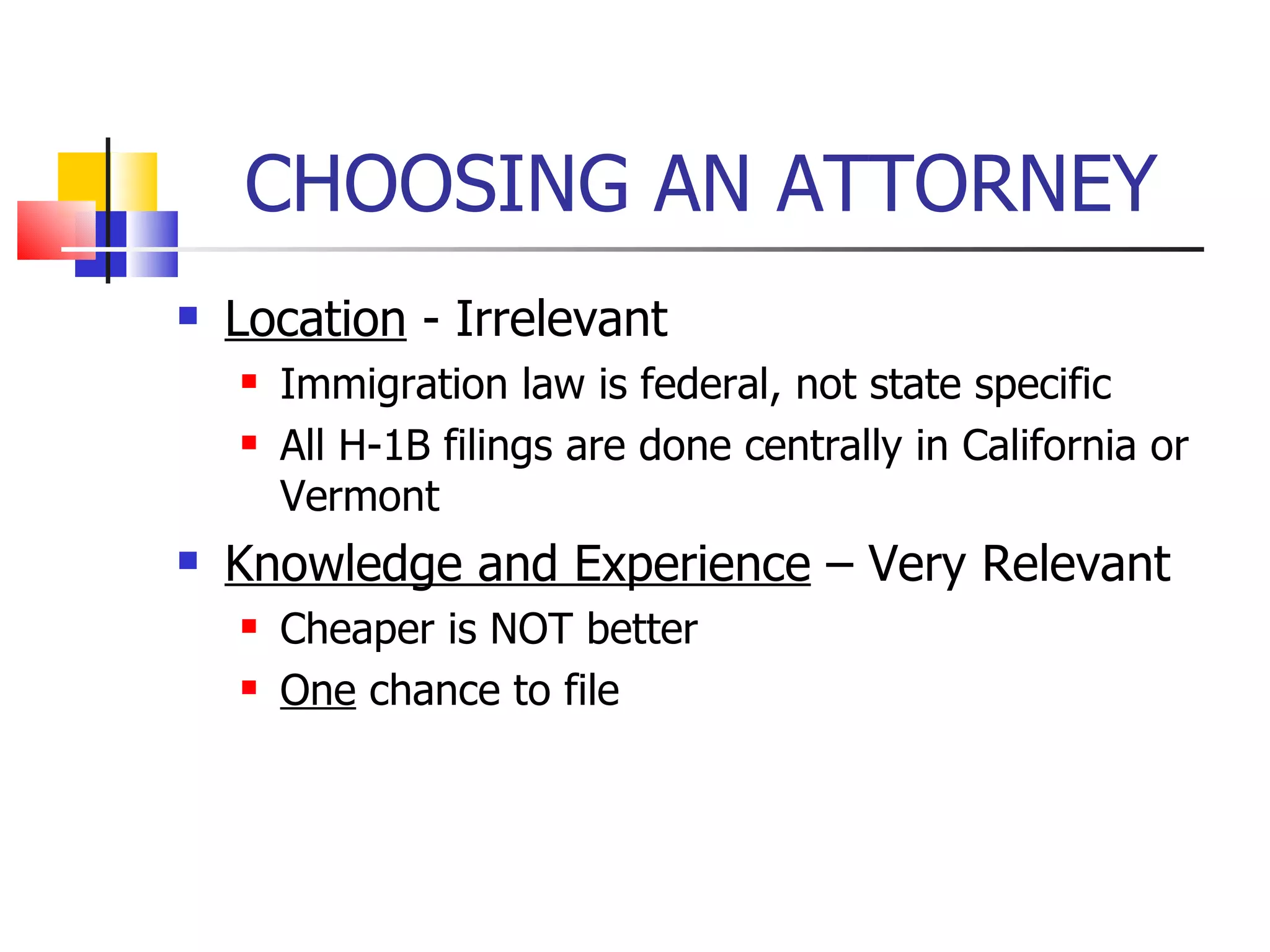
CHOOSING AN ATTORNEY Location  - Irrelevant Immigration law is federal, not state specific All H-1B filings are done centrally in California or Vermont Knowledge and Experience  – Very Relevant Cheaper is NOT better One  chance to file
RESOURCES www.lawmh.com Practice Areas Immigration Mark Rhoads [email_address] (804) 775-3824 Helen Konrad [email_address] (804)775-3825   9/2011 815727

H1-B Visas and Beyond

  • 1.
    WORK OPTIONS FORFOREIGN STUDENTS Mark B. Rhoads, Esquire Helen L. Konrad, Esquire Phone: (804) 775-3824 Phone: (804) 775-3825 Email: [email_address] Email: [email_address] McCandlish Holton PC Website: www.lawmh.com
  • 2.
    VISA CATEGORIES FORSTUDENTS F-1 – Foreign students attending academic college or university J-1 – “Exchange visitor” or trainee often used for graduate students, medical residents, etc. Dependent Visas – Students whose parents are in the U.S. on a work visa such as H-1B (H-4), L-1 (L -2), E Visa, etc.
  • 3.
    PRE-GRADUATION WORK (F-1) On-campus employment Curricular Practical Training (CPT) – Integral part of established program (work/study) Optional Practical Training (OPT) – 12 months of OPT for F-1; use during degree program or after graduation Economic Hardship – Extreme, unforeseen economic hardship such as loss of parents, currency crisis, political unrest Designated International Organizations – Certain organizations are permitted to hire F-1 students for work experience (United Nations, IMF, World Bank, etc.) Volunteer – Almost never an option
  • 4.
    POST-GRADUATION EMPLOYMENT Employerslike qualities of international students - - smart, independent, motivated Employers do not understand visas Students must understand the immigration process, and be able to explain
  • 5.
    TYPICAL POST- COMPLETIONEMPLOYMENT PATH F-1 - Optional Practical Training (12 or 29 months) or J-1 – Academic Training (18 or 36 months) then H-1B – Most common work visa (6 years of work eligibility)
  • 6.
    INTRODUCTION TO U.S. IMMIGRATION LAW Permanent Resident Green Cards: Live forever in the United States Ease of Employment Ease of Travel Only limited ways to obtain / lengthy processing Temporary Non-Immigrant Visas: Many categories (A – V) Few allow employment Focus on: F-1 – OPT H-1B
  • 7.
    EMPLOYER CONCERNS CostTiming Obligations and Responsibilities
  • 8.
    WORK AFTER GRADUATIONOptional Practical Training (F-1) 12 months of OPT post-graduation (reduced by OPT used pre-graduation) Allows work for any job related to degree Must get work card (Employment Authorization Document) Can apply for card up to 90 days before completion of program, or up to 60 days post-completion Must apply within 30 days of OPT authorization from Foreign Student Advisor Can make card effective up to 60 days post-completion 90 – 120 day processing time No more than 90 days of unemployment permitted
  • 9.
    OPT EXTENSION 17 months of post-graduation employment AFTER completion of initial 12 months of OPT Must be applied for during 12 months validity of initial OPT F-1 student must be completing initial OPT based on Science, Technology, Engineering or Math (STEM) degree Employer F-1 will work for MUST be enrolled in E-Verify No more than 120 days of unemployment, including time during initial 12 months of OPT Employer agrees to notify school within 48 hours of termination
  • 10.
    E-VERIFY Web basedsystem for verifying work authorization Required for employers seeking 17 month STEM extension Required for companies which have federal contracts or subcontracts For others, it is voluntary
  • 11.
    TRAVEL ON OPTANY travel by an F-1 student is risky because you MUST show intent to return to home country If you choose to travel, you will need Endorsed I-20 Valid Visa Employment Authorization Document (EAD) Employment letter Absence of ANY presents additional risk Travel after applying for H-1B is not advised
  • 12.
    WORK AFTER GRADUATION H-1B – Most Common Work Visa Employer must “sponsor” (offer a job that requires a degree) Applicant must have degree Degree must relate to the job No need to advertise for U.S. workers
  • 13.
    H-1B ISSUES Duration 3 years initially 3 year extension 6 year maximum Scope of H-1B Authorization Can only work for this employer, doing what was described on the petition in the location described on the petition Change Employer New employer must file new petition But can begin working as soon as new petition is filed without waiting for approval
  • 14.
    H-1B ISSUES Cost - Who Pays? Legal Fee CIS Filing Fees Base fee - $325 Fraud Prevention Fee - $500 “ Training Fee” - $1500 ($750 for 25 employees or less) Optional Premium Processing Fee (15 days) - $1225 Additional $2000 fee for companies with 50 or more employees, and 50% or more of workforce is H-1B or L.
  • 15.
    H-1B QUOTAS CISFISCAL YEAR : October 1 – September 30 Quotas : 85,000 H-1Bs available U.S. Advanced Degree Applicants – 20,000 All Degrees – 65,000 Current availability : ?
  • 16.
    BEAT THE H-1BCAP October 1 – new quota released April 1 – pre-filing for new quota May/Dec – graduation & OPT April 1 May October 1 January 1 April 1 May September 30
  • 17.
    H-1B “CAP GAP”RELIEF If you file an H-1B application on or after April 1, AND OPT is still valid at the time of filing, THEN OPT is extended until September 30
  • 18.
    H-1B EXEMPT ORGANIZATIONSUniversities Non-profit organizations affiliated with universities (such as research facilities or hospitals) Non-profit research organizations, engaged primarily in basic or applied research Governmental research organizations
  • 19.
    H-1B ALTERNATIVES Canada,Mexico, Chile, Singapore, Australia L-1 Manager / Executive / Specialized Knowledge. Work overseas for one year; now working for affiliate in United States E treaty investor/trader (not China, India) working for companies owned by citizens of your country in the United States Re-enroll in full-time study (F-1 or J-1) Other possible options are very limited (O-1, Q, J-1). Consult qualified immigration specialist
  • 20.
    GREEN CARD LimitedWays to Obtain Family Relationships Lottery Employment/Special Skills EB-1 – Extraordinary / Outstanding / Multi-national EB-2 - Advance Degree / Exceptional EB-3 - Bachelor’s Degree/ Skilled worker PERM Processing – lengthy Must maintain non-immigrant status
  • 21.
    EXTEND H-1B BEYOND6 YEARS Normal length of H-1B – 6 years Can Extend for the following: Recapture time outside the U.S. Green card pending at least 1 year – can extend H-1B in 1 year increments Approved I-140, but no quota number to adjust - - 3 year extension
  • 22.
    CHOOSING AN ATTORNEYLocation - Irrelevant Immigration law is federal, not state specific All H-1B filings are done centrally in California or Vermont Knowledge and Experience – Very Relevant Cheaper is NOT better One chance to file
  • 23.
    RESOURCES www.lawmh.com PracticeAreas Immigration Mark Rhoads [email_address] (804) 775-3824 Helen Konrad [email_address] (804)775-3825 9/2011 815727