HIRING STUDENTS: CURRENT F-1 WORK AUTHORIZATION ISSUES Ilana Drummond and Nadia Johnson 415.986.4559 www.jackson-hertogs.com
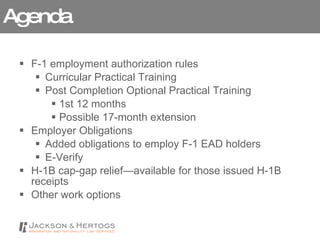
Agenda F-1 employment authorization rules Curricular Practical Training Post Completion Optional Practical Training 1st 12 months Possible 17-month extension Employer Obligations Added obligations to employ F-1 EAD holders  E-Verify H-1B cap-gap relief—available for those issued H-1B receipts Other work options
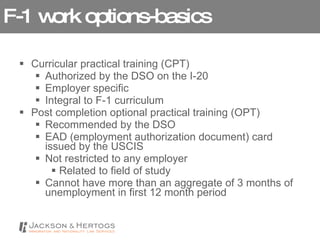
F-1 work options-basics Curricular practical training (CPT) Authorized by the DSO on the I-20 Employer specific Integral to F-1 curriculum Post completion optional practical training (OPT) Recommended by the DSO EAD (employment authorization document) card issued by the USCIS Not restricted to any employer Related to field of study Cannot have more than an aggregate of 3 months of unemployment in first 12 month period
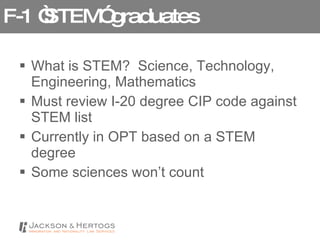
F-1 “STEM” graduates What is STEM?  Science, Technology, Engineering, Mathematics Must review I-20 degree CIP code against STEM list Currently in OPT based on a STEM degree  Some sciences won’t count
17 month STEM OPT extension 17 month extension of OPT = 29 months Employer must enroll in E-Verify Recent F-1 workers may immigrate without going to H-1B status Nonimmigrant intent issues Non-STEM F-1s are shut out from extension but still get initial12 month period
OPT STEM extension process Student graduated from listed STEM program and currently on OPT Student is offered employment with employer who is enrolled in E-Verify or will soon be DSO recommends the OPT extension and properly annotated I-20 issued for STEM employment Student submits Form I-765 with the employer’s E-Verify registration number and the new I-20 before current EAD expires Timely filed extension authorizes student to work after EAD expires up to 180 days (new receipt rule)
Obligations on the F-1 student For student granted STEM extension, must report within 10 days to DSO any change in:  Legal name Residential or mailing address E-mail address Employer name Employer address Report to DSO every 6 months with information above, even if no changes Requirement to report continues if student receives cap-gap extension Unemployment of more than 120 days over the total 29 month period places the individual out of status
Duration of reporting obligation Until a change of educational programs (e.g., BS graduate in CS returns to school to complete an MBA) Until a change of universities to complete a new degree in the same field, or Until 17 month OPT extension period ends If granted a change of status—reporting requirement ends
New employer obligations Register for E-Verify and provide registration number to student Reporting obligations Notify DSO within 48 hours of student terminating employment before end of 17 month period Hiring a student who is already in possession of a 17 month OPT extension Same reporting requirements and must be registered for E-Verify Question: How would subsequent employer know?
E-verify MOU among DHS, SSA and employer Employer agrees to use E-Verify for all new hires NOTE: this means that no current employees including the F-1s already employed will be included in E-Verify, ever. Unless pursuant to federal contractor rules which may go into effect May 2009 E-Verify is controversial, as employer liabilities are unclear E-Verify may be inevitable Required for 17-month OPT extension Shortly to be required by DHS for all federal contractors
E-verify: obligations Display notices Provide to SSA & DHS contact info for employer representatives (e.g., HR) Perform E-Verify on all new hires, not just foreign nationals Promise to take refresher tutorials Abide by all I-9 procedures Use photo tool to verify certain I-9 documents (currently: EAD & Green Cards) NOTE: employers can still NOT insist that certain documents be provided
E-verify: upshot Don’t register for E-Verify until your corporate counsel has given explicit authorization to do so Understand that hiring managers, recruiters and/or employees may push for registration without thought to the liabilities Registration must be considered within the overall employment policies and the decision to register must be at the executive level & I-9 procedures need to be reviewed/changed to comply That said, accept the fact that E-Verify as a universal requirement is probably inevitable
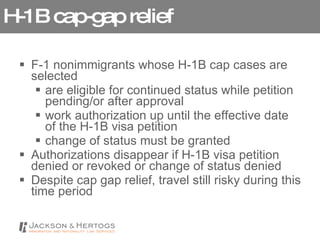
H-1B cap-gap relief F-1 nonimmigrants whose H-1B cap cases are selected  are eligible for continued status while petition pending/or after approval work authorization up until the effective date of the H-1B visa petition change of status must be granted  Authorizations disappear if H-1B visa petition denied or revoked or change of status denied Despite cap gap relief, travel still risky during this time period
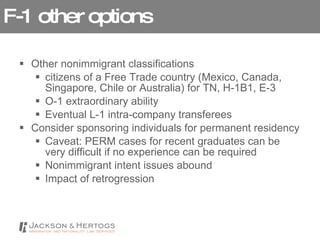
F-1 other options Other nonimmigrant classifications citizens of a Free Trade country (Mexico, Canada, Singapore, Chile or Australia) for TN, H-1B1, E-3  O-1 extraordinary ability Eventual L-1 intra-company transferees Consider sponsoring individuals for permanent residency Caveat: PERM cases for recent graduates can be very difficult if no experience can be required Nonimmigrant intent issues abound Impact of retrogression
Next webinar May 27, 2009 9:30 am (pacific) Alternatives to the H-1B category.   This webinar will address alternatives to the H-1B category. While there may not be options for all foreign national employees who were “shut out” of the H-1B cap, there are some alternatives that should be considered. Citizens of certain countries (e.g., Canada, Mexico, Chile, Singapore, & Australia) can often find work visas independent of the H-1B category. Further, certain international transferees, citizens of countries sharing nationality with foreign-owned corporations, and foreign nationals of “extraordinary ability” can also be eligible for visas independent of the H-1B.   (PHR/SPHR cert 1.5 hrs)  To register, please e-mail  [email_address]
Questions?

Hiring Students (April 2009)

  • 1.
    HIRING STUDENTS: CURRENTF-1 WORK AUTHORIZATION ISSUES Ilana Drummond and Nadia Johnson 415.986.4559 www.jackson-hertogs.com
  • 2.
    Agenda F-1 employmentauthorization rules Curricular Practical Training Post Completion Optional Practical Training 1st 12 months Possible 17-month extension Employer Obligations Added obligations to employ F-1 EAD holders E-Verify H-1B cap-gap relief—available for those issued H-1B receipts Other work options
  • 3.
    F-1 work options-basicsCurricular practical training (CPT) Authorized by the DSO on the I-20 Employer specific Integral to F-1 curriculum Post completion optional practical training (OPT) Recommended by the DSO EAD (employment authorization document) card issued by the USCIS Not restricted to any employer Related to field of study Cannot have more than an aggregate of 3 months of unemployment in first 12 month period
  • 4.
    F-1 “STEM” graduatesWhat is STEM? Science, Technology, Engineering, Mathematics Must review I-20 degree CIP code against STEM list Currently in OPT based on a STEM degree Some sciences won’t count
  • 5.
    17 month STEMOPT extension 17 month extension of OPT = 29 months Employer must enroll in E-Verify Recent F-1 workers may immigrate without going to H-1B status Nonimmigrant intent issues Non-STEM F-1s are shut out from extension but still get initial12 month period
  • 6.
    OPT STEM extensionprocess Student graduated from listed STEM program and currently on OPT Student is offered employment with employer who is enrolled in E-Verify or will soon be DSO recommends the OPT extension and properly annotated I-20 issued for STEM employment Student submits Form I-765 with the employer’s E-Verify registration number and the new I-20 before current EAD expires Timely filed extension authorizes student to work after EAD expires up to 180 days (new receipt rule)
  • 7.
    Obligations on theF-1 student For student granted STEM extension, must report within 10 days to DSO any change in: Legal name Residential or mailing address E-mail address Employer name Employer address Report to DSO every 6 months with information above, even if no changes Requirement to report continues if student receives cap-gap extension Unemployment of more than 120 days over the total 29 month period places the individual out of status
  • 8.
    Duration of reportingobligation Until a change of educational programs (e.g., BS graduate in CS returns to school to complete an MBA) Until a change of universities to complete a new degree in the same field, or Until 17 month OPT extension period ends If granted a change of status—reporting requirement ends
  • 9.
    New employer obligationsRegister for E-Verify and provide registration number to student Reporting obligations Notify DSO within 48 hours of student terminating employment before end of 17 month period Hiring a student who is already in possession of a 17 month OPT extension Same reporting requirements and must be registered for E-Verify Question: How would subsequent employer know?
  • 10.
    E-verify MOU amongDHS, SSA and employer Employer agrees to use E-Verify for all new hires NOTE: this means that no current employees including the F-1s already employed will be included in E-Verify, ever. Unless pursuant to federal contractor rules which may go into effect May 2009 E-Verify is controversial, as employer liabilities are unclear E-Verify may be inevitable Required for 17-month OPT extension Shortly to be required by DHS for all federal contractors
  • 11.
    E-verify: obligations Displaynotices Provide to SSA & DHS contact info for employer representatives (e.g., HR) Perform E-Verify on all new hires, not just foreign nationals Promise to take refresher tutorials Abide by all I-9 procedures Use photo tool to verify certain I-9 documents (currently: EAD & Green Cards) NOTE: employers can still NOT insist that certain documents be provided
  • 12.
    E-verify: upshot Don’tregister for E-Verify until your corporate counsel has given explicit authorization to do so Understand that hiring managers, recruiters and/or employees may push for registration without thought to the liabilities Registration must be considered within the overall employment policies and the decision to register must be at the executive level & I-9 procedures need to be reviewed/changed to comply That said, accept the fact that E-Verify as a universal requirement is probably inevitable
  • 13.
    H-1B cap-gap reliefF-1 nonimmigrants whose H-1B cap cases are selected are eligible for continued status while petition pending/or after approval work authorization up until the effective date of the H-1B visa petition change of status must be granted Authorizations disappear if H-1B visa petition denied or revoked or change of status denied Despite cap gap relief, travel still risky during this time period
  • 14.
    F-1 other optionsOther nonimmigrant classifications citizens of a Free Trade country (Mexico, Canada, Singapore, Chile or Australia) for TN, H-1B1, E-3 O-1 extraordinary ability Eventual L-1 intra-company transferees Consider sponsoring individuals for permanent residency Caveat: PERM cases for recent graduates can be very difficult if no experience can be required Nonimmigrant intent issues abound Impact of retrogression
  • 15.
    Next webinar May27, 2009 9:30 am (pacific) Alternatives to the H-1B category.  This webinar will address alternatives to the H-1B category. While there may not be options for all foreign national employees who were “shut out” of the H-1B cap, there are some alternatives that should be considered. Citizens of certain countries (e.g., Canada, Mexico, Chile, Singapore, & Australia) can often find work visas independent of the H-1B category. Further, certain international transferees, citizens of countries sharing nationality with foreign-owned corporations, and foreign nationals of “extraordinary ability” can also be eligible for visas independent of the H-1B.   (PHR/SPHR cert 1.5 hrs) To register, please e-mail [email_address]
  • 16.