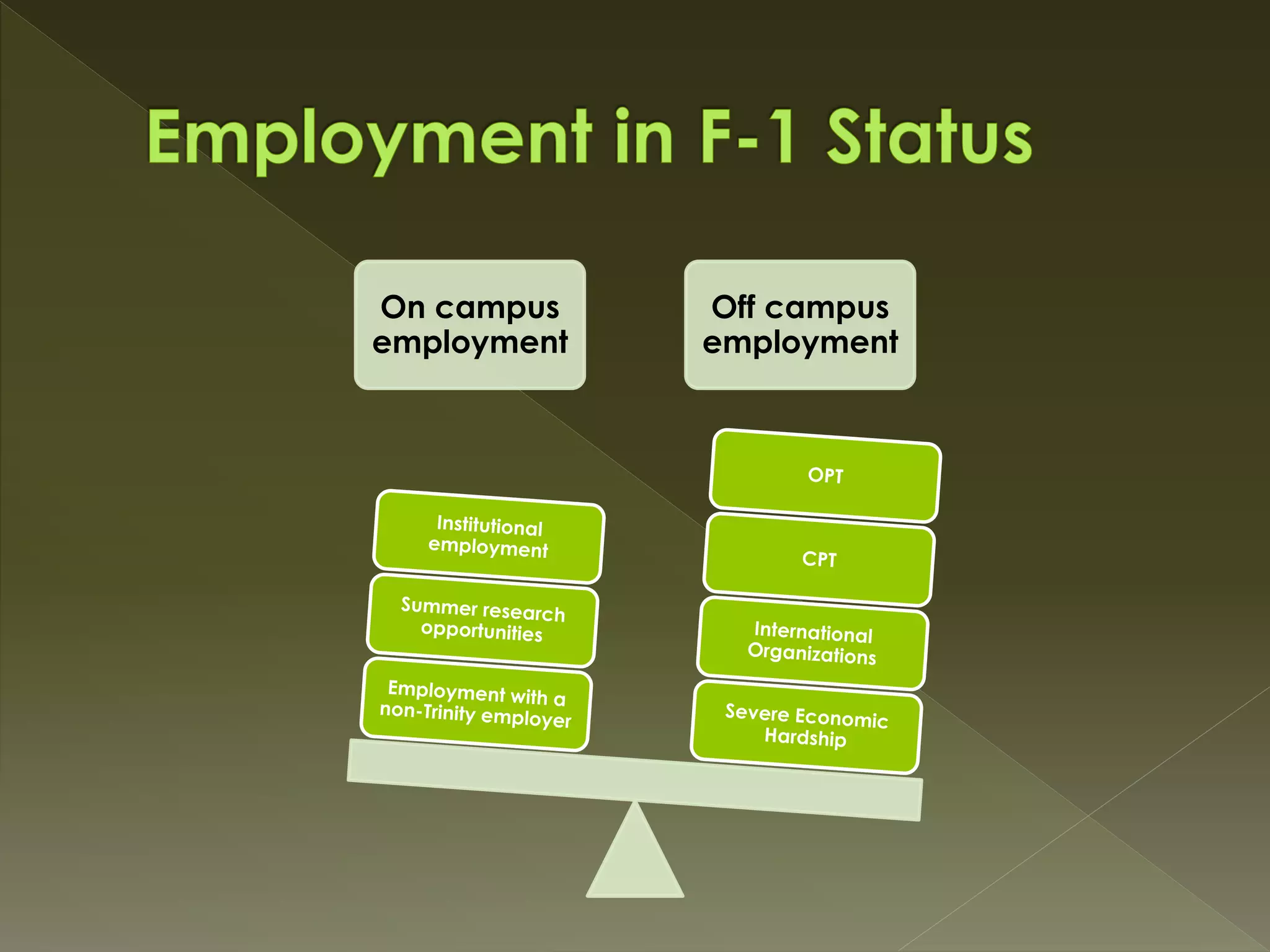
On campus
employment
Off campus
employment
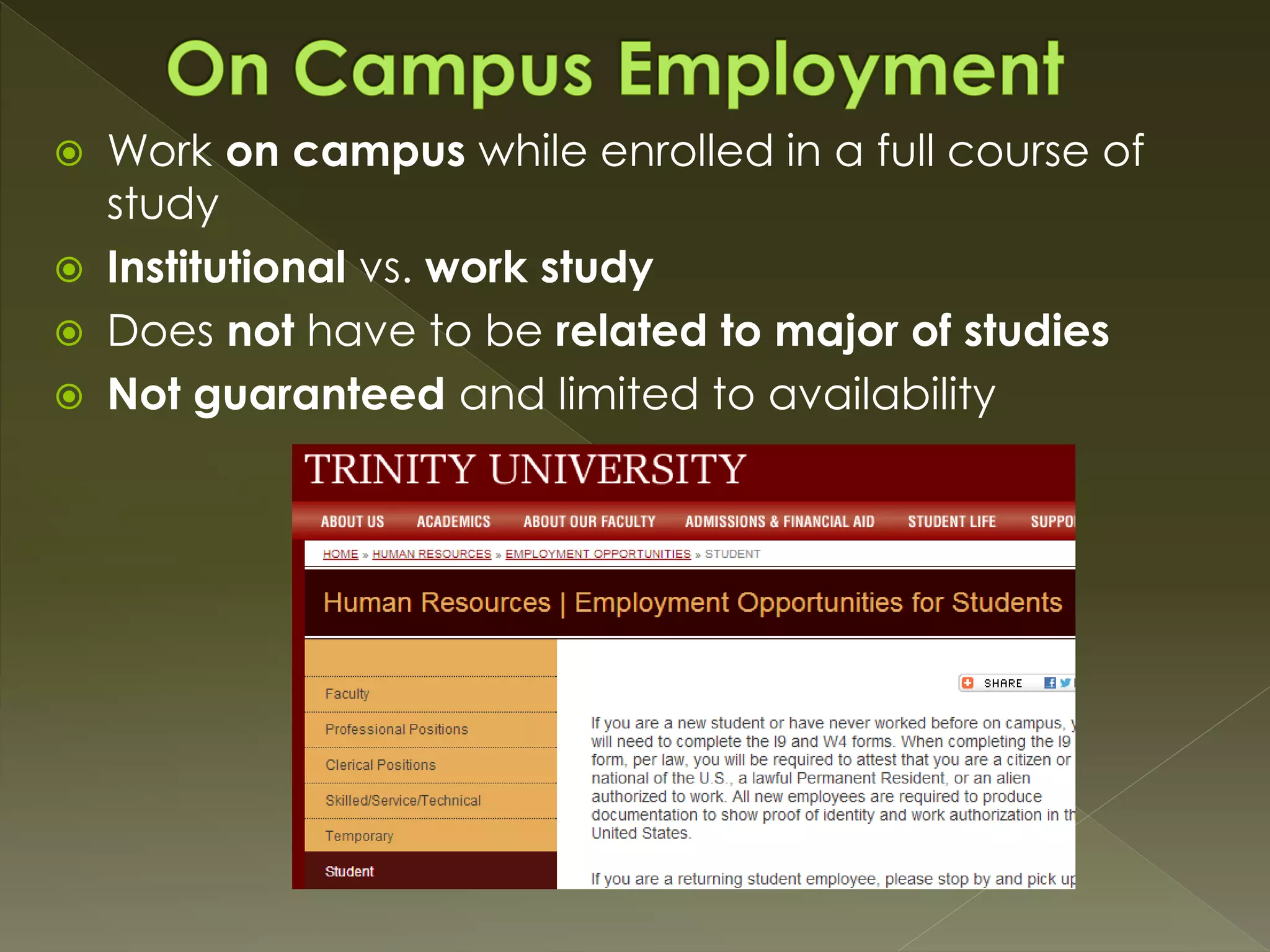
 Work on campus while enrolled in a full course of
study
 Institutional vs. work study
 Does not have to be related to major of studies
 Not guaranteed and limited to availability
 Allowed to work part-time (20
hours per week or less) during
the semester and full-time
(more than 20 hours per week)
during official school breaks
 On-campus employment must
provide direct student services
 Trinity University employers:
Aramark and Barnes & Noble
 Babysitting
 House cleaning
 Translating texts for the local town library
 Editing papers for other students online
 Working for outside companies
 Participating as a research subject
 An internship, or co-op that is an “an
integral part of an established curriculum”
 Must be part of a student’s program of
study, either required for completion or
optional, but for academic credit
 Most F-1 students are eligible for curricular
practical training after completing 1 full
year of academic study
 Is job specific, if you change employers or
employment terms, a new I-20 must be
issued
 May be part-time (20 hours per week or
less) or full-time (more than 20 hours per
week)
 International students who participate in
12 months or more of full-time CPT are
ineligible for OPT
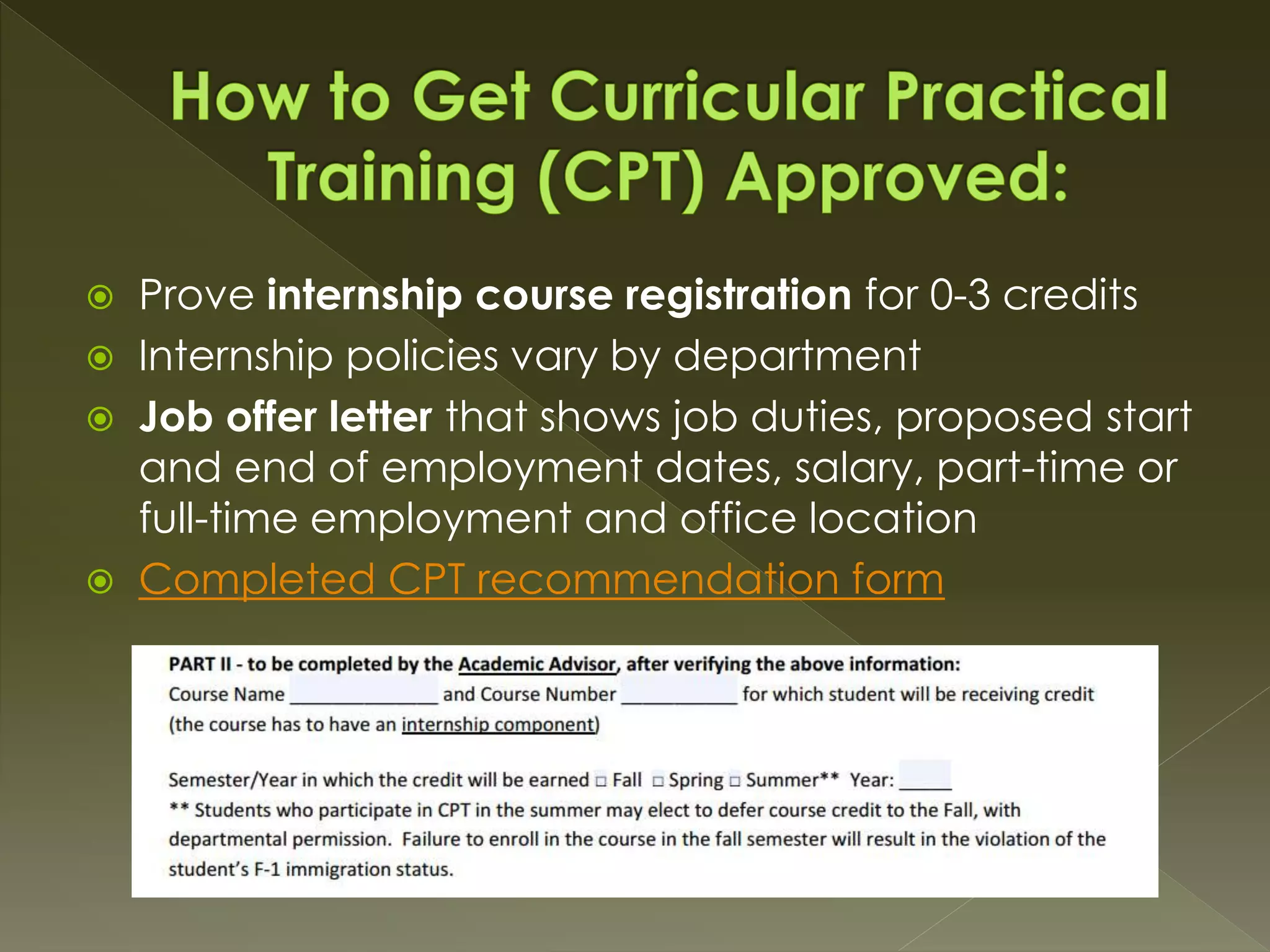
 Prove internship course registration for 0-3 credits
 Internship policies vary by department
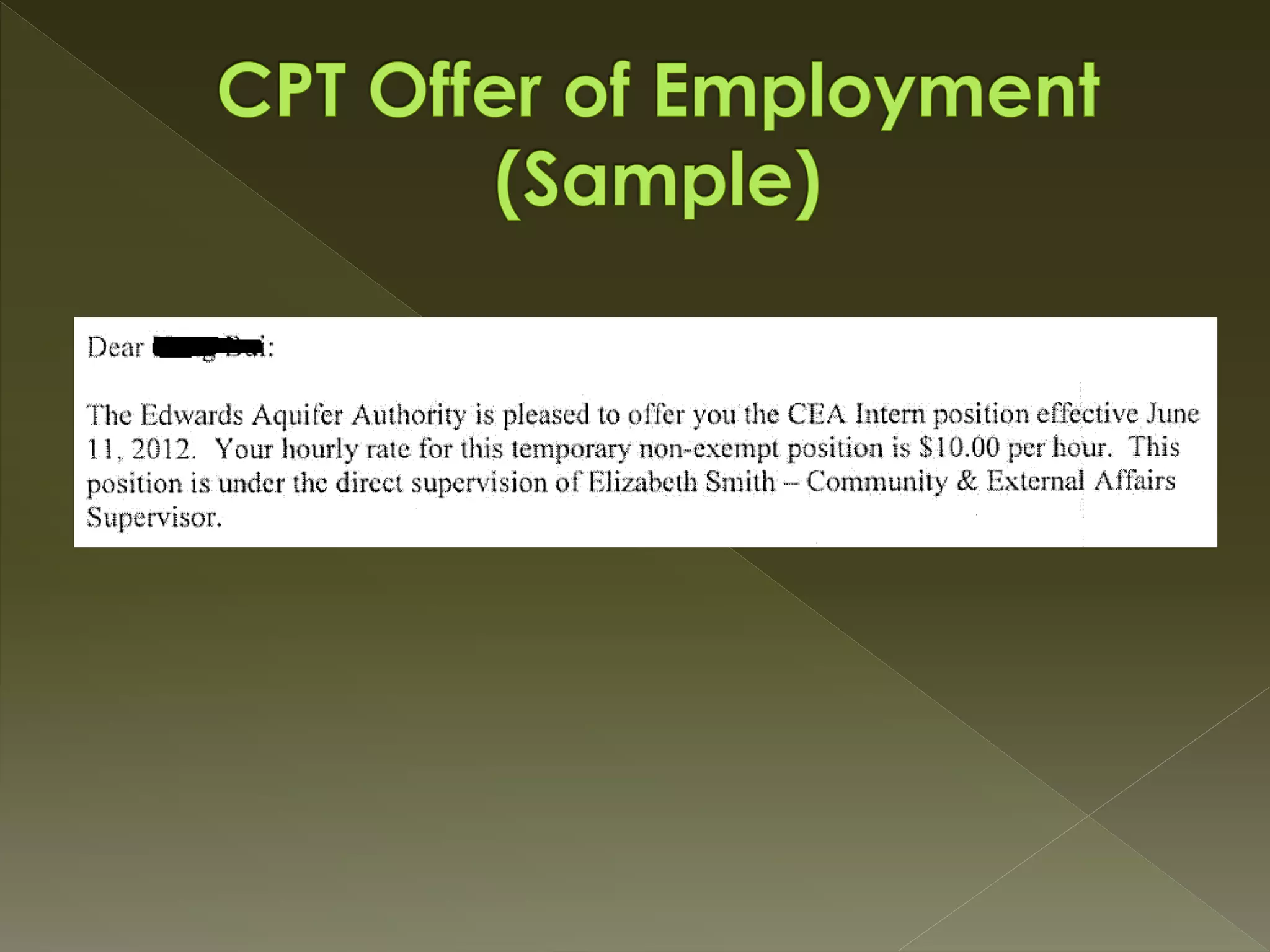
 Job offer letter that shows job duties, proposed start
and end of employment dates, salary, part-time or
full-time employment and office location
 Completed CPT recommendation form
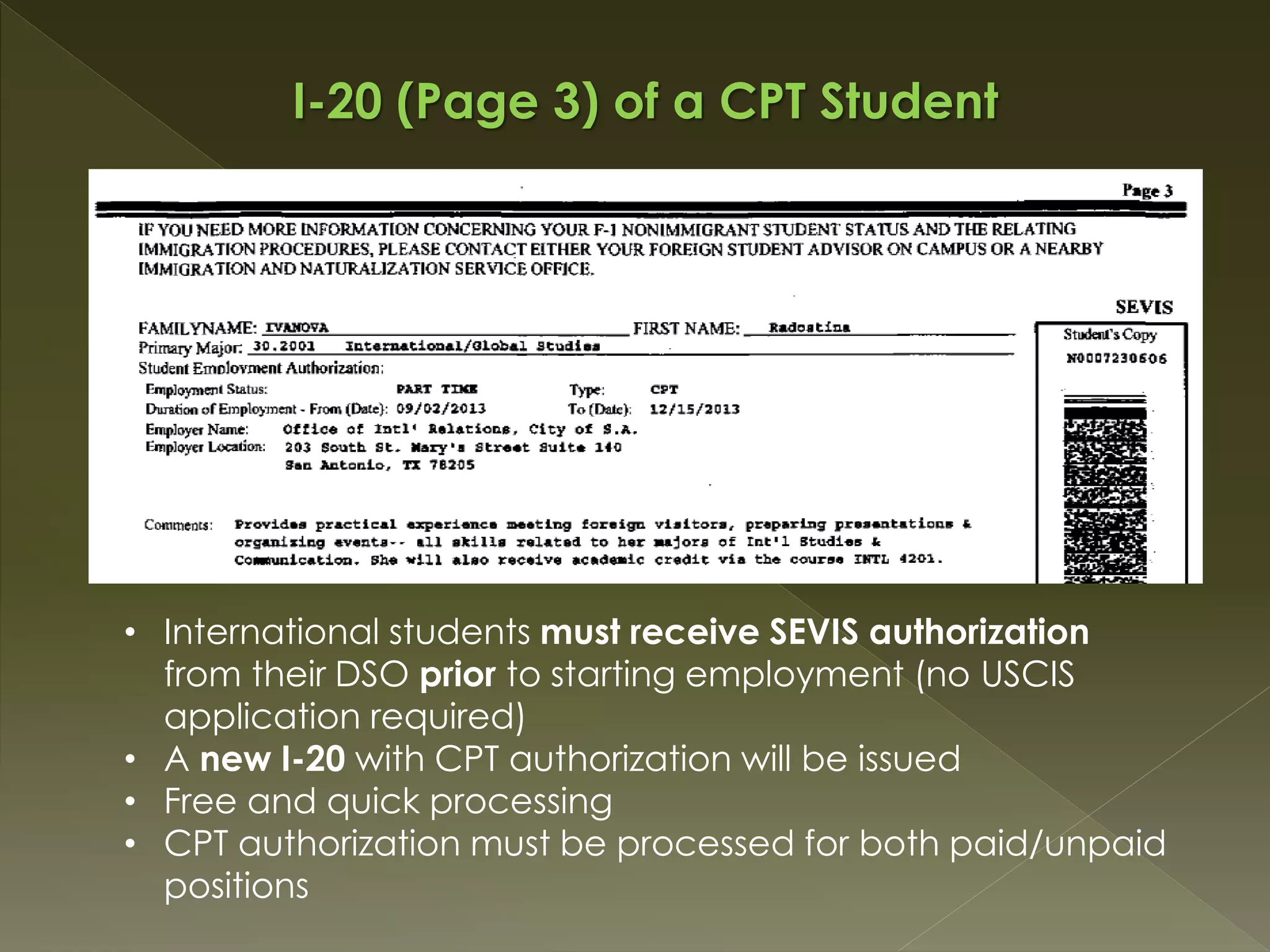
I-20 (Page 3) of a CPT Student
• International students must receive SEVIS authorization
from their DSO prior to starting employment (no USCIS
application required)
• A new I-20 with CPT authorization will be issued
• Free and quick processing
• CPT authorization must be processed for both paid/unpaid
positions
 related to a student’s field of study and
can occur during or after completion of
a program of study
 Does not have to be job specific
Pre-completion
 Rather uncommon
 Deducted from the
post-completion OPT
time (12 months)
 Must file a new petition
each time and include
processing fee
 More difficult to
establish a relationship
with an employer in a
short period of time
 Could be a good
option for STEM majors
 Prepare well in
advance
Post-completion
 No need to wait for a
job offer
 USCIS must receive
your application 120
days before or within
60 days after your
official graduation
date
 The application
process takes 2-3
months after the
application is mailed
 Prepare well in
advance
 Application components
 New I-20 processed by Trinity ISSS
 Copies of all previous I-20 form(s)
 Copies of all passport identity pages
 Copies of previous Employment
Authorization Documents (EAD cards)
 Money order for $380.00 payable to the
US department of Homeland Security
 Verification of enrollment with
anticipated graduation date from the
Office of the Registrar (verifying major(s))
 Application components
 2 recent passport-style photos on white
background
 electronic I-94 print out
 Your name and I-94 number must be printed
in pencil on the back of the photos
 Completed I-765 form
 Preferred beginning and end dates
 ISSS mails and monitors your OPT application.
You will receive scans of OPT petition submitted
for your record keeping purposes, original
Notice of Action documentation and an EAD
card when it is received by our office.
 Difficult to predict, but try to
estimate strategically
 Earliest start date: on or
after the program
completion date
 Latest start date: 60
calendar days after the
program completion date
 You cannot begin working
before you receive the EAD
and you reach the stated
start date
 Dates cannot be changed
after submitted, so think
carefully
 post-completion OPT students may be
eligible for a 17-month extension if they
received a degree in a DHS-designated
science, technology, engineering or
mathematics field
 What majors qualify?
 E-Verify
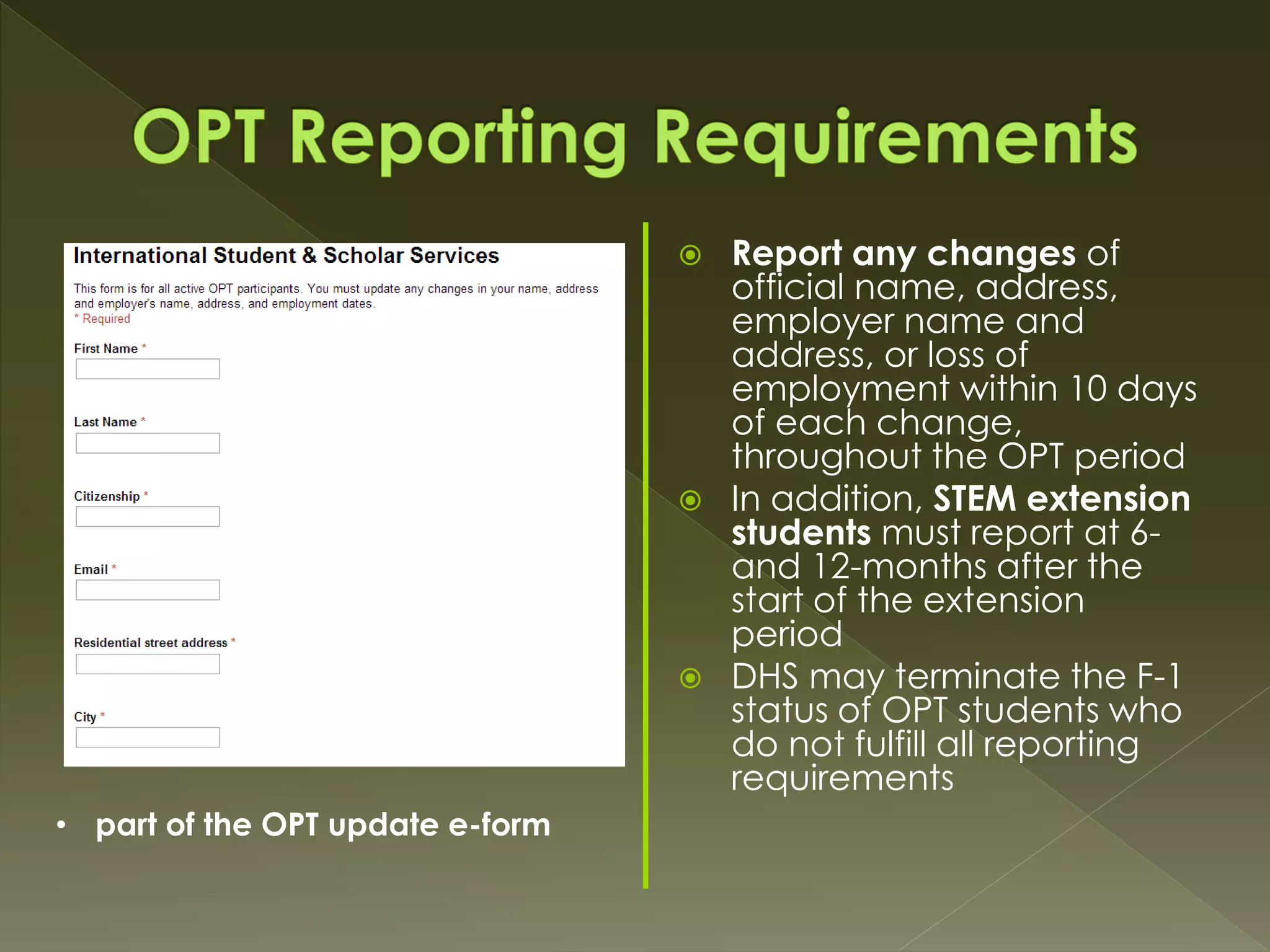
 Report any changes of
official name, address,
employer name and
address, or loss of
employment within 10 days
of each change,
throughout the OPT period
 In addition, STEM extension
students must report at 6-
and 12-months after the
start of the extension
period
 DHS may terminate the F-1
status of OPT students who
do not fulfill all reporting
requirements
• part of the OPT update e-form
 Paid employment of at
least 20 hours per week
 Unpaid employment
(volunteer/unpaid
internship) of at least 20
hours per week
 Multiple employers
 Work for hire/1099
employment
 Self-employed business
owner (student should
have evidence of proper
business licenses)
 Employment through an
agency or consulting firm
 The job must be directly
related to the major(s) and
educational level that is on
your current I-20
 You and the employer
make this determination
 You can change
employers as long as each
job is directly related to
your current major and
educational level
 If you withdraw your OPT
application, you lose the
paid SEVIS fee
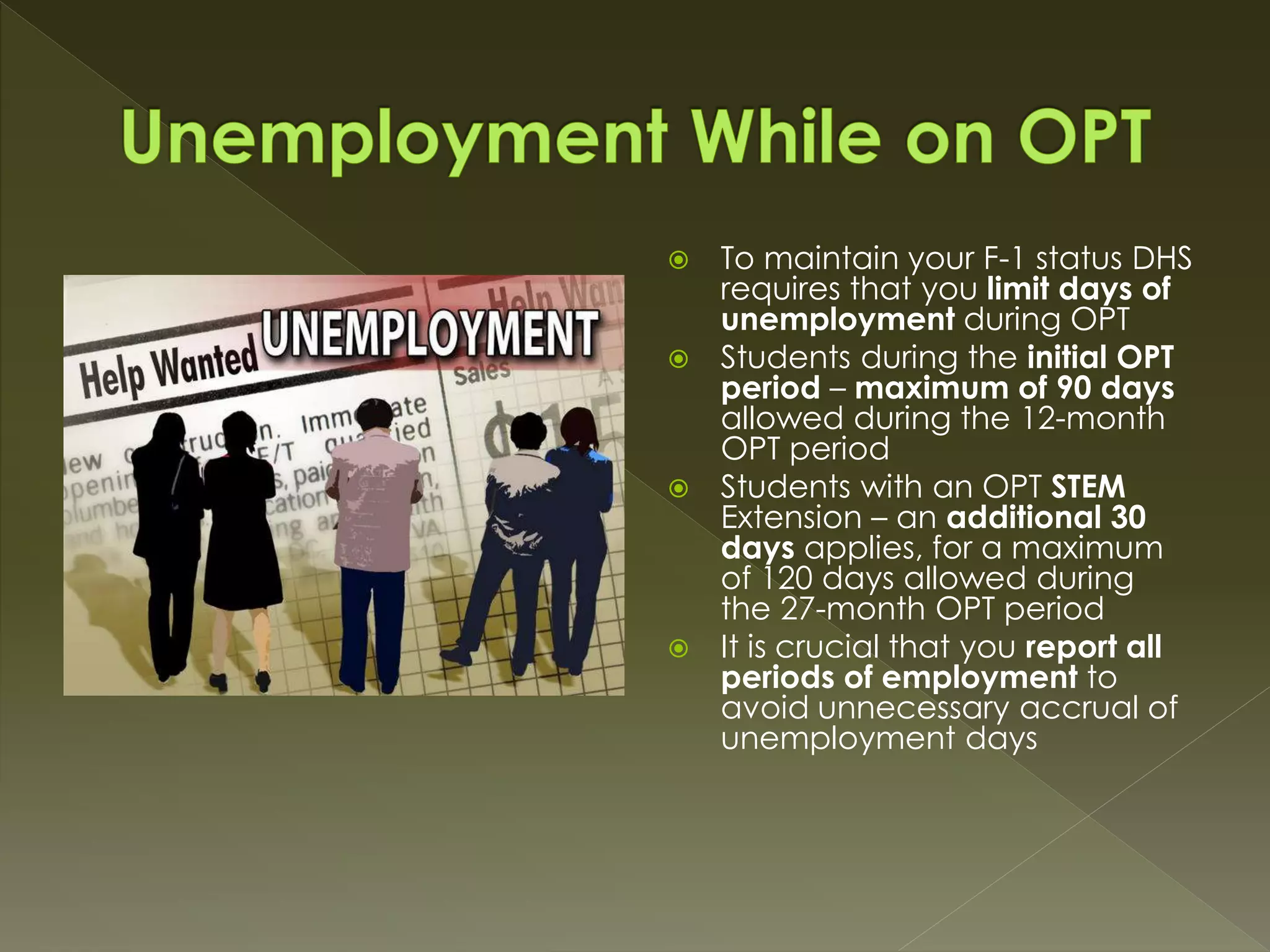
 To maintain your F-1 status DHS
requires that you limit days of
unemployment during OPT
 Students during the initial OPT
period – maximum of 90 days
allowed during the 12-month
OPT period
 Students with an OPT STEM
Extension – an additional 30
days applies, for a maximum
of 120 days allowed during
the 27-month OPT period
 It is crucial that you report all
periods of employment to
avoid unnecessary accrual of
unemployment days
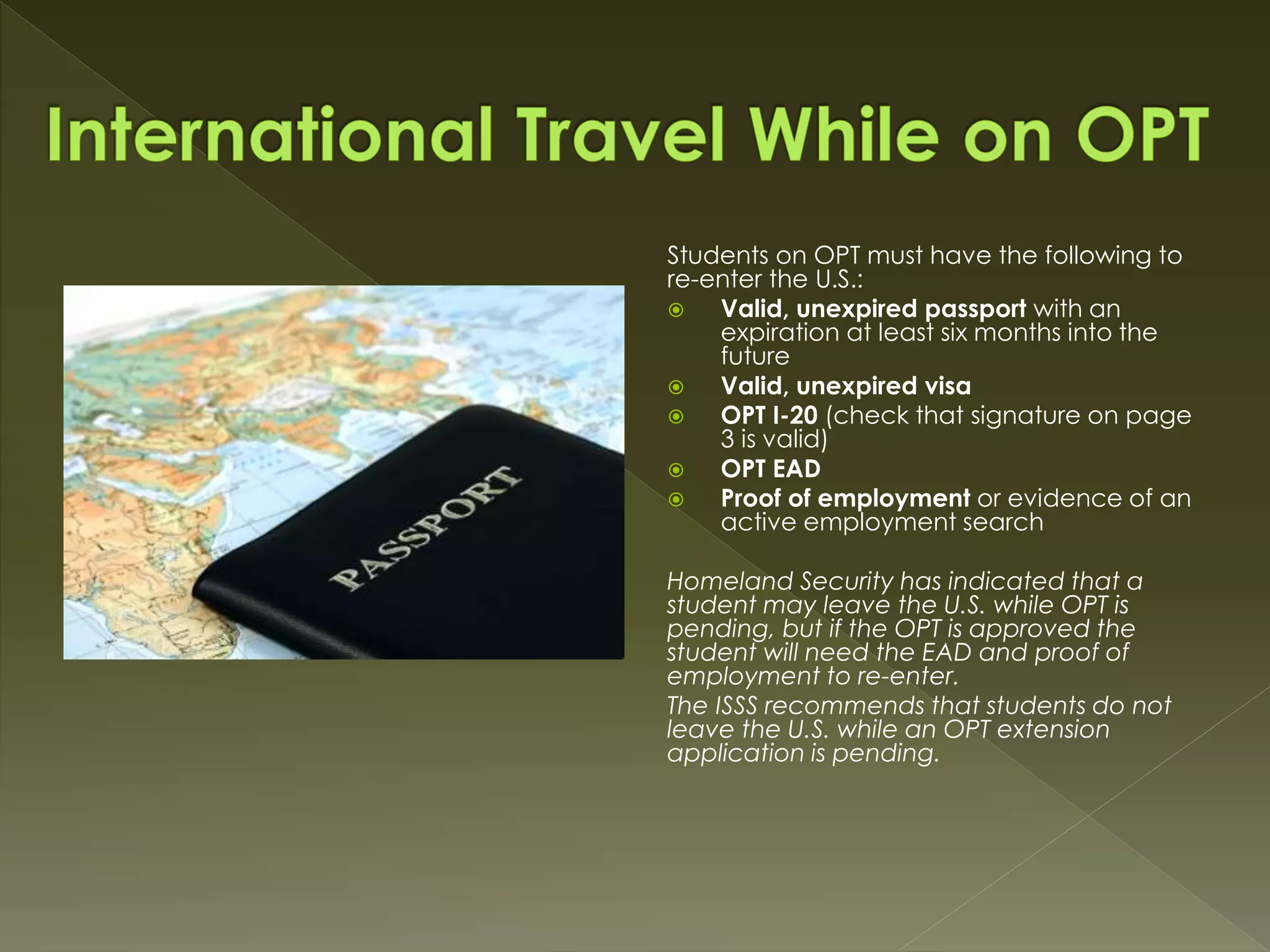
Students on OPT must have the following to
re-enter the U.S.:
 Valid, unexpired passport with an
expiration at least six months into the
future
 Valid, unexpired visa
 OPT I-20 (check that signature on page
3 is valid)
 OPT EAD
 Proof of employment or evidence of an
active employment search
Homeland Security has indicated that a
student may leave the U.S. while OPT is
pending, but if the OPT is approved the
student will need the EAD and proof of
employment to re-enter.
The ISSS recommends that students do not
leave the U.S. while an OPT extension
application is pending.
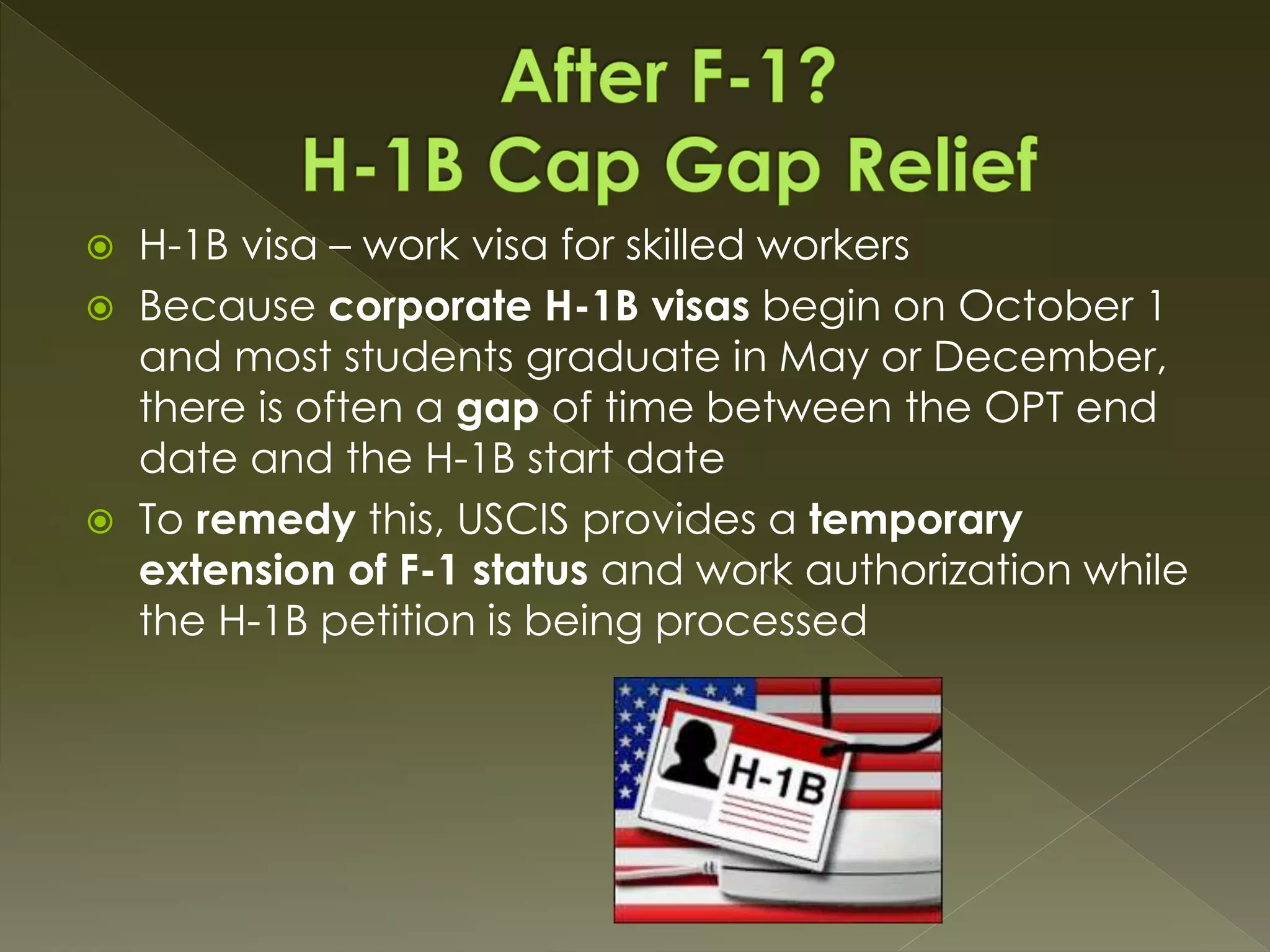
 H-1B visa – work visa for skilled workers
 Because corporate H-1B visas begin on October 1
and most students graduate in May or December,
there is often a gap of time between the OPT end
date and the H-1B start date
 To remedy this, USCIS provides a temporary
extension of F-1 status and work authorization while
the H-1B petition is being processed
 This benefit is offered only from April 1 to October 1
and only in conjunction with a corporate H-1B
petition that is pending or approved with an October
1 start date. The extension begins the day after the
OPT EAD end date and ends on October 1
 You can obtain a new I-20 that indicates this
extension and remain F-1 until the H-1B start date
 If your H-1B petition is denied or withdrawn and your
OPT has ended, your status ends 60 days from the
date posted on your denial/withdrawal
 H-1Bs with nonprofit organizations do not follow these
deadlines
 F-1 students suffering a severe economic
hardship due to unforeseen changes in their
financial circumstances
 Eligibility:
 Be in F-1 status for one academic year
 Be in good academic standing
 On campus opportunities are unavailable or
insufficient to meet your needs
 Examples of circumstances: loss of financial
support or employment, medical bills, etc.
 Application processing – 2-3 months
 Application:
 Form I-765
 $380 fee (can request to waive the fee due
to extreme economic hardship)
 Photocopy of I-20 form with your ISSS
adviser’s recommendation for economic
hardship employment
 A letter describing your financial situation
and supporting evidence
 Photocopies of passport/visa pages
 Photocopies of previous EAD pages (if
applicable)
 You may work for a qualified
international organization, as defined by
the International Organization Immunities
Act of December 29, 1945
 If you have an offer from an employer on
the List of International Organizations you
may apply to the United States
Citizenship and Immigration Services
(USCIS)for an EAD
 Application process: similar to the
employment based on severe economic
hardship’s application process
 Aimed to relieve student coming from
countries suffering from temporary
economic/ civil unrest
 2012 – 2015: special student relief (SSR)
benefits to F-1 students from Syria who
are “experiencing severe economic
hardship as a direct result of civil unrest”
 Eligibility criteria
 On-campus benefits
 Off-campus benefits
When considering an employment off
campus, ask ISSS Advisor before pursuing
employment-- regulations often change and
information from friends or family may not be
accurate. Homeland Security is increasingly
strict about employment violations. There can
be severe penalties for working without
proper permission, including exclusion from
the US for up to ten years.
 Email: isss@trinity.edu
 Website: http://web.trinity.edu/x9118.xml
 Facebook:
http://facebook.com/trinityisss
 Inessa Stepanenko
Assistant Director, International Student &
Scholar Services
istepane@trinity.edu
(210) 999-7313

Employment in F-1 Status

  • 2.
  • 3.
     Work oncampus while enrolled in a full course of study  Institutional vs. work study  Does not have to be related to major of studies  Not guaranteed and limited to availability
  • 4.
     Allowed towork part-time (20 hours per week or less) during the semester and full-time (more than 20 hours per week) during official school breaks  On-campus employment must provide direct student services  Trinity University employers: Aramark and Barnes & Noble
  • 5.
     Babysitting  Housecleaning  Translating texts for the local town library  Editing papers for other students online  Working for outside companies  Participating as a research subject
  • 6.
     An internship,or co-op that is an “an integral part of an established curriculum”  Must be part of a student’s program of study, either required for completion or optional, but for academic credit  Most F-1 students are eligible for curricular practical training after completing 1 full year of academic study  Is job specific, if you change employers or employment terms, a new I-20 must be issued
  • 7.
     May bepart-time (20 hours per week or less) or full-time (more than 20 hours per week)  International students who participate in 12 months or more of full-time CPT are ineligible for OPT
  • 8.
     Prove internshipcourse registration for 0-3 credits  Internship policies vary by department  Job offer letter that shows job duties, proposed start and end of employment dates, salary, part-time or full-time employment and office location  Completed CPT recommendation form
  • 10.
    I-20 (Page 3)of a CPT Student • International students must receive SEVIS authorization from their DSO prior to starting employment (no USCIS application required) • A new I-20 with CPT authorization will be issued • Free and quick processing • CPT authorization must be processed for both paid/unpaid positions
  • 11.
     related toa student’s field of study and can occur during or after completion of a program of study  Does not have to be job specific
  • 12.
    Pre-completion  Rather uncommon Deducted from the post-completion OPT time (12 months)  Must file a new petition each time and include processing fee  More difficult to establish a relationship with an employer in a short period of time  Could be a good option for STEM majors  Prepare well in advance Post-completion  No need to wait for a job offer  USCIS must receive your application 120 days before or within 60 days after your official graduation date  The application process takes 2-3 months after the application is mailed  Prepare well in advance
  • 13.
     Application components New I-20 processed by Trinity ISSS  Copies of all previous I-20 form(s)  Copies of all passport identity pages  Copies of previous Employment Authorization Documents (EAD cards)  Money order for $380.00 payable to the US department of Homeland Security  Verification of enrollment with anticipated graduation date from the Office of the Registrar (verifying major(s))
  • 14.
     Application components 2 recent passport-style photos on white background  electronic I-94 print out  Your name and I-94 number must be printed in pencil on the back of the photos  Completed I-765 form  Preferred beginning and end dates  ISSS mails and monitors your OPT application. You will receive scans of OPT petition submitted for your record keeping purposes, original Notice of Action documentation and an EAD card when it is received by our office.
  • 15.
     Difficult topredict, but try to estimate strategically  Earliest start date: on or after the program completion date  Latest start date: 60 calendar days after the program completion date  You cannot begin working before you receive the EAD and you reach the stated start date  Dates cannot be changed after submitted, so think carefully
  • 16.
     post-completion OPTstudents may be eligible for a 17-month extension if they received a degree in a DHS-designated science, technology, engineering or mathematics field  What majors qualify?  E-Verify
  • 17.
     Report anychanges of official name, address, employer name and address, or loss of employment within 10 days of each change, throughout the OPT period  In addition, STEM extension students must report at 6- and 12-months after the start of the extension period  DHS may terminate the F-1 status of OPT students who do not fulfill all reporting requirements • part of the OPT update e-form
  • 18.
     Paid employmentof at least 20 hours per week  Unpaid employment (volunteer/unpaid internship) of at least 20 hours per week  Multiple employers  Work for hire/1099 employment  Self-employed business owner (student should have evidence of proper business licenses)  Employment through an agency or consulting firm  The job must be directly related to the major(s) and educational level that is on your current I-20  You and the employer make this determination  You can change employers as long as each job is directly related to your current major and educational level  If you withdraw your OPT application, you lose the paid SEVIS fee
  • 19.
     To maintainyour F-1 status DHS requires that you limit days of unemployment during OPT  Students during the initial OPT period – maximum of 90 days allowed during the 12-month OPT period  Students with an OPT STEM Extension – an additional 30 days applies, for a maximum of 120 days allowed during the 27-month OPT period  It is crucial that you report all periods of employment to avoid unnecessary accrual of unemployment days
  • 20.
    Students on OPTmust have the following to re-enter the U.S.:  Valid, unexpired passport with an expiration at least six months into the future  Valid, unexpired visa  OPT I-20 (check that signature on page 3 is valid)  OPT EAD  Proof of employment or evidence of an active employment search Homeland Security has indicated that a student may leave the U.S. while OPT is pending, but if the OPT is approved the student will need the EAD and proof of employment to re-enter. The ISSS recommends that students do not leave the U.S. while an OPT extension application is pending.
  • 21.
     H-1B visa– work visa for skilled workers  Because corporate H-1B visas begin on October 1 and most students graduate in May or December, there is often a gap of time between the OPT end date and the H-1B start date  To remedy this, USCIS provides a temporary extension of F-1 status and work authorization while the H-1B petition is being processed
  • 22.
     This benefitis offered only from April 1 to October 1 and only in conjunction with a corporate H-1B petition that is pending or approved with an October 1 start date. The extension begins the day after the OPT EAD end date and ends on October 1  You can obtain a new I-20 that indicates this extension and remain F-1 until the H-1B start date  If your H-1B petition is denied or withdrawn and your OPT has ended, your status ends 60 days from the date posted on your denial/withdrawal  H-1Bs with nonprofit organizations do not follow these deadlines
  • 23.
     F-1 studentssuffering a severe economic hardship due to unforeseen changes in their financial circumstances  Eligibility:  Be in F-1 status for one academic year  Be in good academic standing  On campus opportunities are unavailable or insufficient to meet your needs  Examples of circumstances: loss of financial support or employment, medical bills, etc.  Application processing – 2-3 months
  • 24.
     Application:  FormI-765  $380 fee (can request to waive the fee due to extreme economic hardship)  Photocopy of I-20 form with your ISSS adviser’s recommendation for economic hardship employment  A letter describing your financial situation and supporting evidence  Photocopies of passport/visa pages  Photocopies of previous EAD pages (if applicable)
  • 25.
     You maywork for a qualified international organization, as defined by the International Organization Immunities Act of December 29, 1945  If you have an offer from an employer on the List of International Organizations you may apply to the United States Citizenship and Immigration Services (USCIS)for an EAD  Application process: similar to the employment based on severe economic hardship’s application process
  • 26.
     Aimed torelieve student coming from countries suffering from temporary economic/ civil unrest  2012 – 2015: special student relief (SSR) benefits to F-1 students from Syria who are “experiencing severe economic hardship as a direct result of civil unrest”  Eligibility criteria  On-campus benefits  Off-campus benefits
  • 27.
    When considering anemployment off campus, ask ISSS Advisor before pursuing employment-- regulations often change and information from friends or family may not be accurate. Homeland Security is increasingly strict about employment violations. There can be severe penalties for working without proper permission, including exclusion from the US for up to ten years.
  • 28.
     Email: isss@trinity.edu Website: http://web.trinity.edu/x9118.xml  Facebook: http://facebook.com/trinityisss  Inessa Stepanenko Assistant Director, International Student & Scholar Services istepane@trinity.edu (210) 999-7313