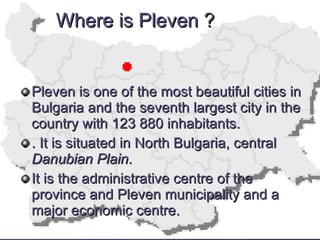
Pleven is one of the most beautiful cities in Bulgaria and the seventh largest city in the country with 123 880 inhabitants. . It is situated in North Bulgaria, central  Danubian Plain .  It is the administrative centre of the province and Pleven municipality and a major economic centre. Where is Pleven ?
of Pleven
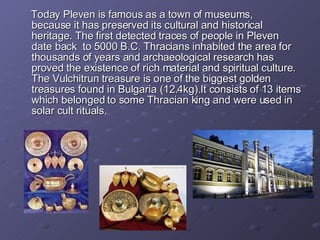
Today Pleven is  famous as a  town of   museums, because  it has preserved  its cultur al  and historical   heritage. The first detected traces of people in   Pleven  date back  to   5000   B.C .  Thracians inhabited the area for thousands of years and  arch a eolog ical   research   has proved   the existence of rich material   and spiritual  culture . The  Vulch it run  treasure is one  of  the  biggest gold en  treasure s  f ou nd  in Bulgaria (12.4kg).It consists of 13 items which belonged to some Thracian king and were used in solar cult rituals.
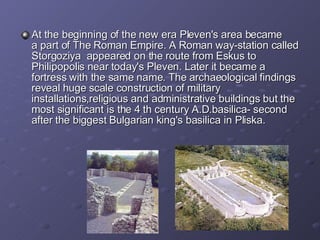
At  the beginning of the new era Pleven's area bec a me a part of The Roman Empire.  A Roman  way-station called Storgozi y a  appeared on t he route  from  Es k us  to Ph ilipopolis  near  today's Pleven . L ater it bec a me a fortress  with the same name.  The a rchaeological find ing s  reveal  huge  scale construction  of military installations , religio u s and administrative buildings  but the most significant is the 4 th  century  A.D. basilica -  second after   the biggest Bulgarian king's basilica in Pliska.
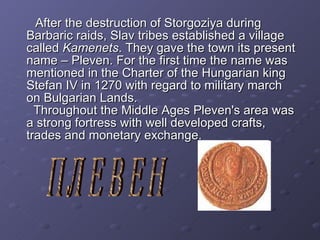
After the destruction of Storgoziya during Barbaric raids, Slav tribes established a village called  Kamenets . They gave the town its present name – Pleven. For the first time the name was mentioned in the Charter of the Hungarian king Stefan IV in 1270 with regard to military march on Bulgarian Lands.   Through ou t the Middle Ages Pleven's area was a strong  fortress  with  well developed  crafts, trades and  monetary exchange . ПЛЕВЕН
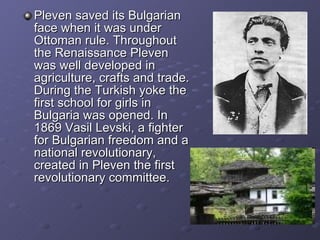
Pleven saved its Bulgarian face when it was under   Ottoman rule. Through ou t the Renaissance Pleven was   well  developed in agriculture ,  crafts and trade. During the Turkish yoke the  first school for girls  in Bulgaria was  open ed . In 1869 Vasil Levski,  a  fighter for   Bulgarian freedom  and a national revolutionary , create d  in Pleven the first   revolution ary  committee.
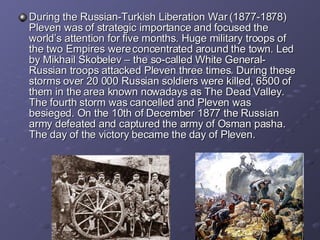
During the  Russia n-Turkish Liberation War (1877-1878) Pleven was of strategic importance and focused the world’s attention for five months. Huge military troops of the two Empires were concentrated around the town. Led by Mikhail Skobelev – the so-called White General- Russian troops attacked Pleven three times. During these storms over 20 000 Russian soldiers were killed, 6500 of them in the area known nowadays as The Dead Valley. The fourth storm was cancelled and Pleven was besieged. On the 10th of December 1877 the Russian army defeated and captured the army of Osman pasha.  The day of the victory   bec a me  the  day of Pleven.
today
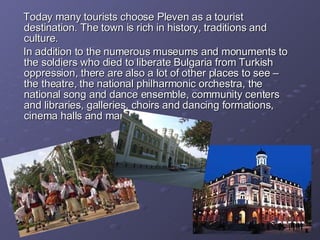
Today many tourists choose Pleven as a tourist destination. The town is rich in history, traditions and culture. In addition to the numerous museums and monuments to the soldiers who died to liberate Bulgaria from Turkish oppression, there are also a lot of other places to see – the theatre, the national philharmonic orchestra, the national song and dance ensemble, community centers and libraries, galleries, choirs and dancing formations, cinema halls and many more.
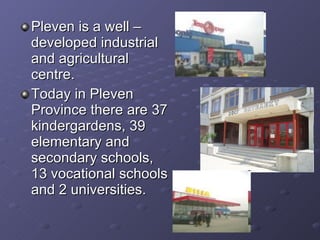
Pleven is a well – developed industrial and agricultural centre. Today in Pleven Province there are 37 kindergardens, 39 elementary and secondary schools,  13 vocational schools and 2 universities.
.
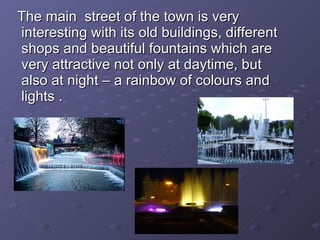
The main  street of the town is very interesting with its old buildings, different shops and beautiful fountains which are very attractive not only at daytime, but also at night – a rainbow of colours and lights .
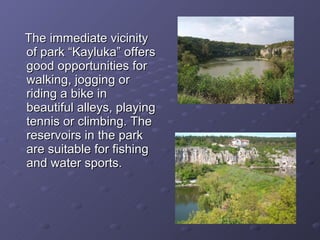
The immediate vicinity of park “Kayluka” offers good opportunities for walking, jogging or riding a bike in beautiful alleys, playing tennis or climbing. The reservoirs in the park are suitable for fishing and water sports.
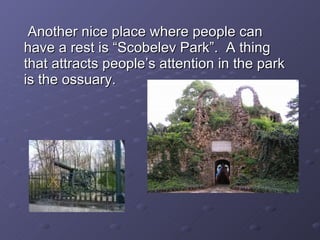
Another nice place where people can have a rest is “Scobelev Park”.  A thing that attracts people’s attention in the park is the ossuary.
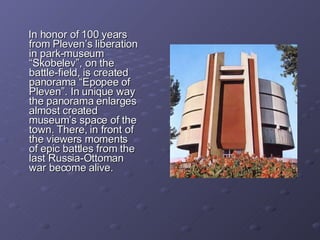
In honor of 100 years from Pleven’s liberation in park-museum “Skobelev”, on the battle-field, is created panorama “Epopee of Pleven”. In unique way the panorama enlarges almost created museum’s space of the town. There, in front of the viewers moments of epic battles from the last Russia-Ottoman war become alive.

Pleven - our hometown by Manuela and Temenuzhka

  • 1.
    Pleven is oneof the most beautiful cities in Bulgaria and the seventh largest city in the country with 123 880 inhabitants. . It is situated in North Bulgaria, central Danubian Plain . It is the administrative centre of the province and Pleven municipality and a major economic centre. Where is Pleven ?
  • 2.
  • 3.
    Today Pleven is famous as a town of museums, because it has preserved its cultur al and historical heritage. The first detected traces of people in Pleven date back to 5000 B.C . Thracians inhabited the area for thousands of years and arch a eolog ical research has proved the existence of rich material and spiritual culture . The Vulch it run treasure is one of the biggest gold en treasure s f ou nd in Bulgaria (12.4kg).It consists of 13 items which belonged to some Thracian king and were used in solar cult rituals.
  • 4.
    At thebeginning of the new era Pleven's area bec a me a part of The Roman Empire. A Roman way-station called Storgozi y a appeared on t he route from Es k us to Ph ilipopolis near today's Pleven . L ater it bec a me a fortress with the same name. The a rchaeological find ing s reveal huge scale construction of military installations , religio u s and administrative buildings but the most significant is the 4 th century A.D. basilica - second after the biggest Bulgarian king's basilica in Pliska.
  • 5.
    After the destructionof Storgoziya during Barbaric raids, Slav tribes established a village called Kamenets . They gave the town its present name – Pleven. For the first time the name was mentioned in the Charter of the Hungarian king Stefan IV in 1270 with regard to military march on Bulgarian Lands. Through ou t the Middle Ages Pleven's area was a strong fortress with well developed crafts, trades and monetary exchange . ПЛЕВЕН
  • 6.
    Pleven saved itsBulgarian face when it was under Ottoman rule. Through ou t the Renaissance Pleven was well developed in agriculture , crafts and trade. During the Turkish yoke the first school for girls in Bulgaria was open ed . In 1869 Vasil Levski, a fighter for Bulgarian freedom and a national revolutionary , create d in Pleven the first revolution ary committee.
  • 7.
    During the Russia n-Turkish Liberation War (1877-1878) Pleven was of strategic importance and focused the world’s attention for five months. Huge military troops of the two Empires were concentrated around the town. Led by Mikhail Skobelev – the so-called White General- Russian troops attacked Pleven three times. During these storms over 20 000 Russian soldiers were killed, 6500 of them in the area known nowadays as The Dead Valley. The fourth storm was cancelled and Pleven was besieged. On the 10th of December 1877 the Russian army defeated and captured the army of Osman pasha. The day of the victory bec a me the day of Pleven.
  • 8.
  • 9.
    Today many touristschoose Pleven as a tourist destination. The town is rich in history, traditions and culture. In addition to the numerous museums and monuments to the soldiers who died to liberate Bulgaria from Turkish oppression, there are also a lot of other places to see – the theatre, the national philharmonic orchestra, the national song and dance ensemble, community centers and libraries, galleries, choirs and dancing formations, cinema halls and many more.
  • 10.
    Pleven is awell – developed industrial and agricultural centre. Today in Pleven Province there are 37 kindergardens, 39 elementary and secondary schools, 13 vocational schools and 2 universities.
  • 11.
  • 12.
    The main street of the town is very interesting with its old buildings, different shops and beautiful fountains which are very attractive not only at daytime, but also at night – a rainbow of colours and lights .
  • 13.
    The immediate vicinityof park “Kayluka” offers good opportunities for walking, jogging or riding a bike in beautiful alleys, playing tennis or climbing. The reservoirs in the park are suitable for fishing and water sports.
  • 14.
    Another nice placewhere people can have a rest is “Scobelev Park”. A thing that attracts people’s attention in the park is the ossuary.
  • 15.
    In honor of100 years from Pleven’s liberation in park-museum “Skobelev”, on the battle-field, is created panorama “Epopee of Pleven”. In unique way the panorama enlarges almost created museum’s space of the town. There, in front of the viewers moments of epic battles from the last Russia-Ottoman war become alive.