AMARAVATI – HISTORICAL SKETCH OF AMARAVATHI
Amaravati and Dharankikota are located on the south bank of the River
Krishna about 35 kilometers north of Guntur city. Colonel Meckenzie who
visited the place in 1818 with a band of Assistants and excavated of the site. A
few sculptured pieces were also recovered by him. In 1845, Sir Walter Smith
excavated the south-west part of the mound and recovered a few sculptured
pieces. Robert Sewell (in 1877), James Burges (in 1881) and Alexander Rea
(in 1888-89) made attempts to excavate and record the sculptured stones
systematically. Rea conducted more attempts in 1905-06 and 1908-09. During
the year 1958-59, under R. Subrahmanyam and K. Krishna Murthy of the
Archaeological Survey brought to view a large number of Architectural pieces.
Some more sculptural slabs were exposed in an excavation carried out by
I.K.Sharma in 1973-74. In the year of 1962-65, M. Venkata Ramanayya and K.
Raghavachary, they were revealed five periods of occupation of the site (H.
Sarkar, 1992, Amaravati). According to Megasthanese, Andhras had 30 towns.
They were 30 clans. Asmikas (Nizamabad), Sibikas (Karimnagar), Mahisakas
(Nalgonda), Nagas (Dharanikota), Yakhas (Bhattiprolu), Somokhas
(Vaddamanu) (B.S.L. Hanumantha Rao, 1995).
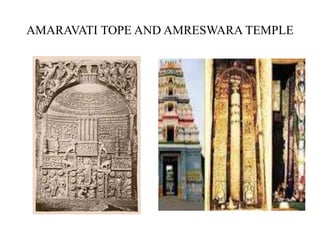
AMARAVATI TOPE AND AMRESWARA TEMPLE
Amaravathi stupa was constructed in5 phases.
First phase : Asokan
Second phase : Post-Asokan
Third phase : Satavahana
Fourth phase : Ekshvaku
Fifth phase : Early Pallava to late medival.
Inscriptional Evidences : Some inscriptions find at
Amaravati. They are:
Komma Nayaka inscription 1158 A.D.
Keta Raja inscription 1258 A.D.
Anavema Reddy inscription 1361 A.D.
Rayala inscription 1517 A.D.
Handrikam Peddappam inscription 1621 A.D
Vasireddy Venkatadri Naidu inscription 1785 A.D.
(Dr. D. Deekshitulu, 2002).
NAGARJUNA KONDA
• NAGARJUNA KONDA (Historical Background)
Nagarjunakonda, the name of valley situated on the right
bank of River Krishna 22 km to the west of Macherla in
Palanadu taluk of the Guntur district, Andhra Pradesh. In
historical times, later Satavahanas ruled this place, they were
Gautamiputra Satakarni, Pulomavi, Yagna Sri Satakarni,
successors of the satavahanas were in the first quarter of the
3rd century A.D. The founder of the Ikshvaku dynasty
established his capital, Vijayapuri, it is interesting to note
that inscriptions of the Ikshvakus mention Vijayapuri
invariably with reference to Sriparvata (E.I. Vol. XX).
Historical Perspective of this Region
The written history of the Nagarjunakonda valley begins with later
Satavahanas. They were mentioned their name in one inscription which was
founded at Nagarjunakonda valley (I.A.R. 1962-62, p. 77). Satavahana
kings were Goutamiputra Satakarni, Pulomavi, Yagnasri etc. This
inscription tells us about that Buddhism had penetrated into the valley well
before the advert of the Ikshvakus. In the time of Satavahanas, decline
Nagarjunakonda rose to prominence only in the
wake of power when Vasishtiputra Chantamula. The Founder of Ikshvaku
dynasty (I.A.R. 1957-58, pp. 8-9) (1958-59, p. 6). The names of the
Ikshvaku rulers were four: (1) Vasishtiputra Chantamula, (2) Mathariputra
Virapurushadatta, (3) Vasishtiputra Ehuvala Chantamula, (4) Vasishtiputra
Rudrapurushadatta are known from the inscriptions and coins discovered at
Nagarjunakonda (P.C. Sircar, E.I. Vol. XXV) & (R. Subramanyam, 1962;
I.K. Sharma, 1959-60). Vasshtiputra Vasusena of the Abhira dynasty of the
Nasik region is available from the inscription discovered at ashtabhuja
temple (E.I. Vol. XXXV, pp. 197-204).
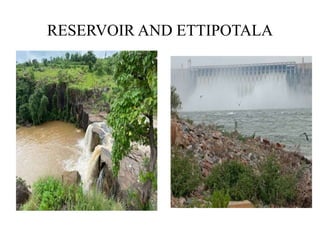
RESERVOIR AND ETTIPOTALA
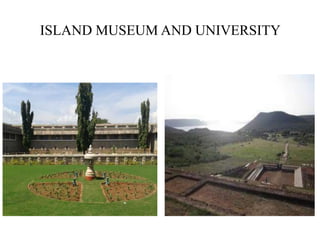
ISLAND MUSEUM AND UNIVERSITY
UNDAVALLI
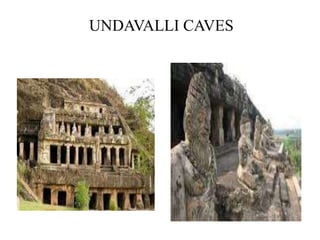
Undavalli is located 5 km from Vijayawada, on the banks of river Krishna. It is famous
for its ancient four storeyed “Rock cut cave temples”. The cave temples at Undavalli were
ascribed to the Vishnukundin. This cave temple enshrined the image of Anantasayana, a
form of Vishnu, reclining on the serpent Ananta (M. Rama Rao, 1963). 55 Once these
were Buddhas monasteries. Afterwards under the influence of vedic culture there were
transformed to Hindu idols of worship. In the above hill range, there is Anantasayana
cave with 4 storeys. This cave resembles the Dotal teental caves of Ellora. I cave: The
first stair of the cave was left idol and empty. II cave: This cave has 4 divisions. In the
second stage, there is a mandapa with 16 pillars and the poornakamala inscribed here
itself resembles the poornakamala of Amaravati. The third division in the second stage
comprises of a mandapa with 4 pillars, 4th division in the second stair consists
another mandapa with 4 pillars. III Cave: The 3rd stage in this cave has one specious
mandapa and Anantasayana temple. The pillars of the mandapa displays Gajendramoksha
and icons of Vishnu, Varahana Narasimha, Vamana, Trivikrama Murthy and one Seetha
under the Asoka tree. In the same caves, we can witnessed the Rishis in the sitting posture
and icon of several lions. There are some small temples. The pillars of the Anantasayana
caves consists the carvings displays the lions showing their claws. It is the concept of the
supremacy of Vishnukundins basing on this event. The king by name Mahendravarma of
Pallava dynasty carves the caves in the Tamil areas, Dalavanuru, Mandagapattu,
Mahabalipuram. The above sculptures can be turned as the first phase of the Hindu
Architectures. There are some inscriptions by the Reddi Rajas under the reign of Raja
Vasi Reddy Venkatadri Naidu. This place enjoyed their height in the history (M.
Somasekhar, 2004, p. 149) (D.V. Krishna Murthy, D. Veeraiah, 1972).
UNDAVALLI CAVES
CHEBROLU
Chebrolu is located 15 km from Guntur. According to Megasthanese, Andhra comprises of
30 towns and Chebrolu is one among them. Under the regime of Pallavas, Chebrlu was
turned as Tombrava, Tamrapuri. Under the Chalukya, it was turned as Jayavolu and
Jayabala with the passage of time they were transformed to the term Chebrolu.
The explorations at this place resulted with the availability of coins of
Satavahana,Ikshvaku periods. This place also had a significant role in the trade can be
verified with the availability of the coins belonging to the Roman kings. This place was
once the Buddhist centre. This place was in its geneth with Saiva under the period of
Vishnukundins. This place was the capital city of the king Yuddhamalla of Eastern
Chalukya dynasty for some time. He constructed various Saiva temples under his regime.
The Bezawada inscription of Yuddhamalla depicts that “the Mahasenas Carnival
was happened from Chebrolu to Bezawada” (M. Somasekhar, 2004 & E. Balaram Murthy,
1981). 56 This place also parted as the camp site of Satyasraya of Kalyani Chalukyan
king. The inscription made by the Kakatiya Ganapatis Army Chief Jayapa reveals that
Chebrolu acted as the Army contonment area. The same place was also utilized as Army
Centre by Velanati chiefs. The Chebrolu area was occupied Ibrahim Kutubsha of Golkonda
when he occupied the Kondaveedu region in 16th century A.D.
Lastly, it went into the hands of English Trading Company that is the British. Chebrolu is
a common saying that there were 101 wells and 101 temples. It is the only place in the
world having the temple of Brahma. The Adikesava Temple is the Ancient temple among
those still prevailing in the Chebrolu area. The Adikesava, Rajyalakshmi, Prasannajaneya
temples were constructed in the same premises. In this premises, there is one uncompleted
from of Galigorpuram.
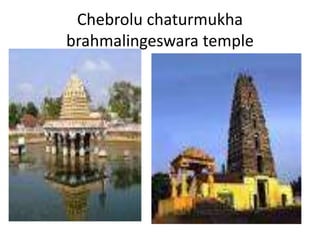
The Temple of Brahmadeva: The Brahmadeva in this temple was postured in the
shape of Lingakara. This was constructed by Rajavasireddy Venkatadrinaidu in the
18th century A.D. The Brahmadeva in the Lingakara posture has four faces directed
to four directions so this idol is turned as Chaturmukha Brahma Lingeswara. Here the
Brahma Deva appears to have the total control over all directions. With Saiva temples
in front and back positions and Vaishnava temples in the two sides and other four
Gods in other four directions.
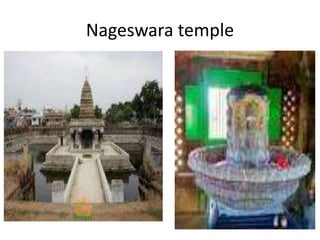
Nageswara Temple: This temple was constructed in 14th century A.D. by two village
officers by names Kantenna and Murthenna. Galigopura in front of the temple was
constructed with beautiful style. The chariot and Nandi idol were very big that were
present in this temple.
Bhimeswara temple: This temple as constructed by Chalukya Bhima I of Eastern
Chalukyan dynasty. This temple is in two stairs resembling the chariot. They are two
sarovars in the Chebrolu region with plenty of water. The archaeological exploration
in the town have revealed various aspects like coins of Satavahana, Ikshvaku, Roman
period, Terracota articles, Rouletted, Aretaine, pottery and other Terracota images,
toys. Buddhist sculptures and neolithic stone axes found. There are some other
temples like Virabhadra, Ranganadha, Venugopala, Chandramouleswara,
Sahasralingeswara, Narasimha and three Anjaneya temples. The famous idol of
Kalabhadra is the prominent one among those present in Chebrolu area (D.V. Krishna
Murthy, D. Veeraiah, 1972). Trilochana Pallava was credited with the construction of
many temples of Siva. Kuduvethi Svaram at Chebrolu
Chebrolu chaturmukha
brahmalingeswara temple
Nageswara temple
KOTAPPAKONDA
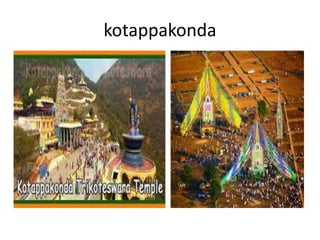
It is located 63 km from Guntur city. It is a place with special Religious
prominence. There is no accurate historical evidence. According to puranas
and local histories, it is the place that has important knowledge to many yogis
and other divine personalities. Lord Siva after destroyed the Daksha Yagna,
resorted to Kailasa and he transformed into a twelve year old by seeking
Brahmacharya with the name of Dakshinamurthy, at that time, Brahma and
others approached him and ask to Brahmopadesa. Agreeing to it Dakshina
Murthy came Trikotadri an important Brahmopadesa and accdaine the name
Trikoteswara. Every year, the famous festival of Mahasivaratri will be
celebrated with high colours. The place acquired the name of Trikutadri basing
on Brahmasikhara, Vishnusikhara and Rudra sikhara. Koteswara Swami
temple is located on Vishnusikhara near the temple. There is one famous
Pushkara under the name Papavinasanam. To the south of this hill, the river
Ogeru flows (D. Veeraiah, Guntur, 1972; D.V. Krishna Murthy edited by)
(S.I.I. Vol. IV, No. 920, S.I.I. No. X, No. 127).
kotappakonda
BAPATLA
Bapatla is located 53 kms from Guntur city. In the early periods, Bapatla
was known as the
place of Buddhist monasteries. But came into the prominence during the
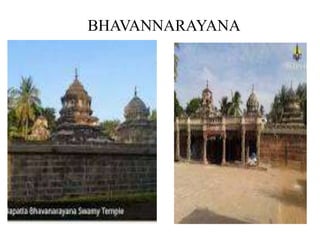
regime of Cholas. Even today, Bapatla is prominently known as Bhavapuri
and it is famous with a special recognised for education, Arts and political
aspects. The famous Chola king by name Krimikantaka Chola in the year
594 A.D., constructed the temple of Sribhannarayana Swamy also known
as Swayambhu idol. Various Hindu Rajas ruled this area during the period
of 594-1574 A.D. making it a place of prominence. In the year 1760, East
India Company took the control of this area and in the year 1803. Raja
Vasireddy Venkatadri Naidu purchased the place along with
Bhavannarayana temple in an public auction and later he patronised the
above said temple. Later on Karpura Vasanta Raya also
known as Komaragiri Raja controlled the area Kondaveedu as his capital.
His courtyard dancer by name Lakumadevi to perform the dance and other
pooja activities in this temple. The famous dancer Mallamma appointed
her daughter Lakuma to perform the pooja activities after her.
But the king denide the proposal made by Mallamma and he sent to Palaquins by has army
chief Boddapareddy along with an invitation to Mallamma, the invitation was denide by
Mallamma and she sent her daughter according to her will. From the time onwards Bapatla
is a place known 58 for its arts, literature, poets and other artists and with prominent
politicians. The prominent of this place can be revealed with the help of various inscriptions.
A.D. 1039 Cholas
A.D. 1050 Kakatiyas
A.D. 1340 Reddis
A.D. 1810 Rajavasi Reddy Venkatadrinaidu
Another 1130, 1287 two inscriptions (D.V. Krishna Murthy D. Veeraiah,1972). Temple of
Bhavannarayana at Bapatla was under the control of “Srivaishnavulu” (S.I.I. Vol. II, Nos. 139,
200). There are some donation inscriptions which tell us about their donations to the God
Bhava Narayana.
1. Nili Setti, the son of Penugonda Venni Setti gave a lamp to God Bhava Narayana at Bapatla
(S.I.I. Vol. VI, No. 143).
2. Suri Sethi, a member of “Teliki” – guild made a gift in cash towards the lamp to God Bhava
Narayana Swami at Bapatla (S.I.I. Vol. VI, No. 152).
3. “Telikula”, Keti setti also made a gift in cash for the lamp to God Bhavanarayana at Bapatla
(Ibid., No. 149).
4. Ketama Reddi, son of Badi Reddi made a gift in cash for the lamp to God Bhavanarayana at
Bapatla (S.I.I., Vol. VI, No. 173).
5. Potireddi, son of Kommiya Reddi alsomade a gift in cash for the lamp to God Bhava
Narayana at Bapatla (S.I.I. Vol. VI, No. 195).
6. Brahmasani, the wife of Bayyapa Nayaka made a gift in cash for the lamp to God
Bhavanarayana at Bapatla (S.I.I. Vol. VI, No. 171).
BHAVANNARAYANA
KONDAVEEDU
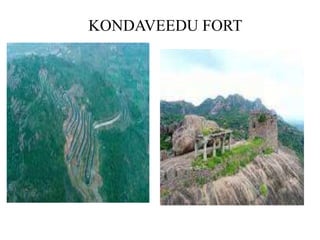
Kondaveedu is located 25 km from Guntur city. This place stands in silence with a
destroyed fort standing as an evidence to the 1000 years old History. During the time of
Bhojaraju and Bheeshmaka, this place acted as the capital with the name Kundinapuram. Basing
on the evidence produced by dandakavita inscription. The Ganapati Kshitriya Vishwambharadeva
ruling for 12 years constructed a Fort for the first time, Prolaya Vema ruled the area with
Kondaveedu as the capital as evidence by same inscription. Anavema shifted to his capital from
Dharanikoda to Kondaveedu, later this was the capital city for various Reddi Rajas. As inscribed
in various inscriptions. In the 11th century, during the time of Karikala Chola division of the
seema jones was done specifying the areas of Krishna, Guntur, Godavari, Nellore, Kurnool in
which the kingdom extended. This kingdom consisted of 5 Forts in Guntur district. They were
four: (1) Kondaveedu, (2) Bellamkonda, (3) Vinukonda, (4) Nagarjunakonda and (5) Kondapalli
The kingdom consisted of 14 regions. 2048 villages and extended at 22,500 sq.miles.
Reddi Rajas who ruled after the Kakatiyas beolnged to Muttimbaka village of Guduru taluk in
Nellore district and hence they were called Panta Reddis. In the kingdom of Addanki with as its
capital, the Natural defence system prevail and it raised general position of kingdom. During the
time of Anavota Kondaveedu raised to the status of capital city basing on defence grounds.
During the time of Anavota, the kingdom successfully faced the attacks of Bahmani,
Padmanayaka, Vijayanagara and The Kakatiyas extended from Mekala Parvatam in the north and
upto Srisailam to the south. The rulers constructed 50 towers on this Fort. The mountain fort
consisted of Vedurula Cheruvu in the west near to this there is one mandapa, one eating place and
an armary. Enrouting this fort, there is one Narasimha temple another structure with 16 pillars.
On the hill, there Arakota, Pillakota, Pedamalemkota, Chinamalamkota, Tattukota were
constructed basing on the defence reasons. 23 gen foes constructed on the Fort (M. Somasekhar,
KONDAVEEDU FORT
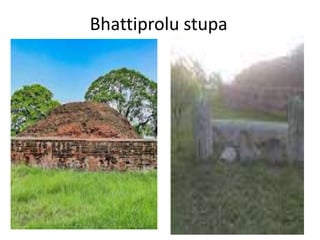
BHATTIPROLU
Bhattiprolu is located 50 km from Guntur city. It is an ancient place in Andhra
Pradesh and South India with one stupa and there is an ancient saying that the
History of Andhra started with Bhattiprolu. The history can be evidenced on
Pattavali Jain Historical Record. According to Megasthanese, Andhras had 30
towns in which Pratipalapura was one among them during the period 300 B.C.
Kuberaka, the son of Savera inscriptions prescribed him as the leader of Yakshas.
He ruled with the help of Nigama and Goshti sabhas. The Buddhist stupa at
Bhattiprolu was contemporary to Asoka in the opinion of some historians.
In 800 A.D., the famous Jain poet Nayasena described about Pratipalapura in
this dharmamrta kavya, according to the history. Yasodhara, the prince of
Ikshvakus came to the south and settled it Vengi kingdom and ruling it with
Pratipalapura as the capital during the period 170 B.C. The Hatigumpha
inscription reveals that Kharavela had some historical connection to this place
(M. Somasekhar, 2004 & B.S.L. Hanumantha Rao, 1995). During the time,
immense war between Jain and Buddhists. In the year 1870, Bhattiprolu come
into the lime light under the efforts Daswell and Sir Walter Elliot. Few relic
caskets were found in this place and gold pieces and pearls were also found.
Bhattiprolu stupa
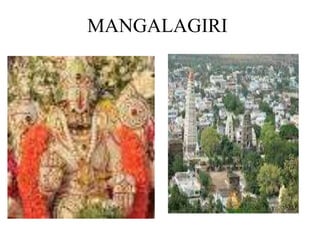
MANGALAGIRI
Mangalagiri is located 20 kms from Guntur city. 15 kms from Vijayawada. It is a place
with historical importance also known as Vaishnava kshetram. The place came into
prominence under the name Mangaladri as the word Mangala defects “Shubham”. This
place has a story saying that Goddess Lakshmidevi had performed religious rituals on this
hill there by occurring the name Mangalagiri. This place acclaimed the status of knowledge
centre. This place has a temple under the name Panakala Lakshmi Narasimha. This place
was ruled by the kings of various dynasties like Ikshvaku, Satavahana, Pallava, Vakataka,
Kakatiya, and Eastern Chalukyas. This place was visited by various prominent personalities
like Sankaracharya in the 8th century A.D. Chaitanya 1250 A.D., Srivallabhacharya had
conducted religious activities at Vatateertham. There are several inscriptions revealing the
history of this area. In the year 1515, Krishnadevaraya visited this place along with his
Prime Minister Thimmarusu and gave huge land and cash donations. In the year 1558, the
king Siddhiraju Ramaiah devara gave 28 villages. In the year 1568, under the region of
Muslims heavy taxation was laid and people left this place. Observing this position, the
Sultan called back the people by sending his Army Chief Ali as inscribed in an inscription.
In the year 1790, this area was subjected to robbery again in the year 1816, it was robbed
for an another time. There were several other temples in this place (D.V. Krishnamurthy, D.
Veeraiah, 1972). In this place, one Galigopura constructed by Raja Vasireddy Venkatadri
Naidu in 17th century A.D.
MANGALAGIRI
MACHERLA
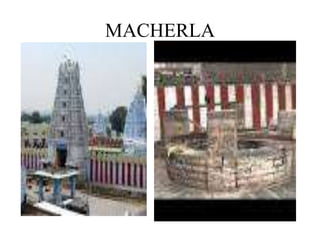
• Macherla is located 75 kms from Guntur. The history of this place can be studied by
the inscriptions of 1113 A.D., followed by 1397, 1414, 1496, 1619 A.D. Inscriptions.
The temple of Chennakesava was builts Sagibeta Raja of Haiheya dynasty and it was
developed by Brahmanaidu. Aditya the son of Makambika in the year 1113 A.D.
installed one Nagastambha. Among the all these inscriptions of this area, the
Nagastambha inscription place the prominent role. It has 94 lines by observing various
inscriptions. We can say that Veerakama, Sagibeta, Aditya had developed the temple
of Chennakesava during 14th century A.D. In the year 1414, Jandhyala Kesava
Nayanimgar had repaired the mukhamandapa of the temple. During the 12th century
A.D., the temple had transformed into the name of Lakshmi Chennakesava temple.
The river Chandra Vanka flows with in adjoining area of this temple and Chola
Architecture can be witnessed in this region (D.V. Krishna Murthy, D. Veeraiah,
1972). According to the Vaishnavite initiation prescribed by Acharya Ramanuja and
threw open the gates of Chennkesava temple at Macherla to the ‘Panchamas’. The
said temple became the centre of his radical reformative activities like inter-dining
and inter-caste marriages (B.S.L. Hanumantha Rao, op. cit., p. 259). One Record from
Macherla informs that the worship of Good Ramanatha and Gangaparameswari was
undertaken with the “Chemanti” flowers, at the rate of 150 flowers per day .
MACHERLA
CHEJARLA
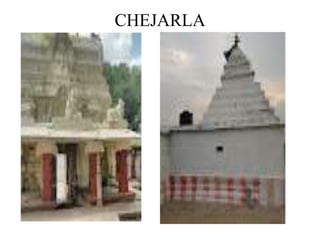
Chejerla located 25 km from Narasaraopet. It is also known as South Kasi adjoining to
this temple, there is on lake with name “Mallikagunta”. According to the Sthalapurana,
the story of the king Sibi and the dove came into the prominence. Ananagotras ruled in
this area with Chejarla as capital town in 3rd century A.D. and this temple was built by
the king Kandara II. During the 3rdcentury A.D., this temple was developed under the 3
phases. Under the I phase, Satavahana, Ikshvaku developed this temple. II phase,
development were done 5th and 6th century A.D. various small temples were
constructed around this temple. III Phase during 7th century A.D., it was developed by
installing Sivalinga, Mahamandapa, Nandimandapa and Dwajastambha (M.
Somasekhar, 2004, p. 148; D.V. Krishna Murthy, D. Veeraiah, 1972, IAR 1995-56).
ETHIPOTALA
Ethipotala is located 15 kms from Macherla. There is one waterfall known as
Ettipotala. It runs from a height of 75 feet and it comprises two streams by names
Chandravanka and Suryavanka, Chandravanka flows as Antarvahini stream. It flows
into a shallow valley supported by big hills on both the sides and flows for 4 kms. and
there by joins the River Krishna at a place called Gangapadalu. Here a crocodile
sanctuary is being developed. This place is known for its beauty and spirituality, above
the hills there are temples like Dattatreya temple and Madhumathi temple having a large
tourist attraction, every year people worship this place on the First Ekadasi by reaching
this place. There are tunnels in between the Dattatreya and Madhumati temples (Andhra
Pradesh, 1998 SEP Monthly;
CHEJARLA
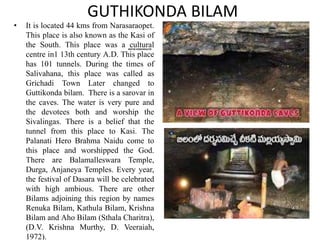
GUTHIKONDA BILAM
GUTHIKONDA
BILAM
• It is located 44 kms from Narasaraopet.
This place is also known as the Kasi of
the South. This place was a cultural
centre in1 13th century A.D. This place
has 101 tunnels. During the times of
Salivahana, this place was called as
Grichadi Town Later changed to
Guttikonda bilam. There is a sarovar in
the caves. The water is very pure and
the devotees both and worship the
Sivalingas. There is a belief that the
tunnel from this place to Kasi. The
Palanati Hero Brahma Naidu come to
this place and worshipped the God.
There are Balamalleswara Temple,
Durga, Anjaneya Temples. Every year,
the festival of Dasara will be celebrated
with high ambious. There are other
Bilams adjoining this region by names
Renuka Bilam, Kathula Bilam, Krishna
Bilam and Aho Bilam (Sthala Charitra),
(D.V. Krishna Murthy, D. Veeraiah,
1972).
PEDAKAKANI
It is located 6 kms from Guntur city. There is a temple with name Bramaramba Sameta
Malleswara Swami temple. This is also known as Bhanuvasura Centre. This place as equal
importance as that of Srisailam. This temple was constructed by Sri Krishnadevaraya. In the
year 1515 A.D., this temple was developed by Vasireddy Venkatadri Naidu in 18th century.
In Pedakakani town, there is an another Venugopala Swami Temple. In the year 1515 A.D.,
Sri Krishna Devaraya visited Vijayawada, Mangalagiri temples and there by appoint his
minister Renturi Chittrusu to construct the temples by endorsing him the necessary cash
requirements (D.V. Krishna Murthy ed. D. Veeraiah, 1972) (Kota Ravikumar, 2003).
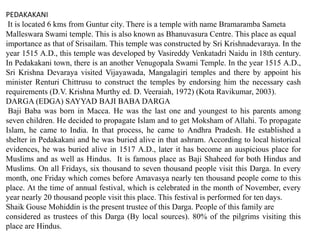
DARGA (EDGA) SAYYAD BAJI BABA DARGA
Baji Baba was born in Macca. He was the last one and youngest to his parents among
seven children. He decided to propagate Islam and to get Moksham of Allahi. To propagate
Islam, he came to India. In that process, he came to Andhra Pradesh. He established a
shelter in Pedakakani and he was buried alive in that ashram. According to local historical
evidences, he was buried alive in 1517 A.D., later it has become an auspicious place for
Muslims and as well as Hindus. It is famous place as Baji Shaheed for both Hindus and
Muslims. On all Fridays, six thousand to seven thousand people visit this Darga. In every
month, one Friday which comes before Amavasya nearly ten thousand people come to this
place. At the time of annual festival, which is celebrated in the month of November, every
year nearly 20 thousand people visit this place. This festival is performed for ten days.
Shaik Gouse Mohiddin is the present trustee of this Darga. People of this family are
considered as trustees of this Darga (By local sources). 80% of the pilgrims visiting this
place are Hindus.
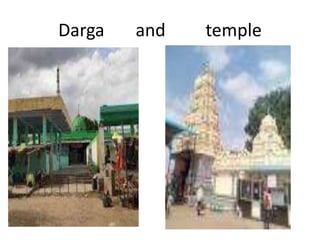
Darga and temple
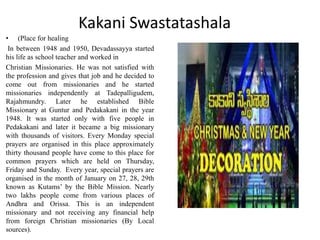
Kakani Swastatashala
• (Place for healing
In between 1948 and 1950, Devadassayya started
his life as school teacher and worked in
Christian Missionaries. He was not satisfied with
the profession and gives that job and he decided to
come out from missionaries and he started
missionaries independently at Tadepalligudem,
Rajahmundry. Later he established Bible
Missionary at Guntur and Pedakakani in the year
1948. It was started only with five people in
Pedakakani and later it became a big missionary
with thousands of visitors. Every Monday special
prayers are organised in this place approximately
thirty thousand people have come to this place for
common prayers which are held on Thursday,
Friday and Sunday. Every year, special prayers are
organised in the month of January on 27, 28, 29th
known as Kutams’ by the Bible Mission. Nearly
two lakhs people come from various places of
Andhra and Orissa. This is an independent
missionary and not receiving any financial help
from foreign Christian missionaries (By Local
sources).
KAREMPUDI
Brahma Naidu, with the implementation of Chapakudu method to uplift the conditions of
down-trodden people, has become pioneer to the present generation. He worked for the
welfare of the Dalits. Building a temple and worshipping a Dalit has to be written in
history with golden words. All religions, classes and castes people attend the Palnadu
Veerostavalu. This shows secularism of that area. The poet Srinadhudu compares
Karempudi with Varanasi. Because of this thing, celebrations after wars have become
important thing. Palnadu war happened in between 1176-1186, having probably nine
hundred years of history. These Veerostavalu are celebrated five days from Kartika
Amavashya (New moon) every year. These five days are called as Raachagavu,
Rayabaram, Mandaporu, Kodiporu and Kallipadu. Brahmanaidu desires to establish a
equal society but he fails to do so. The people who were appointed by him were occupied
the Palnati Veerachara Peetham and they ruled it. This kind of celebrations are performed
in this world only at two places. One is Rome and the second one is Palnadu (Karempudi).
Poet Srinadhudu describes Palanati war as Andhra Kurukshetram (Palanati Bharatam).
This war was taken place between Nalagamudu and Malidevudu, but their ministers
Nagamma and Brahmanaidu played very important roles. In this war, Kakatiyas,
Hoyasalas, Kota Rajas and Rudradeva also participated in support of Nalagamudu.
Malidevudu got the help of Kalachuri Rajas. After the death of Balachandra, who was son
of Malideva and leader of war, Kalachuri Komana represented the war. Finally in that
battle Brahmanaidu defeats. It is said, he gives up everything and he spends spiritual life.
This war is being celebrated five days ceremonies. This war is compared with
Mahabharata war and there are some similarities are there. As rivalry in Mahabharata, in
this war cocks fighting has an important place. Alaraju Rayabaram is compared with Sri
Krishna Rayabaram. Balachandra is compared with Abhimanya.
KAREMPUDI
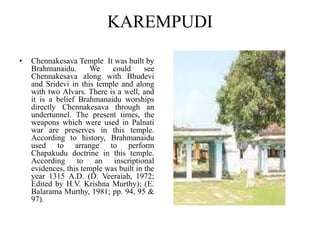
• Chennakesava Temple It was built by
Brahmanaidu. We could see
Chennakesava along with Bhudevi
and Sridevi in this temple and along
with two Alvars. There is a well, and
it is a belief Brahmanaidu worships
directly Chennakesava through an
undertunnel. The present times, the
weapons which were used in Palnati
war are preserves in this temple.
According to history, Brahmanaidu
used to arrange to perform
Chapakudu doctrine in this temple.
According to an inscriptional
evidences, this temple was built in the
year 1315 A.D. (D. Veeraiah, 1972;
Edited by H.V. Krishna Murthy); (E.
Balarama Murthy, 1981; pp. 94, 95 &
97).
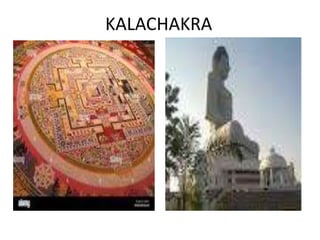
KALACHAKRA, 2006
• – AMARAVATI His Holiness, the 14th Dalailama was offered the
Kalachakra empowerment for the 30th time in his life from 5th to 16th
January, 2006 at Amaravathi in Guntur, A.P. in South India. Dalailama
and his followers believe that Buddha has empowered his followers
for the first time at Amaravati. Before 2006 A.D., the 14th Dalailama
has organised 29 Kalachakra Empowerments various places in the
world (G. Satyanarayana, 2006). The 14th Dalailama Kalachakra held
at: Norbulingka Institute has organised the Kalachakra, 2006 on behalf
of the Busshokai Centre. The Central Tibetan Administration and the
Government of Andhra Pradesh are also collaborated to set up the
necessary infrastructure to host the event. Norbulingka Institute is a
trust operating under the Chairmanship of His Holiness, the
Dalailama. The Institute is committed to the preservation of the
traditional creative and literary arts of Tibet. Kalachakra is a
Vajrayana Buddhist Tantric practice belonging to the Highest
yogatantras. According to Tibet scriptures, the Kalachakra was first
taught on the 15th day of the 3rd March in the year following Buddha
Sakyamunis Enlightenment.
• The initiation was originally requested by Suchandra, the king of Sambhala, an
emanation of Vajrapani. Sambhala is a mythical kingdom located some where north
of Kashmir. It is regarded as the pure land but is an essential reference point in
Buddhist practice while the Buddha teaching the perfection of wisdom on vulture’s
peak near Rajgir, he simultaneously taught the Kalachakra Root tantra at Shri-
Dhanyakataka to a host of followers including Bodhisattvas celestial beings and the
96 satraps of Sambhala. King Suchandra compiled the 12,000 verse teaching and
later composed a commentary in 96,000 verses. The Kalachakra continued to be
transmitted through a succession of seven dharma kings and seventeen kalki
chieftains of Sambhala. The legendary Indian masters, Manjushrikirti and
Pundarika Pundit codified the teachings in their texts, Sri Kalachakra and the
Vimalaprabha respectively. In Tibet, the Kalachakra teaching was first spread by
the Translator. Gvi-Jo Lotsawa Dawa O-Ser 11th century A.D. Khedrup Norsang
Gyatso’s based on the Vimalaprabha, is considered the most holistic exposition of
this tantra. In the 18th century A.D., the Kalachakra lineage was passed to the
Nangyal monastery by the Seventh Dalailama. Both the Lamas and Panchen Lamas
have had a long standing link to be Kalachakra practice. His Holiness, the present
Dalailama received the empowerment from his tutor. Lang Rimpoche and
transmitted the initiation for the first time in the Norbulingka place in Lausa, Tibet
in May 1954. The Kalchakra processed by nearly ten days of ritual preparation.
• The initiation was originally requested by Suchandra, the king of Sambhala, an
emanation of Vajrapani. Sambhala is a mythical kingdom located some where north of
Kashmir. It is regarded as the pure land but is an essential reference point in Buddhist
practice while the Buddha teaching the perfection of wisdom on vulture’s peak near
Rajgir, he simultaneously taught the Kalachakra Root tantra at Shri-Dhanyakataka to a
host of followers including Bodhisattvas celestial beings and the 96 satraps of Sambhala.
King Suchandra compiled the 12,000 verse teaching and later composed a commentary
in 96,000 verses. The Kalachakra continued to be transmitted through a succession of
seven dharma kings and seventeen kalki chieftains of Sambhala. The legendary Indian
masters, Manjushrikirti and Pundarika Pundit codified the teachings in their texts, Sri
Kalachakra and the Vimalaprabha respectively. In Tibet, the Kalachakra teaching was
first spread by the Translator. Gvi-Jo Lotsawa Dawa O-Ser 11th century A.D. Khedrup
Norsang Gyatso’s based on the Vimalaprabha, is considered the most holistic exposition
of this tantra. In the 18th century A.D., the Kalachakra lineage was passed to the
Nangyal monastery by the Seventh Dalailama. Both the Lamas and Panchen Lamas have
had a long standing link to be Kalachakra practice. His Holiness, the present Dalailama
received the empowerment from his tutor. Lang Rimpoche and transmitted the initiation
for the first time in the Norbulingka place in Lausa,Tibet in May 1954. The Kalchakra
processed by nearly ten days of ritual preparation.
KALACHAKRA
KRISHNA PUSHKARAMS
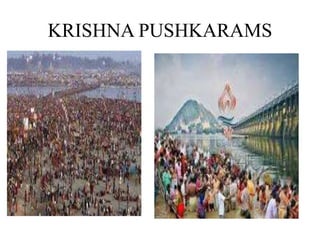
• These Krishna Pushkarams are celebrated once in twelve years. Origin of
Krishna river is at Sahyadri mountains in Maharashtra. This is a
combination of Krishna and Veni. It flows 560 km through Maharashtra and
Karnataka. It enters into Andhra Pradesh at Alampur of Mahaboobnagar. It
flows nearly 720 km in Andhra Pradesh and finally at the place of Puligadda
it divides into two channels and enters into Bay of Bengal at Hamsala
Deevi. Dindi, Palaeru, Musi, Munneru, Aleru, Ahalya, Chandravanka,
Naguleru, Patalaganga and Tungabhadra are the sub-rivers of Krishna River.
Bruhaspathi takes 12 years to revolve around the Sun. Bruhaspti stays one
year in every zodiac sign. Like this, he stays twelve years in twelve zodiac
signs, when Bruhaspathi enters into sign virgin people celebrate
Pushkarams. People use to perform religious riots to their forefather in this
Krishna Pushkaras to console therein spirits. At this time, nearly 20 lakh
people use to visit these pushkaras (Commissioner, Information and
Broadcasting, Government of Andhra Pradesh, 2004 and 2016).
KRISHNA PUSHKARAMS

GUNTUR.pptx

  • 1.
    AMARAVATI – HISTORICALSKETCH OF AMARAVATHI Amaravati and Dharankikota are located on the south bank of the River Krishna about 35 kilometers north of Guntur city. Colonel Meckenzie who visited the place in 1818 with a band of Assistants and excavated of the site. A few sculptured pieces were also recovered by him. In 1845, Sir Walter Smith excavated the south-west part of the mound and recovered a few sculptured pieces. Robert Sewell (in 1877), James Burges (in 1881) and Alexander Rea (in 1888-89) made attempts to excavate and record the sculptured stones systematically. Rea conducted more attempts in 1905-06 and 1908-09. During the year 1958-59, under R. Subrahmanyam and K. Krishna Murthy of the Archaeological Survey brought to view a large number of Architectural pieces. Some more sculptural slabs were exposed in an excavation carried out by I.K.Sharma in 1973-74. In the year of 1962-65, M. Venkata Ramanayya and K. Raghavachary, they were revealed five periods of occupation of the site (H. Sarkar, 1992, Amaravati). According to Megasthanese, Andhras had 30 towns. They were 30 clans. Asmikas (Nizamabad), Sibikas (Karimnagar), Mahisakas (Nalgonda), Nagas (Dharanikota), Yakhas (Bhattiprolu), Somokhas (Vaddamanu) (B.S.L. Hanumantha Rao, 1995).
  • 2.
    AMARAVATI TOPE ANDAMRESWARA TEMPLE
  • 3.
    Amaravathi stupa wasconstructed in5 phases. First phase : Asokan Second phase : Post-Asokan Third phase : Satavahana Fourth phase : Ekshvaku Fifth phase : Early Pallava to late medival. Inscriptional Evidences : Some inscriptions find at Amaravati. They are: Komma Nayaka inscription 1158 A.D. Keta Raja inscription 1258 A.D. Anavema Reddy inscription 1361 A.D. Rayala inscription 1517 A.D. Handrikam Peddappam inscription 1621 A.D Vasireddy Venkatadri Naidu inscription 1785 A.D. (Dr. D. Deekshitulu, 2002).
  • 4.
    NAGARJUNA KONDA • NAGARJUNAKONDA (Historical Background) Nagarjunakonda, the name of valley situated on the right bank of River Krishna 22 km to the west of Macherla in Palanadu taluk of the Guntur district, Andhra Pradesh. In historical times, later Satavahanas ruled this place, they were Gautamiputra Satakarni, Pulomavi, Yagna Sri Satakarni, successors of the satavahanas were in the first quarter of the 3rd century A.D. The founder of the Ikshvaku dynasty established his capital, Vijayapuri, it is interesting to note that inscriptions of the Ikshvakus mention Vijayapuri invariably with reference to Sriparvata (E.I. Vol. XX).
  • 5.
    Historical Perspective ofthis Region The written history of the Nagarjunakonda valley begins with later Satavahanas. They were mentioned their name in one inscription which was founded at Nagarjunakonda valley (I.A.R. 1962-62, p. 77). Satavahana kings were Goutamiputra Satakarni, Pulomavi, Yagnasri etc. This inscription tells us about that Buddhism had penetrated into the valley well before the advert of the Ikshvakus. In the time of Satavahanas, decline Nagarjunakonda rose to prominence only in the wake of power when Vasishtiputra Chantamula. The Founder of Ikshvaku dynasty (I.A.R. 1957-58, pp. 8-9) (1958-59, p. 6). The names of the Ikshvaku rulers were four: (1) Vasishtiputra Chantamula, (2) Mathariputra Virapurushadatta, (3) Vasishtiputra Ehuvala Chantamula, (4) Vasishtiputra Rudrapurushadatta are known from the inscriptions and coins discovered at Nagarjunakonda (P.C. Sircar, E.I. Vol. XXV) & (R. Subramanyam, 1962; I.K. Sharma, 1959-60). Vasshtiputra Vasusena of the Abhira dynasty of the Nasik region is available from the inscription discovered at ashtabhuja temple (E.I. Vol. XXXV, pp. 197-204).
  • 6.
  • 7.
  • 8.
    UNDAVALLI Undavalli is located5 km from Vijayawada, on the banks of river Krishna. It is famous for its ancient four storeyed “Rock cut cave temples”. The cave temples at Undavalli were ascribed to the Vishnukundin. This cave temple enshrined the image of Anantasayana, a form of Vishnu, reclining on the serpent Ananta (M. Rama Rao, 1963). 55 Once these were Buddhas monasteries. Afterwards under the influence of vedic culture there were transformed to Hindu idols of worship. In the above hill range, there is Anantasayana cave with 4 storeys. This cave resembles the Dotal teental caves of Ellora. I cave: The first stair of the cave was left idol and empty. II cave: This cave has 4 divisions. In the second stage, there is a mandapa with 16 pillars and the poornakamala inscribed here itself resembles the poornakamala of Amaravati. The third division in the second stage comprises of a mandapa with 4 pillars, 4th division in the second stair consists another mandapa with 4 pillars. III Cave: The 3rd stage in this cave has one specious mandapa and Anantasayana temple. The pillars of the mandapa displays Gajendramoksha and icons of Vishnu, Varahana Narasimha, Vamana, Trivikrama Murthy and one Seetha under the Asoka tree. In the same caves, we can witnessed the Rishis in the sitting posture and icon of several lions. There are some small temples. The pillars of the Anantasayana caves consists the carvings displays the lions showing their claws. It is the concept of the supremacy of Vishnukundins basing on this event. The king by name Mahendravarma of Pallava dynasty carves the caves in the Tamil areas, Dalavanuru, Mandagapattu, Mahabalipuram. The above sculptures can be turned as the first phase of the Hindu Architectures. There are some inscriptions by the Reddi Rajas under the reign of Raja Vasi Reddy Venkatadri Naidu. This place enjoyed their height in the history (M. Somasekhar, 2004, p. 149) (D.V. Krishna Murthy, D. Veeraiah, 1972).
  • 9.
  • 10.
    CHEBROLU Chebrolu is located15 km from Guntur. According to Megasthanese, Andhra comprises of 30 towns and Chebrolu is one among them. Under the regime of Pallavas, Chebrlu was turned as Tombrava, Tamrapuri. Under the Chalukya, it was turned as Jayavolu and Jayabala with the passage of time they were transformed to the term Chebrolu. The explorations at this place resulted with the availability of coins of Satavahana,Ikshvaku periods. This place also had a significant role in the trade can be verified with the availability of the coins belonging to the Roman kings. This place was once the Buddhist centre. This place was in its geneth with Saiva under the period of Vishnukundins. This place was the capital city of the king Yuddhamalla of Eastern Chalukya dynasty for some time. He constructed various Saiva temples under his regime. The Bezawada inscription of Yuddhamalla depicts that “the Mahasenas Carnival was happened from Chebrolu to Bezawada” (M. Somasekhar, 2004 & E. Balaram Murthy, 1981). 56 This place also parted as the camp site of Satyasraya of Kalyani Chalukyan king. The inscription made by the Kakatiya Ganapatis Army Chief Jayapa reveals that Chebrolu acted as the Army contonment area. The same place was also utilized as Army Centre by Velanati chiefs. The Chebrolu area was occupied Ibrahim Kutubsha of Golkonda when he occupied the Kondaveedu region in 16th century A.D. Lastly, it went into the hands of English Trading Company that is the British. Chebrolu is a common saying that there were 101 wells and 101 temples. It is the only place in the world having the temple of Brahma. The Adikesava Temple is the Ancient temple among those still prevailing in the Chebrolu area. The Adikesava, Rajyalakshmi, Prasannajaneya temples were constructed in the same premises. In this premises, there is one uncompleted from of Galigorpuram.
  • 11.
    The Temple ofBrahmadeva: The Brahmadeva in this temple was postured in the shape of Lingakara. This was constructed by Rajavasireddy Venkatadrinaidu in the 18th century A.D. The Brahmadeva in the Lingakara posture has four faces directed to four directions so this idol is turned as Chaturmukha Brahma Lingeswara. Here the Brahma Deva appears to have the total control over all directions. With Saiva temples in front and back positions and Vaishnava temples in the two sides and other four Gods in other four directions. Nageswara Temple: This temple was constructed in 14th century A.D. by two village officers by names Kantenna and Murthenna. Galigopura in front of the temple was constructed with beautiful style. The chariot and Nandi idol were very big that were present in this temple. Bhimeswara temple: This temple as constructed by Chalukya Bhima I of Eastern Chalukyan dynasty. This temple is in two stairs resembling the chariot. They are two sarovars in the Chebrolu region with plenty of water. The archaeological exploration in the town have revealed various aspects like coins of Satavahana, Ikshvaku, Roman period, Terracota articles, Rouletted, Aretaine, pottery and other Terracota images, toys. Buddhist sculptures and neolithic stone axes found. There are some other temples like Virabhadra, Ranganadha, Venugopala, Chandramouleswara, Sahasralingeswara, Narasimha and three Anjaneya temples. The famous idol of Kalabhadra is the prominent one among those present in Chebrolu area (D.V. Krishna Murthy, D. Veeraiah, 1972). Trilochana Pallava was credited with the construction of many temples of Siva. Kuduvethi Svaram at Chebrolu
  • 12.
  • 13.
  • 14.
    KOTAPPAKONDA It is located63 km from Guntur city. It is a place with special Religious prominence. There is no accurate historical evidence. According to puranas and local histories, it is the place that has important knowledge to many yogis and other divine personalities. Lord Siva after destroyed the Daksha Yagna, resorted to Kailasa and he transformed into a twelve year old by seeking Brahmacharya with the name of Dakshinamurthy, at that time, Brahma and others approached him and ask to Brahmopadesa. Agreeing to it Dakshina Murthy came Trikotadri an important Brahmopadesa and accdaine the name Trikoteswara. Every year, the famous festival of Mahasivaratri will be celebrated with high colours. The place acquired the name of Trikutadri basing on Brahmasikhara, Vishnusikhara and Rudra sikhara. Koteswara Swami temple is located on Vishnusikhara near the temple. There is one famous Pushkara under the name Papavinasanam. To the south of this hill, the river Ogeru flows (D. Veeraiah, Guntur, 1972; D.V. Krishna Murthy edited by) (S.I.I. Vol. IV, No. 920, S.I.I. No. X, No. 127).
  • 15.
  • 16.
    BAPATLA Bapatla is located53 kms from Guntur city. In the early periods, Bapatla was known as the place of Buddhist monasteries. But came into the prominence during the regime of Cholas. Even today, Bapatla is prominently known as Bhavapuri and it is famous with a special recognised for education, Arts and political aspects. The famous Chola king by name Krimikantaka Chola in the year 594 A.D., constructed the temple of Sribhannarayana Swamy also known as Swayambhu idol. Various Hindu Rajas ruled this area during the period of 594-1574 A.D. making it a place of prominence. In the year 1760, East India Company took the control of this area and in the year 1803. Raja Vasireddy Venkatadri Naidu purchased the place along with Bhavannarayana temple in an public auction and later he patronised the above said temple. Later on Karpura Vasanta Raya also known as Komaragiri Raja controlled the area Kondaveedu as his capital. His courtyard dancer by name Lakumadevi to perform the dance and other pooja activities in this temple. The famous dancer Mallamma appointed her daughter Lakuma to perform the pooja activities after her.
  • 17.
    But the kingdenide the proposal made by Mallamma and he sent to Palaquins by has army chief Boddapareddy along with an invitation to Mallamma, the invitation was denide by Mallamma and she sent her daughter according to her will. From the time onwards Bapatla is a place known 58 for its arts, literature, poets and other artists and with prominent politicians. The prominent of this place can be revealed with the help of various inscriptions. A.D. 1039 Cholas A.D. 1050 Kakatiyas A.D. 1340 Reddis A.D. 1810 Rajavasi Reddy Venkatadrinaidu Another 1130, 1287 two inscriptions (D.V. Krishna Murthy D. Veeraiah,1972). Temple of Bhavannarayana at Bapatla was under the control of “Srivaishnavulu” (S.I.I. Vol. II, Nos. 139, 200). There are some donation inscriptions which tell us about their donations to the God Bhava Narayana. 1. Nili Setti, the son of Penugonda Venni Setti gave a lamp to God Bhava Narayana at Bapatla (S.I.I. Vol. VI, No. 143). 2. Suri Sethi, a member of “Teliki” – guild made a gift in cash towards the lamp to God Bhava Narayana Swami at Bapatla (S.I.I. Vol. VI, No. 152). 3. “Telikula”, Keti setti also made a gift in cash for the lamp to God Bhavanarayana at Bapatla (Ibid., No. 149). 4. Ketama Reddi, son of Badi Reddi made a gift in cash for the lamp to God Bhavanarayana at Bapatla (S.I.I., Vol. VI, No. 173). 5. Potireddi, son of Kommiya Reddi alsomade a gift in cash for the lamp to God Bhava Narayana at Bapatla (S.I.I. Vol. VI, No. 195). 6. Brahmasani, the wife of Bayyapa Nayaka made a gift in cash for the lamp to God Bhavanarayana at Bapatla (S.I.I. Vol. VI, No. 171).
  • 19.
  • 20.
    KONDAVEEDU Kondaveedu is located25 km from Guntur city. This place stands in silence with a destroyed fort standing as an evidence to the 1000 years old History. During the time of Bhojaraju and Bheeshmaka, this place acted as the capital with the name Kundinapuram. Basing on the evidence produced by dandakavita inscription. The Ganapati Kshitriya Vishwambharadeva ruling for 12 years constructed a Fort for the first time, Prolaya Vema ruled the area with Kondaveedu as the capital as evidence by same inscription. Anavema shifted to his capital from Dharanikoda to Kondaveedu, later this was the capital city for various Reddi Rajas. As inscribed in various inscriptions. In the 11th century, during the time of Karikala Chola division of the seema jones was done specifying the areas of Krishna, Guntur, Godavari, Nellore, Kurnool in which the kingdom extended. This kingdom consisted of 5 Forts in Guntur district. They were four: (1) Kondaveedu, (2) Bellamkonda, (3) Vinukonda, (4) Nagarjunakonda and (5) Kondapalli The kingdom consisted of 14 regions. 2048 villages and extended at 22,500 sq.miles. Reddi Rajas who ruled after the Kakatiyas beolnged to Muttimbaka village of Guduru taluk in Nellore district and hence they were called Panta Reddis. In the kingdom of Addanki with as its capital, the Natural defence system prevail and it raised general position of kingdom. During the time of Anavota Kondaveedu raised to the status of capital city basing on defence grounds. During the time of Anavota, the kingdom successfully faced the attacks of Bahmani, Padmanayaka, Vijayanagara and The Kakatiyas extended from Mekala Parvatam in the north and upto Srisailam to the south. The rulers constructed 50 towers on this Fort. The mountain fort consisted of Vedurula Cheruvu in the west near to this there is one mandapa, one eating place and an armary. Enrouting this fort, there is one Narasimha temple another structure with 16 pillars. On the hill, there Arakota, Pillakota, Pedamalemkota, Chinamalamkota, Tattukota were constructed basing on the defence reasons. 23 gen foes constructed on the Fort (M. Somasekhar,
  • 21.
  • 22.
    BHATTIPROLU Bhattiprolu is located50 km from Guntur city. It is an ancient place in Andhra Pradesh and South India with one stupa and there is an ancient saying that the History of Andhra started with Bhattiprolu. The history can be evidenced on Pattavali Jain Historical Record. According to Megasthanese, Andhras had 30 towns in which Pratipalapura was one among them during the period 300 B.C. Kuberaka, the son of Savera inscriptions prescribed him as the leader of Yakshas. He ruled with the help of Nigama and Goshti sabhas. The Buddhist stupa at Bhattiprolu was contemporary to Asoka in the opinion of some historians. In 800 A.D., the famous Jain poet Nayasena described about Pratipalapura in this dharmamrta kavya, according to the history. Yasodhara, the prince of Ikshvakus came to the south and settled it Vengi kingdom and ruling it with Pratipalapura as the capital during the period 170 B.C. The Hatigumpha inscription reveals that Kharavela had some historical connection to this place (M. Somasekhar, 2004 & B.S.L. Hanumantha Rao, 1995). During the time, immense war between Jain and Buddhists. In the year 1870, Bhattiprolu come into the lime light under the efforts Daswell and Sir Walter Elliot. Few relic caskets were found in this place and gold pieces and pearls were also found.
  • 23.
  • 24.
    MANGALAGIRI Mangalagiri is located20 kms from Guntur city. 15 kms from Vijayawada. It is a place with historical importance also known as Vaishnava kshetram. The place came into prominence under the name Mangaladri as the word Mangala defects “Shubham”. This place has a story saying that Goddess Lakshmidevi had performed religious rituals on this hill there by occurring the name Mangalagiri. This place acclaimed the status of knowledge centre. This place has a temple under the name Panakala Lakshmi Narasimha. This place was ruled by the kings of various dynasties like Ikshvaku, Satavahana, Pallava, Vakataka, Kakatiya, and Eastern Chalukyas. This place was visited by various prominent personalities like Sankaracharya in the 8th century A.D. Chaitanya 1250 A.D., Srivallabhacharya had conducted religious activities at Vatateertham. There are several inscriptions revealing the history of this area. In the year 1515, Krishnadevaraya visited this place along with his Prime Minister Thimmarusu and gave huge land and cash donations. In the year 1558, the king Siddhiraju Ramaiah devara gave 28 villages. In the year 1568, under the region of Muslims heavy taxation was laid and people left this place. Observing this position, the Sultan called back the people by sending his Army Chief Ali as inscribed in an inscription. In the year 1790, this area was subjected to robbery again in the year 1816, it was robbed for an another time. There were several other temples in this place (D.V. Krishnamurthy, D. Veeraiah, 1972). In this place, one Galigopura constructed by Raja Vasireddy Venkatadri Naidu in 17th century A.D.
  • 25.
  • 26.
    MACHERLA • Macherla islocated 75 kms from Guntur. The history of this place can be studied by the inscriptions of 1113 A.D., followed by 1397, 1414, 1496, 1619 A.D. Inscriptions. The temple of Chennakesava was builts Sagibeta Raja of Haiheya dynasty and it was developed by Brahmanaidu. Aditya the son of Makambika in the year 1113 A.D. installed one Nagastambha. Among the all these inscriptions of this area, the Nagastambha inscription place the prominent role. It has 94 lines by observing various inscriptions. We can say that Veerakama, Sagibeta, Aditya had developed the temple of Chennakesava during 14th century A.D. In the year 1414, Jandhyala Kesava Nayanimgar had repaired the mukhamandapa of the temple. During the 12th century A.D., the temple had transformed into the name of Lakshmi Chennakesava temple. The river Chandra Vanka flows with in adjoining area of this temple and Chola Architecture can be witnessed in this region (D.V. Krishna Murthy, D. Veeraiah, 1972). According to the Vaishnavite initiation prescribed by Acharya Ramanuja and threw open the gates of Chennkesava temple at Macherla to the ‘Panchamas’. The said temple became the centre of his radical reformative activities like inter-dining and inter-caste marriages (B.S.L. Hanumantha Rao, op. cit., p. 259). One Record from Macherla informs that the worship of Good Ramanatha and Gangaparameswari was undertaken with the “Chemanti” flowers, at the rate of 150 flowers per day .
  • 27.
  • 28.
    CHEJARLA Chejerla located 25km from Narasaraopet. It is also known as South Kasi adjoining to this temple, there is on lake with name “Mallikagunta”. According to the Sthalapurana, the story of the king Sibi and the dove came into the prominence. Ananagotras ruled in this area with Chejarla as capital town in 3rd century A.D. and this temple was built by the king Kandara II. During the 3rdcentury A.D., this temple was developed under the 3 phases. Under the I phase, Satavahana, Ikshvaku developed this temple. II phase, development were done 5th and 6th century A.D. various small temples were constructed around this temple. III Phase during 7th century A.D., it was developed by installing Sivalinga, Mahamandapa, Nandimandapa and Dwajastambha (M. Somasekhar, 2004, p. 148; D.V. Krishna Murthy, D. Veeraiah, 1972, IAR 1995-56). ETHIPOTALA Ethipotala is located 15 kms from Macherla. There is one waterfall known as Ettipotala. It runs from a height of 75 feet and it comprises two streams by names Chandravanka and Suryavanka, Chandravanka flows as Antarvahini stream. It flows into a shallow valley supported by big hills on both the sides and flows for 4 kms. and there by joins the River Krishna at a place called Gangapadalu. Here a crocodile sanctuary is being developed. This place is known for its beauty and spirituality, above the hills there are temples like Dattatreya temple and Madhumathi temple having a large tourist attraction, every year people worship this place on the First Ekadasi by reaching this place. There are tunnels in between the Dattatreya and Madhumati temples (Andhra Pradesh, 1998 SEP Monthly;
  • 29.
  • 30.
    GUTHIKONDA BILAM GUTHIKONDA BILAM • Itis located 44 kms from Narasaraopet. This place is also known as the Kasi of the South. This place was a cultural centre in1 13th century A.D. This place has 101 tunnels. During the times of Salivahana, this place was called as Grichadi Town Later changed to Guttikonda bilam. There is a sarovar in the caves. The water is very pure and the devotees both and worship the Sivalingas. There is a belief that the tunnel from this place to Kasi. The Palanati Hero Brahma Naidu come to this place and worshipped the God. There are Balamalleswara Temple, Durga, Anjaneya Temples. Every year, the festival of Dasara will be celebrated with high ambious. There are other Bilams adjoining this region by names Renuka Bilam, Kathula Bilam, Krishna Bilam and Aho Bilam (Sthala Charitra), (D.V. Krishna Murthy, D. Veeraiah, 1972).
  • 31.
    PEDAKAKANI It is located6 kms from Guntur city. There is a temple with name Bramaramba Sameta Malleswara Swami temple. This is also known as Bhanuvasura Centre. This place as equal importance as that of Srisailam. This temple was constructed by Sri Krishnadevaraya. In the year 1515 A.D., this temple was developed by Vasireddy Venkatadri Naidu in 18th century. In Pedakakani town, there is an another Venugopala Swami Temple. In the year 1515 A.D., Sri Krishna Devaraya visited Vijayawada, Mangalagiri temples and there by appoint his minister Renturi Chittrusu to construct the temples by endorsing him the necessary cash requirements (D.V. Krishna Murthy ed. D. Veeraiah, 1972) (Kota Ravikumar, 2003). DARGA (EDGA) SAYYAD BAJI BABA DARGA Baji Baba was born in Macca. He was the last one and youngest to his parents among seven children. He decided to propagate Islam and to get Moksham of Allahi. To propagate Islam, he came to India. In that process, he came to Andhra Pradesh. He established a shelter in Pedakakani and he was buried alive in that ashram. According to local historical evidences, he was buried alive in 1517 A.D., later it has become an auspicious place for Muslims and as well as Hindus. It is famous place as Baji Shaheed for both Hindus and Muslims. On all Fridays, six thousand to seven thousand people visit this Darga. In every month, one Friday which comes before Amavasya nearly ten thousand people come to this place. At the time of annual festival, which is celebrated in the month of November, every year nearly 20 thousand people visit this place. This festival is performed for ten days. Shaik Gouse Mohiddin is the present trustee of this Darga. People of this family are considered as trustees of this Darga (By local sources). 80% of the pilgrims visiting this place are Hindus.
  • 32.
  • 33.
    Kakani Swastatashala • (Placefor healing In between 1948 and 1950, Devadassayya started his life as school teacher and worked in Christian Missionaries. He was not satisfied with the profession and gives that job and he decided to come out from missionaries and he started missionaries independently at Tadepalligudem, Rajahmundry. Later he established Bible Missionary at Guntur and Pedakakani in the year 1948. It was started only with five people in Pedakakani and later it became a big missionary with thousands of visitors. Every Monday special prayers are organised in this place approximately thirty thousand people have come to this place for common prayers which are held on Thursday, Friday and Sunday. Every year, special prayers are organised in the month of January on 27, 28, 29th known as Kutams’ by the Bible Mission. Nearly two lakhs people come from various places of Andhra and Orissa. This is an independent missionary and not receiving any financial help from foreign Christian missionaries (By Local sources).
  • 34.
    KAREMPUDI Brahma Naidu, withthe implementation of Chapakudu method to uplift the conditions of down-trodden people, has become pioneer to the present generation. He worked for the welfare of the Dalits. Building a temple and worshipping a Dalit has to be written in history with golden words. All religions, classes and castes people attend the Palnadu Veerostavalu. This shows secularism of that area. The poet Srinadhudu compares Karempudi with Varanasi. Because of this thing, celebrations after wars have become important thing. Palnadu war happened in between 1176-1186, having probably nine hundred years of history. These Veerostavalu are celebrated five days from Kartika Amavashya (New moon) every year. These five days are called as Raachagavu, Rayabaram, Mandaporu, Kodiporu and Kallipadu. Brahmanaidu desires to establish a equal society but he fails to do so. The people who were appointed by him were occupied the Palnati Veerachara Peetham and they ruled it. This kind of celebrations are performed in this world only at two places. One is Rome and the second one is Palnadu (Karempudi). Poet Srinadhudu describes Palanati war as Andhra Kurukshetram (Palanati Bharatam). This war was taken place between Nalagamudu and Malidevudu, but their ministers Nagamma and Brahmanaidu played very important roles. In this war, Kakatiyas, Hoyasalas, Kota Rajas and Rudradeva also participated in support of Nalagamudu. Malidevudu got the help of Kalachuri Rajas. After the death of Balachandra, who was son of Malideva and leader of war, Kalachuri Komana represented the war. Finally in that battle Brahmanaidu defeats. It is said, he gives up everything and he spends spiritual life. This war is being celebrated five days ceremonies. This war is compared with Mahabharata war and there are some similarities are there. As rivalry in Mahabharata, in this war cocks fighting has an important place. Alaraju Rayabaram is compared with Sri Krishna Rayabaram. Balachandra is compared with Abhimanya.
  • 35.
    KAREMPUDI • Chennakesava TempleIt was built by Brahmanaidu. We could see Chennakesava along with Bhudevi and Sridevi in this temple and along with two Alvars. There is a well, and it is a belief Brahmanaidu worships directly Chennakesava through an undertunnel. The present times, the weapons which were used in Palnati war are preserves in this temple. According to history, Brahmanaidu used to arrange to perform Chapakudu doctrine in this temple. According to an inscriptional evidences, this temple was built in the year 1315 A.D. (D. Veeraiah, 1972; Edited by H.V. Krishna Murthy); (E. Balarama Murthy, 1981; pp. 94, 95 & 97).
  • 36.
    KALACHAKRA, 2006 • –AMARAVATI His Holiness, the 14th Dalailama was offered the Kalachakra empowerment for the 30th time in his life from 5th to 16th January, 2006 at Amaravathi in Guntur, A.P. in South India. Dalailama and his followers believe that Buddha has empowered his followers for the first time at Amaravati. Before 2006 A.D., the 14th Dalailama has organised 29 Kalachakra Empowerments various places in the world (G. Satyanarayana, 2006). The 14th Dalailama Kalachakra held at: Norbulingka Institute has organised the Kalachakra, 2006 on behalf of the Busshokai Centre. The Central Tibetan Administration and the Government of Andhra Pradesh are also collaborated to set up the necessary infrastructure to host the event. Norbulingka Institute is a trust operating under the Chairmanship of His Holiness, the Dalailama. The Institute is committed to the preservation of the traditional creative and literary arts of Tibet. Kalachakra is a Vajrayana Buddhist Tantric practice belonging to the Highest yogatantras. According to Tibet scriptures, the Kalachakra was first taught on the 15th day of the 3rd March in the year following Buddha Sakyamunis Enlightenment.
  • 37.
    • The initiationwas originally requested by Suchandra, the king of Sambhala, an emanation of Vajrapani. Sambhala is a mythical kingdom located some where north of Kashmir. It is regarded as the pure land but is an essential reference point in Buddhist practice while the Buddha teaching the perfection of wisdom on vulture’s peak near Rajgir, he simultaneously taught the Kalachakra Root tantra at Shri- Dhanyakataka to a host of followers including Bodhisattvas celestial beings and the 96 satraps of Sambhala. King Suchandra compiled the 12,000 verse teaching and later composed a commentary in 96,000 verses. The Kalachakra continued to be transmitted through a succession of seven dharma kings and seventeen kalki chieftains of Sambhala. The legendary Indian masters, Manjushrikirti and Pundarika Pundit codified the teachings in their texts, Sri Kalachakra and the Vimalaprabha respectively. In Tibet, the Kalachakra teaching was first spread by the Translator. Gvi-Jo Lotsawa Dawa O-Ser 11th century A.D. Khedrup Norsang Gyatso’s based on the Vimalaprabha, is considered the most holistic exposition of this tantra. In the 18th century A.D., the Kalachakra lineage was passed to the Nangyal monastery by the Seventh Dalailama. Both the Lamas and Panchen Lamas have had a long standing link to be Kalachakra practice. His Holiness, the present Dalailama received the empowerment from his tutor. Lang Rimpoche and transmitted the initiation for the first time in the Norbulingka place in Lausa, Tibet in May 1954. The Kalchakra processed by nearly ten days of ritual preparation.
  • 38.
    • The initiationwas originally requested by Suchandra, the king of Sambhala, an emanation of Vajrapani. Sambhala is a mythical kingdom located some where north of Kashmir. It is regarded as the pure land but is an essential reference point in Buddhist practice while the Buddha teaching the perfection of wisdom on vulture’s peak near Rajgir, he simultaneously taught the Kalachakra Root tantra at Shri-Dhanyakataka to a host of followers including Bodhisattvas celestial beings and the 96 satraps of Sambhala. King Suchandra compiled the 12,000 verse teaching and later composed a commentary in 96,000 verses. The Kalachakra continued to be transmitted through a succession of seven dharma kings and seventeen kalki chieftains of Sambhala. The legendary Indian masters, Manjushrikirti and Pundarika Pundit codified the teachings in their texts, Sri Kalachakra and the Vimalaprabha respectively. In Tibet, the Kalachakra teaching was first spread by the Translator. Gvi-Jo Lotsawa Dawa O-Ser 11th century A.D. Khedrup Norsang Gyatso’s based on the Vimalaprabha, is considered the most holistic exposition of this tantra. In the 18th century A.D., the Kalachakra lineage was passed to the Nangyal monastery by the Seventh Dalailama. Both the Lamas and Panchen Lamas have had a long standing link to be Kalachakra practice. His Holiness, the present Dalailama received the empowerment from his tutor. Lang Rimpoche and transmitted the initiation for the first time in the Norbulingka place in Lausa,Tibet in May 1954. The Kalchakra processed by nearly ten days of ritual preparation.
  • 39.
  • 40.
    KRISHNA PUSHKARAMS • TheseKrishna Pushkarams are celebrated once in twelve years. Origin of Krishna river is at Sahyadri mountains in Maharashtra. This is a combination of Krishna and Veni. It flows 560 km through Maharashtra and Karnataka. It enters into Andhra Pradesh at Alampur of Mahaboobnagar. It flows nearly 720 km in Andhra Pradesh and finally at the place of Puligadda it divides into two channels and enters into Bay of Bengal at Hamsala Deevi. Dindi, Palaeru, Musi, Munneru, Aleru, Ahalya, Chandravanka, Naguleru, Patalaganga and Tungabhadra are the sub-rivers of Krishna River. Bruhaspathi takes 12 years to revolve around the Sun. Bruhaspti stays one year in every zodiac sign. Like this, he stays twelve years in twelve zodiac signs, when Bruhaspathi enters into sign virgin people celebrate Pushkarams. People use to perform religious riots to their forefather in this Krishna Pushkaras to console therein spirits. At this time, nearly 20 lakh people use to visit these pushkaras (Commissioner, Information and Broadcasting, Government of Andhra Pradesh, 2004 and 2016).
  • 41.