Guide to Lean Principles Leadership Personal
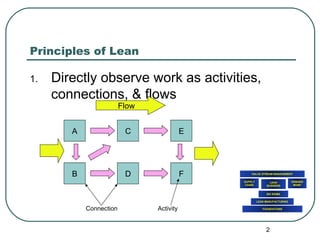
Principles of Lean Directly observe work as activities, connections, & flows A B C D E F Flow Activity Connection
2. Systematic Waste Elimination 8 Types of waste- 1.Overproduction (more or sooner) 2. Transportation ( movement of anything) 3. Inventory 4. Motion (any movement of people) 5. Waiting (any downtime) 6. Overprocessing (doing more than the  customer requires) 7. Defects (any error) 8. Talent Principles of Lean
3. Establish high agreement of what & how - The people closest to an activity or process should be in agreement about what & how an activity or process should be accomplished 4. Systematic problem solving Five Whys DMAIC  (Define, Measure, Analyze, Improve, Control) Get to the root cause of a problem, not the root blame Principles of Lean
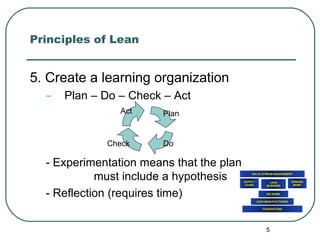
5. Create a learning organization Plan – Do – Check – Act - Experimentation means that the plan  must include a hypothesis - Reflection (requires time) Principles of Lean Plan Do Check Act
Leadership Lean  Leaders Must be Teachers -  Transfer ideas, skill & understanding to others 2. Build Tension, Not Stress -  People feel stress when conditions are  nearly impossible - People feel tension when they sense a gap between the current state & the ideal state - The leader must pull people together  & provide the means to cross the chasm
3. Eliminate Fear & Comfort - Force people out of the comfort zone by setting clear goals & providing mechanisms - Provide physical, emotional & professional safety - Model the proper behavior   Leadership Lean Comfort  Zone Fear Zone Current Knowledge Learning Zone
4. Lead through visible participation, not proclamation - Pull the organization through the process - Active engagement of Lean Coordinator and other training sources 5. Build lean into personal practice - Leaders need to look at their own practices - Design a structured flow for work - Standardization - Use the scientific method  (hypothesis)  - Broadcast incorporation of lean  Leadership Lean
Personal Lean Always work for the customer Push  means there is no demand for the resource Pull  means that there is a demand Problem solving at a relationship level Manage commitments Use systemic problem solving & the 5 Whys to determine the true root cause, not root blame Personal learning through Plan/ Do/ Check/ Act Capture  expectations – this leads to developing a hypothesis Master what you can control – by eliminating variation you can create more predictable outcomes See more with your own eyes – directly observe work as activities, connections & flows

Guide To Lean

  • 1.
    Guide to LeanPrinciples Leadership Personal
  • 2.
    Principles of LeanDirectly observe work as activities, connections, & flows A B C D E F Flow Activity Connection
  • 3.
    2. Systematic WasteElimination 8 Types of waste- 1.Overproduction (more or sooner) 2. Transportation ( movement of anything) 3. Inventory 4. Motion (any movement of people) 5. Waiting (any downtime) 6. Overprocessing (doing more than the customer requires) 7. Defects (any error) 8. Talent Principles of Lean
  • 4.
    3. Establish highagreement of what & how - The people closest to an activity or process should be in agreement about what & how an activity or process should be accomplished 4. Systematic problem solving Five Whys DMAIC (Define, Measure, Analyze, Improve, Control) Get to the root cause of a problem, not the root blame Principles of Lean
  • 5.
    5. Create alearning organization Plan – Do – Check – Act - Experimentation means that the plan must include a hypothesis - Reflection (requires time) Principles of Lean Plan Do Check Act
  • 6.
    Leadership Lean Leaders Must be Teachers - Transfer ideas, skill & understanding to others 2. Build Tension, Not Stress - People feel stress when conditions are nearly impossible - People feel tension when they sense a gap between the current state & the ideal state - The leader must pull people together & provide the means to cross the chasm
  • 7.
    3. Eliminate Fear& Comfort - Force people out of the comfort zone by setting clear goals & providing mechanisms - Provide physical, emotional & professional safety - Model the proper behavior Leadership Lean Comfort Zone Fear Zone Current Knowledge Learning Zone
  • 8.
    4. Lead throughvisible participation, not proclamation - Pull the organization through the process - Active engagement of Lean Coordinator and other training sources 5. Build lean into personal practice - Leaders need to look at their own practices - Design a structured flow for work - Standardization - Use the scientific method (hypothesis) - Broadcast incorporation of lean Leadership Lean
  • 9.
    Personal Lean Alwayswork for the customer Push means there is no demand for the resource Pull means that there is a demand Problem solving at a relationship level Manage commitments Use systemic problem solving & the 5 Whys to determine the true root cause, not root blame Personal learning through Plan/ Do/ Check/ Act Capture expectations – this leads to developing a hypothesis Master what you can control – by eliminating variation you can create more predictable outcomes See more with your own eyes – directly observe work as activities, connections & flows