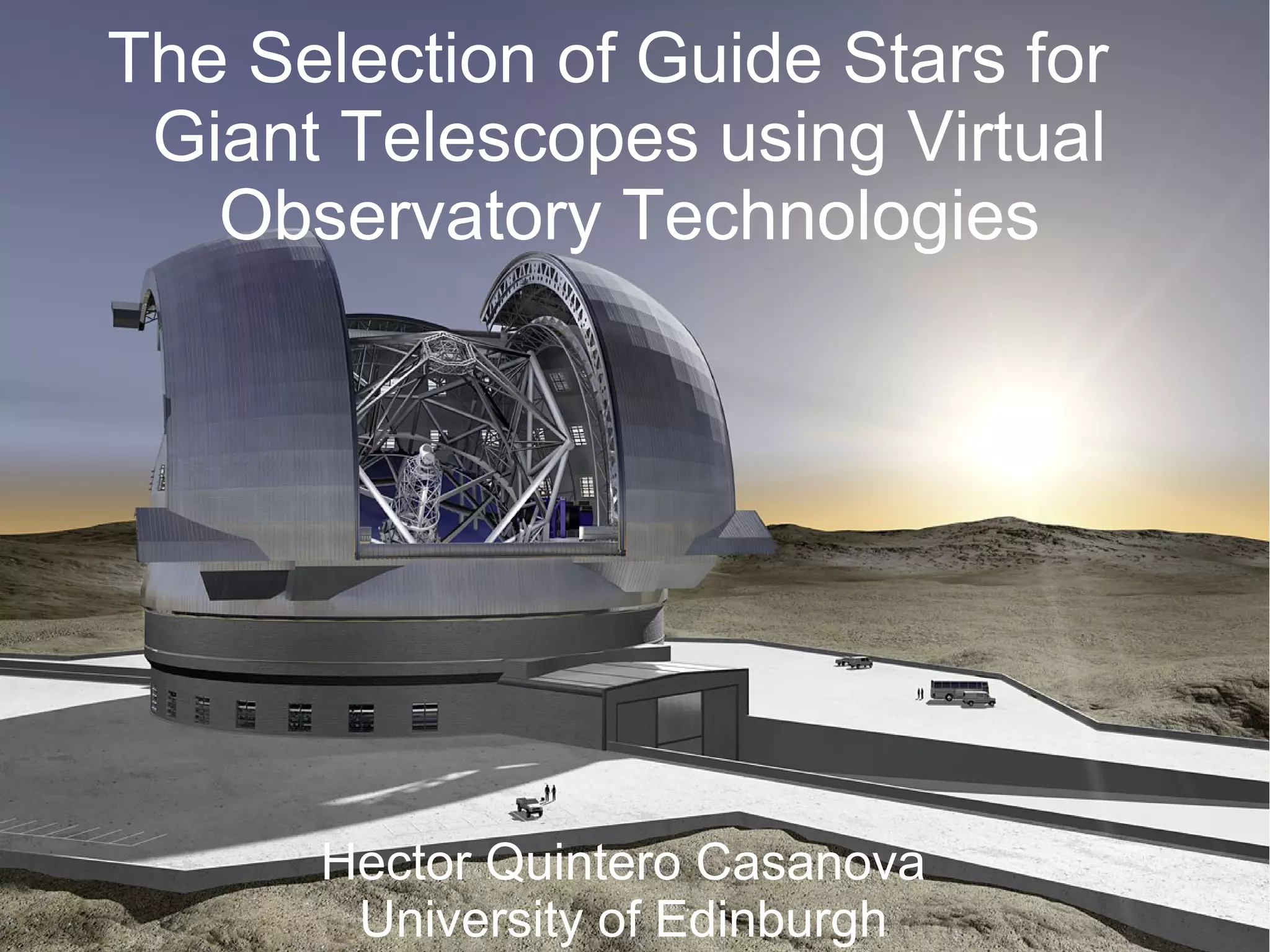

The Selection of Guide Stars for
 Giant Telescopes using Virtual
   Observatory Technologies


      Hector Quintero Casanova
       University of Edinburgh
Title is too long...

    Selection: universal search tool.
      –   General service available to applications.

    Guide stars: trackable starry objects in the sky.
      –   Point-like: cannot be resolved to extended shape.
      –   Stationary: no proper motion.
      –   Other constraints: number, size, brightness...

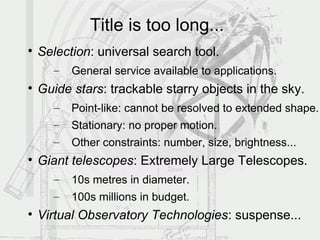
    Giant telescopes: Extremely Large Telescopes.
      –   10s metres in diameter.
      –   100s millions in budget.

    Virtual Observatory Technologies: suspense...
?
  Depends on constraints
  They are tough for ELTs

Are we running out of stars?
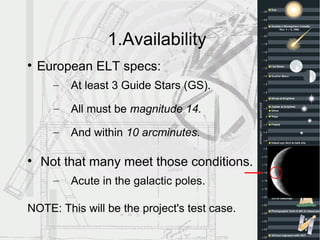
1.Availability

    European ELT specs:
      –   At least 3 Guide Stars (GS).

      –   All must be magnitude 14.

      –   And within 10 arcminutes.


    Not that many meet those conditions.
      –   Acute in the galactic poles.

NOTE: This will be the project's test case.
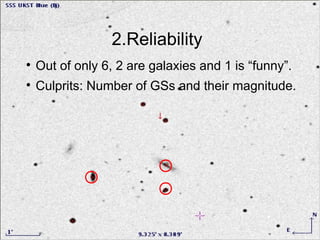
2.Reliability

    Out of only 6, 2 are galaxies and 1 is “funny”.

    Culprits: Number of GSs and their magnitude.


                Most stars here
Adaptive optics
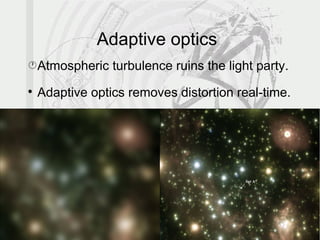
• Atmospheric turbulence ruins the light party.

    Adaptive optics removes distortion real-time.

    Needs a GS to probe turbulence pattern:
      –   Bright enough: limiting magnitude.
      –   Isolated: near-neighbour problem.
      –   Initially, at minimum distance from target.
            •   Otherwise, affected by different turbulence.
            •   Solved with multiple GSs ≃ MCAO
            •   MCAO applied in ELTs.
The challenge

    MCAO requires at least 3 stars magnitude 19.

    ELTs work with a smaller Field Of View (FOV).
      –   AO corrections more accurate: brighter Gss.

    But in a smaller FOV, less bright GSs.
      –   Stronger dependence on less reliable GSs.
            •   Shape might help filter out some of those.
            •   Other data to filter some more: proper motion.
            •   What happens with still point-like ones?
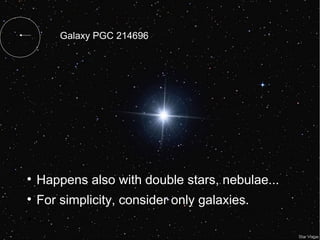
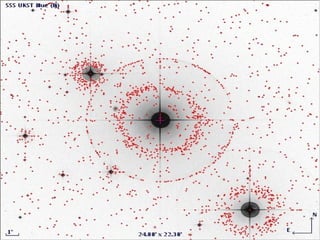
Galaxy PGC 214696



    Happens also with double stars, nebulae...

    For simplicity, consider only galaxies.

Catalogues

    Tables of objects in all or part of the sky.

    Format and fields vary. Required:
       –   Coordinates and proper motion (astrometry).
       –   Magnitude (photometry; band V).
       –   Shape (eccentricity, ellipticity...).
       –   Class (star/galaxy separation, number...).

    May contain artifacts. Class field handy.

    Which? All... More information, less guesses.
Virtual Observatory

    Provides uniform access to astronomy data.

    Framework of standards. Most relevant:
      –   UCDs: universally describe fields.
      –   Cone search: most catalogues support it.

    But full automation is not possible:
      –   UCDs cannot be used in queries.
               Cannot abstract completely from schema.
      –   No descriptor for sky coverage.
               Cannot search by spatial relevance.
Pre-emptive catalogue selection

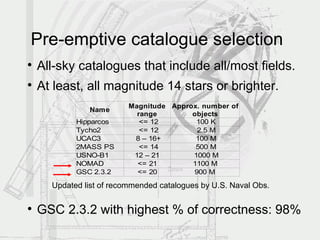
    All-sky catalogues that include all/most fields.

    At least, all magnitude 14 stars or brighter.
                          Magnitude Approx. number of
               Name
                            range        objects
            Hipparcos        <= 12        100 K
            Tycho2           <= 12        2.5 M
            UCAC3          8 – 16+        100 M
            2MASS PS         <= 14        500 M
            USNO-B1        12 – 21       1000 M
            NOMAD           <= 21        1100 M
            GSC 2.3.2       <= 20        900 M

      Updated list of recommended catalogues by U.S. Naval Obs.


    GSC 2.3.2 with highest % of correctness: 98%
Pre-emptive catalogue selection

    Use GSC 2.3.2 as a baseline against user's:
      –   To guarantee availability of required fields.
            •   More flexibility allowed in user's choice.
      –   To use its classifier as a first coarse filter.
            •   Reduces no. of operations in point-like search.
            •   Cannot use GSC 2.3.2 data directly anyway.

    Use crossmatching to relate catalogues.

    At service level, all catalogues as parameters.

    At interface level, recommended catalogues.
Limitations

    Similar accuracy in user & baseline catalogues?
      –   Introduces slight differences in astrometry.
            •    Not so bad for point-like search.
            •    Hampers near-neighbour filtering: object repetition.
            •    Hampers galaxy filtering: object off-setting.


    Solutions:
      –   List of recommended catalogues is vital.
      –   Near-neighbour and galaxy filtering low-priority.
            •    Galaxy filtering similar process to baseline filtering.
            •    Generalise as crossmatching wrapper for extension.
Limitations

    Balance between availability and reliability?
      –   Model of successive filtering favours reliability.
            •    In areas like the NGP, it may affect availability.
            •    So far, user has been left out in that process.


    Solutions:
      –   Sort list of final candidates by shape fidelity.
            •    How much of a point-like object are they?
      –   Introduce parameter for level of filtering.
            •    Relevant when doing filtering with other catalogues.
                       Make it low-priority.
Project Milestones and Priorities
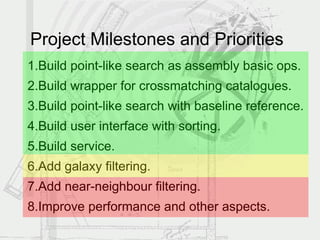
1.Build point-like search as assembly basic ops.
2.Build wrapper for crossmatching catalogues.
3.Build point-like search with baseline reference.
4.Build user interface with sorting.
5.Build service.
6.Add galaxy filtering.
7.Add near-neighbour filtering.
8.Improve performance and other aspects.
Project plan

    Software methodology: waterfall + iterative devel.
      –   Although important, interface is not central.
      –   Requirements are likely to be stable.
      –   Simple model to follow: less technical digressions.

    Risk mitigation:
      –   Study of complexities and prioritisation (checked).
            •   Helps increase de-coupling from supervisor's input.
      –   Iterative development and testing. Design of tests.
      –   Plan with as much detail of design as possible.
      –   Include intermediate stages. Will act as buffer.
¿?

The selection of guide stars for giant telescopes using Virtual Observatory technologies

  • 1.
    The Selection ofGuide Stars for Giant Telescopes using Virtual Observatory Technologies Hector Quintero Casanova University of Edinburgh
  • 2.
    Title is toolong...  Selection: universal search tool. – General service available to applications.  Guide stars: trackable starry objects in the sky. – Point-like: cannot be resolved to extended shape. – Stationary: no proper motion. – Other constraints: number, size, brightness...  Giant telescopes: Extremely Large Telescopes. – 10s metres in diameter. – 100s millions in budget.  Virtual Observatory Technologies: suspense...
  • 3.
    ? Dependson constraints They are tough for ELTs Are we running out of stars?
  • 4.
    1.Availability  European ELT specs: – At least 3 Guide Stars (GS). – All must be magnitude 14. – And within 10 arcminutes.  Not that many meet those conditions. – Acute in the galactic poles. NOTE: This will be the project's test case.
  • 5.
    2.Reliability  Out of only 6, 2 are galaxies and 1 is “funny”.  Culprits: Number of GSs and their magnitude. Most stars here
  • 6.
    Adaptive optics • Atmosphericturbulence ruins the light party.  Adaptive optics removes distortion real-time.  Needs a GS to probe turbulence pattern: – Bright enough: limiting magnitude. – Isolated: near-neighbour problem. – Initially, at minimum distance from target. • Otherwise, affected by different turbulence. • Solved with multiple GSs ≃ MCAO • MCAO applied in ELTs.
  • 7.
    The challenge  MCAO requires at least 3 stars magnitude 19.  ELTs work with a smaller Field Of View (FOV). – AO corrections more accurate: brighter Gss.  But in a smaller FOV, less bright GSs. – Stronger dependence on less reliable GSs. • Shape might help filter out some of those. • Other data to filter some more: proper motion. • What happens with still point-like ones?
  • 8.
    Galaxy PGC 214696  Happens also with double stars, nebulae...  For simplicity, consider only galaxies. 
  • 9.
    Catalogues  Tables of objects in all or part of the sky.  Format and fields vary. Required: – Coordinates and proper motion (astrometry). – Magnitude (photometry; band V). – Shape (eccentricity, ellipticity...). – Class (star/galaxy separation, number...).  May contain artifacts. Class field handy.  Which? All... More information, less guesses.
  • 10.
    Virtual Observatory  Provides uniform access to astronomy data.  Framework of standards. Most relevant: – UCDs: universally describe fields. – Cone search: most catalogues support it.  But full automation is not possible: – UCDs cannot be used in queries.  Cannot abstract completely from schema. – No descriptor for sky coverage.  Cannot search by spatial relevance.
  • 11.
    Pre-emptive catalogue selection  All-sky catalogues that include all/most fields.  At least, all magnitude 14 stars or brighter. Magnitude Approx. number of Name range objects Hipparcos <= 12 100 K Tycho2 <= 12 2.5 M UCAC3 8 – 16+ 100 M 2MASS PS <= 14 500 M USNO-B1 12 – 21 1000 M NOMAD <= 21 1100 M GSC 2.3.2 <= 20 900 M Updated list of recommended catalogues by U.S. Naval Obs.  GSC 2.3.2 with highest % of correctness: 98%
  • 12.
    Pre-emptive catalogue selection  Use GSC 2.3.2 as a baseline against user's: – To guarantee availability of required fields. • More flexibility allowed in user's choice. – To use its classifier as a first coarse filter. • Reduces no. of operations in point-like search. • Cannot use GSC 2.3.2 data directly anyway.  Use crossmatching to relate catalogues.  At service level, all catalogues as parameters.  At interface level, recommended catalogues.
  • 13.
    Limitations  Similar accuracy in user & baseline catalogues? – Introduces slight differences in astrometry. • Not so bad for point-like search. • Hampers near-neighbour filtering: object repetition. • Hampers galaxy filtering: object off-setting.  Solutions: – List of recommended catalogues is vital. – Near-neighbour and galaxy filtering low-priority. • Galaxy filtering similar process to baseline filtering. • Generalise as crossmatching wrapper for extension.
  • 14.
    Limitations  Balance between availability and reliability? – Model of successive filtering favours reliability. • In areas like the NGP, it may affect availability. • So far, user has been left out in that process.  Solutions: – Sort list of final candidates by shape fidelity. • How much of a point-like object are they? – Introduce parameter for level of filtering. • Relevant when doing filtering with other catalogues.  Make it low-priority.
  • 15.
    Project Milestones andPriorities 1.Build point-like search as assembly basic ops. 2.Build wrapper for crossmatching catalogues. 3.Build point-like search with baseline reference. 4.Build user interface with sorting. 5.Build service. 6.Add galaxy filtering. 7.Add near-neighbour filtering. 8.Improve performance and other aspects.
  • 16.
    Project plan  Software methodology: waterfall + iterative devel. – Although important, interface is not central. – Requirements are likely to be stable. – Simple model to follow: less technical digressions.  Risk mitigation: – Study of complexities and prioritisation (checked). • Helps increase de-coupling from supervisor's input. – Iterative development and testing. Design of tests. – Plan with as much detail of design as possible. – Include intermediate stages. Will act as buffer.
  • 17.