Multi-Break Rearrangements
             and
  Chromosomal Evolution
       Max Alekseyev
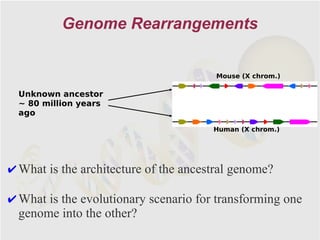
Genome Rearrangements


                                        Mouse (X chrom.)

  Unknown ancestor
  ~ 80 million years
  ago
                                       Human (X chrom.)


✔ What is the architecture of the ancestral genome?

✔ What is the evolutionary scenario for transforming one
  genome into the other?
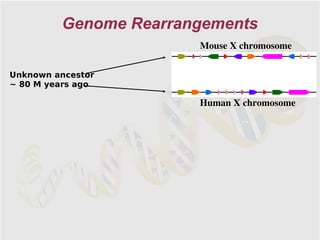
Genome Rearrangements
                       Mouse X chromosome

Unknown ancestor
~ 80 M years ago

                       Human X chromosome
Genome Rearrangements:
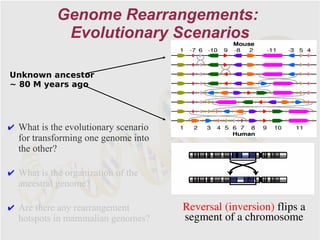
             Evolutionary Scenarios

Unknown ancestor
~ 80 M years ago


✔ What is the evolutionary scenario
  for transforming one genome into
  the other?

✔ What is the organization of the
  ancestral genome?

✔ Are there any rearrangement         Reversal (inversion) flips a
  hotspots in mammalian genomes?      segment of a chromosome
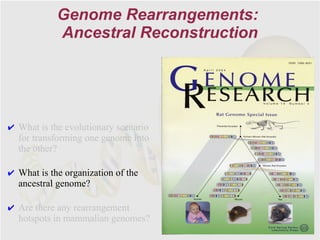
Genome Rearrangements:
            Ancestral Reconstruction


✔ What is the evolutionary scenario
  for transforming one genome into
  the other?

✔ What is the organization of the
  ancestral genome?

✔ Are there any rearrangement
  hotspots in mammalian genomes?
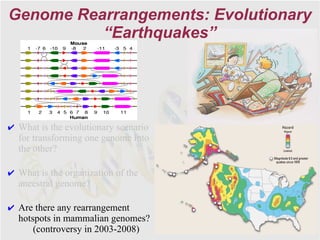
Genome Rearrangements: Evolutionary
          “Earthquakes”


✔ What is the evolutionary scenario
  for transforming one genome into
  the other?

✔ What is the organization of the
  ancestral genome?

✔ Are there any rearrangement
  hotspots in mammalian genomes?
      (controversy in 2003-2008)
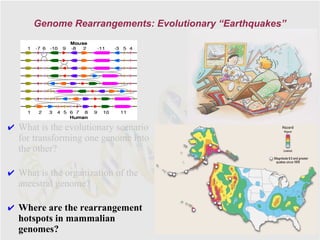
Genome Rearrangements: Evolutionary “Earthquakes”


✔ What is the evolutionary scenario
  for transforming one genome into
  the other?

✔ What is the organization of the
  ancestral genome?

✔ Where are the rearrangement
  hotspots in mammalian
  genomes?
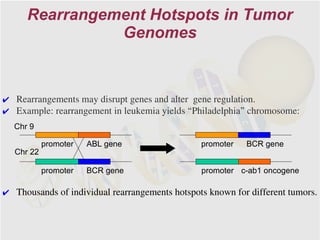
Rearrangement Hotspots in Tumor
               Genomes


✔ Rearrangements may disrupt genes and alter gene regulation.
✔ Example: rearrangement in leukemia yields “Philadelphia” chromosome:
  Chr 9

           promoter   ABL gene                  promoter   BCR gene
  Chr 22

           promoter   BCR gene                  promoter c-ab1 oncogene

✔ Thousands of individual rearrangements hotspots known for different tumors.
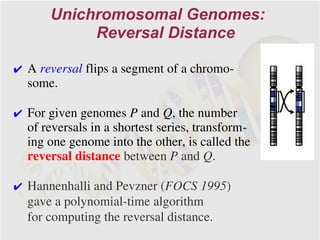
Unichromosomal Genomes:
            Reversal Distance

✔ A reversal flips a segment of a chromo-
  some.

✔ For given genomes P and Q, the number
  of reversals in a shortest series, transform-
  ing one genome into the other, is called the
  reversal distance between P and Q.

✔ Hannenhalli and Pevzner (FOCS 1995)
  gave a polynomial-time algorithm
  for computing the reversal distance.
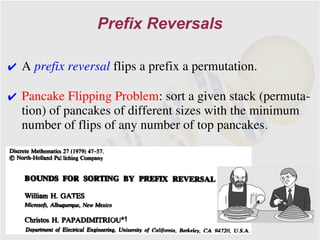
Prefix Reversals

✔ A prefix reversal flips a prefix a permutation.

✔ Pancake Flipping Problem: sort a given stack (permuta-
  tion) of pancakes of different sizes with the minimum
  number of flips of any number of top pancakes.
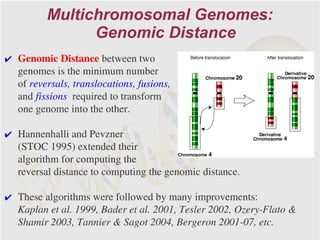
Multichromosomal Genomes:
                Genomic Distance
✔ Genomic Distance between two
  genomes is the minimum number
  of reversals, translocations, fusions,
  and fissions required to transform
  one genome into the other.

✔ Hannenhalli and Pevzner
  (STOC 1995) extended their
  algorithm for computing the
  reversal distance to computing the genomic distance.

✔ These algorithms were followed by many improvements:
  Kaplan et al. 1999, Bader et al. 2001, Tesler 2002, Ozery-Flato &
  Shamir 2003, Tannier & Sagot 2004, Bergeron 2001-07, etc.
HP Theory Is Rather Complicated:
     Is There a Simpler Alternative?


✔ HP theory is a key tool in most genome rearrange-
  ment studies. However, it is rather complicated that
  makes it difficult to apply in complex setups.

✔ To study genome rearrangements in multiple
  genomes, we use 2-break rearrangements, also
  known as DCJ (Yancopoulus et al., Bioinformatics
  2005).
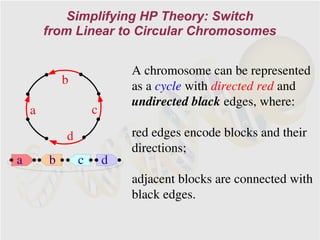
Simplifying HP Theory: Switch
        from Linear to Circular Chromosomes


                            A chromosome can be represented
            b               as a cycle with directed red and
                            undirected black edges, where:
    a               c

            d               red edges encode blocks and their
                            directions;
a       b       c       d
                            adjacent blocks are connected with
                            black edges.
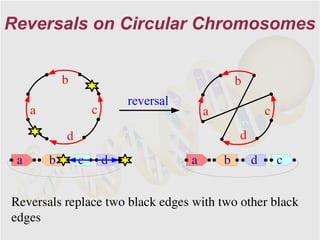
Reversals on Circular Chromosomes


             b                                      b
                             reversal
     a               c                      a               c
             d                                      d
 a       b       c       d              a       b       d       c


Reversals replace two black edges with two other black
edges
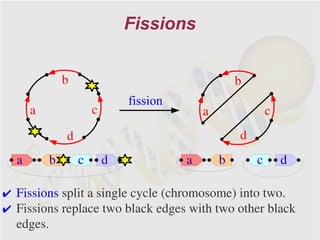
Fissions


              b                                     b
                              fission
      a               c                     a               c
              d                                     d
  a       b       c       d             a       b       c       d

✔ Fissions split a single cycle (chromosome) into two.
✔ Fissions replace two black edges with two other black
  edges.
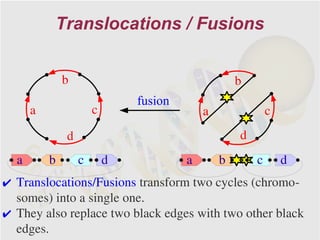
Translocations / Fusions


              b                                    b
                              fusion
      a               c                    a               c
              d                                    d
  a       b       c       d            a       b       c       d
✔ Translocations/Fusions transform two cycles (chromo-
  somes) into a single one.
✔ They also replace two black edges with two other black
  edges.
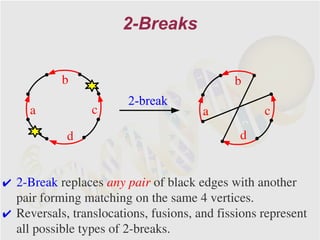
2-Breaks


           b                                 b
                        2-break
     a           c                     a           c
            d                                 d


✔ 2-Break replaces any pair of black edges with another
  pair forming matching on the same 4 vertices.
✔ Reversals, translocations, fusions, and fissions represent
  all possible types of 2-breaks.
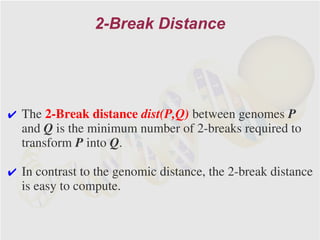
2-Break Distance


✔ The 2-Break distance dist(P,Q) between genomes P
  and Q is the minimum number of 2-breaks required to
  transform P into Q.

✔ In contrast to the genomic distance, the 2-break distance
  is easy to compute.
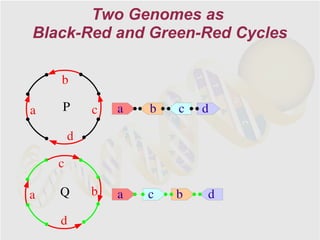
Two Genomes as
Black-Red and Green-Red Cycles

    b

a   P       c   a   b   c   d

        d

    c

a   Q       b   a   c   b   d

    d
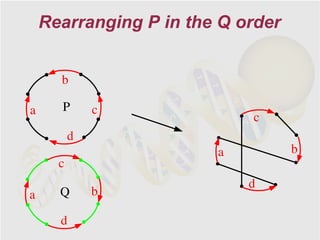
Rearranging P in the Q order


      b

a     P       c
                            c
          d
                        a          b
      c
                            d
a     Q       b

      d
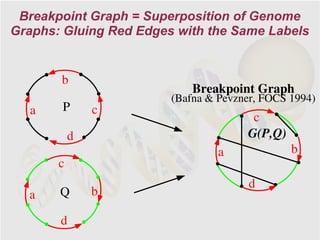
Breakpoint Graph = Superposition of Genome
Graphs: Gluing Red Edges with the Same Labels


       b
                            Breakpoint Graph
                        (Bafna & Pevzner, FOCS 1994)
  a    P       c
                                       c
           d                          G(P,Q)
                                 a             b
       c
                                       d
  a    Q       b

       d
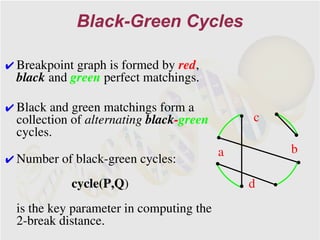
Black-Green Cycles

✔ Breakpoint graph is formed by red,
  black and green perfect matchings.

✔ Black and green matchings form a
  collection of alternating black-green       c
  cycles.
                                          a       b
✔ Number of black-green cycles:
            cycle(P,Q)                        d
  is the key parameter in computing the
  2-break distance.
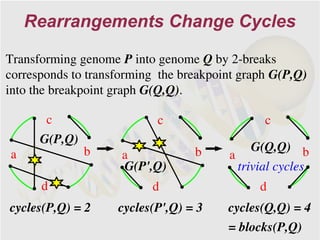
Rearrangements Change Cycles

Transforming genome P into genome Q by 2-breaks
corresponds to transforming the breakpoint graph G(P,Q)
into the breakpoint graph G(Q,Q).

       c                   c                   c
      G(P,Q)
               b                  b          G(Q,Q) b
a                    a                  a
                     G(P',Q)              trivial cycles
      d                   d                   d
cycles(P,Q) = 2     cycles(P',Q) = 3    cycles(Q,Q) = 4
                                        = blocks(P,Q)
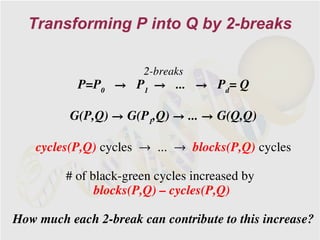
Transforming P into Q by 2-breaks

                       2-breaks
           P=P0 → P1 → ... → Pd= Q

          G(P,Q) → G(P1,Q) → ... → G(Q,Q)

    cycles(P,Q) cycles → ... → blocks(P,Q) cycles

         # of black-green cycles increased by
               blocks(P,Q) – cycles(P,Q)

How much each 2-break can contribute to this increase?
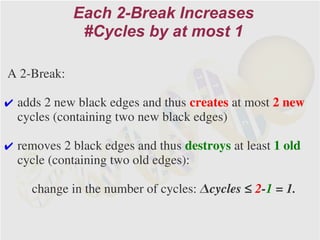
Each 2-Break Increases
              #Cycles by at most 1

A 2-Break:

✔ adds 2 new black edges and thus creates at most 2 new
  cycles (containing two new black edges)

✔ removes 2 black edges and thus destroys at least 1 old
  cycle (containing two old edges):

     change in the number of cycles: Δcycles ≤ 2-1 = 1.
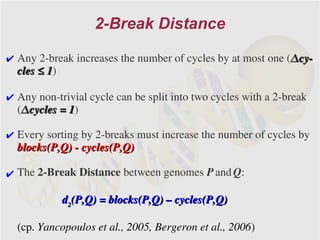
2-Break Distance

✔ Any 2-break increases the number of cycles by at most one (Δcy-
  cles ≤ 1)
         1

✔ Any non-trivial cycle can be split into two cycles with a 2-break
  (Δcycles = 1)
             1

✔ Every sorting by 2-breaks must increase the number of cycles by
  blocks(P,Q) - cycles(P,Q)

✔ The 2-Break Distance between genomes P and Q:

            d2(P,Q) = blocks(P,Q) – cycles(P,Q)

  (cp. Yancopoulos et al., 2005, Bergeron et al., 2006)
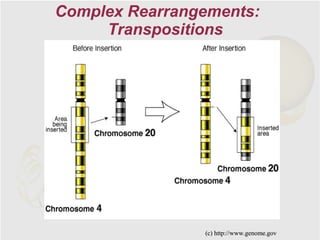
Complex Rearrangements:
     Transpositions


                (с) http://www.genome.gov
Sorting by Transpositions
✔ Sorting by Transpositions Problem:
  Given two genomes, find the shortest sequence of trans-
  positions transforming one genome into the other.

✔ First 1.5-approximation algorithm was given by Bafna
  and Pevzner (SODA 1995).

✔ Best achievement: 1.375-approximation algorithm due to
  Elias and Hartman (WABI 2005).

✔ Proved to be NP-complete by Bulteau, Fertin, and Rusu
  (ICALP 2011).
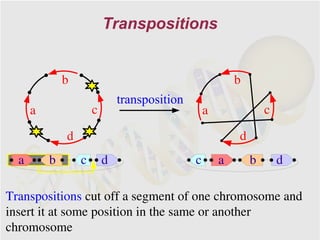
Transpositions


              b                                           b
                              transposition
      a               c                           a               c

              d                                           d
  a       b       c       d                   c       a       b       d

Transpositions cut off a segment of one chromosome and
insert it at some position in the same or another
chromosome
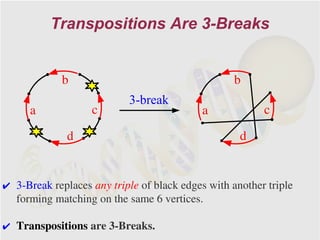
Transpositions Are 3-Breaks


             b                                     b
                           3-break
      a            c                        a            c

              d                                     d


✔ 3-Break replaces any triple of black edges with another triple
  forming matching on the same 6 vertices.

✔ Transpositions are 3-Breaks.
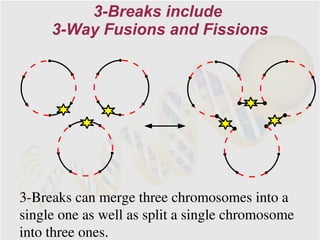
3-Breaks include
     3-Way Fusions and Fissions


3-Breaks can merge three chromosomes into a
single one as well as split a single chromosome
into three ones.
3-Break Distance


The 3-Break Distance d3(P,Q) between genomes P
and Q is the minimum number of 3-breaks required
to transform P into Q.
3-Break Distance

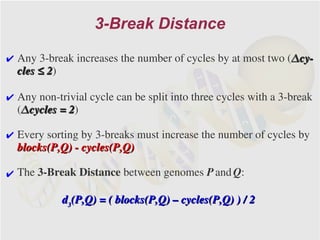
✔ Any 3-break increases the number of cycles by at most two (Δcy-
  cles ≤ 2)
         2

✔ Any non-trivial cycle can be split into three cycles with a 3-break
  (Δcycles = 2)
             2

✔ Every sorting by 3-breaks must increase the number of cycles by
  blocks(P,Q) - cycles(P,Q)

✔ The 3-Break Distance between genomes P and Q:

            d3(P,Q) = ( blocks(P,Q) – cycles(P,Q) ) / 2
3-Break Distance: OOPS!

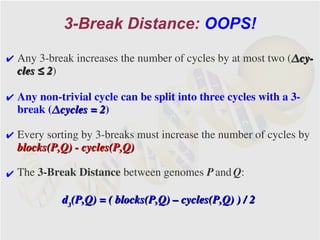
✔ Any 3-break increases the number of cycles by at most two (Δcy-
  cles ≤ 2)
         2

✔ Any non-trivial cycle can be split into three cycles with a 3-
  break (Δcycles = 2)
                   2

✔ Every sorting by 3-breaks must increase the number of cycles by
  blocks(P,Q) - cycles(P,Q)

✔ The 3-Break Distance between genomes P and Q:

            d3(P,Q) = ( blocks(P,Q) – cycles(P,Q) ) / 2
3-Break Splitting Odd Cycle


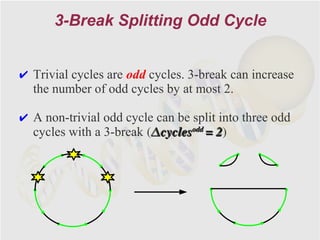
✔ Trivial cycles are odd cycles. 3-break can increase
  the number of odd cycles by at most 2.

✔ A non-trivial odd cycle can be split into three odd
  cycles with a 3-break (Δcyclesodd = 2)
                                      2
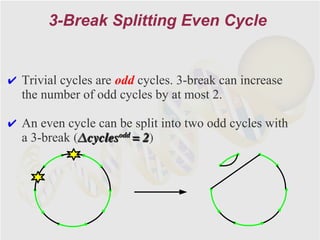
3-Break Splitting Even Cycle


✔ Trivial cycles are odd cycles. 3-break can increase
  the number of odd cycles by at most 2.

✔ An even cycle can be split into two odd cycles with
  a 3-break (Δcyclesodd = 2)
                          2
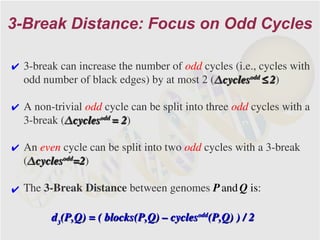
3-Break Distance: Focus on Odd Cycles

✔ 3-break can increase the number of odd cycles (i.e., cycles with
  odd number of black edges) by at most 2 (Δcyclesodd ≤ 2)

✔ A non-trivial odd cycle can be split into three odd cycles with a
  3-break (Δcyclesodd = 2)
                        2

✔ An even cycle can be split into two odd cycles with a 3-break
  (Δcyclesodd=2)
             =2

✔ The 3-Break Distance between genomes P and Q is:

        d3(P,Q) = ( blocks(P,Q) – cyclesodd(P,Q) ) / 2
Multi-Break Rearrangements

✔ The standard rearrangement operations (reversals, translocations, fusions,
  and fissions) make 2 breakages in a genome and glue the resulting pieces
  in a new order.

✔ k-Break rearrangement operation makes k breakages in a genome and
  glues the resulting pieces in a new order.

✔ Rearrangements are rare evolutionary events and biologists believe that k-
  break rearrangements are unlikely for k>3 and relatively rare for k=3 (at
  least in the mammalian evolution).

✔ Also, in radiation biology, chromosome aberrations for k>2 (indicative of
  chromosome damage rather than evolutionary viable variations) may be
  more common, e.g., complex rearrangements in irradiated human lympho-
  cytes (Sachs et al., 2004; Levy et al., 2004).
k-Breaks


✔ k-Break replaces k black edges, forming a match-
  ing on 2k vertices, with a set of k black edges,
  forming another matching on the same 2k ver-
  tices.

✔ k-Break Distance Problem: Given two genomes
  P and Q, find the shortest sequence of k-breaks
  transforming P into Q.
Number of Cycles


✔ Every k-break introduces at most k breakages.

✔ A k-break “destroys” at least one cycle

✔ A k-break creates at most k new cycles

✔ Therefore, k-break can increase the number of cycles
  by at most k-1, .i.e., Δcycles ≤ k-1
Computing k-Break Distance
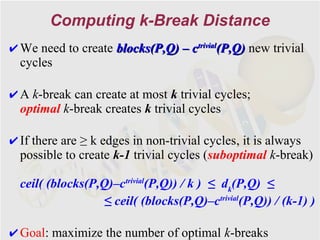
✔ We need to create blocks(P,Q) – ctrivial(P,Q) new trivial
  cycles

✔ A k-break can create at most k trivial cycles;
  optimal k-break creates k trivial cycles

✔ If there are ≥ k edges in non-trivial cycles, it is always
  possible to create k-1 trivial cycles (suboptimal k-break)

  ceil( (blocks(P,Q)–ctrivial(P,Q)) / k ) ≤ dk(P,Q) ≤
                   ≤ ceil( (blocks(P,Q)–ctrivial(P,Q)) / (k-1) )

✔ Goal: maximize the number of optimal k-breaks
Optimal k-Breaks
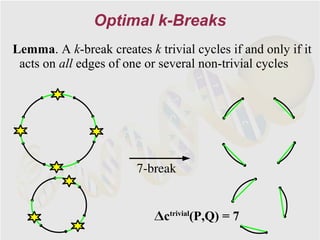
Lemma. A k-break creates k trivial cycles if and only if it
 acts on all edges of one or several non-trivial cycles


                        7-break


                           Δctrivial(P,Q) = 7
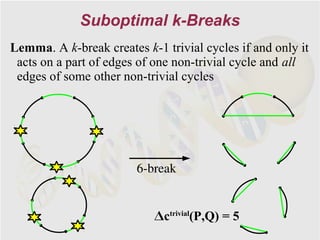
Suboptimal k-Breaks
Lemma. A k-break creates k-1 trivial cycles if and only it
 acts on a part of edges of one non-trivial cycle and all
 edges of some other non-trivial cycles


                        6-break


                            Δctrivial(P,Q) = 5
Greedy Construction of a Suboptimal k-
               Break

  If there are ≥ k edges in non-trivial cycles, a subopti-
  mal (or even optimal) k-break can be constructed in a
  greedy way:

✔ Take all edges of one cycle, all edges of another cycle,
  and so on while the total number of taken edges is less
  than k.
✔ Then take a part of edges of yet another cycle, making
  the total number of taken edges equal k.
Breakable Sets


✔ A set of black-gray cycles is breakable if the total
  number of black edges is 1 modulo (k-1)

 ✔ E.g.: for k=2, any set of cycles is breakable

 ✔ E.g.: for k=3, a set of cycles is breakable if and only
   if it contains odd number of odd cycles
Breaking a Breakable Set
             into Trivial Cycles

✔ A breakable set can be broken into trivial cycles using
  a series of suboptimal k-breaks and at least one opti-
  mal k-break

✔ A breakable set with m black edges can be broken into
  m trivial cycles with t=(m-1)/(k-1) k-breaks:

  t-1 suboptimal k-breaks create (t-1)·(k-1) = m-k trivial cycles
  leaving k edges in non-trivial cycles that are handled by an op-
  timal k-break
k-Break Distance
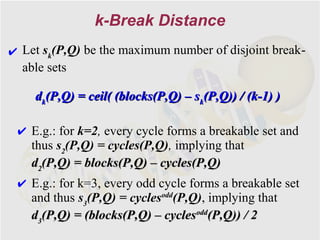
✔ Let sk(P,Q) be the maximum number of disjoint break-
  able sets

    dk(P,Q) = ceil( (blocks(P,Q) – sk(P,Q)) / (k-1) )

 ✔ E.g.: for k=2, every cycle forms a breakable set and
   thus s2(P,Q) = cycles(P,Q), implying that
   d2(P,Q) = blocks(P,Q) – cycles(P,Q)
 ✔ E.g.: for k=3, every odd cycle forms a breakable set
   and thus s3(P,Q) = cyclesodd(P,Q), implying that
   d3(P,Q) = (blocks(P,Q) – cyclesodd(P,Q)) / 2
More Examples


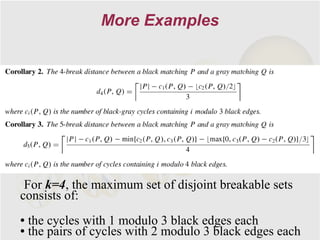
 For k=4, the maximum set of disjoint breakable sets
consists of:
● the cycles with 1 modulo 3 black edges each
● the pairs of cycles with 2 modulo 3 black edges each
Computing sk(P,Q)
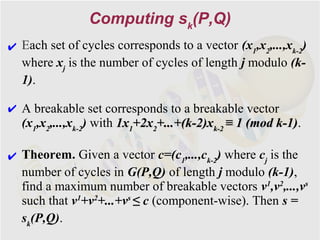
✔ Each set of cycles corresponds to a vector (x1,x2,...,xk-2)
  where xj is the number of cycles of length j modulo (k-
  1).

✔ A breakable set corresponds to a breakable vector
  (x1,x2,...,xk-2) with 1x1+2x2+...+(k-2)xk-2 ≡ 1 (mod k-1).
                                                       k-1)

✔ Theorem. Given a vector c=(c1,...,ck-2) where cj is the
  number of cycles in G(P,Q) of length j modulo (k-1),
  find a maximum number of breakable vectors v1,v2,...,vs
  such that v1+v2+...+vs ≤ c (component-wise). Then s =
  sk(P,Q).
Dynamic Programming
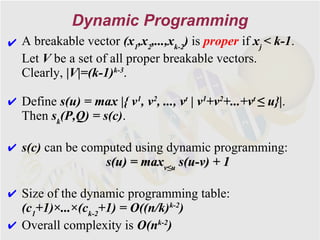
✔ A breakable vector (x1,x2,...,xk-2) is proper if xj < k-1.
  Let V be a set of all proper breakable vectors.
  Clearly, |V|=(k-1)k-3.

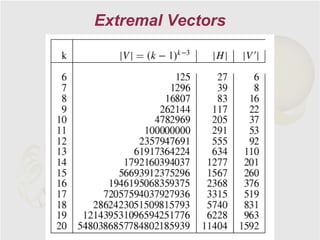
✔ Define s(u) = max |{ v1, v2, ..., vt | v1+v2+...+vt ≤ u}|.
  Then sk(P,Q) = s(c).

✔ s(c) can be computed using dynamic programming:
                 s(u) = maxv≤u s(u-v) + 1

✔ Size of the dynamic programming table:
  (c1+1)×...×(ck-2+1) = O((n/k)k-2)
✔ Overall complexity is O(nk-2)
Extremal Vectors


✔ If u ≤ v for u, v from V, then v can be removed from V.

✔ Vector v in V is extremal if there is no u in V such that
  u ≤ v.

✔ The set of all extremal vectors V' can be computed us-
  ing Hilbert bases.
Extremal Vectors
Weighted Genomic Distance can hardly
impose a bound on the proportion of
transpositions


                Max Alekseyev
  University of South Carolina, Columbia, SC, U.S.A.
                        2010
Introduction

• Genome Rearrangements

• Genomic Distance and Breakpoint Graphs

• Transpositions and Weighted Genomic Distance

• Optimal Transformations

• Main Theorem
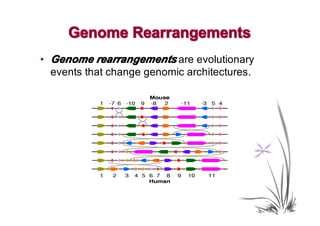
Genome Rearrangements
• Genome rearrangements are evolutionary
  events that change genomic architectures.
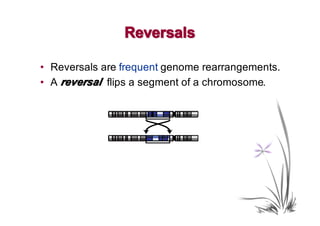
Reversals

• Reversals are frequent genome rearrangements.
• A reversal flips a segment of a chromosome.
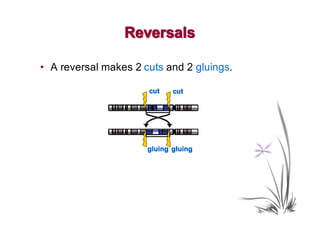
Reversals

• A reversal makes 2 cuts and 2 gluings.

                      cut    cut


                      gluing gluing
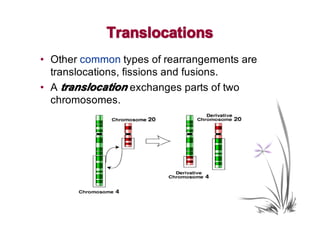
Translocations
• Other common types of rearrangements are
  translocations, fissions and fusions.
• A translocation exchanges parts of two
  chromosomes.
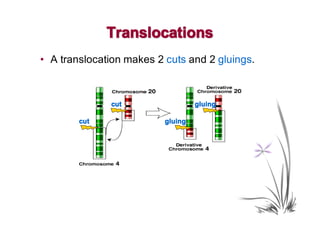
Translocations
• A translocation makes 2 cuts and 2 gluings.


              cut                  gluing

        cut               gluing
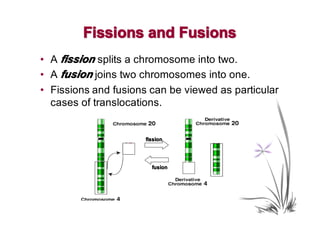
Fissions and Fusions
• A fission splits a chromosome into two.
• A fusion joins two chromosomes into one.
• Fissions and fusions can be viewed as particular
  cases of translocations.


                      fission


                        fusion
Genomic Distance and Breakpoint
            Graphs
Genomic Distance
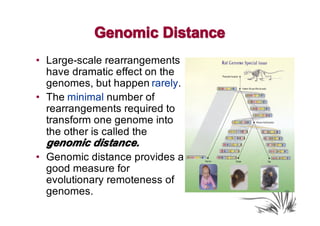
• Large-scale rearrangements
  have dramatic effect on the
  genomes, but happen rarely.
• The minimal number of
  rearrangements required to
  transform one genome into
  the other is called the
  genomic distance.
• Genomic distance provides a
  good measure for
  evolutionary remoteness of
  genomes.
Circular Genomes

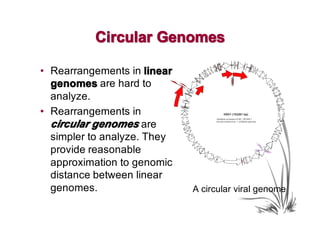
• Rearrangements in linear
  genomes are hard to
  analyze.
• Rearrangements in
  circular genomes are
  simpler to analyze. They
  provide reasonable
  approximation to genomic
  distance between linear
  genomes.                   A circular viral genome
Genome Graph
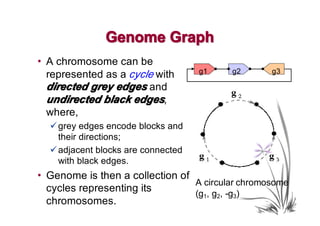
• A chromosome can be
                                    g1   g2       g3
  represented as a cycle with
  directed grey edges and
  undirected black edges,
  where,
  � grey edges encode blocks and
    their directions;
  � adjacent blocks are connected
    with black edges.
• Genome is then a collection of
                                 A circular chromosome
  cycles representing its        (g1, g2, -g3)
  chromosomes.
2-break Rearrangement
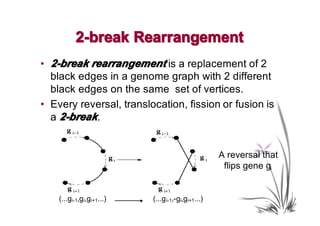
• 2-break rearrangement is a replacement of 2
  black edges in a genome graph with 2 different
  black edges on the same set of vertices.
• Every reversal, translocation, fission or fusion is
  a 2-break.


                                                    A reversal that
                                                     flips gene gi


    (...gi-1,gi,gi+1...)   (...g i-1,-gi,gi+1...)
2-break Distance

• 2-break distance is the minimal number of 2-
  breaks required to transform one genome into
  the other.

• Analyzing distance is a hard problem.

• In contrast to reversal distance, 2-break distance
  is easier to compute and provides a reasonable
  approximation to reversal distance.
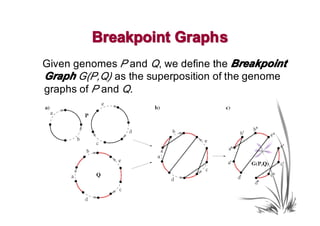
Breakpoint Graph s
Given genomes P and Q, we define the Breakpoint
Graph G(P,Q) as the superposition of the genome
graphs of P and Q.
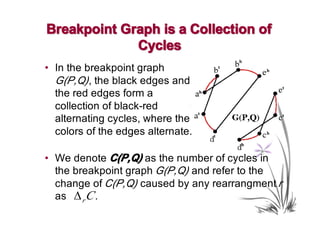
Breakpoint Graph is a Collection of
             Cycles
• In the breakpoint graph
  G(P,Q), the black edges and
  the red edges form a
  collection of black-red
  alternating cycles, where the
  colors of the edges alternate.

• We denote C(P,Q) as the number of cycles in
  the breakpoint graph G(P,Q) and refer to the
  change of C(P,Q) caused by any rearrangment r
  as ∆ r C .
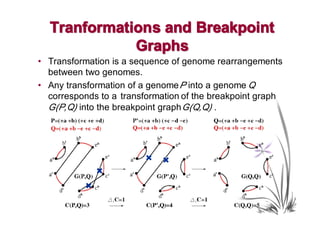
Tranformation s and Breakpoint
             Graphs
• Transformation is a sequence of genome rearrangements
  between two genomes.
• Any transformation of a genome P into a genome Q
  corresponds to a transformation of the breakpoint graph
  G(P,Q) into the breakpoint graph G(Q,Q) .


                         ×   ×
               ×
           ×
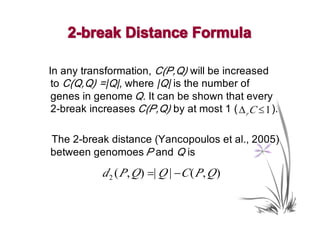
2-break Distance Formula

In any transformation, C(P,Q) will be increased
 to C(Q,Q) =|Q|, where |Q| is the number of
 genes in genome Q. It can be shown that every
 2-break increases C(P,Q) by at most 1 ( ∆ r C ≤ 1 ).

The 2-break distance (Yancopoulos et al., 2005)
between genomoes P and Q is
            d 2 ( P , Q ) =| Q | −C ( P , Q )
Transpositions and Weighted
     Genomic Distance
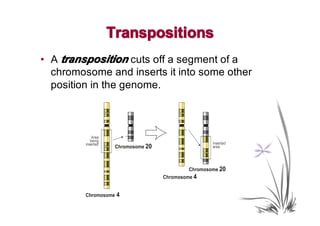
Transpositions
• A transposition cuts off a segment of a
  chromosome and inserts it into some other
  position in the genome.
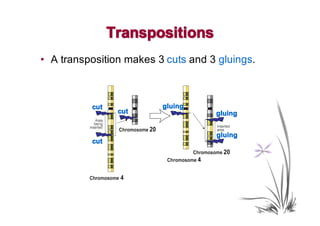
Transpositions
• A transposition makes 3 cuts and 3 gluings.


          cut            gluing
                 cut                gluing


                                    gluing
          cut
Computing Transposition Distance
• Transpositions are very hard to ananlyze. The
  complexity of computing transposition ditance
  remains an open problem.

• The best known algorithm for computing
  transposition distance is 1.375-approximation
  algorithm by Elias and Hartman, 2006.

• 3-break rearrangements model transpositions and
  lead to a simpler 3-break distance problem.
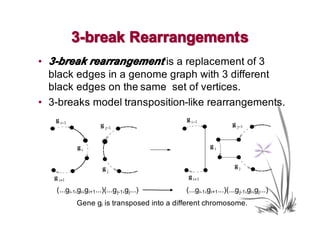
3-break Rearrangement s
• 3-break rearrangement is a replacement of 3
  black edges in a genome graph with 3 different
  black edges on the same set of vertices.
• 3-breaks model transposition-like rearrangements.


   (...gi-1,gi,gi+1...)(...g j-1,gj...)    (...gi-1,gi+1...)(...g j-1,gi,gj...)
           Gene gi is transposed into a different chromosome.
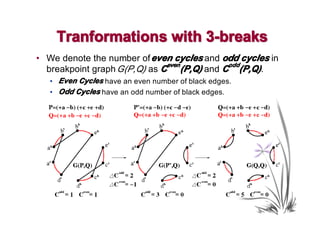
Tranformations with 3-breaks
• We denote the number of even cycles and odd cycles in
                              even         odd
  breakpoint graph G(P,Q) as C (P,Q) and C (P,Q).
   • Even Cycles have an even number of black edges.
   • Odd Cycles have an odd number of black edges.
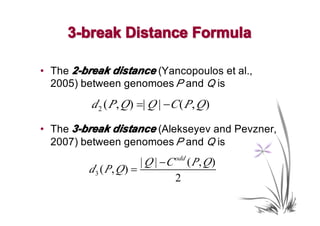
3-break Distance Formula

• The 2-break distance (Yancopoulos et al.,
  2005) between genomoes P and Q is

          d 2 ( P , Q ) =| Q | −C ( P , Q )

• The 3-break distance (Alekseyev and Pevzner,
  2007) between genomoes P and Q is
                   | Q. | −C odd ( P , Q )
         d3 ( P, Q) =
                                 2
Transpositions are " powerful" but rare

• Shortest transformations between two
  genomes have the minimal number of
  rearrangemments (equal the genomic distance
  between these genomes).

• When the rearrangement model includes
  transpositions, they typically have a large
  proportion in any shortest transformation
  between two genomes.

• However, in reality, transpositions are very rare.
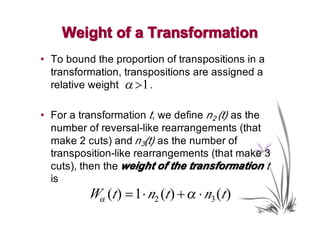
Weight of a Transformation
• To bound the proportion of transpositions in a
  transformation, transpositions are assigned a
  relative weight α >1 .

• For a transformation t, we define n2 (t) as the
  number of reversal-like rearrangements (that
  make 2 cuts) and n3(t) as the number of
  transposition-like rearrangements (that make 3
  cuts), then the weight of the transformation t
  is
          Wα (t ) = 1⋅ n2 (t ) + α ⋅ n3 (t )
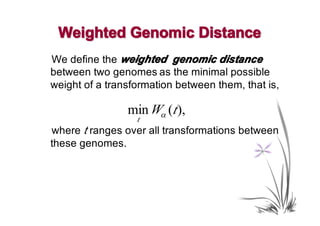
Weighted Genomic Distance
We define the weighted genomic distance
between two genomes as the minimal possible
weight of a transformation between them, that is,

                min Wα (t ),
                  t
where t ranges over all transformations between
these genomes.
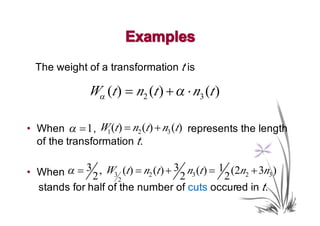
Examples
  The weight of a transformation t is

                Wα (t ) = n2 (t ) + α ⋅ n3 (t )

• When α = 1 , W1 (t ) = n2 (t) + n3 (t) represents the length
  of the transformation t.

• When α = 3 2 , W3 (t ) = n2 (t ) + 3 2 n3 (t ) = 1 2 (2n2 + 3n3 )
                    2
  stands for half of the number of cuts occured in t.
Previous Results
• The complexity of computing weighted genomic
  distance remains unknown.

• Barder and Ohlebusch, 2007 developed a 1.5-
  approximation algorithm for computing the weighted
  genomic distance for α ∈ [1,2] .

• Eriksen, 2001 proposed a (1 + ε ) - approximation
  algorithm for computing the weighted genomic
  distance for α = 2, and any ε > 0.

• Blanchette et al, 1995, observed that if α ∈ (1,2), then
  typical transformation still includes large proportion of
  transpositions.
Our Contribution
• We first characterize optimal transformations that at
                                transformations
  the same time have the shortest length and make the
  smallest number of cuts in the genomes, first introduced
  by Alekseyev and Pevzner, PLoS Comput. Biol, 2007.

• Then, we prove that for α ∈ (1,2] , the weighted genomic
  distance between two genomes with necessity
  corresponds to an optimal tranformation between them.

• In particular, we show that a minimum-weight
  transformation may entirely consist of transpositions.
Optimal Transformation s
Shortest and Optimal
              Transformation s
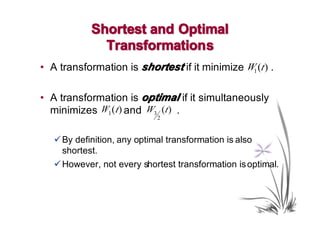
• A transformation is shortest if it minimize W1 (t ) .

• A transformation is optimal if it simultaneously
  minimizes W1 (t ) and W3 (t ) .
                            2


   � By definition, any optimal transformation is also
     shortest.
   � However, not every shortest transformation is optimal.
Classification of Shortest
           Transformations
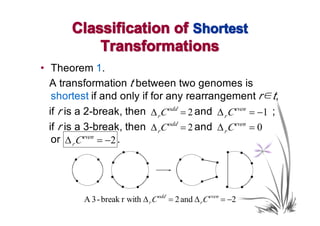
• Theorem 1.
  A transformation t between two genomes is
   shortest if and only if for any rearrangement r∈t,
  if r is a 2-break, then ∆ rC odd = 2 and ∆ r C even = −1 ;
  if r is a 3-break, then ∆ rC odd = 2 and ∆ r C even = 0
   or ∆ r C even = −2 .


          A 3 - break r with ∆ r C odd = 2 and ∆ r C even = −2
Classification of Optimal
           Transformations
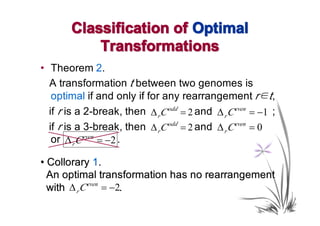
• Theorem 2.
  A transformation t between two genomes is
   optimal if and only if for any rearrangement r∈t,
  if r is a 2-break, then ∆ rC odd = 2 and ∆ r C even = −1 ;
  if r is a 3-break, then ∆ rC odd = 2 and ∆ r C even = 0
   or ∆ r C even = −2 .

• Collorary 1.
  An optimal transformation has no rearrangement
  with ∆ r C even = −2.
Number of 2-breaks and 3-breaks
  in Optimal Transformations
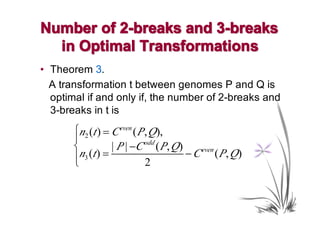
• Theorem 3.
  A transformation t between genomes P and Q is
  optimal if and only if, the number of 2-breaks and
  3-breaks in t is
       ⎧n2 (t ) = C even ( P , Q),
       ⎪
       ⎨          | P | −C odd ( P, Q)    even
       ⎪n3 (t ) =
       ⎩                     2
                                       − C ( P , Q)
Main Theorem
Main Theorem
• Theorem 4.
  For α ∈(1,2],
           min {Wα ( t )} = Wα ( t 0 ),
              t
  where t goes over all transformations between
  two genomes and t0 is any optimal
  transformation between them.

• That is, for any α ∈(1,2], the weighted genomic
  distance between two genomes equals the
  weight of any optimal transformation between
  them.
Proof Idea
• We classify all possible changes in the numbers
  of odd and even black-red cycles caused by a
  rearrangement r.

• For an arbitrary transformation t and an optimal
  transformation t0, we use our classification and
  Theorem 4 to show that for any α ∈(1,2],

               Wα (t ) ≥ Wα (t0 ).
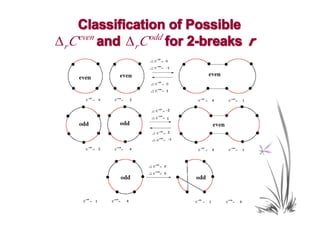
Classification of Possible
    even
∆rC      and ∆ r C odd for 2-breaks r
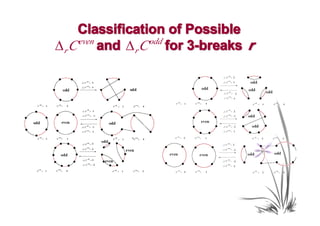
Classification of Possible
    even
∆rC      and ∆ r C odd for 3-breaks r
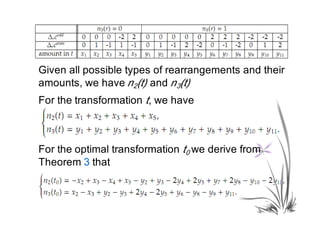
Given all possible types of rearrangements and their
amounts, we have n2(t) and n3(t)
For the transformation t, we have


For the optimal transformation t0 we derive from
Theorem 3 that
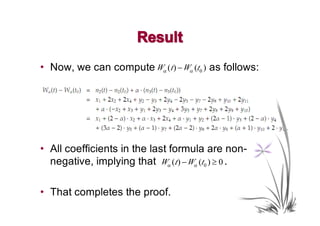
Result
• Now, we can compute Wα (t ) − Wα (t0 ) as follows:


• All coefficients in the last formula are non-
  negative, implying that Wα (t ) − Wα (t0 ) ≥ 0 .

• That completes the proof.
Corollary
• For an optimal transformation t between
  genomes P and Q, we have
  � (Theorem 3)
           ⎧n2 (t ) = C even( P, Q),
           ⎪
           ⎨          | P | −C odd ( P, Q )
           ⎪n3 (t ) =                       − C even( P, Q)
           ⎩                   2
  � (Theorem 4)
      For any α ∈ (1,2], the weight of t equals the
       weighted genomic distance between P and Q.

• Corollary 2.
  If ∆C even (P, Q ) = 0, then transformationt has n2 (t ) = 0
  and thus consists entirely 3-breaks (transpositions).
Conclusions
• We proved that for α ∈(1,2] , the minimum-weight
  transformations include the optimal
  transformations that may entirely consist of
  transposition-like rearrangements.

• Thus, the corresponding weighted genomic
  distance does not actually impose any bound on
  the proportion of transpositions.

Guests 2011-11-09-alekseyev-rearrangements

  • 1.
    Multi-Break Rearrangements and Chromosomal Evolution Max Alekseyev
  • 2.
    Genome Rearrangements Mouse (X chrom.) Unknown ancestor ~ 80 million years ago Human (X chrom.) ✔ What is the architecture of the ancestral genome? ✔ What is the evolutionary scenario for transforming one genome into the other?
  • 3.
    Genome Rearrangements Mouse X chromosome Unknown ancestor ~ 80 M years ago Human X chromosome
  • 4.
    Genome Rearrangements: Evolutionary Scenarios Unknown ancestor ~ 80 M years ago ✔ What is the evolutionary scenario for transforming one genome into the other? ✔ What is the organization of the ancestral genome? ✔ Are there any rearrangement Reversal (inversion) flips a hotspots in mammalian genomes? segment of a chromosome
  • 5.
    Genome Rearrangements: Ancestral Reconstruction ✔ What is the evolutionary scenario for transforming one genome into the other? ✔ What is the organization of the ancestral genome? ✔ Are there any rearrangement hotspots in mammalian genomes?
  • 6.
    Genome Rearrangements: Evolutionary “Earthquakes” ✔ What is the evolutionary scenario for transforming one genome into the other? ✔ What is the organization of the ancestral genome? ✔ Are there any rearrangement hotspots in mammalian genomes? (controversy in 2003-2008)
  • 7.
    Genome Rearrangements: Evolutionary“Earthquakes” ✔ What is the evolutionary scenario for transforming one genome into the other? ✔ What is the organization of the ancestral genome? ✔ Where are the rearrangement hotspots in mammalian genomes?
  • 8.
    Rearrangement Hotspots inTumor Genomes ✔ Rearrangements may disrupt genes and alter gene regulation. ✔ Example: rearrangement in leukemia yields “Philadelphia” chromosome: Chr 9 promoter ABL gene promoter BCR gene Chr 22 promoter BCR gene promoter c-ab1 oncogene ✔ Thousands of individual rearrangements hotspots known for different tumors.
  • 9.
    Unichromosomal Genomes: Reversal Distance ✔ A reversal flips a segment of a chromo- some. ✔ For given genomes P and Q, the number of reversals in a shortest series, transform- ing one genome into the other, is called the reversal distance between P and Q. ✔ Hannenhalli and Pevzner (FOCS 1995) gave a polynomial-time algorithm for computing the reversal distance.
  • 10.
    Prefix Reversals ✔ Aprefix reversal flips a prefix a permutation. ✔ Pancake Flipping Problem: sort a given stack (permuta- tion) of pancakes of different sizes with the minimum number of flips of any number of top pancakes.
  • 11.
    Multichromosomal Genomes: Genomic Distance ✔ Genomic Distance between two genomes is the minimum number of reversals, translocations, fusions, and fissions required to transform one genome into the other. ✔ Hannenhalli and Pevzner (STOC 1995) extended their algorithm for computing the reversal distance to computing the genomic distance. ✔ These algorithms were followed by many improvements: Kaplan et al. 1999, Bader et al. 2001, Tesler 2002, Ozery-Flato & Shamir 2003, Tannier & Sagot 2004, Bergeron 2001-07, etc.
  • 12.
    HP Theory IsRather Complicated: Is There a Simpler Alternative? ✔ HP theory is a key tool in most genome rearrange- ment studies. However, it is rather complicated that makes it difficult to apply in complex setups. ✔ To study genome rearrangements in multiple genomes, we use 2-break rearrangements, also known as DCJ (Yancopoulus et al., Bioinformatics 2005).
  • 13.
    Simplifying HP Theory:Switch from Linear to Circular Chromosomes A chromosome can be represented b as a cycle with directed red and undirected black edges, where: a c d red edges encode blocks and their directions; a b c d adjacent blocks are connected with black edges.
  • 14.
    Reversals on CircularChromosomes b b reversal a c a c d d a b c d a b d c Reversals replace two black edges with two other black edges
  • 15.
    Fissions b b fission a c a c d d a b c d a b c d ✔ Fissions split a single cycle (chromosome) into two. ✔ Fissions replace two black edges with two other black edges.
  • 16.
    Translocations / Fusions b b fusion a c a c d d a b c d a b c d ✔ Translocations/Fusions transform two cycles (chromo- somes) into a single one. ✔ They also replace two black edges with two other black edges.
  • 17.
    2-Breaks b b 2-break a c a c d d ✔ 2-Break replaces any pair of black edges with another pair forming matching on the same 4 vertices. ✔ Reversals, translocations, fusions, and fissions represent all possible types of 2-breaks.
  • 18.
    2-Break Distance ✔ The2-Break distance dist(P,Q) between genomes P and Q is the minimum number of 2-breaks required to transform P into Q. ✔ In contrast to the genomic distance, the 2-break distance is easy to compute.
  • 19.
    Two Genomes as Black-Redand Green-Red Cycles b a P c a b c d d c a Q b a c b d d
  • 20.
    Rearranging P inthe Q order b a P c c d a b c d a Q b d
  • 21.
    Breakpoint Graph =Superposition of Genome Graphs: Gluing Red Edges with the Same Labels b Breakpoint Graph (Bafna & Pevzner, FOCS 1994) a P c c d G(P,Q) a b c d a Q b d
  • 22.
    Black-Green Cycles ✔ Breakpointgraph is formed by red, black and green perfect matchings. ✔ Black and green matchings form a collection of alternating black-green c cycles. a b ✔ Number of black-green cycles: cycle(P,Q) d is the key parameter in computing the 2-break distance.
  • 23.
    Rearrangements Change Cycles Transforminggenome P into genome Q by 2-breaks corresponds to transforming the breakpoint graph G(P,Q) into the breakpoint graph G(Q,Q). c c c G(P,Q) b b G(Q,Q) b a a a G(P',Q) trivial cycles d d d cycles(P,Q) = 2 cycles(P',Q) = 3 cycles(Q,Q) = 4 = blocks(P,Q)
  • 24.
    Transforming P intoQ by 2-breaks 2-breaks P=P0 → P1 → ... → Pd= Q G(P,Q) → G(P1,Q) → ... → G(Q,Q) cycles(P,Q) cycles → ... → blocks(P,Q) cycles # of black-green cycles increased by blocks(P,Q) – cycles(P,Q) How much each 2-break can contribute to this increase?
  • 25.
    Each 2-Break Increases #Cycles by at most 1 A 2-Break: ✔ adds 2 new black edges and thus creates at most 2 new cycles (containing two new black edges) ✔ removes 2 black edges and thus destroys at least 1 old cycle (containing two old edges): change in the number of cycles: Δcycles ≤ 2-1 = 1.
  • 26.
    2-Break Distance ✔ Any2-break increases the number of cycles by at most one (Δcy- cles ≤ 1) 1 ✔ Any non-trivial cycle can be split into two cycles with a 2-break (Δcycles = 1) 1 ✔ Every sorting by 2-breaks must increase the number of cycles by blocks(P,Q) - cycles(P,Q) ✔ The 2-Break Distance between genomes P and Q: d2(P,Q) = blocks(P,Q) – cycles(P,Q) (cp. Yancopoulos et al., 2005, Bergeron et al., 2006)
  • 27.
    Complex Rearrangements: Transpositions (с) http://www.genome.gov
  • 28.
    Sorting by Transpositions ✔Sorting by Transpositions Problem: Given two genomes, find the shortest sequence of trans- positions transforming one genome into the other. ✔ First 1.5-approximation algorithm was given by Bafna and Pevzner (SODA 1995). ✔ Best achievement: 1.375-approximation algorithm due to Elias and Hartman (WABI 2005). ✔ Proved to be NP-complete by Bulteau, Fertin, and Rusu (ICALP 2011).
  • 29.
    Transpositions b b transposition a c a c d d a b c d c a b d Transpositions cut off a segment of one chromosome and insert it at some position in the same or another chromosome
  • 30.
    Transpositions Are 3-Breaks b b 3-break a c a c d d ✔ 3-Break replaces any triple of black edges with another triple forming matching on the same 6 vertices. ✔ Transpositions are 3-Breaks.
  • 31.
    3-Breaks include 3-Way Fusions and Fissions 3-Breaks can merge three chromosomes into a single one as well as split a single chromosome into three ones.
  • 32.
    3-Break Distance The 3-BreakDistance d3(P,Q) between genomes P and Q is the minimum number of 3-breaks required to transform P into Q.
  • 33.
    3-Break Distance ✔ Any3-break increases the number of cycles by at most two (Δcy- cles ≤ 2) 2 ✔ Any non-trivial cycle can be split into three cycles with a 3-break (Δcycles = 2) 2 ✔ Every sorting by 3-breaks must increase the number of cycles by blocks(P,Q) - cycles(P,Q) ✔ The 3-Break Distance between genomes P and Q: d3(P,Q) = ( blocks(P,Q) – cycles(P,Q) ) / 2
  • 34.
    3-Break Distance: OOPS! ✔Any 3-break increases the number of cycles by at most two (Δcy- cles ≤ 2) 2 ✔ Any non-trivial cycle can be split into three cycles with a 3- break (Δcycles = 2) 2 ✔ Every sorting by 3-breaks must increase the number of cycles by blocks(P,Q) - cycles(P,Q) ✔ The 3-Break Distance between genomes P and Q: d3(P,Q) = ( blocks(P,Q) – cycles(P,Q) ) / 2
  • 35.
    3-Break Splitting OddCycle ✔ Trivial cycles are odd cycles. 3-break can increase the number of odd cycles by at most 2. ✔ A non-trivial odd cycle can be split into three odd cycles with a 3-break (Δcyclesodd = 2) 2
  • 36.
    3-Break Splitting EvenCycle ✔ Trivial cycles are odd cycles. 3-break can increase the number of odd cycles by at most 2. ✔ An even cycle can be split into two odd cycles with a 3-break (Δcyclesodd = 2) 2
  • 37.
    3-Break Distance: Focuson Odd Cycles ✔ 3-break can increase the number of odd cycles (i.e., cycles with odd number of black edges) by at most 2 (Δcyclesodd ≤ 2) ✔ A non-trivial odd cycle can be split into three odd cycles with a 3-break (Δcyclesodd = 2) 2 ✔ An even cycle can be split into two odd cycles with a 3-break (Δcyclesodd=2) =2 ✔ The 3-Break Distance between genomes P and Q is: d3(P,Q) = ( blocks(P,Q) – cyclesodd(P,Q) ) / 2
  • 38.
    Multi-Break Rearrangements ✔ Thestandard rearrangement operations (reversals, translocations, fusions, and fissions) make 2 breakages in a genome and glue the resulting pieces in a new order. ✔ k-Break rearrangement operation makes k breakages in a genome and glues the resulting pieces in a new order. ✔ Rearrangements are rare evolutionary events and biologists believe that k- break rearrangements are unlikely for k>3 and relatively rare for k=3 (at least in the mammalian evolution). ✔ Also, in radiation biology, chromosome aberrations for k>2 (indicative of chromosome damage rather than evolutionary viable variations) may be more common, e.g., complex rearrangements in irradiated human lympho- cytes (Sachs et al., 2004; Levy et al., 2004).
  • 39.
    k-Breaks ✔ k-Break replacesk black edges, forming a match- ing on 2k vertices, with a set of k black edges, forming another matching on the same 2k ver- tices. ✔ k-Break Distance Problem: Given two genomes P and Q, find the shortest sequence of k-breaks transforming P into Q.
  • 40.
    Number of Cycles ✔Every k-break introduces at most k breakages. ✔ A k-break “destroys” at least one cycle ✔ A k-break creates at most k new cycles ✔ Therefore, k-break can increase the number of cycles by at most k-1, .i.e., Δcycles ≤ k-1
  • 41.
    Computing k-Break Distance ✔We need to create blocks(P,Q) – ctrivial(P,Q) new trivial cycles ✔ A k-break can create at most k trivial cycles; optimal k-break creates k trivial cycles ✔ If there are ≥ k edges in non-trivial cycles, it is always possible to create k-1 trivial cycles (suboptimal k-break) ceil( (blocks(P,Q)–ctrivial(P,Q)) / k ) ≤ dk(P,Q) ≤ ≤ ceil( (blocks(P,Q)–ctrivial(P,Q)) / (k-1) ) ✔ Goal: maximize the number of optimal k-breaks
  • 42.
    Optimal k-Breaks Lemma. Ak-break creates k trivial cycles if and only if it acts on all edges of one or several non-trivial cycles 7-break Δctrivial(P,Q) = 7
  • 43.
    Suboptimal k-Breaks Lemma. Ak-break creates k-1 trivial cycles if and only it acts on a part of edges of one non-trivial cycle and all edges of some other non-trivial cycles 6-break Δctrivial(P,Q) = 5
  • 44.
    Greedy Construction ofa Suboptimal k- Break If there are ≥ k edges in non-trivial cycles, a subopti- mal (or even optimal) k-break can be constructed in a greedy way: ✔ Take all edges of one cycle, all edges of another cycle, and so on while the total number of taken edges is less than k. ✔ Then take a part of edges of yet another cycle, making the total number of taken edges equal k.
  • 45.
    Breakable Sets ✔ Aset of black-gray cycles is breakable if the total number of black edges is 1 modulo (k-1) ✔ E.g.: for k=2, any set of cycles is breakable ✔ E.g.: for k=3, a set of cycles is breakable if and only if it contains odd number of odd cycles
  • 46.
    Breaking a BreakableSet into Trivial Cycles ✔ A breakable set can be broken into trivial cycles using a series of suboptimal k-breaks and at least one opti- mal k-break ✔ A breakable set with m black edges can be broken into m trivial cycles with t=(m-1)/(k-1) k-breaks: t-1 suboptimal k-breaks create (t-1)·(k-1) = m-k trivial cycles leaving k edges in non-trivial cycles that are handled by an op- timal k-break
  • 47.
    k-Break Distance ✔ Letsk(P,Q) be the maximum number of disjoint break- able sets dk(P,Q) = ceil( (blocks(P,Q) – sk(P,Q)) / (k-1) ) ✔ E.g.: for k=2, every cycle forms a breakable set and thus s2(P,Q) = cycles(P,Q), implying that d2(P,Q) = blocks(P,Q) – cycles(P,Q) ✔ E.g.: for k=3, every odd cycle forms a breakable set and thus s3(P,Q) = cyclesodd(P,Q), implying that d3(P,Q) = (blocks(P,Q) – cyclesodd(P,Q)) / 2
  • 48.
    More Examples Fork=4, the maximum set of disjoint breakable sets consists of: ● the cycles with 1 modulo 3 black edges each ● the pairs of cycles with 2 modulo 3 black edges each
  • 49.
    Computing sk(P,Q) ✔ Eachset of cycles corresponds to a vector (x1,x2,...,xk-2) where xj is the number of cycles of length j modulo (k- 1). ✔ A breakable set corresponds to a breakable vector (x1,x2,...,xk-2) with 1x1+2x2+...+(k-2)xk-2 ≡ 1 (mod k-1). k-1) ✔ Theorem. Given a vector c=(c1,...,ck-2) where cj is the number of cycles in G(P,Q) of length j modulo (k-1), find a maximum number of breakable vectors v1,v2,...,vs such that v1+v2+...+vs ≤ c (component-wise). Then s = sk(P,Q).
  • 50.
    Dynamic Programming ✔ Abreakable vector (x1,x2,...,xk-2) is proper if xj < k-1. Let V be a set of all proper breakable vectors. Clearly, |V|=(k-1)k-3. ✔ Define s(u) = max |{ v1, v2, ..., vt | v1+v2+...+vt ≤ u}|. Then sk(P,Q) = s(c). ✔ s(c) can be computed using dynamic programming: s(u) = maxv≤u s(u-v) + 1 ✔ Size of the dynamic programming table: (c1+1)×...×(ck-2+1) = O((n/k)k-2) ✔ Overall complexity is O(nk-2)
  • 51.
    Extremal Vectors ✔ Ifu ≤ v for u, v from V, then v can be removed from V. ✔ Vector v in V is extremal if there is no u in V such that u ≤ v. ✔ The set of all extremal vectors V' can be computed us- ing Hilbert bases.
  • 52.
  • 53.
    Weighted Genomic Distancecan hardly impose a bound on the proportion of transpositions Max Alekseyev University of South Carolina, Columbia, SC, U.S.A. 2010
  • 54.
    Introduction • Genome Rearrangements •Genomic Distance and Breakpoint Graphs • Transpositions and Weighted Genomic Distance • Optimal Transformations • Main Theorem
  • 55.
  • 56.
    Genome Rearrangements • Genomerearrangements are evolutionary events that change genomic architectures.
  • 57.
    Reversals • Reversals arefrequent genome rearrangements. • A reversal flips a segment of a chromosome.
  • 58.
    Reversals • A reversalmakes 2 cuts and 2 gluings. cut cut gluing gluing
  • 59.
    Translocations • Other commontypes of rearrangements are translocations, fissions and fusions. • A translocation exchanges parts of two chromosomes.
  • 60.
    Translocations • A translocationmakes 2 cuts and 2 gluings. cut gluing cut gluing
  • 61.
    Fissions and Fusions •A fission splits a chromosome into two. • A fusion joins two chromosomes into one. • Fissions and fusions can be viewed as particular cases of translocations. fission fusion
  • 62.
    Genomic Distance andBreakpoint Graphs
  • 63.
    Genomic Distance • Large-scalerearrangements have dramatic effect on the genomes, but happen rarely. • The minimal number of rearrangements required to transform one genome into the other is called the genomic distance. • Genomic distance provides a good measure for evolutionary remoteness of genomes.
  • 64.
    Circular Genomes • Rearrangementsin linear genomes are hard to analyze. • Rearrangements in circular genomes are simpler to analyze. They provide reasonable approximation to genomic distance between linear genomes. A circular viral genome
  • 65.
    Genome Graph • Achromosome can be g1 g2 g3 represented as a cycle with directed grey edges and undirected black edges, where, � grey edges encode blocks and their directions; � adjacent blocks are connected with black edges. • Genome is then a collection of A circular chromosome cycles representing its (g1, g2, -g3) chromosomes.
  • 66.
    2-break Rearrangement • 2-breakrearrangement is a replacement of 2 black edges in a genome graph with 2 different black edges on the same set of vertices. • Every reversal, translocation, fission or fusion is a 2-break. A reversal that flips gene gi (...gi-1,gi,gi+1...) (...g i-1,-gi,gi+1...)
  • 67.
    2-break Distance • 2-breakdistance is the minimal number of 2- breaks required to transform one genome into the other. • Analyzing distance is a hard problem. • In contrast to reversal distance, 2-break distance is easier to compute and provides a reasonable approximation to reversal distance.
  • 68.
    Breakpoint Graph s Givengenomes P and Q, we define the Breakpoint Graph G(P,Q) as the superposition of the genome graphs of P and Q.
  • 69.
    Breakpoint Graph isa Collection of Cycles • In the breakpoint graph G(P,Q), the black edges and the red edges form a collection of black-red alternating cycles, where the colors of the edges alternate. • We denote C(P,Q) as the number of cycles in the breakpoint graph G(P,Q) and refer to the change of C(P,Q) caused by any rearrangment r as ∆ r C .
  • 70.
    Tranformation s andBreakpoint Graphs • Transformation is a sequence of genome rearrangements between two genomes. • Any transformation of a genome P into a genome Q corresponds to a transformation of the breakpoint graph G(P,Q) into the breakpoint graph G(Q,Q) . × × × ×
  • 71.
    2-break Distance Formula Inany transformation, C(P,Q) will be increased to C(Q,Q) =|Q|, where |Q| is the number of genes in genome Q. It can be shown that every 2-break increases C(P,Q) by at most 1 ( ∆ r C ≤ 1 ). The 2-break distance (Yancopoulos et al., 2005) between genomoes P and Q is d 2 ( P , Q ) =| Q | −C ( P , Q )
  • 72.
  • 73.
    Transpositions • A transpositioncuts off a segment of a chromosome and inserts it into some other position in the genome.
  • 74.
    Transpositions • A transpositionmakes 3 cuts and 3 gluings. cut gluing cut gluing gluing cut
  • 75.
    Computing Transposition Distance •Transpositions are very hard to ananlyze. The complexity of computing transposition ditance remains an open problem. • The best known algorithm for computing transposition distance is 1.375-approximation algorithm by Elias and Hartman, 2006. • 3-break rearrangements model transpositions and lead to a simpler 3-break distance problem.
  • 76.
    3-break Rearrangement s •3-break rearrangement is a replacement of 3 black edges in a genome graph with 3 different black edges on the same set of vertices. • 3-breaks model transposition-like rearrangements. (...gi-1,gi,gi+1...)(...g j-1,gj...) (...gi-1,gi+1...)(...g j-1,gi,gj...) Gene gi is transposed into a different chromosome.
  • 77.
    Tranformations with 3-breaks •We denote the number of even cycles and odd cycles in even odd breakpoint graph G(P,Q) as C (P,Q) and C (P,Q). • Even Cycles have an even number of black edges. • Odd Cycles have an odd number of black edges.
  • 78.
    3-break Distance Formula •The 2-break distance (Yancopoulos et al., 2005) between genomoes P and Q is d 2 ( P , Q ) =| Q | −C ( P , Q ) • The 3-break distance (Alekseyev and Pevzner, 2007) between genomoes P and Q is | Q. | −C odd ( P , Q ) d3 ( P, Q) = 2
  • 79.
    Transpositions are "powerful" but rare • Shortest transformations between two genomes have the minimal number of rearrangemments (equal the genomic distance between these genomes). • When the rearrangement model includes transpositions, they typically have a large proportion in any shortest transformation between two genomes. • However, in reality, transpositions are very rare.
  • 80.
    Weight of aTransformation • To bound the proportion of transpositions in a transformation, transpositions are assigned a relative weight α >1 . • For a transformation t, we define n2 (t) as the number of reversal-like rearrangements (that make 2 cuts) and n3(t) as the number of transposition-like rearrangements (that make 3 cuts), then the weight of the transformation t is Wα (t ) = 1⋅ n2 (t ) + α ⋅ n3 (t )
  • 81.
    Weighted Genomic Distance Wedefine the weighted genomic distance between two genomes as the minimal possible weight of a transformation between them, that is, min Wα (t ), t where t ranges over all transformations between these genomes.
  • 82.
    Examples Theweight of a transformation t is Wα (t ) = n2 (t ) + α ⋅ n3 (t ) • When α = 1 , W1 (t ) = n2 (t) + n3 (t) represents the length of the transformation t. • When α = 3 2 , W3 (t ) = n2 (t ) + 3 2 n3 (t ) = 1 2 (2n2 + 3n3 ) 2 stands for half of the number of cuts occured in t.
  • 83.
    Previous Results • Thecomplexity of computing weighted genomic distance remains unknown. • Barder and Ohlebusch, 2007 developed a 1.5- approximation algorithm for computing the weighted genomic distance for α ∈ [1,2] . • Eriksen, 2001 proposed a (1 + ε ) - approximation algorithm for computing the weighted genomic distance for α = 2, and any ε > 0. • Blanchette et al, 1995, observed that if α ∈ (1,2), then typical transformation still includes large proportion of transpositions.
  • 84.
    Our Contribution • Wefirst characterize optimal transformations that at transformations the same time have the shortest length and make the smallest number of cuts in the genomes, first introduced by Alekseyev and Pevzner, PLoS Comput. Biol, 2007. • Then, we prove that for α ∈ (1,2] , the weighted genomic distance between two genomes with necessity corresponds to an optimal tranformation between them. • In particular, we show that a minimum-weight transformation may entirely consist of transpositions.
  • 85.
  • 86.
    Shortest and Optimal Transformation s • A transformation is shortest if it minimize W1 (t ) . • A transformation is optimal if it simultaneously minimizes W1 (t ) and W3 (t ) . 2 � By definition, any optimal transformation is also shortest. � However, not every shortest transformation is optimal.
  • 87.
    Classification of Shortest Transformations • Theorem 1. A transformation t between two genomes is shortest if and only if for any rearrangement r∈t, if r is a 2-break, then ∆ rC odd = 2 and ∆ r C even = −1 ; if r is a 3-break, then ∆ rC odd = 2 and ∆ r C even = 0 or ∆ r C even = −2 . A 3 - break r with ∆ r C odd = 2 and ∆ r C even = −2
  • 88.
    Classification of Optimal Transformations • Theorem 2. A transformation t between two genomes is optimal if and only if for any rearrangement r∈t, if r is a 2-break, then ∆ rC odd = 2 and ∆ r C even = −1 ; if r is a 3-break, then ∆ rC odd = 2 and ∆ r C even = 0 or ∆ r C even = −2 . • Collorary 1. An optimal transformation has no rearrangement with ∆ r C even = −2.
  • 89.
    Number of 2-breaksand 3-breaks in Optimal Transformations • Theorem 3. A transformation t between genomes P and Q is optimal if and only if, the number of 2-breaks and 3-breaks in t is ⎧n2 (t ) = C even ( P , Q), ⎪ ⎨ | P | −C odd ( P, Q) even ⎪n3 (t ) = ⎩ 2 − C ( P , Q)
  • 90.
  • 91.
    Main Theorem • Theorem4. For α ∈(1,2], min {Wα ( t )} = Wα ( t 0 ), t where t goes over all transformations between two genomes and t0 is any optimal transformation between them. • That is, for any α ∈(1,2], the weighted genomic distance between two genomes equals the weight of any optimal transformation between them.
  • 92.
    Proof Idea • Weclassify all possible changes in the numbers of odd and even black-red cycles caused by a rearrangement r. • For an arbitrary transformation t and an optimal transformation t0, we use our classification and Theorem 4 to show that for any α ∈(1,2], Wα (t ) ≥ Wα (t0 ).
  • 93.
    Classification of Possible even ∆rC and ∆ r C odd for 2-breaks r
  • 94.
    Classification of Possible even ∆rC and ∆ r C odd for 3-breaks r
  • 95.
    Given all possibletypes of rearrangements and their amounts, we have n2(t) and n3(t) For the transformation t, we have For the optimal transformation t0 we derive from Theorem 3 that
  • 96.
    Result • Now, wecan compute Wα (t ) − Wα (t0 ) as follows: • All coefficients in the last formula are non- negative, implying that Wα (t ) − Wα (t0 ) ≥ 0 . • That completes the proof.
  • 97.
    Corollary • For anoptimal transformation t between genomes P and Q, we have � (Theorem 3) ⎧n2 (t ) = C even( P, Q), ⎪ ⎨ | P | −C odd ( P, Q ) ⎪n3 (t ) = − C even( P, Q) ⎩ 2 � (Theorem 4) For any α ∈ (1,2], the weight of t equals the weighted genomic distance between P and Q. • Corollary 2. If ∆C even (P, Q ) = 0, then transformationt has n2 (t ) = 0 and thus consists entirely 3-breaks (transpositions).
  • 98.
    Conclusions • We provedthat for α ∈(1,2] , the minimum-weight transformations include the optimal transformations that may entirely consist of transposition-like rearrangements. • Thus, the corresponding weighted genomic distance does not actually impose any bound on the proportion of transpositions.