Dr.B.B.Tiwari
Professor
SRMGPC, Lucknow (U.P.)
India
Contact: bhupendra.tiwari07@gmail.com
Mobile:9473509687
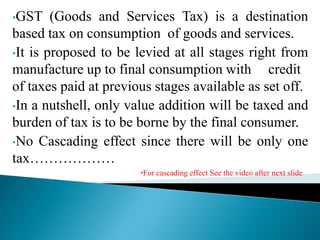
•GST (Goods and Services Tax) is a destination
based tax on consumption of goods and services.
•It is proposed to be levied at all stages right from
manufacture up to final consumption with credit
of taxes paid at previous stages available as set off.
•In a nutshell, only value addition will be taxed and
burden of tax is to be borne by the final consumer.
•No Cascading effect since there will be only one
tax………………
•For cascading effect See the video after next slide
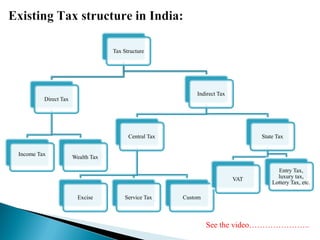
Tax Structure
Direct Tax
Income Tax
Wealth Tax
Indirect Tax
Central Tax
Excise Service Tax Custom
State Tax
VAT
Entry Tax,
luxury tax,
Lottery Tax, etc.
See the video…………………..
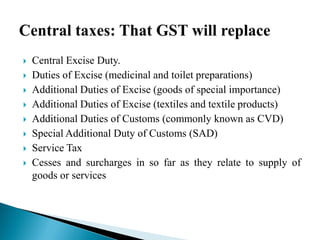
 Central Excise Duty.
 Duties of Excise (medicinal and toilet preparations)
 Additional Duties of Excise (goods of special importance)
 Additional Duties of Excise (textiles and textile products)
 Additional Duties of Customs (commonly known as CVD)
 Special Additional Duty of Customs (SAD)
 Service Tax
 Cesses and surcharges in so far as they relate to supply of
goods or services
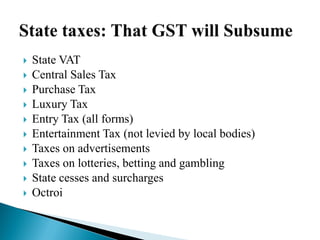
 State VAT
 Central Sales Tax
 Purchase Tax
 Luxury Tax
 Entry Tax (all forms)
 Entertainment Tax (not levied by local bodies)
 Taxes on advertisements
 Taxes on lotteries, betting and gambling
 State cesses and surcharges
 Octroi
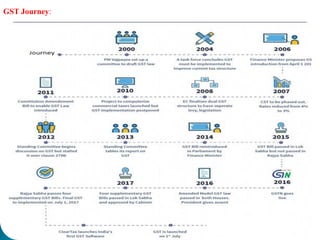
GST Journey:
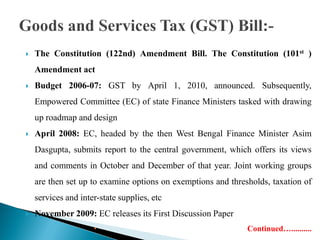
 The Constitution (122nd) Amendment Bill. The Constitution (101st )
Amendment act
 Budget 2006-07: GST by April 1, 2010, announced. Subsequently,
Empowered Committee (EC) of state Finance Ministers tasked with drawing
up roadmap and design
 April 2008: EC, headed by the then West Bengal Finance Minister Asim
Dasgupta, submits report to the central government, which offers its views
and comments in October and December of that year. Joint working groups
are then set up to examine options on exemptions and thresholds, taxation of
services and inter-state supplies, etc
 November 2009: EC releases its First Discussion Paper
 Continued…..........

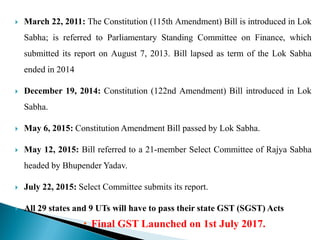
 March 22, 2011: The Constitution (115th Amendment) Bill is introduced in Lok
Sabha; is referred to Parliamentary Standing Committee on Finance, which
submitted its report on August 7, 2013. Bill lapsed as term of the Lok Sabha
ended in 2014
 December 19, 2014: Constitution (122nd Amendment) Bill introduced in Lok
Sabha.
 May 6, 2015: Constitution Amendment Bill passed by Lok Sabha.
 May 12, 2015: Bill referred to a 21-member Select Committee of Rajya Sabha
headed by Bhupender Yadav.
 July 22, 2015: Select Committee submits its report.
 All 29 states and 9 UTs will have to pass their state GST (SGST) Acts
 Final GST Launched on 1st July 2017.
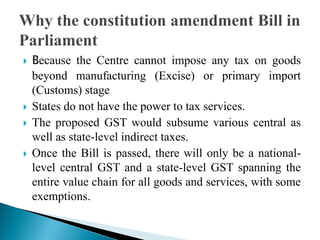
 Because the Centre cannot impose any tax on goods
beyond manufacturing (Excise) or primary import
(Customs) stage
 States do not have the power to tax services.
 The proposed GST would subsume various central as
well as state-level indirect taxes.
 Once the Bill is passed, there will only be a national-
level central GST and a state-level GST spanning the
entire value chain for all goods and services, with some
exemptions.
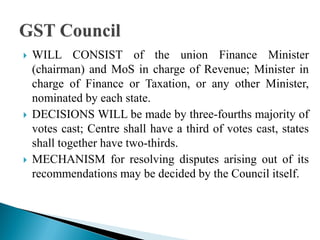
 WILL CONSIST of the union Finance Minister
(chairman) and MoS in charge of Revenue; Minister in
charge of Finance or Taxation, or any other Minister,
nominated by each state.
 DECISIONS WILL be made by three-fourths majority of
votes cast; Centre shall have a third of votes cast, states
shall together have two-thirds.
 MECHANISM for resolving disputes arising out of its
recommendations may be decided by the Council itself.
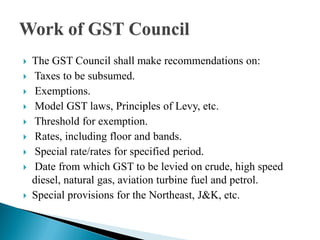
 The GST Council shall make recommendations on:
 Taxes to be subsumed.
 Exemptions.
 Model GST laws, Principles of Levy, etc.
 Threshold for exemption.
 Rates, including floor and bands.
 Special rate/rates for specified period.
 Date from which GST to be levied on crude, high speed
diesel, natural gas, aviation turbine fuel and petrol.
 Special provisions for the Northeast, J&K, etc.
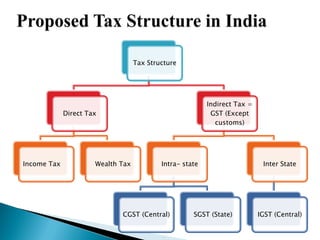
Tax Structure
Direct Tax
Income Tax Wealth Tax
Indirect Tax =
GST (Except
customs)
Intra- state
CGST (Central) SGST (State)
Inter State
IGST (Central)
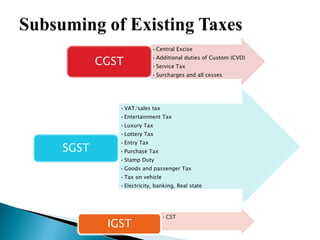
•Central Excise
•Additional duties of Custom (CVD)
•Service Tax
•Surcharges and all cesses
CGST
•VAT/sales tax
•Entertainment Tax
•Luxury Tax
•Lottery Tax
•Entry Tax
•Purchase Tax
•Stamp Duty
•Goods and passenger Tax
•Tax on vehicle
•Electricity, banking, Real state
SGST
•CST
IGST
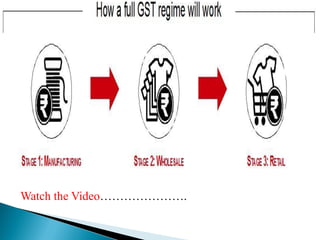
Watch the Video………………….
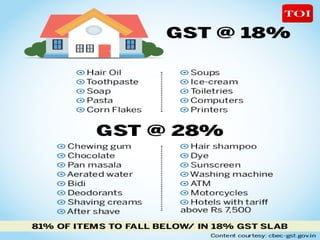
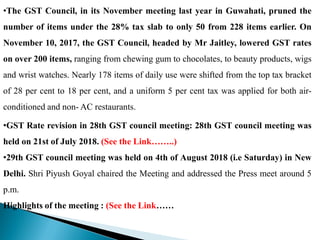
•The GST Council, in its November meeting last year in Guwahati, pruned the
number of items under the 28% tax slab to only 50 from 228 items earlier. On
November 10, 2017, the GST Council, headed by Mr Jaitley, lowered GST rates
on over 200 items, ranging from chewing gum to chocolates, to beauty products, wigs
and wrist watches. Nearly 178 items of daily use were shifted from the top tax bracket
of 28 per cent to 18 per cent, and a uniform 5 per cent tax was applied for both air-
conditioned and non- AC restaurants.
•GST Rate revision in 28th GST council meeting: 28th GST council meeting was
held on 21st of July 2018. (See the Link……..)
•29th GST council meeting was held on 4th of August 2018 (i.e Saturday) in New
Delhi. Shri Piyush Goyal chaired the Meeting and addressed the Press meet around 5
p.m.
Highlights of the meeting : (See the Link……
Watch the Video………DNA/ABP NEWS ground report
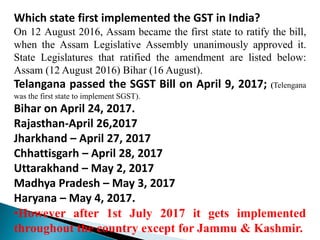
Which state first implemented the GST in India?
On 12 August 2016, Assam became the first state to ratify the bill,
when the Assam Legislative Assembly unanimously approved it.
State Legislatures that ratified the amendment are listed below:
Assam (12 August 2016) Bihar (16 August).
Telangana passed the SGST Bill on April 9, 2017; (Telengana
was the first state to implement SGST).
Bihar on April 24, 2017.
Rajasthan-April 26,2017
Jharkhand – April 27, 2017
Chhattisgarh – April 28, 2017
Uttarakhand – May 2, 2017
Madhya Pradesh – May 3, 2017
Haryana – May 4, 2017.
•However after 1st July 2017 it gets implemented
throughout the country except for Jammu & Kashmir.
GST - A New Tax Regime

GST - A New Tax Regime

  • 1.
    Dr.B.B.Tiwari Professor SRMGPC, Lucknow (U.P.) India Contact:bhupendra.tiwari07@gmail.com Mobile:9473509687
  • 2.
    •GST (Goods andServices Tax) is a destination based tax on consumption of goods and services. •It is proposed to be levied at all stages right from manufacture up to final consumption with credit of taxes paid at previous stages available as set off. •In a nutshell, only value addition will be taxed and burden of tax is to be borne by the final consumer. •No Cascading effect since there will be only one tax……………… •For cascading effect See the video after next slide
  • 3.
    Tax Structure Direct Tax IncomeTax Wealth Tax Indirect Tax Central Tax Excise Service Tax Custom State Tax VAT Entry Tax, luxury tax, Lottery Tax, etc. See the video…………………..
  • 4.
     Central ExciseDuty.  Duties of Excise (medicinal and toilet preparations)  Additional Duties of Excise (goods of special importance)  Additional Duties of Excise (textiles and textile products)  Additional Duties of Customs (commonly known as CVD)  Special Additional Duty of Customs (SAD)  Service Tax  Cesses and surcharges in so far as they relate to supply of goods or services
  • 5.
     State VAT Central Sales Tax  Purchase Tax  Luxury Tax  Entry Tax (all forms)  Entertainment Tax (not levied by local bodies)  Taxes on advertisements  Taxes on lotteries, betting and gambling  State cesses and surcharges  Octroi
  • 6.
  • 7.
     The Constitution(122nd) Amendment Bill. The Constitution (101st ) Amendment act  Budget 2006-07: GST by April 1, 2010, announced. Subsequently, Empowered Committee (EC) of state Finance Ministers tasked with drawing up roadmap and design  April 2008: EC, headed by the then West Bengal Finance Minister Asim Dasgupta, submits report to the central government, which offers its views and comments in October and December of that year. Joint working groups are then set up to examine options on exemptions and thresholds, taxation of services and inter-state supplies, etc  November 2009: EC releases its First Discussion Paper  Continued….......... 
  • 8.
     March 22,2011: The Constitution (115th Amendment) Bill is introduced in Lok Sabha; is referred to Parliamentary Standing Committee on Finance, which submitted its report on August 7, 2013. Bill lapsed as term of the Lok Sabha ended in 2014  December 19, 2014: Constitution (122nd Amendment) Bill introduced in Lok Sabha.  May 6, 2015: Constitution Amendment Bill passed by Lok Sabha.  May 12, 2015: Bill referred to a 21-member Select Committee of Rajya Sabha headed by Bhupender Yadav.  July 22, 2015: Select Committee submits its report.  All 29 states and 9 UTs will have to pass their state GST (SGST) Acts  Final GST Launched on 1st July 2017.
  • 9.
     Because theCentre cannot impose any tax on goods beyond manufacturing (Excise) or primary import (Customs) stage  States do not have the power to tax services.  The proposed GST would subsume various central as well as state-level indirect taxes.  Once the Bill is passed, there will only be a national- level central GST and a state-level GST spanning the entire value chain for all goods and services, with some exemptions.
  • 10.
     WILL CONSISTof the union Finance Minister (chairman) and MoS in charge of Revenue; Minister in charge of Finance or Taxation, or any other Minister, nominated by each state.  DECISIONS WILL be made by three-fourths majority of votes cast; Centre shall have a third of votes cast, states shall together have two-thirds.  MECHANISM for resolving disputes arising out of its recommendations may be decided by the Council itself.
  • 11.
     The GSTCouncil shall make recommendations on:  Taxes to be subsumed.  Exemptions.  Model GST laws, Principles of Levy, etc.  Threshold for exemption.  Rates, including floor and bands.  Special rate/rates for specified period.  Date from which GST to be levied on crude, high speed diesel, natural gas, aviation turbine fuel and petrol.  Special provisions for the Northeast, J&K, etc.
  • 12.
    Tax Structure Direct Tax IncomeTax Wealth Tax Indirect Tax = GST (Except customs) Intra- state CGST (Central) SGST (State) Inter State IGST (Central)
  • 13.
    •Central Excise •Additional dutiesof Custom (CVD) •Service Tax •Surcharges and all cesses CGST •VAT/sales tax •Entertainment Tax •Luxury Tax •Lottery Tax •Entry Tax •Purchase Tax •Stamp Duty •Goods and passenger Tax •Tax on vehicle •Electricity, banking, Real state SGST •CST IGST
  • 14.
  • 19.
    •The GST Council,in its November meeting last year in Guwahati, pruned the number of items under the 28% tax slab to only 50 from 228 items earlier. On November 10, 2017, the GST Council, headed by Mr Jaitley, lowered GST rates on over 200 items, ranging from chewing gum to chocolates, to beauty products, wigs and wrist watches. Nearly 178 items of daily use were shifted from the top tax bracket of 28 per cent to 18 per cent, and a uniform 5 per cent tax was applied for both air- conditioned and non- AC restaurants. •GST Rate revision in 28th GST council meeting: 28th GST council meeting was held on 21st of July 2018. (See the Link……..) •29th GST council meeting was held on 4th of August 2018 (i.e Saturday) in New Delhi. Shri Piyush Goyal chaired the Meeting and addressed the Press meet around 5 p.m. Highlights of the meeting : (See the Link……
  • 20.
  • 24.
    Which state firstimplemented the GST in India? On 12 August 2016, Assam became the first state to ratify the bill, when the Assam Legislative Assembly unanimously approved it. State Legislatures that ratified the amendment are listed below: Assam (12 August 2016) Bihar (16 August). Telangana passed the SGST Bill on April 9, 2017; (Telengana was the first state to implement SGST). Bihar on April 24, 2017. Rajasthan-April 26,2017 Jharkhand – April 27, 2017 Chhattisgarh – April 28, 2017 Uttarakhand – May 2, 2017 Madhya Pradesh – May 3, 2017 Haryana – May 4, 2017. •However after 1st July 2017 it gets implemented throughout the country except for Jammu & Kashmir.