Sharing Code and
Experiences
@fabriziomello
Just to stay
all of us tuned!!!
Everybody knows what a database is?
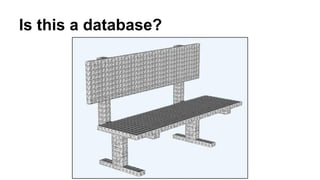
Is this a database?
Of course not!
But what wikipedia tell us?
A database is an integrated and organized
collection of logically related records or files or
data that are stored in a computer system
which consolidates records previously stored in
a separate files into a common pool of data
records that provides data for many
applications.
Source: http://en.wikipedia.org/wiki/Database
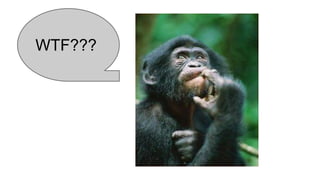
WTF???
Ok, more simple and in pt-br !!
“Bancos de dados ou bases de dados são
coleções organizadas de dados que se
relacionam de forma a criar algum sentido
(Informação) e dar mais eficiência durante uma
pesquisa ou estudo.” (Wikipedia)
Source: http://pt.wikipedia.org/wiki/Banco_de_dados
Database is a concept
Relational Database Management Systems
is the implementation of this concept
About me
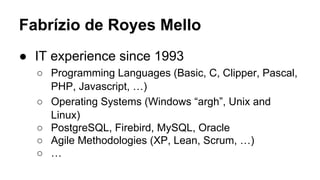
● IT experience since 1993
○ Programming Languages (Basic, C, Clipper, Pascal,
PHP, Javascript, …)
○ Operating Systems (Windows “argh”, Unix and
Linux)
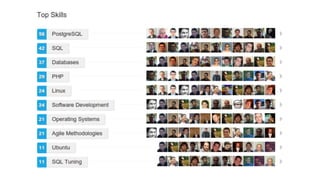
○ PostgreSQL, Firebird, MySQL, Oracle
○ Agile Methodologies (XP, Lean, Scrum, …)
○ …
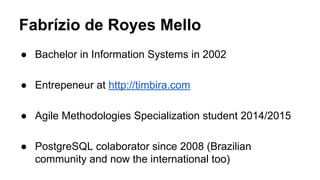
Fabrízio de Royes Mello
● Bachelor in Information Systems in 2002
● Entrepeneur at http://timbira.com
● Agile Methodologies Specialization student 2014/2015
● PostgreSQL colaborator since 2008 (Brazilian
community and now the international too)
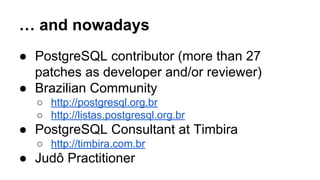
… and nowadays
● PostgreSQL contributor (more than 27
patches as developer and/or reviewer)
● Brazilian Community
○ http://postgresql.org.br
○ http://listas.postgresql.org.br
● PostgreSQL Consultant at Timbira
○ http://timbira.com.br
● Judô Practitioner
About PostgreSQL
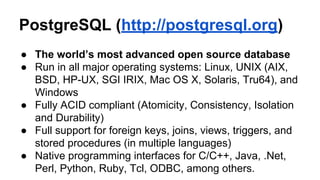
PostgreSQL (http://postgresql.org)
● The world’s most advanced open source database
● Run in all major operating systems: Linux, UNIX (AIX,
BSD, HP-UX, SGI IRIX, Mac OS X, Solaris, Tru64), and
Windows
● Fully ACID compliant (Atomicity, Consistency, Isolation
and Durability)
● Full support for foreign keys, joins, views, triggers, and
stored procedures (in multiple languages)
● Native programming interfaces for C/C++, Java, .Net,
Perl, Python, Ruby, Tcl, ODBC, among others.
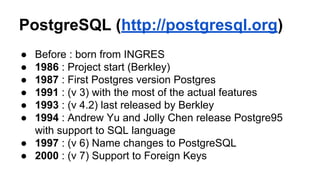
PostgreSQL (http://postgresql.org)
● Before : born from INGRES
● 1986 : Project start (Berkley)
● 1987 : First Postgres version Postgres
● 1991 : (v 3) with the most of the actual features
● 1993 : (v 4.2) last released by Berkley
● 1994 : Andrew Yu and Jolly Chen release Postgre95
with support to SQL language
● 1997 : (v 6) Name changes to PostgreSQL
● 2000 : (v 7) Support to Foreign Keys
PostgreSQL (http://postgresql.org)
● 2005 : (v 8) Native port to Windows, Tablespaces,
Savepoints, Point-In-Time-Recovery
● 2005 : (v 8.1) Two-phase Commit, Roles
● 2006 : (v 8.2) [Insert, Update, Delete] Returning,
improve performance OLTP and BI
● 2008 : (v 8.3) Debug PL/PgSQL, Tsearch2 (XML)
incorporated to the core, performance improvements
● 2009 : (v 8.4) Windowing Functions, Common Table
Expressions and Recursive Queries, Parallel Restore,
“pg_upgrade”
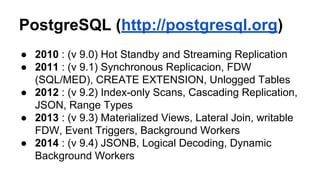
PostgreSQL (http://postgresql.org)
● 2010 : (v 9.0) Hot Standby and Streaming Replication
● 2011 : (v 9.1) Synchronous Replicacion, FDW
(SQL/MED), CREATE EXTENSION, Unlogged Tables
● 2012 : (v 9.2) Index-only Scans, Cascading Replication,
JSON, Range Types
● 2013 : (v 9.3) Materialized Views, Lateral Join, writable
FDW, Event Triggers, Background Workers
● 2014 : (v 9.4) JSONB, Logical Decoding, Dynamic
Background Workers
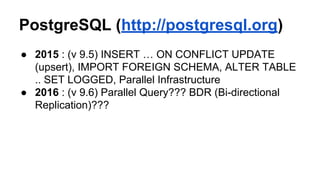
PostgreSQL (http://postgresql.org)
● 2015 : (v 9.5) INSERT … ON CONFLICT UPDATE
(upsert), IMPORT FOREIGN SCHEMA, ALTER TABLE
.. SET LOGGED, Parallel Infrastructure
● 2016 : (v 9.6) Parallel Query??? BDR (Bi-directional
Replication)???
About FOOS and Google
FOSS (free and open source software) and me
● My first contact was using Linux in 1997
● I fell in love with this culture since then
● In 1999 I met PostgreSQL so since then I
knew this would be part of my life
● Because of this decision I had a lot of
troubles, including financial…
● But here I am :-)
Is a global program that
offers students stipends to
write code for open source
projects.
We have worked with the
open source community to
identify and fund exciting
projects for the upcoming
summer.
Connect students to
open source communities
GSoC and PostgreSQL
● Since 2006
● Cool projects
○ Fast GiST index build
○ New phpPgAdmin Plugin Architecture (brazilian)
○ pgAdmin database designer
○ Better indexing for ranges
○ Document collection Foreign-data Wrapper
And now my project ...
PostgreSQL 9.1 introduced a new kind of table
Unlogged Tables
What means “Unlogged”?
First we need to know what means “WAL”
PostgreSQL is Full-ACID and to guarantee data
integrity uses a standard method called
WAL (Write-Ahead Logging)
“In computer science, write-ahead logging (WAL) is a family
of techniques for providing atomicity and durability (two of
the ACID properties) in database systems.
In a system using WAL, all modifications are written to a log
before they are applied. Usually both redo and undo
information is stored in the log.”
http://en.wikipedia.org/wiki/Write-ahead_logging
Ok, and what means “Unlogged” ?
● Unlogged means that the data written in
these tables is not written to WAL.
● So it makes written really, really fast
compared to written into regular tables.
So I’ll use it to all of my tables...
● However you won’t want to do that, because
● They are neither crash-safe (an unlogged
table is automatically truncated after a crash
or unclean shutdown)
● And they are nor replicated using SR
But there are some cool use cases
● Speed ETL jobs
● Cache
● Session State
● Queues?!
● ...
And now we have the power to ...
● change from UNLOGGED to LOGGED
○ ALTER TABLE name SET LOGGED;
● change from LOGGED to UNLOGGED
○ ALTER TABLE name SET UNLOGGED;
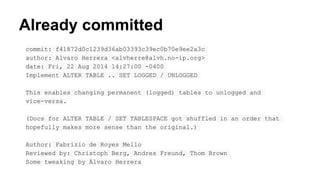
Already committed
commit: f41872d0c1239d36ab03393c39ec0b70e9ee2a3c
author: Alvaro Herrera <alvherre@alvh.no-ip.org>
date: Fri, 22 Aug 2014 14:27:00 -0400
Implement ALTER TABLE .. SET LOGGED / UNLOGGED
This enables changing permanent (logged) tables to unlogged and
vice-versa.
(Docs for ALTER TABLE / SET TABLESPACE got shuffled in an order that
hopefully makes more sense than the original.)
Author: Fabrízio de Royes Mello
Reviewed by: Christoph Berg, Andres Freund, Thom Brown
Some tweaking by Álvaro Herrera
How it works
1. Acquire AcessExclusiveLock
2. Check dependencies
a. Cannot change temp tables
b. Check Foreign Keys
3. Change indexes “relpersistence”
4. Create new heap/toast with new relpersistence
5. Rewrite heap/toast
6. Rewrite indexes
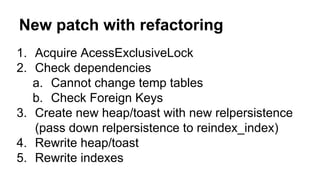
New patch with refactoring
1. Acquire AcessExclusiveLock
2. Check dependencies
a. Cannot change temp tables
b. Check Foreign Keys
3. Create new heap/toast with new relpersistence
(pass down relpersistence to reindex_index)
4. Rewrite heap/toast
5. Rewrite indexes
Currently Caveats
● AccessExclusiveLock
● Rewrite datafiles
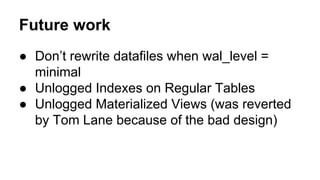
Future work
● Don’t rewrite datafiles when wal_level =
minimal
● Unlogged Indexes on Regular Tables
● Unlogged Materialized Views (was reverted
by Tom Lane because of the bad design)
Questions?
Special thanks to
● Stephen Frost (mentor)
● Josh Berkus and Thom Brown (organizers)
● Christoph Berg (patch review)
● Álvaro Herrera (patch review and commit)
● Maristela Kohlrausch de Andrade (my
english teacher)
● http://fabriziomello.github.io
● https://www.linkedin.com/in/fabriziomello
● @fabriziomello
My contacts
GSoC2014 - Uniritter Presentation May, 2015

GSoC2014 - Uniritter Presentation May, 2015

  • 1.
  • 2.
    Just to stay allof us tuned!!! Everybody knows what a database is?
  • 3.
    Is this adatabase?
  • 4.
  • 5.
    But what wikipediatell us? A database is an integrated and organized collection of logically related records or files or data that are stored in a computer system which consolidates records previously stored in a separate files into a common pool of data records that provides data for many applications. Source: http://en.wikipedia.org/wiki/Database
  • 6.
  • 7.
    Ok, more simpleand in pt-br !! “Bancos de dados ou bases de dados são coleções organizadas de dados que se relacionam de forma a criar algum sentido (Informação) e dar mais eficiência durante uma pesquisa ou estudo.” (Wikipedia) Source: http://pt.wikipedia.org/wiki/Banco_de_dados
  • 8.
    Database is aconcept Relational Database Management Systems is the implementation of this concept
  • 9.
  • 10.
    ● IT experiencesince 1993 ○ Programming Languages (Basic, C, Clipper, Pascal, PHP, Javascript, …) ○ Operating Systems (Windows “argh”, Unix and Linux) ○ PostgreSQL, Firebird, MySQL, Oracle ○ Agile Methodologies (XP, Lean, Scrum, …) ○ … Fabrízio de Royes Mello
  • 11.
    Fabrízio de RoyesMello ● Bachelor in Information Systems in 2002 ● Entrepeneur at http://timbira.com ● Agile Methodologies Specialization student 2014/2015 ● PostgreSQL colaborator since 2008 (Brazilian community and now the international too)
  • 13.
    … and nowadays ●PostgreSQL contributor (more than 27 patches as developer and/or reviewer) ● Brazilian Community ○ http://postgresql.org.br ○ http://listas.postgresql.org.br ● PostgreSQL Consultant at Timbira ○ http://timbira.com.br ● Judô Practitioner
  • 14.
  • 15.
    PostgreSQL (http://postgresql.org) ● Theworld’s most advanced open source database ● Run in all major operating systems: Linux, UNIX (AIX, BSD, HP-UX, SGI IRIX, Mac OS X, Solaris, Tru64), and Windows ● Fully ACID compliant (Atomicity, Consistency, Isolation and Durability) ● Full support for foreign keys, joins, views, triggers, and stored procedures (in multiple languages) ● Native programming interfaces for C/C++, Java, .Net, Perl, Python, Ruby, Tcl, ODBC, among others.
  • 16.
    PostgreSQL (http://postgresql.org) ● Before: born from INGRES ● 1986 : Project start (Berkley) ● 1987 : First Postgres version Postgres ● 1991 : (v 3) with the most of the actual features ● 1993 : (v 4.2) last released by Berkley ● 1994 : Andrew Yu and Jolly Chen release Postgre95 with support to SQL language ● 1997 : (v 6) Name changes to PostgreSQL ● 2000 : (v 7) Support to Foreign Keys
  • 17.
    PostgreSQL (http://postgresql.org) ● 2005: (v 8) Native port to Windows, Tablespaces, Savepoints, Point-In-Time-Recovery ● 2005 : (v 8.1) Two-phase Commit, Roles ● 2006 : (v 8.2) [Insert, Update, Delete] Returning, improve performance OLTP and BI ● 2008 : (v 8.3) Debug PL/PgSQL, Tsearch2 (XML) incorporated to the core, performance improvements ● 2009 : (v 8.4) Windowing Functions, Common Table Expressions and Recursive Queries, Parallel Restore, “pg_upgrade”
  • 18.
    PostgreSQL (http://postgresql.org) ● 2010: (v 9.0) Hot Standby and Streaming Replication ● 2011 : (v 9.1) Synchronous Replicacion, FDW (SQL/MED), CREATE EXTENSION, Unlogged Tables ● 2012 : (v 9.2) Index-only Scans, Cascading Replication, JSON, Range Types ● 2013 : (v 9.3) Materialized Views, Lateral Join, writable FDW, Event Triggers, Background Workers ● 2014 : (v 9.4) JSONB, Logical Decoding, Dynamic Background Workers
  • 19.
    PostgreSQL (http://postgresql.org) ● 2015: (v 9.5) INSERT … ON CONFLICT UPDATE (upsert), IMPORT FOREIGN SCHEMA, ALTER TABLE .. SET LOGGED, Parallel Infrastructure ● 2016 : (v 9.6) Parallel Query??? BDR (Bi-directional Replication)???
  • 20.
  • 21.
    FOSS (free andopen source software) and me ● My first contact was using Linux in 1997 ● I fell in love with this culture since then ● In 1999 I met PostgreSQL so since then I knew this would be part of my life ● Because of this decision I had a lot of troubles, including financial… ● But here I am :-)
  • 22.
    Is a globalprogram that offers students stipends to write code for open source projects. We have worked with the open source community to identify and fund exciting projects for the upcoming summer.
  • 23.
    Connect students to opensource communities
  • 24.
    GSoC and PostgreSQL ●Since 2006 ● Cool projects ○ Fast GiST index build ○ New phpPgAdmin Plugin Architecture (brazilian) ○ pgAdmin database designer ○ Better indexing for ranges ○ Document collection Foreign-data Wrapper
  • 25.
    And now myproject ... PostgreSQL 9.1 introduced a new kind of table Unlogged Tables
  • 26.
    What means “Unlogged”? Firstwe need to know what means “WAL” PostgreSQL is Full-ACID and to guarantee data integrity uses a standard method called WAL (Write-Ahead Logging)
  • 27.
    WAL (Write-Ahead Logging) “Incomputer science, write-ahead logging (WAL) is a family of techniques for providing atomicity and durability (two of the ACID properties) in database systems. In a system using WAL, all modifications are written to a log before they are applied. Usually both redo and undo information is stored in the log.” http://en.wikipedia.org/wiki/Write-ahead_logging
  • 28.
    Ok, and whatmeans “Unlogged” ? ● Unlogged means that the data written in these tables is not written to WAL. ● So it makes written really, really fast compared to written into regular tables.
  • 29.
    So I’ll useit to all of my tables... ● However you won’t want to do that, because ● They are neither crash-safe (an unlogged table is automatically truncated after a crash or unclean shutdown) ● And they are nor replicated using SR
  • 30.
    But there aresome cool use cases ● Speed ETL jobs ● Cache ● Session State ● Queues?! ● ...
  • 31.
    And now wehave the power to ... ● change from UNLOGGED to LOGGED ○ ALTER TABLE name SET LOGGED; ● change from LOGGED to UNLOGGED ○ ALTER TABLE name SET UNLOGGED;
  • 32.
    Already committed commit: f41872d0c1239d36ab03393c39ec0b70e9ee2a3c author:Alvaro Herrera <alvherre@alvh.no-ip.org> date: Fri, 22 Aug 2014 14:27:00 -0400 Implement ALTER TABLE .. SET LOGGED / UNLOGGED This enables changing permanent (logged) tables to unlogged and vice-versa. (Docs for ALTER TABLE / SET TABLESPACE got shuffled in an order that hopefully makes more sense than the original.) Author: Fabrízio de Royes Mello Reviewed by: Christoph Berg, Andres Freund, Thom Brown Some tweaking by Álvaro Herrera
  • 33.
    How it works 1.Acquire AcessExclusiveLock 2. Check dependencies a. Cannot change temp tables b. Check Foreign Keys 3. Change indexes “relpersistence” 4. Create new heap/toast with new relpersistence 5. Rewrite heap/toast 6. Rewrite indexes
  • 34.
    New patch withrefactoring 1. Acquire AcessExclusiveLock 2. Check dependencies a. Cannot change temp tables b. Check Foreign Keys 3. Create new heap/toast with new relpersistence (pass down relpersistence to reindex_index) 4. Rewrite heap/toast 5. Rewrite indexes
  • 35.
  • 36.
    Future work ● Don’trewrite datafiles when wal_level = minimal ● Unlogged Indexes on Regular Tables ● Unlogged Materialized Views (was reverted by Tom Lane because of the bad design)
  • 37.
  • 38.
    Special thanks to ●Stephen Frost (mentor) ● Josh Berkus and Thom Brown (organizers) ● Christoph Berg (patch review) ● Álvaro Herrera (patch review and commit) ● Maristela Kohlrausch de Andrade (my english teacher)
  • 39.