GSLV
GEOSYNCHRONOUS SATELLITE LAUNCH VEHICLE
By,
Mohamed Rafath R,
170101021, Pre-Final Year,
Department of Aeronautical Engineering,
Rajalakshmi Engineering College – 602 105.
GSLV MK-III
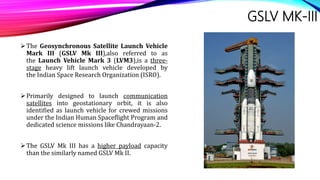
The Geosynchronous Satellite Launch Vehicle
Mark III (GSLV Mk III),also referred to as
the Launch Vehicle Mark 3 (LVM3),is a three-
stage heavy lift launch vehicle developed by
the Indian Space Research Organization (ISRO).
Primarily designed to launch communication
satellites into geostationary orbit, it is also
identified as launch vehicle for crewed missions
under the Indian Human Spaceflight Program and
dedicated science missions like Chandrayaan-2.
The GSLV Mk III has a higher payload capacity
than the similarly named GSLV Mk II.
GSLV MK-III
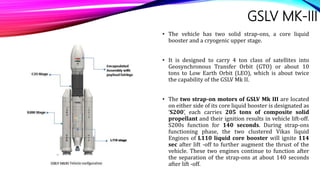
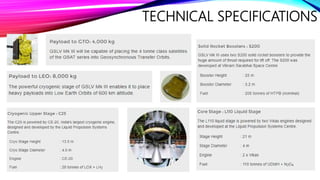
• The vehicle has two solid strap-ons, a core liquid
booster and a cryogenic upper stage.
• It is designed to carry 4 ton class of satellites into
Geosynchronous Transfer Orbit (GTO) or about 10
tons to Low Earth Orbit (LEO), which is about twice
the capability of the GSLV Mk II.
• The two strap-on motors of GSLV Mk III are located
on either side of its core liquid booster is designated as
‘S200’, each carries 205 tons of composite solid
propellant and their ignition results in vehicle lift-off.
S200s function for 140 seconds. During strap-ons
functioning phase, the two clustered Vikas liquid
Engines of L110 liquid core booster will ignite 114
sec after lift -off to further augment the thrust of the
vehicle. These two engines continue to function after
the separation of the strap-ons at about 140 seconds
after lift -off.
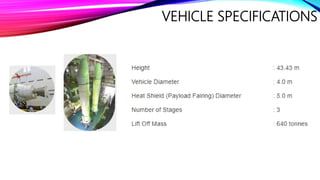
VEHICLE SPECIFICATIONS
TECHNICAL SPECIFICATIONS
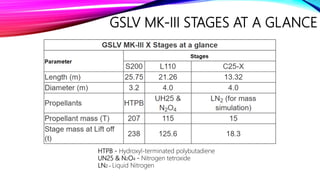
GSLV MK-III STAGES AT A GLANCE
HTPB - Hydroxyl-terminated polybutadiene
UN25 & N2O4 - Nitrogen tetroxide
LN2 – Liquid Nitrogen
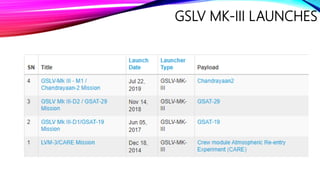
GSLV MK-III LAUNCHES
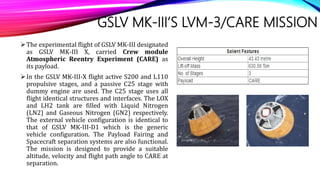
GSLV MK-III’S LVM-3/CARE MISSION
The experimental flight of GSLV MK-III designated
as GSLV MK-III X, carried Crew module
Atmospheric Reentry Experiment (CARE) as
its payload.
In the GSLV MK-III-X flight active S200 and L110
propulsive stages, and a passive C25 stage with
dummy engine are used. The C25 stage uses all
flight identical structures and interfaces. The LOX
and LH2 tank are filled with Liquid Nitrogen
(LN2) and Gaseous Nitrogen (GN2) respectively.
The external vehicle configuration is identical to
that of GSLV MK-III-D1 which is the generic
vehicle configuration. The Payload Fairing and
Spacecraft separation systems are also functional.
The mission is designed to provide a suitable
altitude, velocity and flight path angle to CARE at
separation.
GSLV MK-III’S GSAT -19
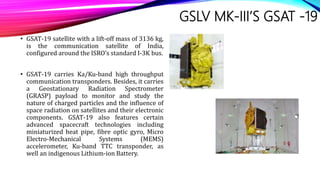
• GSAT-19 satellite with a lift-off mass of 3136 kg,
is the communication satellite of India,
configured around the ISRO’s standard I-3K bus.
• GSAT-19 carries Ka/Ku-band high throughput
communication transponders. Besides, it carries
a Geostationary Radiation Spectrometer
(GRASP) payload to monitor and study the
nature of charged particles and the influence of
space radiation on satellites and their electronic
components. GSAT-19 also features certain
advanced spacecraft technologies including
miniaturized heat pipe, fibre optic gyro, Micro
Electro-Mechanical Systems (MEMS)
accelerometer, Ku-band TTC transponder, as
well an indigenous Lithium-ion Battery.
GSLV MK-III’S GSAT -29
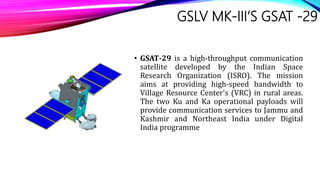
• GSAT-29 is a high-throughput communication
satellite developed by the Indian Space
Research Organization (ISRO). The mission
aims at providing high-speed bandwidth to
Village Resource Center's (VRC) in rural areas.
The two Ku and Ka operational payloads will
provide communication services to Jammu and
Kashmir and Northeast India under Digital
India programme
GSLV MK-III’S CHANDRAYAAN-2
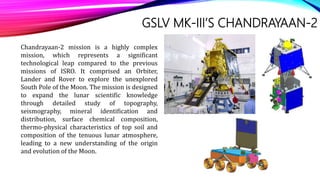
Chandrayaan-2 mission is a highly complex
mission, which represents a significant
technological leap compared to the previous
missions of ISRO. It comprised an Orbiter,
Lander and Rover to explore the unexplored
South Pole of the Moon. The mission is designed
to expand the lunar scientific knowledge
through detailed study of topography,
seismography, mineral identification and
distribution, surface chemical composition,
thermo-physical characteristics of top soil and
composition of the tenuous lunar atmosphere,
leading to a new understanding of the origin
and evolution of the Moon.
GSLV MKIII

GSLV MKIII

  • 1.
    GSLV GEOSYNCHRONOUS SATELLITE LAUNCHVEHICLE By, Mohamed Rafath R, 170101021, Pre-Final Year, Department of Aeronautical Engineering, Rajalakshmi Engineering College – 602 105.
  • 2.
    GSLV MK-III The GeosynchronousSatellite Launch Vehicle Mark III (GSLV Mk III),also referred to as the Launch Vehicle Mark 3 (LVM3),is a three- stage heavy lift launch vehicle developed by the Indian Space Research Organization (ISRO). Primarily designed to launch communication satellites into geostationary orbit, it is also identified as launch vehicle for crewed missions under the Indian Human Spaceflight Program and dedicated science missions like Chandrayaan-2. The GSLV Mk III has a higher payload capacity than the similarly named GSLV Mk II.
  • 3.
    GSLV MK-III • Thevehicle has two solid strap-ons, a core liquid booster and a cryogenic upper stage. • It is designed to carry 4 ton class of satellites into Geosynchronous Transfer Orbit (GTO) or about 10 tons to Low Earth Orbit (LEO), which is about twice the capability of the GSLV Mk II. • The two strap-on motors of GSLV Mk III are located on either side of its core liquid booster is designated as ‘S200’, each carries 205 tons of composite solid propellant and their ignition results in vehicle lift-off. S200s function for 140 seconds. During strap-ons functioning phase, the two clustered Vikas liquid Engines of L110 liquid core booster will ignite 114 sec after lift -off to further augment the thrust of the vehicle. These two engines continue to function after the separation of the strap-ons at about 140 seconds after lift -off.
  • 4.
  • 5.
  • 6.
    GSLV MK-III STAGESAT A GLANCE HTPB - Hydroxyl-terminated polybutadiene UN25 & N2O4 - Nitrogen tetroxide LN2 – Liquid Nitrogen
  • 7.
  • 8.
    GSLV MK-III’S LVM-3/CAREMISSION The experimental flight of GSLV MK-III designated as GSLV MK-III X, carried Crew module Atmospheric Reentry Experiment (CARE) as its payload. In the GSLV MK-III-X flight active S200 and L110 propulsive stages, and a passive C25 stage with dummy engine are used. The C25 stage uses all flight identical structures and interfaces. The LOX and LH2 tank are filled with Liquid Nitrogen (LN2) and Gaseous Nitrogen (GN2) respectively. The external vehicle configuration is identical to that of GSLV MK-III-D1 which is the generic vehicle configuration. The Payload Fairing and Spacecraft separation systems are also functional. The mission is designed to provide a suitable altitude, velocity and flight path angle to CARE at separation.
  • 9.
    GSLV MK-III’S GSAT-19 • GSAT-19 satellite with a lift-off mass of 3136 kg, is the communication satellite of India, configured around the ISRO’s standard I-3K bus. • GSAT-19 carries Ka/Ku-band high throughput communication transponders. Besides, it carries a Geostationary Radiation Spectrometer (GRASP) payload to monitor and study the nature of charged particles and the influence of space radiation on satellites and their electronic components. GSAT-19 also features certain advanced spacecraft technologies including miniaturized heat pipe, fibre optic gyro, Micro Electro-Mechanical Systems (MEMS) accelerometer, Ku-band TTC transponder, as well an indigenous Lithium-ion Battery.
  • 10.
    GSLV MK-III’S GSAT-29 • GSAT-29 is a high-throughput communication satellite developed by the Indian Space Research Organization (ISRO). The mission aims at providing high-speed bandwidth to Village Resource Center's (VRC) in rural areas. The two Ku and Ka operational payloads will provide communication services to Jammu and Kashmir and Northeast India under Digital India programme
  • 11.
    GSLV MK-III’S CHANDRAYAAN-2 Chandrayaan-2mission is a highly complex mission, which represents a significant technological leap compared to the previous missions of ISRO. It comprised an Orbiter, Lander and Rover to explore the unexplored South Pole of the Moon. The mission is designed to expand the lunar scientific knowledge through detailed study of topography, seismography, mineral identification and distribution, surface chemical composition, thermo-physical characteristics of top soil and composition of the tenuous lunar atmosphere, leading to a new understanding of the origin and evolution of the Moon.