Session I: Effective Local Strategies to 
Boost Quality Job Creation, Employment 
and Participation 
Randall W. Eberts 
W. E. Upjohn Institute for Employment Research 
U.S. Department of Labor-OECD LEED 
Workshop on Workforce Development and Local Job Creation: 
An International Perspective 
18-19 November, 2014
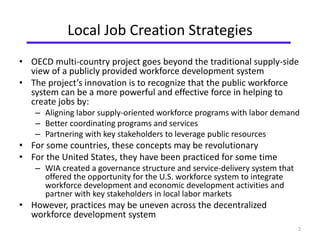
Local Job Creation Strategies 
• OECD multi-country project goes beyond the traditional supply-side 
view of a publicly provided workforce development system 
• The project’s innovation is to recognize that the public workforce 
system can be a more powerful and effective force in helping to 
create jobs by: 
– Aligning labor supply-oriented workforce programs with labor demand 
– Better coordinating programs and services 
– Partnering with key stakeholders to leverage public resources 
• For some countries, these concepts may be revolutionary 
• For the United States, they have been practiced for some time 
– WIA created a governance structure and service-delivery system that 
offered the opportunity for the U.S. workforce system to integrate 
workforce development and economic development activities and 
partner with key stakeholders in local labor markets 
• However, practices may be uneven across the decentralized 
workforce development system 
2
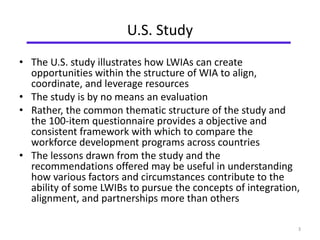
U.S. Study 
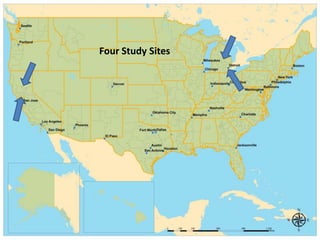
• The U.S. study illustrates how LWIAs can create 
opportunities within the structure of WIA to align, 
coordinate, and leverage resources 
• The study is by no means an evaluation 
• Rather, the common thematic structure of the study and 
the 100-item questionnaire provides a objective and 
consistent framework with which to compare the 
workforce development programs across countries 
• The lessons drawn from the study and the 
recommendations offered may be useful in understanding 
how various factors and circumstances contribute to the 
ability of some LWIBs to pursue the concepts of integration, 
alignment, and partnerships more than others 
3
4 
Four Study Sites
5 
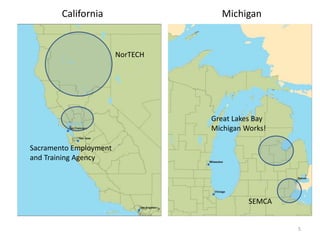
California Michigan 
NorTECH 
Sacramento Employment 
and Training Agency 
Great Lakes Bay 
Michigan Works! 
SEMCA
6 
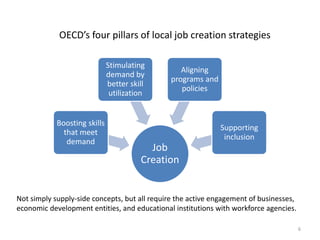
OECD’s four pillars of local job creation strategies 
Job 
Creation 
Boosting skills 
that meet 
demand 
Stimulating 
demand by 
better skill 
utilization 
Aligning 
programs and 
policies 
Supporting 
inclusion 
Not simply supply-side concepts, but all require the active engagement of businesses, 
economic development entities, and educational institutions with workforce agencies.
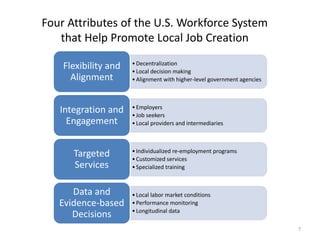
• Decentralization 
• Local decision making 
• Alignment with higher-level government agencies 
Flexibility and 
Alignment 
•Employers 
• Job seekers 
• Local providers and intermediaries 
Integration and 
Engagement 
• Individualized re-employment programs 
• Customized services 
• Specialized training 
Targeted 
Services 
• Local labor market conditions 
• Performance monitoring 
• Longitudinal data 
Data and 
Evidence-based 
Decisions 
7 
Four Attributes of the U.S. Workforce System 
that Help Promote Local Job Creation
8 
Flexibility and Alignment 
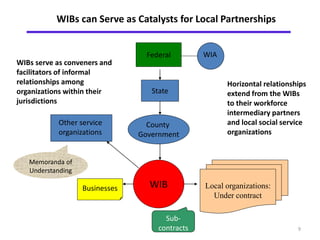
• Local workforce investment boards (WIBs) are arguably the heart of the 
WIA system 
– They administer federal and state labor exchange and job training programs 
• WIA is a partnership among the federal, state and local governments 
– Local WIBs are not agencies of the federal or state governments but are 
extensions of a local government unit—typically a county government 
– Local non-profit organizations are often the administrative entity for the WIB 
– A fixed-term renewable master contract governs the relationship between the 
WIB and the county government 
• WIBs are governed by their own board, which by law is comprised 
predominantly of business leaders who help design local workforce 
strategy and oversee its implementation and administration 
• Most federal and state funding flows through WIBs, which subcontract 
with other local government agencies and non-government organizations 
to provide services 
– Most services are delivered through one-stop career centers 
– WIA does not allow WIBs to provide services 
• This structure allows WIBs to be a catalyst for local collaboration 
– Partnerships are the focal point for both vertical and horizontal relationships 
among the various partners within the workforce development system
9 
WIBs can Serve as Catalysts for Local Partnerships 
Federal 
State 
County 
Government 
WIB 
WIA 
Local organizations: 
Under contract 
Sub-contracts 
WIBs serve as conveners and 
facilitators of informal 
relationships among 
organizations within their 
jurisdictions 
Other service 
organizations 
Businesses 
Horizontal relationships 
extend from the WIBs 
to their workforce 
intermediary partners 
and local social service 
organizations 
Memoranda of 
Understanding
Flexibility and Alignment: Examples 
10 
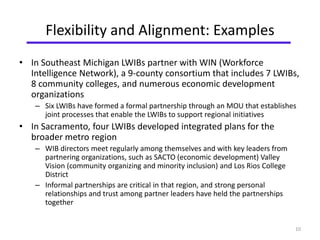
• In Southeast Michigan LWIBs partner with WIN (Workforce 
Intelligence Network), a 9-county consortium that includes 7 LWIBs, 
8 community colleges, and numerous economic development 
organizations 
– Six LWIBs have formed a formal partnership through an MOU that establishes 
joint processes that enable the LWIBs to support regional initiatives 
• In Sacramento, four LWIBs developed integrated plans for the 
broader metro region 
– WIB directors meet regularly among themselves and with key leaders from 
partnering organizations, such as SACTO (economic development) Valley 
Vision (community organizing and minority inclusion) and Los Rios College 
District 
– Informal partnerships are critical in that region, and strong personal 
relationships and trust among partner leaders have held the partnerships 
together
Integration and Engagement 
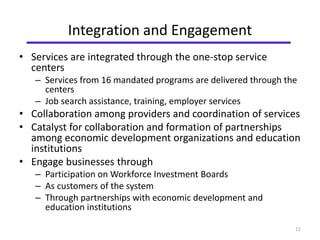
• Services are integrated through the one-stop service 
centers 
– Services from 16 mandated programs are delivered through the 
centers 
– Job search assistance, training, employer services 
• Collaboration among providers and coordination of services 
• Catalyst for collaboration and formation of partnerships 
among economic development organizations and education 
institutions 
• Engage businesses through 
– Participation on Workforce Investment Boards 
– As customers of the system 
– Through partnerships with economic development and 
education institutions 
11
Business Engagement: Examples 
• State of California created a state-wide information system (CalJOBS) and 
made it available to all one-stop service center partners so that they can 
record contacts made with employers as a method of co-ordinating those 
contacts 
• NoRTECH employs six full-time staff to continuously call on businesses and 
maintains a “business first” system that assists businesses with retention 
and expansion efforts 
• The Sacramento Training and Response (START) is a partnership of regional 
economic development entities, business, education, labor, and 
government and provides businesses with a one-stop services. 
– To attract a large firm to the Sacramento area, it recruited and trained nearly 
4,000 workers within eight months 
• Los Rios College District’s Next Skills Institute addresses the soft and 
employability skills deficiencies among individuals in the area by providing 
certification in employability skills 
• Delta College in Michigan is set up to offer “just-in-time” training within 
four weeks by hiring qualified trainers from outside the college and 
working with business to design the curricula. 
12
Targeted Services 
• Tailor services to meet the specific and varied needs of 
individual customers 
• Job seekers 
– Individualized reemployment plans 
– Career pathways 
– Sector partnerships to increase employment in in-demand 
industries and occupations 
– Individual Training Accounts 
• Employers 
– Match employers with qualified workers 
– Customized incumbent worker training 
13
Targeted Services: Examples 
14 
• A principle problem affecting people living in poverty in Michigan was a 
lack of transportation (with city bus routes under threat and difficulties 
obtaining insurance for car ownership), but this was less of a problem in 
California which is better served by public transport. 
• The Sacremento board in California had a strong focus on helping local 
disadvantaged neighbourhoods, with a recent strategy to tackle youth 
gang membership: the Sacramento Works CalGRIP Program. 
• There were one-stop services embedded in local communities dominated 
by particular immigrant and ethnic groups. These are often delivered 
through not-for-profit agencies targeted at these communities, which may 
lead to problems in terms of isolation from broader networks. 
• There appeared to be a general lack of services to help immigrants to 
convert their skills to new labour markets, partly because many recent 
immigrants are required to already have jobs secured in order to receive 
visas.
Data and Evidence-Based Decisions 
• Accountability of WIA programs based on labor market outcomes of 
participants, not on process 
• Performance measures use objective administrative data 
• Individual outcome and transaction data 
– Workforce Investment Act Standardized Record Database (WIASRD) 
– Workforce Data Quality Initiative 
– Increased use of internet job postings 
• Performance goals set at national and state levels 
• WIA legislation requires local economic conditions and participant’s 
personal characteristics to be considered in negotiating goals 
• Regression-adjusted performance goals used on a voluntary basis by states 
in recent years 
• ETA requires states to include analysis of local labor market conditions in 
strategic plans 
• WIBs must determine what occupations are in demand for training 
referrals 
15
Data: Examples 
• WIN in Michigan delivers real-time, actionable marketplace intelligence to 
support better and more efficient solutions for employers by compiling 
and analyzing internet job postings 
• NoRTECH developed a set of indicators to track their progress, including 
developing a ROI procedure 
• They also developed a model that estimates the impact of filling job openings 
for the region 
• SETA depends upon the strong analytical capabilities of SACTO and Los 
Rios College’s Centers of Excellence to provide detailed information about 
jobs in demand and sectors with future job growth potential 
• Updated the occupational content of regional critical occupational clusters 
lists, which guides job seekers 
– Michigan is developing the Workforce Quality Initiatives, with financial 
assistance from the federal government 
16
Recommendations 
1. Reinforce the multi-level and flexible approach to workforce 
development, encouraging policy coordination and integration 
2. Consider what mechanisms exist to provide staff with training to 
build their local labor market capacity to serve clients 
3. Performance measures could take into account the variation in 
personal characteristics and labor market conditions more 
rigorously 
4. Continue to collect and share information and data locally about 
what works 
5. Ensure community colleges are able to achieve the right balance 
between responding to businesses and offering diverse curricula 
6. Build capacities at the local level with employers on maximizing 
effective work organization to better utilize skills 
7. Ensure efforts take to serve employers do not displace resources 
for the most vulnerable groups 
17
What’s Next: WIOA 
• Emphasizes federal-state-local partnerships 
• Places WIBs at the center of the design and delivery of 
services 
• Places an even greater emphasis on the local WIB as a 
catalyst for fostering partnerships with education, 
economic development, workforce development entities 
and businesses 
• Requires educational institutions to provide information on 
job prospects of their graduates 
• Establishes outcome-based performance measures and 
targets, and 
• Embeds evidence-based decision making into the 
management of the system. 
18

Effective Local Strategies to Boost Quality Job Creation, Employment and Participation

  • 1.
    Session I: EffectiveLocal Strategies to Boost Quality Job Creation, Employment and Participation Randall W. Eberts W. E. Upjohn Institute for Employment Research U.S. Department of Labor-OECD LEED Workshop on Workforce Development and Local Job Creation: An International Perspective 18-19 November, 2014
  • 2.
    Local Job CreationStrategies • OECD multi-country project goes beyond the traditional supply-side view of a publicly provided workforce development system • The project’s innovation is to recognize that the public workforce system can be a more powerful and effective force in helping to create jobs by: – Aligning labor supply-oriented workforce programs with labor demand – Better coordinating programs and services – Partnering with key stakeholders to leverage public resources • For some countries, these concepts may be revolutionary • For the United States, they have been practiced for some time – WIA created a governance structure and service-delivery system that offered the opportunity for the U.S. workforce system to integrate workforce development and economic development activities and partner with key stakeholders in local labor markets • However, practices may be uneven across the decentralized workforce development system 2
  • 3.
    U.S. Study •The U.S. study illustrates how LWIAs can create opportunities within the structure of WIA to align, coordinate, and leverage resources • The study is by no means an evaluation • Rather, the common thematic structure of the study and the 100-item questionnaire provides a objective and consistent framework with which to compare the workforce development programs across countries • The lessons drawn from the study and the recommendations offered may be useful in understanding how various factors and circumstances contribute to the ability of some LWIBs to pursue the concepts of integration, alignment, and partnerships more than others 3
  • 4.
  • 5.
    5 California Michigan NorTECH Sacramento Employment and Training Agency Great Lakes Bay Michigan Works! SEMCA
  • 6.
    6 OECD’s fourpillars of local job creation strategies Job Creation Boosting skills that meet demand Stimulating demand by better skill utilization Aligning programs and policies Supporting inclusion Not simply supply-side concepts, but all require the active engagement of businesses, economic development entities, and educational institutions with workforce agencies.
  • 7.
    • Decentralization •Local decision making • Alignment with higher-level government agencies Flexibility and Alignment •Employers • Job seekers • Local providers and intermediaries Integration and Engagement • Individualized re-employment programs • Customized services • Specialized training Targeted Services • Local labor market conditions • Performance monitoring • Longitudinal data Data and Evidence-based Decisions 7 Four Attributes of the U.S. Workforce System that Help Promote Local Job Creation
  • 8.
    8 Flexibility andAlignment • Local workforce investment boards (WIBs) are arguably the heart of the WIA system – They administer federal and state labor exchange and job training programs • WIA is a partnership among the federal, state and local governments – Local WIBs are not agencies of the federal or state governments but are extensions of a local government unit—typically a county government – Local non-profit organizations are often the administrative entity for the WIB – A fixed-term renewable master contract governs the relationship between the WIB and the county government • WIBs are governed by their own board, which by law is comprised predominantly of business leaders who help design local workforce strategy and oversee its implementation and administration • Most federal and state funding flows through WIBs, which subcontract with other local government agencies and non-government organizations to provide services – Most services are delivered through one-stop career centers – WIA does not allow WIBs to provide services • This structure allows WIBs to be a catalyst for local collaboration – Partnerships are the focal point for both vertical and horizontal relationships among the various partners within the workforce development system
  • 9.
    9 WIBs canServe as Catalysts for Local Partnerships Federal State County Government WIB WIA Local organizations: Under contract Sub-contracts WIBs serve as conveners and facilitators of informal relationships among organizations within their jurisdictions Other service organizations Businesses Horizontal relationships extend from the WIBs to their workforce intermediary partners and local social service organizations Memoranda of Understanding
  • 10.
    Flexibility and Alignment:Examples 10 • In Southeast Michigan LWIBs partner with WIN (Workforce Intelligence Network), a 9-county consortium that includes 7 LWIBs, 8 community colleges, and numerous economic development organizations – Six LWIBs have formed a formal partnership through an MOU that establishes joint processes that enable the LWIBs to support regional initiatives • In Sacramento, four LWIBs developed integrated plans for the broader metro region – WIB directors meet regularly among themselves and with key leaders from partnering organizations, such as SACTO (economic development) Valley Vision (community organizing and minority inclusion) and Los Rios College District – Informal partnerships are critical in that region, and strong personal relationships and trust among partner leaders have held the partnerships together
  • 11.
    Integration and Engagement • Services are integrated through the one-stop service centers – Services from 16 mandated programs are delivered through the centers – Job search assistance, training, employer services • Collaboration among providers and coordination of services • Catalyst for collaboration and formation of partnerships among economic development organizations and education institutions • Engage businesses through – Participation on Workforce Investment Boards – As customers of the system – Through partnerships with economic development and education institutions 11
  • 12.
    Business Engagement: Examples • State of California created a state-wide information system (CalJOBS) and made it available to all one-stop service center partners so that they can record contacts made with employers as a method of co-ordinating those contacts • NoRTECH employs six full-time staff to continuously call on businesses and maintains a “business first” system that assists businesses with retention and expansion efforts • The Sacramento Training and Response (START) is a partnership of regional economic development entities, business, education, labor, and government and provides businesses with a one-stop services. – To attract a large firm to the Sacramento area, it recruited and trained nearly 4,000 workers within eight months • Los Rios College District’s Next Skills Institute addresses the soft and employability skills deficiencies among individuals in the area by providing certification in employability skills • Delta College in Michigan is set up to offer “just-in-time” training within four weeks by hiring qualified trainers from outside the college and working with business to design the curricula. 12
  • 13.
    Targeted Services •Tailor services to meet the specific and varied needs of individual customers • Job seekers – Individualized reemployment plans – Career pathways – Sector partnerships to increase employment in in-demand industries and occupations – Individual Training Accounts • Employers – Match employers with qualified workers – Customized incumbent worker training 13
  • 14.
    Targeted Services: Examples 14 • A principle problem affecting people living in poverty in Michigan was a lack of transportation (with city bus routes under threat and difficulties obtaining insurance for car ownership), but this was less of a problem in California which is better served by public transport. • The Sacremento board in California had a strong focus on helping local disadvantaged neighbourhoods, with a recent strategy to tackle youth gang membership: the Sacramento Works CalGRIP Program. • There were one-stop services embedded in local communities dominated by particular immigrant and ethnic groups. These are often delivered through not-for-profit agencies targeted at these communities, which may lead to problems in terms of isolation from broader networks. • There appeared to be a general lack of services to help immigrants to convert their skills to new labour markets, partly because many recent immigrants are required to already have jobs secured in order to receive visas.
  • 15.
    Data and Evidence-BasedDecisions • Accountability of WIA programs based on labor market outcomes of participants, not on process • Performance measures use objective administrative data • Individual outcome and transaction data – Workforce Investment Act Standardized Record Database (WIASRD) – Workforce Data Quality Initiative – Increased use of internet job postings • Performance goals set at national and state levels • WIA legislation requires local economic conditions and participant’s personal characteristics to be considered in negotiating goals • Regression-adjusted performance goals used on a voluntary basis by states in recent years • ETA requires states to include analysis of local labor market conditions in strategic plans • WIBs must determine what occupations are in demand for training referrals 15
  • 16.
    Data: Examples •WIN in Michigan delivers real-time, actionable marketplace intelligence to support better and more efficient solutions for employers by compiling and analyzing internet job postings • NoRTECH developed a set of indicators to track their progress, including developing a ROI procedure • They also developed a model that estimates the impact of filling job openings for the region • SETA depends upon the strong analytical capabilities of SACTO and Los Rios College’s Centers of Excellence to provide detailed information about jobs in demand and sectors with future job growth potential • Updated the occupational content of regional critical occupational clusters lists, which guides job seekers – Michigan is developing the Workforce Quality Initiatives, with financial assistance from the federal government 16
  • 17.
    Recommendations 1. Reinforcethe multi-level and flexible approach to workforce development, encouraging policy coordination and integration 2. Consider what mechanisms exist to provide staff with training to build their local labor market capacity to serve clients 3. Performance measures could take into account the variation in personal characteristics and labor market conditions more rigorously 4. Continue to collect and share information and data locally about what works 5. Ensure community colleges are able to achieve the right balance between responding to businesses and offering diverse curricula 6. Build capacities at the local level with employers on maximizing effective work organization to better utilize skills 7. Ensure efforts take to serve employers do not displace resources for the most vulnerable groups 17
  • 18.
    What’s Next: WIOA • Emphasizes federal-state-local partnerships • Places WIBs at the center of the design and delivery of services • Places an even greater emphasis on the local WIB as a catalyst for fostering partnerships with education, economic development, workforce development entities and businesses • Requires educational institutions to provide information on job prospects of their graduates • Establishes outcome-based performance measures and targets, and • Embeds evidence-based decision making into the management of the system. 18