National Summer Project Contest – 2006 GSBA, Greater Noida 25 th  February 2006 Dr. Jyotiprava Pattanaik Apollo Institute of Hospital Administration Jubilee Hills, Hyderabad
Comparative Analysis of Inpatient Discharge Process An Effort, Not to Blame Anyone… The Task is to Find a solution.
List Of Contents Need for the Study Objectives of the Study Methodology Observations (Cause & Effect) Suggestions Legal Implications Devising a Model Conclusion
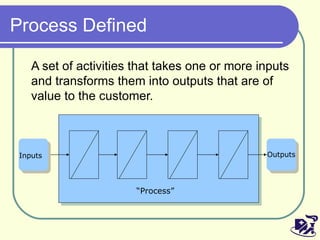
Process Defined A set of activities that takes one or more inputs and transforms them into outputs that are of value to the customer. Inputs Outputs “ Process”
Need for the Study Inefficiencies in Patient Discharge… A Global Concern for All Healthcare providers
Objectives Comparison with previous study Turnaround time analysis Know the Bottlenecks Identify Opportunities
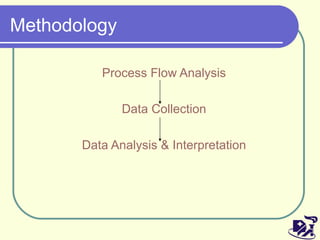
Methodology Process Flow Analysis Data Collection Data Analysis & Interpretation
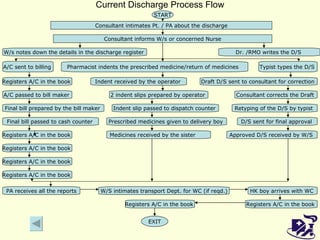
Current Discharge Process Flow Consultant intimates Pt. / PA about the discharge Consultant informs W/s or concerned Nurse W/s notes down the details in the discharge register  Dr. /RMO writes the D/S  A/C sent to billing  Typist types the D/S  Pharmacist indents the prescribed medicine/return of medicines  Registers A/C in the book  Indent received by the operator  Draft D/S sent to consultant for correction  A/C passed to bill maker  Final bill prepared by the bill maker  Consultant corrects the Draft  Final bill passed to cash counter  2 indent slips prepared by operator  Prescribed medicines given to delivery boy  Registers A/C in the book  Indent slip passed to dispatch counter  Registers A/C in the book  D/S sent for final approval  Registers A/C in the book  Approved D/S received by W/S  Retyping of the D/S by typist  W/S intimates transport Dept. for WC (if reqd.) Registers A/C in the book  HK boy arrives with WC  Registers A/C in the book  Registers A/C in the book  PA receives all the reports Medicines received by the sister   START EXIT
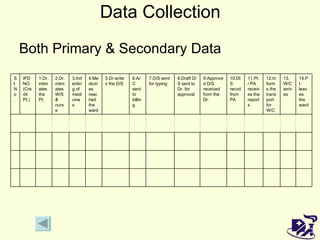
Data Collection  Both Primary & Secondary Data 14.Pt. leaves the ward 13. W/C arrives 12.Informs the transport for W/C 11.Pt./ PA receives the reports 10.DIS recvd from PA 9.Approved D/S received from the Dr. 8.Draft D/S sent to Dr. for  approval 7.D/S sent for typing 6.A/C sent to billing 5.Dr.writes the D/S 4.Medicines reached the ward 3.Indenting of medicines 2.Dr. intimates W/S & nurse 1.Dr.intimates the Pt. IPD NO. (Credit Pt.) Sl. No.
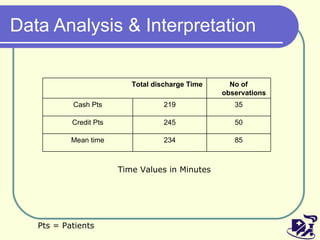
Data Analysis & Interpretation Time Values in Minutes Pts = Patients 85 234 Mean time 50 245 Credit Pts 35 219 Cash Pts No of observations Total discharge Time
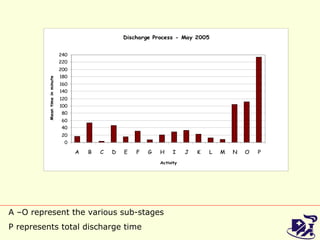
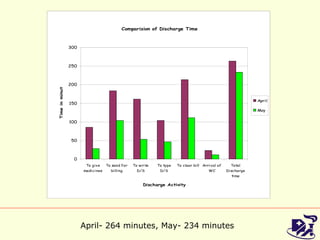
A –O represent the various sub-stages P represents total discharge time
April- 264 minutes, May- 234 minutes
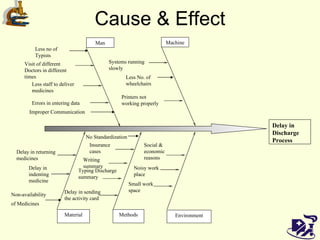
Cause & Effect Visit of different Doctors in different times Improper Communication Delay in returning medicines Delay in indenting medicine Writing summary Typing Discharge summary Delay in sending the activity card No Standardization Noisy work place Small work space Less No. of wheelchairs Non-availability of Medicines   Delay in Discharge Process Man Machine Material Methods Environment Less no of Typists Less staff to deliver medicines  Systems running slowly Printers not working properly Social & economic reasons Insurance cases Errors in entering data
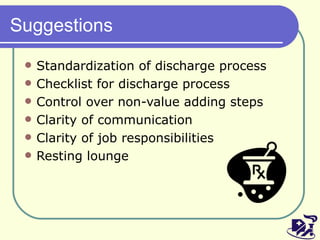
Suggestions Standardization of discharge process Checklist for discharge process Control over non-value adding steps Clarity of communication Clarity of job responsibilities Resting lounge
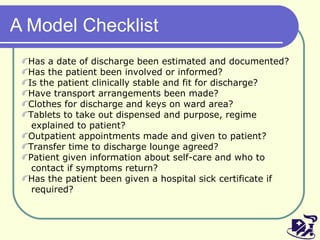
A Model Checklist Has a date of discharge been estimated and documented? Has the patient been involved or informed? Is the patient clinically stable and fit for discharge? Have transport arrangements been made? Clothes for discharge and keys on ward area? Tablets to take out dispensed and purpose, regime  explained to patient? Outpatient appointments made and given to patient? Transfer time to discharge lounge agreed? Patient given information about self-care and who to  contact if symptoms return? Has the patient been given a hospital sick certificate if  required?
Legal Implications Community care (Delayed discharge) Act 2003 (UK) Delayed discharges (Continuing care) Directions 2004 IMC Guidelines Accreditation Norms
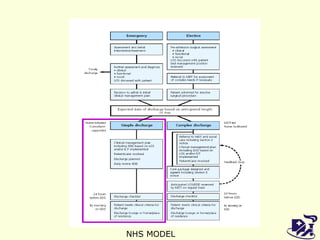
NHS MODEL

Summer Project Contest

  • 1.
    National Summer ProjectContest – 2006 GSBA, Greater Noida 25 th February 2006 Dr. Jyotiprava Pattanaik Apollo Institute of Hospital Administration Jubilee Hills, Hyderabad
  • 2.
    Comparative Analysis ofInpatient Discharge Process An Effort, Not to Blame Anyone… The Task is to Find a solution.
  • 3.
    List Of ContentsNeed for the Study Objectives of the Study Methodology Observations (Cause & Effect) Suggestions Legal Implications Devising a Model Conclusion
  • 4.
    Process Defined Aset of activities that takes one or more inputs and transforms them into outputs that are of value to the customer. Inputs Outputs “ Process”
  • 5.
    Need for theStudy Inefficiencies in Patient Discharge… A Global Concern for All Healthcare providers
  • 6.
    Objectives Comparison withprevious study Turnaround time analysis Know the Bottlenecks Identify Opportunities
  • 7.
    Methodology Process FlowAnalysis Data Collection Data Analysis & Interpretation
  • 8.
    Current Discharge ProcessFlow Consultant intimates Pt. / PA about the discharge Consultant informs W/s or concerned Nurse W/s notes down the details in the discharge register Dr. /RMO writes the D/S A/C sent to billing Typist types the D/S Pharmacist indents the prescribed medicine/return of medicines Registers A/C in the book Indent received by the operator Draft D/S sent to consultant for correction A/C passed to bill maker Final bill prepared by the bill maker Consultant corrects the Draft Final bill passed to cash counter 2 indent slips prepared by operator Prescribed medicines given to delivery boy Registers A/C in the book Indent slip passed to dispatch counter Registers A/C in the book D/S sent for final approval Registers A/C in the book Approved D/S received by W/S Retyping of the D/S by typist W/S intimates transport Dept. for WC (if reqd.) Registers A/C in the book HK boy arrives with WC Registers A/C in the book Registers A/C in the book PA receives all the reports Medicines received by the sister START EXIT
  • 9.
    Data Collection Both Primary & Secondary Data 14.Pt. leaves the ward 13. W/C arrives 12.Informs the transport for W/C 11.Pt./ PA receives the reports 10.DIS recvd from PA 9.Approved D/S received from the Dr. 8.Draft D/S sent to Dr. for approval 7.D/S sent for typing 6.A/C sent to billing 5.Dr.writes the D/S 4.Medicines reached the ward 3.Indenting of medicines 2.Dr. intimates W/S & nurse 1.Dr.intimates the Pt. IPD NO. (Credit Pt.) Sl. No.
  • 10.
    Data Analysis &Interpretation Time Values in Minutes Pts = Patients 85 234 Mean time 50 245 Credit Pts 35 219 Cash Pts No of observations Total discharge Time
  • 11.
    A –O representthe various sub-stages P represents total discharge time
  • 12.
    April- 264 minutes,May- 234 minutes
  • 13.
    Cause & EffectVisit of different Doctors in different times Improper Communication Delay in returning medicines Delay in indenting medicine Writing summary Typing Discharge summary Delay in sending the activity card No Standardization Noisy work place Small work space Less No. of wheelchairs Non-availability of Medicines Delay in Discharge Process Man Machine Material Methods Environment Less no of Typists Less staff to deliver medicines Systems running slowly Printers not working properly Social & economic reasons Insurance cases Errors in entering data
  • 14.
    Suggestions Standardization ofdischarge process Checklist for discharge process Control over non-value adding steps Clarity of communication Clarity of job responsibilities Resting lounge
  • 15.
    A Model ChecklistHas a date of discharge been estimated and documented? Has the patient been involved or informed? Is the patient clinically stable and fit for discharge? Have transport arrangements been made? Clothes for discharge and keys on ward area? Tablets to take out dispensed and purpose, regime explained to patient? Outpatient appointments made and given to patient? Transfer time to discharge lounge agreed? Patient given information about self-care and who to contact if symptoms return? Has the patient been given a hospital sick certificate if required?
  • 16.
    Legal Implications Communitycare (Delayed discharge) Act 2003 (UK) Delayed discharges (Continuing care) Directions 2004 IMC Guidelines Accreditation Norms
  • 17.