Growth and Development
of Nasomaxillary complex
Dr.Vivek G. Chitte.
Dept of Orthodontics and Dentofacial
Orthopedics
S.B. Patil institute for Dental Sciences and
Research
CONTENTS
 Anatomy
 Pre natal growth
 Growth and development of palate
 Post natal growth
 Applied anatomy
 References
Anatomy
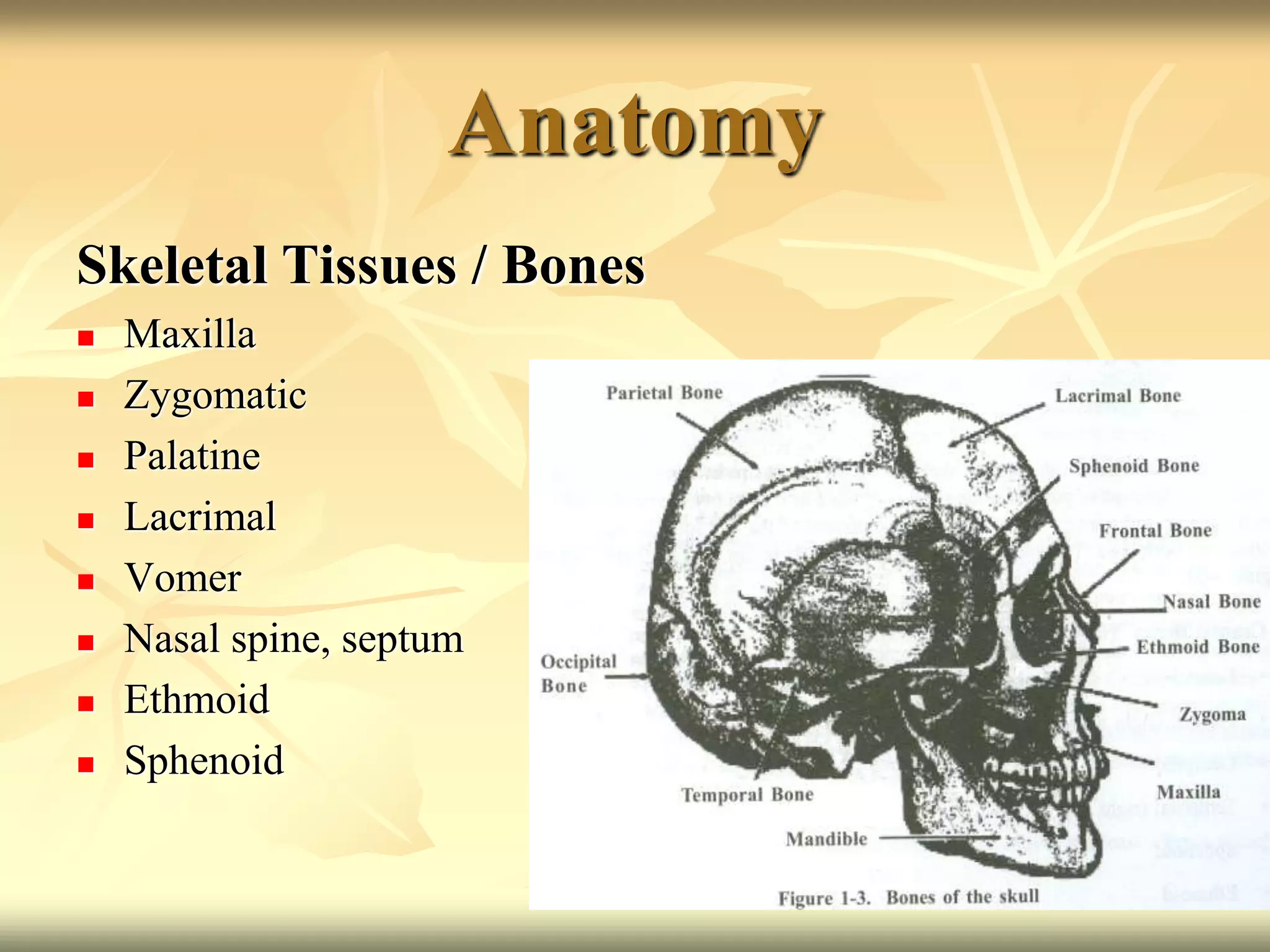
Skeletal Tissues / Bones
 Maxilla
 Zygomatic
 Palatine
 Lacrimal
 Vomer
 Nasal spine, septum
 Ethmoid
 Sphenoid
Sinuses
 Maxillary
 Frontal
 Ethmoid
 Sphenoid
Nasal cavity
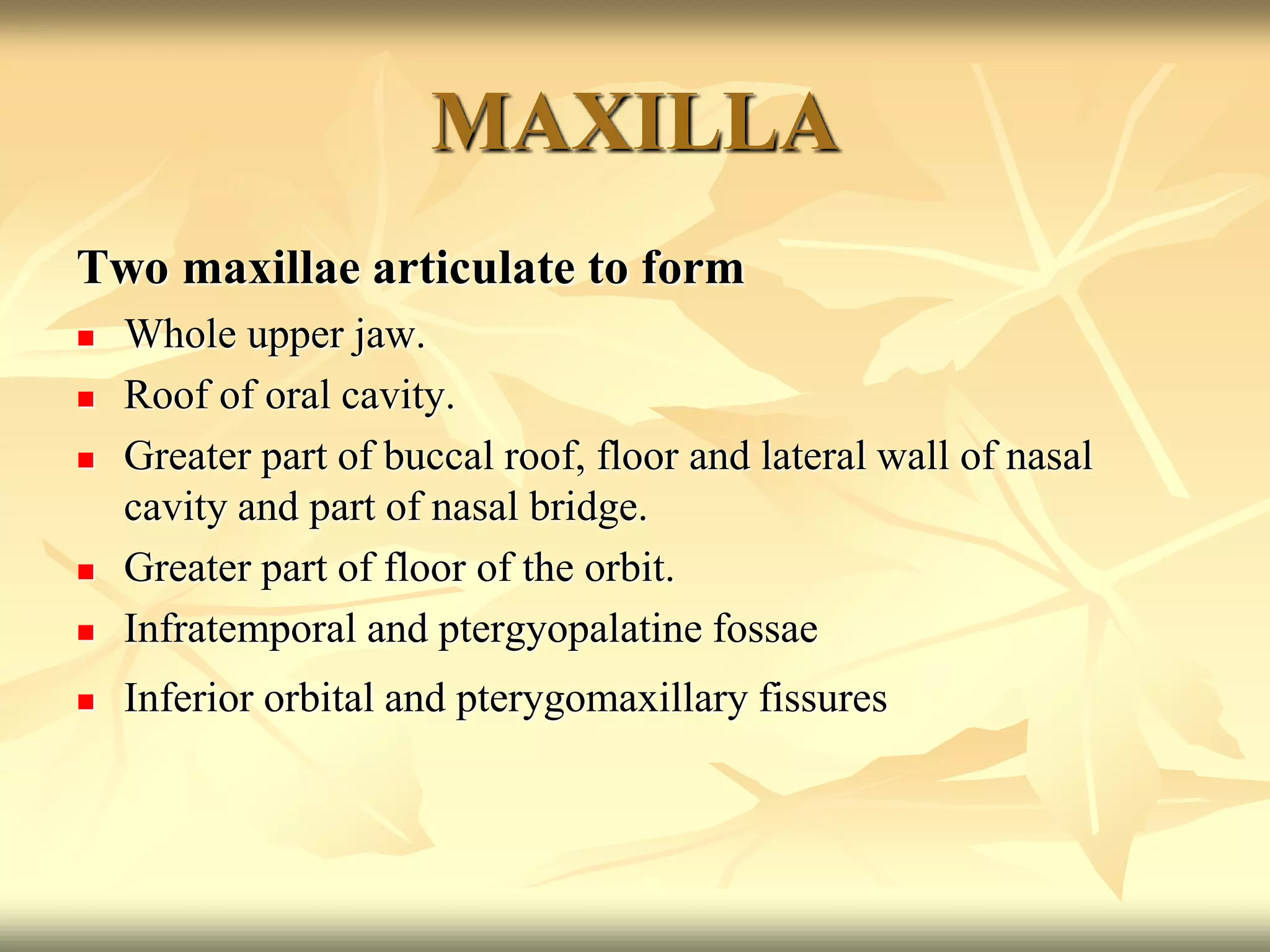
MAXILLA
Two maxillae articulate to form
 Whole upper jaw.
 Roof of oral cavity.
 Greater part of buccal roof, floor and lateral wall of nasal
cavity and part of nasal bridge.
 Greater part of floor of the orbit.
 Infratemporal and ptergyopalatine fossae
 Inferior orbital and pterygomaxillary fissures
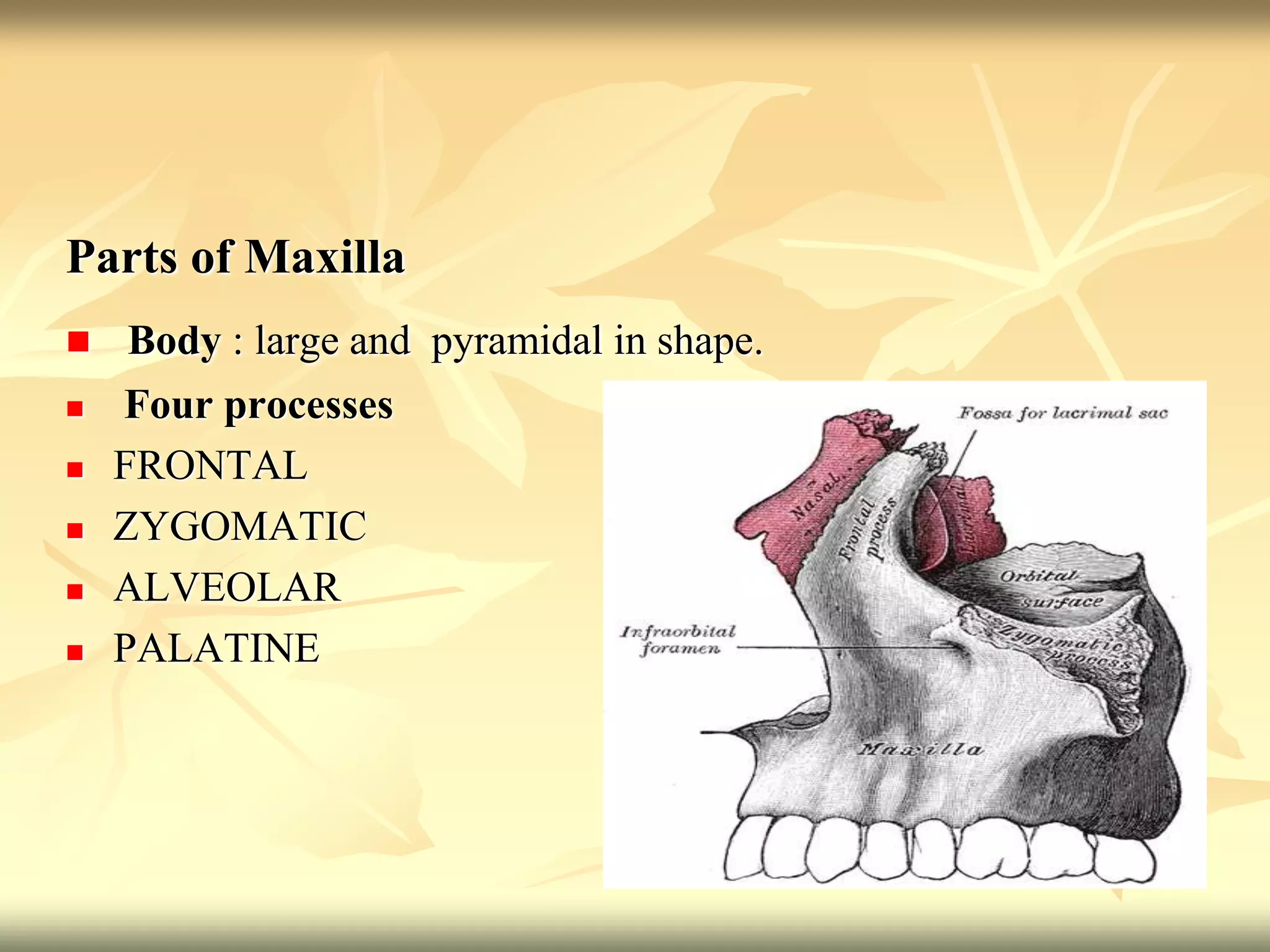
Parts of Maxilla
 Body : large and pyramidal in shape.
 Four processes
 FRONTAL
 ZYGOMATIC
 ALVEOLAR
 PALATINE
Maxillary sinus
Frontal process
Alveolar process
Maxilla –Medial View
Maxillary process [palatine]
Horizontal plate of palatine
Palatine process[maxilla]
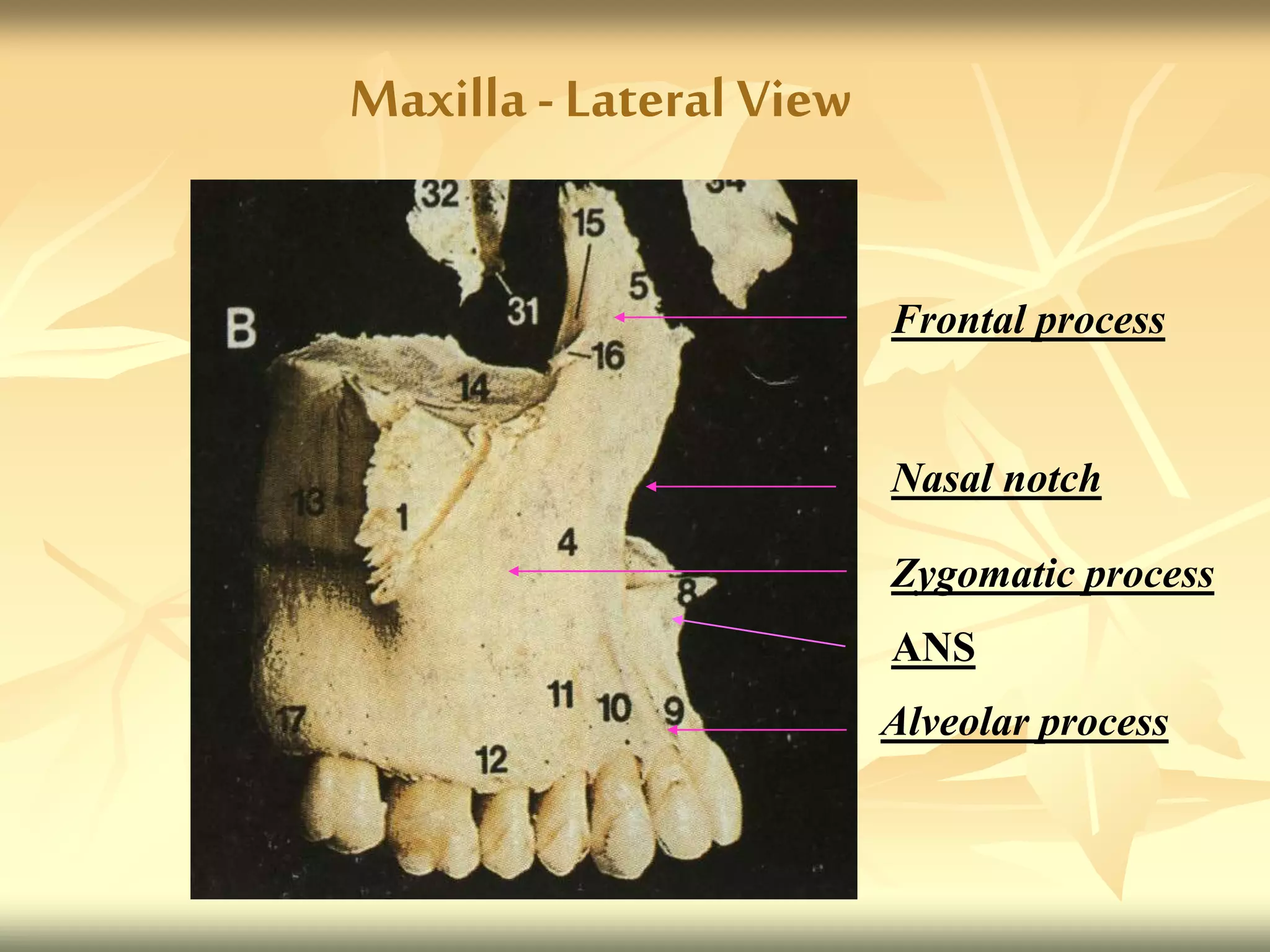
Nasal notch
ANS
Alveolar process
Maxilla -Lateral View
Frontal process
Zygomatic process
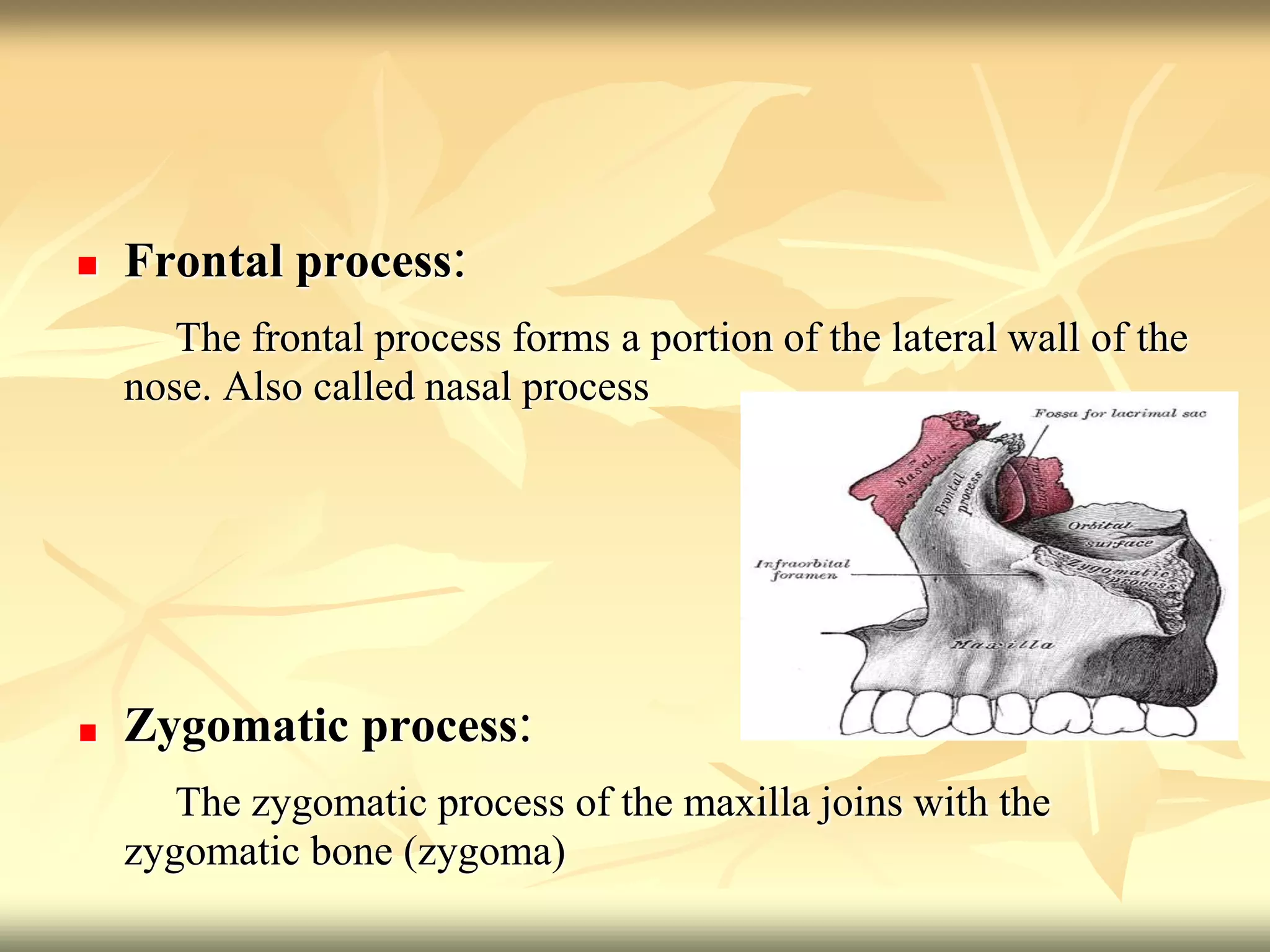
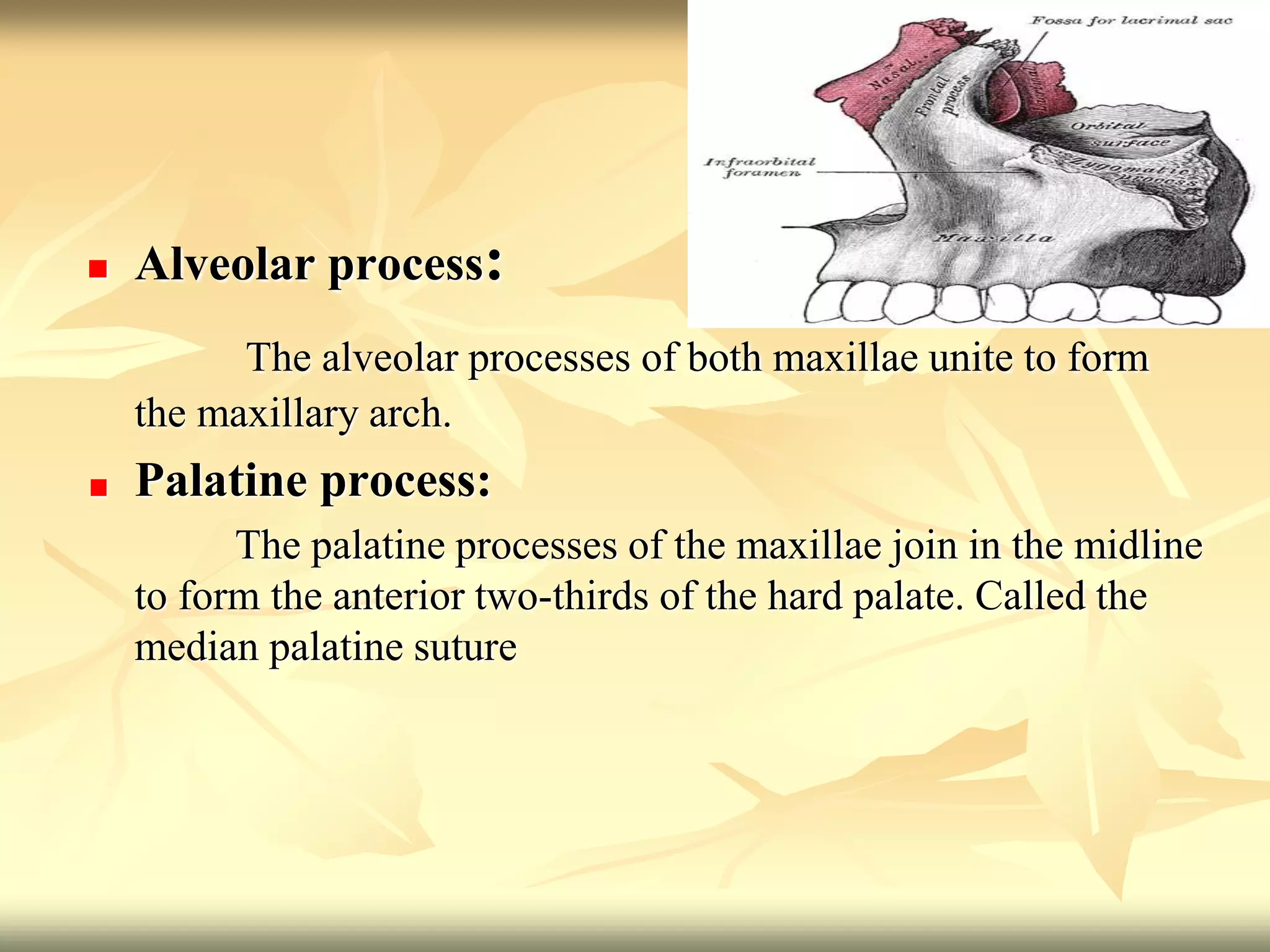
 Frontal process:
The frontal process forms a portion of the lateral wall of the
nose. Also called nasal process
Zygomatic process:
The zygomatic process of the maxilla joins with the
zygomatic bone (zygoma)
 Alveolar process:
The alveolar processes of both maxillae unite to form
the maxillary arch.
Palatine process:
The palatine processes of the maxillae join in the midline
to form the anterior two-thirds of the hard palate. Called the
median palatine suture
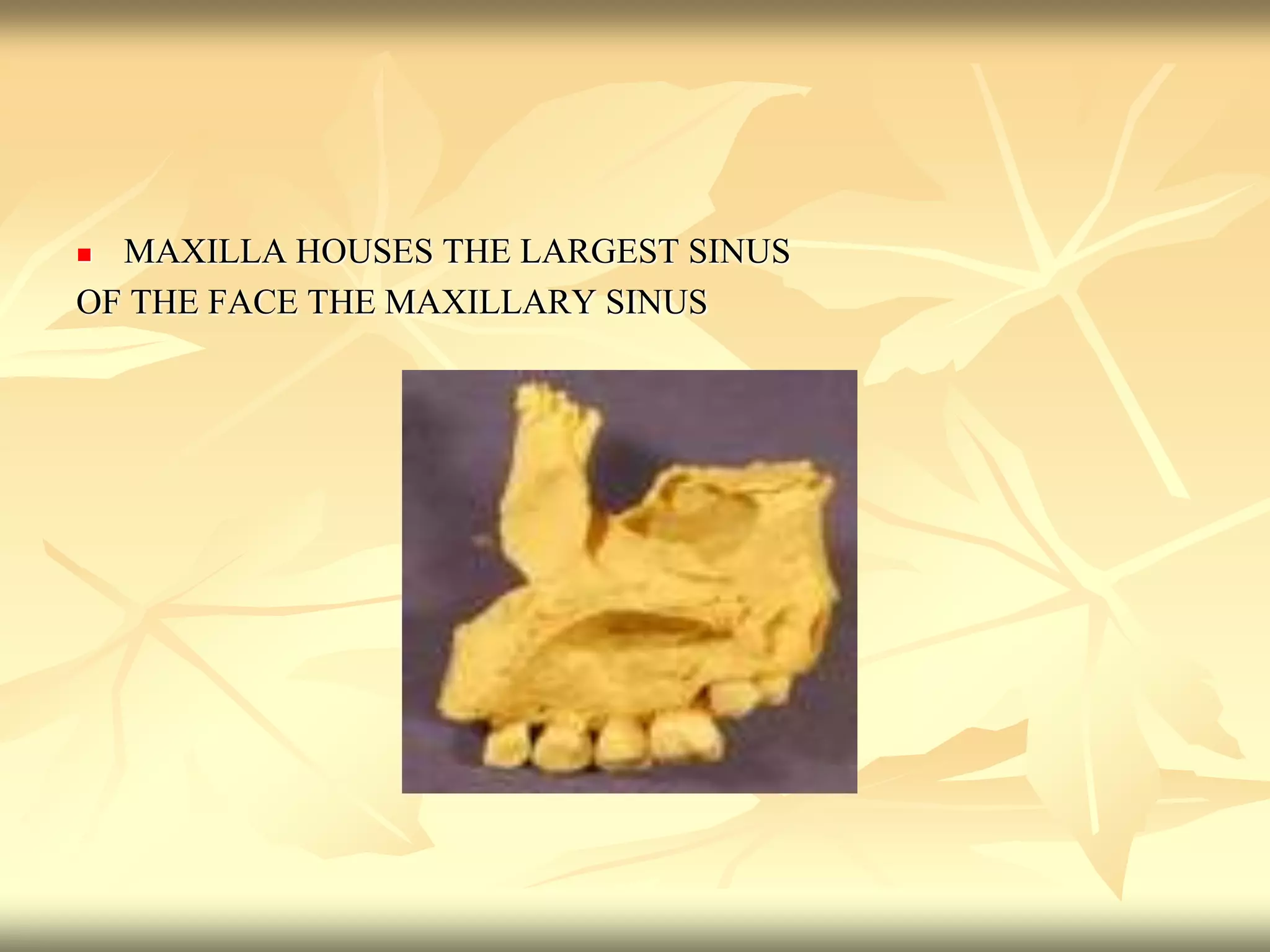
 MAXILLA HOUSES THE LARGEST SINUS
OF THE FACE THE MAXILLARY SINUS
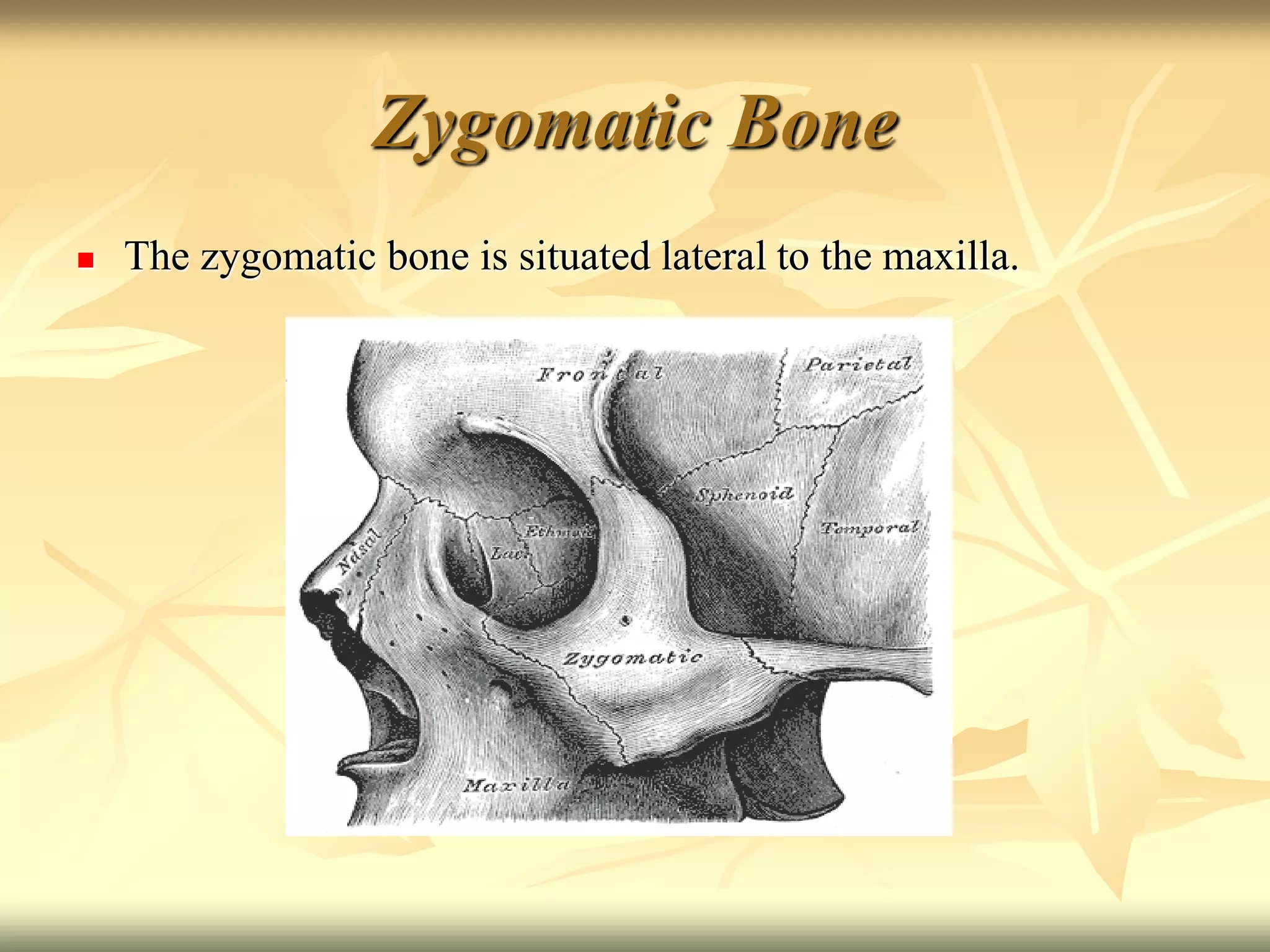
Zygomatic Bone
 The zygomatic bone is situated lateral to the maxilla.
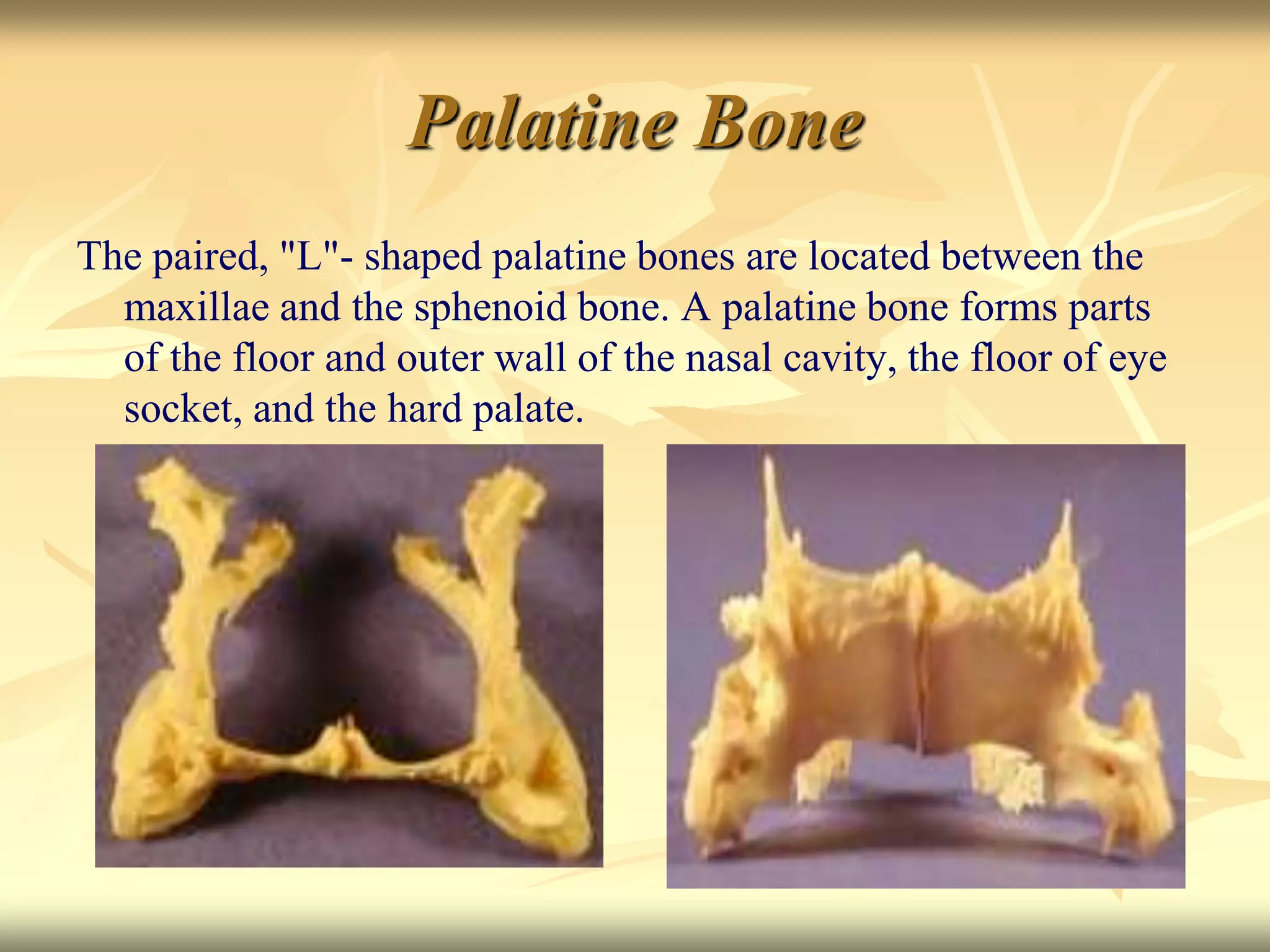
Palatine Bone
The paired, "L"- shaped palatine bones are located between the
maxillae and the sphenoid bone. A palatine bone forms parts
of the floor and outer wall of the nasal cavity, the floor of eye
socket, and the hard palate.
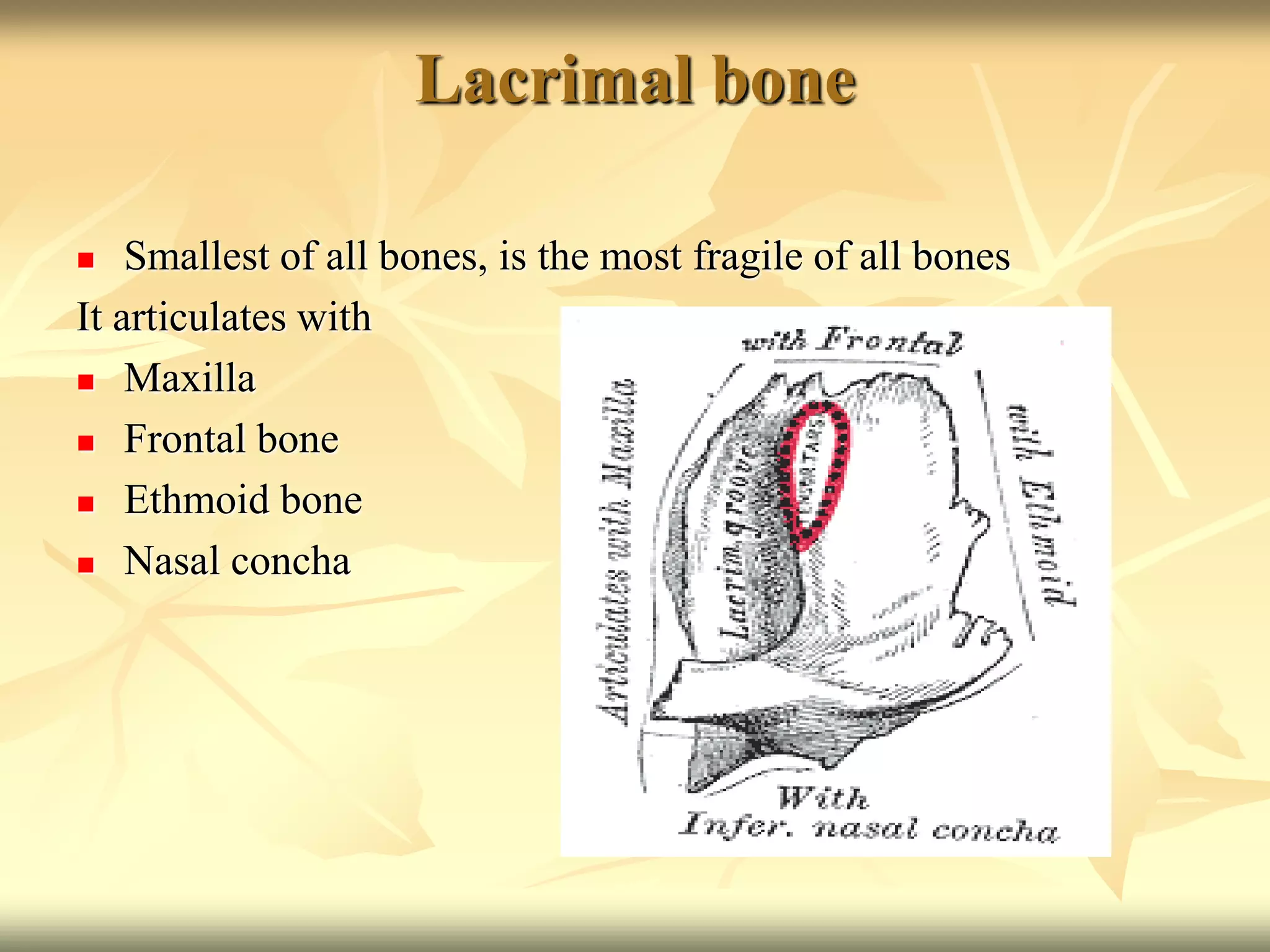
Lacrimal bone
 Smallest of all bones, is the most fragile of all bones
It articulates with
 Maxilla
 Frontal bone
 Ethmoid bone
 Nasal concha
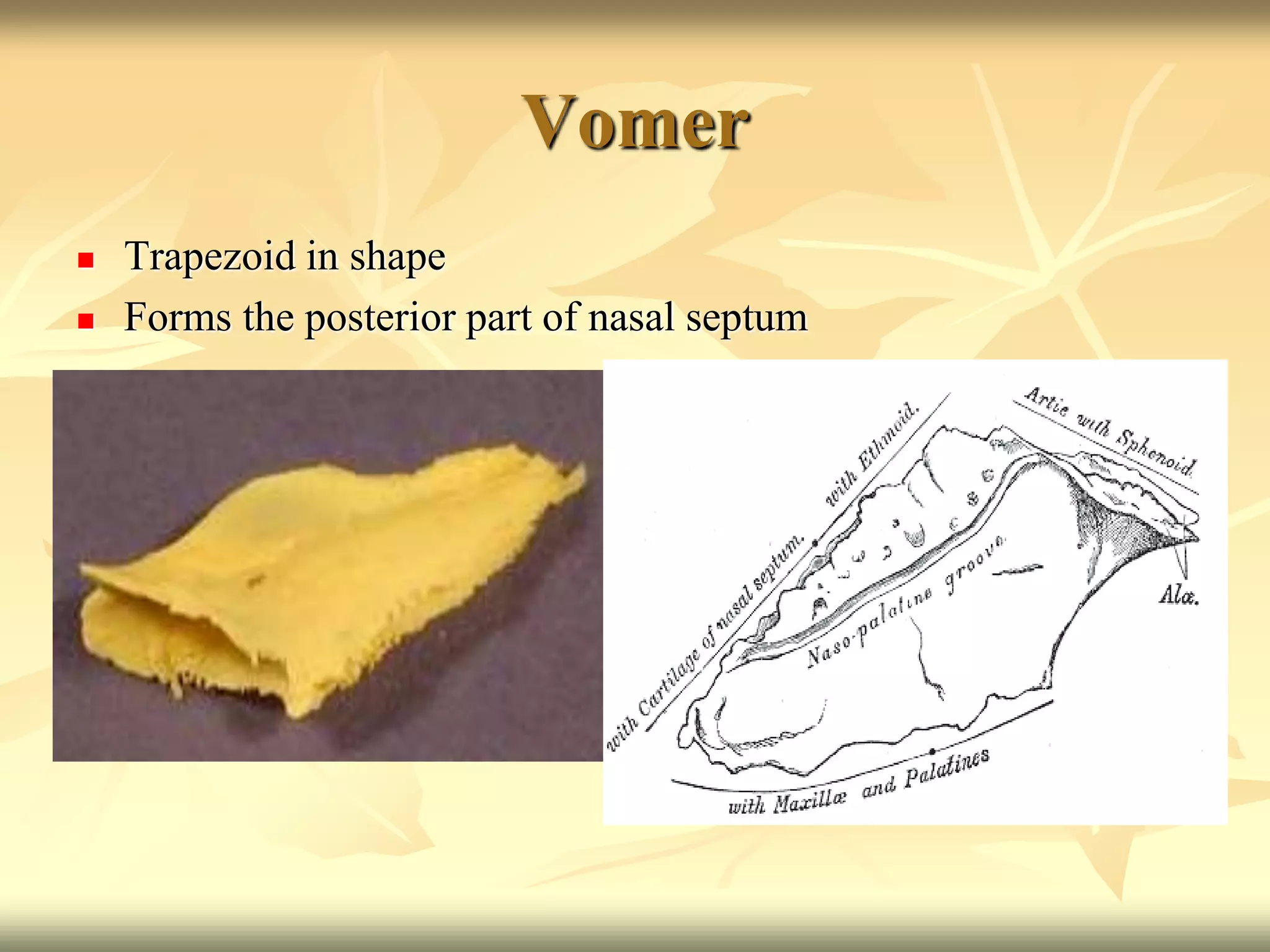
Vomer
 Trapezoid in shape
 Forms the posterior part of nasal septum
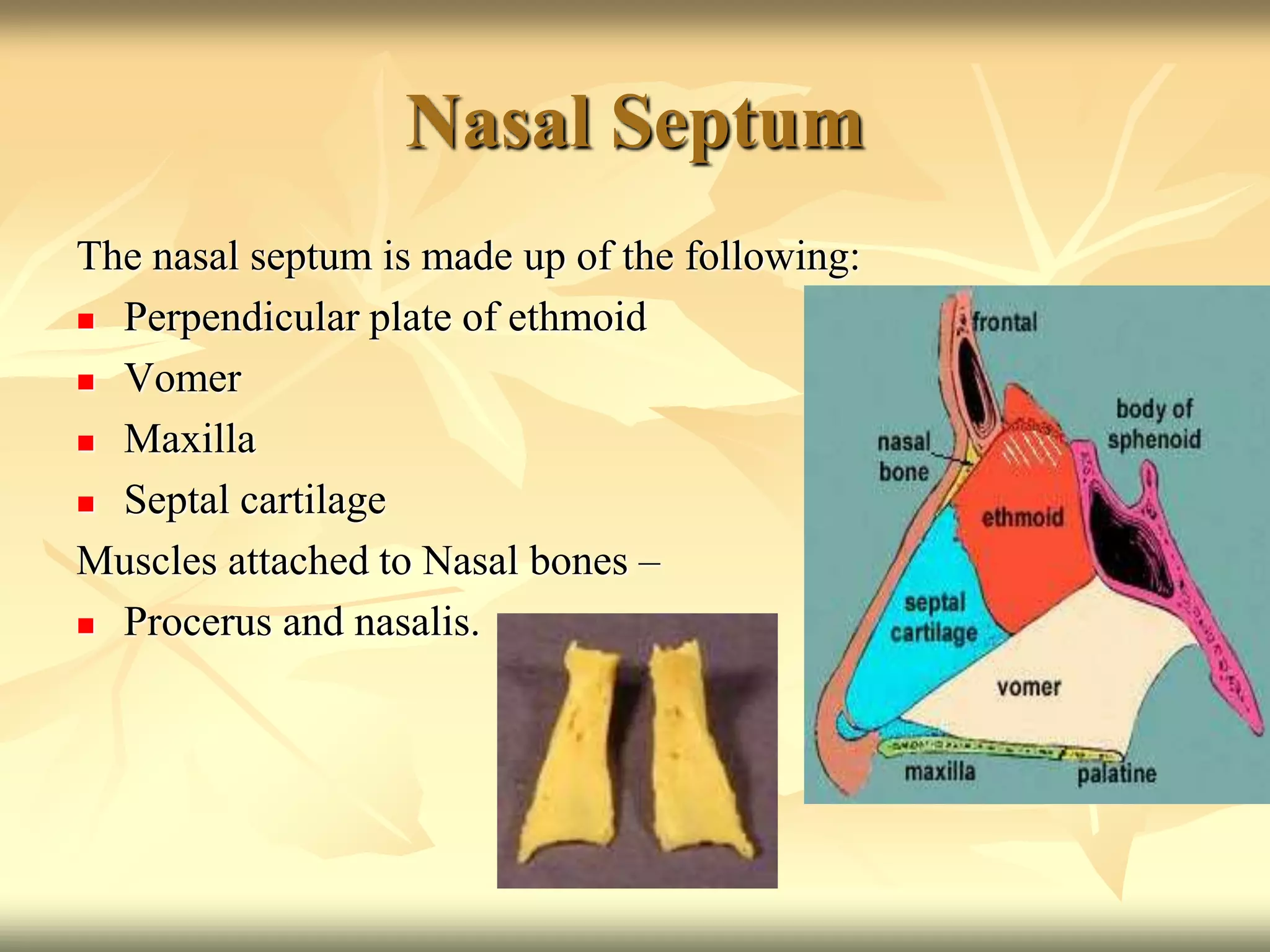
Nasal Septum
The nasal septum is made up of the following:
 Perpendicular plate of ethmoid
 Vomer
 Maxilla
 Septal cartilage
Muscles attached to Nasal bones –
 Procerus and nasalis.
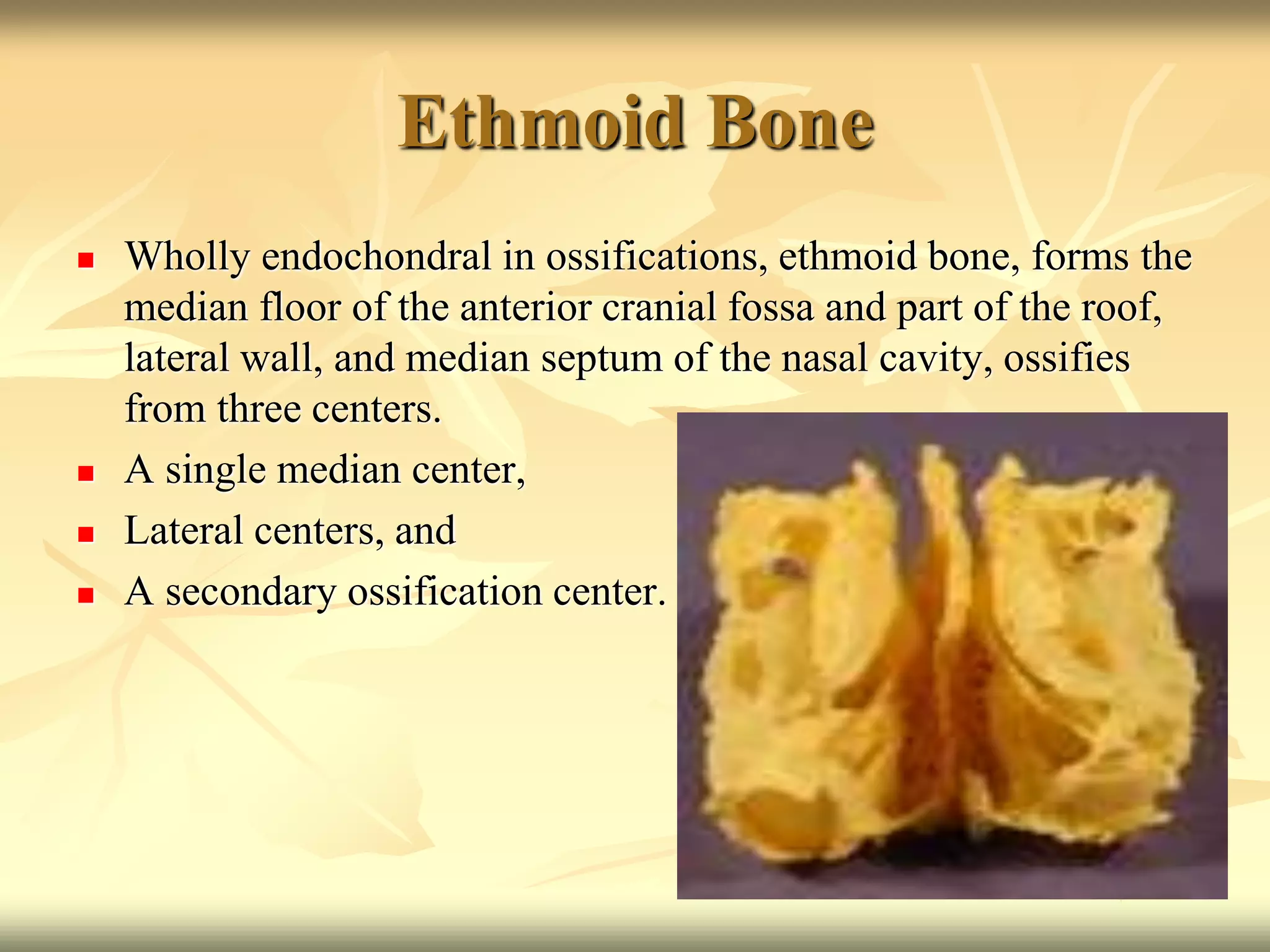
Ethmoid Bone
 Wholly endochondral in ossifications, ethmoid bone, forms the
median floor of the anterior cranial fossa and part of the roof,
lateral wall, and median septum of the nasal cavity, ossifies
from three centers.
 A single median center,
 Lateral centers, and
 A secondary ossification center.
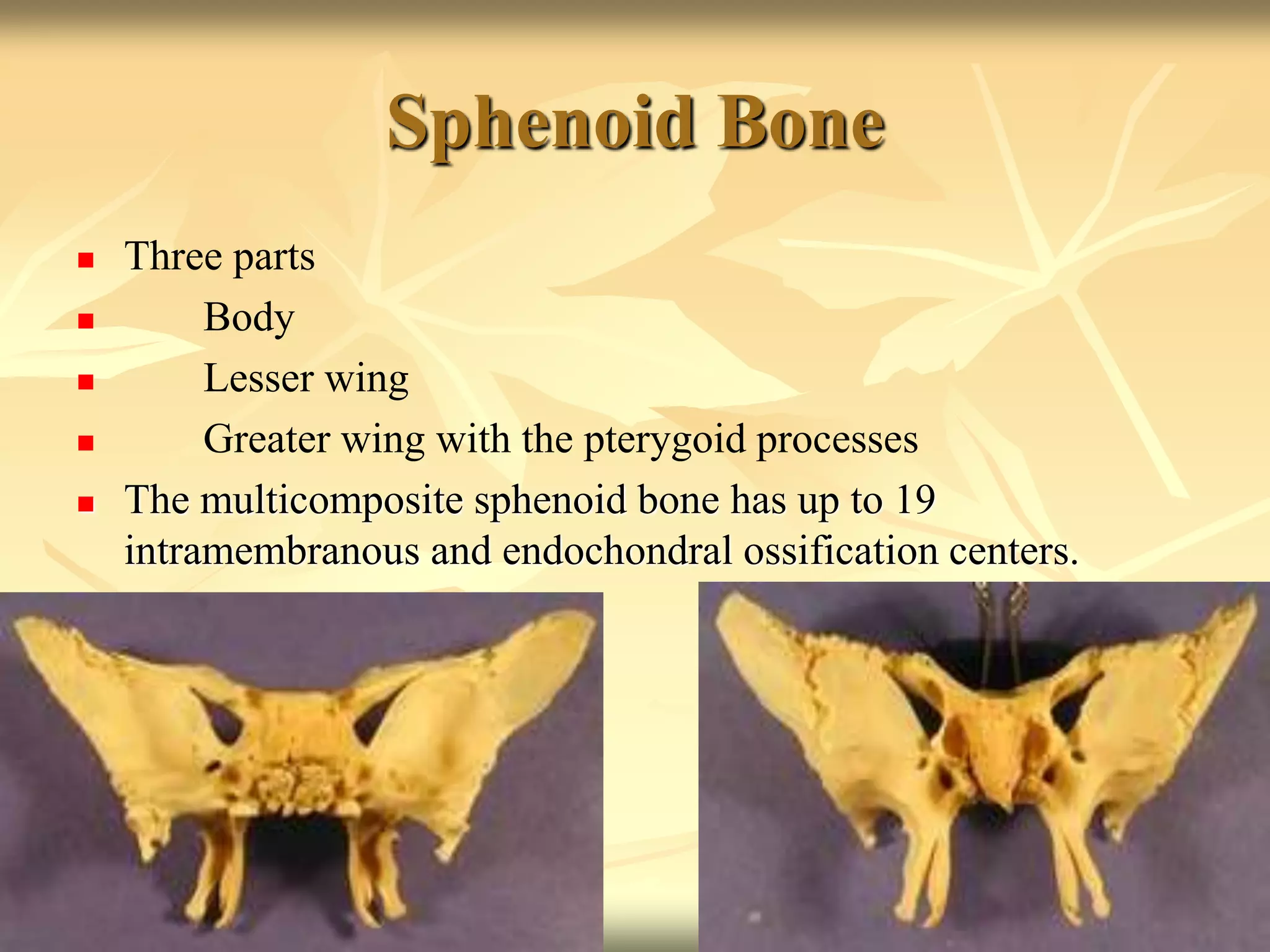
Sphenoid Bone
 Three parts
 Body
 Lesser wing
 Greater wing with the pterygoid processes
 The multicomposite sphenoid bone has up to 19
intramembranous and endochondral ossification centers.
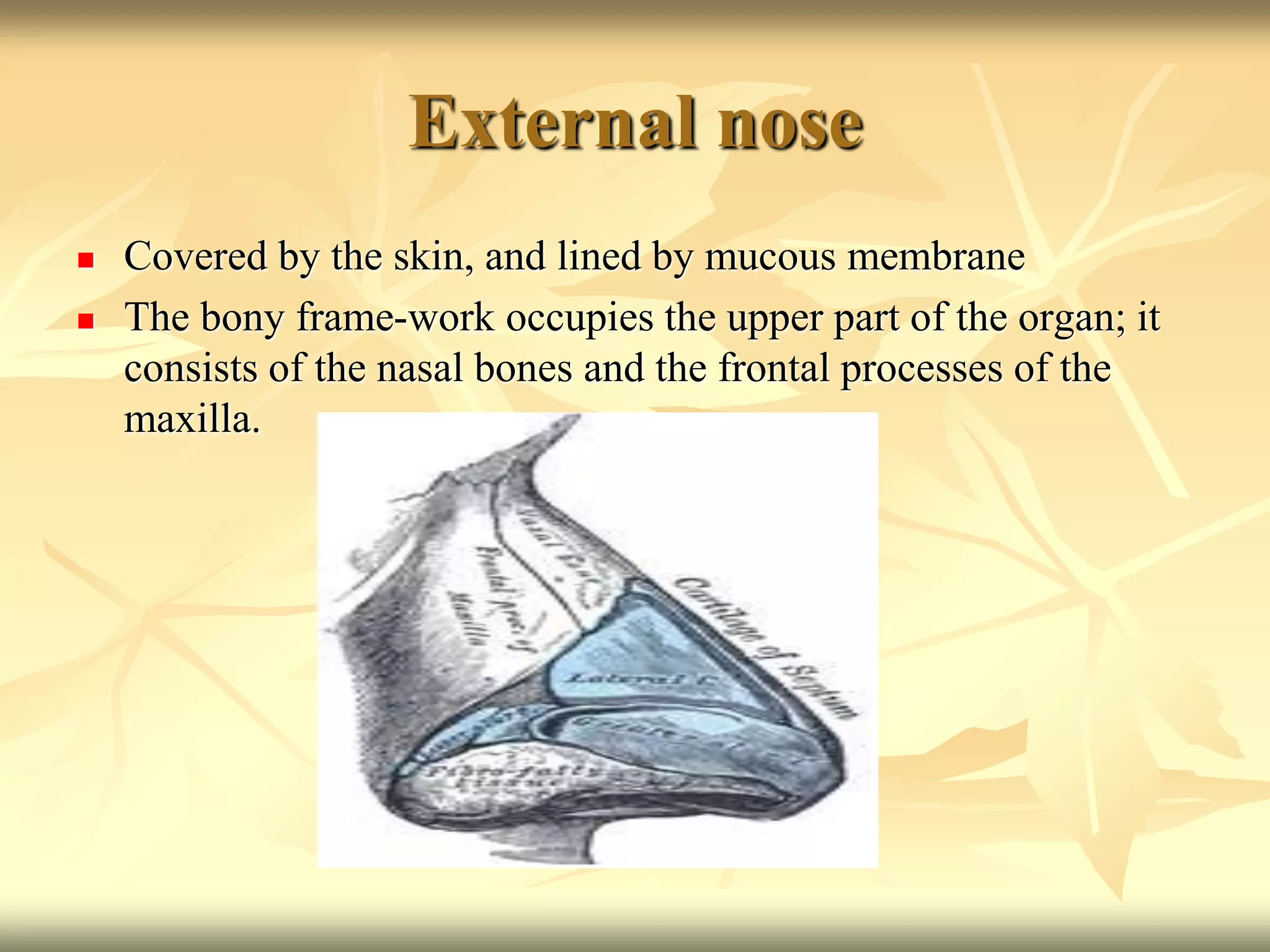
External nose
 Covered by the skin, and lined by mucous membrane
 The bony frame-work occupies the upper part of the organ; it
consists of the nasal bones and the frontal processes of the
maxilla.
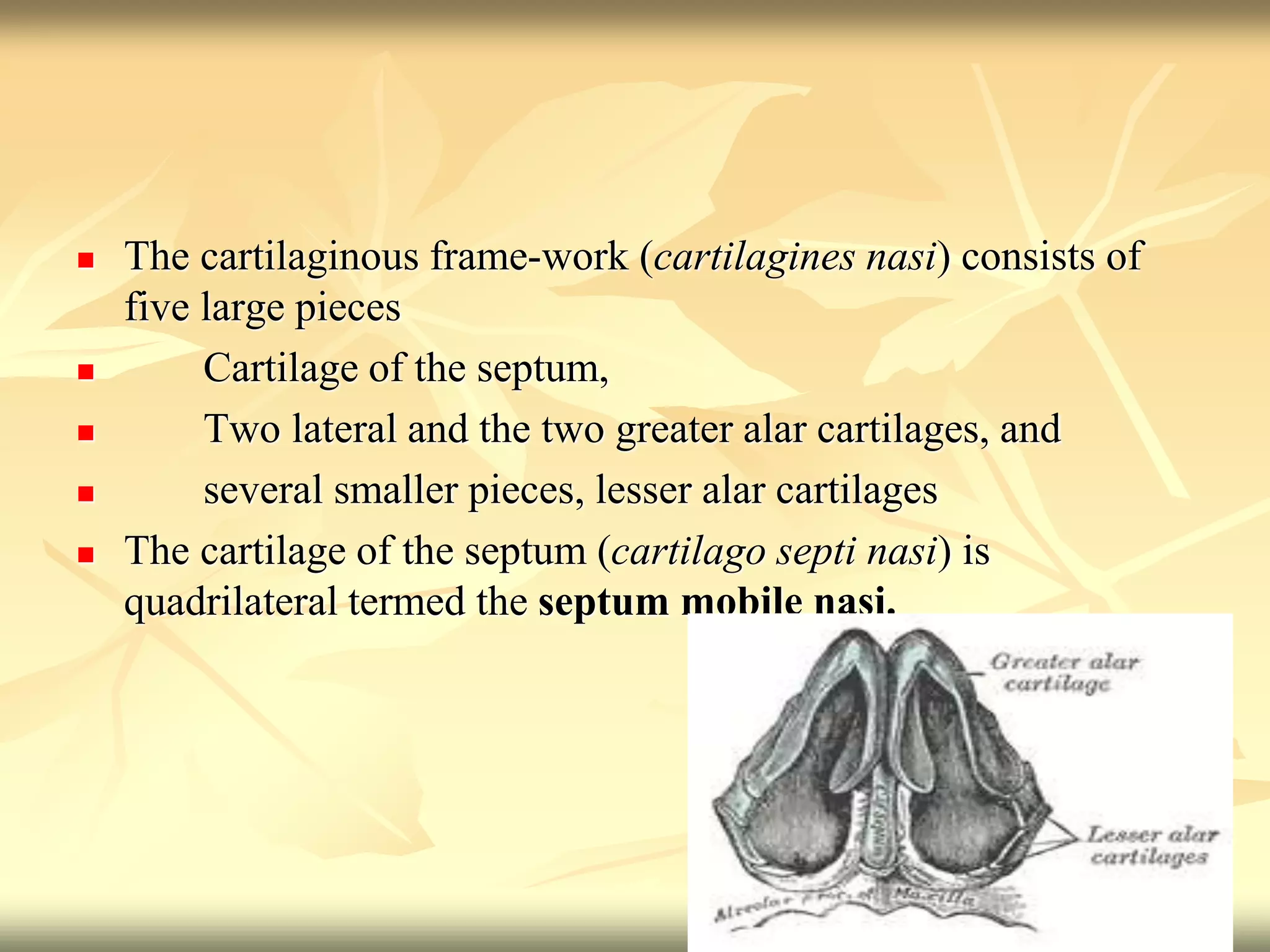
 The cartilaginous frame-work (cartilagines nasi) consists of
five large pieces
 Cartilage of the septum,
 Two lateral and the two greater alar cartilages, and
 several smaller pieces, lesser alar cartilages
 The cartilage of the septum (cartilago septi nasi) is
quadrilateral termed the septum mobile nasi.
Para nasal Sinuses
 They begin to develop at the end of 3rd month post
conception.
 Primary Pneumatisation :The early paranasal sinuses expand
into the cartilage walls and roof of the nasal fossae by growth
of mucous membrane sacs, this is Primary Pneumatisation.
 Secondary Pneumatization :The sinuses enlarge into bone
retaining communication with the nasal fossae through Ostia,
this is called Secondary Pneumatization.
Maxillary sinus
 Pyramidal in shape. The maxillary sinus enlarges slightly
faster than overall maxilla, by bone resorption of the maxillary
internal walls
Frontal sinus
 Present behind the superciliary arches
Average measurements are :
 Height, 3 cm, Breadth, 2.5 cm
 Depth , 2.5 cm
 Opens into middle meatus of the nose through the Frontonasal
duct
 Absent at birth
 Reach their full size after puberty
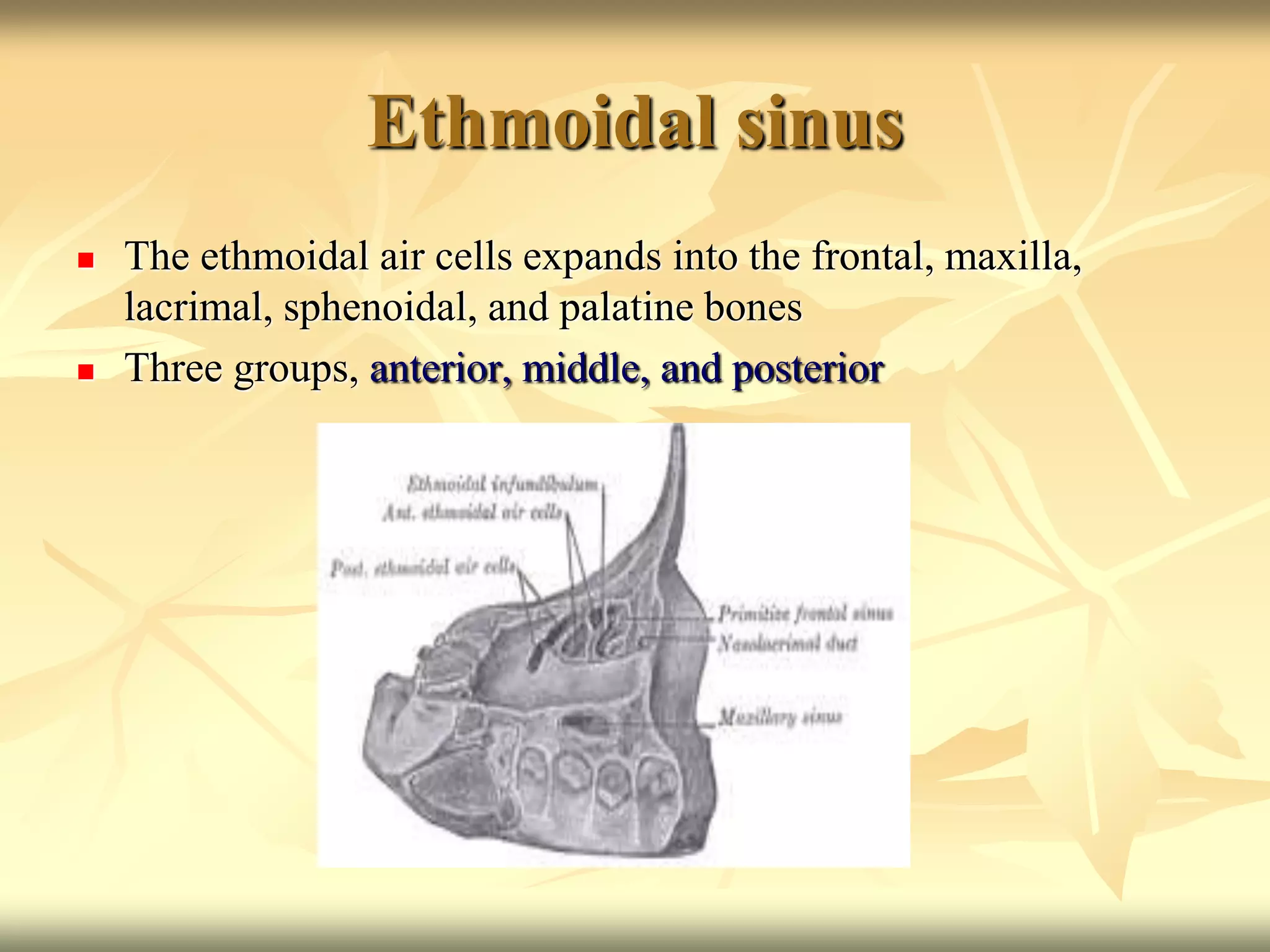
Ethmoidal sinus
 The ethmoidal air cells expands into the frontal, maxilla,
lacrimal, sphenoidal, and palatine bones
 Three groups, anterior, middle, and posterior
Sphenoidal sinus
 Communicates with the sphenoethmoidal recess
 Minute cavities at birth, start developing at 4th month i.u.
 Continues to grow in early adulthood.
 Average measurements→2 cm
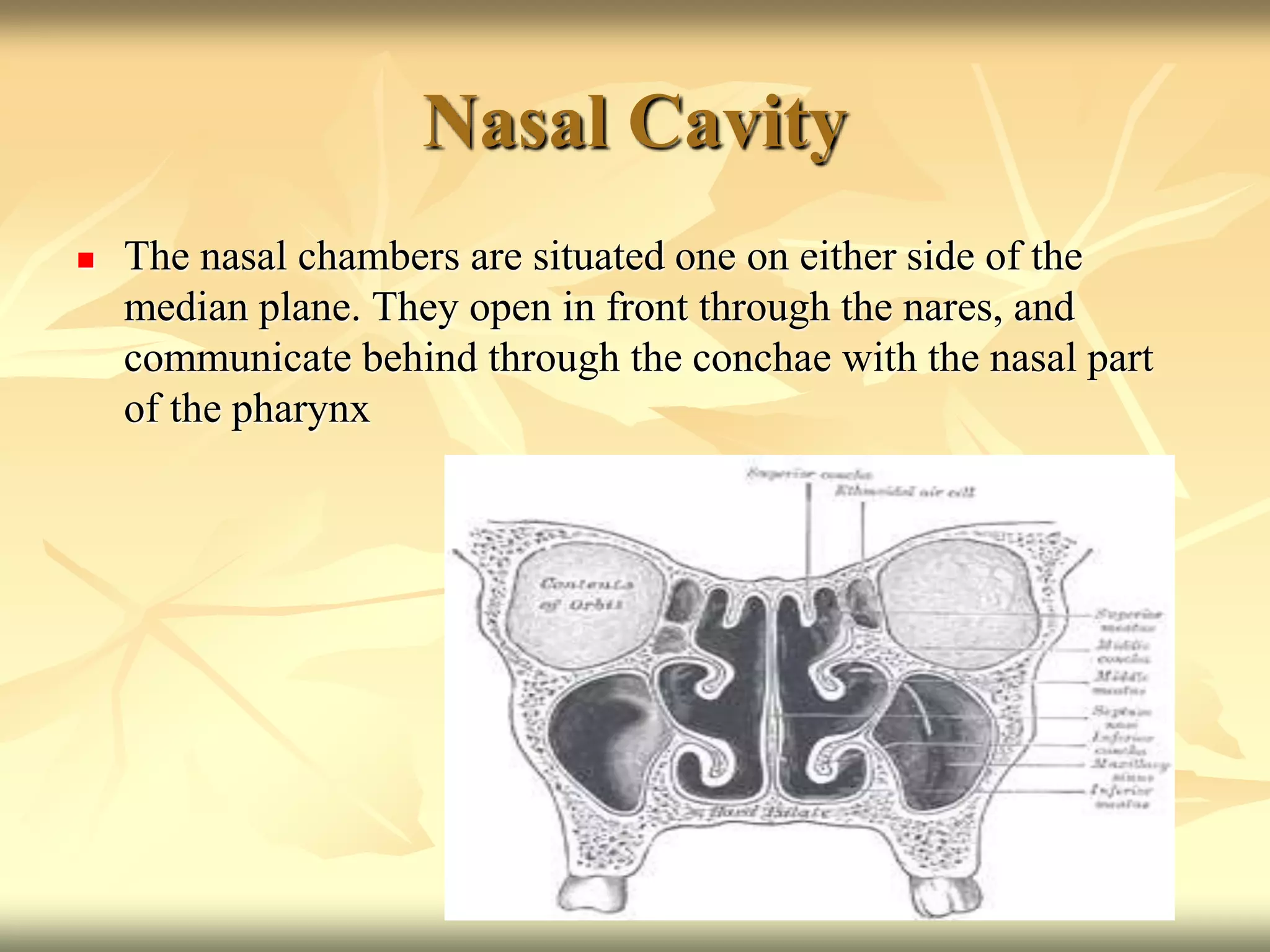
Nasal Cavity
 The nasal chambers are situated one on either side of the
median plane. They open in front through the nares, and
communicate behind through the conchae with the nasal part
of the pharynx
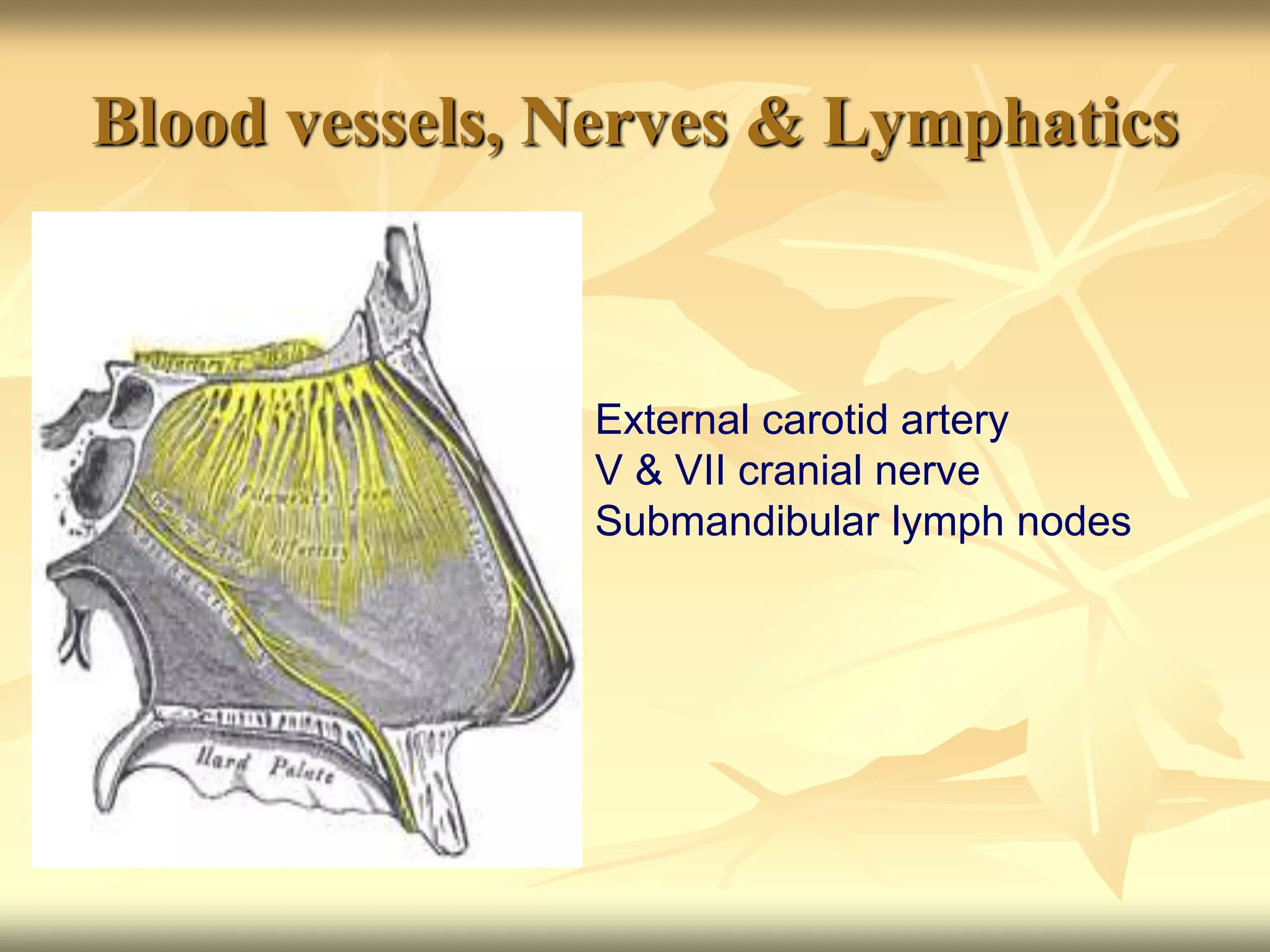
Blood vessels, Nerves & Lymphatics
External carotid artery
V & VII cranial nerve
Submandibular lymph nodes
Pre natal growth and
development
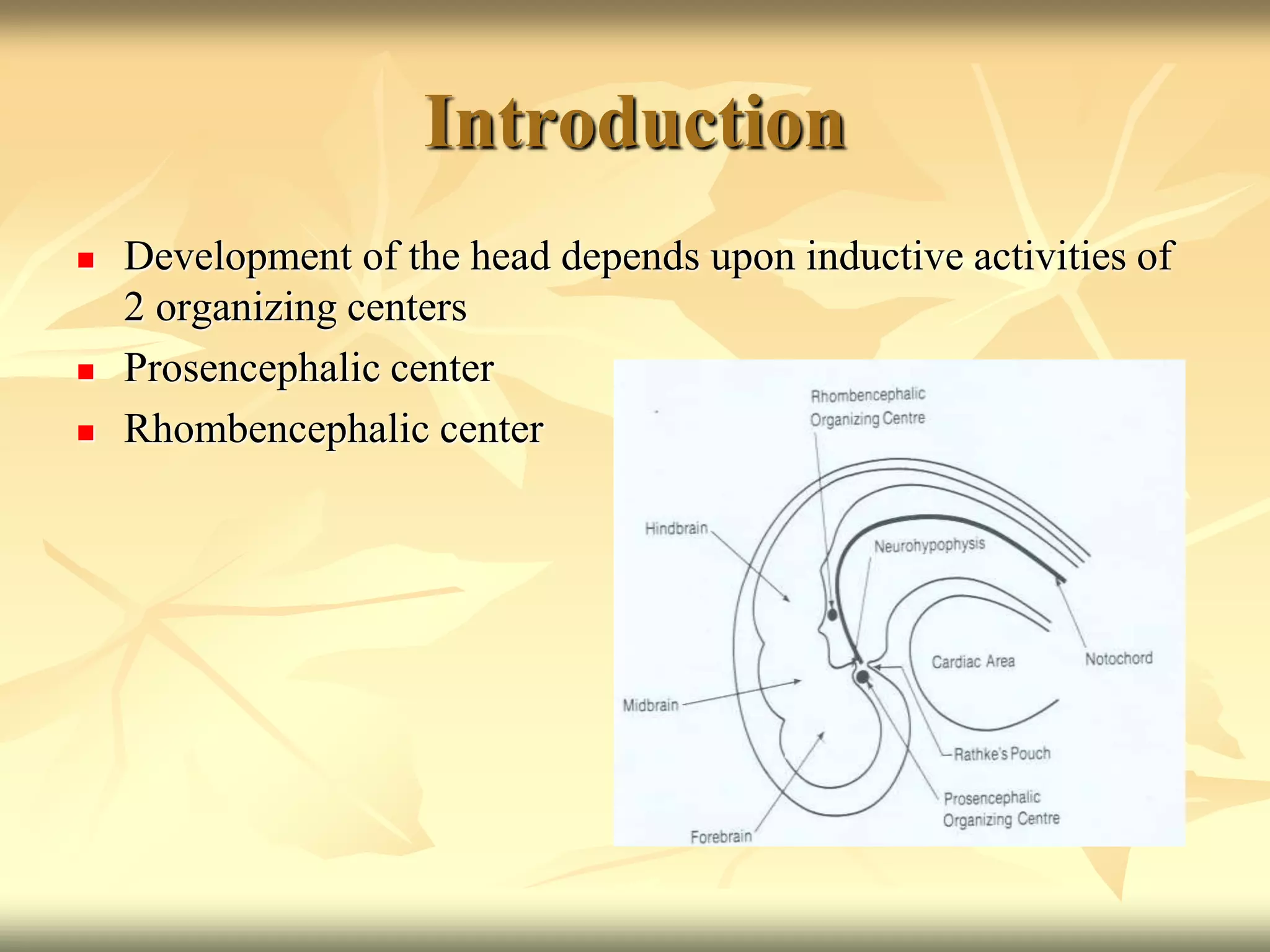
Introduction
 Development of the head depends upon inductive activities of
2 organizing centers
 Prosencephalic center
 Rhombencephalic center
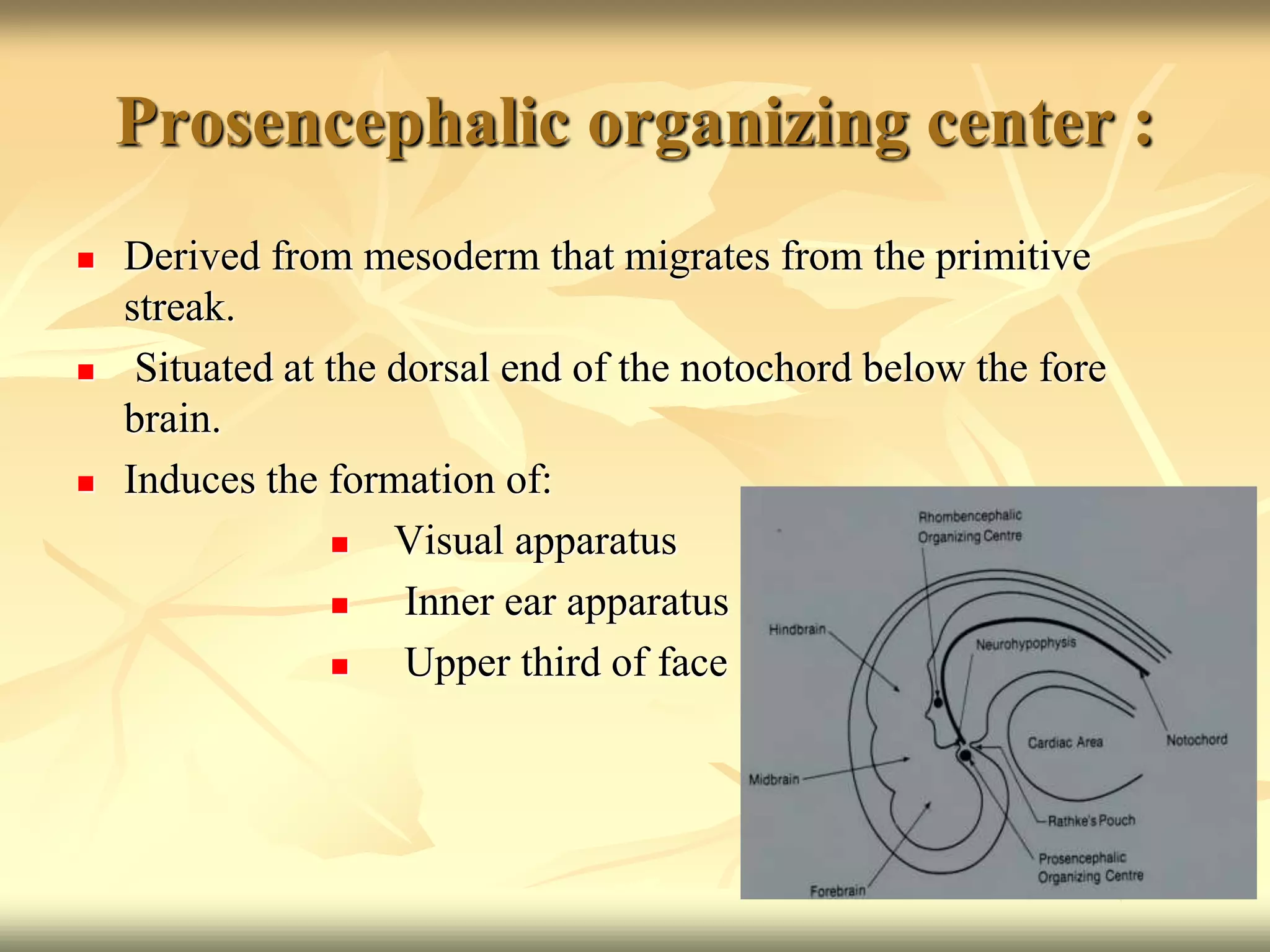
Prosencephalic organizing center :
 Derived from mesoderm that migrates from the primitive
streak.
 Situated at the dorsal end of the notochord below the fore
brain.
 Induces the formation of:
 Visual apparatus
 Inner ear apparatus
 Upper third of face
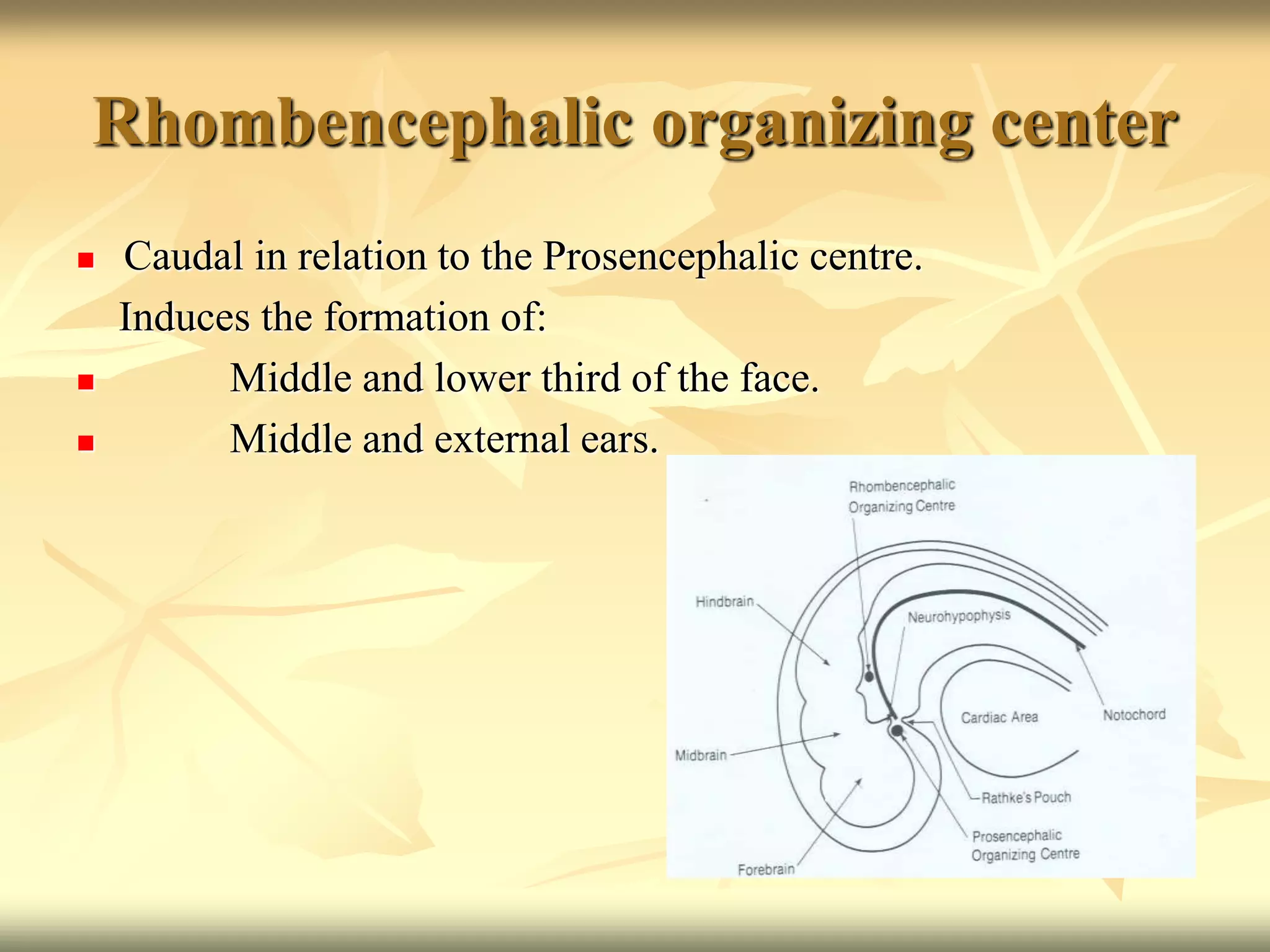
Rhombencephalic organizing center
 Caudal in relation to the Prosencephalic centre.
Induces the formation of:
 Middle and lower third of the face.
 Middle and external ears.
 Oral development in embryo is demarcated extremely early in
life by the appearance of the prechordal plate (14th day).
 The endodermal thickening of the prechordal plate designate
the cranial pole of the oval embroyonic disk.
 Later it contributes to the oropharyngeal membrane
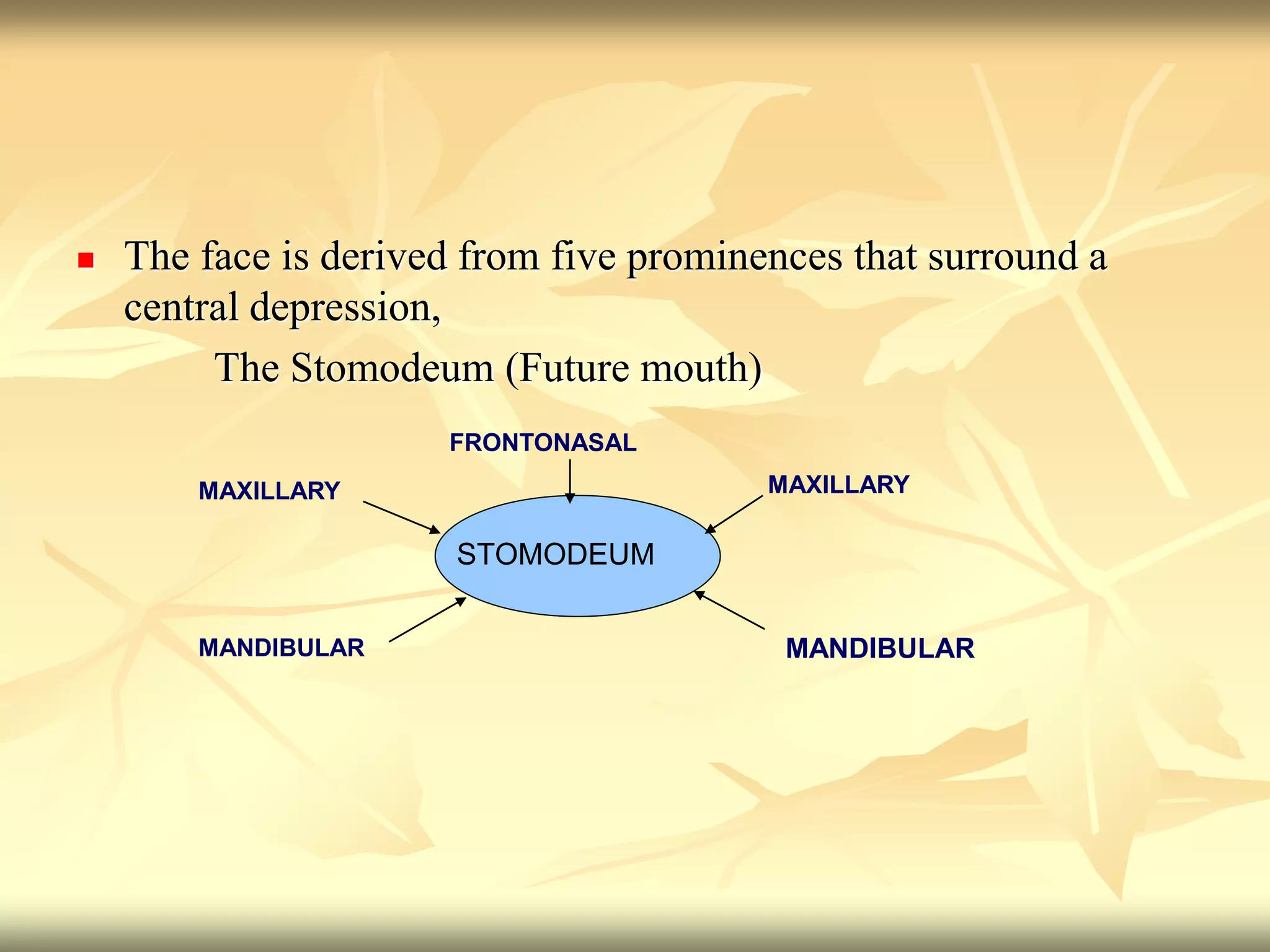
 The face is derived from five prominences that surround a
central depression,
The Stomodeum (Future mouth)
STOMODEUM
FRONTONASAL
MAXILLARY
MAXILLARY
MANDIBULAR MANDIBULAR
Face
 Upper 1/3rd is formed by the Frontonasal process
 Middle1/3rd is formed by the Maxillary process
 Lower1/3rd is formed by the Mandibular process
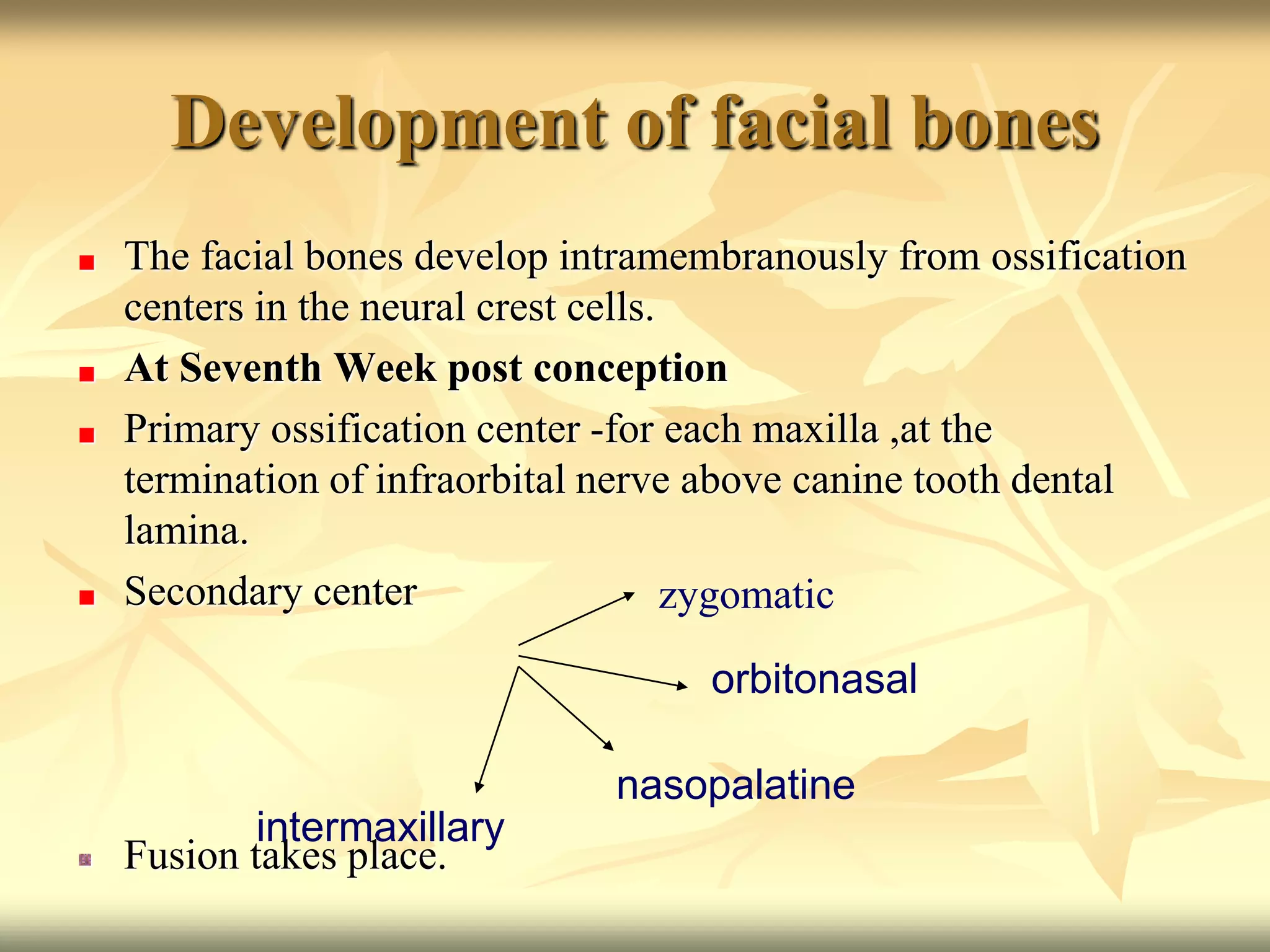
Development of facial bones
The facial bones develop intramembranously from ossification
centers in the neural crest cells.
At Seventh Week post conception
Primary ossification center -for each maxilla ,at the
termination of infraorbital nerve above canine tooth dental
lamina.
Secondary center
Fusion takes place.
zygomatic
orbitonasal
nasopalatine
intermaxillary
 8th week post conception →the medial Pterygoid plates of
the sphenoid bone
↓
 the greater wing and the lateral Pterygoid plate
↓
 fusion of medial and lateral Pterygoid plates
takes place in the 5th month post conception.
 8th week post conception
↓
 nasal and lacrimal bones , palatine bones , vomer , zygomatic
bones and squamous portions of temporal bones
Twelfth Week
Anteroposterior maxillo- mandibular relationship approaches
that of newborn infant
Maxilla increases in height
Growth and development of
palate
The palate develops from:
 Formation of primary and secondary palate
 Elevation of palatal shelves
 Fusion of palatal shelves
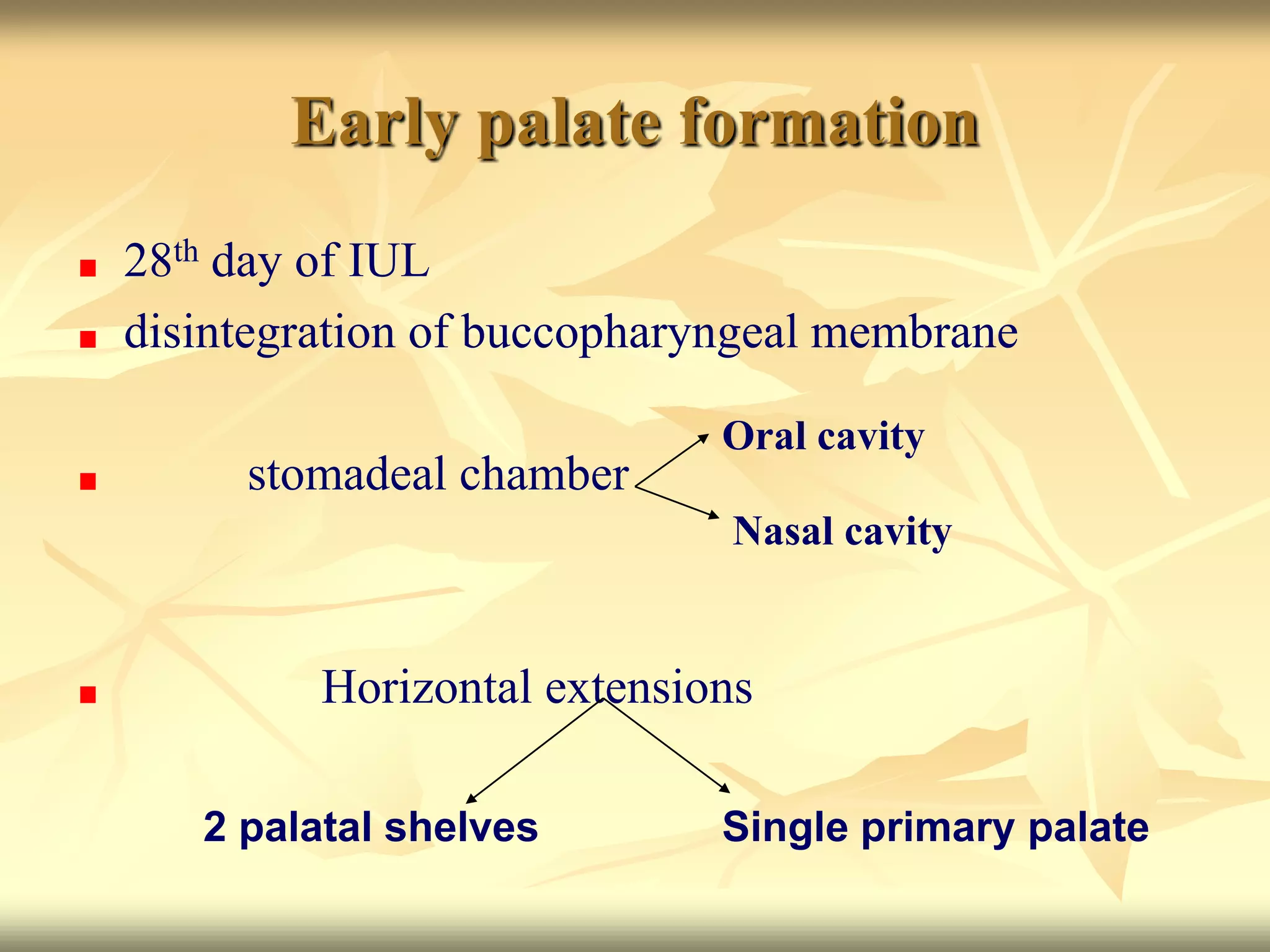
Early palate formation
28th day of IUL
disintegration of buccopharyngeal membrane
stomadeal chamber
Horizontal extensions
Oral cavity
Nasal cavity
2 palatal shelves Single primary palate
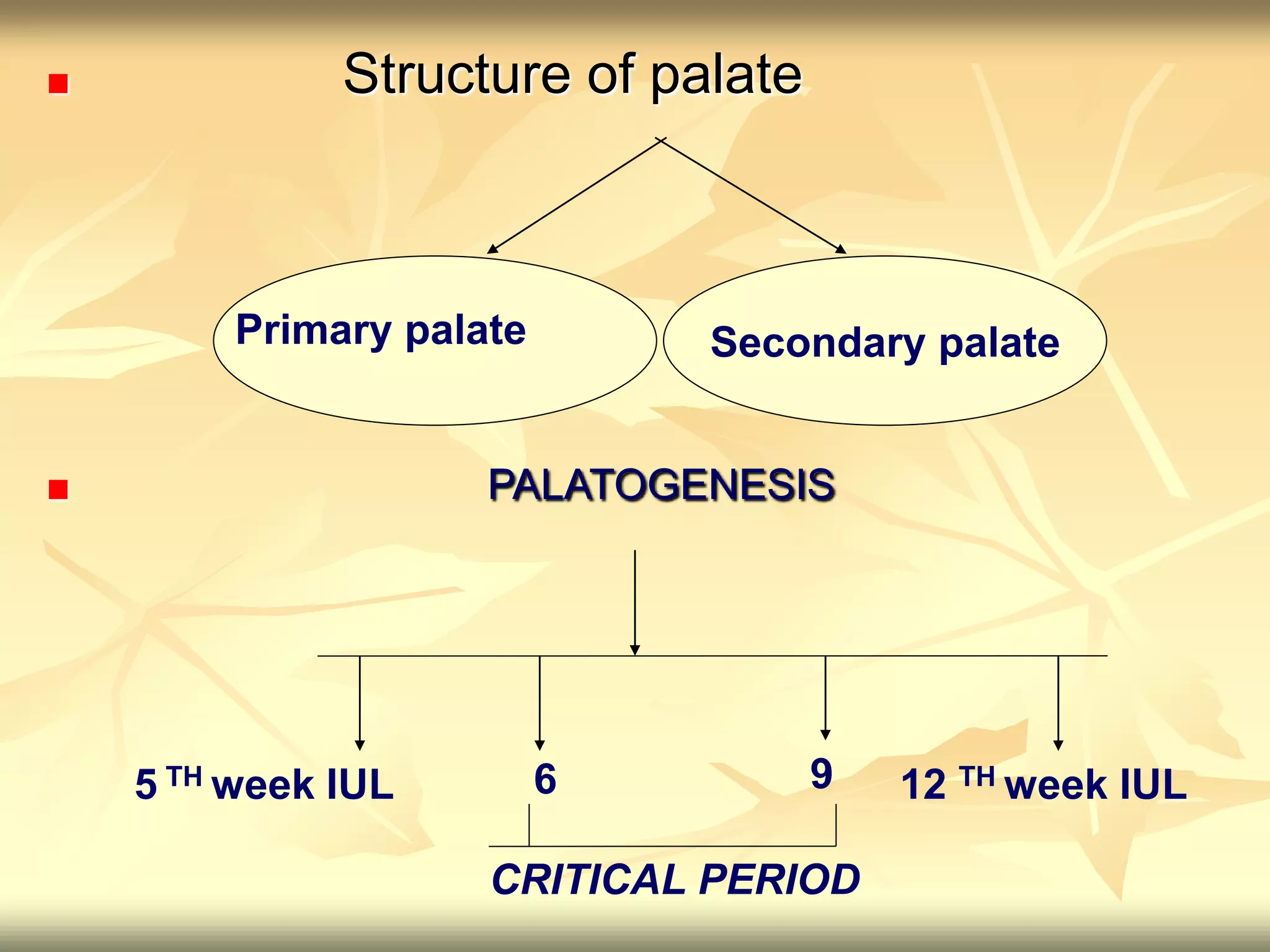
Structure of palate
PALATOGENESIS
Secondary palate
Primary palate
5 TH week IUL 12 TH week IUL
6 9
CRITICAL PERIOD
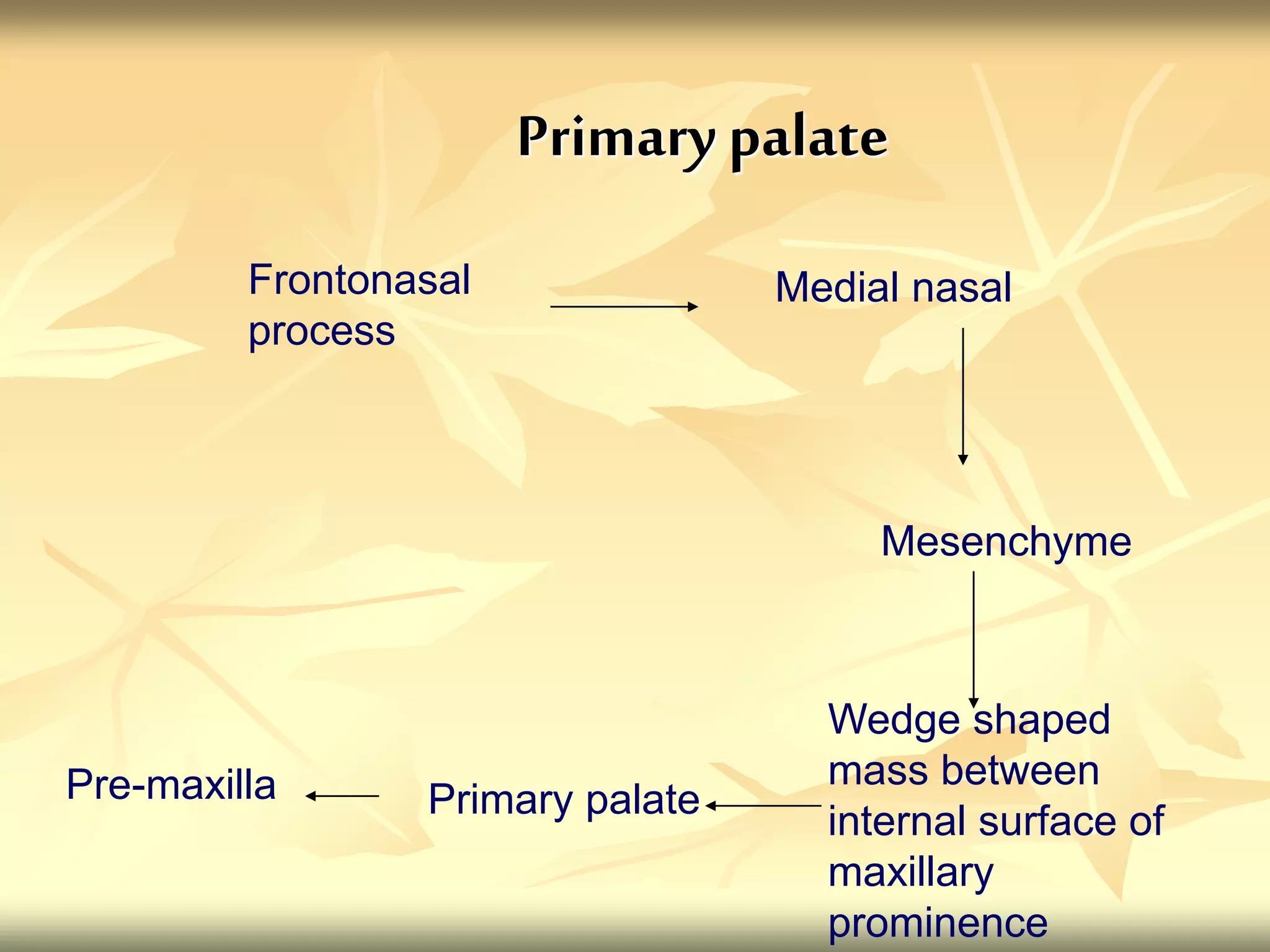
Primary palate
Frontonasal
process
Medial nasal
Mesenchyme
Wedge shaped
mass between
internal surface of
maxillary
prominence
Primary palate
Pre-maxilla
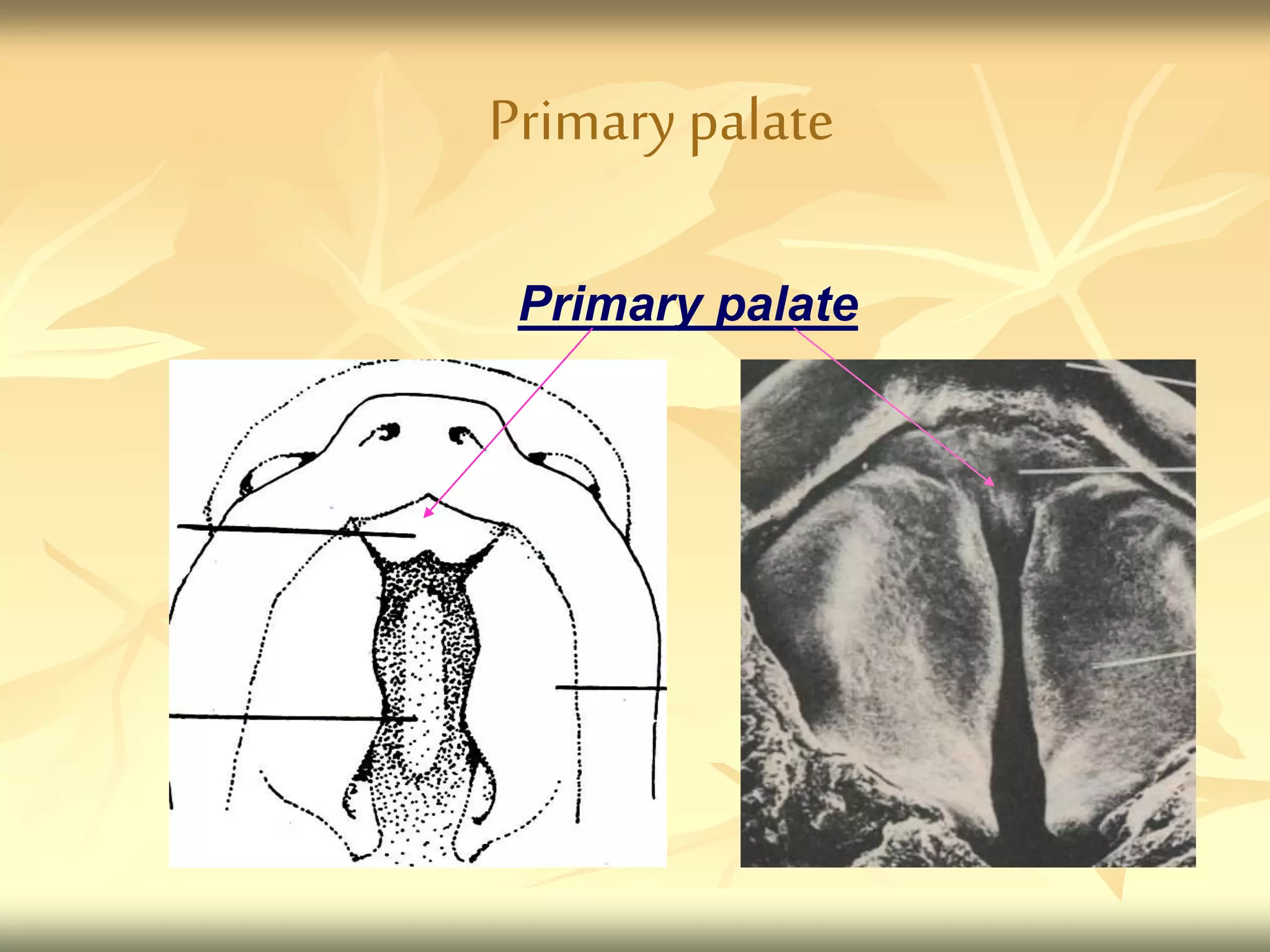
Primary palate
Primary palate
Secondarypalate
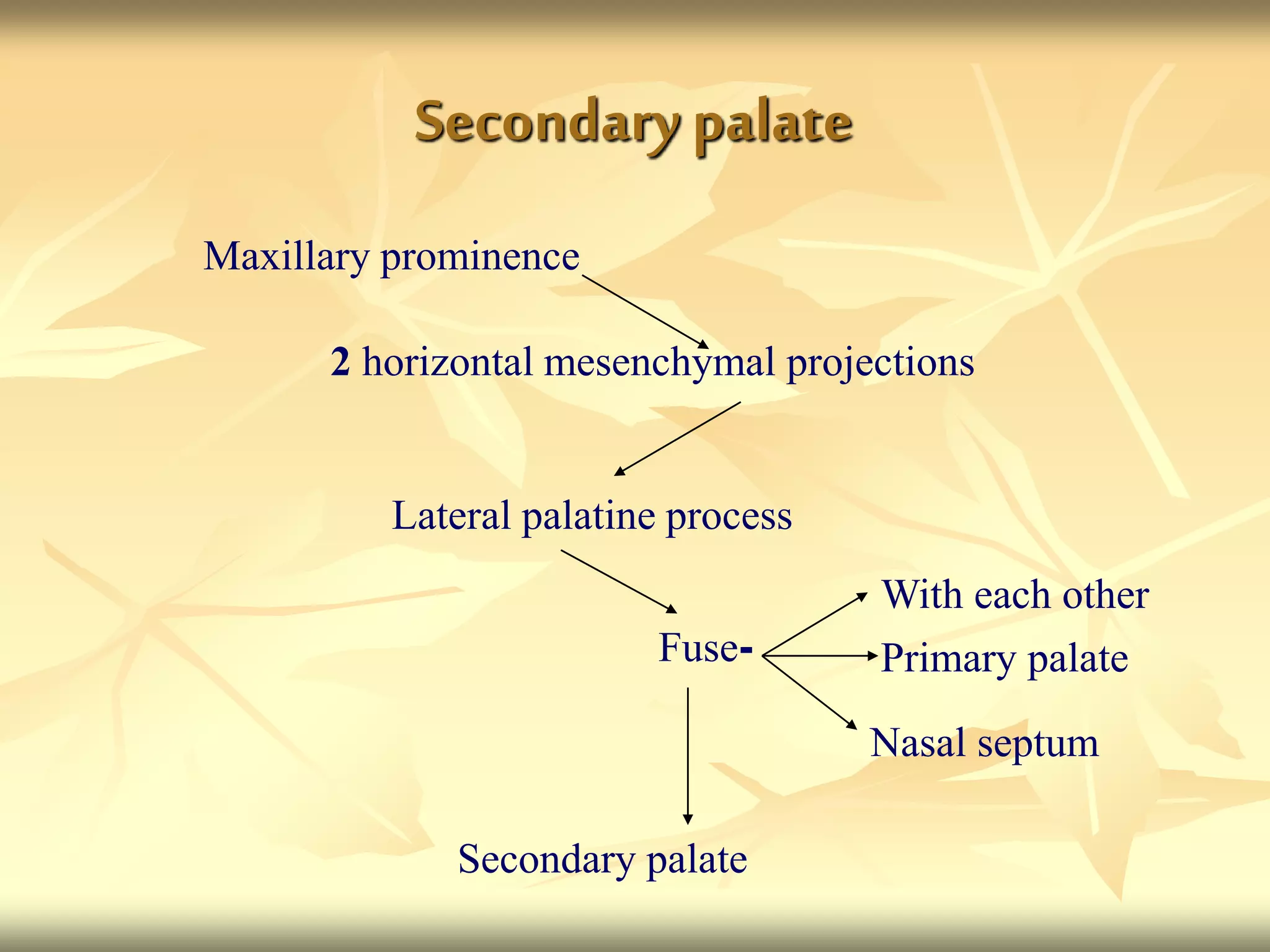
Maxillary prominence
Lateral palatine process
Fuse-
With each other
Primary palate
Nasal septum
Secondary palate
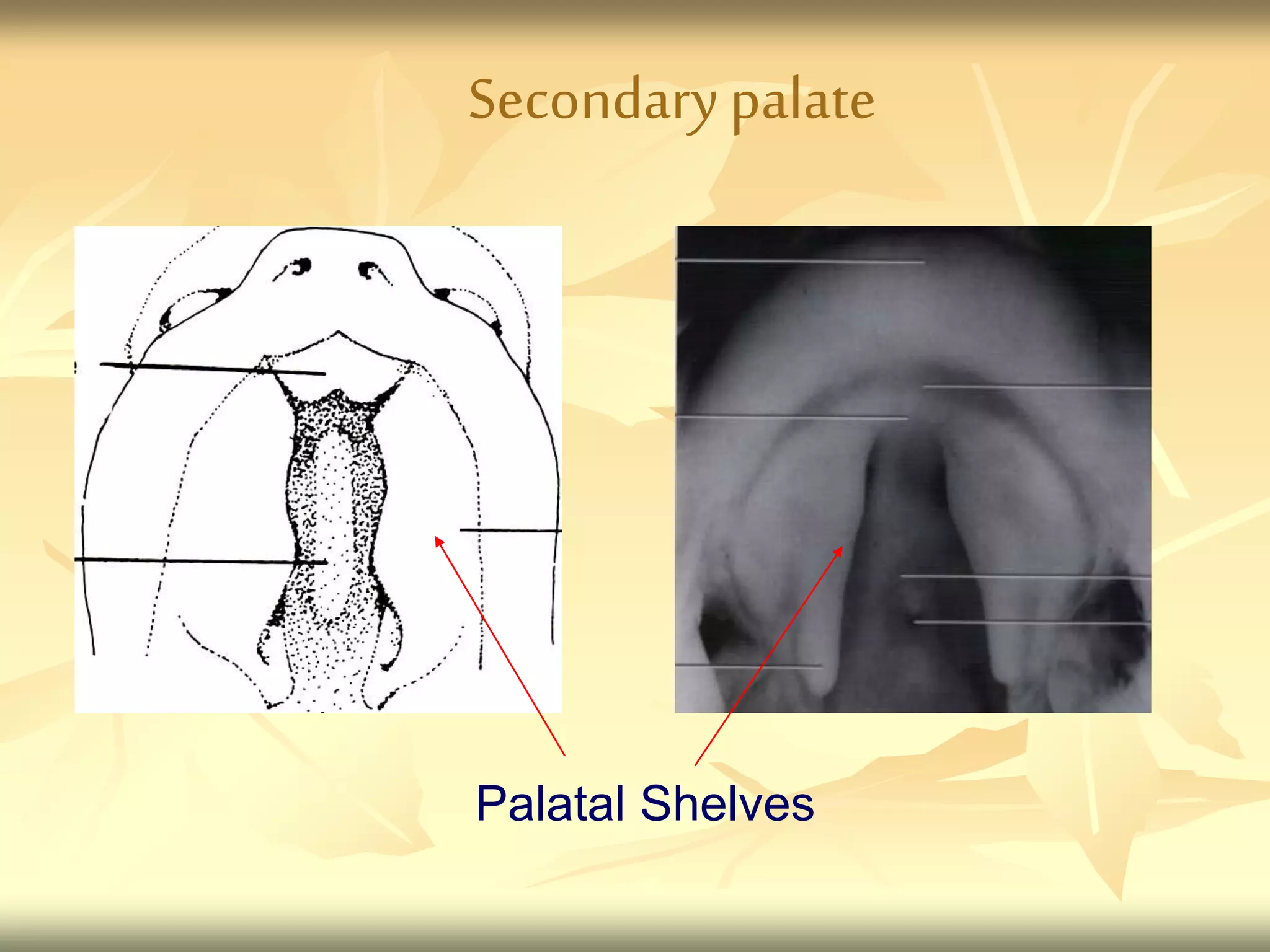
2 horizontal mesenchymal projections
Secondarypalate
Palatal Shelves
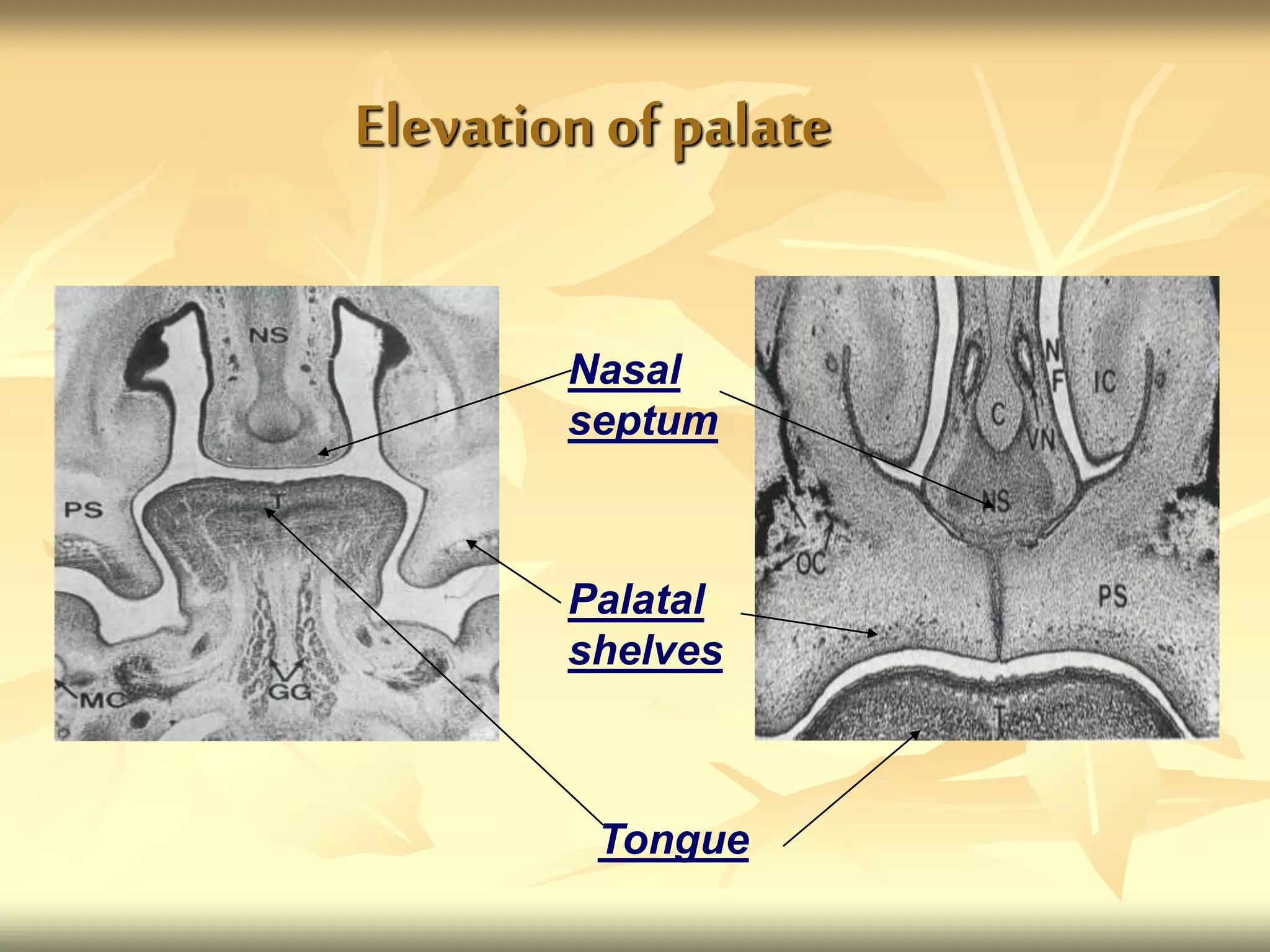
Elevation of palate
Nasal
septum
Palatal
shelves
Tongue
At 8 weeks
Elevation of palatal shelves
Muscular
movement
Pressure
differences
Biomechanical
transformation
Intrinsic
shelf force
Differential
mitotic growth
Withdrawal of
embryo’s face
Vascular
changes
Increase in tissue
turger
Fusion ofpalate
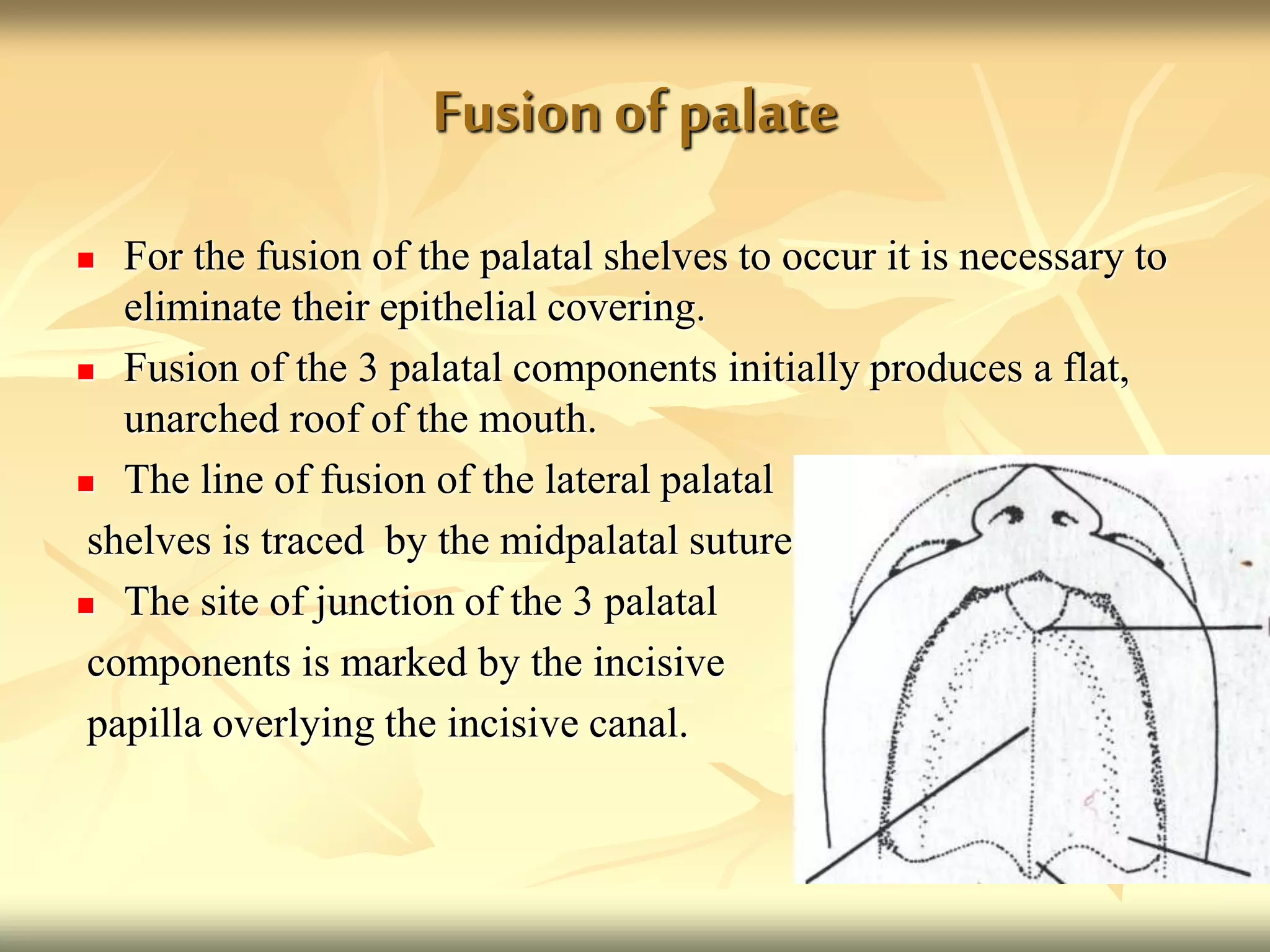
 For the fusion of the palatal shelves to occur it is necessary to
eliminate their epithelial covering.
 Fusion of the 3 palatal components initially produces a flat,
unarched roof of the mouth.
 The line of fusion of the lateral palatal
shelves is traced by the midpalatal suture
 The site of junction of the 3 palatal
components is marked by the incisive
papilla overlying the incisive canal.
Formation of palate[summary]
Primordium
of
Formed
by
Derived
from
Primary
palate
Secondary
palate
Pre
maxilla
Hard and
soft
palate
Median
palatine
process
Lateral
palatine
process
Maxillary
process
Frontonasal
process
Ossification ofthe palate
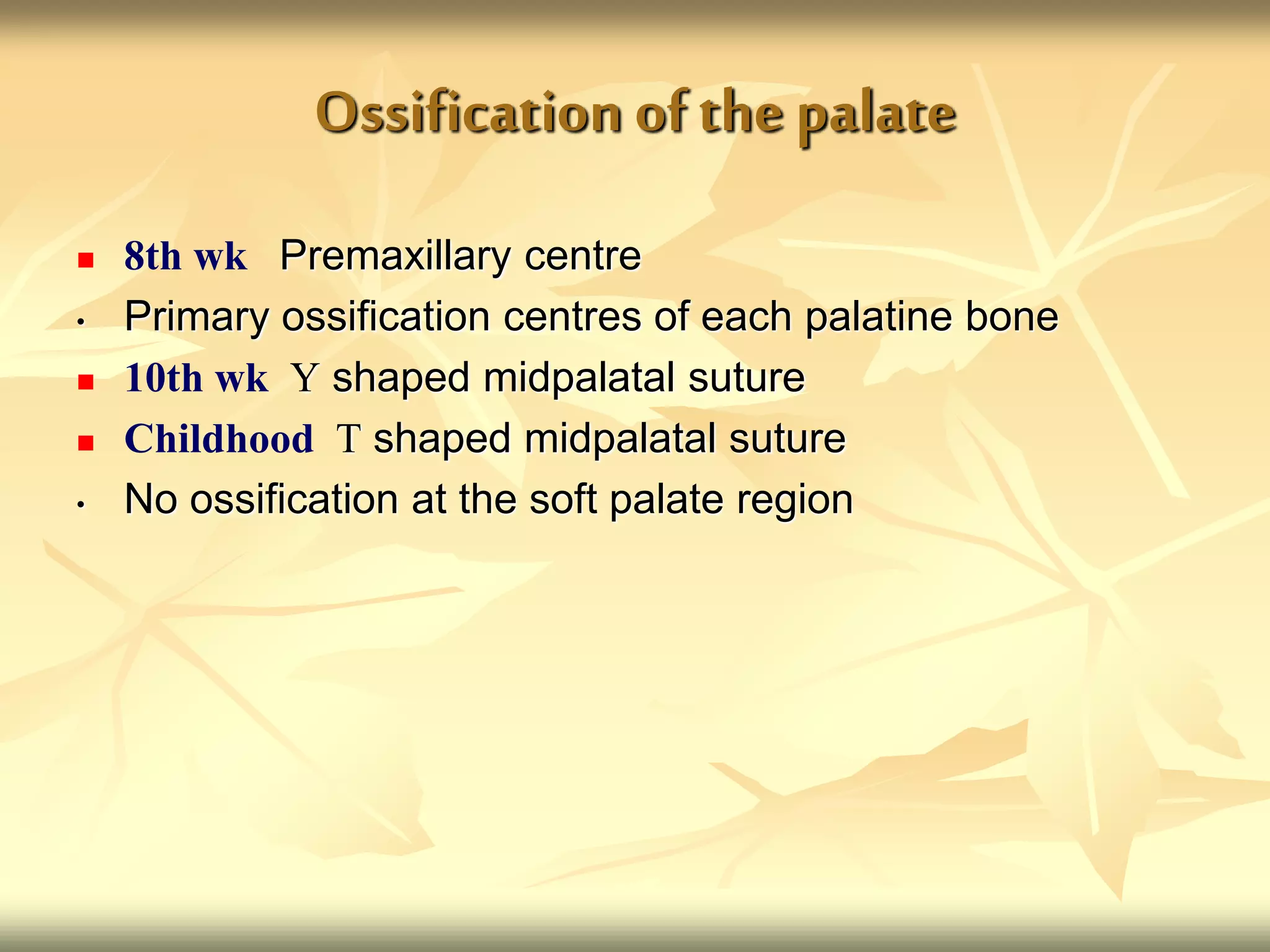
 8th wk Premaxillary centre
• Primary ossification centres of each palatine bone
 10th wk Y shaped midpalatal suture
 Childhood T shaped midpalatal suture
• No ossification at the soft palate region
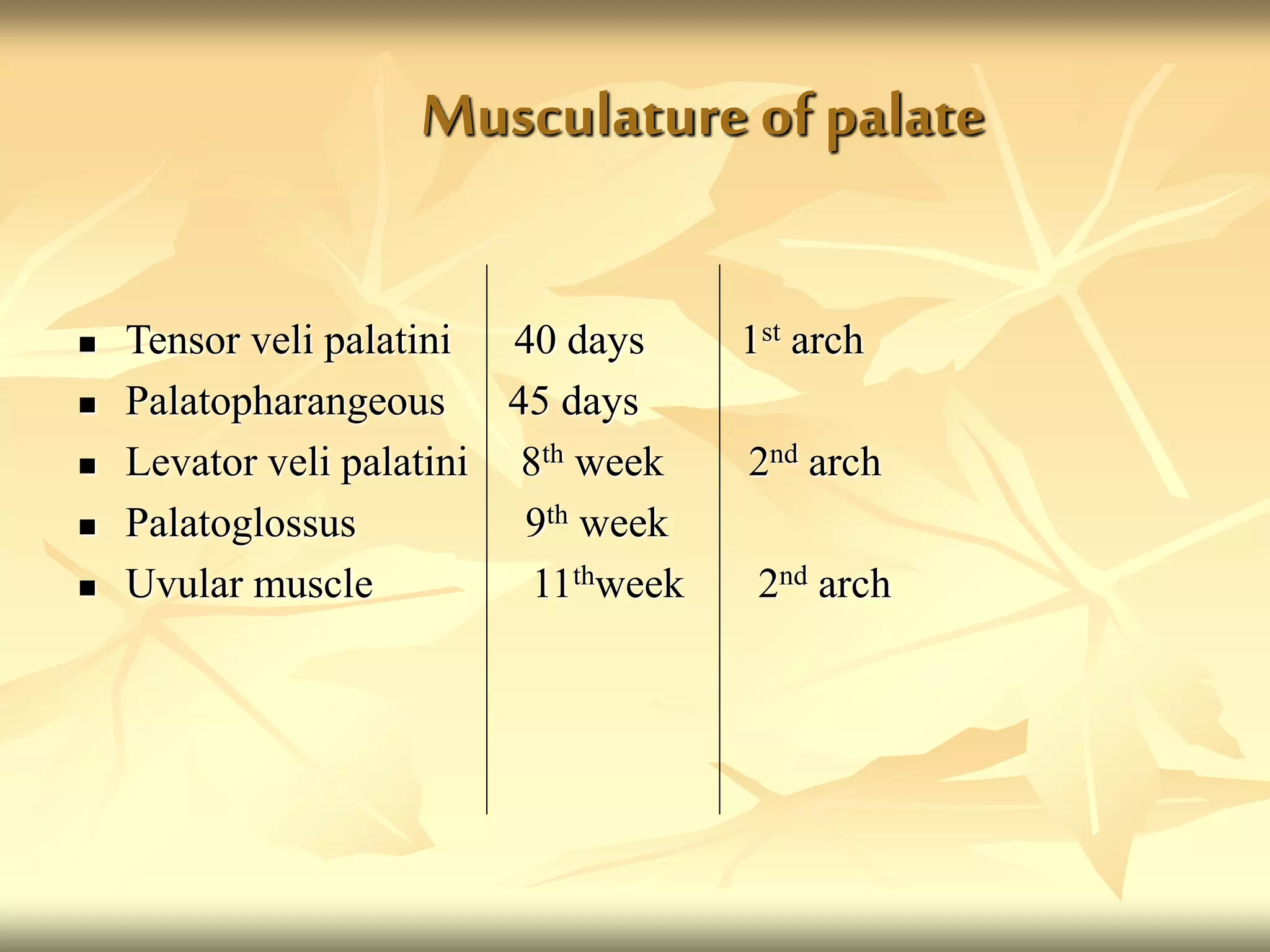
Musculature of palate
 Tensor veli palatini 40 days 1st arch
 Palatopharangeous 45 days
 Levator veli palatini 8th week 2nd arch
 Palatoglossus 9th week
 Uvular muscle 11thweek 2nd arch
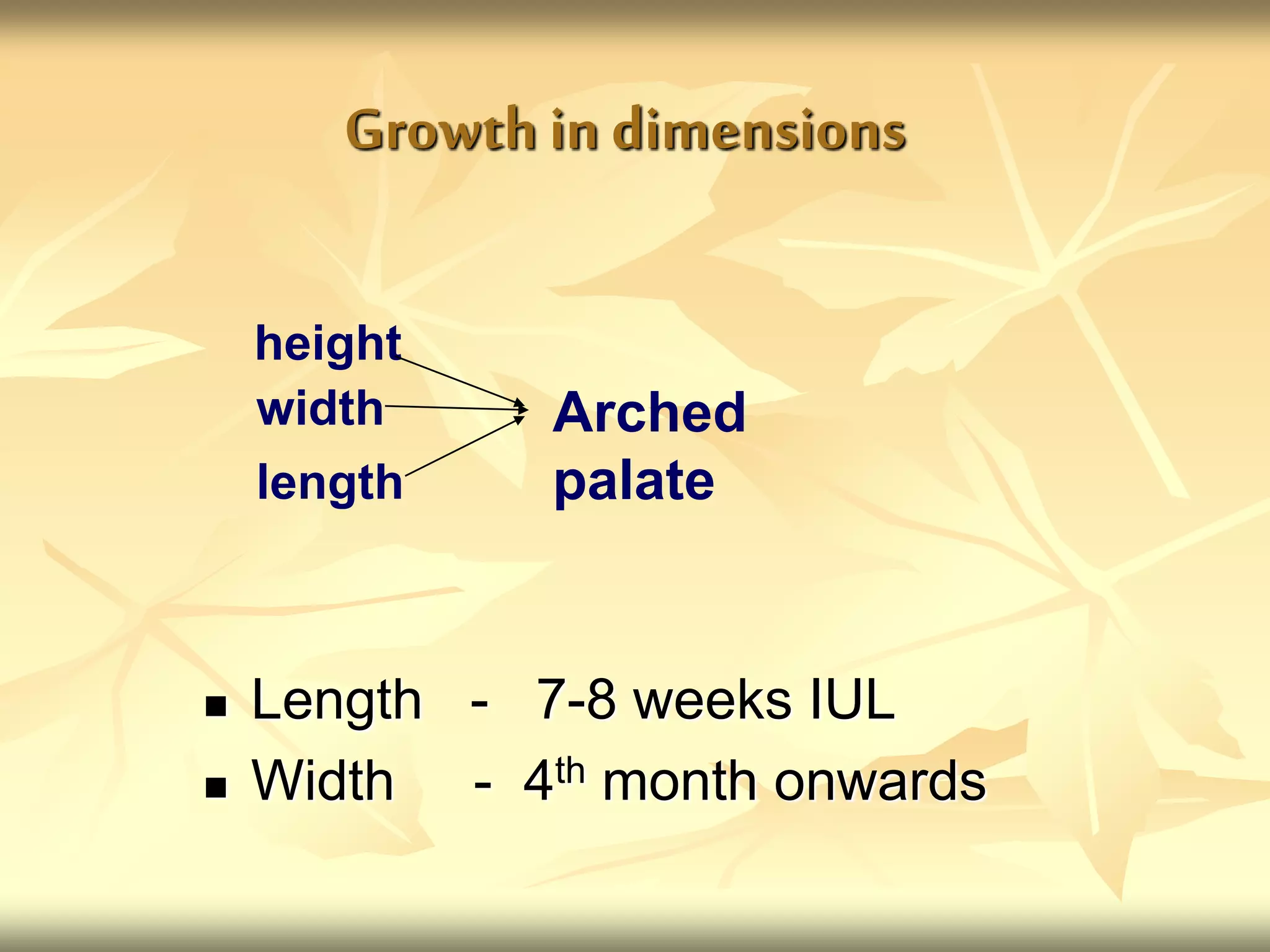
Growth in dimensions
 Length - 7-8 weeks IUL
 Width - 4th month onwards
height
width
length
Arched
palate
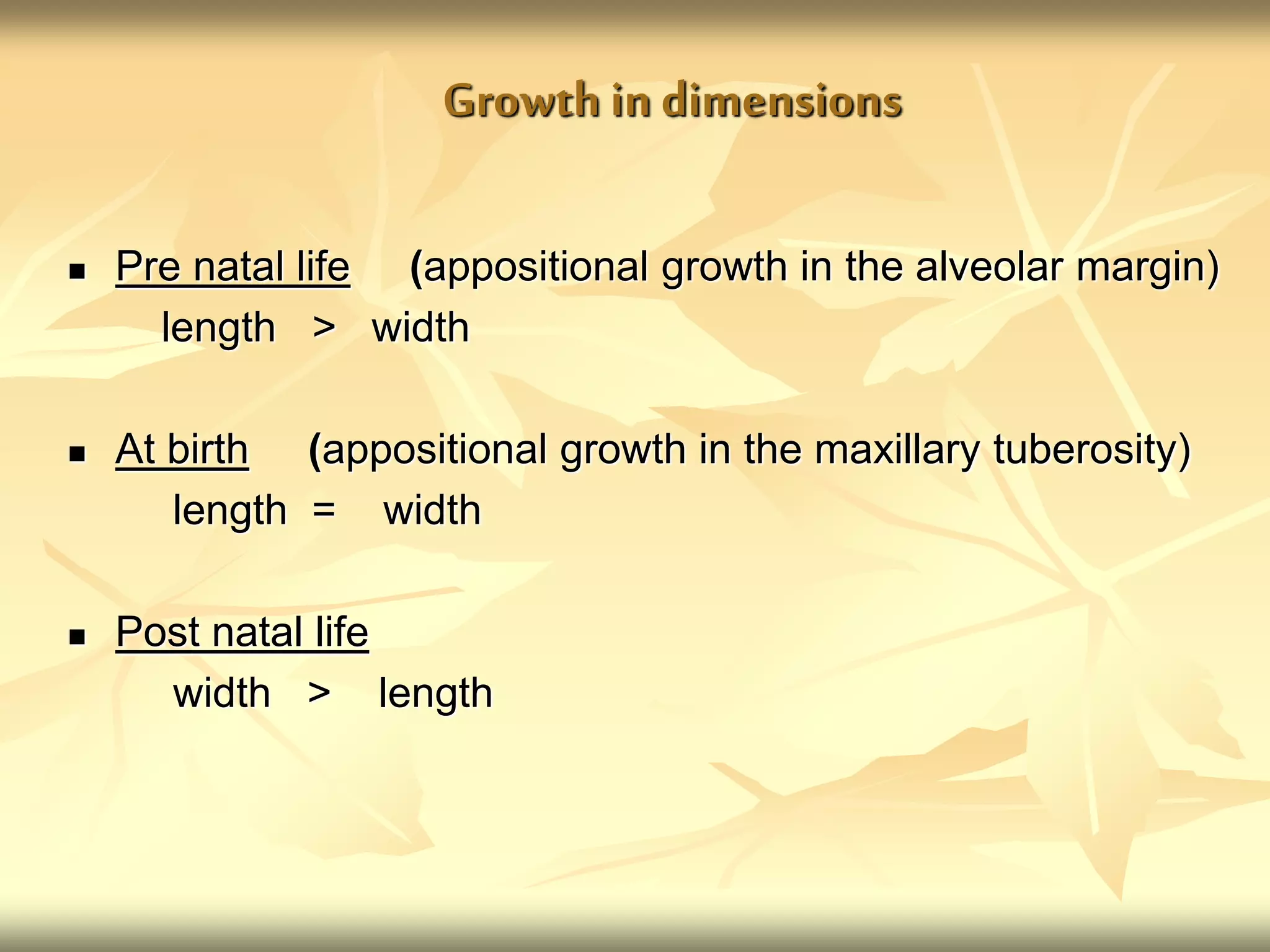
Growth in dimensions
 Pre natal life (appositional growth in the alveolar margin)
length > width
 At birth (appositional growth in the maxillary tuberosity)
length = width
 Post natal life
width > length
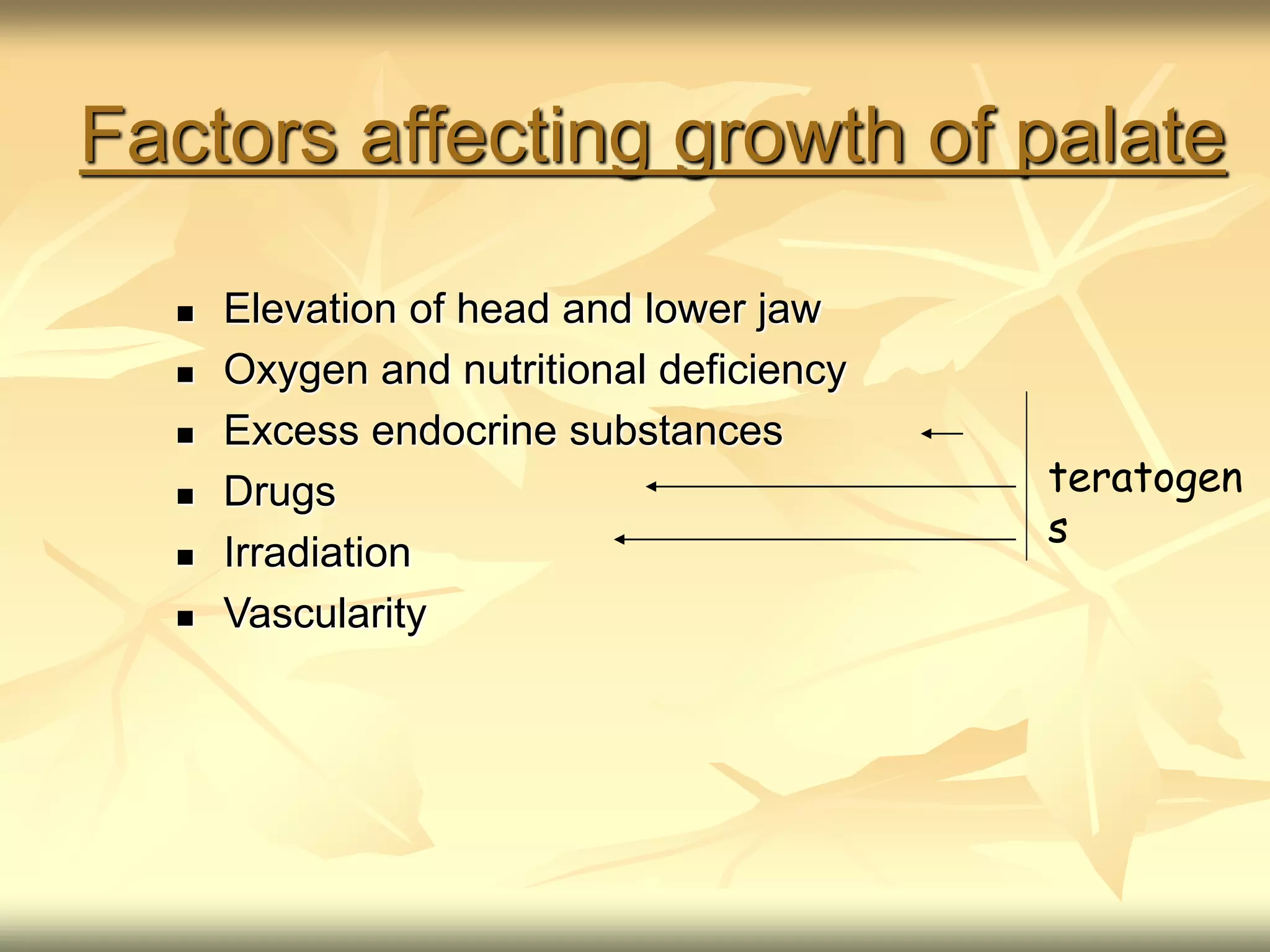
Factors affecting growth of palate
 Elevation of head and lower jaw
 Oxygen and nutritional deficiency
 Excess endocrine substances
 Drugs
 Irradiation
 Vascularity
teratogen
s
Anomalies of Palatal development
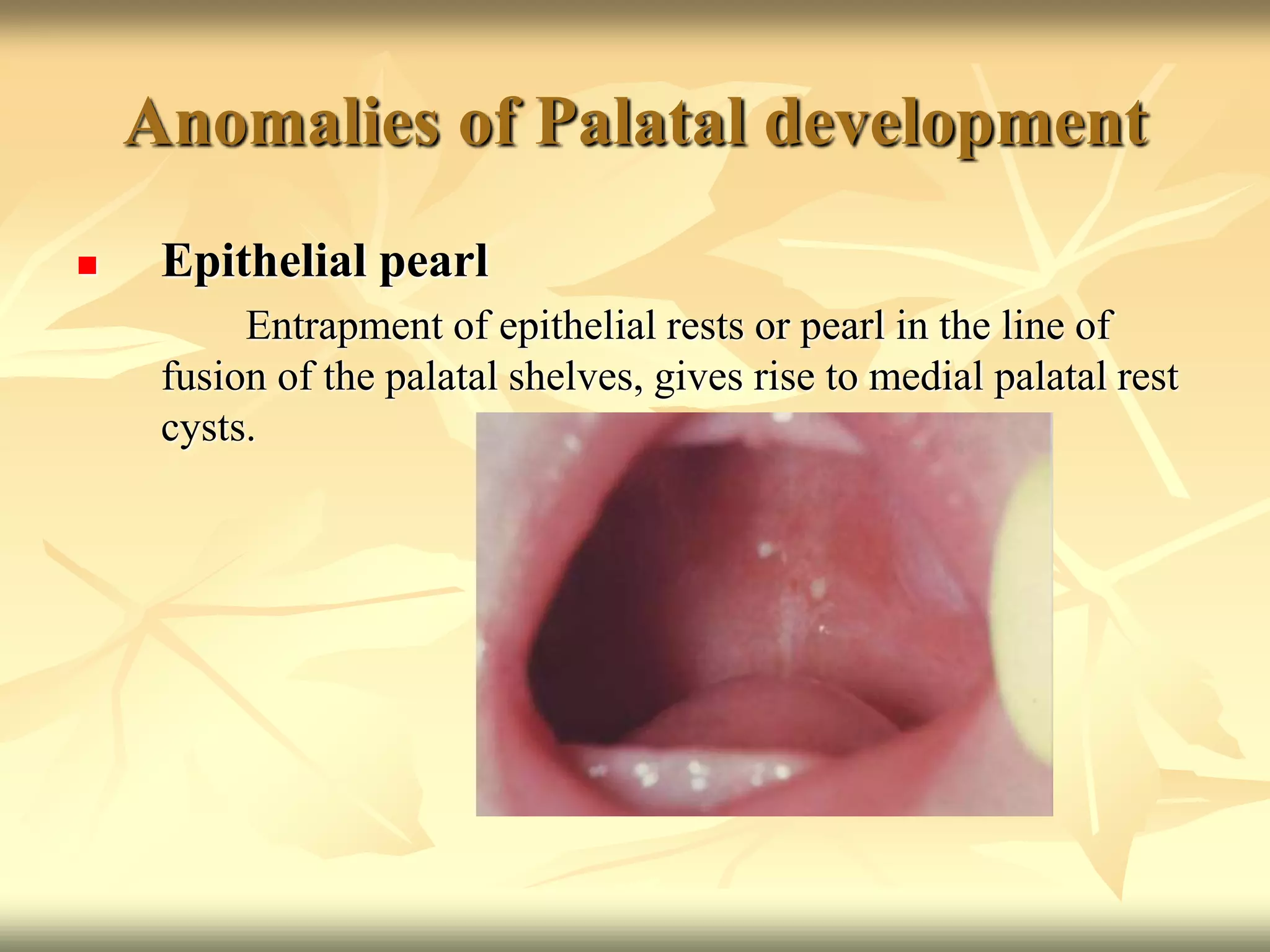
 Epithelial pearl
Entrapment of epithelial rests or pearl in the line of
fusion of the palatal shelves, gives rise to medial palatal rest
cysts.
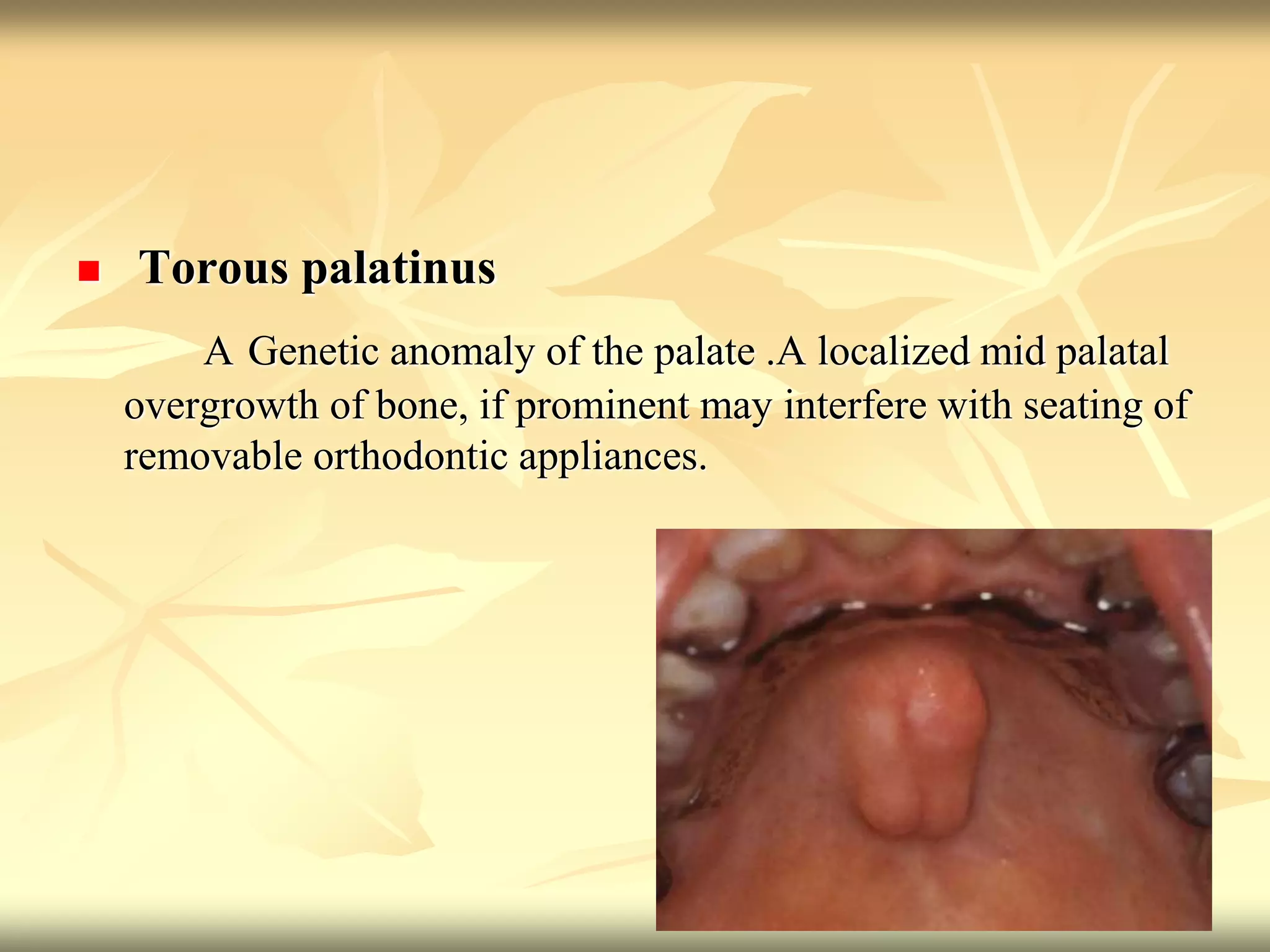
 Torous palatinus
A Genetic anomaly of the palate .A localized mid palatal
overgrowth of bone, if prominent may interfere with seating of
removable orthodontic appliances.
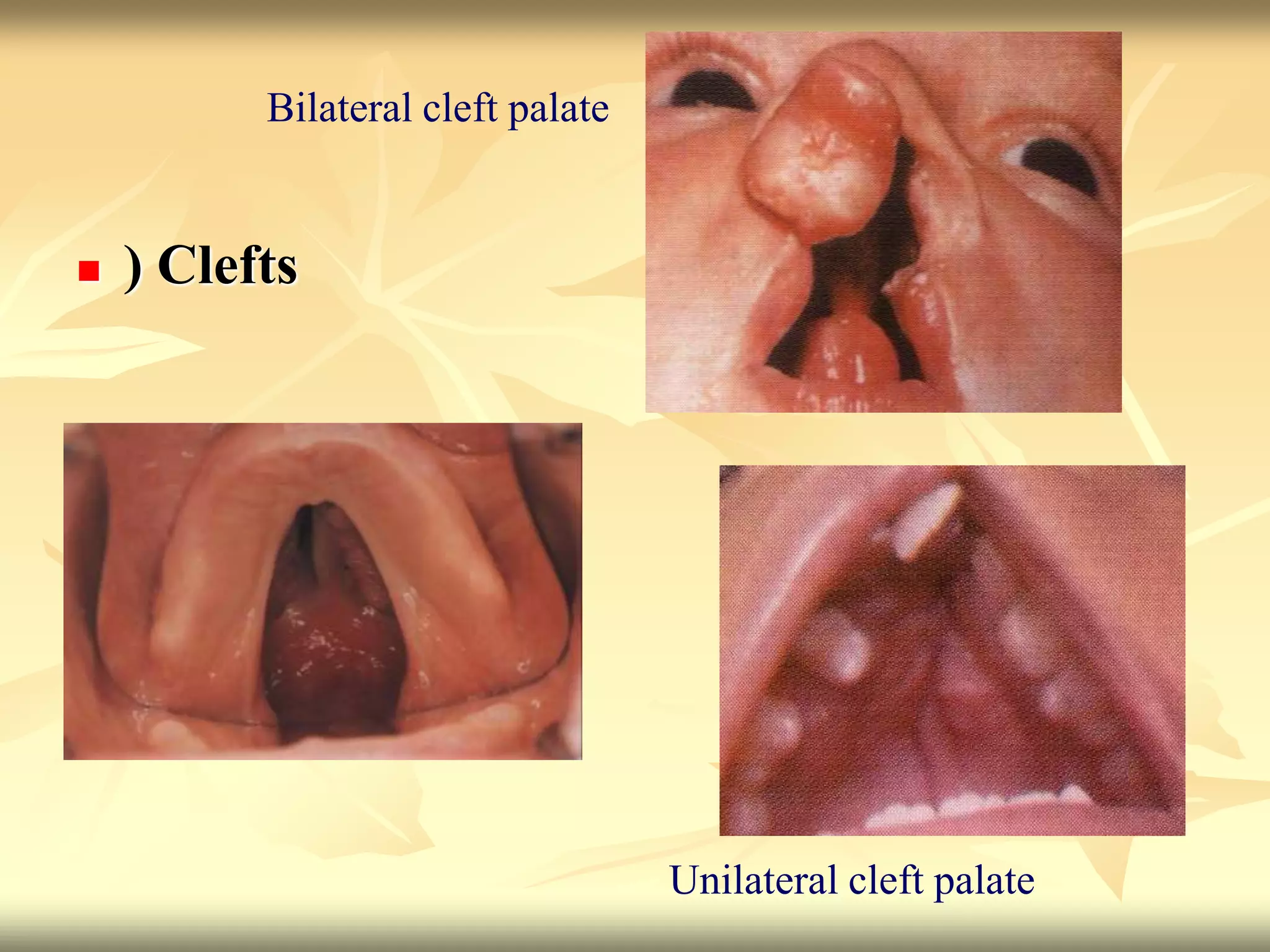
 ) Clefts
Unilateral cleft palate
Bilateral cleft palate
Cleft palate results from a lack of fusion of the palatine shelves
which may be due to:
 smallness of the shelves,
 failure of the shelves to elevate,
 inhibition of fusion process itself, or
 Failure of tongue to drop from between the shelves because of
micrognathia.
Post natal growth and
development of maxilla
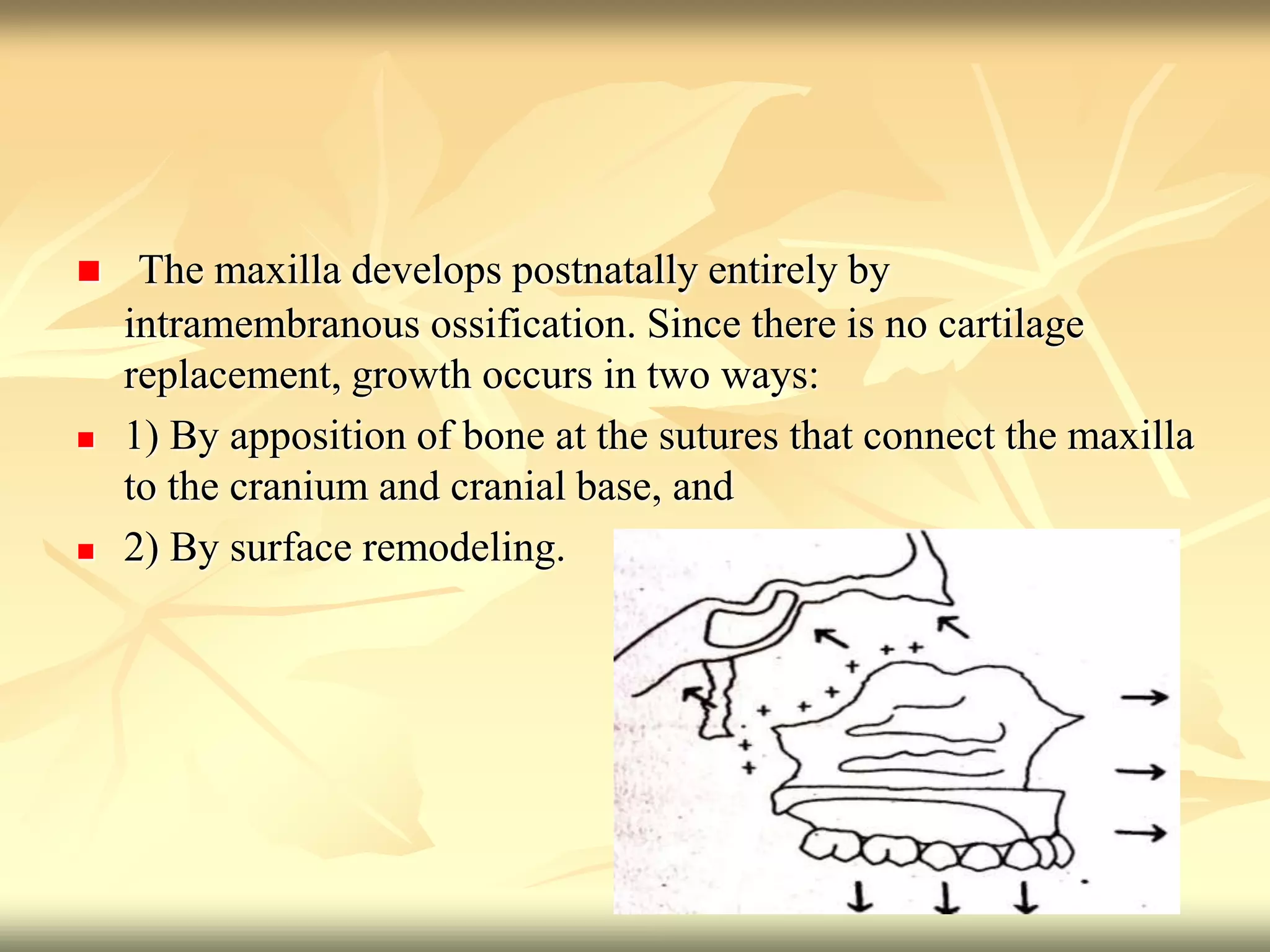
 The maxilla develops postnatally entirely by
intramembranous ossification. Since there is no cartilage
replacement, growth occurs in two ways:
 1) By apposition of bone at the sutures that connect the maxilla
to the cranium and cranial base, and
 2) By surface remodeling.
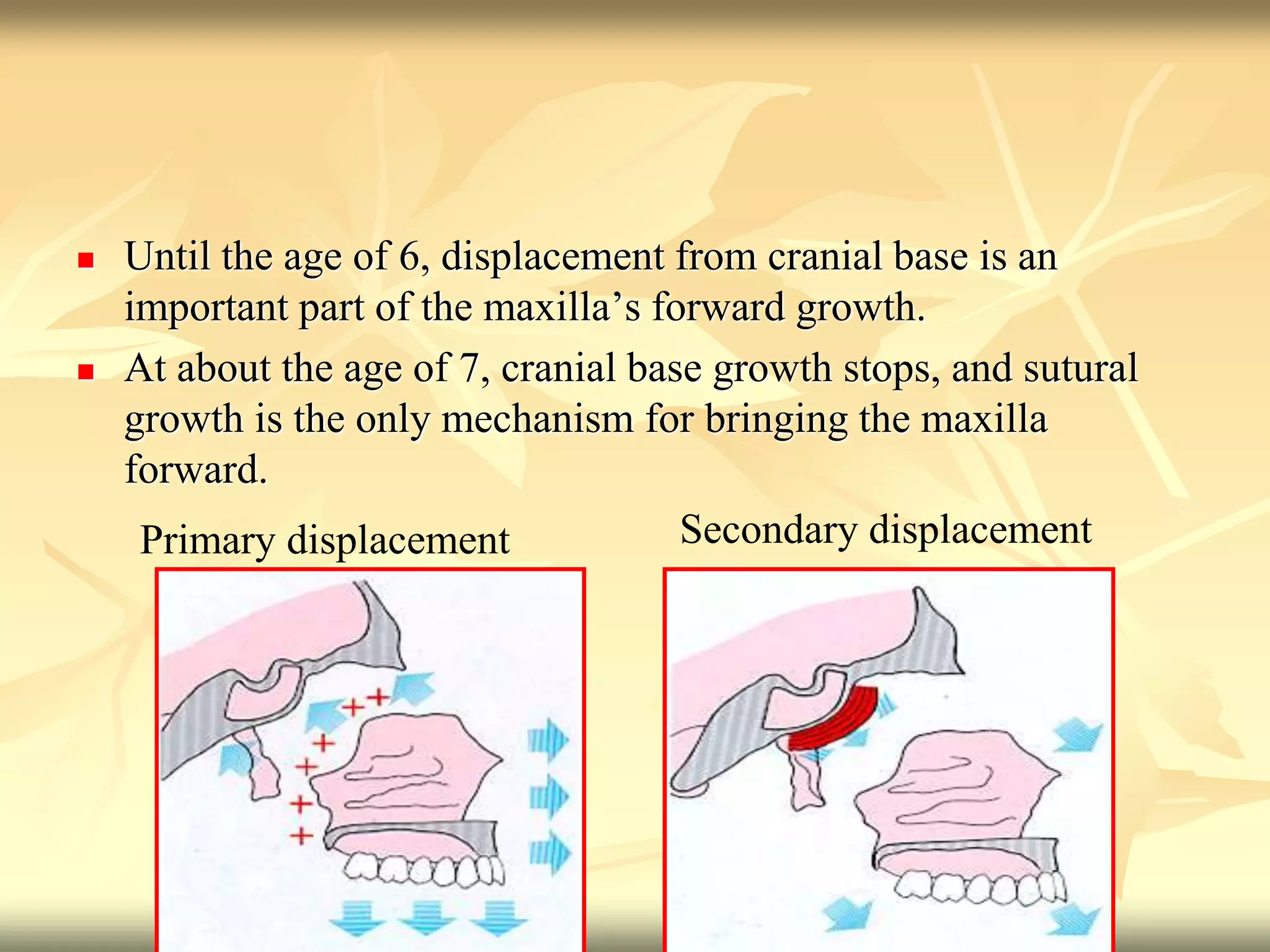
 Until the age of 6, displacement from cranial base is an
important part of the maxilla’s forward growth.
 At about the age of 7, cranial base growth stops, and sutural
growth is the only mechanism for bringing the maxilla
forward.
Primary displacement Secondary displacement
Sutures attaching the maxilla :
 frontomaxillary suture,
 zygomaticomaxillary suture,
 zygomaticotemporal suture,
 pterygo palatine suture,
 these all sutures are relatively oblique and parallel to each
other.
 Thus growth in these areas serves to move maxilla in forward
and downward direction.
 As this happens, the space that would open up at the suture is
filled in by proliferation of bone at these locations.
 The suture remains the same width, and the various processes
of the maxilla become longer.
 Bone apposition occurs on both sides of a suture, so the bone
to which the maxilla is attached also becomes larger.
 As the maxilla grows downward and forward, its front
surface are remodeled and bone is removed from most of the
anterior surface.
 The overall growth changes are the result of a downward and
forward translation of the maxilla and a simultaneous
remodeling. The whole bony nasomaxillary complex is
moving downward and forward relative to the cranium, being
translated in space.
 Enlow shows this in a cartoon form;
 The maxilla is like the platform on wheels, being rolled
forward, while at the same time its surface, represented by the
wall in the cartoon, is being reduced on its anterior side and
built up posteriorly,moving in space opposite to the direction
of the overall growth.
Dimensional changes
 Growth in height vertical
 Growth in width transverse
 Growth in length A - P
Vertical growth
 Bjork and Skieller implant studies
 - height increases because of sutural growth toward the
frontal and zygomatic bones
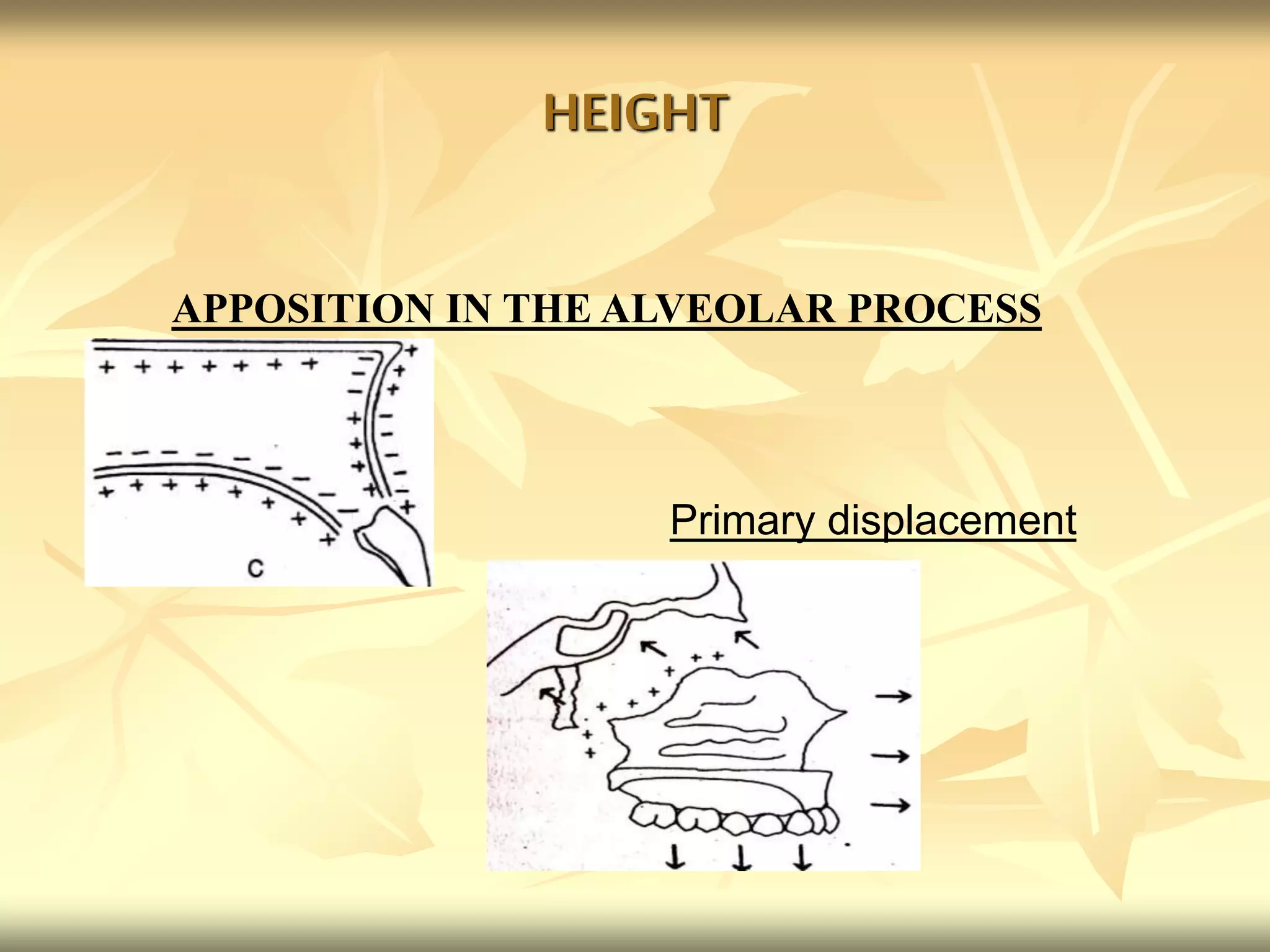
 - appositional growth in the alveolar bone, floor of orbit,
on hard palate and resorption on nasal floor
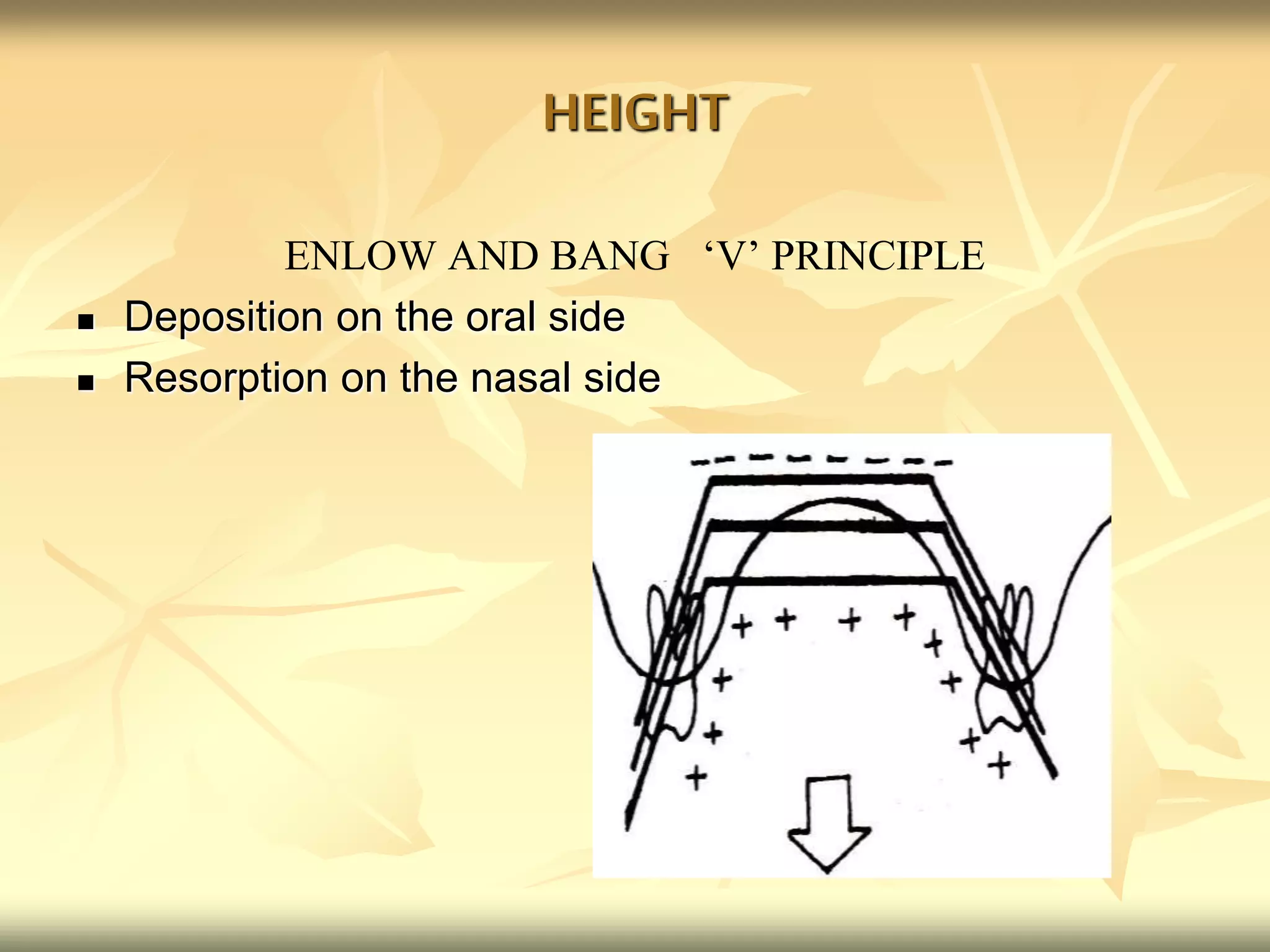
HEIGHT
ENLOW AND BANG ‘V’ PRINCIPLE
 Deposition on the oral side
 Resorption on the nasal side
HEIGHT
APPOSITION IN THE ALVEOLAR PROCESS
Primary displacement
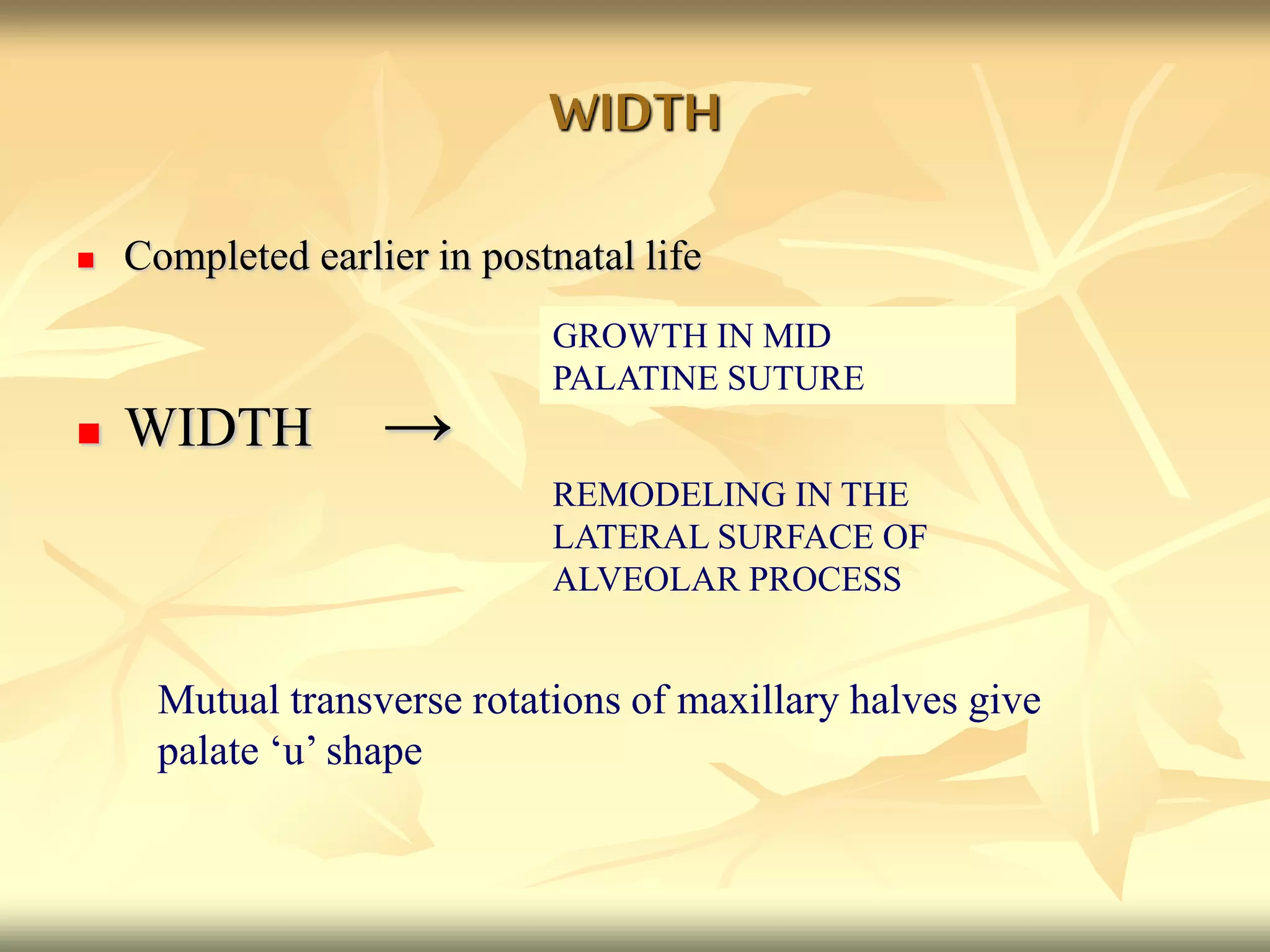
WIDTH
 Completed earlier in postnatal life
 WIDTH →
GROWTH IN MID
PALATINE SUTURE
REMODELING IN THE
LATERAL SURFACE OF
ALVEOLAR PROCESS
Mutual transverse rotations of maxillary halves give
palate ‘u’ shape
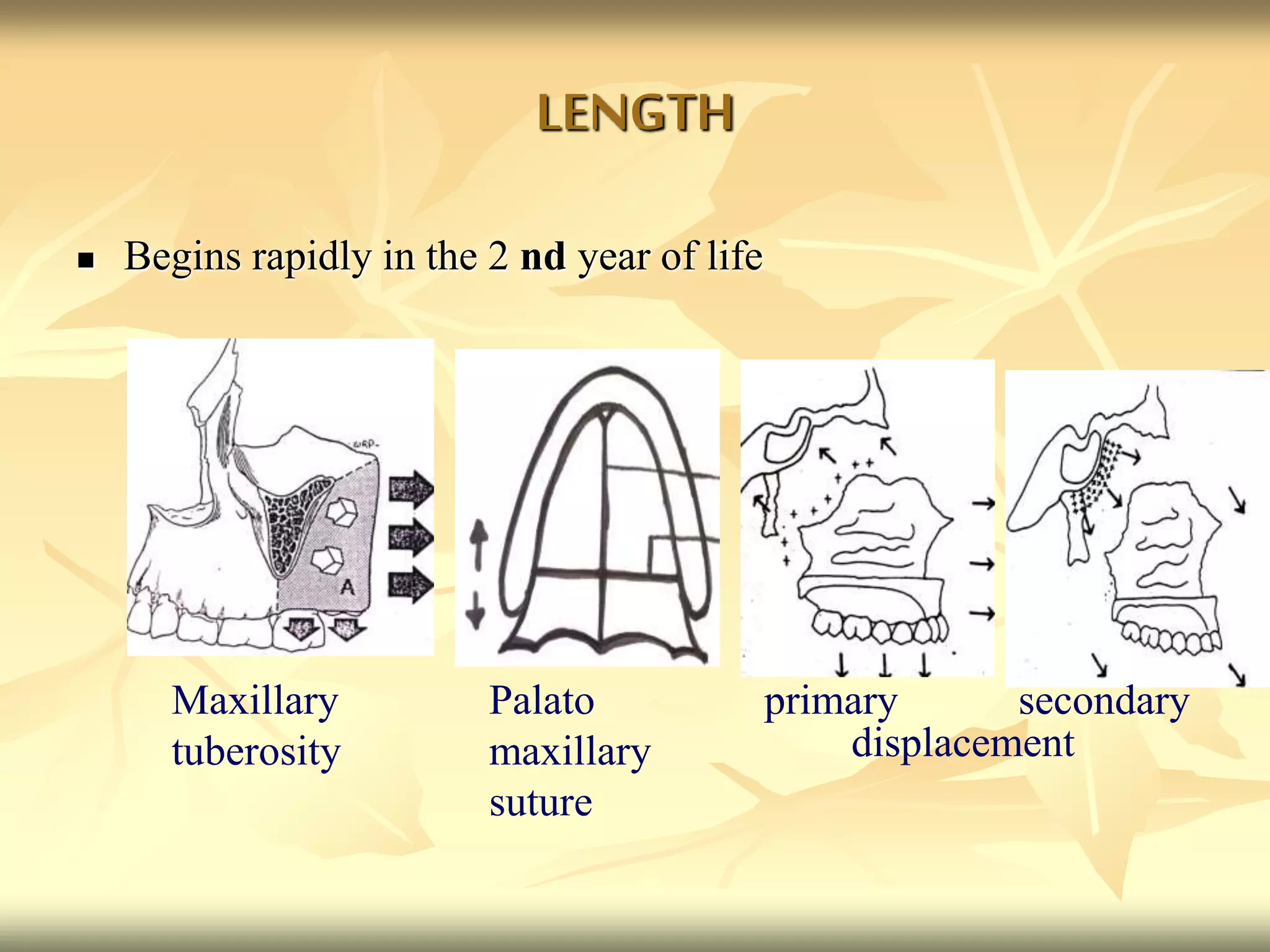
LENGTH
 Begins rapidly in the 2 nd year of life
Maxillary
tuberosity
Palato
maxillary
suture
primary secondary
displacement
LENGTH
• Resorption in the anterior region of the maxilla
• Maxilla rotates in relation to the anterior cranial base
• Bjork and Skieller implant studies have shown that anterior
surface is stable sagittally
Timing
 Growth in width is completed first, then in length, and finally
growth in height.
 Growth in width →before the adolescent growth spurt.
 Growth in length →through the period of puberty
 growth in vertical height of the face →continues longer
The Nasomaxillary Complex
Remodeling
• The Maxillary tuberosity
• Key ridge
• Vertical drift of teeth
• Nasal airway
• Palatal remodeling
• Downward maxillary displacement
• Maxillary sutures
• The Cheekbone and Zygomatic Arch
• The paranasal sinuses
• Orbital Growth
Maxillary tuberosity
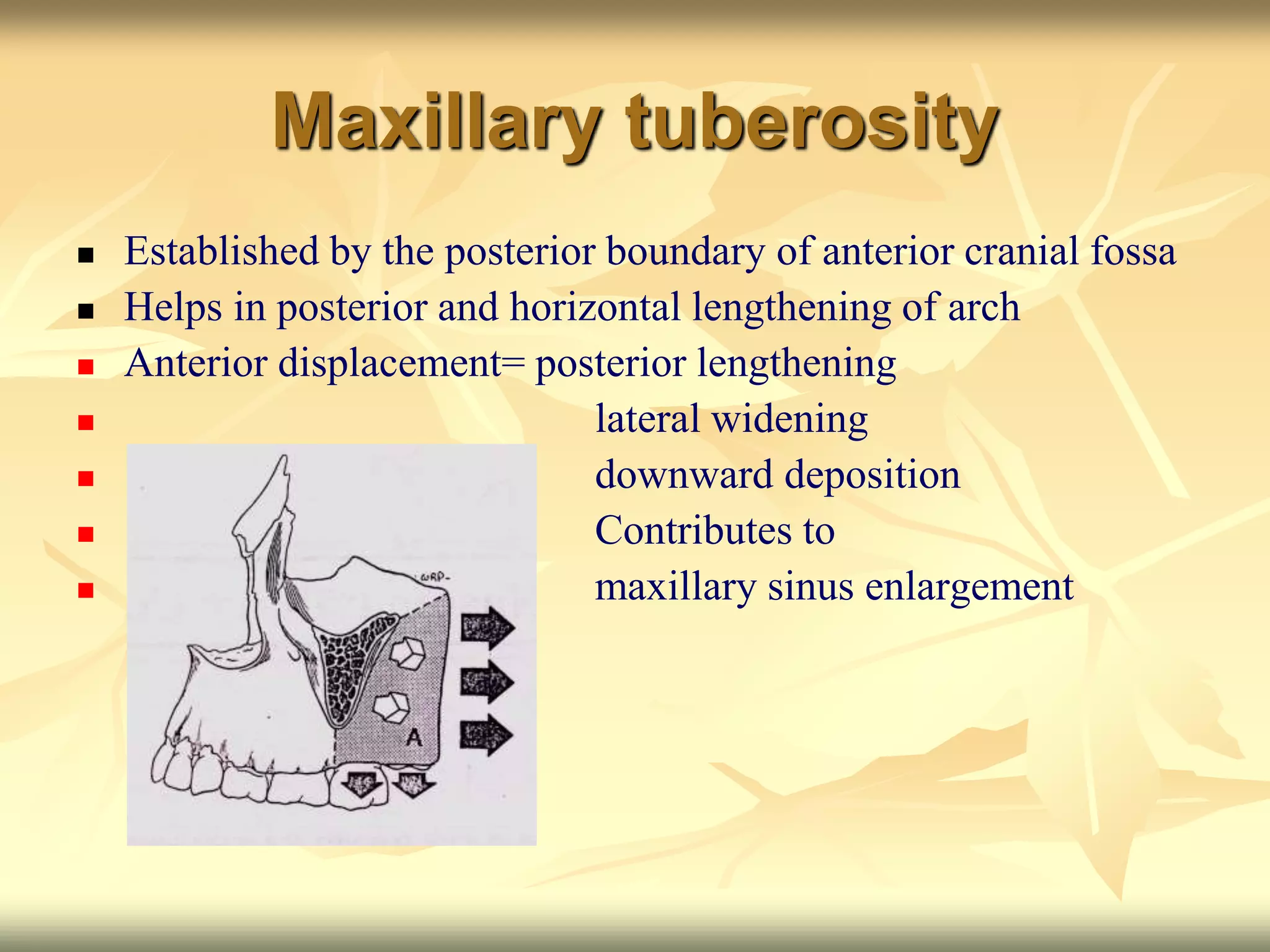
 Established by the posterior boundary of anterior cranial fossa
 Helps in posterior and horizontal lengthening of arch
 Anterior displacement= posterior lengthening
 lateral widening
 downward deposition
 Contributes to
 maxillary sinus enlargement
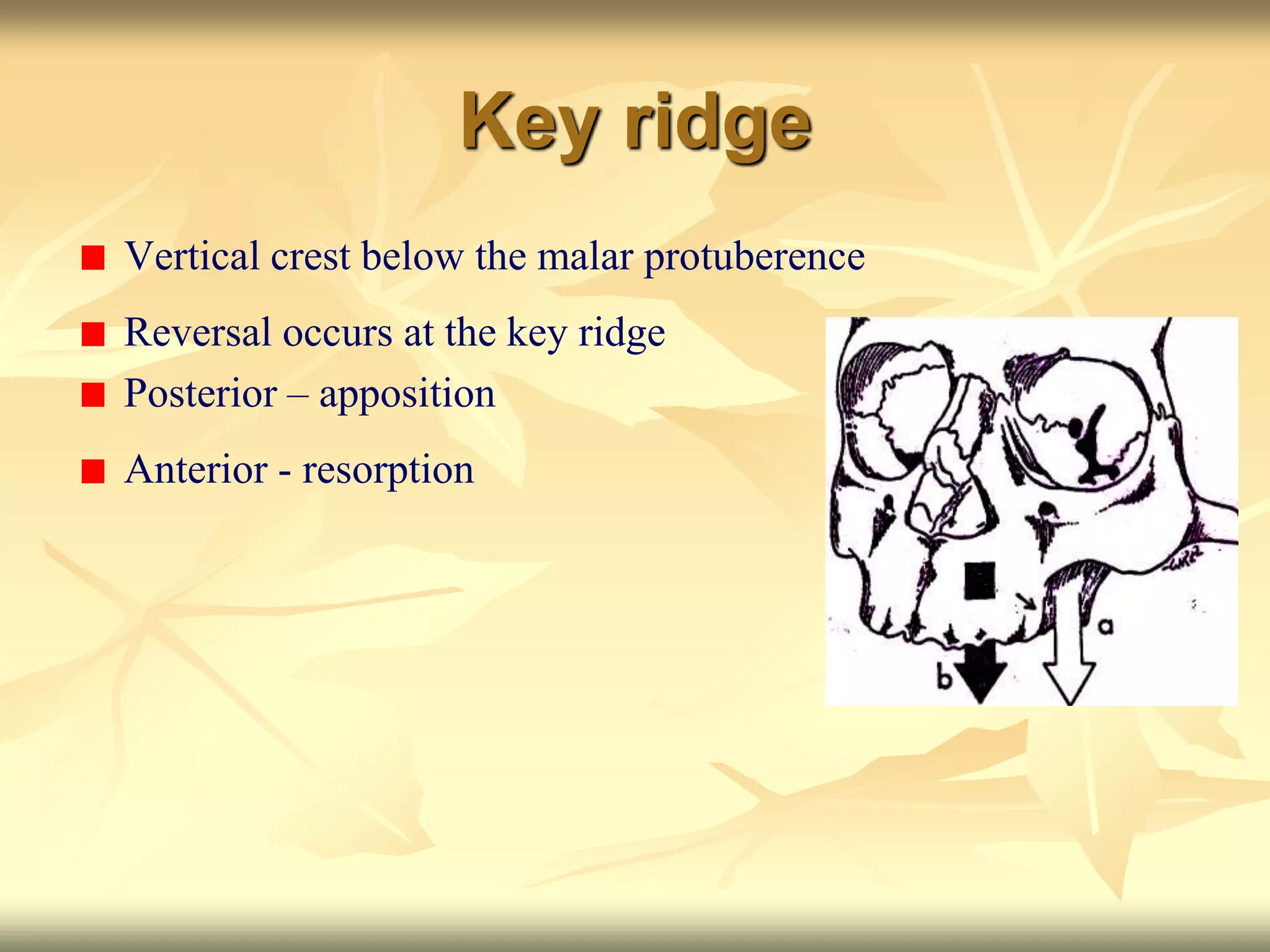
Key ridge
Vertical crest below the malar protuberence
Reversal occurs at the key ridge
Posterior – apposition
Anterior - resorption
Vertical drift of teeth
 As a tooth drifts, alveolar remodeling takes place
 The periodontal connective tissue also moves together with the
drifting teeth .
 It is this important periodontal membrane that-
Provides intra membranous bone remodeling that changes the
location of alveolar socket.
Move the tooth itself.
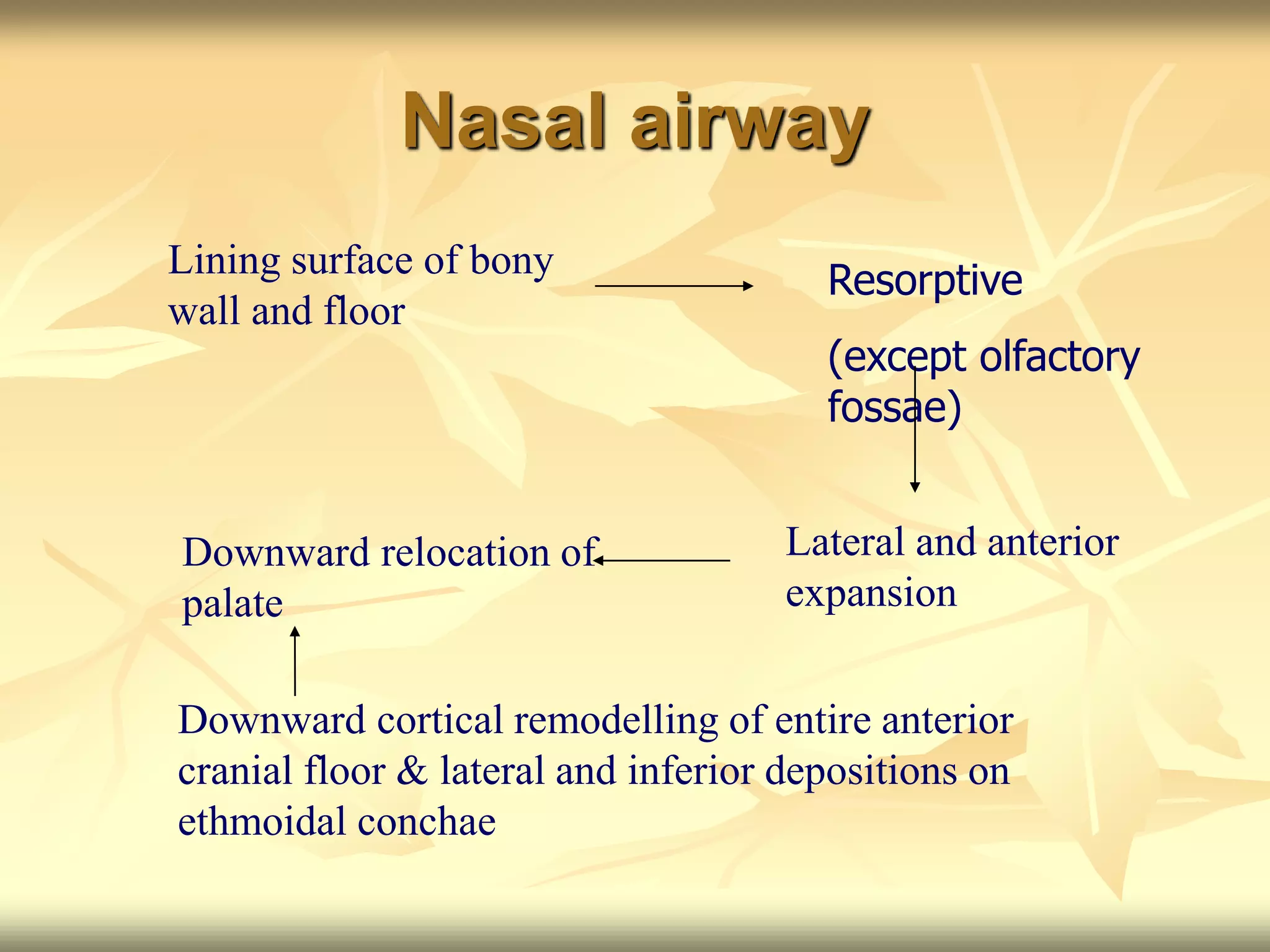
Nasal airway
Lining surface of bony
wall and floor
Resorptive
(except olfactory
fossae)
Downward relocation of
palate
Lateral and anterior
expansion
Downward cortical remodelling of entire anterior
cranial floor & lateral and inferior depositions on
ethmoidal conchae
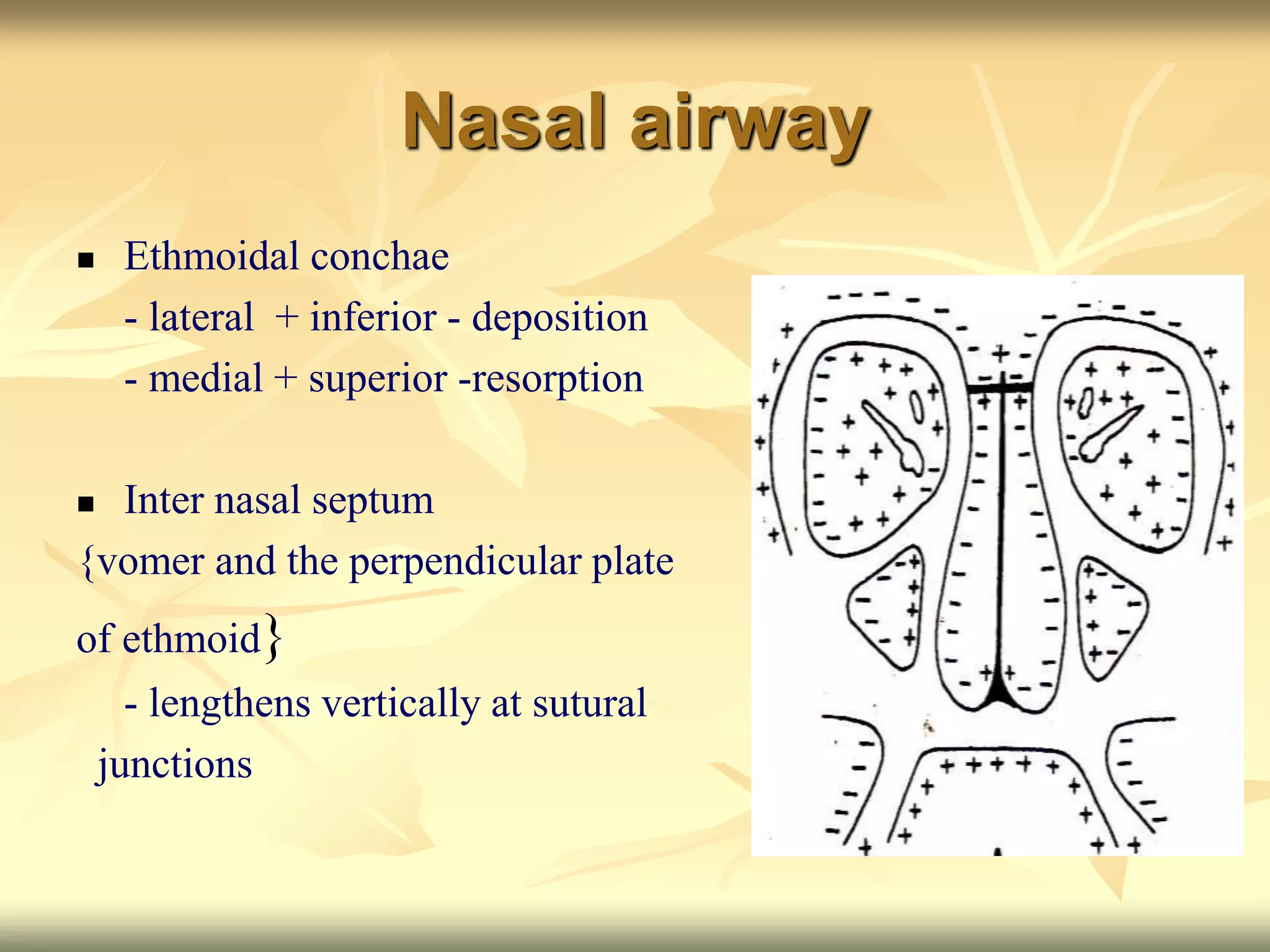
Nasal airway
 Ethmoidal conchae
- lateral + inferior - deposition
- medial + superior -resorption
 Inter nasal septum
{vomer and the perpendicular plate
of ethmoid}
- lengthens vertically at sutural
junctions
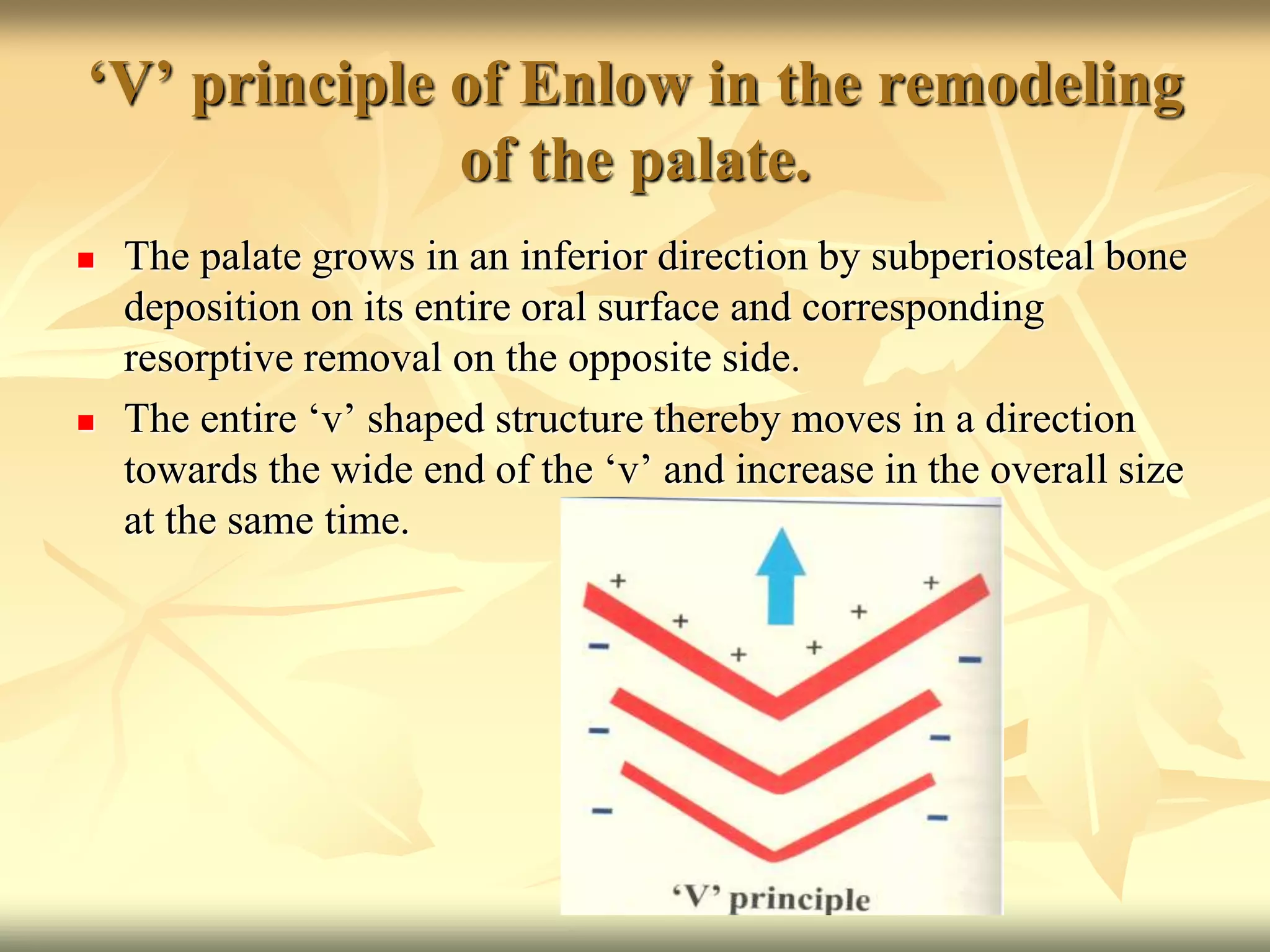
‘V’ principle of Enlow in the remodeling
of the palate.
 The palate grows in an inferior direction by subperiosteal bone
deposition on its entire oral surface and corresponding
resorptive removal on the opposite side.
 The entire ‘v’ shaped structure thereby moves in a direction
towards the wide end of the ‘v’ and increase in the overall size
at the same time.
Downward maxillary
displacement
• Primary displacement of the ethmomaxillary complex
inferiorly
• New bone is added at all sutures and these sutures accompany
displacement produced by the soft tissues
Downward maxillary
displacement
• The balance of > or < growth in posterior and anterior maxilla
is due to clockwise/counter clockwise rotatory displacement
caused by downward and forward growth of the middle cranial
fossa
• Nasomaxillary complex undergoes compensatory remodelling
rotation to sustain its position relative to the vertical reference
line and to the neutral orbital axis
Maxillary sutures
• Sutures slide or slippage of bones along the interface
• Remodelling and relinkage of the collagenous fiber
connections within the sutural connective tissue causes
the displacement process
Cheek and zygomatic bone
• Posterior side of malar protuberances within the temporal
fossa is depository
• Cheek bone relocates posteriorly as it enlarges
• Posterior relocation slows after dental arch length is achieved
during childhood
• Zygomatic arch moves laterally by resorption on the medial
side
• Zygoma and cheekbone complex are displaced anteriorly and
inferiorly in the same directions as the maxilla
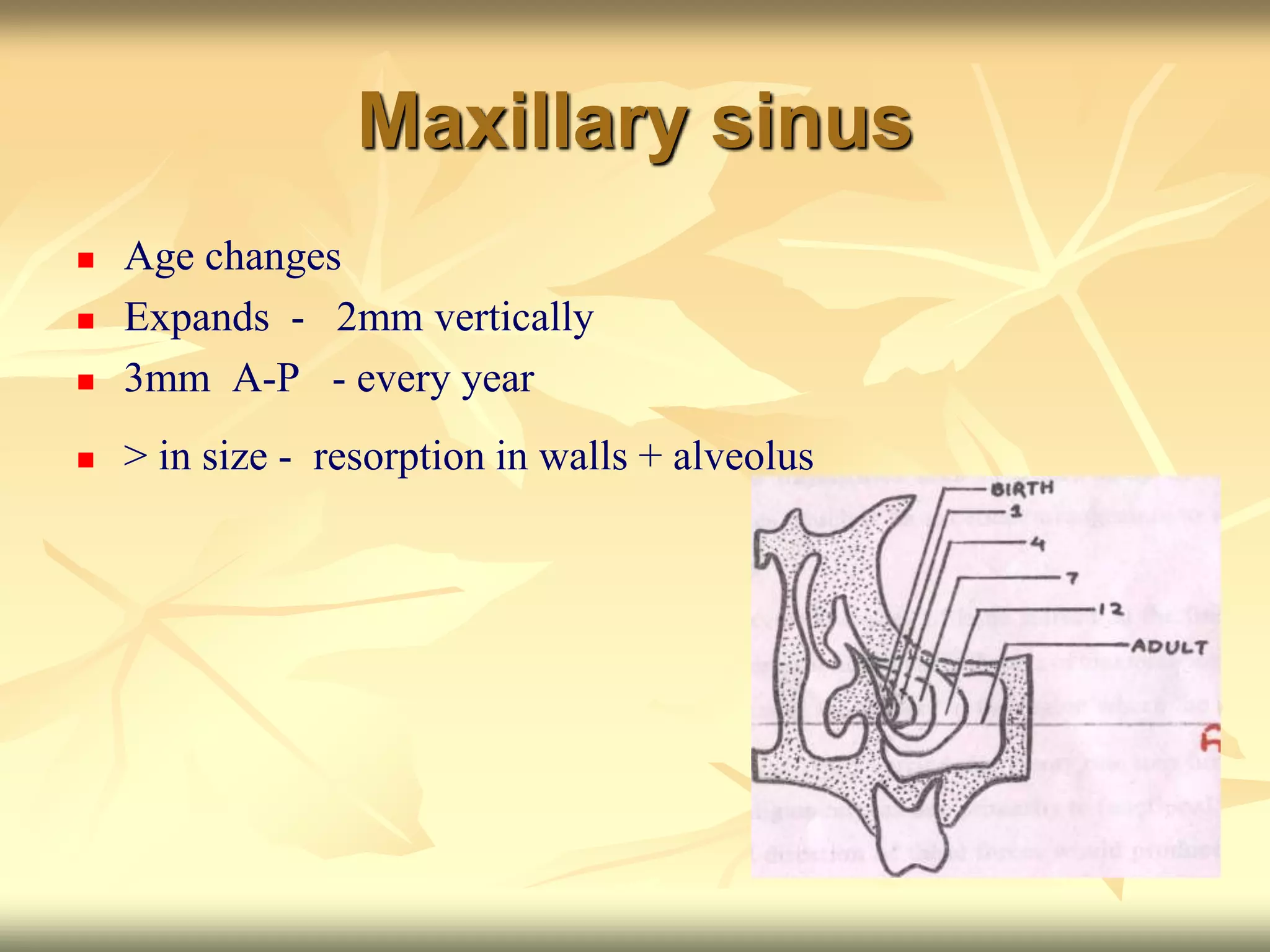
Maxillary sinus
 Age changes
 Expands - 2mm vertically
 3mm A-P - every year
 > in size - resorption in walls + alveolus
 POST NATAL
 All internal surfaces -resorption
 [expect medial]
 Rapid continuous downward growth
 close proximity to buccal maxillary
teeth
Orbital growth
Most of the lining roof and floor are depository
Lateral wall remodels by deposition and medial by resorption
i)Forward remodelling of the nasal and superior orbital rim,
ii) backward remodelling of the inferior orbital rim and the
malar area
iii) downward remodelling of the premaxillary region
combine to produce rotation and alignment of the midface and
upper facial regions
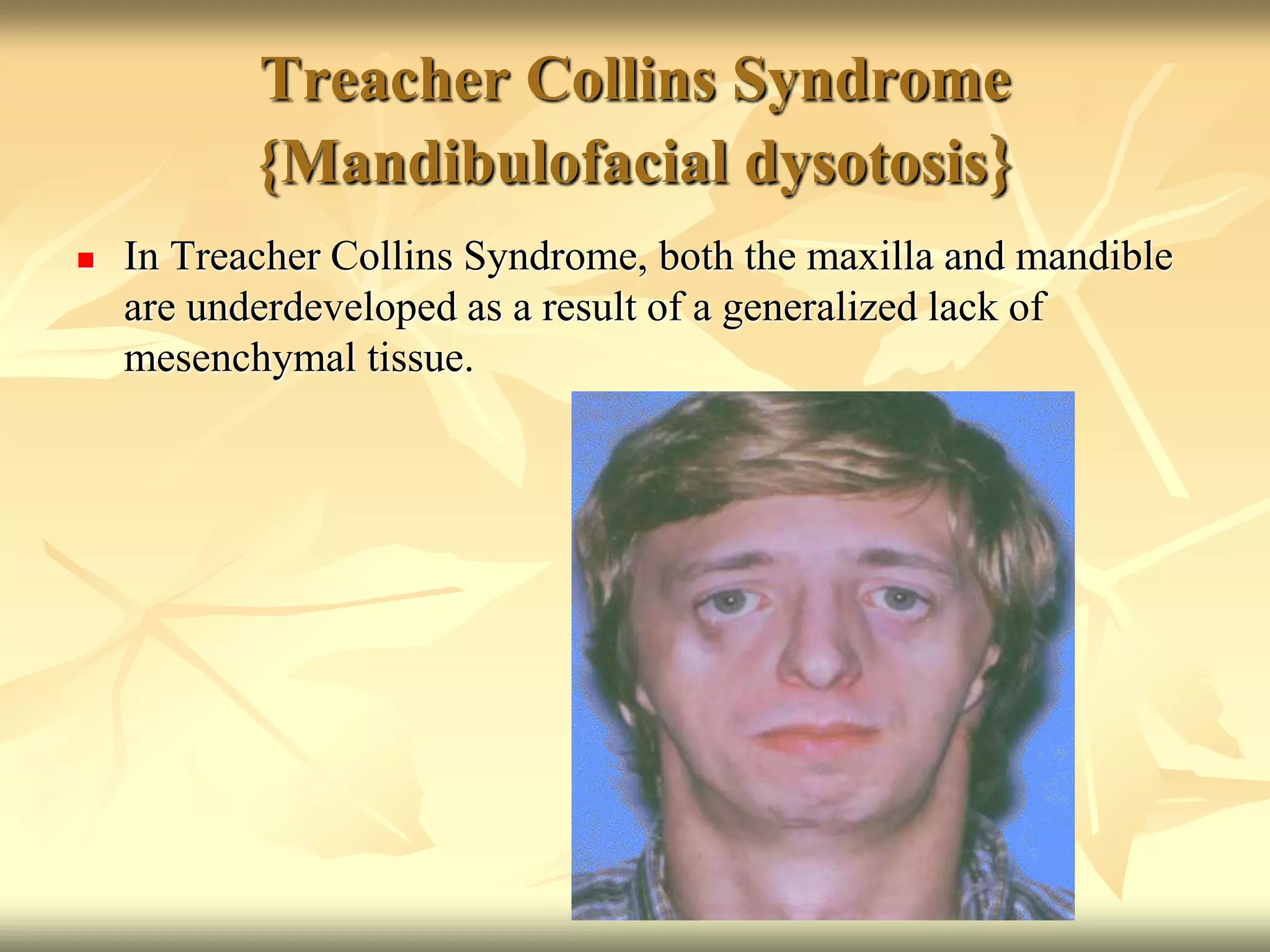
Treacher Collins Syndrome
{Mandibulofacial dysotosis}
 In Treacher Collins Syndrome, both the maxilla and mandible
are underdeveloped as a result of a generalized lack of
mesenchymal tissue.
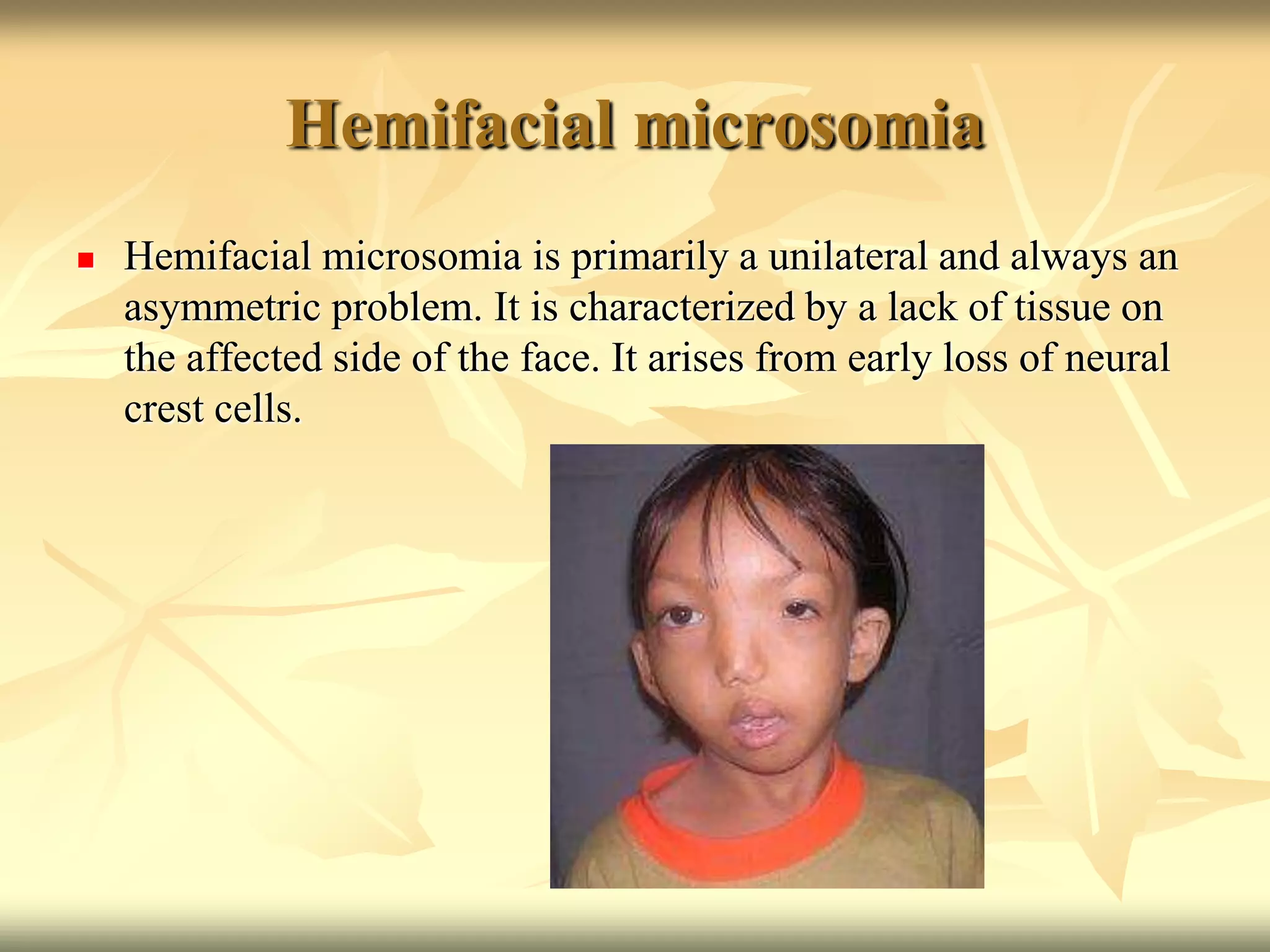
Hemifacial microsomia
 Hemifacial microsomia is primarily a unilateral and always an
asymmetric problem. It is characterized by a lack of tissue on
the affected side of the face. It arises from early loss of neural
crest cells.
Crozon’s syndrome
 It is characterized by underdevelopment of the midface and
eyes that seem to bulge from their sockets.
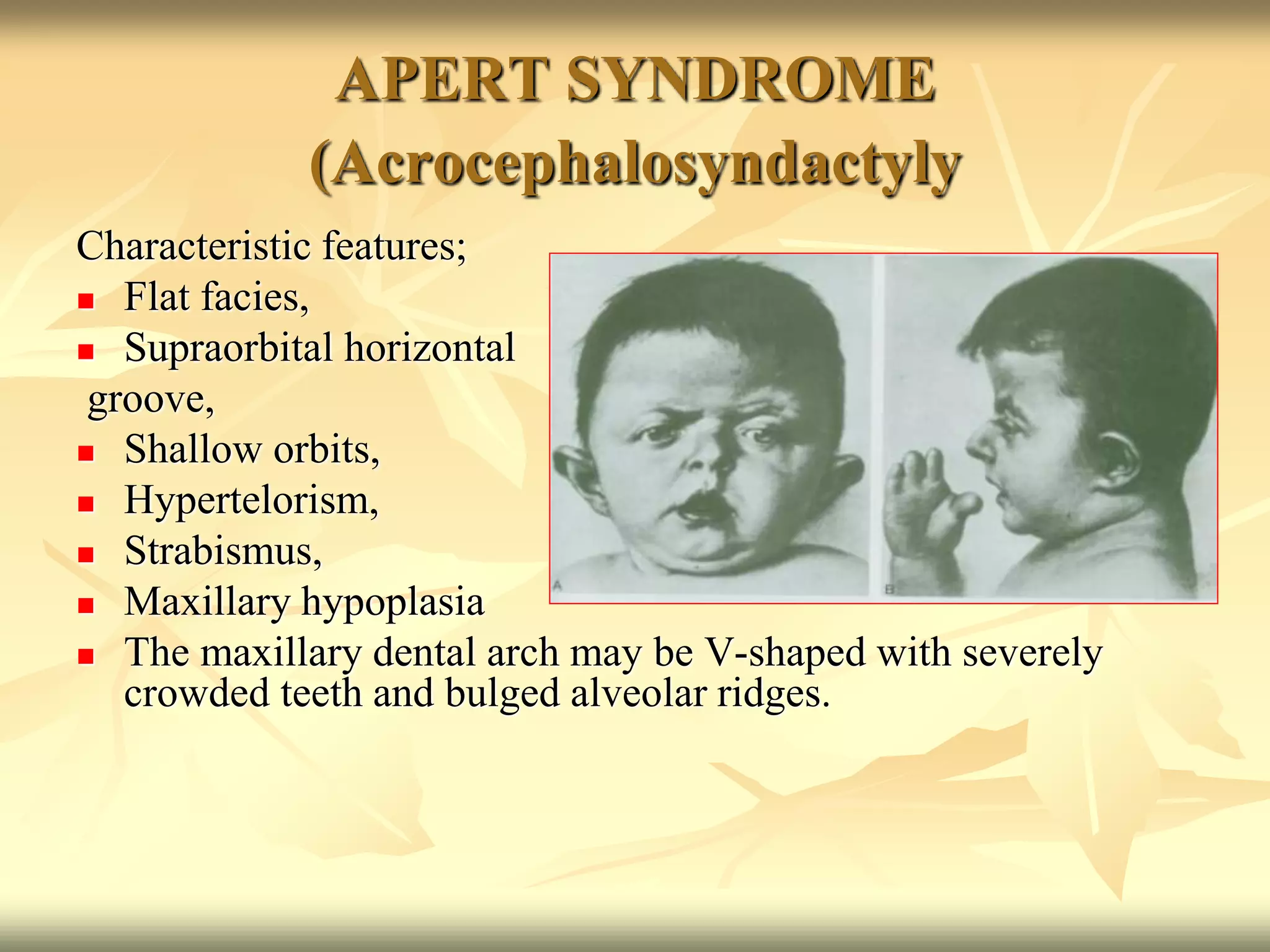
APERT SYNDROME
(Acrocephalosyndactyly
Characteristic features;
 Flat facies,
 Supraorbital horizontal
groove,
 Shallow orbits,
 Hypertelorism,
 Strabismus,
 Maxillary hypoplasia
 The maxillary dental arch may be V-shaped with severely
crowded teeth and bulged alveolar ridges.
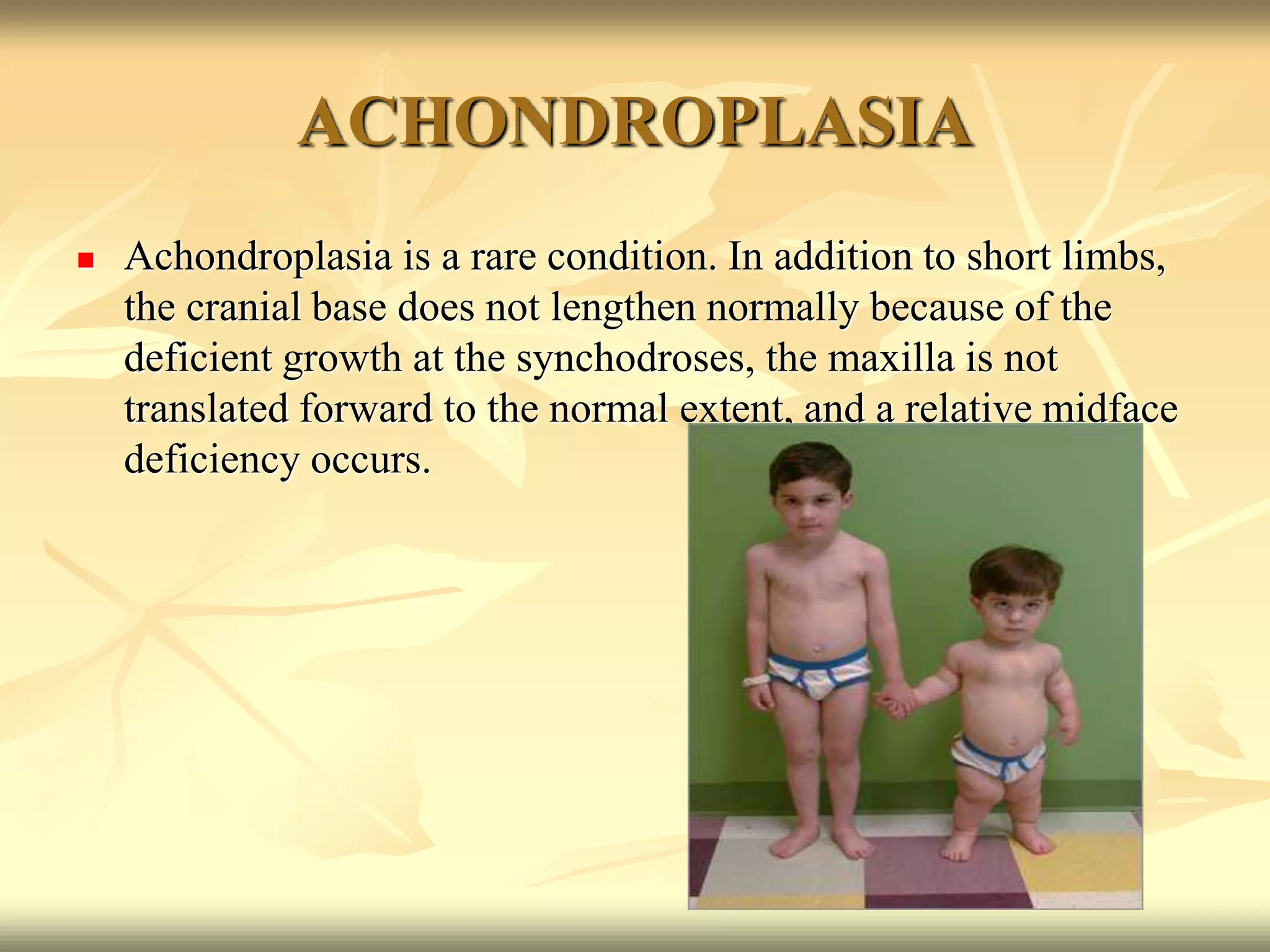
ACHONDROPLASIA
 Achondroplasia is a rare condition. In addition to short limbs,
the cranial base does not lengthen normally because of the
deficient growth at the synchodroses, the maxilla is not
translated forward to the normal extent, and a relative midface
deficiency occurs.
References
 Contemporary orthodontics by WILLIAM H PROFFIT, third
edition and fourth edition
 Hand Book of Facial Growth-ENLOW
 Oral histology and embryology - TENCATE
 Human embryology by INDERBIR SINGH
 Craniofacial embryology - SPERBER
 Essentials of facial growth - ENLOW
 Principles and practice of orthodontics – T M GRABER
 A Text Book of Oral Pathology – SHAFER, HINE, LEVY
 Handbook of orthodontics – MOYERS
THANK U

Growth and Development of Nasomaxillary complex PPT.ppt

  • 1.
    Growth and Development ofNasomaxillary complex Dr.Vivek G. Chitte. Dept of Orthodontics and Dentofacial Orthopedics S.B. Patil institute for Dental Sciences and Research
  • 2.
    CONTENTS  Anatomy  Prenatal growth  Growth and development of palate  Post natal growth  Applied anatomy  References
  • 3.
    Anatomy Skeletal Tissues /Bones  Maxilla  Zygomatic  Palatine  Lacrimal  Vomer  Nasal spine, septum  Ethmoid  Sphenoid
  • 4.
    Sinuses  Maxillary  Frontal Ethmoid  Sphenoid Nasal cavity
  • 5.
    MAXILLA Two maxillae articulateto form  Whole upper jaw.  Roof of oral cavity.  Greater part of buccal roof, floor and lateral wall of nasal cavity and part of nasal bridge.  Greater part of floor of the orbit.  Infratemporal and ptergyopalatine fossae  Inferior orbital and pterygomaxillary fissures
  • 6.
    Parts of Maxilla Body : large and pyramidal in shape.  Four processes  FRONTAL  ZYGOMATIC  ALVEOLAR  PALATINE
  • 7.
    Maxillary sinus Frontal process Alveolarprocess Maxilla –Medial View Maxillary process [palatine] Horizontal plate of palatine Palatine process[maxilla]
  • 8.
    Nasal notch ANS Alveolar process Maxilla-Lateral View Frontal process Zygomatic process
  • 9.
     Frontal process: Thefrontal process forms a portion of the lateral wall of the nose. Also called nasal process Zygomatic process: The zygomatic process of the maxilla joins with the zygomatic bone (zygoma)
  • 10.
     Alveolar process: Thealveolar processes of both maxillae unite to form the maxillary arch. Palatine process: The palatine processes of the maxillae join in the midline to form the anterior two-thirds of the hard palate. Called the median palatine suture
  • 11.
     MAXILLA HOUSESTHE LARGEST SINUS OF THE FACE THE MAXILLARY SINUS
  • 12.
    Zygomatic Bone  Thezygomatic bone is situated lateral to the maxilla.
  • 13.
    Palatine Bone The paired,"L"- shaped palatine bones are located between the maxillae and the sphenoid bone. A palatine bone forms parts of the floor and outer wall of the nasal cavity, the floor of eye socket, and the hard palate.
  • 14.
    Lacrimal bone  Smallestof all bones, is the most fragile of all bones It articulates with  Maxilla  Frontal bone  Ethmoid bone  Nasal concha
  • 15.
    Vomer  Trapezoid inshape  Forms the posterior part of nasal septum
  • 16.
    Nasal Septum The nasalseptum is made up of the following:  Perpendicular plate of ethmoid  Vomer  Maxilla  Septal cartilage Muscles attached to Nasal bones –  Procerus and nasalis.
  • 17.
    Ethmoid Bone  Whollyendochondral in ossifications, ethmoid bone, forms the median floor of the anterior cranial fossa and part of the roof, lateral wall, and median septum of the nasal cavity, ossifies from three centers.  A single median center,  Lateral centers, and  A secondary ossification center.
  • 18.
    Sphenoid Bone  Threeparts  Body  Lesser wing  Greater wing with the pterygoid processes  The multicomposite sphenoid bone has up to 19 intramembranous and endochondral ossification centers.
  • 19.
    External nose  Coveredby the skin, and lined by mucous membrane  The bony frame-work occupies the upper part of the organ; it consists of the nasal bones and the frontal processes of the maxilla.
  • 20.
     The cartilaginousframe-work (cartilagines nasi) consists of five large pieces  Cartilage of the septum,  Two lateral and the two greater alar cartilages, and  several smaller pieces, lesser alar cartilages  The cartilage of the septum (cartilago septi nasi) is quadrilateral termed the septum mobile nasi.
  • 21.
    Para nasal Sinuses They begin to develop at the end of 3rd month post conception.  Primary Pneumatisation :The early paranasal sinuses expand into the cartilage walls and roof of the nasal fossae by growth of mucous membrane sacs, this is Primary Pneumatisation.  Secondary Pneumatization :The sinuses enlarge into bone retaining communication with the nasal fossae through Ostia, this is called Secondary Pneumatization.
  • 22.
    Maxillary sinus  Pyramidalin shape. The maxillary sinus enlarges slightly faster than overall maxilla, by bone resorption of the maxillary internal walls
  • 23.
    Frontal sinus  Presentbehind the superciliary arches Average measurements are :  Height, 3 cm, Breadth, 2.5 cm  Depth , 2.5 cm  Opens into middle meatus of the nose through the Frontonasal duct  Absent at birth  Reach their full size after puberty
  • 24.
    Ethmoidal sinus  Theethmoidal air cells expands into the frontal, maxilla, lacrimal, sphenoidal, and palatine bones  Three groups, anterior, middle, and posterior
  • 25.
    Sphenoidal sinus  Communicateswith the sphenoethmoidal recess  Minute cavities at birth, start developing at 4th month i.u.  Continues to grow in early adulthood.  Average measurements→2 cm
  • 26.
    Nasal Cavity  Thenasal chambers are situated one on either side of the median plane. They open in front through the nares, and communicate behind through the conchae with the nasal part of the pharynx
  • 27.
    Blood vessels, Nerves& Lymphatics External carotid artery V & VII cranial nerve Submandibular lymph nodes
  • 28.
    Pre natal growthand development
  • 29.
    Introduction  Development ofthe head depends upon inductive activities of 2 organizing centers  Prosencephalic center  Rhombencephalic center
  • 30.
    Prosencephalic organizing center:  Derived from mesoderm that migrates from the primitive streak.  Situated at the dorsal end of the notochord below the fore brain.  Induces the formation of:  Visual apparatus  Inner ear apparatus  Upper third of face
  • 31.
    Rhombencephalic organizing center Caudal in relation to the Prosencephalic centre. Induces the formation of:  Middle and lower third of the face.  Middle and external ears.
  • 32.
     Oral developmentin embryo is demarcated extremely early in life by the appearance of the prechordal plate (14th day).  The endodermal thickening of the prechordal plate designate the cranial pole of the oval embroyonic disk.  Later it contributes to the oropharyngeal membrane
  • 33.
     The faceis derived from five prominences that surround a central depression, The Stomodeum (Future mouth) STOMODEUM FRONTONASAL MAXILLARY MAXILLARY MANDIBULAR MANDIBULAR
  • 34.
    Face  Upper 1/3rdis formed by the Frontonasal process  Middle1/3rd is formed by the Maxillary process  Lower1/3rd is formed by the Mandibular process
  • 35.
    Development of facialbones The facial bones develop intramembranously from ossification centers in the neural crest cells. At Seventh Week post conception Primary ossification center -for each maxilla ,at the termination of infraorbital nerve above canine tooth dental lamina. Secondary center Fusion takes place. zygomatic orbitonasal nasopalatine intermaxillary
  • 36.
     8th weekpost conception →the medial Pterygoid plates of the sphenoid bone ↓  the greater wing and the lateral Pterygoid plate ↓  fusion of medial and lateral Pterygoid plates takes place in the 5th month post conception.
  • 37.
     8th weekpost conception ↓  nasal and lacrimal bones , palatine bones , vomer , zygomatic bones and squamous portions of temporal bones
  • 38.
    Twelfth Week Anteroposterior maxillo-mandibular relationship approaches that of newborn infant Maxilla increases in height
  • 39.
  • 40.
    The palate developsfrom:  Formation of primary and secondary palate  Elevation of palatal shelves  Fusion of palatal shelves
  • 41.
    Early palate formation 28thday of IUL disintegration of buccopharyngeal membrane stomadeal chamber Horizontal extensions Oral cavity Nasal cavity 2 palatal shelves Single primary palate
  • 42.
    Structure of palate PALATOGENESIS Secondarypalate Primary palate 5 TH week IUL 12 TH week IUL 6 9 CRITICAL PERIOD
  • 43.
    Primary palate Frontonasal process Medial nasal Mesenchyme Wedgeshaped mass between internal surface of maxillary prominence Primary palate Pre-maxilla
  • 44.
  • 45.
    Secondarypalate Maxillary prominence Lateral palatineprocess Fuse- With each other Primary palate Nasal septum Secondary palate 2 horizontal mesenchymal projections
  • 46.
  • 47.
  • 48.
    At 8 weeks Elevationof palatal shelves Muscular movement Pressure differences Biomechanical transformation Intrinsic shelf force Differential mitotic growth Withdrawal of embryo’s face Vascular changes Increase in tissue turger
  • 49.
    Fusion ofpalate  Forthe fusion of the palatal shelves to occur it is necessary to eliminate their epithelial covering.  Fusion of the 3 palatal components initially produces a flat, unarched roof of the mouth.  The line of fusion of the lateral palatal shelves is traced by the midpalatal suture  The site of junction of the 3 palatal components is marked by the incisive papilla overlying the incisive canal.
  • 50.
    Formation of palate[summary] Primordium of Formed by Derived from Primary palate Secondary palate Pre maxilla Hardand soft palate Median palatine process Lateral palatine process Maxillary process Frontonasal process
  • 51.
    Ossification ofthe palate 8th wk Premaxillary centre • Primary ossification centres of each palatine bone  10th wk Y shaped midpalatal suture  Childhood T shaped midpalatal suture • No ossification at the soft palate region
  • 52.
    Musculature of palate Tensor veli palatini 40 days 1st arch  Palatopharangeous 45 days  Levator veli palatini 8th week 2nd arch  Palatoglossus 9th week  Uvular muscle 11thweek 2nd arch
  • 53.
    Growth in dimensions Length - 7-8 weeks IUL  Width - 4th month onwards height width length Arched palate
  • 54.
    Growth in dimensions Pre natal life (appositional growth in the alveolar margin) length > width  At birth (appositional growth in the maxillary tuberosity) length = width  Post natal life width > length
  • 55.
    Factors affecting growthof palate  Elevation of head and lower jaw  Oxygen and nutritional deficiency  Excess endocrine substances  Drugs  Irradiation  Vascularity teratogen s
  • 56.
    Anomalies of Palataldevelopment  Epithelial pearl Entrapment of epithelial rests or pearl in the line of fusion of the palatal shelves, gives rise to medial palatal rest cysts.
  • 57.
     Torous palatinus AGenetic anomaly of the palate .A localized mid palatal overgrowth of bone, if prominent may interfere with seating of removable orthodontic appliances.
  • 58.
     ) Clefts Unilateralcleft palate Bilateral cleft palate
  • 59.
    Cleft palate resultsfrom a lack of fusion of the palatine shelves which may be due to:  smallness of the shelves,  failure of the shelves to elevate,  inhibition of fusion process itself, or  Failure of tongue to drop from between the shelves because of micrognathia.
  • 60.
    Post natal growthand development of maxilla
  • 61.
     The maxilladevelops postnatally entirely by intramembranous ossification. Since there is no cartilage replacement, growth occurs in two ways:  1) By apposition of bone at the sutures that connect the maxilla to the cranium and cranial base, and  2) By surface remodeling.
  • 62.
     Until theage of 6, displacement from cranial base is an important part of the maxilla’s forward growth.  At about the age of 7, cranial base growth stops, and sutural growth is the only mechanism for bringing the maxilla forward. Primary displacement Secondary displacement
  • 63.
    Sutures attaching themaxilla :  frontomaxillary suture,  zygomaticomaxillary suture,  zygomaticotemporal suture,  pterygo palatine suture,  these all sutures are relatively oblique and parallel to each other.  Thus growth in these areas serves to move maxilla in forward and downward direction.
  • 64.
     As thishappens, the space that would open up at the suture is filled in by proliferation of bone at these locations.  The suture remains the same width, and the various processes of the maxilla become longer.  Bone apposition occurs on both sides of a suture, so the bone to which the maxilla is attached also becomes larger.  As the maxilla grows downward and forward, its front surface are remodeled and bone is removed from most of the anterior surface.
  • 65.
     The overallgrowth changes are the result of a downward and forward translation of the maxilla and a simultaneous remodeling. The whole bony nasomaxillary complex is moving downward and forward relative to the cranium, being translated in space.
  • 66.
     Enlow showsthis in a cartoon form;  The maxilla is like the platform on wheels, being rolled forward, while at the same time its surface, represented by the wall in the cartoon, is being reduced on its anterior side and built up posteriorly,moving in space opposite to the direction of the overall growth.
  • 67.
    Dimensional changes  Growthin height vertical  Growth in width transverse  Growth in length A - P
  • 68.
    Vertical growth  Bjorkand Skieller implant studies  - height increases because of sutural growth toward the frontal and zygomatic bones  - appositional growth in the alveolar bone, floor of orbit, on hard palate and resorption on nasal floor
  • 69.
    HEIGHT ENLOW AND BANG‘V’ PRINCIPLE  Deposition on the oral side  Resorption on the nasal side
  • 70.
    HEIGHT APPOSITION IN THEALVEOLAR PROCESS Primary displacement
  • 71.
    WIDTH  Completed earlierin postnatal life  WIDTH → GROWTH IN MID PALATINE SUTURE REMODELING IN THE LATERAL SURFACE OF ALVEOLAR PROCESS Mutual transverse rotations of maxillary halves give palate ‘u’ shape
  • 72.
    LENGTH  Begins rapidlyin the 2 nd year of life Maxillary tuberosity Palato maxillary suture primary secondary displacement
  • 73.
    LENGTH • Resorption inthe anterior region of the maxilla • Maxilla rotates in relation to the anterior cranial base • Bjork and Skieller implant studies have shown that anterior surface is stable sagittally
  • 74.
    Timing  Growth inwidth is completed first, then in length, and finally growth in height.  Growth in width →before the adolescent growth spurt.  Growth in length →through the period of puberty  growth in vertical height of the face →continues longer
  • 75.
    The Nasomaxillary Complex Remodeling •The Maxillary tuberosity • Key ridge • Vertical drift of teeth • Nasal airway • Palatal remodeling • Downward maxillary displacement • Maxillary sutures • The Cheekbone and Zygomatic Arch • The paranasal sinuses • Orbital Growth
  • 76.
    Maxillary tuberosity  Establishedby the posterior boundary of anterior cranial fossa  Helps in posterior and horizontal lengthening of arch  Anterior displacement= posterior lengthening  lateral widening  downward deposition  Contributes to  maxillary sinus enlargement
  • 77.
    Key ridge Vertical crestbelow the malar protuberence Reversal occurs at the key ridge Posterior – apposition Anterior - resorption
  • 78.
    Vertical drift ofteeth  As a tooth drifts, alveolar remodeling takes place  The periodontal connective tissue also moves together with the drifting teeth .  It is this important periodontal membrane that- Provides intra membranous bone remodeling that changes the location of alveolar socket. Move the tooth itself.
  • 79.
    Nasal airway Lining surfaceof bony wall and floor Resorptive (except olfactory fossae) Downward relocation of palate Lateral and anterior expansion Downward cortical remodelling of entire anterior cranial floor & lateral and inferior depositions on ethmoidal conchae
  • 80.
    Nasal airway  Ethmoidalconchae - lateral + inferior - deposition - medial + superior -resorption  Inter nasal septum {vomer and the perpendicular plate of ethmoid} - lengthens vertically at sutural junctions
  • 81.
    ‘V’ principle ofEnlow in the remodeling of the palate.  The palate grows in an inferior direction by subperiosteal bone deposition on its entire oral surface and corresponding resorptive removal on the opposite side.  The entire ‘v’ shaped structure thereby moves in a direction towards the wide end of the ‘v’ and increase in the overall size at the same time.
  • 82.
    Downward maxillary displacement • Primarydisplacement of the ethmomaxillary complex inferiorly • New bone is added at all sutures and these sutures accompany displacement produced by the soft tissues
  • 83.
    Downward maxillary displacement • Thebalance of > or < growth in posterior and anterior maxilla is due to clockwise/counter clockwise rotatory displacement caused by downward and forward growth of the middle cranial fossa • Nasomaxillary complex undergoes compensatory remodelling rotation to sustain its position relative to the vertical reference line and to the neutral orbital axis
  • 84.
    Maxillary sutures • Suturesslide or slippage of bones along the interface • Remodelling and relinkage of the collagenous fiber connections within the sutural connective tissue causes the displacement process
  • 85.
    Cheek and zygomaticbone • Posterior side of malar protuberances within the temporal fossa is depository • Cheek bone relocates posteriorly as it enlarges • Posterior relocation slows after dental arch length is achieved during childhood • Zygomatic arch moves laterally by resorption on the medial side • Zygoma and cheekbone complex are displaced anteriorly and inferiorly in the same directions as the maxilla
  • 86.
    Maxillary sinus  Agechanges  Expands - 2mm vertically  3mm A-P - every year  > in size - resorption in walls + alveolus
  • 87.
     POST NATAL All internal surfaces -resorption  [expect medial]  Rapid continuous downward growth  close proximity to buccal maxillary teeth
  • 88.
    Orbital growth Most ofthe lining roof and floor are depository Lateral wall remodels by deposition and medial by resorption i)Forward remodelling of the nasal and superior orbital rim, ii) backward remodelling of the inferior orbital rim and the malar area iii) downward remodelling of the premaxillary region combine to produce rotation and alignment of the midface and upper facial regions
  • 89.
    Treacher Collins Syndrome {Mandibulofacialdysotosis}  In Treacher Collins Syndrome, both the maxilla and mandible are underdeveloped as a result of a generalized lack of mesenchymal tissue.
  • 90.
    Hemifacial microsomia  Hemifacialmicrosomia is primarily a unilateral and always an asymmetric problem. It is characterized by a lack of tissue on the affected side of the face. It arises from early loss of neural crest cells.
  • 91.
    Crozon’s syndrome  Itis characterized by underdevelopment of the midface and eyes that seem to bulge from their sockets.
  • 92.
    APERT SYNDROME (Acrocephalosyndactyly Characteristic features; Flat facies,  Supraorbital horizontal groove,  Shallow orbits,  Hypertelorism,  Strabismus,  Maxillary hypoplasia  The maxillary dental arch may be V-shaped with severely crowded teeth and bulged alveolar ridges.
  • 93.
    ACHONDROPLASIA  Achondroplasia isa rare condition. In addition to short limbs, the cranial base does not lengthen normally because of the deficient growth at the synchodroses, the maxilla is not translated forward to the normal extent, and a relative midface deficiency occurs.
  • 94.
    References  Contemporary orthodonticsby WILLIAM H PROFFIT, third edition and fourth edition  Hand Book of Facial Growth-ENLOW  Oral histology and embryology - TENCATE  Human embryology by INDERBIR SINGH  Craniofacial embryology - SPERBER  Essentials of facial growth - ENLOW  Principles and practice of orthodontics – T M GRABER  A Text Book of Oral Pathology – SHAFER, HINE, LEVY  Handbook of orthodontics – MOYERS
  • 95.