Growing Long Term Value
Through
Gift Optimization Strategies
Presenters
Angelo Licursi
Paradysz
Adam Hannah
Paradysz
Philip Fertick
Feeding America
3
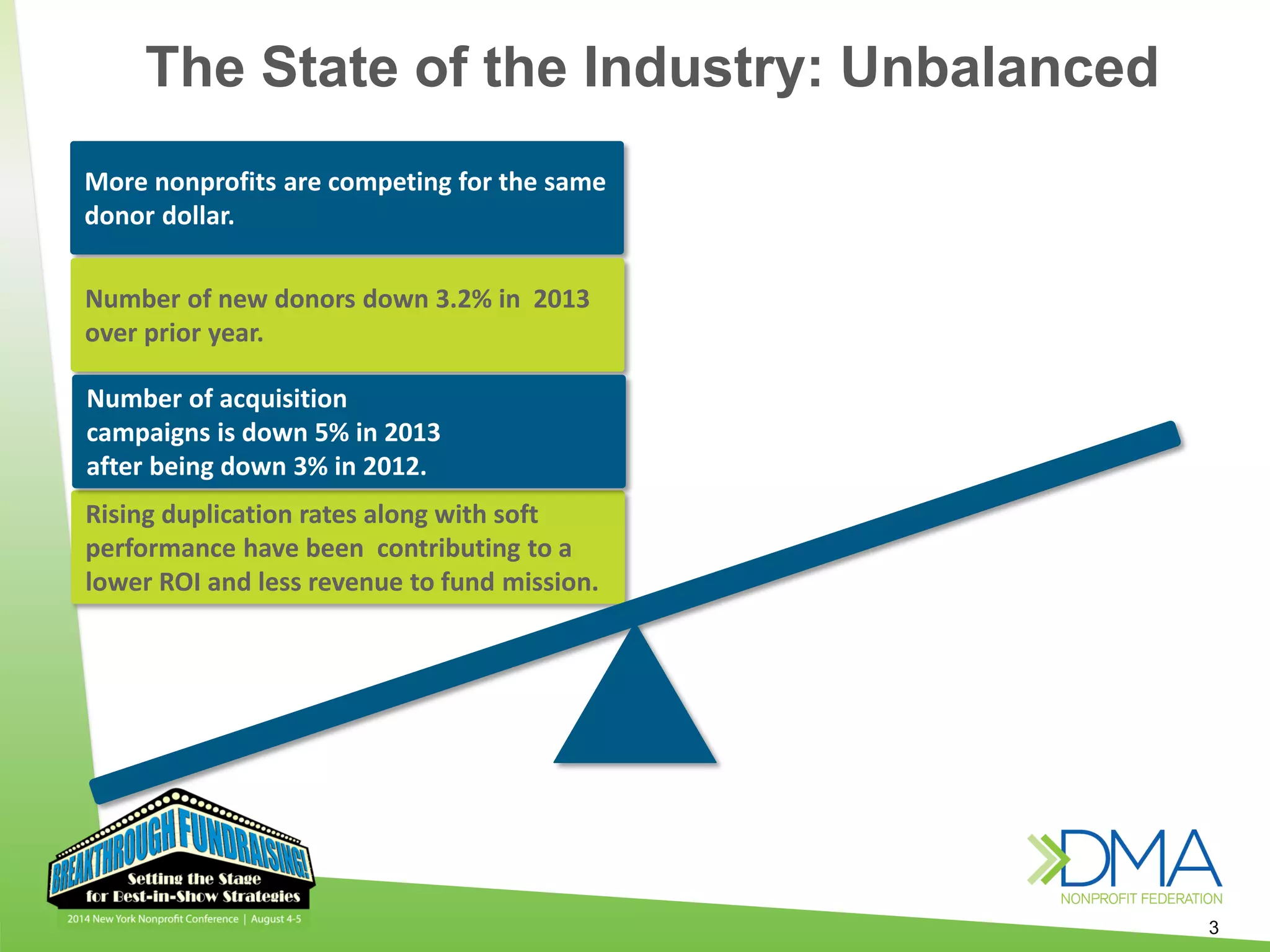
Rising duplication rates along with soft
performance have been contributing to a
lower ROI and less revenue to fund mission.
The State of the Industry: Unbalanced
More nonprofits are competing for the same
donor dollar.
Number of new donors down 3.2% in 2013
over prior year.
Number of acquisition
campaigns is down 5% in 2013
after being down 3% in 2012.
4
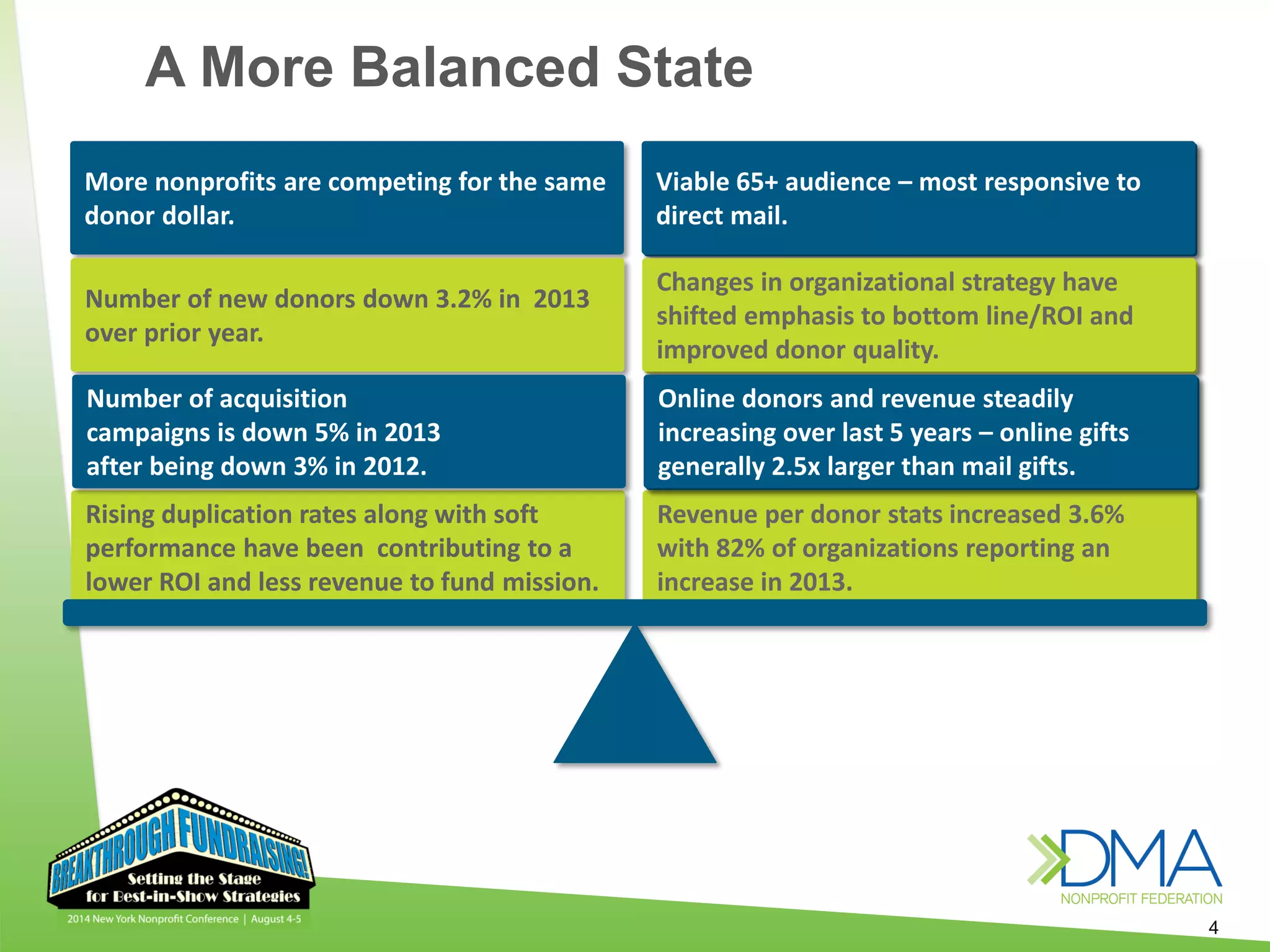
Number of acquisition
campaigns is down 5% in 2013
after being down 3% in 2012.
Revenue per donor stats increased 3.6%
with 82% of organizations reporting an
increase in 2013.
Rising duplication rates along with soft
performance have been contributing to a
lower ROI and less revenue to fund mission.
More nonprofits are competing for the same
donor dollar.
Number of new donors down 3.2% in 2013
over prior year.
Number of acquisition
campaigns is down 5% in 2013
after being down 3% in 2012.
A More Balanced State
More nonprofits are competing for the same
donor dollar.
Rising duplication rates along with soft
performance have been contributing to a
lower ROI and less revenue to fund mission.
Number of new donors down 3.2% in 2013
over prior year.
Viable 65+ audience – most responsive to
direct mail.
Changes in organizational strategy have
shifted emphasis to bottom line/ROI and
improved donor quality.
Online donors and revenue steadily
increasing over last 5 years – online gifts
generally 2.5x larger than mail gifts.
5
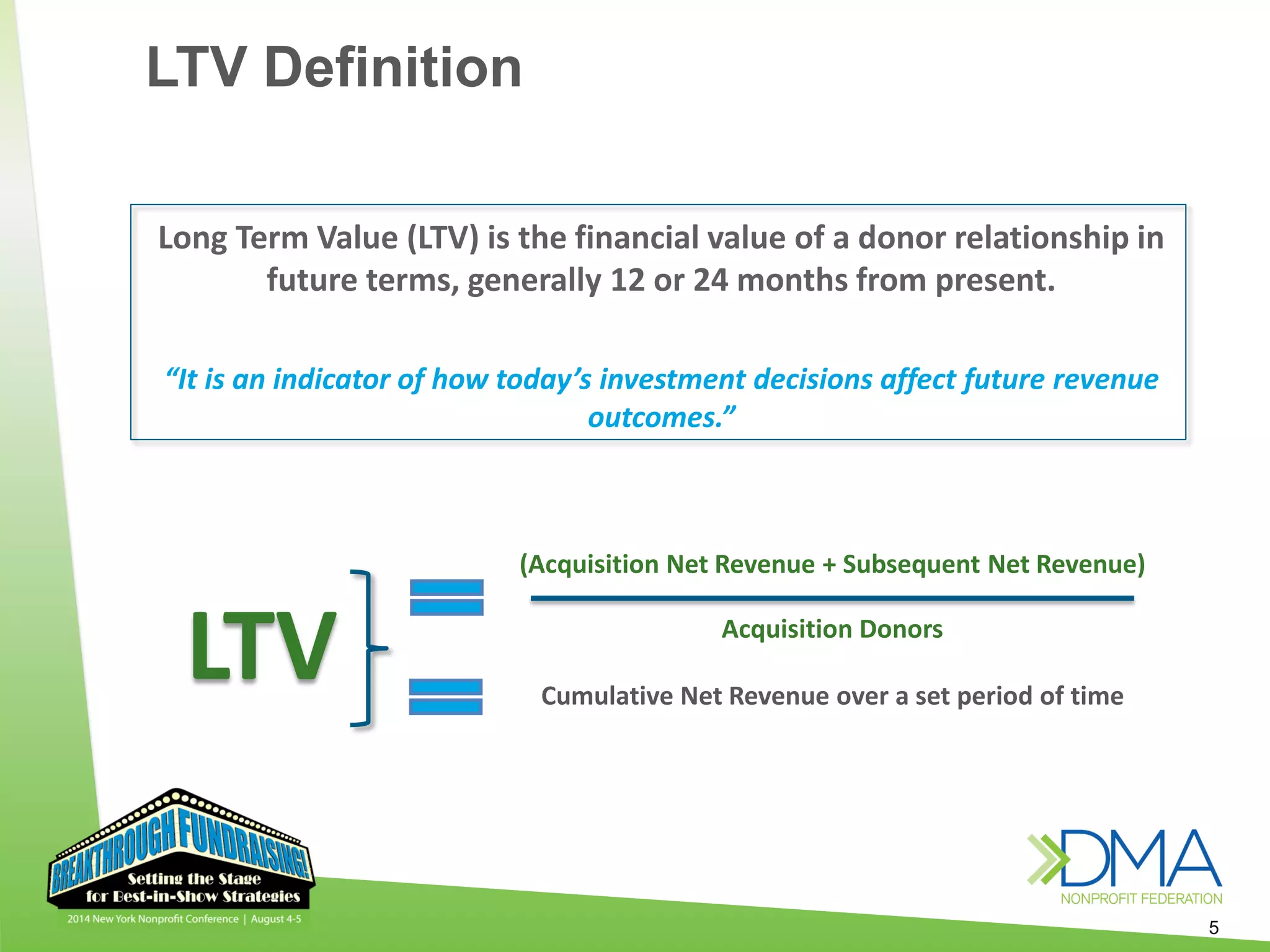
(Acquisition Net Revenue + Subsequent Net Revenue)
Acquisition Donors
LTV
Long Term Value (LTV) is the financial value of a donor relationship in
future terms, generally 12 or 24 months from present.
“It is an indicator of how today’s investment decisions affect future revenue
outcomes.”
LTV Definition
Cumulative Net Revenue over a set period of time
6
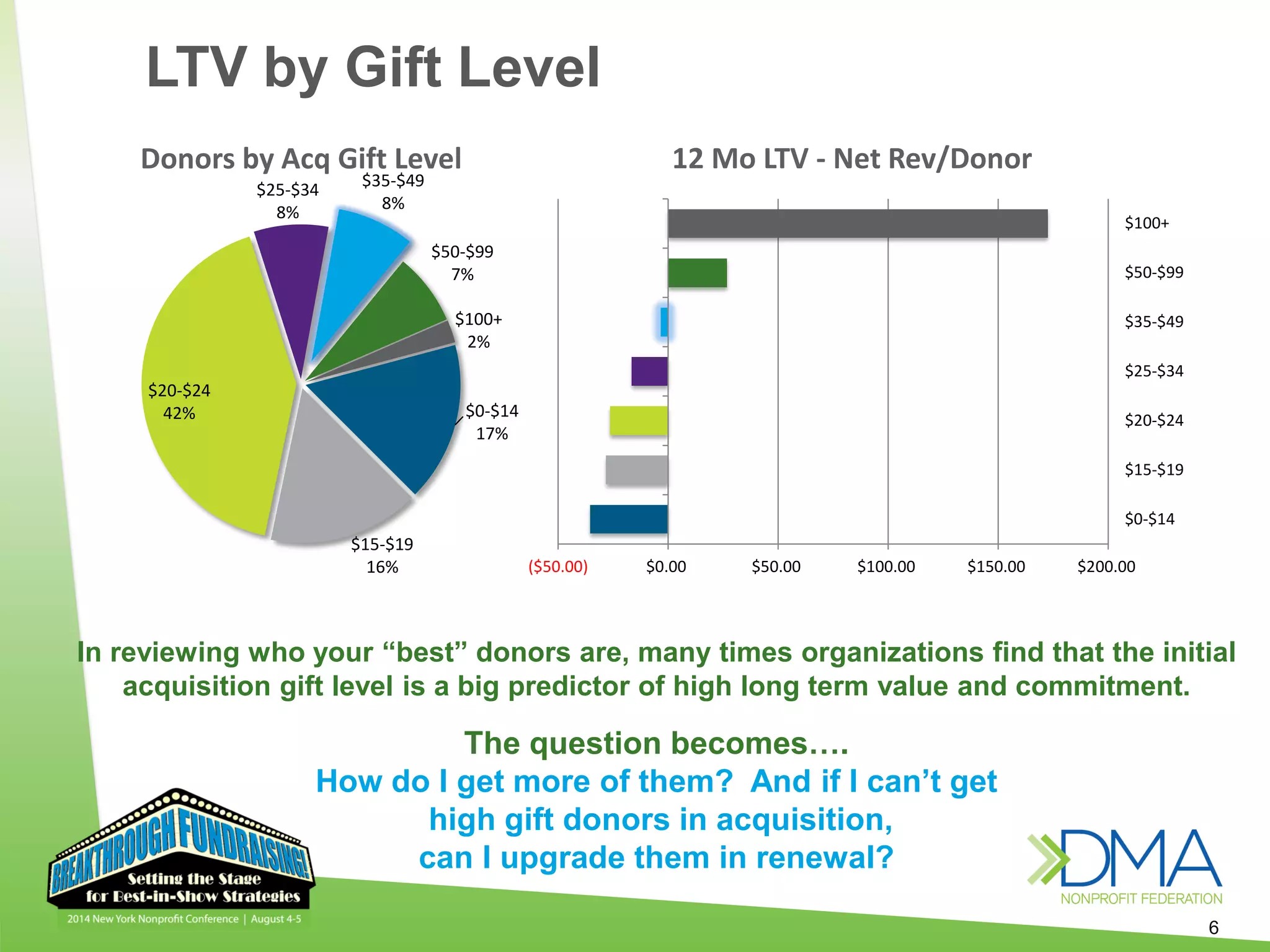
In reviewing who your “best” donors are, many times organizations find that the initial
acquisition gift level is a big predictor of high long term value and commitment.
The question becomes….
How do I get more of them? And if I can’t get
high gift donors in acquisition,
can I upgrade them in renewal?
LTV by Gift Level
($50.00) $0.00 $50.00 $100.00 $150.00 $200.00
$0-$14
$15-$19
$20-$24
$25-$34
$35-$49
$50-$99
$100+
12 Mo LTV - Net Rev/Donor
$0-$14
17%
$15-$19
16%
$20-$24
42%
$25-$34
8%
$35-$49
8%
$50-$99
7%
$100+
2%
Donors by Acq Gift Level
7
HIGH GIFT DONORS COME FROM ALL ACQUISITION SOURCES.
The ability to separate high gift
from low gift prospects for improved targeting
is a challenge for many organizations.
LTV by Gift Level: List Source
0%
20%
40%
60%
80%
100%
120%
List #1 List #2 List #3 List #4 List #5 List #6 List #7
$0-$14 $15-$19 $20-$24 $25-$34 $35-$49 $50-$99 $100+
New leadership from commercial sector
Increased scrutiny on Direct Mail
acquisition budget
– Largest single expense source
Corporate giving overshadows DM due to
minimal cost of fundraising
– Corporate food donors often become funds
donors
– DM revenue is unrestricted
– DM revenue creates steady stream of revenue
35%
62%
3%
Feeding America (2013)
73%
6%
14%
7%
Industry (2012)
Individuals Corporations
Foundations Other
Feeding America – Our Story
Significant growth of online channel
Online new donor metrics better than that of Direct Mail
initially…
– Higher average gift
– Ability to acquire new sustainers
– Organic contributions further improve online metrics
Asked to invest more in digital than direct mail –
although digital not easily scalable
25%
75%
Digital
Sourced
Donors
Direct Mail
Sourced
Donors
Direct Mail vs. Online
CFO considers ROI at 12-month and 3-year views for
investment decisions
Became necessary to understand multi-channel LTV
– Built acquisition tool to look at subsequent giving and true
ROI by donor source
Need to shift focus from channel metrics to overall new
donor metrics
– Understand online attribution to offline
Investing more to test new channels
with lower costs – success with insert media
LTV and Investment Opportunities
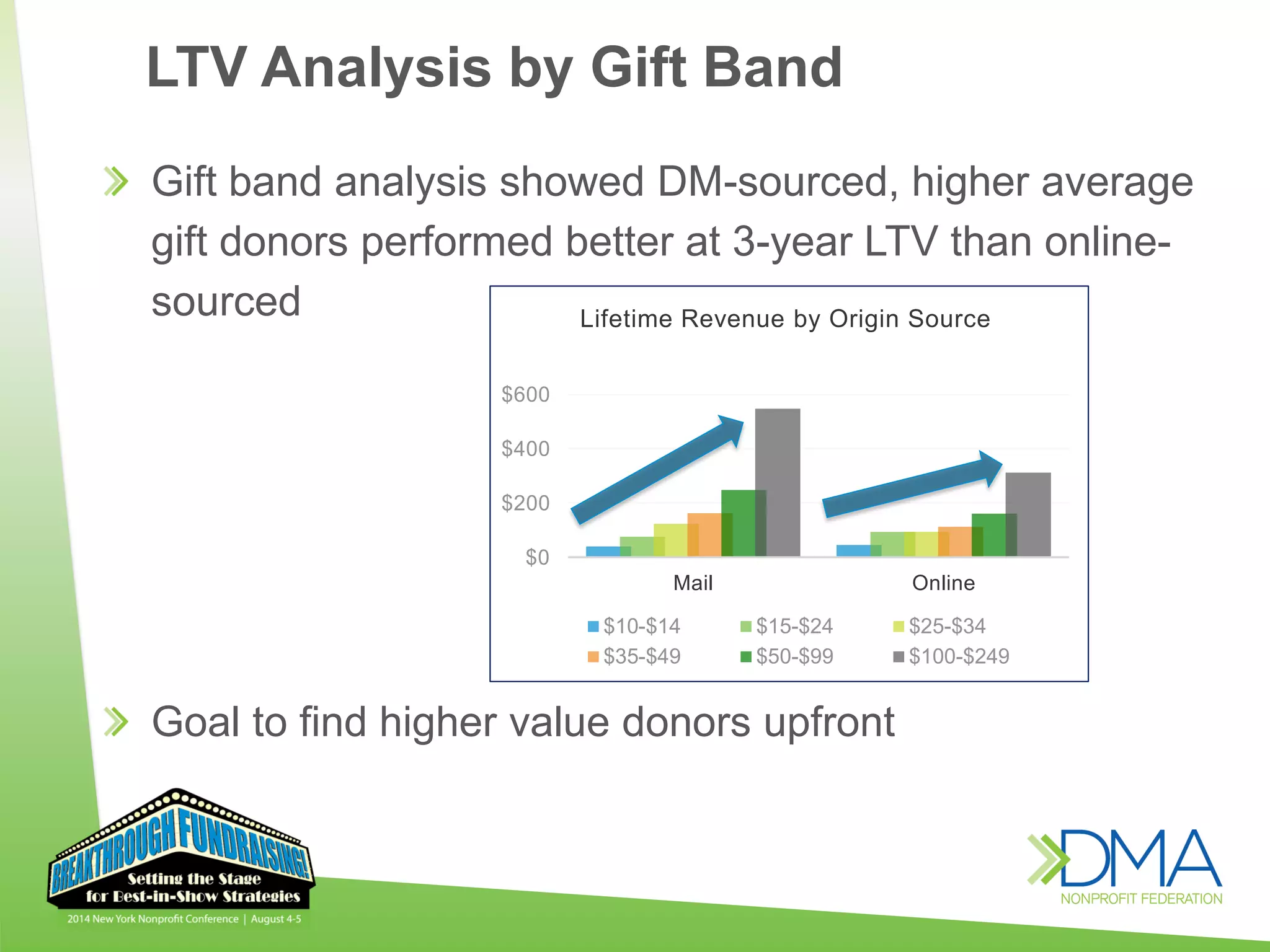
Gift band analysis showed DM-sourced, higher average
gift donors performed better at 3-year LTV than online-
sourced
Goal to find higher value donors upfront
$0
$200
$400
$600
Mail Online
Lifetime Revenue by Origin Source
$10-$14 $15-$24 $25-$34
$35-$49 $50-$99 $100-$249
LTV Analysis by Gift Band
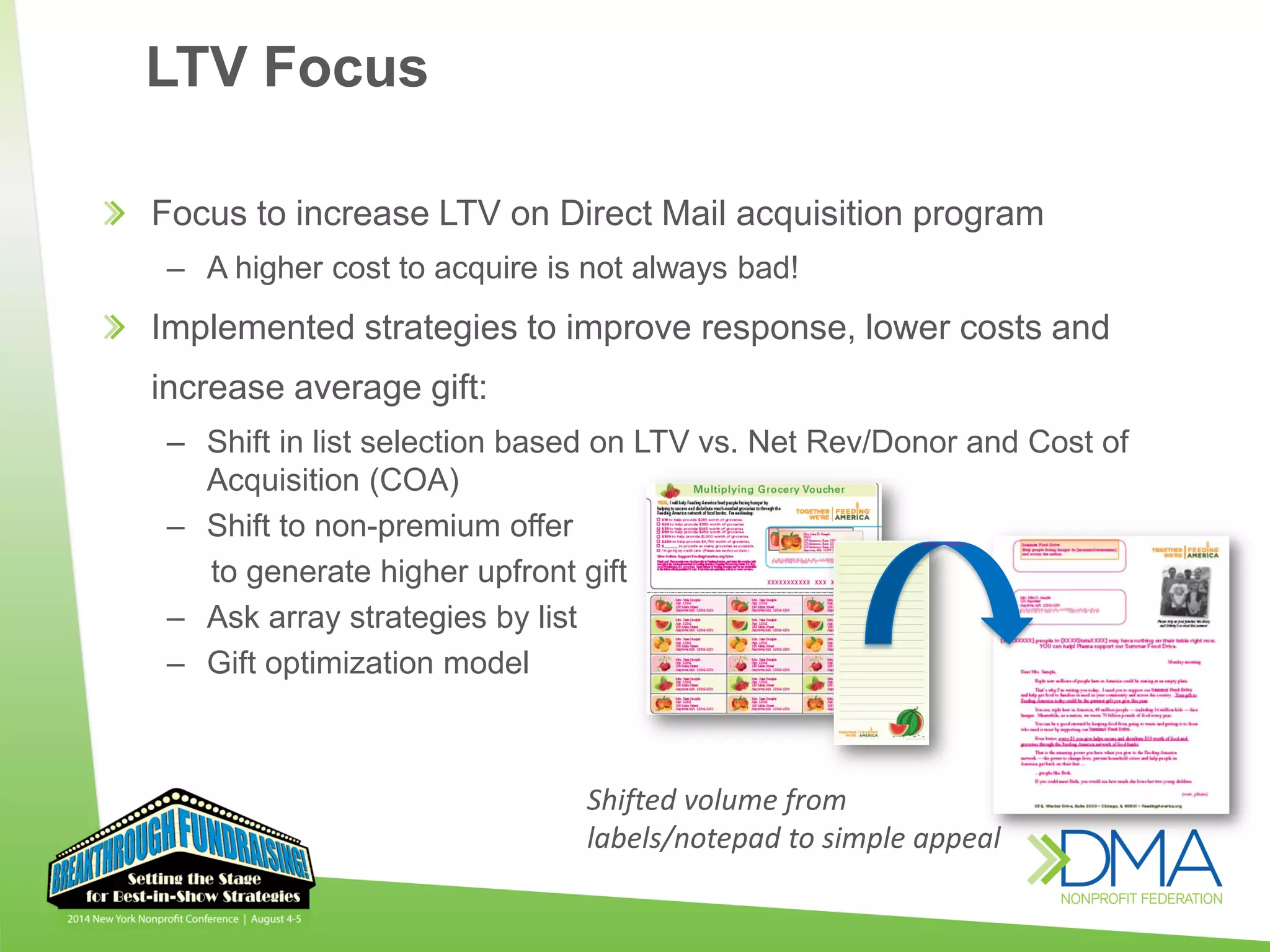
Focus to increase LTV on Direct Mail acquisition program
– A higher cost to acquire is not always bad!
Implemented strategies to improve response, lower costs and
increase average gift:
– Shift in list selection based on LTV vs. Net Rev/Donor and Cost of
Acquisition (COA)
– Shift to non-premium offer
to generate higher upfront gift
– Ask array strategies by list
– Gift optimization model
Shifted volume from
labels/notepad to simple appeal
LTV Focus
Targeting
High Gift
Donors & Prospects
14
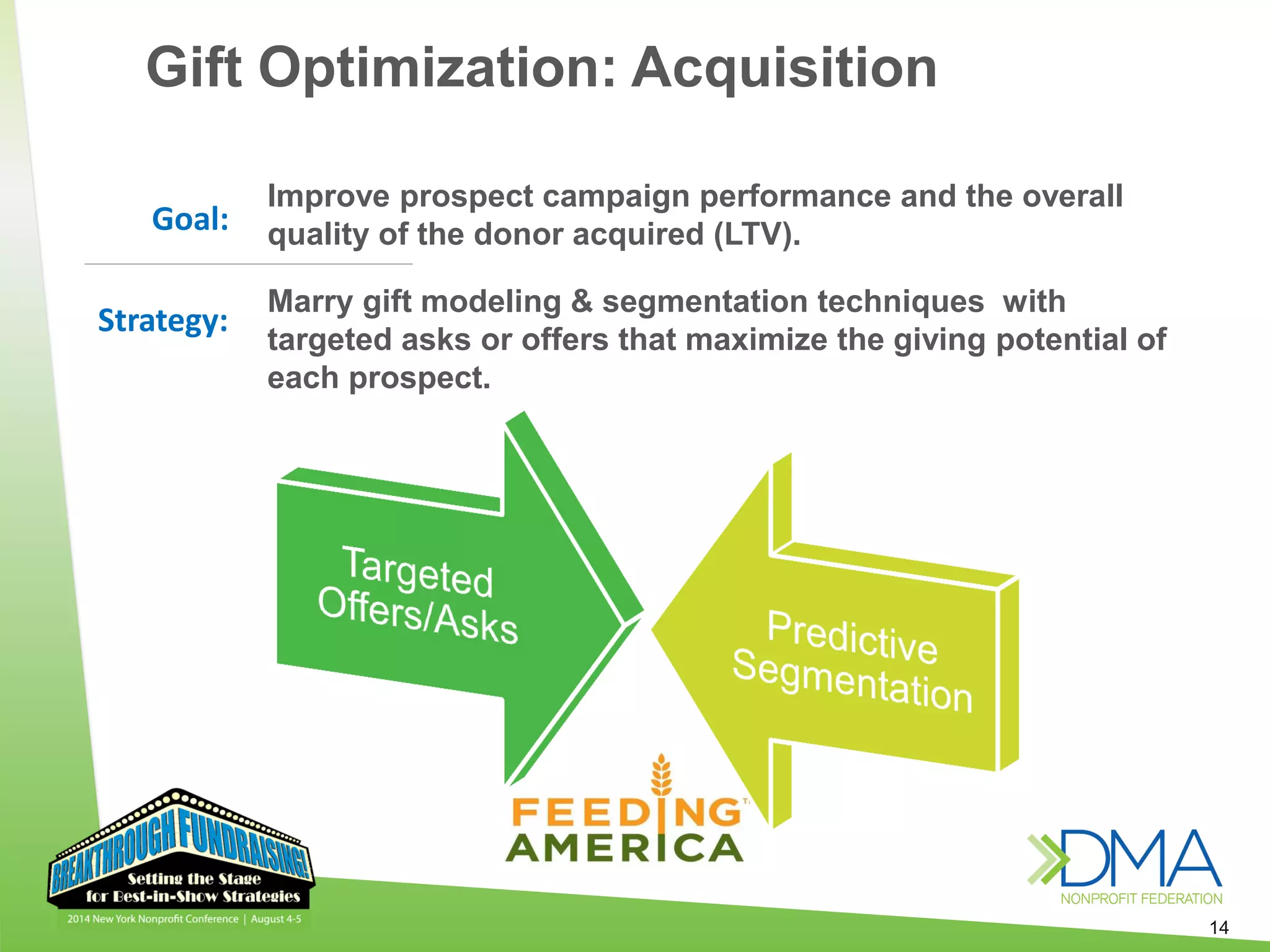
Marry gift modeling & segmentation techniques with
targeted asks or offers that maximize the giving potential of
each prospect.
Goal:
Strategy:
Improve prospect campaign performance and the overall
quality of the donor acquired (LTV).
Gift Optimization: Acquisition
15
91 95
131
172
94
47
0
20
40
60
80
100
120
140
160
180
200
HIGH $ MED $ LOW $
FEEDING AMERICA
GIFT OPTIMIZATION MODEL
RESP INDEX AVG $ INDEX
Combining demographic and lifestyle data variables with campaign
response behavior leads to predictive model segmentation.
Gift Optimization: Model Development
16
Key Differences Between “High Gift” and “Low Gift” prospects…
Recent Retirees: Ages 65-74
 Married
 Male
 Higher Income & Net Worth
 More likely to donate to Wildlife and Art causes
 Older Retirees: Ages 75+
 Single
 Female
 Lower Income & Net Worth
 More likely to donate to Cancer, Children, or
Catholic causes
High Gift
Low Gift
Gift Optimization: Audience Profile
17
Panel Audience
Test: Open
Ask
Test: High
Ask #1
Test: High
Ask #2
Control Ask
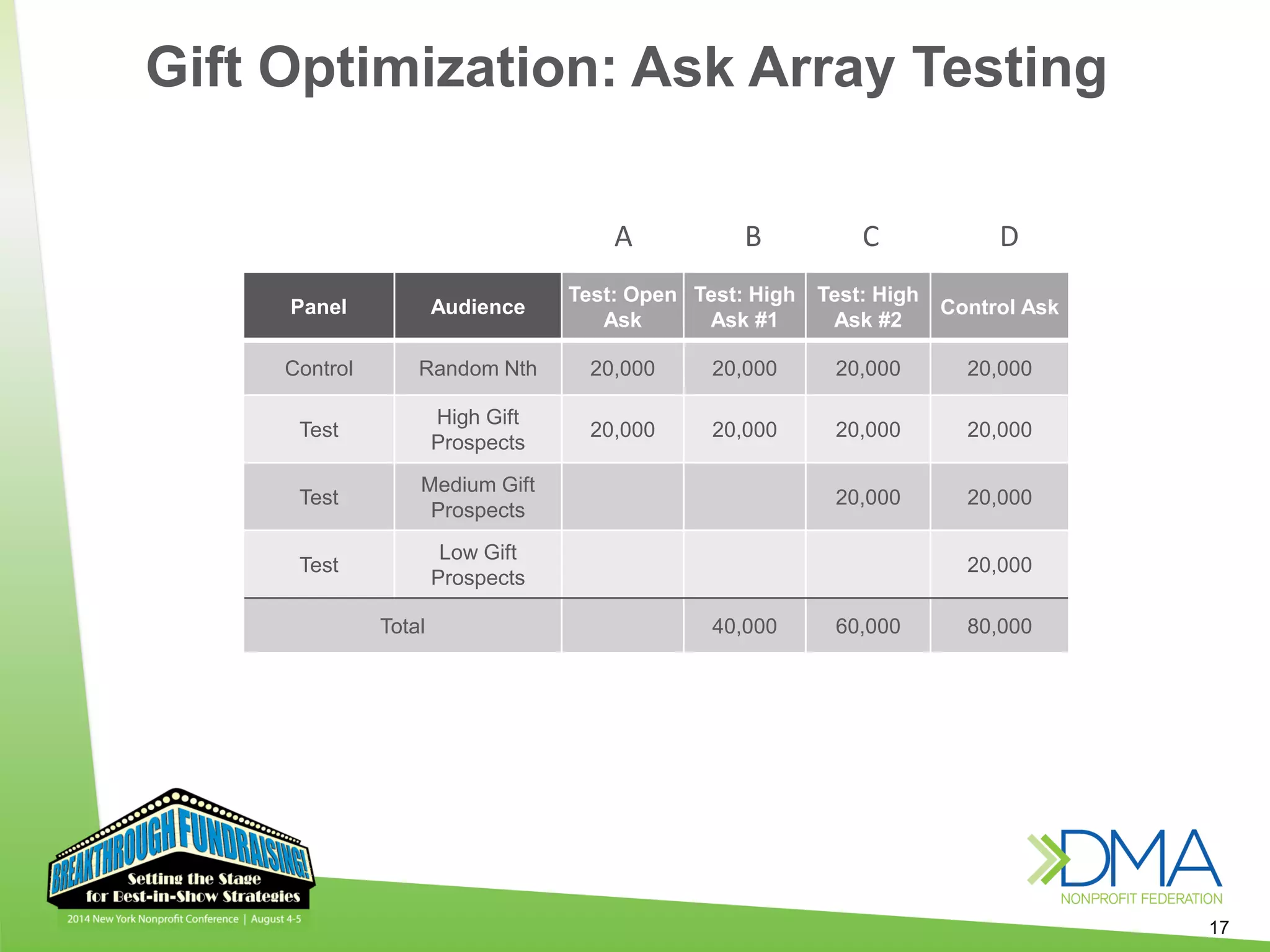
Control Random Nth 20,000 20,000 20,000 20,000
Test
High Gift
Prospects
20,000 20,000 20,000 20,000
Test
Medium Gift
Prospects
20,000 20,000
Test
Low Gift
Prospects
20,000
Total 40,000 60,000 80,000
Gift Optimization: Ask Array Testing
A CB D
18
Gift Optimization: Ask Array Testing
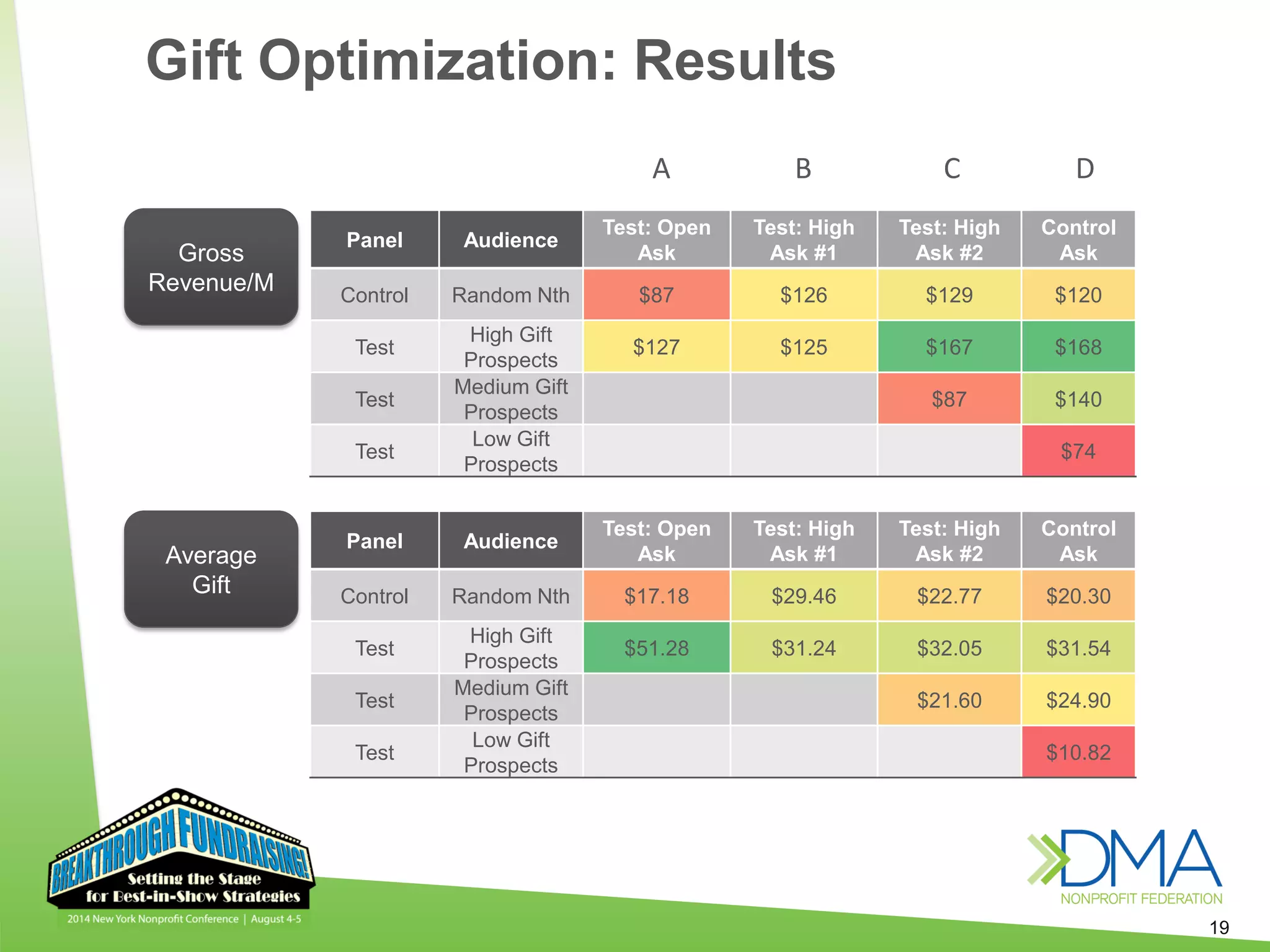
In addition to the
control ask array;
two higher arrays
and an open ask
were tested across
audience segments.
19
Panel Audience
Test: Open
Ask
Test: High
Ask #1
Test: High
Ask #2
Control
Ask
Control Random Nth $87 $126 $129 $120
Test
High Gift
Prospects
$127 $125 $167 $168
Test
Medium Gift
Prospects
$87 $140
Test
Low Gift
Prospects
$74
Panel Audience
Test: Open
Ask
Test: High
Ask #1
Test: High
Ask #2
Control
Ask
Control Random Nth $17.18 $29.46 $22.77 $20.30
Test
High Gift
Prospects
$51.28 $31.24 $32.05 $31.54
Test
Medium Gift
Prospects
$21.60 $24.90
Test
Low Gift
Prospects
$10.82
Gross
Revenue/M
Average
Gift
Gift Optimization: Results
A B C D
20
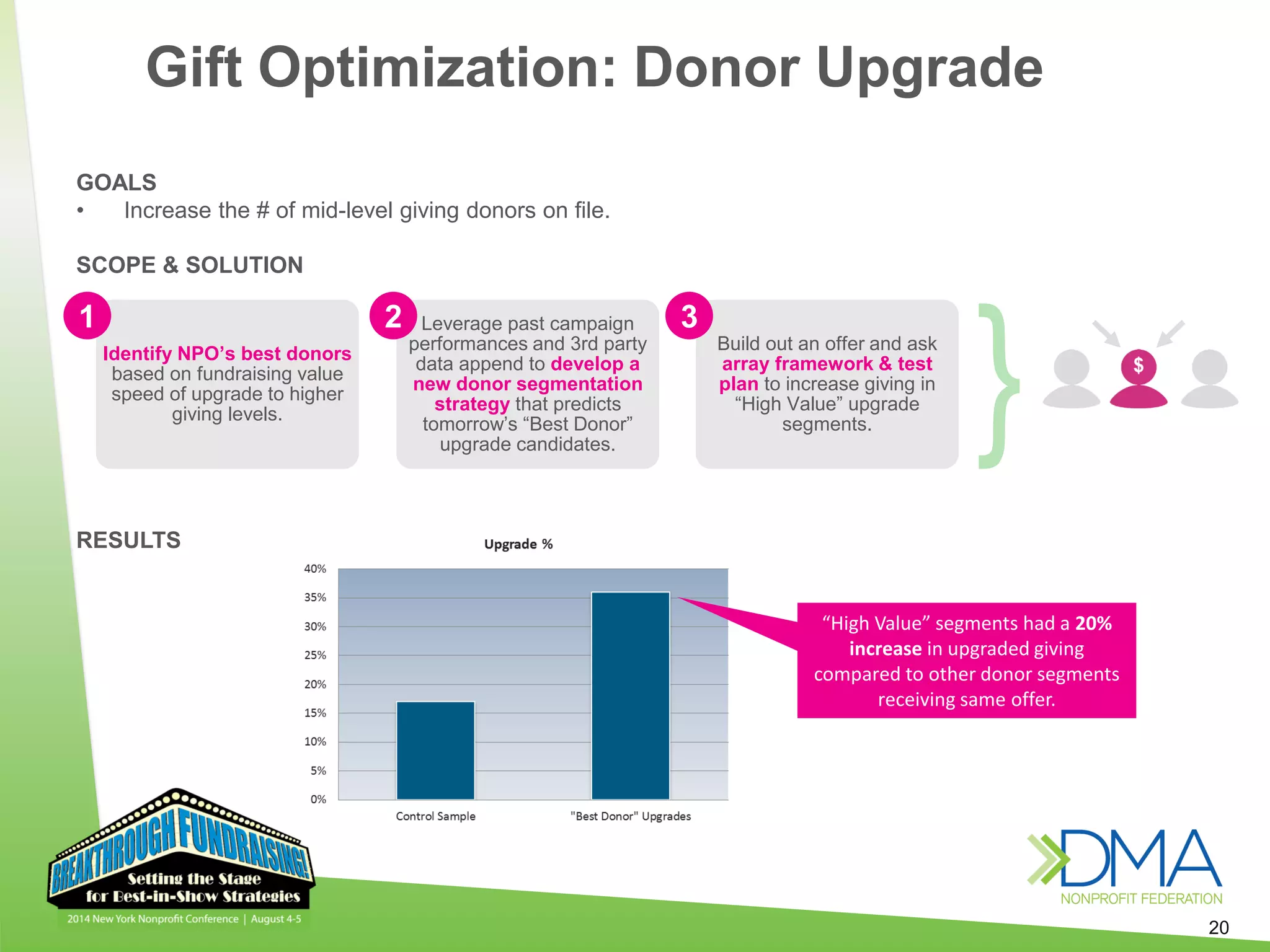
“High Value” segments had a 20%
increase in upgraded giving
compared to other donor segments
receiving same offer.
Identify NPO’s best donors
based on fundraising value
speed of upgrade to higher
giving levels.
Leverage past campaign
performances and 3rd party
data append to develop a
new donor segmentation
strategy that predicts
tomorrow’s “Best Donor”
upgrade candidates.
Build out an offer and ask
array framework & test
plan to increase giving in
“High Value” upgrade
segments.
1 2 3
}
GOALS
• Increase the # of mid-level giving donors on file.
SCOPE & SOLUTION
RESULTS
Gift Optimization: Donor Upgrade
21
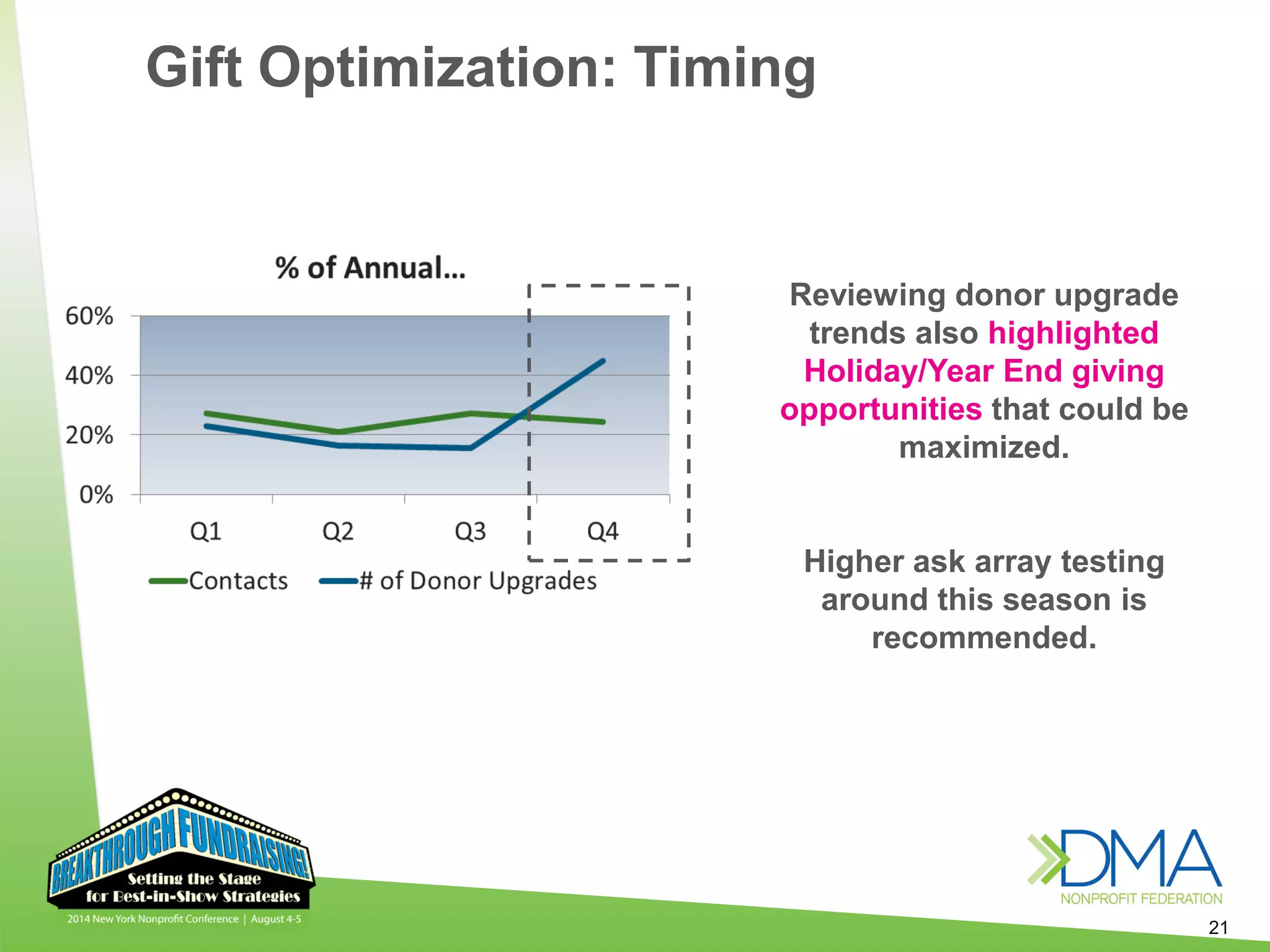
Reviewing donor upgrade
trends also highlighted
Holiday/Year End giving
opportunities that could be
maximized.
Higher ask array testing
around this season is
recommended.
Gift Optimization: Timing
22
• The recipe of receiving higher gifts from
your prospects and donors requires all
the ingredients…
– Audience
– Timing
– Offer
– Ask
• Define objective, test strategy & measurement upfront
– Should include specific audience that is being targeted
– Testing strategy should include creative, timing, offer and ask array
variables
– Be very specific about the key performance metrics used to evaluate
success (ex. Avg Gift or # of upgraded donors)
Best Practices & Methodology
Thank you
Philip Fertick
Director, Acquisition and New Media
Feeding America
pfertick@feedingamerica.org
Growing Long Term Value Through Gift
Optimization Strategies
Angelo Licursi
Vice President, Research Advisory Services
Paradysz
alicursi@paradysz.com
Adam Hannah
Director, Relationship Management
Paradysz
ahannah@paradysz.com

Growing-LTV

  • 1.
    Growing Long TermValue Through Gift Optimization Strategies
  • 2.
  • 3.
    3 Rising duplication ratesalong with soft performance have been contributing to a lower ROI and less revenue to fund mission. The State of the Industry: Unbalanced More nonprofits are competing for the same donor dollar. Number of new donors down 3.2% in 2013 over prior year. Number of acquisition campaigns is down 5% in 2013 after being down 3% in 2012.
  • 4.
    4 Number of acquisition campaignsis down 5% in 2013 after being down 3% in 2012. Revenue per donor stats increased 3.6% with 82% of organizations reporting an increase in 2013. Rising duplication rates along with soft performance have been contributing to a lower ROI and less revenue to fund mission. More nonprofits are competing for the same donor dollar. Number of new donors down 3.2% in 2013 over prior year. Number of acquisition campaigns is down 5% in 2013 after being down 3% in 2012. A More Balanced State More nonprofits are competing for the same donor dollar. Rising duplication rates along with soft performance have been contributing to a lower ROI and less revenue to fund mission. Number of new donors down 3.2% in 2013 over prior year. Viable 65+ audience – most responsive to direct mail. Changes in organizational strategy have shifted emphasis to bottom line/ROI and improved donor quality. Online donors and revenue steadily increasing over last 5 years – online gifts generally 2.5x larger than mail gifts.
  • 5.
    5 (Acquisition Net Revenue+ Subsequent Net Revenue) Acquisition Donors LTV Long Term Value (LTV) is the financial value of a donor relationship in future terms, generally 12 or 24 months from present. “It is an indicator of how today’s investment decisions affect future revenue outcomes.” LTV Definition Cumulative Net Revenue over a set period of time
  • 6.
    6 In reviewing whoyour “best” donors are, many times organizations find that the initial acquisition gift level is a big predictor of high long term value and commitment. The question becomes…. How do I get more of them? And if I can’t get high gift donors in acquisition, can I upgrade them in renewal? LTV by Gift Level ($50.00) $0.00 $50.00 $100.00 $150.00 $200.00 $0-$14 $15-$19 $20-$24 $25-$34 $35-$49 $50-$99 $100+ 12 Mo LTV - Net Rev/Donor $0-$14 17% $15-$19 16% $20-$24 42% $25-$34 8% $35-$49 8% $50-$99 7% $100+ 2% Donors by Acq Gift Level
  • 7.
    7 HIGH GIFT DONORSCOME FROM ALL ACQUISITION SOURCES. The ability to separate high gift from low gift prospects for improved targeting is a challenge for many organizations. LTV by Gift Level: List Source 0% 20% 40% 60% 80% 100% 120% List #1 List #2 List #3 List #4 List #5 List #6 List #7 $0-$14 $15-$19 $20-$24 $25-$34 $35-$49 $50-$99 $100+
  • 8.
    New leadership fromcommercial sector Increased scrutiny on Direct Mail acquisition budget – Largest single expense source Corporate giving overshadows DM due to minimal cost of fundraising – Corporate food donors often become funds donors – DM revenue is unrestricted – DM revenue creates steady stream of revenue 35% 62% 3% Feeding America (2013) 73% 6% 14% 7% Industry (2012) Individuals Corporations Foundations Other Feeding America – Our Story
  • 9.
    Significant growth ofonline channel Online new donor metrics better than that of Direct Mail initially… – Higher average gift – Ability to acquire new sustainers – Organic contributions further improve online metrics Asked to invest more in digital than direct mail – although digital not easily scalable 25% 75% Digital Sourced Donors Direct Mail Sourced Donors Direct Mail vs. Online
  • 10.
    CFO considers ROIat 12-month and 3-year views for investment decisions Became necessary to understand multi-channel LTV – Built acquisition tool to look at subsequent giving and true ROI by donor source Need to shift focus from channel metrics to overall new donor metrics – Understand online attribution to offline Investing more to test new channels with lower costs – success with insert media LTV and Investment Opportunities
  • 11.
    Gift band analysisshowed DM-sourced, higher average gift donors performed better at 3-year LTV than online- sourced Goal to find higher value donors upfront $0 $200 $400 $600 Mail Online Lifetime Revenue by Origin Source $10-$14 $15-$24 $25-$34 $35-$49 $50-$99 $100-$249 LTV Analysis by Gift Band
  • 12.
    Focus to increaseLTV on Direct Mail acquisition program – A higher cost to acquire is not always bad! Implemented strategies to improve response, lower costs and increase average gift: – Shift in list selection based on LTV vs. Net Rev/Donor and Cost of Acquisition (COA) – Shift to non-premium offer to generate higher upfront gift – Ask array strategies by list – Gift optimization model Shifted volume from labels/notepad to simple appeal LTV Focus
  • 13.
  • 14.
    14 Marry gift modeling& segmentation techniques with targeted asks or offers that maximize the giving potential of each prospect. Goal: Strategy: Improve prospect campaign performance and the overall quality of the donor acquired (LTV). Gift Optimization: Acquisition
  • 15.
    15 91 95 131 172 94 47 0 20 40 60 80 100 120 140 160 180 200 HIGH $MED $ LOW $ FEEDING AMERICA GIFT OPTIMIZATION MODEL RESP INDEX AVG $ INDEX Combining demographic and lifestyle data variables with campaign response behavior leads to predictive model segmentation. Gift Optimization: Model Development
  • 16.
    16 Key Differences Between“High Gift” and “Low Gift” prospects… Recent Retirees: Ages 65-74  Married  Male  Higher Income & Net Worth  More likely to donate to Wildlife and Art causes  Older Retirees: Ages 75+  Single  Female  Lower Income & Net Worth  More likely to donate to Cancer, Children, or Catholic causes High Gift Low Gift Gift Optimization: Audience Profile
  • 17.
    17 Panel Audience Test: Open Ask Test:High Ask #1 Test: High Ask #2 Control Ask Control Random Nth 20,000 20,000 20,000 20,000 Test High Gift Prospects 20,000 20,000 20,000 20,000 Test Medium Gift Prospects 20,000 20,000 Test Low Gift Prospects 20,000 Total 40,000 60,000 80,000 Gift Optimization: Ask Array Testing A CB D
  • 18.
    18 Gift Optimization: AskArray Testing In addition to the control ask array; two higher arrays and an open ask were tested across audience segments.
  • 19.
    19 Panel Audience Test: Open Ask Test:High Ask #1 Test: High Ask #2 Control Ask Control Random Nth $87 $126 $129 $120 Test High Gift Prospects $127 $125 $167 $168 Test Medium Gift Prospects $87 $140 Test Low Gift Prospects $74 Panel Audience Test: Open Ask Test: High Ask #1 Test: High Ask #2 Control Ask Control Random Nth $17.18 $29.46 $22.77 $20.30 Test High Gift Prospects $51.28 $31.24 $32.05 $31.54 Test Medium Gift Prospects $21.60 $24.90 Test Low Gift Prospects $10.82 Gross Revenue/M Average Gift Gift Optimization: Results A B C D
  • 20.
    20 “High Value” segmentshad a 20% increase in upgraded giving compared to other donor segments receiving same offer. Identify NPO’s best donors based on fundraising value speed of upgrade to higher giving levels. Leverage past campaign performances and 3rd party data append to develop a new donor segmentation strategy that predicts tomorrow’s “Best Donor” upgrade candidates. Build out an offer and ask array framework & test plan to increase giving in “High Value” upgrade segments. 1 2 3 } GOALS • Increase the # of mid-level giving donors on file. SCOPE & SOLUTION RESULTS Gift Optimization: Donor Upgrade
  • 21.
    21 Reviewing donor upgrade trendsalso highlighted Holiday/Year End giving opportunities that could be maximized. Higher ask array testing around this season is recommended. Gift Optimization: Timing
  • 22.
    22 • The recipeof receiving higher gifts from your prospects and donors requires all the ingredients… – Audience – Timing – Offer – Ask • Define objective, test strategy & measurement upfront – Should include specific audience that is being targeted – Testing strategy should include creative, timing, offer and ask array variables – Be very specific about the key performance metrics used to evaluate success (ex. Avg Gift or # of upgraded donors) Best Practices & Methodology
  • 23.
    Thank you Philip Fertick Director,Acquisition and New Media Feeding America pfertick@feedingamerica.org Growing Long Term Value Through Gift Optimization Strategies Angelo Licursi Vice President, Research Advisory Services Paradysz alicursi@paradysz.com Adam Hannah Director, Relationship Management Paradysz ahannah@paradysz.com