
1
|
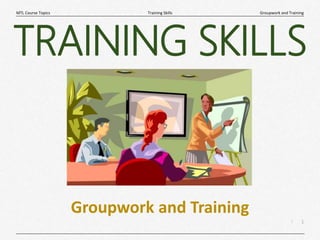
Groupwork and Training
Training Skills
MTL Course Topics
Groupwork and Training
TRAINING SKILLS
2
|
Groupwork and Training
Training Skills
MTL Course Topics
The Course Topics series from Manage Train Learn is a large collection of topics that will help you as a learner
to quickly and easily master a range of skills in your everyday working life and life outside work. If you are a
trainer, they are perfect for adding to your classroom courses and online learning plans.
COURSE TOPICS FROM MTL
The written content in this Slide Topic belongs exclusively to Manage Train Learn and may only be reprinted
either by attribution to Manage Train Learn or with the express written permission of Manage Train Learn.
They are designed as a series of numbered
slides. As with all programmes on Slide
Topics, these slides are fully editable and
can be used in your own programmes,
royalty-free. Your only limitation is that
you may not re-publish or sell these slides
as your own.
Copyright Manage Train Learn 2020
onwards.
Attribution: All images are from sources
which do not require attribution and may
be used for commercial uses. Sources
include pixabay, unsplash, and freepik.
These images may also be those which are
in the public domain, out of copyright, for
fair use, or allowed under a Creative
Commons license.
3
|
Groupwork and Training
Training Skills
MTL Course Topics
ARE YOU READY?
OK, LET’S START!
4
|
Groupwork and Training
Training Skills
MTL Course Topics
INTRODUCTION
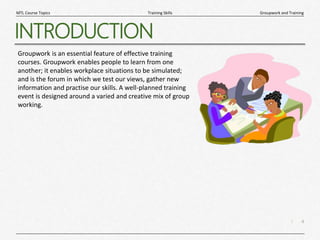
Groupwork is an essential feature of effective training
courses. Groupwork enables people to learn from one
another; it enables workplace situations to be simulated;
and is the forum in which we test our views, gather new
information and practise our skills. A well-planned training
event is designed around a varied and creative mix of group
working.
5
|
Groupwork and Training
Training Skills
MTL Course Topics
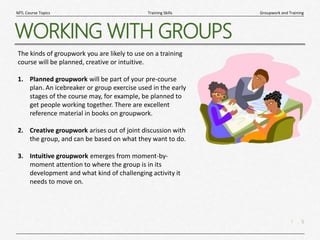
WORKING WITH GROUPS
The kinds of groupwork you are likely to use on a training
course will be planned, creative or intuitive.
1. Planned groupwork will be part of your pre-course
plan. An icebreaker or group exercise used in the early
stages of the course may, for example, be planned to
get people working together. There are excellent
reference material in books on groupwork.
2. Creative groupwork arises out of joint discussion with
the group, and can be based on what they want to do.
3. Intuitive groupwork emerges from moment-by-
moment attention to where the group is in its
development and what kind of challenging activity it
needs to move on.
6
|
Groupwork and Training
Training Skills
MTL Course Topics
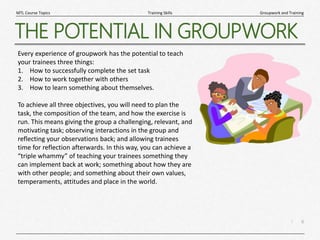
THE POTENTIAL IN GROUPWORK
Every experience of groupwork has the potential to teach
your trainees three things:
1. How to successfully complete the set task
2. How to work together with others
3. How to learn something about themselves.
To achieve all three objectives, you will need to plan the
task, the composition of the team, and how the exercise is
run. This means giving the group a challenging, relevant, and
motivating task; observing interactions in the group and
reflecting your observations back; and allowing trainees
time for reflection afterwards. In this way, you can achieve a
“triple whammy” of teaching your trainees something they
can implement back at work; something about how they are
with other people; and something about their own values,
temperaments, attitudes and place in the world.
7
|
Groupwork and Training
Training Skills
MTL Course Topics
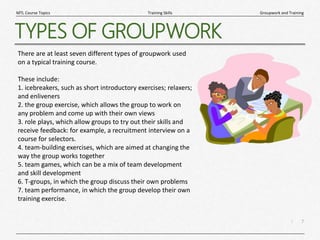
TYPES OF GROUPWORK
There are at least seven different types of groupwork used
on a typical training course.
These include:
1. icebreakers, such as short introductory exercises; relaxers;
and enliveners
2. the group exercise, which allows the group to work on
any problem and come up with their own views
3. role plays, which allow groups to try out their skills and
receive feedback: for example, a recruitment interview on a
course for selectors.
4. team-building exercises, which are aimed at changing the
way the group works together
5. team games, which can be a mix of team development
and skill development
6. T-groups, in which the group discuss their own problems
7. team performance, in which the group develop their own
training exercise.
8
|
Groupwork and Training
Training Skills
MTL Course Topics
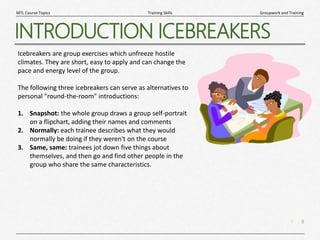
INTRODUCTION ICEBREAKERS
Icebreakers are group exercises which unfreeze hostile
climates. They are short, easy to apply and can change the
pace and energy level of the group.
The following three icebreakers can serve as alternatives to
personal "round-the-room" introductions:
1. Snapshot: the whole group draws a group self-portrait
on a flipchart, adding their names and comments
2. Normally: each trainee describes what they would
normally be doing if they weren't on the course
3. Same, same: trainees jot down five things about
themselves, and then go and find other people in the
group who share the same characteristics.
9
|
Groupwork and Training
Training Skills
MTL Course Topics
QUICKIE ICEBREAKERS
Quickies are icebreaker exercises which act as fill-ins, quick
review sessions, or activities to change the pace of a course.
Here are five Quickie icebreakers:
1. Hot ball A to Z: trainees throw a hot-ball (woolly ball),
from person to person. When someone catches the ball,
they say a word connected with the course themes,
moving from A to Z.
2. Spot running: run on the spot for a few minutes.
3. Seat change: everyone changes seats so that they are
not next to anyone they've already sat beside.
4. Graffiti chart: the group put any comments about how
they feel right now on a graffiti flipchart.
5. Mountain call: the group split into four and stand in the
four corners of the room. From here they take turns to
call out a course theme as if they were calling from a
mountain top.
10
|
Groupwork and Training
Training Skills
MTL Course Topics
RELAXING ICEBREAKERS
Relaxers are group exercises that slow the pace and allow
people to relax. They can be combined with visualisation
exercises to carry out quiet reviews of course material.
Feathers
Sit quietly, close your eyes and imagine that you can see a
white feather falling gently in front of you against a clear
blue sky. As the feather descends, you unwind and your
muscles gradually lose their rigidity. When the feather
eventually touches the ground, you are completely relaxed.
The Classical Rose
Sit quietly, close your eyes and imagine a red rose in your
mind's eye. At the start it is a closed bud, but gradually each
petal opens. As the petals open, you unwind and your
muscles relax. Eventually, the rose is fully open and you are
completely at ease.
11
|
Groupwork and Training
Training Skills
MTL Course Topics
THE GROUP EXERCISE
The Group Exercise is the basic format for all groupwork.
It consists of the following steps:
1. Set the whole group as individuals a task eg "How can the
company improve customer service?" Allow five minutes for
trainees to write down their ideas.
2. Now split the group into teams of 4 or 5 (or alternatively
ask them to split themselves).
3. Instruct the teams to go into their own space and discuss
their ideas. At the end of, say, 25 minutes, they must record
their views on a flipchart.
4. Before they return to present their views, the teams must
also agree a team name, and decide how they will present
their views using everyone in the team.
5. Teams return and present their views.
6. The whole group discusses both the team's views and
how each team worked as a team.
12
|
Groupwork and Training
Training Skills
MTL Course Topics
ROLE PLAY
Group role play exercises offer the chance to practise skills
and responses in situations which imitate those in the
workplace. They are particularly useful for rehearsing set-
piece situations such as interviews and group meetings.
These are key points in succeeding with role plays:
1. role plays should only be attempted when there is a
high level of trust in the group
2. trainees should be allowed to volunteer or hold back
from participating until they feel ready
3. role plays can be conducted in large or small groups
4. others in the group should act as observers; the group
can be instructed in how to give feedback to each other
5. set-piece role plays can be usefully video-ed and then
played back to participants for comments
6. "ghost-cards" can be slipped to participants in a role
play, such as "stop listening" or "get angry" or "make it
difficult" to alter the situation.
13
|
Groupwork and Training
Training Skills
MTL Course Topics
T-GROUP TRAINING
T-group, or sensitivity, training aims to train people to work
better in teams by confronting their personal feelings about
others in the group.
Exercises can range from openly discussing personal blocks
about others to mime and movement work aimed at freeing
or expressing deep-seated emotions.
While T-group training may have a valuable role to play in
dealing with major blocks in teamwork, it needs an
experienced and sensitive facilitator and a supportive team.
Some of the issues uncovered in the training room can be
highly personal and potentially embarrassing.
14
|
Groupwork and Training
Training Skills
MTL Course Topics
BUILDING THE TEAM
Many of the groupwork exercises on a training course can
have team-building as their principal aim. There are four
types of team-building exercise:
1. Co-ordinating games: the team members receive bits of
a puzzle and have to work together to find the solution
2. Team problem-solving: the team are given a problem to
solve. This can test any of the following team skills:
leadership, communication, planning, and organising.
3. Team competition: the group splits into teams in
competition with each other. A good example is a team
quiz.
4. Outdoor training: the team meets in an outdoor
environment to complete a task. This could be any task
in the vicinity or an adventure training exercise such as
mountain climbing and abseiling.
15
|
Groupwork and Training
Training Skills
MTL Course Topics
THE SIGMA RAY EMITTER
The following are instructions for an Outdoor training
exercise in a location close to a training centre:
Your team are members of an emergency bomb disposal
unit. Two boys have just discovered a brown box nearby
which has been identified as a highly dangerous sigma ray
emitter. One of the boys touched it and is now critically ill in
hospital.
Your task is to find the device and bring it back to this base
before it goes critical in 40 minutes.
You cannot touch the device without having to immediately
retire for medical treatment. Nor can you approach within a
metre of the emitter or drop it to the ground during
recovery.
Metal, wood and rope may be used without fear of
conducting the dangerous rays.
Hurry! There is no time to lose. (Thanks to BACIE)
16
|
Groupwork and Training
Training Skills
MTL Course Topics
TEAM GAMES
Team games are sometimes used as set-pieces or grand
finales to courses. They work best when teams have
become established, have high levels of openness and trust
and people are ready to mix work and fun.
The role of the trainer during a team game is...
1. to explain the task clearly
2. to make sure that the correct materials are provided
3. to act as observer and recorder of how the teams work,
possibly including video recording
4. to act as impartial arbiter if problems arise
5. to intervene if things start going seriously wrong
6. to make sure everyone is involved
7. to organise the post-game presentation
8. to lead de-briefing sessions.
17
|
Groupwork and Training
Training Skills
MTL Course Topics
TEAM PERFORMANCE
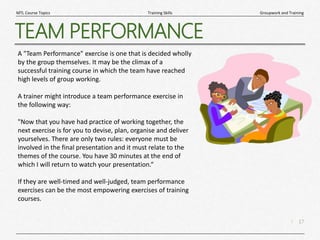
A "Team Performance" exercise is one that is decided wholly
by the group themselves. It may be the climax of a
successful training course in which the team have reached
high levels of group working.
A trainer might introduce a team performance exercise in
the following way:
"Now that you have had practice of working together, the
next exercise is for you to devise, plan, organise and deliver
yourselves. There are only two rules: everyone must be
involved in the final presentation and it must relate to the
themes of the course. You have 30 minutes at the end of
which I will return to watch your presentation.“
If they are well-timed and well-judged, team performance
exercises can be the most empowering exercises of training
courses.
18
|
Groupwork and Training
Training Skills
MTL Course Topics
THAT’S
IT!
WELL DONE!
19
|
Groupwork and Training
Training Skills
MTL Course Topics
THANK YOU
This has been a Slide Topic from Manage Train Learn

Groupwork and Training

  • 1.
    1 | Groupwork and Training TrainingSkills MTL Course Topics Groupwork and Training TRAINING SKILLS
  • 2.
    2 | Groupwork and Training TrainingSkills MTL Course Topics The Course Topics series from Manage Train Learn is a large collection of topics that will help you as a learner to quickly and easily master a range of skills in your everyday working life and life outside work. If you are a trainer, they are perfect for adding to your classroom courses and online learning plans. COURSE TOPICS FROM MTL The written content in this Slide Topic belongs exclusively to Manage Train Learn and may only be reprinted either by attribution to Manage Train Learn or with the express written permission of Manage Train Learn. They are designed as a series of numbered slides. As with all programmes on Slide Topics, these slides are fully editable and can be used in your own programmes, royalty-free. Your only limitation is that you may not re-publish or sell these slides as your own. Copyright Manage Train Learn 2020 onwards. Attribution: All images are from sources which do not require attribution and may be used for commercial uses. Sources include pixabay, unsplash, and freepik. These images may also be those which are in the public domain, out of copyright, for fair use, or allowed under a Creative Commons license.
  • 3.
    3 | Groupwork and Training TrainingSkills MTL Course Topics ARE YOU READY? OK, LET’S START!
  • 4.
    4 | Groupwork and Training TrainingSkills MTL Course Topics INTRODUCTION Groupwork is an essential feature of effective training courses. Groupwork enables people to learn from one another; it enables workplace situations to be simulated; and is the forum in which we test our views, gather new information and practise our skills. A well-planned training event is designed around a varied and creative mix of group working.
  • 5.
    5 | Groupwork and Training TrainingSkills MTL Course Topics WORKING WITH GROUPS The kinds of groupwork you are likely to use on a training course will be planned, creative or intuitive. 1. Planned groupwork will be part of your pre-course plan. An icebreaker or group exercise used in the early stages of the course may, for example, be planned to get people working together. There are excellent reference material in books on groupwork. 2. Creative groupwork arises out of joint discussion with the group, and can be based on what they want to do. 3. Intuitive groupwork emerges from moment-by- moment attention to where the group is in its development and what kind of challenging activity it needs to move on.
  • 6.
    6 | Groupwork and Training TrainingSkills MTL Course Topics THE POTENTIAL IN GROUPWORK Every experience of groupwork has the potential to teach your trainees three things: 1. How to successfully complete the set task 2. How to work together with others 3. How to learn something about themselves. To achieve all three objectives, you will need to plan the task, the composition of the team, and how the exercise is run. This means giving the group a challenging, relevant, and motivating task; observing interactions in the group and reflecting your observations back; and allowing trainees time for reflection afterwards. In this way, you can achieve a “triple whammy” of teaching your trainees something they can implement back at work; something about how they are with other people; and something about their own values, temperaments, attitudes and place in the world.
  • 7.
    7 | Groupwork and Training TrainingSkills MTL Course Topics TYPES OF GROUPWORK There are at least seven different types of groupwork used on a typical training course. These include: 1. icebreakers, such as short introductory exercises; relaxers; and enliveners 2. the group exercise, which allows the group to work on any problem and come up with their own views 3. role plays, which allow groups to try out their skills and receive feedback: for example, a recruitment interview on a course for selectors. 4. team-building exercises, which are aimed at changing the way the group works together 5. team games, which can be a mix of team development and skill development 6. T-groups, in which the group discuss their own problems 7. team performance, in which the group develop their own training exercise.
  • 8.
    8 | Groupwork and Training TrainingSkills MTL Course Topics INTRODUCTION ICEBREAKERS Icebreakers are group exercises which unfreeze hostile climates. They are short, easy to apply and can change the pace and energy level of the group. The following three icebreakers can serve as alternatives to personal "round-the-room" introductions: 1. Snapshot: the whole group draws a group self-portrait on a flipchart, adding their names and comments 2. Normally: each trainee describes what they would normally be doing if they weren't on the course 3. Same, same: trainees jot down five things about themselves, and then go and find other people in the group who share the same characteristics.
  • 9.
    9 | Groupwork and Training TrainingSkills MTL Course Topics QUICKIE ICEBREAKERS Quickies are icebreaker exercises which act as fill-ins, quick review sessions, or activities to change the pace of a course. Here are five Quickie icebreakers: 1. Hot ball A to Z: trainees throw a hot-ball (woolly ball), from person to person. When someone catches the ball, they say a word connected with the course themes, moving from A to Z. 2. Spot running: run on the spot for a few minutes. 3. Seat change: everyone changes seats so that they are not next to anyone they've already sat beside. 4. Graffiti chart: the group put any comments about how they feel right now on a graffiti flipchart. 5. Mountain call: the group split into four and stand in the four corners of the room. From here they take turns to call out a course theme as if they were calling from a mountain top.
  • 10.
    10 | Groupwork and Training TrainingSkills MTL Course Topics RELAXING ICEBREAKERS Relaxers are group exercises that slow the pace and allow people to relax. They can be combined with visualisation exercises to carry out quiet reviews of course material. Feathers Sit quietly, close your eyes and imagine that you can see a white feather falling gently in front of you against a clear blue sky. As the feather descends, you unwind and your muscles gradually lose their rigidity. When the feather eventually touches the ground, you are completely relaxed. The Classical Rose Sit quietly, close your eyes and imagine a red rose in your mind's eye. At the start it is a closed bud, but gradually each petal opens. As the petals open, you unwind and your muscles relax. Eventually, the rose is fully open and you are completely at ease.
  • 11.
    11 | Groupwork and Training TrainingSkills MTL Course Topics THE GROUP EXERCISE The Group Exercise is the basic format for all groupwork. It consists of the following steps: 1. Set the whole group as individuals a task eg "How can the company improve customer service?" Allow five minutes for trainees to write down their ideas. 2. Now split the group into teams of 4 or 5 (or alternatively ask them to split themselves). 3. Instruct the teams to go into their own space and discuss their ideas. At the end of, say, 25 minutes, they must record their views on a flipchart. 4. Before they return to present their views, the teams must also agree a team name, and decide how they will present their views using everyone in the team. 5. Teams return and present their views. 6. The whole group discusses both the team's views and how each team worked as a team.
  • 12.
    12 | Groupwork and Training TrainingSkills MTL Course Topics ROLE PLAY Group role play exercises offer the chance to practise skills and responses in situations which imitate those in the workplace. They are particularly useful for rehearsing set- piece situations such as interviews and group meetings. These are key points in succeeding with role plays: 1. role plays should only be attempted when there is a high level of trust in the group 2. trainees should be allowed to volunteer or hold back from participating until they feel ready 3. role plays can be conducted in large or small groups 4. others in the group should act as observers; the group can be instructed in how to give feedback to each other 5. set-piece role plays can be usefully video-ed and then played back to participants for comments 6. "ghost-cards" can be slipped to participants in a role play, such as "stop listening" or "get angry" or "make it difficult" to alter the situation.
  • 13.
    13 | Groupwork and Training TrainingSkills MTL Course Topics T-GROUP TRAINING T-group, or sensitivity, training aims to train people to work better in teams by confronting their personal feelings about others in the group. Exercises can range from openly discussing personal blocks about others to mime and movement work aimed at freeing or expressing deep-seated emotions. While T-group training may have a valuable role to play in dealing with major blocks in teamwork, it needs an experienced and sensitive facilitator and a supportive team. Some of the issues uncovered in the training room can be highly personal and potentially embarrassing.
  • 14.
    14 | Groupwork and Training TrainingSkills MTL Course Topics BUILDING THE TEAM Many of the groupwork exercises on a training course can have team-building as their principal aim. There are four types of team-building exercise: 1. Co-ordinating games: the team members receive bits of a puzzle and have to work together to find the solution 2. Team problem-solving: the team are given a problem to solve. This can test any of the following team skills: leadership, communication, planning, and organising. 3. Team competition: the group splits into teams in competition with each other. A good example is a team quiz. 4. Outdoor training: the team meets in an outdoor environment to complete a task. This could be any task in the vicinity or an adventure training exercise such as mountain climbing and abseiling.
  • 15.
    15 | Groupwork and Training TrainingSkills MTL Course Topics THE SIGMA RAY EMITTER The following are instructions for an Outdoor training exercise in a location close to a training centre: Your team are members of an emergency bomb disposal unit. Two boys have just discovered a brown box nearby which has been identified as a highly dangerous sigma ray emitter. One of the boys touched it and is now critically ill in hospital. Your task is to find the device and bring it back to this base before it goes critical in 40 minutes. You cannot touch the device without having to immediately retire for medical treatment. Nor can you approach within a metre of the emitter or drop it to the ground during recovery. Metal, wood and rope may be used without fear of conducting the dangerous rays. Hurry! There is no time to lose. (Thanks to BACIE)
  • 16.
    16 | Groupwork and Training TrainingSkills MTL Course Topics TEAM GAMES Team games are sometimes used as set-pieces or grand finales to courses. They work best when teams have become established, have high levels of openness and trust and people are ready to mix work and fun. The role of the trainer during a team game is... 1. to explain the task clearly 2. to make sure that the correct materials are provided 3. to act as observer and recorder of how the teams work, possibly including video recording 4. to act as impartial arbiter if problems arise 5. to intervene if things start going seriously wrong 6. to make sure everyone is involved 7. to organise the post-game presentation 8. to lead de-briefing sessions.
  • 17.
    17 | Groupwork and Training TrainingSkills MTL Course Topics TEAM PERFORMANCE A "Team Performance" exercise is one that is decided wholly by the group themselves. It may be the climax of a successful training course in which the team have reached high levels of group working. A trainer might introduce a team performance exercise in the following way: "Now that you have had practice of working together, the next exercise is for you to devise, plan, organise and deliver yourselves. There are only two rules: everyone must be involved in the final presentation and it must relate to the themes of the course. You have 30 minutes at the end of which I will return to watch your presentation.“ If they are well-timed and well-judged, team performance exercises can be the most empowering exercises of training courses.
  • 18.
    18 | Groupwork and Training TrainingSkills MTL Course Topics THAT’S IT! WELL DONE!
  • 19.
    19 | Groupwork and Training TrainingSkills MTL Course Topics THANK YOU This has been a Slide Topic from Manage Train Learn