


1
|
03. Teamwork
Teambuilding
MTL Course Topics
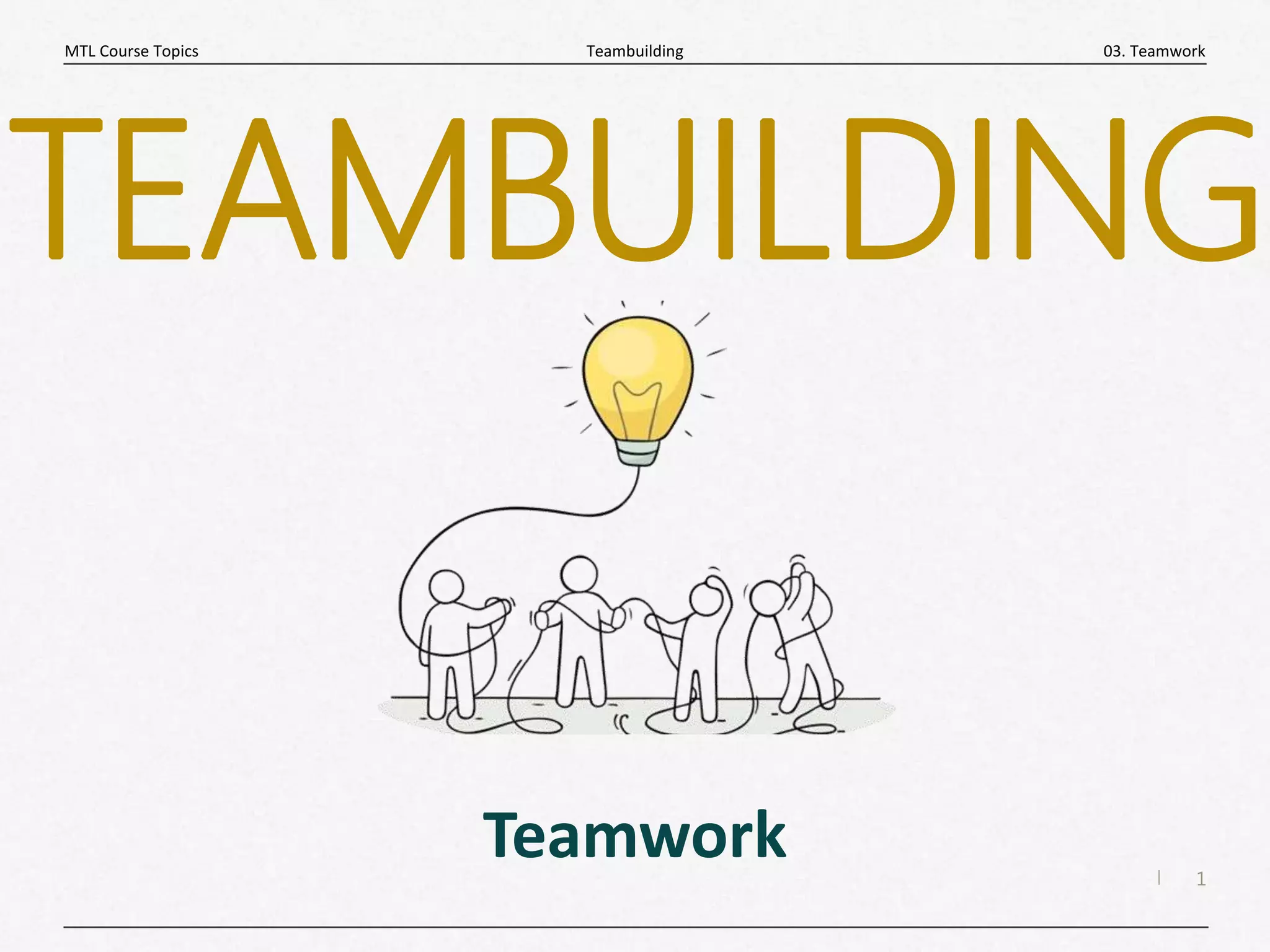
Teamwork
TEAMBUILDING
2
|
03. Teamwork
Teambuilding
MTL Course Topics
The Course Topics series from Manage Train Learn is a large collection of topics that will help you as a learner
to quickly and easily master a range of skills in your everyday working life and life outside work. If you are a
trainer, they are perfect for adding to your classroom courses and online learning plans.
COURSE TOPICS FROM MTL
The written content in this Slide Topic belongs exclusively to Manage Train Learn and may only be reprinted
either by attribution to Manage Train Learn or with the express written permission of Manage Train Learn.
They are designed as a series of numbered
slides. As with all programmes on Slide
Topics, these slides are fully editable and
can be used in your own programmes,
royalty-free. Your only limitation is that
you may not re-publish or sell these slides
as your own.
Copyright Manage Train Learn 2020
onwards.
Attribution: All images are from sources
which do not require attribution and may
be used for commercial uses. Sources
include pixabay, unsplash, and freepik.
These images may also be those which are
in the public domain, out of copyright, for
fair use, or allowed under a Creative
Commons license.
3
|
03. Teamwork
Teambuilding
MTL Course Topics
ARE YOU READY?
OK, LET’S START!
4
|
03. Teamwork
Teambuilding
MTL Course Topics
INTRODUCTION
In all strong teams, there is evidence of behaviour which is
aimed at strengthening the way the team works as a team.
It can be seen when the team interacts whilst carrying out
their normal business. At first, these behaviours may have to
be consciously learnt and applied, since some of them -
sharing, for example, - are not instinctive behaviours. In
time, these strands of interacting are observed, tested and
repeated by others in the team until they become a way of
team life.
5
|
03. Teamwork
Teambuilding
MTL Course Topics
ACTS OF TEAMWORK
Acts of teamwork are those things which the members of a
team do to encourage the interdependence of the team. In
teams that are already well-developed and successful, these
acts may appear to happen spontaneously and naturally. In
teams which are at earlier stages of development, they may
need to be consciously applied.
Eight key acts of teamwork that will foster interdependence
and the team's development are:
1. sharing, ie sharing of ideas, plans, and feelings
2. asking for help from others in the team
3. building a positive can-do climate
4. making people feel important in the team
5. trust in those on whom you rely
6. giving constructive feedback
7. convergent rather than divergent thinking
8. taking risks together.
6
|
03. Teamwork
Teambuilding
MTL Course Topics
SHARING
It is a uniquely human characteristic to give and receive. A
six-month old baby that receives things from its mother will,
by the time it is nine months old be handing them back to
her as well.
Teams become stronger not just when we share goals,
information and ideas, but when we share personal things
such as feelings, fears, values and needs, as well.
Open acts of sharing are the mainstay of good teams. They
break down the barriers of defensiveness and tell others
that the team is more important than any individual on their
own.
7
|
03. Teamwork
Teambuilding
MTL Course Topics
SHARING GOALS
Goals can exist in different time frames, from daily goals to
lifetime goals; and in different dimensions, from personal
goals to shared goals.
When people focus on goals that are big, exciting and
reachable only through combined efforts, then a new and
powerful motivation enters teamwork.
Three people were working on a construction site. All were
doing the same job but when each one was asked what he
was doing, the answers varied.
"Breaking rocks", said the first.
"Earning a living," answered the second.
"Helping to build a cathedral," replied the third.
(Peter Schultz, Porsche)
8
|
03. Teamwork
Teambuilding
MTL Course Topics
LIVING GOALS
When groups have a clear knowledge of the goal they're
working towards, and are committed to it, they become a
team.
Team-builders can assist this process if they...
1. have a goal that is simply stated
2. communicate it to everyone in the team especially
newcomers
3. make it a living daily goal, not a far-off dream
4. check that it means something to everyone
5. make the goal worthwhile
6. take every opportunity to repeat it, re-phrase it and re-
frame it.
"When xne key xn the typewriter dxesn't wxrk prxperly, it's
like xne persxn in the team nxt playing their full part. It
destrxys the whxle effect."
9
|
03. Teamwork
Teambuilding
MTL Course Topics
ASKING FOR HELP
Seeking help from others is a sign of a maturing team.
Instead of pretending that we know it all, we are honest to
admit we don't know everything and need help.
We often hesitate to ask for help because we think we
should know the answers, or because we fear being
rejected. It may also be the culture of the organisation that
people are judged on their own abilities and so asking for
help is a sign of weakness; only losers need help. That way
does not build teams.
One way to encourage mutual reliance is to get each team
member to work for a period of time with each other team
member in turn. This helps people to appreciate the
strengths of others in the team and to learn from them. In
larger organisations, people from one function should spend
time with people from other functions.
10
|
03. Teamwork
Teambuilding
MTL Course Topics
GEESE IN FLIGHT
Geese fly in a V shape to protect members of the flock and
to conserve energy.
As the bird in front travels forward, it leaves a gap behind it
called a vortex. This means that its following teammates
have less air resistance to fly against.
When the leader gets tired, it moves to the back of the V
and all the geese move up the formation so that each of
them gets a turn at leading.
The formation allows all the geese to keep an eye on each
other. This care and the technique of flying means that a
flock of geese can cover 70% more distance than a bird
flying on its own.
Because each bird maximizes its strength, it is also much
harder for predators to single out any bird for attack. This
ensures the survival of the flock.
11
|
03. Teamwork
Teambuilding
MTL Course Topics
A CAN-DO CLIMATE
Strong teams have an unshakeable belief that they and
everyone else are going to win from being in the team.
1. goals are described in terms of what the team can
achieve not what it can't
2. people look for the best points in each other and build
on them
3. when one member has a setback, the whole team feel it
and rally round
4. supportive and encouraging phrases outnumber
knocking and denigrating phrases
5. the team's vision is described repeatedly and in clear
achievement images
6. the success of one team member is shared equally and
without envy by all team members.
12
|
03. Teamwork
Teambuilding
MTL Course Topics
THE 3 A’S, NOT THE 3 C'S
Jim and Sid are two team leaders on a
manufacturing site. They work on different
shifts but their teams do the same job. Jim has a
great team; Sid has a poor team.
Jim and Sid rarely have time to meet and discuss
their teams, until they find themselves together
at coffee on day one of a training course.
Sid: Jim, you're so lucky having such a good
team. I'd willingly swap yours with mine.
Jim: Wouldn't make any difference, Sid.
Sid: How's that?
Jim: It's not about who you've got; it's about
how you think about them and what you do.
Sid: What do you mean?
Jim: Well, take yourself and Ian, your deputy.
You're full of the 3 C's.
Sid: The what?
Jim: The 3 C's: criticising, complaining, and
condemning...
Sid: Too right.
Jim: ...whereas we ban the 3 C's and try to use
the 3 A's.
Sid: What are they then?
Jim: Accept, acknowledge and appreciate. We
try to let everyone on the team know they
belong to the team, even the poor performers.
That's "accepting". Then we acknowledge them.
We use their names a lot and we let them know
they're important. Lastly, we let them know we
appreciate them. That's because we do.
13
|
03. Teamwork
Teambuilding
MTL Course Topics
VALUING OTHERS
We all need to feel important. When we are valued, we take
pride in who we are and what we do. The acts of valuing
others can be taken by anyone in the team.
Know who the team members are. Use their name.
Remember personal things about them. Show interest.
Don't judge others. Give them strokes of recognition. Listen
to them. Accept them for who they are.
Warren Bennis is professor of business administration at the
University of Southern California. The campus is in what he
describes as a "dry, crack-infested part of LA". But, he says,
every morning is a delight because the grounds of the
university are kept so green and fresh forming a contrast to
the surrounding city. "It makes a big difference to me, but I
wonder if anyone has reminded the gardeners of the
importance of their work."
14
|
03. Teamwork
Teambuilding
MTL Course Topics
THE FAMILIARITY CURVE
The "Familiarity Curve" throws some interesting and
amusing light on how we address others in a large team.
1. close familiarity, as expressed in pet names, nicknames
or abbreviated names, is usually reserved for those
nearest, and curiously, for those furthest away, (eg
"Joe")
2. those who are not so close, nor so distant, are more
formally addressed, though still with some friendliness,
(eg "Joseph")
3. those who occupy the middle ground between
closeness and distance are often addressed most
formally (eg "Mr Brown" or "Brown").
15
|
03. Teamwork
Teambuilding
MTL Course Topics
TRUST
Trust is the invisible glue of strong teams.
In teams which live with danger - firefighters, rescue teams,
the armed forces, circus troupes - your life may depend on
others. You need to trust them as much as they have to
trust you.
You can't make people trust you but you can create a
trusting climate by...
1. showing unconditional trust in your fellow team
members
2. not withdrawing trust even when others let you down
3. keeping your promises
4. disclosing weaknesses and parts of yourself that are
vulnerable
5. working to eliminate secrecy, selfishness, hidden
agendas and politicking.
16
|
03. Teamwork
Teambuilding
MTL Course Topics
CONSTRUCTIVE FEEDBACK
We find it easier to give criticism than to give praise. This is
often in the mistaken belief that we can change people if we
point out what they are doing wrong rather than point out
what they are doing right.
Constructive feedback is a way to tell others in the team
what we like about what they are doing and at the same
time suggest ways in which they can do even better. Its
premise is that there is always something in a person's
performance that you can praise and build on.
"Rachel, I thought your handling of that customer was really
good. I liked the way you showed him you were listening.
Your body language was really spot on. I wasn't sure about
threatening to report him for the swearing. I would have
ignored it myself. But I'm going to try out your listening
tactics myself."
17
|
03. Teamwork
Teambuilding
MTL Course Topics
CONVERGENT THINKING
In a discussion in which divergent listening predominates,
people's views go off into space and are lost forever.
In convergent listening, the team captures everything that is
said. They look for and find connections and links between
what one person says, what another has said, what has
gone before and what might come after. This is because
they spend more time listening to others than they do to
themselves. Instead of pushing their own viewpoint, as
happens in divergent listening, they seek to add to what
others say, link it to other viewpoints and so build on it.
"That's an interesting idea, Ann; it ties in with what Jilly was
just saying. It doesn't go as far as Ron's point. Maybe we
should hear if anyone else can bridge the gap..."
18
|
03. Teamwork
Teambuilding
MTL Course Topics
GROUPS AND TEAMS
Groups are defined as collections of individuals who come
together in order to put forward their own views. They are
principally interested in coming up with the best individual
idea rather than a group idea. Groups are therefore
essentially competitive. Teams, on the other hand, work
together.
Peter Honey has studied the behaviours of groups and the
behaviours of teams. According to his findings, team
behaviours are noticeably more convergent than group
behaviours:
1. teams spend more time seeking ideas, suggesting ideas,
building on ideas, supporting ideas and seeking
information
2. groups spend more time proposing their own ideas,
disagreeing with what others say, pointing out the
problems in others' ideas and clarifying what has been
said.
19
|
03. Teamwork
Teambuilding
MTL Course Topics
TAKING RISKS
The team's unique capacity for support comes to the fore
when the team takes risks and navigates its way through
change.
Risks and change occur in the natural development of teams
but are also an unavoidable feature of the modern world of
work.
Teams can support each other when changes are imposed
from outside. The strength of a good team also means that
when change is undertaken from within the team, the
burden of risk is shared if it all goes wrong. Teams allow us
to take greater and bigger risks than we could afford to take
alone.
"Great discoveries and improvements invariably involve the
co-operation of many minds." (Alexander Graham Bell)
20
|
03. Teamwork
Teambuilding
MTL Course Topics
A MODEL OF CHANGE
Elisabeth Kubler-Ross has developed a model of risk-taking
change in which she signposts seven stages where the
team's support is crucial. Any team facing externally-
imposed or self-imposed change may go through these
stages before the change is fully accepted.
Stage 1: shock: "This is hard!"
Stage 2: denial: "I can't handle this!"
Stage 3: frustration: "Nothing works properly anymore."
Stage 4: depression: "This is hopeless. I can't see a way out."
Stage 5: experimentation: "Maybe if...; it might work if..."
Stage 6: decisions: "I think I'll try it this way..."
Stage 7: integration: "It works!"
21
|
03. Teamwork
Teambuilding
MTL Course Topics
TEAM MORALE
Morale shows itself as a state of mind radiating confidence
in people.
Where each member feels sure of his own niche, stands on
his own abilities and works out his own solutions knowing
he is part of a team.
Where no person feels anxiety to be better than anyone
else.
Where there exists a sharing of ideas, a freedom to plan, a
sureness of worth and a knowledge that help is available for
the asking.
To the end that people grow and mature, warmed by a
friendly climate.
22
|
03. Teamwork
Teambuilding
MTL Course Topics
SPOON FEEDING
A rabbi spoke with God about heaven and hell.
"I will show you hell," God said, and they went into a room
which had a large pot of stew in the middle.
The smell was delicious, but around the pot sat people who
were famished and desperate. All were holding spoons with
very long handles which reached to the pot, but, because
the handles were longer than their arms, it was impossible
to get the stew back into their mouths.
"Now I will show you heaven," God said, and they went into
an identical room. There was a similar pot of stew, the smell
was delicious, and the people had identical spoons, but they
were well-nourished and happy.
The rabbi looked puzzled. "It’s simple," God said. "You see,
the people here have learned to feed one another."
23
|
03. Teamwork
Teambuilding
MTL Course Topics
THAT’S
IT!
WELL DONE!
24
|
03. Teamwork
Teambuilding
MTL Course Topics
THANK YOU
This has been a Slide Topic from Manage Train Learn

Teamwork

  • 1.
    1 | 03. Teamwork Teambuilding MTL CourseTopics Teamwork TEAMBUILDING
  • 2.
    2 | 03. Teamwork Teambuilding MTL CourseTopics The Course Topics series from Manage Train Learn is a large collection of topics that will help you as a learner to quickly and easily master a range of skills in your everyday working life and life outside work. If you are a trainer, they are perfect for adding to your classroom courses and online learning plans. COURSE TOPICS FROM MTL The written content in this Slide Topic belongs exclusively to Manage Train Learn and may only be reprinted either by attribution to Manage Train Learn or with the express written permission of Manage Train Learn. They are designed as a series of numbered slides. As with all programmes on Slide Topics, these slides are fully editable and can be used in your own programmes, royalty-free. Your only limitation is that you may not re-publish or sell these slides as your own. Copyright Manage Train Learn 2020 onwards. Attribution: All images are from sources which do not require attribution and may be used for commercial uses. Sources include pixabay, unsplash, and freepik. These images may also be those which are in the public domain, out of copyright, for fair use, or allowed under a Creative Commons license.
  • 3.
    3 | 03. Teamwork Teambuilding MTL CourseTopics ARE YOU READY? OK, LET’S START!
  • 4.
    4 | 03. Teamwork Teambuilding MTL CourseTopics INTRODUCTION In all strong teams, there is evidence of behaviour which is aimed at strengthening the way the team works as a team. It can be seen when the team interacts whilst carrying out their normal business. At first, these behaviours may have to be consciously learnt and applied, since some of them - sharing, for example, - are not instinctive behaviours. In time, these strands of interacting are observed, tested and repeated by others in the team until they become a way of team life.
  • 5.
    5 | 03. Teamwork Teambuilding MTL CourseTopics ACTS OF TEAMWORK Acts of teamwork are those things which the members of a team do to encourage the interdependence of the team. In teams that are already well-developed and successful, these acts may appear to happen spontaneously and naturally. In teams which are at earlier stages of development, they may need to be consciously applied. Eight key acts of teamwork that will foster interdependence and the team's development are: 1. sharing, ie sharing of ideas, plans, and feelings 2. asking for help from others in the team 3. building a positive can-do climate 4. making people feel important in the team 5. trust in those on whom you rely 6. giving constructive feedback 7. convergent rather than divergent thinking 8. taking risks together.
  • 6.
    6 | 03. Teamwork Teambuilding MTL CourseTopics SHARING It is a uniquely human characteristic to give and receive. A six-month old baby that receives things from its mother will, by the time it is nine months old be handing them back to her as well. Teams become stronger not just when we share goals, information and ideas, but when we share personal things such as feelings, fears, values and needs, as well. Open acts of sharing are the mainstay of good teams. They break down the barriers of defensiveness and tell others that the team is more important than any individual on their own.
  • 7.
    7 | 03. Teamwork Teambuilding MTL CourseTopics SHARING GOALS Goals can exist in different time frames, from daily goals to lifetime goals; and in different dimensions, from personal goals to shared goals. When people focus on goals that are big, exciting and reachable only through combined efforts, then a new and powerful motivation enters teamwork. Three people were working on a construction site. All were doing the same job but when each one was asked what he was doing, the answers varied. "Breaking rocks", said the first. "Earning a living," answered the second. "Helping to build a cathedral," replied the third. (Peter Schultz, Porsche)
  • 8.
    8 | 03. Teamwork Teambuilding MTL CourseTopics LIVING GOALS When groups have a clear knowledge of the goal they're working towards, and are committed to it, they become a team. Team-builders can assist this process if they... 1. have a goal that is simply stated 2. communicate it to everyone in the team especially newcomers 3. make it a living daily goal, not a far-off dream 4. check that it means something to everyone 5. make the goal worthwhile 6. take every opportunity to repeat it, re-phrase it and re- frame it. "When xne key xn the typewriter dxesn't wxrk prxperly, it's like xne persxn in the team nxt playing their full part. It destrxys the whxle effect."
  • 9.
    9 | 03. Teamwork Teambuilding MTL CourseTopics ASKING FOR HELP Seeking help from others is a sign of a maturing team. Instead of pretending that we know it all, we are honest to admit we don't know everything and need help. We often hesitate to ask for help because we think we should know the answers, or because we fear being rejected. It may also be the culture of the organisation that people are judged on their own abilities and so asking for help is a sign of weakness; only losers need help. That way does not build teams. One way to encourage mutual reliance is to get each team member to work for a period of time with each other team member in turn. This helps people to appreciate the strengths of others in the team and to learn from them. In larger organisations, people from one function should spend time with people from other functions.
  • 10.
    10 | 03. Teamwork Teambuilding MTL CourseTopics GEESE IN FLIGHT Geese fly in a V shape to protect members of the flock and to conserve energy. As the bird in front travels forward, it leaves a gap behind it called a vortex. This means that its following teammates have less air resistance to fly against. When the leader gets tired, it moves to the back of the V and all the geese move up the formation so that each of them gets a turn at leading. The formation allows all the geese to keep an eye on each other. This care and the technique of flying means that a flock of geese can cover 70% more distance than a bird flying on its own. Because each bird maximizes its strength, it is also much harder for predators to single out any bird for attack. This ensures the survival of the flock.
  • 11.
    11 | 03. Teamwork Teambuilding MTL CourseTopics A CAN-DO CLIMATE Strong teams have an unshakeable belief that they and everyone else are going to win from being in the team. 1. goals are described in terms of what the team can achieve not what it can't 2. people look for the best points in each other and build on them 3. when one member has a setback, the whole team feel it and rally round 4. supportive and encouraging phrases outnumber knocking and denigrating phrases 5. the team's vision is described repeatedly and in clear achievement images 6. the success of one team member is shared equally and without envy by all team members.
  • 12.
    12 | 03. Teamwork Teambuilding MTL CourseTopics THE 3 A’S, NOT THE 3 C'S Jim and Sid are two team leaders on a manufacturing site. They work on different shifts but their teams do the same job. Jim has a great team; Sid has a poor team. Jim and Sid rarely have time to meet and discuss their teams, until they find themselves together at coffee on day one of a training course. Sid: Jim, you're so lucky having such a good team. I'd willingly swap yours with mine. Jim: Wouldn't make any difference, Sid. Sid: How's that? Jim: It's not about who you've got; it's about how you think about them and what you do. Sid: What do you mean? Jim: Well, take yourself and Ian, your deputy. You're full of the 3 C's. Sid: The what? Jim: The 3 C's: criticising, complaining, and condemning... Sid: Too right. Jim: ...whereas we ban the 3 C's and try to use the 3 A's. Sid: What are they then? Jim: Accept, acknowledge and appreciate. We try to let everyone on the team know they belong to the team, even the poor performers. That's "accepting". Then we acknowledge them. We use their names a lot and we let them know they're important. Lastly, we let them know we appreciate them. That's because we do.
  • 13.
    13 | 03. Teamwork Teambuilding MTL CourseTopics VALUING OTHERS We all need to feel important. When we are valued, we take pride in who we are and what we do. The acts of valuing others can be taken by anyone in the team. Know who the team members are. Use their name. Remember personal things about them. Show interest. Don't judge others. Give them strokes of recognition. Listen to them. Accept them for who they are. Warren Bennis is professor of business administration at the University of Southern California. The campus is in what he describes as a "dry, crack-infested part of LA". But, he says, every morning is a delight because the grounds of the university are kept so green and fresh forming a contrast to the surrounding city. "It makes a big difference to me, but I wonder if anyone has reminded the gardeners of the importance of their work."
  • 14.
    14 | 03. Teamwork Teambuilding MTL CourseTopics THE FAMILIARITY CURVE The "Familiarity Curve" throws some interesting and amusing light on how we address others in a large team. 1. close familiarity, as expressed in pet names, nicknames or abbreviated names, is usually reserved for those nearest, and curiously, for those furthest away, (eg "Joe") 2. those who are not so close, nor so distant, are more formally addressed, though still with some friendliness, (eg "Joseph") 3. those who occupy the middle ground between closeness and distance are often addressed most formally (eg "Mr Brown" or "Brown").
  • 15.
    15 | 03. Teamwork Teambuilding MTL CourseTopics TRUST Trust is the invisible glue of strong teams. In teams which live with danger - firefighters, rescue teams, the armed forces, circus troupes - your life may depend on others. You need to trust them as much as they have to trust you. You can't make people trust you but you can create a trusting climate by... 1. showing unconditional trust in your fellow team members 2. not withdrawing trust even when others let you down 3. keeping your promises 4. disclosing weaknesses and parts of yourself that are vulnerable 5. working to eliminate secrecy, selfishness, hidden agendas and politicking.
  • 16.
    16 | 03. Teamwork Teambuilding MTL CourseTopics CONSTRUCTIVE FEEDBACK We find it easier to give criticism than to give praise. This is often in the mistaken belief that we can change people if we point out what they are doing wrong rather than point out what they are doing right. Constructive feedback is a way to tell others in the team what we like about what they are doing and at the same time suggest ways in which they can do even better. Its premise is that there is always something in a person's performance that you can praise and build on. "Rachel, I thought your handling of that customer was really good. I liked the way you showed him you were listening. Your body language was really spot on. I wasn't sure about threatening to report him for the swearing. I would have ignored it myself. But I'm going to try out your listening tactics myself."
  • 17.
    17 | 03. Teamwork Teambuilding MTL CourseTopics CONVERGENT THINKING In a discussion in which divergent listening predominates, people's views go off into space and are lost forever. In convergent listening, the team captures everything that is said. They look for and find connections and links between what one person says, what another has said, what has gone before and what might come after. This is because they spend more time listening to others than they do to themselves. Instead of pushing their own viewpoint, as happens in divergent listening, they seek to add to what others say, link it to other viewpoints and so build on it. "That's an interesting idea, Ann; it ties in with what Jilly was just saying. It doesn't go as far as Ron's point. Maybe we should hear if anyone else can bridge the gap..."
  • 18.
    18 | 03. Teamwork Teambuilding MTL CourseTopics GROUPS AND TEAMS Groups are defined as collections of individuals who come together in order to put forward their own views. They are principally interested in coming up with the best individual idea rather than a group idea. Groups are therefore essentially competitive. Teams, on the other hand, work together. Peter Honey has studied the behaviours of groups and the behaviours of teams. According to his findings, team behaviours are noticeably more convergent than group behaviours: 1. teams spend more time seeking ideas, suggesting ideas, building on ideas, supporting ideas and seeking information 2. groups spend more time proposing their own ideas, disagreeing with what others say, pointing out the problems in others' ideas and clarifying what has been said.
  • 19.
    19 | 03. Teamwork Teambuilding MTL CourseTopics TAKING RISKS The team's unique capacity for support comes to the fore when the team takes risks and navigates its way through change. Risks and change occur in the natural development of teams but are also an unavoidable feature of the modern world of work. Teams can support each other when changes are imposed from outside. The strength of a good team also means that when change is undertaken from within the team, the burden of risk is shared if it all goes wrong. Teams allow us to take greater and bigger risks than we could afford to take alone. "Great discoveries and improvements invariably involve the co-operation of many minds." (Alexander Graham Bell)
  • 20.
    20 | 03. Teamwork Teambuilding MTL CourseTopics A MODEL OF CHANGE Elisabeth Kubler-Ross has developed a model of risk-taking change in which she signposts seven stages where the team's support is crucial. Any team facing externally- imposed or self-imposed change may go through these stages before the change is fully accepted. Stage 1: shock: "This is hard!" Stage 2: denial: "I can't handle this!" Stage 3: frustration: "Nothing works properly anymore." Stage 4: depression: "This is hopeless. I can't see a way out." Stage 5: experimentation: "Maybe if...; it might work if..." Stage 6: decisions: "I think I'll try it this way..." Stage 7: integration: "It works!"
  • 21.
    21 | 03. Teamwork Teambuilding MTL CourseTopics TEAM MORALE Morale shows itself as a state of mind radiating confidence in people. Where each member feels sure of his own niche, stands on his own abilities and works out his own solutions knowing he is part of a team. Where no person feels anxiety to be better than anyone else. Where there exists a sharing of ideas, a freedom to plan, a sureness of worth and a knowledge that help is available for the asking. To the end that people grow and mature, warmed by a friendly climate.
  • 22.
    22 | 03. Teamwork Teambuilding MTL CourseTopics SPOON FEEDING A rabbi spoke with God about heaven and hell. "I will show you hell," God said, and they went into a room which had a large pot of stew in the middle. The smell was delicious, but around the pot sat people who were famished and desperate. All were holding spoons with very long handles which reached to the pot, but, because the handles were longer than their arms, it was impossible to get the stew back into their mouths. "Now I will show you heaven," God said, and they went into an identical room. There was a similar pot of stew, the smell was delicious, and the people had identical spoons, but they were well-nourished and happy. The rabbi looked puzzled. "It’s simple," God said. "You see, the people here have learned to feed one another."
  • 23.
    23 | 03. Teamwork Teambuilding MTL CourseTopics THAT’S IT! WELL DONE!
  • 24.
    24 | 03. Teamwork Teambuilding MTL CourseTopics THANK YOU This has been a Slide Topic from Manage Train Learn