1	
  
  2	
  
To	
  my	
  Mentor.:	
  The	
  only	
  person	
  able	
  to	
  
narrow	
  my	
  thoughts.	


To	
  my	
  other	
  Mentor:	
  the	
  one	
  who	
  never	
  
stop	
  to	
  support	
  me.	


GRAZIE	
  
  3	
  
Abstract
This study investigates how creativity and innovation are fostered within advertising agencies. It
shows how the implementation of a collaborative thinking model founded on effective
communication, the well-being of the group, the design of the environment and a culture of
innovation can be a practical alternative to lead an organisation to succeed. It considers effective
collaboration as one of the most important measures that define a successful advertising
organisation against an ordinary one. In consequence a definition of the optimal conditions to
foster team’s creative collaboration is required. The reason why I developed this concept is because
the terms ‘groupthink’ and ‘collaborative thinking’ have entered in the organisational world but no
attention, though, has been directed straight towards the standard way advertising agencies should
treat creative collaboration. My aim is to create a collaborative thinking model that can fit in every
advertising agency, free from context boundaries and socio-demographical influences.
I have conducted an anthropological comparative analysis of two Italian advertising agencies to
understand the internal structure and structural inner tensions using an emic approach, participant
observation, and a semi structured questionnaire addressed to all the professional figures in the
agency. I have considered two completely different type of advertising agencies, in terms of
accounts and visions, in order to have a clearer idea of the basic structure that combine agencies.
This article also covers practical examples from the most innovative organisations that have shaped
the structure of the industries and their way to treat group collaboration with particular interest to
group creativity. For example, inspired by the multi award-winning computer animation company,
Pixar, producer of films such as Toy Story, Up and Finding Nemo, and aware of the consistently
more numerous constraints advertising agencies have to face, I will explore their method of
enhancing group creativity and see how it can be adapted to the structure of advertising.
The project demonstrates that a collaborative thinking approach can be used in advertising to
overtake the limits it presents today and follow the step of Pixar’s success.
The concepts of field and habitus theorised by Bourdieu (1979-1984) are used to bring to the light
some of the constraints the industry is affected by. It focuses on the review of the traditional way of
doing advertising and it offers an alternative approach to foster group creativity, free from the idea
of ‘departments’ and ‘job specific tasks’. We are a group, we work together to achieve a common
object: the success of the organisation.
The methodology employed is that of a long-term participant observation (Milan), consisting of a 6
months period of fieldwork in the shoes of a creative account in the agency, followed by occasional
visits. In the case of the agency in Rome due to time restrictions, the period of analysis was
considerably shorter (2 visits).
  4	
  
Methodology of analysis
As Lett (1990) explains, from an anthropological perspective “Emic constructs are accounts,
descriptions and analyses expressed in terms of the conceptual schemes and categories regarded as
meaningful and appropriate by the native members of the culture whose beliefs and behaviours are
being studied” (p. 130).
In taking an emic approach, I have tried to put aside prior theories and assumptions in order to let
the participants and data “speak” to allow themes, patterns, concepts and structural tensions to
emerge. This arises from the fact that many dynamics are hidden on the inner life of an
organisation. Only by watching what people do instead that of recording what they say (object of
customary discrepancy, Moeran, 2009) reveals some of those hidden patterns. For example, an
anthropological method of analysis enables the fieldworker to recognise the use of cultural and
social capitals (Bourdieu, 1977 in Sweetman, 2009) to draw more accurate conclusions (dress code,
language, facilitations, expectations and tastes are some of the dimensions that can be explored
through an anthropological research method).
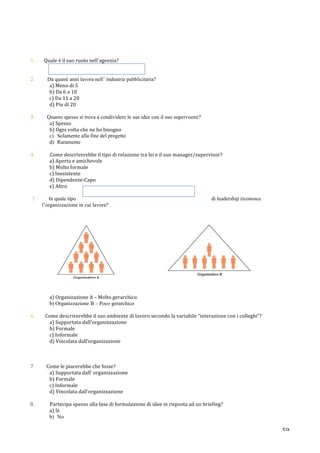
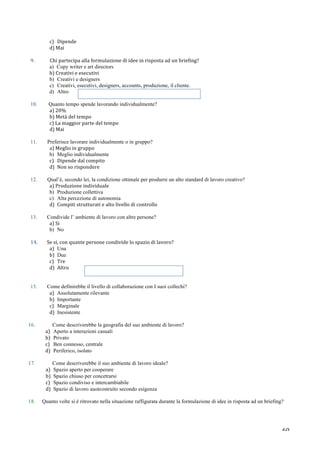
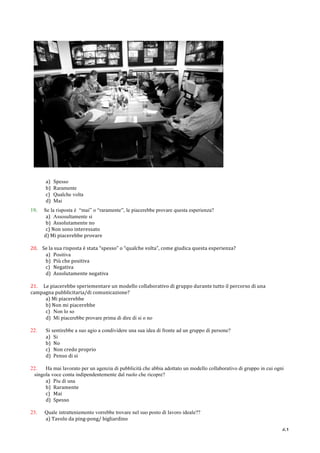
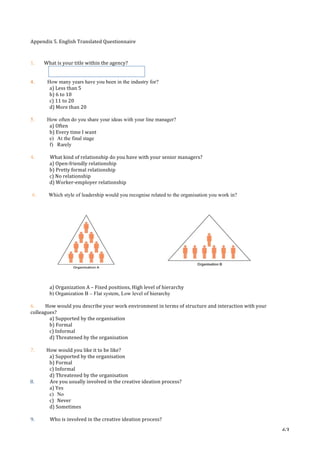
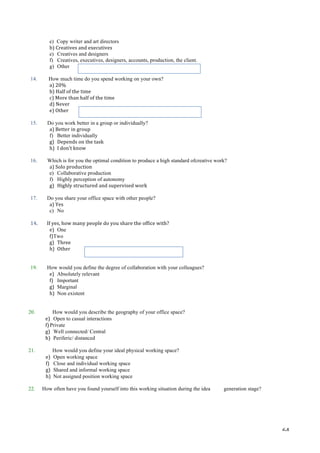
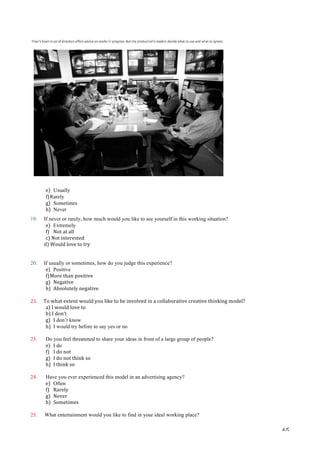
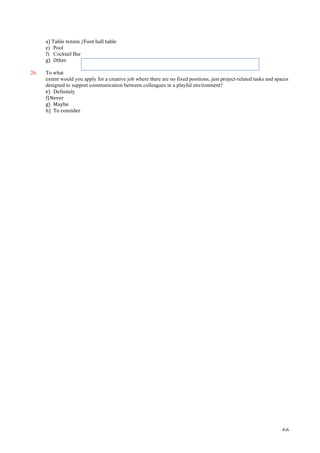
Supported by the compilation of a semi-structured questionnaire (in Appendix n.5) including 25
questions with multiple choices answers this experience gave me knowledge to suggest
improvements and create an advertising - customised model. The questions are concentrated on:
• Personal perception of the current working space (How would you describe the geography
of your office space?; How would you define the degree of collaboration with your
colleagues?; How would you describe your work environment in terms of structure and
interaction with your colleagues?;)
• Investigation of the perception of the ideal working conditions (Which is for you the optimal
condition to produce a high standard of creative work?; How would you define your ideal
physical working space?; What entertainment would you like to find in your ideal working
place?)
• Degree of experience with the collaborative thinking model (How often have you found
yourself into this working situation during the idea generation stage?; Have you ever
experienced this model in an advertising agency? If usually or sometimes, how do you judge
this experience?)
• Personal feelings (Do you feel threatened to share your ideas in front of a large group of
people; Do you work better in a group or individually? To what extent would you like to be
involved in a collaborative creative thinking model?)
Also, to identify the dimensions to take the best out from group collaboration, a wide range of
theoretical approaches have been explored: from organisational theories, group dynamics studies,
sociology, behavioural sciences, to environmental design proofs and leadership journals. The
anthropological method fits with my analysis because of the need to observe and considerate multi
level aspects, from increase my knowledge of the industry to define the conditions to develop a
model that considers group collaboration as the potential tool to overcome advertising industry
tensions.
  5	
  
Introduction
The literature concerning team collaboration has grown in the last 20 years and the focus on the
well being of the individual has moved towards a focus on the well being of the group. Maybe
because, nowadays more than before, the human being grows up in a new social context, free from
geographical and temporal borders. His or her social life is shaped and supported by technological
devices. We are more social than ever and despite the fact that social conditions have changed
dramatically due to the digital revolution, the motivation underneath social needs has not: humans
generally organize their social life in terms of their relations with others in order to satisfy a
personal social need. (Fiske, 1992)
Supposedly, the advertising industry has taken all the benefits from the digital revolution: the
advertisers attention has moved from traditional media to a full immersion on digital contents. As a
result Digital, Media and Web agencies have born since the global audiences have migrated toward
new media platforms. The speed of information as well as a the personalisation of the message, the
effective costs, the engagement at a personal level, the content co-creation with customers and their
direct experience with the brand (LoveMarks, 2009) are just few examples on the advantages the
digital revolution has brought with it. Inevitably, those massive changes have transformed the habits
of individuals as well as the inner reality of advertising agencies:
“Technology is advancing exponentially. It's transforming how people work, think, and connect. It's
transforming our cultural values. Organisations need people who can be innovative, who can think
differently to face everyday challenge. So being creative is essential to us; it's essential for our
economy”.
(Robinson, 2009)
To face the challenges of the digital economy, advertising approaches have to continually transform
and evolve to follow the trends. To produce high quality advertising contents there are more tools
available then ever before, the real matter is to recognise them. Charles Lumpkin (2012), social
media expert and advertising professional underlines, “Sometimes, the big brands have a reasonable
idea who their audience is. But a lot of times during the research stage, accounts can find different
segmentations or demographics that are really surprising to them: one example is that people that
are patriotic are more likely to like a particular brand of orange juice than other people.” Those are
the kind of breakthroughs contemporary advertising needs to develop to be competitive in the
marketplace. Unsurprisingly, it has been demonstrated that a greater number of discoveries come
from people interacting. (Allen 1977; Csikszentmihalyi 2003; Huysman & Wulf, 2004). When
people run into each other and make eye contact, things happen”. (Jobs, 2009) For this reason, to
provide the best conditions for the group to effectively collaborate, in this enormous field of action,
it is vital to unleash group’s creative outputs. Researches have shown that the ability to be creative
and in particular the ability of being creative in teams, is becoming the critical skill and competence
that the industry is looking for in employees. (West, 2009) Sawyer has defined collaboration as “
the secret breakthrough creativity”. Some advertising agencies, mostly American corporations such
as Wieden + Kennedy, Crispin Porter + Bogusky, Deutsch L.A have embraced the view that idea
generation comes from people interactinging “At Deutsch, is all about collaboration. And now, it’s
gotten to the point where it’s not just the art director and the writer sitting in the room coming up
with ideas. It’s everybody”. Eric Springer, creative director at Deutsch L.A. (in Berman and
Blakeman, 2009:36) “All department of the agency have creative talent and all contribute to the
generation of ideas” Tiffany Kosel & Scott Linnen, creative team at Crispin Porter + Bogusky (in
Berman and Blakeman, 2009:38). This need of networking, in particular, ‘learning by switching’
(Dornisch, 2002) is already in the air.
  6	
  
In London, in 2012, the ‘Creative Swap’ initiative gained huge success by taking talented
individuals out of their comfort zone and swapped them with other professionals in the industry for
a short period of time. The idea is to encourage different ways of thinking and problem solving as
well as affording them an enhanced appreciation for creative processes outside of their own. The
creative business is all about taking in as many experiences, inspirations and new things to make the
most cutting edge and creative ideas can be produced.
Defining Collaborative thinking
The terms Group Think was devised in the 1980s by the American psychologist Irvin Janis, who
described it as a form of decision-making characterised by uncritical acceptance of a prevailing
point of view. (1982:12) His definition recommends a potential downside that affects the group
defective decision-making. (Rose, 2011) In particular, Janis (1982) underlines 3 dangerous
symptoms of groupthink:
Overestimation of the group: including illusion of Invulnerability and belief in group‘s inherent
morality.
Consequences: Members ignore obvious danger, take extreme risk, and are overly
optimistic. Members believe their decisions are morally correct, ignoring the ethical
consequences of their decisions.
Closed Mindedness: including collective rationalization and stereotypes of out-groups.
Consequences: members discredit and explain away warning contrary to group thinking.
The group constructs negative stereotypes of rivals outside the group.
Pressure towards Conformity: including self-censorship, illusion unanimity, direct pressure on
dissenters, self-appointed mind guards
Consequences: Members withhold their dissenting views and counter-arguments. They
perceive falsely that everyone agrees with the group's decision; silence is seen as
consent. Some members appoint themselves to the role of protecting the group from
adverse information that might threaten group complacency.
Together with problems, he identified solutions or better ‘prevention recommendations’:
the organisational leadership is responsible to protect the group from those threats; each member
should be a critical evaluator of the group‘s course of action; leaders should limit themselves
initially to fostering open inquiry; they should bring in outside experts to challenge the views of the
core members; Reconsider the decision in second chance meetings before going public.
In respond to this claim, groupthink can only work if properly managed, supported from the
leadership style (Susan Cain, 2012) and shared through the organisational values (Amabile, 1996):
An organisation aimed to establish its success from taking the best from the interactions of its
employee has adopted a collaborative thinking model. When it is willing to build the right context
to allow group creativity to happen and flourish, no matters what kind of organisation is (Jim
Collins in Hensen, 2009) or which country and culture embraces, it can lead the organisation to the
best desired achievements. (Hensen, 2009) Despite the “the very little consensus among researchers
on the validity of group think” (Park, 2000:837) since it was first published group thinking
approach has been widely accepted (Mitchell  Eckstein, 2009:164) thanks to the fact that the most
  7	
  
innovative organizations in the world have adopted it: Ideo, Google, Cisco, 3M, Toyota, W.L. Gore,
Apple, Pixar, You Tube, E-bay, Whole food, Procter and Gamble are just some examples.
Business Idea VS Creative idea
Creative thinking is not typically seen as having any real corporate value for the business.
(Schmetterer, 2003). Over creativity, strategy reins the business interests. This trend caused a shift
between business ideas and creative ideas. On the other hand, the creative product attracts the target
audience attention towards the message. Creativity in advertising is not just a method to achieve
strategic goals: in this document, strategic and creative thinking are treated as playing the same
inseparable role in the process. No effective strategy can work without an appealing creative
content, no appealing creative content can work without an effective strategy.
Effective strategy + appealing creative content = Innovation.
  8	
  
1. The internal structure of advertising agencies
advertising agencies are a complex reality where professionals from different backgrounds, mind-
sets and skills collaborate to create creative contents for advertising purposes. However, they do not
always feel they lead the organisation to success.
By collecting data on the range of job positions available within the industry, it is easy to see that
the internal structure of advertising agencies is more or less the same, even if the agency culture,
size and style is different. (Source: IPA and Prospects.uk)
A full service advertising agency is traditionally organised around 4 key departments (Leiss, Kline,
Jhally,  Botterill, 2005)
- Account/research department
- Financial department
- Creative department
- Digital Marketing / Media department
Development / Production department can be internal in larger corporation but most of the time, the
agencies hire professional outsiders and locations to accomplish production work (Moeran,2009).
In the majority of cases, an agency provides a 360 degree service to its clients and covers the entire
process from the concept generation stage to post production, going through to market research
(internal in larger agencies) and the actual development of the idea and media placement.
The risk of working in departments is that by working with a stable set of colleagues, members
develop team, rather than agency, loyalty (Grabher, 2002).
1.1 Culture
Theories of organization design are concerned with the fundamental problem of establishing
coherence between organizational structure processes and goals and purposes for which the
organization exists (Galbraith, 1977). There is no secret formula or process for being creative. As I
have already stated, creativity and collaboration practices are fostered according to the singular
vision of the agency. For example, the number of departments an advertising agency is divided into
depends upon the values the agency embraces. Also, the vision which defines the nature of the
agency can be the distinctive tract that will lead a client to choose for one agency over another one.
My vision is that the collaborative thinking model, free from job constraints and communication
barriers can lead the industry towards the next level following what Pixar has done with the
Animation industry.
The top 10 Agencies with the Best Company Culture, 2010, share the vision that the happiness of
the employees and the design of the environments support creativity and innovation. (The Agency
Post, 2010). Their unique approach is the key to be the very best workplace for employees. In
nurturing their employee’s satisfaction, those agencies offer:
• Brainstorming sessions at founder’s apartment, inviting their staff for dinner. (Chandelier
Creative, NY)
• Playful and funny Team-building exercises. (Chandelier Creative, NY)
• Open communication, supported by no door’s offices. (Red Door Interactive, CA)
• Half days off for summer games (Red Door Interactive, CA)
	
  
  9	
  
• Surf sessions, races in the parking, bowling leagues (BFG, South Carolina)
	
  
• $200 health care credit for a gym membership, workout gear or anything else that keeps
every single employee moving. (Saatchi, LA)
	
  
• $2,000 in tuition to continue to learn about new industry trends. (Saatchi, LA)
	
  
• Community and family support, together with Subarus for employee to use! (Carmichael
Lynch, MI)
	
  
• One entire week off for the best creative performance (Switch, MI)
	
  
• Entrepreneurial inspiration: learning by touching. Employees are PUSHED to experiment
and free their creativity in the labs and to enjoy a relaxing massage! (KBS+, NY)
	
  
• Rewards for collaboration (Team One, CA)
	
  
• Agency-wide happy hour every Friday and Wexley Symposium lunch hours to spark
creativity. (Wexley School for Girls, WA)
The basic assumption is that the most innovative organisations in the world are associated by almost
the same vision: From Google, to Ideo, Pixar and Procter  Gamble. They believe their success
depends on the effective collaboration of their teams and on the conditions the company provides to
the employees to get the best out of their interactions. They recognise that creativity is just a matter
of circumstances: everybody can be creative. It has nothing to do with art and special people, it
might be an attitude, but creativity can be taught, developed, enhanced and supported (Robinson)
and if it is done in group’s conditions the results are simply much better.
1.2 Job Division
According to IPA (Institute of Practitioners in advertising) the main positions present in the
majority of advertising agencies are:
ACCOUNTS:
In the agency is the figure that represents the client. Their job is to maintain a positive relation with
them, ensuring its satisfaction, providing support and assistance. They are the link between the
agency and its clients;
Included in this position there are the account planners, the account directors and account
executives, responsible to oversee all aspects of a campaign from start to finish and focus on four
essential things: Finance, timing, process and quality without forget to facilitate the work flow.
STRATEGIC PLANNERS:
They are the voice of the consumers in the agency. They are responsible for developing the key
strategic insights, which lies behind the advertising idea. They get under the skin of the consumer
and understand as much as possible about their thinking. This includes targeting the right audience
as well as setting the tone and message of the campaign.
They combine market data, qualitative research and product knowledge, within a brief to enable the
creative team to produce innovative ideas that will reach consumers.
  10	
  
MEDIA PLANNERS/BUYERS:
They map how to connect the consumer to the creative idea. They ensure that client messages
appear in the right place at the right time to reach the maximum target audience to achieve client’s
marketing objectives. They tend to be rooted in qualitative, ethnographic approaches to the study of
consumers. (Grabher, 2002)
The media research department is responsible to identify which media platform would best
advertise a client’s brand or service, according to their budget, recommending the most appropriate
types of media to use, as well as the most effective time spans and locations.
Media buyers are responsible for negotiating with the media owners of the relevant channels in
order to get the best position, timing and price for their client’s exposure and therefore guarantee
the maximum value and impact from the client’s budget.
CREATIVES:
The creative department is where all the insights from the accounts, the researches, the client’s
needs come together to make up the actual campaign.
Creatives are generally hired in pairs: Copywriters  Art directors. They usually answer the
creative brief typically prepared by planners to explain the advertising objectives, target audience,
and creative task. (Hackley, 2005) Once the get the ‘OK’ from the creative director, they work with
the media planners, buyers, and the production department in order to turn those ideas into a reality.
They create ideas based on the client brief and they work together for days or even weeks. Their
task has to do with creative thinking rather then realisation. They are the brains behind great
advertising campaign (Berman and Blakeman, 2009)
CREATIVE DIRECTORS:
The creative director, practice a function of control over the direction that the ideas take. They
decide if an idea proceeds or not. It is his or her job to ensure that the work the teams are doing is
both on brief and of the required quality. The creative director also decides who will work on which
project together with the account executive, and will often be there to present the work to the client
together with the team who devised the campaign. They are the heroes turn things great, they make
the decisions, they call the shots, they are the geniuses (Hansen, 2009).
DESIGNERS:
They ensure the advertising contents are made to the highest quality, on time and within budget.
They assist copywriters and art directors with campaign materials and their graphic, production and
post-production skills. They take the idea to the next level and give the finished work a polish that
the creative team could not add. They must create eye-catching advertisements or a memorable
theme.
They edit and manipulate advertising presentation according to clients and superiors specifications,
and are responsible for the final layout of the campaign: typography, composition, digital
publishing, digital imaging and illustrations.
In this category are included web designers, graphic designers, engineers and all the professionals
that bring the ideas to the reality thanks to their visual skills and creative design abilities.
Advertising professionals, though, are highly interactive and collaborative for the nature of their
job. They continually have to demonstrate their communication and technical skills to ensure the
work flow of their colleagues. Wide range of personalities, skills, and mind-sets bring their different
prospective and work (together) on title’s attached tasks: the creative director directs, the
development team develops, the creative team creates, the designer design, the account team plans.
Their established roles often collapse in the process (Moeran, 2009:976) but their contribution in
the project depends upon their job title.
  11	
  
1.3 Agency Work Flows
We are going to have a look now on the process of creating advertisements which is different from
agency to agency, but the basic steps are more or less the same:
1. The account manager (and team) meets with the client to identify the problem that needs to
be solved.
2. The account manager writes a creative brief based on that problem. This will include
competitive analysis, research, the assistance of the planner and/or creative director, and
eventually, sign off from the client.
3. Once the overall marketing strategy and creative brief have been determined and approved
they are presented to the agency’s creative team and includes timeline, budget, proposed
media and other factors.
4. The creative team works on the project for several days (or weeks if they’re lucky) and
brings the first round of ideas to the creative director.
5. The creative director will cull the ideas that are not working, and direct the team to explore
the good ideas.
6. The creative team will continue to work on the ideas, but bring in the production department
(if needed), account manager and other members of the agency to make sure the work is on
track. If there are printed pieces, or a shoot is required, this is when the production
department will begin estimates.
7. The creative director approves the final ideas, and the creative team presents (hopefully)
them to the client.
8. The client will go away and discuss the ideas, before giving feedback to the agency. This
may result in a reworking of ideas (repeat steps 3 to 7) or a green light to move into the
execution of the ideas. At this point, a budget and timeline will once again be approved.
9. The creative team works closely with the account team, media buying, production, and the
creative director to produce the ads, whatever form they may take.
10. The final ads are placed in front of the client for approval. Once the client approves, the ads
are published, be it online, in print, outdoor, on the air, or any other media.
11. The agency will monitor the success, and ROI, of the ads and give the feedback to the
client.
12. The client pays the agency. And then the whole process is repeated.


  12	
  
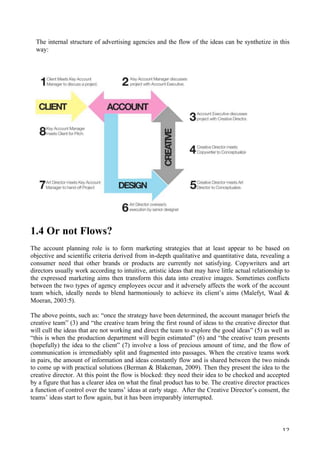
The internal structure of advertising agencies and the flow of the ideas can be synthetize in this
way:
1.4 Or not Flows?
The account planning role is to form marketing strategies that at least appear to be based on
objective and scientific criteria derived from in-depth qualitative and quantitative data, revealing a
consumer need that other brands or products are currently not satisfying. Copywriters and art
directors usually work according to intuitive, artistic ideas that may have little actual relationship to
the expressed marketing aims then transform this data into creative images. Sometimes conflicts
between the two types of agency employees occur and it adversely affects the work of the account
team which, ideally needs to blend harmoniously to achieve its client’s aims (Malefyt, Waal 
Moeran, 2003:5).
The above points, such as: “once the strategy have been determined, the account manager briefs the
creative team” (3) and “the creative team bring the first round of ideas to the creative director that
will cull the ideas that are not working and direct the team to explore the good ideas” (5) as well as
“this is when the production department will begin estimated” (6) and “the creative team presents
(hopefully) the idea to the client” (7) involve a loss of precious amount of time, and the flow of
communication is irremediably split and fragmented into passages. When the creative teams work
in pairs, the amount of information and ideas constantly flow and is shared between the two minds
to come up with practical solutions (Berman  Blakeman, 2009). Then they present the idea to the
creative director. At this point the flow is blocked: they need their idea to be checked and accepted
by a figure that has a clearer idea on what the final product has to be. The creative director practices
a function of control over the teams’ ideas at early stage. After the Creative Director’s consent, the
teams’ ideas start to flow again, but it has been irreparably interrupted.
  13	
  
1. 4 Advertising industry constraints
An innovative and creative business as advertising is not free from systematic constraints: it is
smothered under certain standards, norms, expectations and conventional ways of doing things
(Becker, 1982). The industry is enclosed in the Bourdieu’s definition of ‘Habitus’ and ‘Field’
(1979) described in the next session.
Advertising was first conceived as a means of ‘generating demand in a capitalistic system by
offering specific information on a product, service or brand, often in a persuasive format’. This
traditional view of advertising to some extent is based on Marxist theories of economic exchange,
has now been replace by one that is more concerned with advertising’s role as a vehicle of social
communication. Various networks are essential to its operation: cooperative, social, personal and
financial arrangements among suppliers, clients, advertising personnel, consumers and so on.
Tichenor, Donahue, and Olien (1973) argued that all communication is produced under systems of
social control: in this view, patterns of private ownership, trends toward centralization of
ownership, the development and appropriation of new media technologies and globalization
structurally influence the form, content and ideology of the media.
The action field of the advertising industry deals with: First, the media institutions in which
advertising is placed: television and radio stations, networks, Internet domains, newspaper and
magazine publishers. Some of these are large conglomerates with global reach (International media
companies, global digital platform) others are extremely local (Local newspapers or radio FM).
Second, the public permissions, the transportation and billboards companies as well as advertising
agencies subcontracting: models, photographer, actors, print shops and recording studios. Not to
forget, the endless restrictions and censorships that form legal constraints. Then, there are the
organizations that pay for the advertising to be produced. These are the clients; the ones who make
the world of advertising go round and round. They tend to be very different from one another, so
that their only real connection with the advertising industry is the fact that they have chosen to
advertise their product or service. As Chavez noted, clients remain the ultimate gatekeepers of
advertising and shape its development (2014:33). They also decide the budget to invest in
advertising communication, therefore, they set the economic limit to the development of the idea.
Finally, there are those organizations that plan and create the actual advertising campaign. The most
important of these is the advertising agency. The advertising agency is an independent service
company, consisting of business, marketing and creative people who develop, prepare and place
advertising solutions in media for their clients. Agencies are the link between industry, media and
consumers. The agency–client relation can also turn out to be a weak point. In fact, it might end for
several reasons: because of social difficulties (the account planner cannot get along with the product
manager of the client company); or because of incompetence revealed at some stage during the
creation of an advertising campaign (creatives refuse to listen to their marketing colleagues’
advice); or because of conceptual weakness (a campaign ‘bombs’); or because of organisational
changes (a product manager is transferred, and her successor adopts a totally different approach to
marketing); or because there is an economic downturn and a client’s advertising budget is suddenly
cut. When a client is loyal to the agency it trusts in the team and insofar, does not allow any
disposition (apart from unpredicted economic downturns) to ruin this positive relationship. This is
possible only, if they share common values and sense of mutual commitment.
  14	
  
1.5 Internal constrains
Like other creative industries, advertising suffers from a number of tensions arising from what
Richard Caves (2000: 6–7) has described as ‘the motley crew’. Such tensions arise from the
different tasks and sets of expertise that different members bring to the conception of an advertising
campaign. In their cross-cultural ethnographic study, Malefyt and Moran (2003) noted that different
kinds of people are ‘obliged’ to come together – from both client and agency sides – to work on a
specific problem. This fusion of people involves ‘all kinds of delicate social negotiations and
strategies, so that every account is fraught with potential disruption’(2003:6) . In his participant
observation study, Moeran (2009) noted how participants in a production team do not decide things
afresh every time they produce an advertising campaign. Rather, they respect roles and positions.
“Social order is progressively inscribed in people’s minds’ through ‘cultural products’ including
systems of education, language, judgements, values, methods of classification and activities of
everyday life. (Bourdieu, 1986: 471). Although the idea of creativity tends to be associated with
individual agency and freedom of action, it is clear how creativity itself is shaped by – and itself
comes to shape – numerous constraints and conventions that affect the work of the motley crew.
(Moeran, 2009:980)
Advertising agencies’ internal issues, lie in the fact that the ‘world outside’ is unrepresented by the
people inhabiting its locals. In his analysis of the Super Bowl 2011 commercials, Lapchick (2011)
has pointed out the underrepresentation of non-American culture in the actual commercials: The
Super Bowl is different from any other game. In that it attracts a diverse viewing audience,
including millions who do not usually watch a football game on Sunday. Unfortunately, advertisers
are not taking this into consideration when creating their spots for the Super Bowl. There was also a
lack of ethnic diversity featured as main characters in the advertisements. According to Nielsen
demographic data, there were 12.5 million African-American viewers and 10 million Latino
viewers of the 2011 Super Bowl, up from 11.2 million and 8.3 million, respectively, in 2010. Also,
there were 51.2 million female viewers, up from 48.5 million female viewers in 2010. Experts have
noted the same underrepresentation trend in the leading roles of the agencies: 93% of the 58 ads
used white creative directors, while 100 % of the commercials in 2010 used white creative
directors. In terms of gender, 94 % of the creative directors were male, while only 6 % were
females, equal to the 94 % and 6 % breakdown in 2010. (2011:2-8). “America is not
overwhelmingly white. Or male. Women make up 52 per cent of our citizenry and non-white babies
are the majority in births today. We’re a mixed-race society, with new notions of marriage, and with
women being the majority of the workforce for the first time in American history”. Kat Gordon,
creative at several large agencies, expert in marketing to woman embraced this cause and in her 3%
conferences witnessed how women weren’t in senior leadership positions and were often absent
from pitches, especially on the creative side. The white-male-dominated workplaces issue
(Cockburn 1983, Elliott, 2006; Rotfeld, 2003) is a recurring matter in advertising articles. Maybe
because has been demonstrated that homogeneity is dangerous for creativity magnificence.
This is why the variable to include new professional profiles in the reality of advertising agencies
should be considered: To include more specialised figures in the practice of generate and develop
advertising ideas should be the key to overtake homogeneity evident disadvantages: Diversity leads
to greater variance in ideas, creativity, and innovation, thus generating better group performance
(Cox, 1993; Jackson, May and Whitney, 1995). Team diversity is a major indicator of creative
performance. (Delbecq  Van de Ven, 1971; Lobel,  Cox, 1996; Austin, 1997; Guzzo and
Dickson, 1996; McLeod, Lobel,  Cox, 1996; Kurtzberg, Amabile, 2000-2001 Kostoff 2003;
Johansson, 2004, Lapchick, 2011). In particular, heterogeneous groups defined by low correlation
in personality profiles and producing members with substantially different perspectives on a
problem, where found to produce a higher proportion of high-quality, high acceptance solutions
  15	
  
than homogeneous groups. (Van de Ven  Delbecq 1971:208). Gary Kirton’s (1991) study of
creative teams in engineering firms found that teams tended to comprise two distinct, opposing
types of thinkers: innovators (inventive, independent thinkers) and adapters (flexible team players
who are good at picking up and adapting other people’s ideas). The teams, which included a
mixture of both inventors and adapters, were the most successful. Homogeneous teams, while
ensuring quick solutions and instant consensus, do little to stimulate creative thinking (Amabile
1999:14).
This idea of diversity around people with different perspectives is the key of group creativity.
(West, 2009) And when groups don’t work is because some of those perspectives are suppressed or
people feel threatened to express their view: more details are included in the ‘Effective
Communication’ content.
  16	
  
2. Field and Habitus: Advertising reality analysis
In his sociologic theory of culture, Bourdieu (1984) defines organisations as social institutions in
which people express and reproduce their dispositions. He calls those spaces “fields”.
A field is a network, structure or set of relationships, which may be intellectual, religious,
educational, cultural, etc. (Navarro 2006: 18) characterised by the social context where the network
takes place.
For Bourdieu, a cultural field is ‘based on a particular form of belief concerning what constitute a
cultural work and its aesthetic or social value’. (1993:9) Moreover, the cultural field is structured by
the distribution of available positions and by the objective characteristics of the agents occupying
them.
The concept of field is strictly related to the concept of “Habitus” (Bourdieu, 1979 in Swartz,1997).
He explains those as internalized dispositions associated with the cultural orientations and social
practices of a particular field. According to his definition, those dispositions are ‘durable’: they last
throughout an agent lifetime but are adjusted to specific situations. The habitus can be seen as the
key to the cultural codes of professionalism and authority. Bourdieu emphasizes the way that
possible positions define the thinkable and the unthinkable, the do-able and the impossible for
agents in the field, depending on the way that ‘the categories of perception constitutive of a certain
habitus’ (1996-1992: 235) allow them to see possible courses of action and intervention.
Advertising agencies are a type of cultural field in which people respect certain conventions and
regulations (Bourdieu 1979, 1984) just because they are established and taken for granted. He
reveals the way that taken-for-granted social practices, tend ultimately to serve the interests of the
dominant class. This trend is located within a historical framework. (1993:254-266). The concept of
hierarchy of power relies in this definition. Social order is progressively inscribed in people’s
minds’ through ‘cultural products’ including systems of education, language, judgements, values,
methods of classification and activities of everyday life (1986: 471).
These all lead to an unconscious acceptance of social differences and hierarchies.
In particular, employees accept the power the leader practice over them in responds to cultural
codes that have become instinctive and habitual.
He describes this attitude as ‘Homology’: the performance of act in accordance with one's desires
rather than reason or moral duty.
This enhanced the expectation of rule following and underestimated the degree of creative disorder
from which advantage might be derived (Fowler,	
  B.	
  1997: 4)
In the structure of advertising offices there is a clear separation between authorities and
subordinated and a standard hierarchy of decisions is embedded in the job title (executives,
directors are the figures in position to give the last word and direct the whole concept). Most
importantly, employees and managers are divided into two classes of power, information,
responsibility and reward. Managers are in class of have’s and employees are in class of have not’s.
Reproducing or transforming their social structures, people act within specific social conditions,
including those that are internalised as part as their habitus. (Fowler, 1997:23). Domination and
subordination, therefore, occur through a variety of means, from the acceptance of certain
conditions to symbolic intimidation. The class organisation, the difference between the upper class
and working class and the perception of command practiced by the first over the second, is
supported by the recognition of certain habitus.
Most people believe that centralised control is especially important in leading a team (Waldron,
1994). By contrast, Amabile (1983) confirmed Ricchiuto’s theory (1952) that creativity is
associated with low-pressure work environment and group flow tends to fade in the presence of
strict high-pressure deadlines. In contrast, group flow increases when people feel autonomy,
  17	
  
competence and relatedness: Team autonomy is the top predictor of team performance (Sawyer,
2007:49).
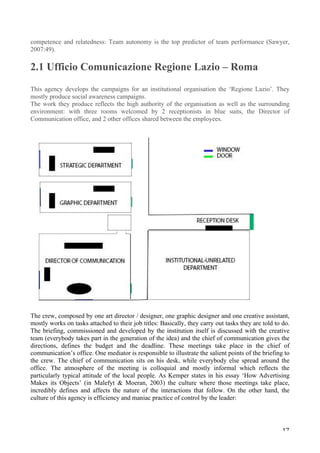
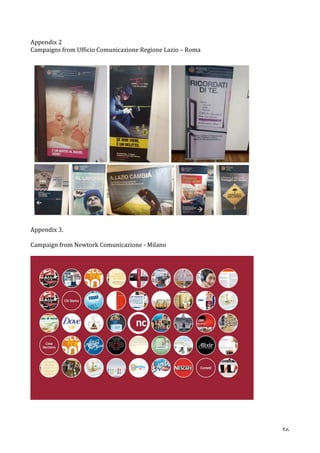
2.1 Ufficio Comunicazione Regione Lazio – Roma
This agency develops the campaigns for an institutional organisation the ‘Regione Lazio’. They
mostly produce social awareness campaigns.
The work they produce reflects the high authority of the organisation as well as the surrounding
environment: with three rooms welcomed by 2 receptionists in blue suits, the Director of
Communication office, and 2 other offices shared between the employees.
The crew, composed by one art director / designer, one graphic designer and one creative assistant,
mostly works on tasks attached to their job titles: Basically, they carry out tasks they are told to do.
The briefing, commissioned and developed by the institution itself is discussed with the creative
team (everybody takes part in the generation of the idea) and the chief of communication gives the
directions, defines the budget and the deadline. These meetings take place in the chief of
communication’s office. One mediator is responsible to illustrate the salient points of the briefing to
the crew. The chief of communication sits on his desk, while everybody else spread around the
office. The atmosphere of the meeting is colloquial and mostly informal which reflects the
particularly typical attitude of the local people. As Kemper states in his essay ‘How Advertising
Makes its Objects’ (in Malefyt  Moeran, 2003) the culture where those meetings take place,
incredibly defines and affects the nature of the interactions that follow. On the other hand, the
culture of this agency is efficiency and maniac practice of control by the leader:
  18	
  
While I was in the chief of communication’s office, one graphic designer entered the office. He
knocked the door and waited for permission to entre. Once the chief allowed him to enter, the
copywriter showed him a draft of his commissioned work. Without saying a word, he waited for the
chief’s consent / disapproval. The work showed was ok. “Good job, go for it!”. He then
immediately left the room. After a while, another copywriter knocked the door. He needed approval
for a layout. He didn’t even enter the room. He stayed on the entrance. He showed the layout from
there. “Do I go for it? he asked. Even if with a ‘snob’ expression, the copywriter received the
consent and went away.
In the 45 minutes interview, I asked him his opinion about a less structured approach to manage a
group of experts free from job assigned tasks and specific roles. He openly stated that “the use of
this kind of model ridicules the profession of the advertisers and the way Pixar and Google act
cannot be taken into consideration because they produce different kind of contents”.
“Advertising has nothing to do with art, most of the time copy writers and art directors are not able
to elaborate strategic plans: it is not true that everybody can do everything, even if supported by the
organization. The ingredients for creativity are attitude and willing to work under the structure of
competence!”
I was not surprised to hear this kind of comments from him. He plays and enjoys the authoritarian
role within the agency, he would never leave his position to adopt a collaborative thinking model
where every voices count.
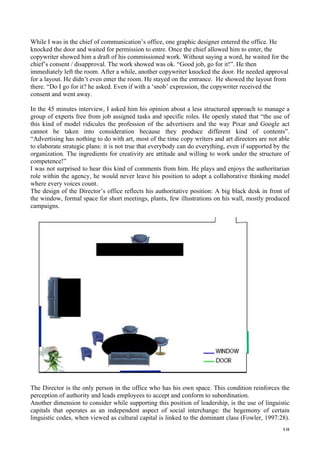
The design of the Director’s office reflects his authoritative position: A big black desk in front of
the window, formal space for short meetings, plants, few illustrations on his wall, mostly produced
campaigns.
The Director is the only person in the office who has his own space. This condition reinforces the
perception of authority and leads employees to accept and conform to subordination.
Another dimension to consider while supporting this position of leadership, is the use of linguistic
capitals that operates as an independent aspect of social interchange: the hegemony of certain
linguistic codes, when viewed as cultural capital is linked to the dominant class (Fowler, 1997:28).
  19	
  
This is why in advanced societies high linguistic capital brings high symbolic profits and high profit
of distinction (1991:55). The Director of Communication’s linguistic style suggested practice of
power. The expressions he used and the attitudes he showed during the interview were symbolic of
a person in position of control.
As an extension of his authority, he is the only member of the agency to have a private parking
space.
Surprisingly, the results of the survey showed all staff members (3) positively rated this agency’s
working environment. In particular, all of them stated their relationship with the leader was open
and friendly (Quest,.4) and the interaction between colleagues was informal (2) or supported by the
organisation. (1) They indicated to be well connected to each others and considered their
collaboration to be absolutely relevant.
Thanks to this analysis I can summarise how the culture of the organisation influences the
perception of the workplace: In this small agency the rules are clear, established and shared by the
employees: they have clear directions on how to do things, they feel safe and protected by the
organisation that provide them all the conditions to perform in the way they do have to do.
Network Comunicazione - Milano
Network Comunicazione is a communication agency sited in Milan since 2005. This is a small size
agency specialised on content creations for multimedia platforms. They deal mostly with well-
established International and Italian brands: Dove, Nescafe’, Fox, Findus  Mulino Bianco to name
a few. I had a chance to interview one of the co-founders of the agency thanks to a previous
collaboration. Network Comunicazione campaigns are developed according to this model:
• Brief: definition of the mission and clients objectives
• Concept: creation of the strategy to adopt
• Contents: development of strategy-related content
• Format: transformation of concepts in real formats
• Brand activation: spread the format on a wide range of media.
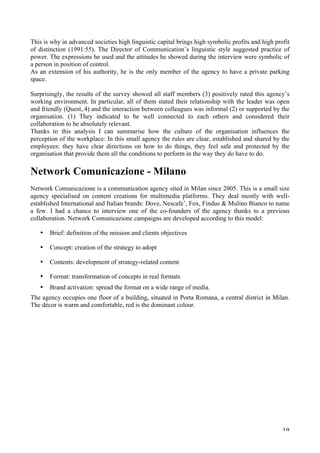
The agency occupies one floor of a building, situated in Porta Romana, a central district in Milan.
The décor is warm and comfortable, red is the dominant colour.
  20	
  
Ten people work for Network Comunicazione. 3 Accounts, 1 Account Executives (co-founder), 3
Art Directors, 2 Creative Directors (1 is CEO), 2 Administrators / accountants, 1 Director of
Strategy (CEO).
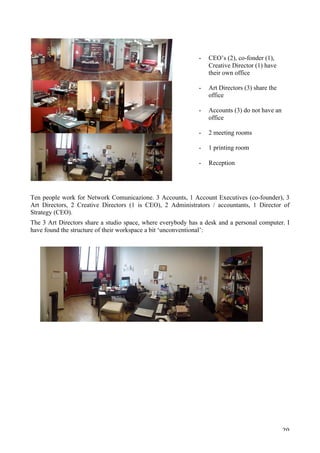
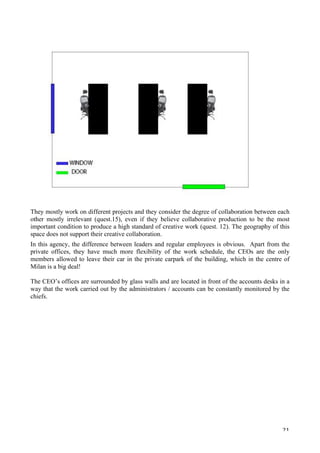
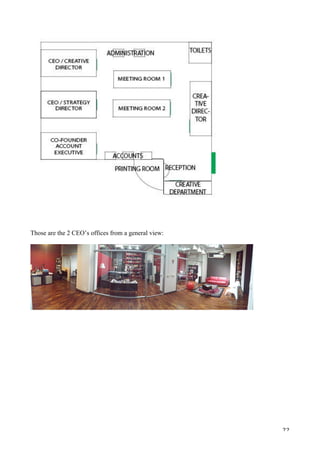
The 3 Art Directors share a studio space, where everybody has a desk and a personal computer. I
have found the structure of their workspace a bit ‘unconventional’:
- CEO’s (2), co-fonder (1),
Creative Director (1) have
their own office
- Art Directors (3) share the
office
	
  
- Accounts (3) do not have an
office
	
  
- 2 meeting rooms
	
  
- 1 printing room
	
  
- Reception
  21	
  
They mostly work on different projects and they consider the degree of collaboration between each
other mostly irrelevant (quest.15), even if they believe collaborative production to be the most
important condition to produce a high standard of creative work (quest. 12). The geography of this
space does not support their creative collaboration.
In this agency, the difference between leaders and regular employees is obvious. Apart from the
private offices, they have much more flexibility of the work schedule, the CEOs are the only
members allowed to leave their car in the private carpark of the building, which in the centre of
Milan is a big deal!
The CEO’s offices are surrounded by glass walls and are located in front of the accounts desks in a
way that the work carried out by the administrators / accounts can be constantly monitored by the
chiefs.
  22	
  
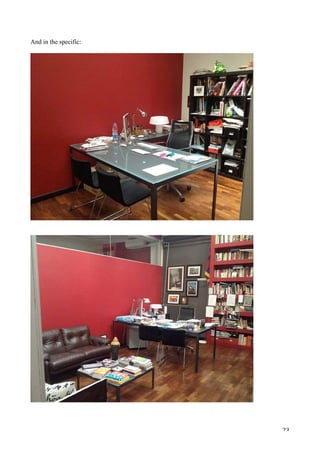
Those are the 2 CEO’s offices from a general view:
  23	
  
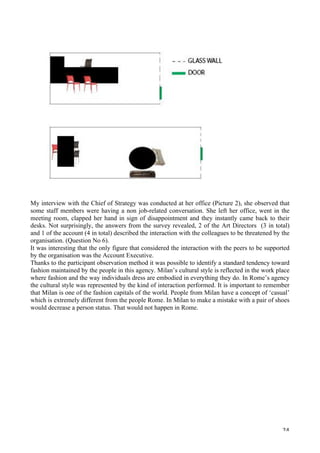
And in the specific:
  24	
  
My interview with the Chief of Strategy was conducted at her office (Picture 2), she observed that
some staff members were having a non job-related conversation. She left her office, went in the
meeting room, clapped her hand in sign of disappointment and they instantly came back to their
desks. Not surprisingly, the answers from the survey revealed, 2 of the Art Directors (3 in total)
and 1 of the account (4 in total) described the interaction with the colleagues to be threatened by the
organisation. (Question No 6).
It was interesting that the only figure that considered the interaction with the peers to be supported
by the organisation was the Account Executive.
Thanks to the participant observation method it was possible to identify a standard tendency toward
fashion maintained by the people in this agency. Milan’s cultural style is reflected in the work place
where fashion and the way individuals dress are embodied in everything they do. In Rome’s agency
the cultural style was represented by the kind of interaction performed. It is important to remember
that Milan is one of the fashion capitals of the world. People from Milan have a concept of ‘casual’
which is extremely different from the people Rome. In Milan to make a mistake with a pair of shoes
would decrease a person status. That would not happen in Rome.
  25	
  
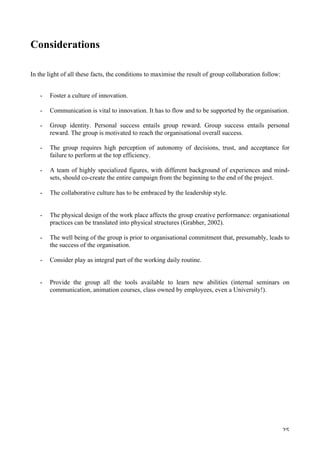
Considerations
In the light of all these facts, the conditions to maximise the result of group collaboration follow:
- Foster a culture of innovation.
- Communication is vital to innovation. It has to flow and to be supported by the organisation.
- Group identity. Personal success entails group reward. Group success entails personal
reward. The group is motivated to reach the organisational overall success.
- The group requires high perception of autonomy of decisions, trust, and acceptance for
failure to perform at the top efficiency.
	
  
- A team of highly specialized figures, with different background of experiences and mind-
sets, should co-create the entire campaign from the beginning to the end of the project.
	
  
- The collaborative culture has to be embraced by the leadership style.
- The physical design of the work place affects the group creative performance: organisational
practices can be translated into physical structures (Grabher, 2002).
	
  
- The well being of the group is prior to organisational commitment that, presumably, leads to
the success of the organisation.
	
  
- Consider play as integral part of the working daily routine.
- Provide the group all the tools available to learn new abilities (internal seminars on
communication, animation courses, class owned by employees, even a University!).
  26	
  
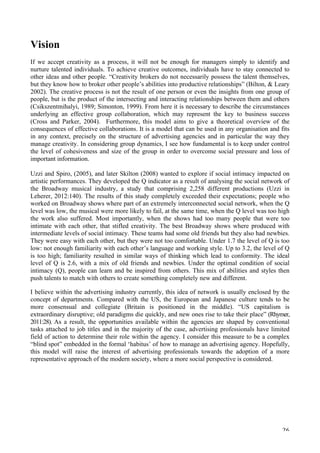
Vision
If we accept creativity as a process, it will not be enough for managers simply to identify and
nurture talented individuals. To achieve creative outcomes, individuals have to stay connected to
other ideas and other people. “Creativity brokers do not necessarily possess the talent themselves,
but they know how to broker other people’s abilities into productive relationships” (Bilton,  Leary
2002). The creative process is not the result of one person or even the insights from one group of
people, but is the product of the intersecting and interacting relationships between them and others
(Csikszentmihalyi, 1989; Simonton, 1999). From here it is necessary to describe the circumstances
underlying an effective group collaboration, which may represent the key to business success
(Cross and Parker, 2004). Furthermore, this model aims to give a theoretical overview of the
consequences of effective collaborations. It is a model that can be used in any organisation and fits
in any context, precisely on the structure of advertising agencies and in particular the way they
manage creativity. In considering group dynamics, I see how fundamental is to keep under control
the level of cohesiveness and size of the group in order to overcome social pressure and loss of
important information.
Uzzi and Spiro, (2005), and later Skilton (2008) wanted to explore if social intimacy impacted on
artistic performances. They developed the Q indicator as a result of analysing the social network of
the Broadway musical industry, a study that comprising 2,258 different productions (Uzzi in
Leherer, 2012:140). The results of this study completely exceeded their expectations; people who
worked on Broadway shows where part of an extremely interconnected social network, when the Q
level was low, the musical were more likely to fail, at the same time, when the Q level was too high
the work also suffered. Most importantly, when the shows had too many people that were too
intimate with each other, that stifled creativity. The best Broadway shows where produced with
intermediate levels of social intimacy. These teams had some old friends but they also had newbies.
They were easy with each other, but they were not too comfortable. Under 1.7 the level of Q is too
low: not enough familiarity with each other’s language and working style. Up to 3.2, the level of Q
is too high; familiarity resulted in similar ways of thinking which lead to conformity. The ideal
level of Q is 2.6, with a mix of old friends and newbies. Under the optimal condition of social
intimacy (Q), people can learn and be inspired from others. This mix of abilities and styles then
push talents to match with others to create something completely new and different.
I believe within the advertising industry currently, this idea of network is usually enclosed by the
concept of departments. Compared with the US, the European and Japanese culture tends to be
more consensual and collegiate (Britain is positioned in the middle). “US capitalism is
extraordinary disruptive; old paradigms die quickly, and new ones rise to take their place” (Rhymer,
2011:28).	
  As a result, the opportunities available within the agencies are shaped by conventional
tasks attached to job titles and in the majority of the case, advertising professionals have limited
field of action to determine their role within the agency. I consider this measure to be a complex
“blind spot” embedded in the formal ‘habitus’ of how to manage an advertising agency. Hopefully,
this model will raise the interest of advertising professionals towards the adoption of a more
representative approach of the modern society, where a more social perspective is considered.
	
  
  27	
  
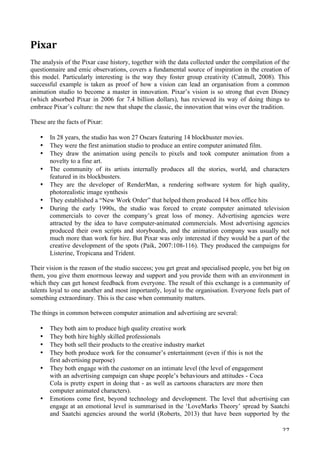
Pixar
The analysis of the Pixar case history, together with the data collected under the compilation of the
questionnaire and emic observations, covers a fundamental source of inspiration in the creation of
this model. Particularly interesting is the way they foster group creativity (Catmull, 2008). This
successful example is taken as proof of how a vision can lead an organisation from a common
animation studio to become a master in innovation. Pixar’s vision is so strong that even Disney
(which absorbed Pixar in 2006 for 7.4 billion dollars), has reviewed its way of doing things to
embrace Pixar’s culture: the new that shape the classic, the innovation that wins over the tradition.
These are the facts of Pixar:
• In 28 years, the studio has won 27 Oscars featuring 14 blockbuster movies.
• They were the first animation studio to produce an entire computer animated film.
• They draw the animation using pencils to pixels and took computer animation from a
novelty to a fine art.
• The community of its artists internally produces all the stories, world, and characters
featured in its blockbusters.
• They are the developer of RenderMan, a rendering software system for high quality,
photorealistic image synthesis
• They established a “New Work Order” that helped them produced 14 box office hits
• During the early 1990s, the studio was forced to create computer animated television
commercials to cover the company’s great loss of money. Advertising agencies were
attracted by the idea to have computer-animated commercials. Most advertising agencies
produced their own scripts and storyboards, and the animation company was usually not
much more than work for hire. But Pixar was only interested if they would be a part of the
creative development of the spots (Paik, 2007:108-116). They produced the campaigns for
Listerine, Tropicana and Trident.
Their vision is the reason of the studio success; you get great and specialised people, you bet big on
them, you give them enormous leeway and support and you provide them with an environment in
which they can get honest feedback from everyone. The result of this exchange is a community of
talents loyal to one another and most importantly, loyal to the organisation. Everyone feels part of
something extraordinary. This is the case when community matters.
The things in common between computer animation and advertising are several:
• They both aim to produce high quality creative work
• They both hire highly skilled professionals
• They both sell their products to the creative industry market
• They both produce work for the consumer’s entertainment (even if this is not the
first advertising purpose)
• They both engage with the customer on an intimate level (the level of engagement
with an advertising campaign can shape people’s behaviours and attitudes - Coca
Cola is pretty expert in doing that - as well as cartoons characters are more then
computer animated characters).
• Emotions come first, beyond technology and development. The level that advertising can
engage at an emotional level is summarised in the ‘LoveMarks Theory’ spread by Saatchi
and Saatchi agencies around the world (Roberts, 2013) that have been supported by the
  28	
  
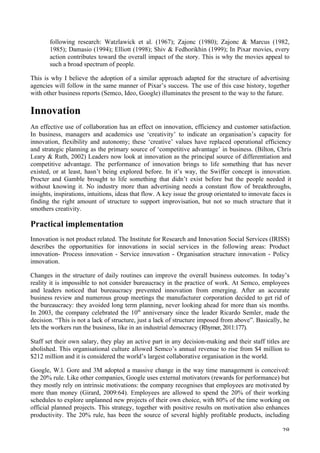
following research: Watzlawick et al. (1967); Zajonc (1980); Zajonc  Marcus (1982,
1985); Damasio (1994); Elliott (1998); Shiv  Fedhorikhin (1999); In Pixar movies, every
action contributes toward the overall impact of the story. This is why the movies appeal to
such a broad spectrum of people.
This is why I believe the adoption of a similar approach adapted for the structure of advertising
agencies will follow in the same manner of Pixar’s success. The use of this case history, together
with other business reports (Semco, Ideo, Google) illuminates the present to the way to the future.
Innovation
An effective use of collaboration has an effect on innovation, efficiency and customer satisfaction.
In business, managers and academics use ‘creativity’ to indicate an organisation’s capacity for
innovation, flexibility and autonomy; these ‘creative’ values have replaced operational efficiency
and strategic planning as the primary source of ‘competitive advantage’ in business. (Bilton, Chris
Leary  Ruth, 2002) Leaders now look at innovation as the principal source of differentiation and
competitive advantage. The performance of innovation brings to life something that has never
existed, or at least, hasn’t being explored before. In it’s way, the Swiffer concept is innovation.
Procter and Gamble brought to life something that didn’t exist before but the people needed it
without knowing it. No industry more than advertising needs a constant flow of breakthroughs,
insights, inspirations, intuitions, ideas that flow. A key issue the group orientated to innovate faces is
finding the right amount of structure to support improvisation, but not so much structure that it
smothers creativity.
Practical implementation
Innovation is not product related. The Institute for Research and Innovation Social Services (IRISS)
describes the opportunities for innovations in social services in the following areas: Product
innovation- Process innovation - Service innovation - Organisation structure innovation - Policy
innovation.
Changes in the structure of daily routines can improve the overall business outcomes. In today’s
reality it is impossible to not consider bureaucracy in the practice of work. At Semco, employees
and leaders noticed that bureaucracy prevented innovation from emerging. After an accurate
business review and numerous group meetings the manufacturer corporation decided to get rid of
the bureaucracy: they avoided long term planning, never looking ahead for more than six months.
In 2003, the company celebrated the 10th
anniversary since the leader Ricardo Semler, made the
decision. “This is not a lack of structure, just a lack of structure imposed from above”. Basically, he
lets the workers run the business, like in an industrial democracy (Rhymer, 2011:177).
Staff set their own salary, they play an active part in any decision-making and their staff titles are
abolished. This organisational culture allowed Semco’s annual revenue to rise from $4 million to
$212 million and it is considered the world’s largest collaborative organisation in the world.
Google, W.l. Gore and 3M adopted a massive change in the way time management is conceived:
the 20% rule. Like other companies, Google uses external motivators (rewards for performance) but
they mostly rely on intrinsic motivations: the company recognises that employees are motivated by
more than money (Girard, 2009:64). Employees are allowed to spend the 20% of their working
schedules to explore unplanned new projects of their own choice, with 80% of the time working on
official planned projects. This strategy, together with positive results on motivation also enhances
productivity. The 20% rule, has been the source of several highly profitable products, including
  29	
  
Gmail, Google Suggest, AdSense for Content, Orkut, Scotchgard Fabric  Upholstery Protector,
Scotch Masking Tape, and the highly profitable Post-it Notes. “If you want a radical innovation,
you need your organization to be at the improvisational extreme” (Sawyer, 2007). Google assumes
that the 20% free time given to its employees will be returned to the company in information,
innovation, and increased loyalty. The possible networks of connection available are the real
essence of creativity. This is innovation at a pure state.
Communication
The structure of communication networks within an organisation affects the performance of
creative problem-solving solutions (Bouchard, et all.1969). When the network of communication is
centralised it requires any communication to pass through certain members before going to other
members. The peripheral members of a centralised networks may feel powerless and
underappreciated, so they become dissatisfied with the group’s communication.
On the other hand, in decentralized networks people have equal access to information.
Collaborative organisations aimed at creative excellence cannot afford to miss out on even one
person’s contributions. “Such open lines of communication are necessary to create a creative
environment where good ideas can be freely shared without worrying that things have to go through
the proper channels”. (Cadmull. 2011)
It has been demonstrated that members of effective teams have strong feeling of inclusion,
commitment, pride and trust in their peers. These feelings are developed by a communication
climate that is open, supportive, inclusive and rewarding (Gibb, 1961) and communication patterns
are evenly distributed between everyone (Levi, 2011:97). Communication needs to be between
anybody at any time, which means it needs to happen out of the structure and out of order. The
problem with this vision is the misleading link between ‘out of order’ and ‘lack of structure’
standard of the current dominant but regressing view.
The role of technology
The easy access to numerous updated communication tools has transformed how companies
communicate with employees and what channels are most effective to reach them (Men, 2014). To
support the network of connections between colleagues and managers it is highly recommended to
use digital platforms tools such as blogs, bulletin boards, and social networking sites, which are
interactive, social, communal, and relational by nature (Crescenzo, 2011) despite having limited
capacity to carry social information compared with face-to face communications. (Parker  Wall,
1998; Sheer, 2011). Face-to-face communication is the richest medium and an optimal channel for
communicating complex information because it facilitates immediate feedback, the use of natural
language and multiple cues, and personal focus (Daft  Lengel, 1984-1986).
Brainstorming and communication
The original brainstorming design, as Osborn invented it, simply didn’t work in generating the most
original new ideas. In the practice process of this technique lays a communication problem.
In fact, brainstorming activities inhibit criticism between the participants. Tersely (in Van de Ven,
 Delbecq, 1986) summarised those inhibitions in:
1) A “focus effect” – the pursue of a single train of thoughts for a long period.
2)“Self weighting” effect – the participation of the single in condition of equal competence.
3) Covert judgements are made but are not expressed as overt criticism.
  30	
  
4) Status incongruities – in low status participants may be inhibited and go along with opinions
expressed by high status participants, even though they feel their opinions are better.
5) Group pressures for conformity.
6) The influence of dominant personality-types upon the group.
7) Maintain group interaction over quality of solutions.
8) Tendency to “speedy decisions”.
In the same direction, in his study conducted on 32 volunteers neuroscientist Gregory Berns
discovered that in the 41% of the cases the group changed the individual perception.
In particular, when the volunteer played alone, the brain scans showed activity in the region
associated with visual and spatial perception, and in the frontal cortex which is associated with
conscious decision making. In the group condition the members deliberately gave the wrong answer
to a simple problem, the scans showed that the volunteer had less brain activity in the decision
making area and more in area associated with visual and spatial perceptions. The peer pressure, in
other words is not only unpleasant but it can change a person’s view of a problem. Brainstorming
facilitates conformity. To overtake those problems a communication culture based on constructive
criticism should be considered.
Practical Implementation
Pixar makes use of ‘Plussing’, ‘Constructive criticism’ and ‘Brain trust’ techniques to ensure
communication to flow. These can be effectively carried out only if the group experiences a sense
of trust in an environment in which they can get honest feedback from everyone. Put smart,
passionate people in a room together, challenge them with identifying and solving problems, and
encourage them to demand for ‘candour’ (flow). The brain trust is not fool proof, but when we get it
right, the results are phenomenal. Discussions still involve challenging problems, like possibly
rejecting initial ideas, but this is done always with a view to replacing them with a better solution.
These techniques involve communication strategies that liberate the director to listen, seek help and
fully consider the advice Ed Cadmull (2008:9). In the particular case of advertising agencies the
group members should be pushed to freely interact in casual encounters. In this environment
colleagues are considered the most effective source of information: pushed by sharing thoughts,
new connections are created just because of the fusion of different personal dispositions. “The more
people are involved into the thinking process and are invited to critique, enjoy and modify our ideas
the more unlimited our mind becomes”. (Ricchiuto1952:45). The systematic use of this fusion is the
essence of effective group communication that is the top priority to lead employees to engagement.
(Charles Woodruffe, 2006 in CIPD)
  31	
  
Group condition
Employees in ‘group condition’ “get a communal mind going. People’s minds interact as
components of a larger mind”. (Shrage, in Ricchiuto 1957:72)
As stated in the Johnson and Johnson Annual report (2009) a group exists for a reason and has a
shared common goal pursued by all the group members. In group condition people who have some
type of relationships, see connections among themselves, or believe that they share a common fate:
They establish a group goal, clarify the objectives to achieve it, they focus on the task, they listen to
what the other have to say, they talk about it, they find solutions. Furthermore, the organisation
exerts a considerable amount of influence on how the team is able to work: “Being better together is
the strength of the organisation” claimed Steve Jobs “Sharing the view of the company means
working together towards the interest of it”. Evidently from his company business examples - Apple
and Pixar - there is a lot to learn from this approach. To an extreme, when the organisational values
are clearly defined, shared, accepted and pursued by the workforce the level of engagement and
commitment makes a great deal of difference to the organisation overall success. Insofar this leads
the group to prioritize the interests of the organisation over and above their own self-interests (Bass,
1999). When employees perceive that the organisation is focused on promoting the well being of
the member as part of its community the level of motivation increases more then if the organisation
attention is focused on the single individual. (Cameron, Dutton,  Quinn, 2003). As a result, the
reward system is also group-oriented: employees are more likely to experience pro-social
motivation when organisations maintain collectivistic rather than individualistic norms and rewards.
(Ajzen, 1991; Hackman, 1992, Chatman  Barsade, 1995, Batson, 1994; Miller, 1999, Perlow 
Weeks, 2002 ; Grant  Berg 2010). On the other hand, individual recognition has to be taken under
control to prevent social loafing (cause of productivity loss, together with social inhibition and
production blocking)
Practical implementation
In the advertising agencies, employees (highly specialised figures industry related and non) are not
seen as single individuals with specific skills and attitudes. Their strengths (and weaknesses) are
interconnected to all other’s strengths (and weaknesses). Collectively they are the greatest networks
of abilities on earth. They learn from each other, they inspire and are inspired by others in the
group. They continually learn new abilities to improve the communication with other professionals
from different backgrounds to be able to give competent advices. “The challenge is to put forth their
creativity in a harmonious way”, said Brad Bird Director at Pixar. Otherwise, it’s like ‘an orchestra
where everybody’s playing their own music. Each individual piece might be beautiful, but together
they’re crazy’. In advertising organisations, the group’s goal should correspond with the
organisation interests: to guarantee the creation of the most relevant and innovative custom-made
advertising campaigns possible to attract more clients and sell more benefits. In return the
organisation will provide the group with everything they need to create better quality of work and
support their well being: seminars, classes, creative playground, group rewards (holiday, daily
experiences, food experiences), professional equipment, software. The group is free of action, they
are trusted and the members are even allowed to transform and reinvent their workspaces according
to the auto-perceptive project-related requirements. (Parker  Wall, 1998) (Question number 17 of
the questionnaire reveals that 4 on 13 of the interviewed defined a not assigned position working
space as their ideal working space).
  32	
  
Group Authority
The most efficient way to resolve the numerous problems that arise in any complex project is to
trust people to address difficulties directly, without having to get permission of execution.
Managers understand they don’t always have to be the first to know about something going in their
realm, and it’s ok to walk into meetings and be surprised. (Lassater, 2003)
Cross  Parker (2004) in a study of over three hundred professionals found that the group will
perform at the top level of ability if it shares a focused goal; it is fully engaged to the cause and has
no preconceived idea of how to reach the goal; it completely concentrates on the task; it perceives
self control (autonomy of decision), equal participation and blending egos; experiences familiarity;
deals with potential for failure; moves the conversation forward and constantly builds
communication possibilities. Most importantly, the group should be able to decide their own
method of working; the roles should be multifunctional and multiskilled; variances in the work
process should be handled at the source; redesign should be continuous to achieve high standard
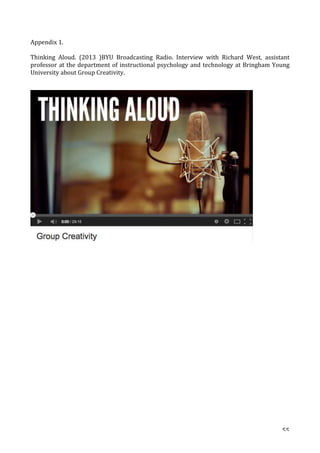
performances. This is an extract from the radio interview with Richard West on group creativity
(link in appendix n.1):
In the animation studio at Birmingham University, instead of working on individual projects, the
students take part in group projects. They have priorities, they have boundaries but they get to
choose the role they want to play within that. A student told to the director of the project: “I would
really like to learn how to animate hair and be the hair animator for this project”. And the director
said “This is awesome, nobody wanted to do hair last time we had really good rocks really good
leather but we had terrible hair! This is going to be great, we are going to have good hair for this
project, this is going to be awesome!” The student gained intrinsic motivation and sense of safety in
expressing her idea, which are two important predictors of organisational commitment and job
satisfaction. Thomsett (1980) in his study conducted to investigate the influence that organisational
cultures plays on individual’s and team’s performances, confirmed that teams need to be allowed to
operate with a certain amount of autonomy and confidence that their membership will stay
reasonably consistent for a period of time. Creativity may be destroyed by close monitoring and
requires a degree of autonomy and experimentation (Amabile, 1996; Townley et al. 2009).
Moreover, low social anxiety due to minimum perception of subordination increases group
performance. (Camacho  Paulus, 1995). This assumption has been confirmed by the most of the
researches in the field (see group diversity in the Internal constructions content).
The concept of failure is a fact of life in collaborative organisations and has a great potential to
innovation (Perry, 1992:52) The best way to great results is to generate a lot of ideas and then select
the best one. According to this statement, the members of the group need to feel comfortable in
sharing these ideas with colleagues and supervisors. The organisational management has to be on
the risk’s side. Employees need to recognise in the leader’s figure a supporter and a listener, a
mentor. They do not need to feel embarrassed or stressed about his or her judgements. (Bayles and
Orland 1993; Amabile 1999). There is a correlation between frustration, conflict and group
performance: stress experienced for a sustained period of time seems to reduce individual’s and
team’s ability to perform well on creative tasks (Norword, Zbigniew, Fafrowicz,  Marek, 1993;
Suls, 2001). If not supported by the leadership style “the risk condition” remains on the aversion
side. The word ‘supervisor’ or ‘manager’ or ‘executive’ (especially in advertising) implies the
practice of control of someone over someone else’s work. This concept kills creativity. “With too
many rules or too much cohesion, the potential for innovation is lost” (Sawyer, 2007:56). Most of
the people are creative, most people want to do well. The issue is not ‘how do you make them more
creative’, rather it is ‘how do we remove the barriers in the blocks’? At Pixar, the journey to the top
hasn’t always been a smooth ride. The studio went through hard times, impossible challenges, like
completely rewriting Toy Story 2 in ninety days and consistent losing money. Steve Jobs lost 1
million dollars a year for 5 years before his investment started to gain positive results. The fact that
  33	
  
Pixar went through many failures, this has become their strength. They have learned how to treat
failure and not just accept it, but taking the best from it. The acceptance of failure as part of the
process is one of the values Pixar stands for. During an interview in 2014 Ed Cadmull said “Every
Pixar movie sucks at the beginning. So, how do we judge the team? The way we do it is by how
well the team works together to find solution to the initial disaster. If they laugh together, if they are
able to rethink the whole process, then all the barriers to creativity disappear ”.
Highly specialized figures
Advertising ideas are insights that come from people who strategically translate the brand message
into visuals and sounds and direct it to the target audience. During the project, one person has a
point of view, two people have more, more people have many. People have more new ideas when
they talk with more people (Allen 1977:123). When the human being looks for solutions he is too
focus in solving the problem as it is. Most of the time he refers to previous standard safe solution
without considering the opportunity to reverse the problem and consequently its solutions. In the
world of the senses, reality is always a matter of perspective and acquired knowledge. This explains
why ten people in a meeting can describe the same problem in at least ten different ways
(Ricchiuto, 1952: 26) and why a collaborative thinking approach can benefit the structure of
advertising agencies.
Practical Implementation
In the model I propose, experts from different backgrounds of experience (from psychology to sales
experts, sociology, multimedia, graphic, production, post production, communication, even music
compositors) with different skills and perspective are pushed to co-create rather than co-operate the
entire adverting project. This variety of professional figures work together to explore the
possibilities, to find solutions, to learn from others, to listen to others, to add value, to freely
communicate needs and ideas, to choose the role they want to play on a project, with no job
position restrictions. Turning ideas into advertising contents requires a range of different types of
thinking and specialised expertise from different individuals, convergent and divergent thinking is
just one of the human dispositions. In involving more people and their views in the whole process,
supporting their interaction and group flow, the product of their ideas will improve dramatically just
because the myriad of new connections that occurs in casual and non-casual interactions. The
ability to ‘broker’ connections between different people, experiences, talents, technologies and
emotions becomes the principal function of both creators and managers in the creative industries.
“Why are we teaching film making to accountants? Well, if you treat accountants like accountants
they are going to act like accountants. But if you treat everyone in the studio as filmmakers (or
Admakers), everyone will understand each other and communicate better” (Palk, 2007). “There is
no line between technical or artistic professionals, at Pixar” Ed Cadmull states. “Technology and art
are both integrated in every part of the company. There are no boundaries between them. It more
reflects the reality of the society”. There is no difference between an artistic or a technical profile,
unless they are not treated as that. The power of collaboration is based on discoveries, complete
each other, and push the boundaries of what a group of expert with different mind-sets can create
together.
  34	
  
Leadership
The myth of “individual creative genius” has dominated the managerial approaches to creativity and
popular culture for ages. (Montuori, 2003; Sawyer, 2007) The need for strict structures of control
over the workers and its management relies in the “classical” theorists, notably in Frederick Taylor
(“The Principles of Scientific Management”, 1913) and Max Weber (his theory of bureaucracy in
“Wirtschaft und Gesellschaft”, 1922). Taylor’s model sprang from factory production and Weber’s
from the offices of public administration, but they had a lot in common – in particular, a reliance on
standardization of work, control of quality, fine-grained division of labour and trust on a strict
hierarchy. Henri Fayol and later Luther Gulick  Urwick (1937) and Mintzberg (1979) emphasized
formal authority and the role of direct supervision to accomplish organisational work. In the
development of organisational theories, this belief in closed, rational models (Scott 1987) gradually
came under attack after World War II. The Human Relations School of Management began by
Mayo and Roethlisberger during the 1930s, brought the individuals and the social relations between
them into focus. Simple as it is, they discovered that the way employee is treated by the
organisation directly affects his or her productivity and job satisfaction. The findings of this study
became known as the Hawthorne Effect. This view will change decades of research in
organisational theories and management, in favour to a more human-focused approach. The new
current of thought postulates the existence of an informal structure growing from the unofficial
contacts people in the organisation had with each other. The informal structure could be just as
important as the formal one in predicting the outcomes - sometimes even more important. It
constituted a major intellectual shift in the way of thinking about organisations (Scott 1987,
Hollway 1991). House et al. (2004) defined leadership as “the ability of an individual to influence,
motivate, and enable others to contribute toward the effectiveness and success of the organisation of
which they are members” (2004:15).
This concept of supremacy and hierarchy of power is extremely discouraged in managing group
creativity (Ancona  Calwell, 1992; Mayer  Amabile, 1996; Waldron,1994; Cross and Parker
2004, Sawyes 2007). “Power suggests influence, the potential to influence, and control over
outcomes” (Lukes, 1974; Fiske  Berdhall, 2007). Even if the relationship between the “upper”
(the one who have) and the “lower” class (the one who have not) is open and based on trust, there
is, anyway the mutual perception of practising power (leaders) and accept power (employee).
Practical implementation
Who is the real innovative leader in business? The one who creates the strongest teams. In
collaborative thinking, formalization of work is strongly repudiated on the grounds that it is
detrimental both, to worker commitment and psychological wellbeing. Shared leadership style
characterized by emphasis on “trust, credibility, openness, relationships, reciprocity, network
symmetry, horizontal communication, feedback, adequacy of information, group-centred style,
tolerance for disagreement and negotiation” (Grunig, 1992, p. 558) is recommended in collaborative
thinking business. The aim is to facilitate dialogue between the company and its employees and to
get the best from this relationship. The managerial role is to “construct an environment that nurtures
trusting and respectful relationships and unleashes everyone’s creativity” (Richards and Engle,
1986). When information is shared through collaboration and decision-making is decentralised,
there is no need for a hierarchy to gather and channel of information to a single decision maker.
Instead, the manager is a catalyst facilitator, acting as a connector between groups, a ‘cross-
pollinator and carrier of knowledge’. (Sawyer, 2007:173).
  35	
  
‘The trick is to act like a benevolent guardian’ (Hansen, 2009): grant the members the respect and
recognition they demand, protect them from organisational rules and politics, and give them room
to pursue private efforts and to fail. The payoff will be a flourishing crop of creative minds that will
enrich the whole organisation experience. The transformational leadership refers to a behavioural
style of inspirational motivation, idealised influence, intellectual stimulation, and individualized
consideration (Avolio, Bass,  Jung, 1999). Scholars have highlighted that transformational leaders
motivate employees and team by linking their performances to the success of the organisation
(Bono  Judge, 2003; Piccolo  Colquitt, 2006; Shamir, House,  Arthur, 1993).
According to Hansen, a management professor at the University of California and specialist in
collaboration, innovation and corporate transformation - collaborative leadership provides the
constructive conflict, buy-in and progress that are necessary to succeed in today’s fast-paced and
constantly changing world. In his book ‘Collaboration’, he introduces the concept of ‘disciplined
collaboration’: a surgical approach to getting collaboration right; in here, he underlines how the
collaborative leadership is characterized by the following:
• Tends to occur in dispersed and cross-functional networks.
• All member of that network have potentially relevant information that the group needs.
• Designated leaders have authority to make decisions to maintain the well being of the group.
Ibarra and Hansen in the issue of Harvard Business Review (2011), found the following common
characteristics of collaborative leaders:
• Act as connectors: collaborative leaders function is to connect experts to each other’s and
to the organisation. They drive attention and respect towards the core value of the company.
• Form Heterogeneous Teams: the significant difference between team members is a
necessary pre-condition to innovative change. Collaboration in heterogeneous teams feels
uncomfortable and puts everyone in the stretch zone. However, this level of discomfort is
necessary for innovation to flourish.
• Create Incentives: leaders need to lower the barriers to necessary collaboration by
rewarding team performance and results as much as they do individually
• Define Clear Decision Rights: Collaboration by its very nature requires a great deal of
dialogue, debate, and conflict. In order for collaboration to work, authority to make and be
held accountable for decisions must exist.
However, the leader does not practice a function of control over its employees. He or she is the
guiding light that ensures the team stays on track. “Even when a production runs into a problem,
we do everything possible to provide support without undermining their authority” (Ed Cadmull
2010:9). In so doing, employees can escape some of the suffocating traits of rigid managerial
structure, cited in Tim Sullivan and Ray Rishman’s recent book, The Org: The Underlying Logic of
the Office. The broader aim is to treat organisational decisions as something internal to the
organisation, custom-made according to the company’s core values perceived, shared and coo-
created with its employees. (Silverman 1970 p. 153). To sum up, it would be easy to conclude that
the best thing a manager can do for creativity is to do nothing, thereby reducing the old divisions
between creativity and management and practice of power. The key, according to Amabile, lies in
clearly defining the creative goal whilst not attempting to prescribe the means (Amabile 1999, 10).
In a more simple way, free them and let them go and be involved in the magic.
  36	
  
Environment
The physical environment of an organisation delivers messages about its culture and core values.
The design of the environment plays a strategic role in defining the overall vision of the company
because ‘behaviour is dependent upon the context in which it occurs’ (Brown 2002:105) and that
there is a causal linear relation between structure and performance. (Raible, 2013 SCP paradigm).
The real organisational challenge is to create an environment in which the sense of trust is spread
between people, which are able to tell the truth to each other. According to Bilton, Chris and Leary,
Ruth (2002) creativity is person-centred, not process- oriented; innovation is privileged over value;
intuition is prized over rational decision- making; ideas emerge suddenly and ‘spontaneously’, not
from evolutionary ‘incremental’ processes. These assumptions lead managers to regard creativity
as a human resources issue (recruitment and training), rather than a matter of organisational design
(systems and processes). For example, many managers approach the problem of creativity by
sending individual employees on creative thinking courses, rather than examining the procedures
and systems within the organisation, which might inhibit or enliven creative processes and improve
group’s interactions.
Even if Leonard  Swap (1999) stated that “the direct link between the design of physical space
and creativity is unproven” (pag.137) and Csikszentmihalyi confirmed saying that “there will never
be evidence that a delightful setting induces creativity”, (1996:135) the interest the companies show
towards this condition says the opposite.
The design of the workspace has become an integral part of innovation strategies to support
creativity and innovation-orientated behaviours in organisations. (Haner  Bakke, 2004)
There is clearly a difference in designing a space to foster group creativity and collaborative
thinking or individual journeys. I will obviously take in consideration the conditions to optimise the
relationship between the group as a whole and the immediate ‘sociocultural context of their work’.
(Csikszentmihalyi,1996).
In creative organisations, creativity and innovation are the essence of daily agency work and people
in charge are aware that there is a relationship between social physical environment and level and
frequency of creative behaviours. (Amabile, Conti, Coon, Lazenby, Herron, 1996).
Physical space can be a powerful tool for companies to support their strategy and improve
performance ( Levin, 2005; Lindholm and Levainen, 2006)
Practical implementation
At Pixar’s animation studio in Emeryville, the buildings are designed to maximize inadvertent
encounters. “It is a single vast space, an open area for people to always be talking to each other”
(Cadmull, 2011).
The space where those people meet is carefully planned and designed by Steve Jobs. The building,
named for him after his death in 2011, is conceived according to the Pixar’s philosophy: toilets
were deliberately placed in the communal central atrium to force creativity out to mingle with
others instead of staying cooped up in their offices. The atrium area was conceived as somewhere
improvised chats and meetings could take place to encourage collaboration. “We think a lot about
the geography of where people are sitting and how the offices are laid out” (Anderson, 2010).
The basic assumption is that to be inventive, people, especially workers have to have fun, maintain
a child-like devotion, enjoy what they do, and never stop learning. “Pixar locals are more like
college campus: swimming pool, football pitch, sand volleyball court, playing fields and people
going around with little scooters. Professionals working for them and engaging with the Emeryville
headquarter consider Pixar structure of work as a “Gift from God”.
At Google, swimming pools, gyms, pool tables and other spaces containing games are the best way
to maintain high standard of innovation and open interaction between the employees. They are
  37	
  
allowed to bring their dogs to work, to get around by scooter, skate boards or rollerblades, to enjoy
massages or gourmet meals and take part in yoga or pilates sessions (Google, 2007, 2009;
Hoahalnd, 2006) (Kurt, Kurt, Medaille, 2010) At IDEO, innovative design solution company,
“there are tubs of markers everywhere, Post-it Notes litter the walls of conference rooms, a gum
ball machine, xylophone, a vintage Volkswagen bus converted into a meeting area completed with
beach chairs on the roof. According to a 2013 study by Expedia.com, Americans only used 10 of
their 14 annual vacation days. That’s twice as many unused days off as in 2012. While the
restorative powers of proper vacation shouldn’t be ignored, the creation of mini-getaways within
the workplace helps people quickly reset and recharge. The high pressure delivered by the highly
technical skills required at Ideo, is overtaken by the structure of its environment. Intuitively, we all
experienced how much the environment affects our moods and behaviours: Offices can either be
numbing or energizing; encourage rigid manners or enhance creativity. At IDEO, they continually
experiment with mood-altering environments. “In a few of our locations, you’ll find picnic tables,
which spark memories of summer vacations and encourage friendly, casual conversations between
colleagues. In our Chicago studio, there’s a cosy, under-the-stair well fort some of our interns
constructed. You need to crawl into it on your hands and knees, like a child”.
To create the physical conditions that supports the well being of the employees is predictive of their
commitments towards the organisation and their will to act collaboratively for its success. (Ryan 
Deci, 2001; Uchida, Norasakkunkit and Kitayama, 2004; Paterson, Park  Seligman, 2005; Ryan at
all. 2006)
Well-being
Together with the design of the space, the work place’s atmosphere affects the creative
performance. (Higgins, Qualls,  Couger, 1992; Murray, Sujan, Hirt,  Sujan, 1990; Zhou, 1998;
Brodersen, M. Brodersen, J.  Eisenberg, 2004). From the last quarter of the twentieth century
onwards, concepts like employee commitment and job satisfaction started to appear on the ground.
From here, the need to evaluate the employee’s experience and nurture the wellbeing on the
workplace, which presumably leads to organisational commitment. Nowadays, manager’s eye is on
how to keep employees engaged in their job. They now realise that by focusing on employee’s
engagement and motivation, they can create a more efficient and productive workforce. (Markos 
Sridevi, 2010). Engaged / committed employees are enthusiastic and energetic about their work and
fully immersed in it. This variable is a predictor of successful performances. (Bakker  Demerouti,
2009). As Bakker at al. (2008) discovered in their study “work engagement is a positive, fulfilling,
affective motivational state of work-related well-being that is characterized by vigour, dedication
and absorption” (2008:187)
Psychologists focused on employee behaviours define two types of motivational states: external, or
extrinsic, and internal, or intrinsic. Intrinsic motivation comes from within the employee, from the
employee’s interest in a task, and the satisfaction that comes from doing a job well. Extrinsic
motivation comes from outside the employee, essentially from rewards such as bonuses, raises, or
changes in responsibilities.
Intrinsic motivation and Pro-social behaviours
Committed individuals are willing to give something of themselves in order to contribute to the
organization’s wellbeing: these pro-social behaviours performed by the members of the group are
vital for the success of the collaborative organisation. Those are not part of an individual’s formal
job and specified role requirements: they are spontaneous acts performed voluntarily to promote the
organisation’s interests and behaving on behalf of others or on behalf of a community (Catterall
2011) or voluntary behaviours made with the intent of benefiting others (Eisenberg  Fabes, 1998;
Kayser 2014). The researches have confirmed that empathy, helping, cooperation, and altruism are
  38	
  
pro-social behaviours predictors (e.g., Fehr  Fischbacher, 2003; Graziano et al., 2007; Mikulincer
 Shaver, 2005; Penner, Dovidio, Piliavin,  Schroeder, 2005; Singer et al., 2004; Staub, 1979).
In this research about the cultivation of human empathy conducted by the National Educational
Longitudinal Study of 1988, one factor particularly stands out: the emotional stability and nurturing
behaviour of the mother have an effect on the children emphatic mind set. Consistent, nurturing,
and positive mothers’ attention is associated with the cultivation of empathy. (Zhou, et al., 2002;
Eisenberg  Fabes, 1998; Hastings et al., 2007). Pro-social behaviours, then, are more likely to
occur in certain individuals more disposed to empathic reactions then others (Strayer,1996;
McMahon, Wernsman  Parnes 2001; Decety and Jackson, 2004).
On the other hand, “neural processes involved with art and creativity have the potential to develop a
capacity for empathy and pro-social behaviours because they condition empathy-related
architectures in the brain”. (Catterall, 2011:20) . At this point, as prosocial-behaviours may vary
‘with age, tenure, gender, achievement motivation, sense of competence’ and personal belief,
(Modway at al. 1982) I support the view that the promotion of empathy and pro-social behaviours
towards the organisation in creative industries is just a matter of structural conditions: the design of
the organisation influences employees pro-social behaviours and organisational commitment.
(Aderman, 1972; Cunningham, Steinberg  Grev, 1980; Isen, Clark  Schwartz, 1976; Isen 
Lewin, 1972; Rosenhan, Solovey  Hargis, 1981). Keeping in mind that the degree of empathy
lies in the individual’s background of experiences and affects the quality of pro-social behaviours
towards others, the organisational structure should be able to allow employees to overtake personal
experiences and make sure they embrace the positive environment that protect them. This
perception is the basic for organisational commitment (Mowday et. al. 1982): the will of behaving
on behalf of others or on behalf of a community (Catterall 2011) or voluntary behaviours made with
the intent of benefiting others (Eisenberg  Fabes, 1998; Kayser 2014)
Isen, Clark, Shalker  Karp (1978) found a relationship between pro-social behaviours,
organisational commitment and good mood which tends to recall more affectively positive
information from memory and think about affectively positive events and experiences.
Organisational commitment towards the organisation involve:
a) More effective job performance
b) Improved communication and coordination between individual and units (interpersonal
trust and understanding)
c) Improved job satisfaction and moral among person who have been treated pro-socially
by others.
d) Improved satisfaction of consumers and clients, which may result in future returning.
e) Improved organizational efficiency in general.
Finally, Gouldener (1960) and others (Blau, 1968; Homans, 1961) investigated the value of
“reciprocity” in support pro-social behaviours towards others, in particular co-workers: they assert
that people are more willing to help those who have helped them.
According to this claim in adopting “ a mutual help approach” as one of the core value of the
organisation will encourage positive collaboration, communication flow, and a valuable problem-
solving strategy.
Motivate people making them feel special is an inexpensive way to intrinsically motivate them to
do exceptional work. “When people feel special they will perform beyond your wildest dreams”
(Kelley, 2001: 93)
  39	
  
Play
Play is often regarded as the antithesis of work. People are used to separate work, pleasure, and
entertainment activities and play is seen as an activity that does not happen while one is working.
Usually playing activities occurs in specific times and spaces that serve to distinguish it from
normal life (Huizinga, 1950) While working is goal directed, play is not; while work activity
concerns with outcomes play does not; while work is pursued for rewards, play is not, usually.
But what happen when play becomes part of the work’s activity?
As Brown stated in 2009, “new ideas can suddenly emerge during play activities’. It is encouraged
by openness to new possibilities and facilitates an environment for serendipity that can result in
creative discoveries. We see things in different ways while playing and we are more prone to have
fresh insight” (2009: 18) Games have a positive impact on the work environment in several ways
but one of its most important benefits is its impact on the creative process and the critical role that
play has in innovation. Play consistently energizes, engages and motivates its participants
(Anderson, 1994) and people who play are likely to be intrinsically motivated to complete the task,
which is critical for creativity (Amabile, 1996). Play is a powerful method of fostering group
creativity and innovation in organizations and help group trust to be established it is an investment
that will receive returns in terms of highly creative output. (Kelley, 2001; Kurt, Kurt, Medaille,
2010) Creative activities and play have much in common both are often or always intrinsically
motivated, almost never occurring when one in anxious or narrowly focused on achieving a
specified goal. (Dansky, 1999) The attitude towards playing is innate in most of the human and
animal beings. Whatever the concept of playing means (performing sports, engaging in enjoyable
activity or to take part in video games) I will consider it as a “State of mind rather than a specific set
of actions” (Brown, 2009)
Dispositional affect - relatively stable personal temperaments or traits (Watson, 2000) as well as
situational patterns determine the mood of the employee. The situational measure can be
manipulated, controlled and directed towards a positive one. Frederickson and Joiner (2002)
produced evidence that positive mood led to a “broadening of perception and enchantment of idea
generation, attention and cognition.”
“Joy, for instance, creates the urge to play, interests creates the urge to explore. Play builds,
physical, socioemotional, and intellectual skills, and fuels brain development. (2002:1)
Pixar, Google, IDEO, 37 signals are just few examples well known for being innovators embracing
a playful culture in the workplace to maintain and support their employees well being and
consequent satisfaction.
Thanks to the success of those organisations cited above, the distinction between play and work are
becoming less pronounced. As Holmes demonstrated in 1999, work actually shares many
similarities with play and the differences between them are not always evident: several successful
businesses have recognized the value of play for innovation then it follows that advertising agencies
focused on innovation could also benefit from organizational play. Actually, this measure has been
explored by advertising agencies that usually host table tennis and football tables and terrace bars to
improve the interaction between team members. The real challenge is to embrace playing as a tool
to unleash the creative power of the employees. Games can be also performed in meetings with the
aim to make them more enjoyable and to contribute to both the content and process objectives of a
team meeting (Newstrom  Scannel, 1998). Most importantly they facilitate:
• Members learning and development of trust
• The appreciation of diversity
• Team functioning
• To surface hidden problems
  40	
  
• To interject greater energy into meetings
Glynn (1994), Webster and Martocchio (1993) founded that labelling tasks as play rather than work
results in greater intrinsic motivation, improved performance quality, more concern with process
and more elaborated image-laden responses. Labelling tasks as work results in more concern with
efficiency, output and comparisons to others.
Practical implementation
When people aren’t having any fun, they don’t produce good advertising. David Ogilvy (1985:45).
If play is to be encouraged in advertising agencies the design f the locals and time management
structure has to be taken in consideration. Integrate playful activities into the structure of creativity
if not defined as a powerful tool for generating ideas in group, might lose its role in foster creativity
because seen as a waste of time. Playing has to be defined and treated as a proper tool/ technique to
foster group creativity in order to add fun, enthusiasm, encourage exuberance and job satisfaction
among the team (Abramis, 1990). Part of the play‘s power as a motivator results from its
association with positive emotional states such as pleasure, joy, excitement, and optimism (Dansky,
1999, Lieberman, 1977), which can be important facilitators of the creative process (Isen, 1999;
Russ 1999) because involved in the act of recalling good memories.
Tools
The company provides courses and workshops to push the workers to explore different areas of
interest and still undiscovered interest. From the assumption that learning together is more effective
then learning individually, the implement of inner classes and seminars in the structure of the
agencies should be considered on the step of “Pixar University” - a professional-development
program that puts as much emphasis on employee education- which is the company's
secret weapon. The aim is not only to teach new employees about the tools they would need to use
but to teach existing employees more about the work their colleagues are doing. At Pixar
University, all the walls between departments come down, and the employee get to be the director
of his or her own creative idea. Learning new skills is essential and it helps improving the quality of
the communication between colleagues. “Pixar University” also offers optional courses (screen play
writing, drawing, sculpting) so people from different disciplines can interact and appreciate what
each other does. This last point is very common in highly innovating companies. Pixar University,
Wieden + Kennedy WK12 are just two example of big corporation that push their employees to
never stop learning. Their concept is that a good animators (Pixar) can be an excellent storytellers,
as well as at Wieden + Kenned (full service integrated advertising agency) they make sure every
employee has all the tools available to contribute to making the agency great.
  41	
  
Conclusions
When I first started investigating about group creativity and collaborative thinking my attention was
pointed towards the way teamwork is managed. This interest raise from the fact that any kind of
business has to deal with people interacting. In this thesis has been considered that the level of
importance an organisation turns to teamwork depends on the perceived value of the results that this
collaboration can bring to the organisation outcomes: in fact, the goal of collaboration is not
collaboration, but better results (Hansen, 2009).
This analysis has shown that one of the major factors that limit the business society is still an
authoritarian system that doesn’t allow democracy in the workplace to happen. Despite this view is
still the dominant trend, a growing number of successful business examples have demonstrated that
the road towards collectivism is a safe one. However, in advertising agencies some of the
dimensions I explored have already been taken in consideration but collaborative thinking is not yet
the standard model approached by them. Moreover, this study has shown that creativity itself is
shaped by numerous constraints and conventions (Moeran, 2009) and how routines become the
conventional way of doing things (Bourdieu, 1990).
Especially thanks to an emic prospective during this analysis I was surprised to see the impact that
the inner culture of the agency plays in defining the way it works. Simply, teamwork sometimes is
only a label attached to people that share the office, nothing more. Other times, teamwork is the
result of the organisational success. But in saying this it is important to note that in advertising
agencies, an effective collaboration between professionals can change the entire results of the final
product. This is why I consider the group as a unit: for example in defining the condition of well
being in the work place, design of the environment, and play implementation I am focus on the
wellness of the group despite of the single employees.
However, although it might not be so evident but this concept of group is mostly underestimated by
advertising agencies that treat the individuals as copywriters, art directors, creative directors,
accounts, employed for the specific task they are asked to accomplish. In bringing their contribution
in the strategic and creative process, these professionals play alone (or in departments) and then mix
the product of their work with the work of other professionals. The final result is a collection of
these contributions. Creative yes but not enough in the today competitive market.
Frequently, collaboration experts use music industry in particular symphony orchestra’s concerts as
examples of effective collaboration: During an orchestra performance, the listener hears the result
of long hours of collective creativity and negotiation. The result is a special synergy: the feeling that
the musicians were playing as much for another as for the audience”. Traub (in Sawyer, 2007:36)
Unsurprisingly, the collaborative thinking approach has impacted this industry, as well. The
Orpheus Chamber Orchestra is an award-winning orchestra that holds over 70 concerts every year
in venues in Asia, Europe and North America. Founded in 1972 by Julian Fifer and fellow
musicians including Ronald Bauch and Joanna Jenner, Orpheus is a self-regulating orchestra where
musicians function in a collaborative leadership style to conduct rehearsals and give concerts.
Because of this self-governing approach, musicians are not limited to the conductor’s viewpoints
and perspectives on how to interpret musical compositions. (Seifter, 2001).
From a more alternative prospective, a successful implement of collaboration thinking in music
industry is recognised in the Major Lazer project. This American electronic group created by DJ
and record producer Diplo and	
  DJ/Producer	
  Switch, is formed by two 4 DJs, and two dancers and
from 2008 they move the masses at the rhythm of their collaboration.
When they perform, they are Major Lazer: Not a DJ or a dancer or a speaker. Everybody dances,
everybody mixes, and everybody entertains. This is why everybody wants to collaborate with them:
they create authentically innovative music worthy of worldwide mainstream attention: From
Beyonce and Busy Signal, to Bruno Mars, Mia, Tyga, Flux Pavillion, Pharrtel Williams, Wynter
  42	
  
Gordon, Shaggy, Snoop Lion, Wyclef, Ezra Koening Vampire Weekend, Dev, Beenie Man, and Mr
Vegas.
Their music spans numerous genres, usually fusing reggae and dancehall music with dance genres
such as moombahton and electro house. The synergy they are able to create comes from their
passion and trust in the other members of the group who are free (and able) to take the microphone
and sing as well as leave the mixer and dance!
If the contemporary advertising agency’s system should be compared to a music group, it would be
much more similar to the Spice Girls than to Major Lazer or Orpheus Chamber Orchestra. Those
two have reinvented and re-imaginated the overall music experience. The British pop girl group
formed in 1994 is the product of 5 members: “Scary Spice”, “Sporty Spice”, “Baby Spice”, “Ginger
Spice”, and “Posh Spice”. In all their performances they bring their ascribed contribution, which
combined with others, give life to the final product. They have been popular cultural icons of the
1990s, they worked really well together, they invaded American’s culture, but they haven’t actually
invented anything new. In December 2000, the group unofficially announced that they were
beginning an indefinite hiatus and would be concentrating on their solo careers in regards to their
foreseeable future, although they pointed out that the group was not splitting.
To conclude, I believe advertising agencies to innovate have to get rid of the ‘dusty’ model of fixed
roles, creative couples, and department divisions that affect their structures from when the concept
of advertising agency was born. My critique to advertising agencies is just a matter of method. I’m
aware that this is a very successful business in terms of outcomes but the people working in the
industry are not always happy: they do not find their job to be fulfilling or worthy of their talent.
The job in advertising industry is associated with super long hours, weekends at work, stress,
service-industry role, the ever-evolving skills one must learn to adopt, deadlines, clients and
horrible briefings. It’s a tough job but it might offer much more. This is why I wanted to develop
this model: because I’m passionate about advertising and I want to make this industry as great as
Pixar for animation. Simple as it is.
  43	
  
Bibliography	


Abramis,	
   D.	
   J.	
   (1990).	
   Play	
   in	
   work:	
   Childish	
   hedonism	
   or	
   adult	
   enthusiasm.	
   American	
  
Behavioral	
  Scientist,	
  33(3),	
  353-­‐37	
  
Aderman,	
   D.	
   (1972).	
   Elation,	
   depression,	
   and	
   helping	
   behavior.	
   Journal	
   of	
   Personality	
   and	
  
Social	
  Psychology,	
  24,91	
  -­‐101.	
  
Ajzen,	
  I.	
  (1991).	
  The	
  theory	
  of	
  planned	
  behavior.	
  Organizational	
  Behavior	
  and	
  Human	
  Decision	
  
Processes,	
  50,	
  179-­‐211.	
  
Allen,	
  T.	
  (1977).	
  Managing	
  the	
  flow	
  of	
  technology,	
  Cambridge:	
  MIT	
  press	
  
Amabile,	
  T.	
  M.	
  (1983).	
  The	
  social	
  psychology	
  of	
  creativity.	
  New	
  York,	
  NY:	
  Springer-­‐	
  Verlag.	
  
Amabile,	
  T.M.	
  (1996)	
  Creativity	
  in	
  Context.	
  New	
  York,	
  Westview	
  Press,	
  Boulder	
  CO.	
  
Amabile	
  T.	
  M.,	
  Conti	
  R.,	
  Coon	
  H.,	
  Lazenby	
  J.,	
  Herron	
  M.	
  (1996).	
  Assessing	
  the	
  work	
  environment	
  
for	
  creativity.	
  Academy	
  of	
  Management	
  Journal,	
  39:	
  1154-­‐1184.	
  
Ancona,	
  D.	
  G.,	
  	
  Caldwell,	
  D.	
  F.	
  1992.	
  Bridging	
  the	
  boundary:	
  External	
  activity	
  and	
  performance	
  
in	
  or-­‐	
  ganizational	
  teams.	
  Administrative	
  Science	
  Quar-­‐	
  terly,	
  37:	
  634–66	
  
Anderson,	
   J.	
   V.	
   (1994).	
   Creativity	
   and	
   play:	
   A	
   systematic	
   approach	
   to	
   managing	
   innovation.	
  
Business	
  Horizons	
  37(2),	
  80-­‐85.	
  	
  
Aronson,	
  E.	
  (2007)	
  The	
  Social	
  Animal,	
  10th	
  ed.,	
  New	
  York,	
  Worth	
  Publishers	
  .	
  
Austin,	
  J.	
  R.	
  (1997).	
  A	
  cognitive	
  framework	
  for	
  understanding	
  demographic	
  influences	
  in	
  groups.	
  
International	
  Journal	
  of	
  Organizational	
  Analysis,	
  5(4),	
  342-­‐359	
  
Avolio,	
  B.	
  J.,	
  Bass,	
  B.	
  M.,	
  	
  Jung,	
  D.	
  (1999).	
  Reexamining	
  the	
  components	
  of	
  transformational	
  
and	
   transactional	
   leadership	
   using	
   the	
   Multi-­‐	
   factor	
   Leadership	
   Questionnaire.	
   Journal	
   of	
  
Occupational	
  and	
  Organi-­‐	
  zational	
  Psychology,	
  7,	
  441–462.	
  
Bakker,	
  A.B.,	
  	
  Demerouti,	
  E.	
  (2009).	
  The	
  crossover	
  of	
  work	
  engagement	
  between	
  working	
  
couples:	
  A	
  closer	
  look	
  at	
  the	
  role	
  of	
  empathy.	
  Journal	
  of	
  Managerial	
  Psychology,	
  24,	
  220–236.	
  
An	
  illustrative	
  study	
  among	
  couples	
  showing	
  that	
  work	
  engagement	
  may	
  be	
  contagious.	
  
Bayles,	
   D.	
   	
   Orland,	
   T.	
   (1993).	
   Art	
   and	
   fear.	
   Observations	
   on	
   the	
   perils	
   (and	
   rewards)	
  
artmaking.	
  Santa	
  Barbara:	
  Capra	
  Press.	
  
Bass,	
  B.	
  M.	
  (1999).	
  Two	
  decades	
  of	
  research	
  and	
  development	
  in	
  transformational	
  leadership.	
  
European	
  Journal	
  of	
  Work	
  and	
  Organizational	
  Psychology,	
  8,	
  9–32.	
  
Batson,	
   D.	
   C.	
   (1990).	
   How	
   social	
   an	
   animal?	
   The	
   human	
   capacity	
   for	
   caring,	
   American	
  
Psychologist,	
  Vol.	
  45,	
  Institute	
  of	
  Fundraising.	


Batson,	
   C.	
   D.	
   (1994).	
   Why	
   act	
   for	
   the	
   public	
   good?	
   Four	
   answers.	
   Personality	
   and	
   Social	
  
Psychology	
  Bulletin,	
  20,	
  603-­‐610.	
  
  44	
  
Berman,	
   M.	
   	
   Blakeman,	
   R.	
   (2009).	
   The	
   brains	
   behind	
   Great	
   Ad	
   Campaigns:	
   Creative	
  
collaboration	
  between	
  Copywriters	
  and	
  Art	
  Directors.	
  U.S.A.	
  Rowman	
  	
  Littlefield	
  Publishers,	
  
INC.	


Bilton,	
  C.	
  and	
  Leary,	
  R.	
  (2002)	
  What	
  can	
  managers	
  do	
  for	
  creativity?	
  Brokering	
  creativity	
  in	
  the	
  
creative	
  industries.	
  International	
  Journal	
  of	
  Cultural	
  Policy,	
  Volume	
  8	
  (Number	
  1).	
  pp.	
  49-­‐64	


Bono,	
   J.	
   E.,	
   	
   Judge,	
   T.	
   A.	
   (2003).	
   Self-­‐concordance	
   at	
   work:	
   Toward	
   understanding	
   the	
  
motivational	
  ef-­‐	
  fects	
  of	
  transformational	
  leaders.	
  Academy	
  of	
  Man-­‐	
  agement	
  Journal,	
  46:	
  554–
571.	
  
Bouchard	
  J.	
  	
  Thomas	
  J.	
  	
  (1969)	
  Personality,	
  problem-­‐solving	
  procedure,	
  and	
  performance	
  in	
  
small	
  groups.	
  	
  Journal	
  of	
  Applied	
  Psychology,	
  Vol	
  53.	


Bourdieu,	
  P.	
  (1990).	
  The	
  Logic	
  of	
  Practice.	
  Polity	
  Press.	


Bourdieu,	
  P.	
  (1993)	
  The	
  field	
  of	
  cultural	
  production	
  :	
  essays	
  on	
  art	
  and	
  literature.	
  	
  
New	
  York,	
  NY:	
  Columbia	
  UP.	


Brown,	
  S.	
  (2009).	
  Play:	
  How	
  it	
  shapes	
  the	
  brain,	
  opens	
  the	
  imagination,	
  and	
  invigorates	
  the	
  soul.	
  
New	
  York:	
  Avery.	


Camacho	
   L.M.	
   Paulus	
   P.B.	
   (1995)	
   The	
   role	
   of	
   social	
   anxiousness	
   in	
   group	
   brainstorming.	
  
Journal	
  of	
  Personality	
  ands	
  Social	
  Psychology,	
  vol.68.	


Cameron,	
   K.,	
   Dutton,	
   J.	
   E.,	
   	
   Quinn,	
   R.	
   E.	
   (2003).	
   Positive	
   organizational	
  
scholarship:Foundations	
  of	
  a	
  new	
  discipline.	
  San	
  Francisco:	
  Berrett-­‐Koehler.	
  
Catmull,	
  E.	
  (2008).	
  How	
  Pixar	
  fosters	
  Collective	
  Creativity.	
  Harvard	
  Business	
  Review,	
  U.S.	
  and	
  
Canada.	


Catteral,	
  J.S.	
  (2011).	
  A	
  Neuroscience	
  of	
  Art	
  and	
  Human	
  Empathy:	
  	
  Aligning	


Behavioural	
  and	
  Brain	
  Imaging	
  Evidence,	
  Los	
  Angeles,	
  CA:	
  I-­‐Group	
  Books.	


Chatman,	
   J.	
   A.,	
   	
   Barsade,	
   S.	
   G.	
   (1995).	
   Personality,	
  organizational	
  culture,	
  and	
  cooperation:	
  
Evidence	
  from	
  a	
  business	
  simulation.	
  Administrative	
  Science	
  Quarterly,	
  40,	
  423-­‐443	


Chavez,	
  C.A.	
  (2014)	
  Linguistic	
  Capital	
  and	
  the	
  Currency	
  of	
  Spanish	
  in	
  Hispanic	
  Advertising	
  
Production.	
  Linguistic	
  Capital	
  and	
  the	
  Currency	
  of	
  Spanish	
  in	
  Hispanic	
  Advertising	
  Production	
  
Journal	
  of	
  Communication	
  Inquiry	
  2014,	
  Vol	
  38(1)	
  25–43.	
  
Cockburn,	
  C.	
  (1983).	
  Brothers:	
  Male	
  dominance	
  and	
  technological	
  change.	
  London:	
  Pluto.	


Crescenzo,	
   S.	
   (2011).	
   Internal	
   employee	
   communications	
   media.	
   In	
   T.	
   Gillis	
   (Ed.),	
   The	
   IABC	
  
handbook	
  of	
  organizational	
  communication	
  (2nd	
  ed.,	
  pp.	
  219-­‐230).	
  Jossey-­‐Bass.	


Cross,	
  R.	
  	
  Parker	
  A.	
  (2004)	
  The	
  Hidden	
  Power	
  of	
  Social	
  Networks:	
  Understanding	
  how	
  Work	
  
Really	
  Gets	
  Done	
  in	
  Organizations.	
  Business	
  	
  Economics:	
  Harvard	
  Business	
  Press	


Csikszentmihalyi,	
  M.	
  (1989).	
  Optimal	
  experience	
  in	
  work	
  and	
  leisure.	
  Journal	
  of	
  Personality	
  and	
  
Social	
  Psychology.	
  Vol	
  56	
  n.5.	
  
  45	
  
Csikszentmihalyi,	
  M.	
  (2003).	
  Good	
  Business,	
  London,	
  Viking	
  Penguin	
  	
  
Cunningham,	
  M.	
  R.,	
  Steinberg,	
  J.,	
  	
  Grev,	
  R.	
  (1980).	
  Wanting	
  to	
  and	
  having	
  to	
  help:	
  Separate	
  
motivations	
   for	
   positive	
   mood	
   and	
   guilt	
   in-­‐	
   duced	
   helping.	
   Journal	
   of	
   Personality	
   and	
   Social	
  
Psychology,	
  38,181-­‐	
  192.	
  
Damasio,	
   A.R.	
   (1994).	
   Descartes’	
  Error.	
   N.Y.:	
   G.P.	
   Putnam’s	
   Sons,	
   Daft,	
   R.L.	
   and	
   R.H.	
   Lengel	
  
(1984),	
   Information	
   Richness:	
   A	
   New	
   Approach	
   to	
   Managerial	
   Behavior	
   and	
   Organization	
  
Design,	
  In	
  B.M.	
  Staw	
  and	
  L.L.	
  Cummings	
  (Eds.),	
  Research	
  in	
  Organizational	
  Behavior,	
  6,	
  (	
  pp.	
  
191-­‐233),	
  Greenwich,	
  CT:	
  JAI	
  Press.	
  
Dansky,	
  J.	
  L.	
  (1999).	
  Play.	
  In	
  M.	
  A.	
  Runco	
  and	
  S.	
  R.	
  Pritzker	
  (Eds.),	
  Encyclopedia	
  of	
  Creativity	
  
(Vol.	
  1,	
  pp.	
  393-­‐408).	
  San	
  Diego:	
  Academic	
  Press.	


Decety,	
   J.	
   and	
   P.	
   L.	
   Jackson.	
   (2006).	
   A	
   social-­‐neuroscience	
   perspective	
   on	
   empathy.	
   Current	
  
Directions	
  in	
  Psychological	
  Science	
  15:	
  54-­‐58.	
  
Delbecq,	
   A.	
   	
   Van	
   de	
   Ven	
   A.	
   (1971).	
   A	
   Group	
   process	
   model	
   for	
   Problem	
   Identification	
   and	
  
Programme	
  Planning.	
  Journal	
  of	
  Applied	
  Behavioural	
  Science.	


Diehl,	
  M.,	
  Stroebe,	
  W.	
  R.	
  	
  Abakoumkin,	
  G.	
  (1992).	
  The	
  illusion	
  of	
  group	
  effectivity.	
  Personal	
  
and	
  Social	
  Psychology	
  Bulletin,	
  18.	
  
Dornisch	
  D.	
  (2002)	
  The	
  evolution	
  of	
  post-­‐socialist	
  projects:	
  Temporary	
  shift	
  and	
  transitional	
  
capacity	
  in	
  a	
  Polish	
  region.	
  Regional	
  Studies	
  Vol.	
  36	
  n.	
  6.	
  307-­‐321	
  
Eisenberg,	
  N.,	
  Fabes,	
  R.	
  A.,	
  	
  Spinard,	
  T.	
  L.	
  (2006).	
  Prosocial	
  development.	
  In	
  W.	
  Damon,	
  R.	
  M.	
  
Lerner,	
  	
  N.	
  Eisenberg	
  (Eds.)	
  (6th	
  ed.)	
  Social,	
  emotional,	
  and	
  personality	
  development:	
  Vol.	
  3.	
  
Handbook	
  of	
  child	
  psychology	
  (pp.	
  646e718).	
  New	
  York:	
  Wiley.	
  
Elliott,	
  R.	
  (1998)	
  A	
  Model	
  of	
  Emotion-­‐Driven	
  Choice.	
  Journal	
  of	
  Marketing	
  Management	
  Vol.	
  14,	
  
Issue	
  1/3:	
  95-­‐108	
  
Fehr,	
  E.,	
  	
  Fischbacher,	
  U.	
  (2003).	
  The	
  nature	
  of	
  human	
  altruism.	
  Nature,	
  425(6960),	
  785-­‐	
  791.	
  
Fiske,	
  A.	
  P.	
  (1992).	
  The	
  four	
  elementary	
  forms	
  of	
  sociality:	
  Framework	
  for	
  a	
  unified	
  theory	
  of	
  
social	
  relations.	
  Vol.	
  99,	
  No,	
  4,	
  689-­‐723.	
  University	
  of	
  Pennsylvania,	
  Psychological	
  Review.	
  	
  
Fiske,	
  S.	
  T.,	
  	
  Berdahl,	
  J.	
  (2007).	
  Social	
  power.	
  In	
  A.	
  W.	
  Kruglanski	
  	
  E.	
  T.	
  Higgins	
  (Eds.),	
  Social	
  
psychology:	
  Handbook	
  of	
  basic	
  principles:	
  678-­‐692.	
  New	
  York:	
  Guilford.	
  
Fowler,	
   B.	
   (1997).	
   Pierre	
   Bourdieu	
   and	
   cultural	
   theory:	
   critical	
   investigations.	
   .	
   Chapter	
   1.	
  
London:	
  Sage.	
  
Frederickson	
   and	
   Joiner	
   (2002)	
   Positive	
  trigger	
  upward	
  spiral	
  toward	
  emotional	
  well-­‐being.	
  
University	
  of	
  Michigan	
  and	
  Florida	
  State	
  university.	
  American	
  Psychological	
  society.	


Yuri	
  M.	
  (2011).	
  Creative	
  workplace:	
  instrumental	
  and	
  symbolic	
  support	
  for	
  creativity,	
  Facilities,	
  
Vol.	
  29	
  Iss:	
  1/2,	
  pp.63	
  -­‐	
  79	
  
Galbraith,	
  J.	
  R.(1977).	
  Organization	
  Design.	
  Reading,	
  MA:	
  Addison-­‐Wesley.
  46	
  
Gibb,	
   J.	
   (1961).	
   Defensive	
   communication.	
   The	
   Journal	
   of	
   Communication,	
   Vol.	
   11	
   issue	
   3,	
  
pag.141-­‐148.	
  
Girard,	
   B.	
   (2009).	
   The	
   Google	
   way:	
   How	
   one	
   company	
   is	
   revolutionizing	
   Management	
   as	
   we	
  
know	
  it.	
  Translation	
  and	
  Revision	
  of	
  the	
  French	
  Original,	
  Le	
  Modele	
  Google,	
  une	
  revolution	
  de	
  
Management.	
  San	
  Francisco,	
  CA:	
  No	
  Starch	
  Press.	
  
Glynn,	
  M.A.	
  1994.	
  Effects	
  of	
  work	
  and	
  play	
  task	
  labels	
  on	
  information	
  processing,	
  judgments,	
  and	
  
motivation.	
  Journal	
  of	
  Applied	
  Psychology,	
  79	
  (1):	
  34-­‐45.	
  
Goffee,	
  R.	
  and	
  Jones,	
  G.	
  (2007)	
  Leading	
  Clever	
  People:	
  Harvard	
  Business	
  Review	
  Vol.	
  5(3):	
  72	
  
Gostick,	
  A.	
  	
  Elton,	
  C.	
  (2010).	
  Orange	
  revolution:	
  How	
  one	
  great	
  team	
  can	
  transform	
  an	
  entire	
  
organization.	
  London:	
  Simon	
  	
  Schuster	
  
Gouldner,	
   A.	
   W.	
   (1960).	
   The	
   norm	
   of	
   reciprocity:	
   A	
   preliminary	
   statement.	
  
AmericanSociological	
  Review,	
  25,	
  161–178.	
  
Grant,	
   A.	
   M.,	
   	
   Berg,	
   J.	
   M.	
   (2010).	
   Prosocial	
   motivation	
   at	
   work:	
   How	
   making	
   a	
   difference	
  
makes	
  a	
  difference.	
  Forthcoming	
  in	
  K.	
  Cameron	
  and	
  G.	
  Spreitzer	
  (Eds.),	
  Handbook	
  of	
  Positive	
  
Organizational	
  Scholarship.	
  Oxford	
  University	
  Press	
  
Grabher,	
   G.,	
   (2002)a,	
   Cool	
   projects,	
   boring	
   institutions:	
   temporary	
   collaboration	
   in	
   social	
  
context.	
   In:	
   Grabher	
   G.	
   (Ed.)	
   Production	
   in	
   projects:	
   Economic	
   geographies	
   of	
   temporary	
  
collaboration,	
  Regional	
  Studies	
  Special	
  Issue,	
  36(3):	
  205-­‐215	
  
Graziano,	
  W.	
  G.,	
  Habashi,	
  M.	
  M.,	
  Sheese,	
  B.	
  E.,	
  	
  Tobin,	
  R.	
  M.	
  (2007).	
  Agreeableness,	
  empathy,	
  
and	
  helping:	
  A	
  person	
  X	
  situation	
  perspective.	
  Journal	
  of	
  Personality	
  and	
  Social	
  Psychology,	
  93,	
  
583-­‐599.	
  
Grunig,	
  J.	
  E.	
  (1992).	
  Excellence	
  in	
  public	
  relations	
  and	
  communication	
  management.	
  Hillsdale,	
  
NJ:	
  Lawrence	
  Erlbaum	
  
Grunig,	
   L.A.,	
   Grunig,	
   J.	
   E.,	
   	
   Dozier,	
   D.	
   (2002).	
   Excellent	
   public	
   relations	
   and	
   effective	
  
organizations:	
   A	
   study	
   of	
   communication	
   management	
   in	
   three	
   countries.	
   Mahwah,	
   NJ:	
  
Lawrence	
  Erlbaum	
  Associates.	
  
Grunig,	
  J.	
  E.,	
  	
  Hung,	
  C.	
  J.	
  (2002).	
  The	
  effect	
  of	
  relationships	
  on	
  reputation	
  and	
  reputation	
  on	
  
Relationships:	
   A	
   cognitive,	
   behavioural	
   study.	
   Paper	
   presented	
   to	
   the	
   International,	
  
Interdisciplinary	
  Public	
  Relations	
  Research	
  Conference,	
  Miami,	
  FL.	
  
Gulick,	
   A	
   	
   Urwick,	
   L,	
   (1937)	
   Paper	
   on	
   Science	
   of	
   Administration.	
   Institute	
   of	
   Public	
  
Administration	
  N.Y.	
  
Guzzo,	
  R.	
  A.,	
  	
  Dickson,	
  M.	
  W.	
  (1996).	
  Teams	
  in	
  organizations:	
  Recent	
  research	
  on	
  performance	
  
and	
  effectiveness.	
  Annual	
  Review	
  of	
  Psychology,	
  47,	
  307–338	
  
Hackley, C. (2005). Advertising and Promotion. Communicating Brands. London: Sage.
Haner,	
  U.E.;	
  Bakke,	
  J.W.	
  (2004):	
  „On	
  how	
  Work	
  Environments	
  influence	
  Innovation	
  A	
  Case	
  Study	
  
from	
  a	
  large	
  ICT	
  company“,	
  in	
  CD-­‐ROM	
  Proceedings	
  of	
  the	
  XV	
  Annual	
  Conference	
  of	
  the	
  
International	
  Society	
  for	
  Professional	
  Innovation	
  Management	
  (ISPIM),	
  Oslo,	
  June	
  20-­‐24	
  
  47	
  
Homans	
   G.C.	
   (1961).	
   Social	
   Behavior:	
   Its	
   Elementary	
   Forms.	
   New	
   York:	
   Harcourt,	
   Brace	
   	
  
World	
  Homans	
  GC.	
  1976.	
  Commentary.	
  In	
  Advances	
  in	
  Experimental	
  Social	
  Psychology,	
  ed.	
  L	
  
Berkowitz,	
  E	
  Walster,	
  9:231–44.	
  Orlando,	
  FL:	
  Academic	
  
Hackman,	
  J.	
  R.	
  (1992).	
  Group	
  influences	
  on	
  individuals	
  in	
  organizations.	
  In	
  M.	
  D.	
  Dunnette	
  L.	
  
M.	
  Hough	
  (Eds.),	
  Handbook	
  of	
  industrial	
  and	
  organizational	
  psychology,	
  2	
  (pp.	
  199–267).	
  Palo	
  
Alto,	
  CA:	
  Consulting	
  Psychologists	
  Press.	
  
Hewett,	
  T.	
  (2005).	
  Informing	
  the	
  design	
  of	
  computer-­‐based	
  environments	
  to	
  support	
  creativity.	
  
International	
  Journal	
  of	
  Human-­‐Computer	
  Studies	
  (IJHCS).	
  
Hansen,	
  M.	
  	
  Ibarra,	
  L.	
  and	
  (2011).	
  Are	
  you	
  a	
  Collaborative	
  Leader?	
  Harvard	
  Business	
  Review.	
  
Hastings,	
   P.	
   D.,	
   Utendale,	
   W.	
   T.,	
   	
   Sullivan,	
   C.	
   (2007).	
   The	
   socialization	
   of	
   prosocial	
  
development.	
  In	
  J.	
  E.	
  Grusec	
  	
  P.	
  D.	
  Hastings	
  (Eds.),	
  Handbook	
  of	
  socialization	
  (pp.	
  638–664).	
  
New	
  York:	
  Guilford	
  Press.	
  
Hoahland,	
   E.	
   (2006)	
   Life	
   in	
   the	
   Googleplex:	
   Inside	
   Google.	
   Journal	
   of	
   Library	
   Innovation,	
  
Volume	
  1,	
  Issue	
  1,	
  2010.21	
  
Holmes,	
  R.	
  M.	
  (1999).	
  Kindergarten	
  and	
  college	
  students'	
  view	
  of	
  play	
  and	
  work	
  at	
  home	
  and	
  
school.	
  Play	
  contexts	
  revisited.	
   In	
   S.	
   Reifel	
   (Ed.),	
   Play	
   	
   Culture	
   Studies	
   (Vol.	
   2,	
   pp.	
   59-­‐72).	
  
Stamford,	
  CT:	
  Ablex	
  Publishing	
  
Hollway,	
  W.	
  (1991):	
  “Work	
  Psychology	
  and	
  Organizational	
  Behaviour	
  –	
  Managing	
  the	
  Individual	
  
at	
  Work,”	
  London,	
  Sage	
  Publications.	
  
Huizinga,	
  J.	
  (1950).	
  Homo	
  ludens.	
  New	
  York:	
  Roy	
  Publishers.	
  
Huysman,	
  M.and	
  Wulf,	
  V.	
  (2004).	
  Social	
  Capital	
  and	
  Information	
  Technology,	
  MIT-­‐Press,	
  
Cambridge	
  MA.	
  
Jackson,	
  S.	
  E.,	
  May	
  K.	
  E.,	
  Whitney	
  K.	
  (1995).	
  Understanding	
  the	
  dynamics	
  of	
  diversity	
  in	
  decision-­‐
making	
   teams.	
   In	
   R.	
   A.	
   Guzzo	
   	
   E.	
   Salas	
   (Eds.),	
   Team	
   effectiveness	
   and	
   decision	
   making	
   in	
  
organizations	
  (pp.	
  204–226).	
  San	
  Francisco,	
  CA:	
  Jossey-­‐Bass	
  
Janis,	
  I.	
  L.	
  (1982).	
  Groupthink	
  (2nd	
  ed.).	
  Boston:	
  Houghton	
  Mifflin.	
  
Jo,	
  S.,	
  	
  Shim,	
  S.	
  (2005).	
  Paradigm	
  shift	
  of	
  employee	
  communication:	
  The	
  effect	
  of	
  management	
  
communication	
  on	
  trusting	
  relationships.	
  Public	
  Relations	
  Review,	
  31,	
  277–280.	
  
Johnson,	
  D.W.	
  	
  Johnson	
  F.P.	
  (2009)	
  Joining	
  together:	
  group	
  theory	
  and	
  group	
  skills.	
  11th	
  ed.	
  
London:	
  Pearson	
  
Kelley,	
   T.	
   (2001).	
   The	
   art	
   of	
   innovation:	
   Lessons	
   in	
   creativity	
   from	
   IDEO,	
   America’s	
   leading	
  
design	
  firm.	
  New	
  York:	
  Doubleday.	
  
Kim,	
  J.	
  	
  Rhee,	
  Y.	
  (2011).	
  Strategic	
  thinking	
  about	
  employee	
  communication	
  behavior	
  (ECB)	
  in	
  
public	
  relations:	
  Testing	
  the	
  models	
  of	
  megaphoning	
  and	
  scouting	
  effects	
  in	
  Korea,	
   Journal	
   of	
  
Public	
  Relations	
  Research,	
  23,	
  243–268	
  
Kostoff,	
   R.	
   N.	
   (2003).	
   Stimulating	
   innovation.	
   In	
   L.	
   V.	
   Shavinia	
   (Ed.),	
   The	
   international	
  
  48	
  
handbook	
  on	
  innovation	
  (pp.	
  388-­‐400).	
  Oxford,	
  United	
  Kingdom:	
  Elsevier.	
  
Kurt,	
  L.,	
  Kurt,	
  W.,	
  	
  Medaille,	
  A.	
  (2010).	
  The	
  power	
  of	
  play:	
  Fostering	
  creativity	
  and	
  innovation	
  
in	
  libraries.	
  Journal	
  of	
  Library	
  Innovation,	
  1(1),	
  8–23.	
  
Kurtzberg,	
  T.R.	
  and	
  Amabile,	
  T.M.	
  (2000-­‐2001).	
  From	
  Guilford	
  to	
  creative	
  synergy:	
  Opening	
  the	
  
black	
  box	
  of	
  team	
  level	
  creativity.	
  Creativity	
  Research	
  Journal,	
  13,	
  285-­‐294.	
  
Isen,	
   A.	
   M.,	
   Clark,	
   M.,	
   	
   Schwartz,	
   M.	
   F.	
   (1976).	
   Duration	
   of	
   the	
   effect	
   of	
   mood	
   on	
   helping:	
  
Footprints	
  on	
  the	
  sands	
  of	
  time.	
  Journal	
  of	
  Personality	
  and	
  Social	
  Psychology,	
  34,	
  385-­‐393.	
  
Isen,	
  A.M.	
  Shalker,	
  T.E	
  Clark,	
  M.S.	
  	
  Karp,	
  L.	
  (1978)	
  Affect,	
  accessibility	
  of	
  material	
  in	
  memory	
  
and	
  behavior:	
  A	
  cognitive	
  loop?	
  Journal	
  of	
  Personality	
  and	
  Social	
  Psychology,	
  34,	
  1-­‐12.	
  
Isen,	
  A.	
  M.,	
  	
  Levin,	
  A.	
  F.	
  (1972).	
  Effect	
  of	
  feeling	
  good	
  on	
  helping:	
  Cookies	
  and	
  kindness.	
  Journal	
  
of	
  Personality	
  and	
  Social	
  Psychology,	
  21,	
  384-­‐388.	
  
Lapchick,	
  R.	
  (2011)	
  White	
  man	
  continue	
  to	
  dominate	
  advertising	
  agencies:	
  A	
  study	
  of	
  the	
  Super	
  
Bowl	
  2011	
  Ads.	
  Produced	
  at	
  the	
  request	
  of	
  the	
  National	
  Association	
  for	
  the	
  Advancement	
  of	
  
Colored	
  People	
  (NAACP)	
  and	
  Mehri	
  	
  Skalet,	
  PLLC.	
  Institute	
  for	
  Diversity	
  and	
  Ethics	
  in	
  Sport.	
  
University	
  of	
  Central	
  Florida	
  (UCF)	
  
Lehrer,	
  J.	
  (2012).	
  Imagine.	
  How	
  creativity	
  works.	
  Boston:	
  Houghton	
  Mifflin	
  Harcourt.	
  	
  
Leiss,	
  W.,	
  Kline,	
  S.,	
  Jhally,	
  S.,	
  	
  Botterill,	
  J.	
  (2004).	
  Social	
  communication	
  in	
  advertising:	
  
Consumption	
  in	
  the	
  mediated	
  marketplace	
  (3rd	
  ed.).	
  New	
  York,	
  NY:	
  Routledge.	
  
Leonard,	
  F.	
  and	
  W.	
  Swap	
  (1999).	
  When	
  sparks	
  fly:	
  Igniting	
  creativity	
  in	
  groups.	
  Boston,	
  	
  MA:	
  
Harvard	
  Business	
  School	
  Press.	
  	
  
Levi,	
  D.	
  (	
  2011).	
  Group	
  Dynamics	
  for	
  Teams.	
  3rd	
  Edition.	
  Sage	
  Publications
Lieberman,	
  J.N.	
  (1977).	
  Playfulness.	
  New	
  York:	
  Academic	
  Press	
  
Lindholm,	
  A.	
  and	
  Levainen,	
  K.I.	
  (2006),	
  A	
  framework	
  for	
  identifying	
  and	
  measuring	
  value	
  added	
  
by	
  corporate	
  real	
  estate,	
  Journal	
  of	
  Corporate	
  Real	
  Estate	
  Vol.	
  8,	
  No.	
  1	
  pp.	
  38-­‐46.	
  
Lumsden	
  G.	
  	
  Lumsden	
  D.L.	
  (1997)	
  Communicating	
  in	
  Groups	
  and	
  Teams:	
  Sharing	
  Leadership.	
  
Wadsworth	
  
Lunenburg	
   F.	
   C.	
   (2010).	
   Communication:	
  The	
  Process,	
  Barriers,	
  And	
  Improving	
  Effectiveness.	
  
Shooling,	
  Vol.	
  1.	
  N.1.	
  Sam	
  Houston	
  State	
  University	
  
Lukes,	
  S.	
  (1974).	
  Power:	
  A	
  radical	
  view.	
  New	
  York:	
  Macmillan.	
  
Malefyt,	
   T.	
   de	
   Waal	
   	
   Moeran,	
   B.	
   (2003)	
   Advertising	
   cultures	
   –	
   advertising	
   cultures:	
  
ethnography	
  and	
  culture.	
  	
  Oxford:	
  Berg.	
  
Markos,	
   S.,	
   	
   Sridevi,	
   M.	
   (2010).	
   Employee	
  Engagement:	
  The	
  Key	
  to	
  Improving	
  Performance.	
  
International	
  Journal	
  Of	
  Business	
  	
  Management,	
  5(12),	
  89-­‐96.	
  
McLeod,	
  P.	
  L.,	
  Lobel,	
  S.	
  A.,	
  	
  Cox,	
  T.	
  H.	
  (1996).	
  Ethnic	
  diversity	
  and	
  creativity	
  in	
  small	
  groups.	
  
  49	
  
Small	
  Group	
  Research,	
  27(2),	
  248-­‐264.	
  
McMahon,	
   Wernsman	
   	
   Parnes	
   (2001)	
   Understanding	
   prosocial	
   behaviors:	
   the	
   impact	
   of	
  
empathy	
  and	
  gender	
  among	
  African	
  American	
  adolescents.	
  Health	
  Journal,	
  vol.39.	
  
Men,	
  L.	
  (2012).	
  The	
  Effects	
  of	
  Organizational	
  Leadership	
  on	
  Strategic	
  Internal	
  Communication	
  
and	
  Employee	
  Outcomes.	
  Open	
  Access	
  Dissertations.	
  University	
  of	
  Miami.	
  Paper	
  796.	
  
Miller,	
  D.	
  T.	
  (1999).	
  The	
  norm	
  of	
  self-­‐interest.	
  American	
  Psychologist,	
  54,	
  1053-­‐1060	
  
Mitchell,	
   D.	
   H.,	
   Eckstein,	
   D.	
   (2009).	
   Jury	
   dynamics	
   and	
   decision-­‐making;	
   A	
   prescription	
   for	
  
groupthink.	
  International	
  Journal	
  of	
  Academic	
  Research,	
  1(1),	
  163-­‐169.	
  
Mintzberg,	
  H.	
  (1979).	
  The	
  Structuring	
  of	
  Organizations,	
  Englewood	
  Cliffs,	
  Prentice-­‐Hall	
  Inc.	
  
Mowday,	
   R.T.,	
   Porter,	
   L.W.	
   and	
   Steers,	
   R.M.	
   (1982)	
   Employee-­‐organization	
   linkages:	
   The	
  
psychology	
  of	
  commitment,	
  absenteeism,	
  and	
  turnover.	
  London:	
  Academic	
  Press.	


Moeran,	
   B.	
   (2009).	
   The	
  organization	
  of	
  creativity	
  in	
  Japanese	
  advertising	
  production.	
  Human	
  
Relations	
  Vol.	
  62,963-­‐985.	
  Sage	
  Publications.	
  
Montuori	
   A.	
   The	
   complexity	
   of	
   improvisation	
   and	
   the	
   improvisation	
   of	
   complexity.	
   Social	
  
science,	
  art,	
  and	
  creativity.	
  Hum	
  Relat.	
  2003;56(2):237–55	
  
Murray,	
  N.,	
  Sujan,	
  H.,	
  Hirt,	
  E.	
  R.,	
  	
  Sujan,	
  M.	
  (1990).	
  The	
  influence	
  of	
  mood	
  on	
  categorization:	
  A	
  
cognitive	
  flexibility	
  interpretation.	
  Journal	
  of	
  Personality	
  and	
  Social	
  Psychology,	
  59,	
  411–425.	
  
Neuman,	
   G.	
   A.,	
   	
   Wright,	
   J.	
   (1999).	
   Team	
   eVectiveness:	
   Beyond	
   skills	
   and	
   cognitive	
   ability.	
  
Journal	
  of	
  Applied	
  Psychology,	
  84,	
  376–389.	
  
Norworol,	
  Z.	
  Zbigniew,	
  M.	
  Fafrowicz,	
  T.	
  Marek.	
  W.	
  Schaufeli,	
  C.	
  Maslach,	
  T.	
  Marek,	
  ed.	
  1993.	
  
Impact	
  of	
  professional	
  burnout	
  on	
  creativity	
  and	
  innovation,	
  163	
  -­‐	
  175,	
  .	
  
Ogilvy,	
  D.	
  (1985)	
  Ogilvy	
  on	
  Advertising.	
  New	
  York,	
  Vintage	
  Books	
  
Park,	
  W.	
  (2000).	
  A	
  comprehensive	
  empirical	
  investigation	
  of	
  the	
  relationships	
  among	
  variables	
  
of	
  the	
  groupthink	
  model.	
  Journal	
  of	
  Organizational	
  Behavior,	
  21,	
  873–887	
  
Parker,	
  S.	
  K.,	
  	
  Wall,	
  T.	
  D.	
  (1998).	
  Job	
  and	
  work	
  design:	
  Organizing	
  work	
  to	
  promote	
  well-­‐being	
  
and	
  effectiveness.	
  San	
  Francisco,	
  CA:	
  Sage.	
  
Pasmore,	
  W.	
  (1988).	
  Designing	
  Effective	
  Organizations:	
  The	
  Sociotechnical	
  System	
  Perpective.	
  
New	
  York:Wiley	
  
Penner,	
   L.	
   A.,	
   Dovidio,	
   J.	
   F.,	
   Piliavin,	
   J.	
   A.,	
   	
   Schroeder,	
   D.	
   A.	
   (2005).	
   Prosocial	
   behavior:	
  
Multilevel	
  perspectives.	
  Annual	
  Review	
  of	
  Psychology,	
  56,	
  365-­‐392.	
  
Perlow,	
  L.,	
  	
  Weeks,	
  J.	
  (2002).	
  Who’s	
  helping	
  whom?	
  Layers	
  of	
  culture	
  and	
  workplace	
  behavior.	
  
Journal	
  of	
  Organizational	
  Behavior,	
  23,	
  345-­‐361.	
  
Perry,	
  P.	
  (1992).	
  Strategic	
  Improvising:	
  How	
  to	
  formulate	
  and	
  implement	
  competitive	
  strategies	
  
in	
  concert;	
  Organisational	
  Dynamics,	
  vl.19	
  n.	
  4)	
  	
  
  50	
  
Peterson,	
   C.,	
   Park,	
   N.,	
   	
   Seligman,	
   M.	
   E.	
   P.	
   (2005).	
   Assessment	
   of	
   character	
   strengths.	
  
Psychologists’	
  New	
  York:	
  Oxford	
  University	
  Press.	
  
Piccolo,	
   R.	
   F.,	
   	
   Colquitt,	
   J.	
   A.	
   (2006).	
   Transformational	
   leadership	
   and	
   job	
   behaviors:	
   The	
  
mediating	
  role	
  of	
  core	
  job	
  characteristics.	
  Academy	
  of	
  Management	
  Journal,	
  49:	
  327–340.	
  
Rackham,	
  H.	
  (1944)	
  Aristotle	
  in	
  23	
  Volumes,	
  Vol.	
  21,	
  Cambridge,	
  MA,	
  Harvard	
  University	
  Press;	
  
London,	
  William	
  Heinemann	
  Ltd.	
  	
  
Rhymer, R.(2011)	
  Business	
  thinkers	
  who	
  changed	
  the	
  world	
  :	
  the	
  management	
  gurus	
  and	
  mavericks	
  who	
  
changed	
  the	
  way	
  we	
  think	
  about	
  business.	
  London:	
  	
  Kogan	
  Page	
  Limited	
  
Ricchiuto,	
   J.	
   (1952)	
  Collaborative	
  creativity:	
  unleashing	
  the	
  power	
  of	
  shared	
  thinking.	
   Akron,	
  
Ohio	
  :	
  Oakhill	
  Press.	
  
Ryan,	
   R.	
   M.,	
   	
   Deci,	
   E.	
   L.	
   (2001).	
   To	
  be	
  happy	
  or	
  to	
  be	
  self-­‐fulfilled:	
  A	
  review	
  of	
  research	
  on	
  
hedonic	
  and	
  eudaimonic	
  well-­‐being.	
  	
  Annual	
  Review	
  of	
  Psychology	
  (Vol.	
  52;	
  141-­‐166).	
  Palo	
  Alto,	
  
CA:	
  Annual	
  Reviews/	
  Inc.	
  
Ryan,	
  R.	
  M.,	
  Deci,	
  E.	
  L.,	
  Grolnick,	
  W.	
  S.,	
  	
  LaGuardia,	
  J.	
  G.	
  (2006).	
  The	
  significance	
  of	
  autonomy	
  
and	
  autonomy	
  support	
  in	
  psychological	
  developmentand	
  psychopathology.	
  In	
  D.	
  Cicchetti	
  	
  D.	
  
Cohen	
  (Eds.)	
  Developmental	
  Psychopathology:	
  Volume	
  1,	
  Theory	
  and	
  Methods	
  (2nd	
  Edition,	
  
pp.	
  295-­‐849).	
  New	
  York:	
  John	
  Wiley	
  	
  Sons.	
  
Robinson,	
  K.	
  (2009).	
  The	
  element.	
  New	
  York:	
  Viking	
  Penguin.	
  	
  
Roschelle,	
   J.,	
   	
   Teasley,	
   S.	
   (1995).	
   The	
   construction	
   of	
   shared	
   knowledge	
   in	
   collaborative	
  
problem	
  solving.	
  In	
  C.	
  O'Malley	
  (Ed.),	
  Computer-­‐supported	
  collaborative	
  learning	
  (pp.	
  69-­‐197).	
  
Berlin,	
  Germany:	
  Springer	
  Verlag.	
  	
  
Rose,	
  J.	
  D.	
  (2011).	
  Diverse	
  Perspectives	
  on	
  the	
  Groupthink	
  Theory	
  –	
  A	
  Literary	
  Review.	
  Emerging	
  
Leadership	
   Journeys,	
   Vol.	
   4	
   Iss.	
   1,	
   2011,	
   pp.	
   37-­‐	
   57.	
  	
   Regent	
   University	
   School	
   of	
   Global	
  
Leadership	
  	
  Entrepreneurship	
  
Rosenhan,D.L.,Salovey,P.,Hargis,K.(1981).The	
   joys	
   of	
   helping:	
   Focus	
   of	
   helping:	
   Focus	
   of	
  
attention	
  mediates	
  the	
  impact	
  of	
  positive	
  affect	
  on	
  altruism.	
  Journal	
  of	
  Personality	
  and	
  Social	
  
Psychology,	
  40,	
  899-­‐905.	
  
Russ,	
  S.W.,	
  Robins,	
  L	
  and	
  Beth	
  A.	
  (1999).	
  “Pretend	
  Play:	
  Longitudinal	
  Prediction	
  of	
  Creativity	
  
and	
  Affect	
  in	
  Fantasy	
  in	
  Children.”	
  Creativity	
  Research	
  Journal	
  12:129–39.	
  
Sawyer,	
   R.	
   K.	
   (2003).	
   Group	
  creativity:	
  Music,	
  theater,	
  collaboration.	
   Mahwah,	
   NJ:	
   Lawrence	
  
Erlbaum.	
  
Sawyer,	
   R.	
   K.	
   (2007)	
   Group	
  Genius:	
  The	
  creative	
  power	
  of	
  collaboration.	
   New	
   York,	
   Perseus	
  
Books	
  Group,	
  NY:	
  Basic	
  books.	
  
Scott,	
   R.	
   W.	
   (1987).	
   Organizations:	
   Rational,	
   Natural	
   and	
   Open	
   Systems,	
   Englewood	
   Cliffs:	
  
Prentice-­‐Hall.	
  
Shamir,	
   B.,	
   House,	
   R.	
   J.,	
   	
   Arthur,	
   M.	
   B.	
   (1993).	
   The	
   motivational	
   effects	
   of	
   charismatic	
  
leadership:	
  A	
  self-­‐	
  concept	
  based	
  theory.	
  Organization	
  Science,	
  4:	
  577–594.	
  
  51	
  
Sheehan,	
  B.	
  (2013)	
  Lovemarks.	
  How	
  the	
  world’s	
  top	
  marketers	
  make	
  emotional	
  connectictions	
  
to	
  win	
  in	
  the	
  marketplace.	
  N.Y:	
  Power	
  House	
  Book.	
  	
  
Sheer,	
   V.	
   C.	
   (2011).	
   Teenagers’	
   use	
   of	
   MSN	
   features,	
   discussion	
   topics,	
   and	
   online	
   friendship	
  
development:	
   The	
   impact	
   of	
   media	
   richness	
   and	
   communication	
   control.	
   Communication	
  
Quarterly,	
  59,	
  82-­‐103.	
  
Silverman	
  D.	
  (1970)	
  The	
  Theory	
  of	
  Organisations.	
  London:	
  Heinemann;	
  	
  
Sullivan	
  	
  Fisherman	
  (2013)The	
  Org:	
  The	
  Underlying	
  Logic	
  of	
  the	
  Office:	
  Twelve	
  
Singer,	
  T.,	
  Seymour,	
  B.,	
  O’Doherty,	
  J.,	
  Kaube,	
  H.,	
  Dolan,	
  R.,	
  	
  Frith,	
  C.	
  D.	
  (2004).	
  Empathy	
  for	
  
pain	
   involves	
   the	
   affective	
   but	
   not	
   sensory	
   components	
   of	
   pain.	
   Science,	
  303(5661),	
   1157-­‐
1162.	
  
Shiv,	
  B.	
  	
  Fedorikhan,	
  A.	
  (1999)	
  Heart	
  	
  Mind	
  in	
  Conflict:	
  The	
  interplay	
  of	
  Affect	
  and	
  Cognition	
  
in	
  Consumer	
  Decision	
  Making,	
  Journal	
  of	
  Consumer	
  Research	
  Vol.	
  26,	
  Issue	
  3:	
  278-­‐292	
  
Shneiderman,	
   B.,	
   Fischer,	
   G.,	
   Czerwinski,	
   M.,	
   Resnick,	
   M.,	
   Myers,	
   B.,	
   	
   Candy,	
   L.	
   (2006).	
  
Creativity	
  support	
  tools:	
  Report	
  from	
  a	
  US	
  NSF	
  sponsored	
  workshop.	
   International	
   Journal	
   of	
  
Human-­‐Computer	
  Interaction	
  (IJHCI).	
  
Skilton,	
  P.	
  F.	
  (2008).	
  Similarity,	
  familiarity	
  and	
  access	
  to	
  elite	
  work	
  in	
  Hollywood:	
  Employer	
  and	
  
employee	
  characteristics	
  in	
  breakthrough	
  employment.	
  Human	
  Relations,	
  61:	
  1743-­‐1774.	
  
Simonton,	
   D.K.	
   (1999).	
   Creative	
   productivity:	
   A	
   Predictive	
   and	
   explanatory	
   model	
   of	
   Career	
  
Trajectories	
   and	
   landmarks.	
   Psychology	
   review	
   104,	
   n.	
   1	
   New	
   York:	
   Cambridge	
   University	
  
Press	
  
Smidts,	
  A.,	
  Pruyn,	
  A.	
  T.	
  H.,	
  	
  Van	
  Riel,	
  C.	
  B.	
  M.	
  (2001).	
  The	
  impact	
  of	
  employee	
  communication	
  
and	
  perceived	
  external	
  prestige	
  on	
  organizational	
  identification.	
  The	
  Academy	
  of	
  Management	
  
Journal,	
  49,	
  1051–1062.	
  
Stahl,	
   G.	
   (2006).	
   Group	
   cognition:	
   Computer	
   support	
   for	
   building	
   collaborative	
   knowledge.	
  
Cambridge,	
  MA:	
  MIT	
  Press	
  
Staub,	
  E.	
  (1979).	
  Positive	
  social	
  behavior	
  and	
  morality:	
  Socialization	
  and	
  development	
  (Vol.	
  2).	
  
New	
  York:	
  Academic	
  Press.	
  
Strayer,	
   J.	
   	
   (1996).	
   Empathy,	
   emotional	
   expressiveness,	
   and	
   prosocial	
   behaviors.	
   Child	
  
Development	
  (67)	
  449-­‐470.	


Suls.	
  J.P.	
  Forgas,	
  ed.	
  2001.	
  Affect,	
  stress,	
  and	
  personality,	
  392	
  –	
  409.	
  
Swartz,	
  D.	
  (Culture	
  and	
  power	
  :	
  the	
  sociology	
  of	
  Pierre	
  Bourdieu. University	
  of	
  Chicago	
  Press	


Sweetman,	
   P.	
   (2009).	
   Revealing	
   habitus,	
   illuminating	
   practice:	
   Bourdieu,	
   photography	
   and	
  
visual	
  methods,	
  The	
  Sociological	
  Review,	
  57	
  (3):	
  491-­‐511	
  
Tichenor,	
  P.J.,	
  Donohue	
  G.A.,	
  	
  Olien	
  C.N.	
  (1970)	
  Mass	
  media	
  flow	
  and	
  differential	
  growth	
  in	
  
knowledge.	
  Public	
  Opinion	
  Q.	
  34	
  (Summer):	
  159-­‐170.	
  
  52	
  
Thomsett,	
  R.	
  (1980).	
  People	
  and	
  Project	
  Management,	
  Yourdon,	
  New	
  York,	
  NY.	
  
Townley,	
  B.,	
  Beech,	
  N.	
  	
  McKinlay	
  A.	
  (2009).	
  Managing	
  in	
  the	
  creative	
  industries:	
  Managing	
  the	
  
motley	
  crew.	
  Human	
  Relations,	
  Vol.	
  62	
  	
  (7)	
  ,pp.	
  939-­‐962.	


Trist,	
   E.	
   (1981).	
   The	
   evolution	
   of	
   Socio-­‐technical	
   systems.	
   Toronto,	
   Ontario:	
   Quality	
   of	
  
working	
  life	
  centre.	
  	
  
Turiera,	
  T.	
  	
  Cross,	
  S.	
  (2013).	
  Co-­‐business:	
  50	
  examples	
  of	
  business	
  collaboration.	
  Barcelona:	
  
Informia.	
  
Uchida,Y.	
  Norasakkunkit,	
  V.	
  and	
  Kitayama	
  S.	
  (2004)	
  Cultural	
  constructions	
  of	
  happiness:	
  theory	
  
and	
  empirical	
  evidence	
  Journal	
  of	
  Happiness	
  Studies	
  5:	
  223–239,	
  2004.	


Uzzi,	
   B.	
   	
   Spiro	
   J.	
   (2005)	
   Collaboration	
   and	
   creativity:	
   The	
   small	
   world	
   problem.	
   American	
  
Journal	
  of	
  Sociology,	
  111:	
  447–504.	
  
Van	
  de	
  Ven,	
  A	
  	
  Delbecq,	
  A.	
  L.	
  	
  (1986)	
  Nominal	
  versus	
  interacting	
  group	
  process	
  for	
  committee	
  
decision-­‐making	
  effectiveness	
  Academy	
  of	
  Management	
  Journal	
  ProQuest	
  Business	
  Collection	
  .	
  
Waldron,	
   M.W.	
   (1994b).	
   Management	
   and	
   supervision.	
   In	
   D.	
   Blackburn	
   (Ed.),	
   Extension	
  
handbook:	
  Processes	
  and	
  practices.	
  Toronto:	
  Thompson	
  Educational	
  Publishing.	
  
Watson,	
  D.	
  (2000).	
  Mood	
  and	
  Temperament,	
  New	
  York:	
  Guildford	
  Press	
  
Watzlawick,P.,	
   Bavelas,	
   J.B.	
   	
   Jackson,	
   D.D.	
   (1967).	
   Pragmatics	
   of	
   Human	
   Communication,	
   ,	
  
New	
  York:	
  Norton	
  	
  Co.	
  Inc	
  
Webster,	
   J.	
   	
   Martocchio,	
   J.J.	
   (1992).	
   Microcomputer	
  playfulness:	
  Development	
  of	
  a	
  measure	
  
with	
  workplace	
  implications.	
  MIS	
  Quarterly,	
  16:	
  201-­‐226.	
  
Weisbord,	
   M.	
   R.	
   	
   (1987).	
   Productive	
   Workplaces:	
   Organizing	
   and	
   Managing	
   for	
   Dignity,	
  
Meaning	
  and	
  Community,	
  ,	
  San	
  Francisco:	
  Jossey-­‐Bass	
  
West,	
  R.	
  E.,	
  	
  Hannafin,	
  M.	
  J.	
  (2011).	
  Learning	
  to	
  design	
  collaboratively:	
  Participation	
  of	
  student	
  
designers	
  in	
  a	
  Community	
  of	
  Innovation.	
  Instructional	
  Science,	
  Vol.	
  39(6),	
  821-­‐841.	


West,	
  R.E.,Tateishi,I.,Wright,G.A.,Fonoimoana,M.(2012).	
  Innovation	
  101:	
  Promoting	
  
undergraduate	
  innovation	
  through	
  a	
  two-­‐day	
  boot	
  camp.	
  Creativity	
  Research	
  Journal,	
  24(2).	
  
Woodruffe,	
   C.	
   CIPD	
   (2006).	
   Reflection	
   on	
   employeee	
   engagement.	
   Nationwide	
   survey	
   on	
  
Engagement.	
  
Zajonc,	
   R.B.	
   (1980)	
   Feeling	
   and	
   Thinking:	
   Preferences	
   need	
   no	
   Inferences.	
   American	
  
Psychologist	
  Vol.	
  35:	
  151-­‐175	
  
Zajonc,	
   R.B.	
   	
   Markus,	
   H.	
   (1982)	
   Affective	
   and	
   Cognitive	
   Factors	
   in	
   Preferences,	
   Journal	
   of	
  
Consumer	
  Research	
  Vol.	
  9,	
  Issue	
  2:	
  123-­‐131;	
  	
  
Zajonc,	
   R.B.	
   	
   Markus,	
   H.	
   (1985)	
   Must	
   All	
   Affect	
   Be	
   Mediated	
   By	
   Cognition?	
   Journal	
   of	
  
Consumer	
  Research	
  Vol.	
  12,	
  Issue	
  3:	
  363-­‐364	
  
Zhou,	
  Q.,	
  N.	
  Eisenberg,	
  S.	
  H.	
  Losoya,	
  R.	
  A.	
  Fabes,	
  M.	
  Reiser,	
  I.	
  K.	
  Guthrie,	
  B.	
  C.	
  Murphy,	
  A.	
  J.	
  
  53	
  
Cumberland,	
   and	
   S.	
   A.	
   Shepard.	
   2002.	
   The	
   relations	
   of	
   parental	
   warmth	
   and	
   positive	
  
expressiveness	
  to	
  children’s	
  empathy-­‐related	
  responding	
  and	
  social	
  functioning:	
  A	
  longitudinal	
  
study.	
  Child	
  Development	
  73:	
  893-­‐915.	
  
Pixar	
  
Catmull,	
  E.	
  (2008).	
  How	
  Pixar	
  fosters	
  Collective	
  Creativity.	
  Harvard	
  Business	
  Review,	
  U.S.	
  and	
  
Canada.	


Catmull,	
  Ed;	
  Amy	
  Wallace	
  (2014).	
  Creativity	
  Inc.:	
  Overcoming	
  the	
  Unseen	
  Forces	
  That	
  Stand	
  in	
  
the	
  Way	
  of	
  True	
  Inspiration.	
  New	
  York:	
  Random	
  House	
  
Paik,	
  K.	
  (2007)	
  To	
  infinity	
  and	
  beyond!:	
  the	
  story	
  of	
  Pixar	
  Animation	
  studios:	
  London,	
  Virgin	
  
Books.	


The	
  Pixar	
  Story,	
  documentary	
  directed	
  by	
  Leslie	
  Iwerks.	
  
BBC	
  Three	
  Documentary	
  (2012)	
  Pixar	
  25	
  magic	
  moments.	
  
https://www.youtube.com/watch?v=sPeDGDQHYEQ	
  
BBC	
  Documentary	
  (2003)	
  Imagine:	
  from	
  Pencils	
  to	
  
Pixelshttps://www.youtube.com/watch?v=lnsBLF5cYpg	
  
Walt	
  Disney	
  Studio	
  (2011)	
  A	
  Day	
  In	
  The	
  Life	
  of	
  John	
  Lasseter	
  	
  
McKinsey	
  Quarterly	
  (2008)	
  Innovation	
  lessons	
  from	
  Pixar:	
  An	
  interview	
  with	
  Oscar-­‐winning	
  
director	
  Brad	
  Bird	
  
http://www.mckinsey.com/insights/innovation/innovation_lessons_from_pixar_an_intervie
w_with_oscar-­‐winning_director_brad_bird	


Online	
  sources	
  
BBC	
  Music	
  /	
  Major	
  Lazer	
  project	
  http://www.bbc.co.uk/music/reviews/z8cg	
  
Major	
  Lazer	
  project:	
  http://thecreatorsproject.vice.com/creators/diplo	
  
Benner,	
  T.	
  (2010).	
  Top	
  10agencies	
  with	
  the	
  best	
  company	
  
culturehttp://www.agencypost.com/top-­‐10-­‐agencies-­‐with-­‐the-­‐best-­‐company-­‐culture	
  	
  
Cain,	
  S.	
  (2012).	
  The	
  power	
  of	
  Introverts	
  –	
  TED	
  Talk	
  -­‐	
  
http://www.ted.com/talks/susan_cain_the_power_of_introverts	
  
Creative	
  Swap	
  London.	
  http://www.creativeswap.co/reasons-­‐to-­‐join.php	
  
Enock,	
  K.	
  (2006).	
  Motivation,	
  creativity	
  and	
  innovation	
  in	
  individuals,	
  and	
  its	
  relationship	
  to	
  
group	
  and	
  team	
  dynamics.	
  http://www.healthknowledge.org.uk/public-­‐health-­‐
textbook/organisation-­‐management/5a-­‐understanding-­‐itd/motivation-­‐creativity-­‐
innovation2	
  
  54	
  
Gordon,	
  K.	
  (2013).	
  Homogeneity	
  Is	
  the	
  Enemy	
  of	
  Creativity	
  	
  
So	
  why	
  are	
  we	
  so	
  male?	
  And	
  so	
  white?	
  http://www.commarts.com/columns/homogeneity-­‐
enemy	
  
Hassett,	
  R.	
  (2014).	
  	
  Interview	
  of	
  Charles	
  Lumpkin,	
  social	
  media	
  advertising	
  professional	
  
http://www.tellmesomethingidontalreadyknow.com/2012/04/20/interview-­‐of-­‐charles-­‐
lumpkin-­‐social-­‐media-­‐prof/	


Seifter,	
  H.	
  (2001)	
  The	
  Conductor-­‐less	
  Orchestra	
  in	
  the	
  journal	
  Leader	
  to	
  Leader,	
  No.	
  21	
  
Summer	


  55	
  
Appendix	
  1.	


Thinking	
   Aloud.	
   (2013	
   )BYU	
   Broadcasting	
   Radio.	
   Interview	
   with	
   Richard	
   West,	
   assistant	
  
professor	
  at	
  the	
  department	
  of	
  instructional	
  psychology	
  and	
  technology	
  at	
  Bringham	
  Young	
  
University	
  about	
  Group	
  Creativity.	


  56	
  
Appendix	
  2	
  
Campaigns	
  from	
  Ufficio	
  Comunicazione	
  Regione	
  Lazio	
  –	
  Roma	


Appendix	
  3.	


Campaign	
  from	
  Newtork	
  Comunicazione	
  -­‐	
  Milano	


  57	
  
Appendix	
  4.	
  Italian	
  Questionnaire	


Questo	
  questionario	
  è	
  stato	
  realizzato	
  ai	
  fini	
  di	
  analizzare	
  l’industria	
  pubblicitaria	
  e	
  il	
  livello	
  con	
  cui	
  
caratteristiche	
  del	
  pensiero	
  di	
  gruppo/collaborativo	
  sono	
  state	
  adottate	
  nella	
  struttura	
  interna	
  del	
  suo	
  approccio	
  
creativo.	
  
Le	
  prestazioni	
  del	
  gruppo	
  di	
  lavoro	
  sono	
  in	
  grado	
  di	
  influenzare	
  notevolmente	
  il	
  successo	
  di	
  un’organizzazione:	
  
esempi	
  pratici	
  e	
  ricerche	
  l’hanno	
  dimostrato	
  ma	
  spesso	
  il	
  termine	
  “team	
  work	
  “	
  è	
  	
  male	
  interpretato	
  o	
  non	
  
sfruttato	
  al	
  massimo	
  dalle	
  organizzazioni.	
  	
  
In	
  ambito	
  di	
  ricerca,	
  la	
  differenza	
  tra	
  i	
  leader	
  dell’innovazione	
  e	
  il	
  resto	
  dl	
  mondo	
  sembra	
  essere	
  l’uso	
  che	
  
l’organizzazione	
  fa	
  del	
  gruppo	
  di	
  lavoro:	
  c’è	
  una	
  chiara	
  differenza	
  tra	
  lavoro	
  di	
  squadra	
  e	
  pensiero	
  collaborativo.	
  
Quest’ultimo	
  è	
  una	
  porta	
  aperta	
  sull’innovazione.	
  Gruppi	
  di	
  persone	
  che	
  collaborano	
  ai	
  fini	
  del	
  raggiungimento	
  di	
  
un	
  unico	
  e	
  identificato	
  scopo	
  comune:	
  il	
  successo	
  dell’organizzazione	
  che,	
  a	
  sua	
  volta,	
  fornisce	
  le	
  condizioni	
  	
  
ideali	
  per	
  rafforzare	
  le	
  dinamiche	
  di	
  gruppo.	
  	
  
Da	
  Google	
  “managment	
  dell’innovazione”	
  al	
  “playground	
  creativo”	
  di	
  Pixar	
  numerosi	
  sono	
  gli	
  esempi	
  di	
  
organizzazioni	
  di	
  successo	
  che	
  hanno	
  adottato	
  un	
  approccio	
  di	
  stile	
  collaborativo	
  di	
  gruppo	
  nel	
  trattamento	
  delle	
  
loro	
  attività	
  creative.	
  
Nel	
  mio	
  studio	
  sostengo	
  apertamente	
  che	
  l’uso	
  del	
  pensiero	
  collettivo/collaborativo	
  sia	
  il	
  futuro	
  delle	
  agenzie	
  
pubblicitarie	
  e	
  che	
  le	
  prestazioni	
  esercitate	
  dal	
  gruppo	
  che	
  si	
  auto	
  percepisce	
  come	
  singola	
  unità	
  	
  rendano	
  piu	
  di	
  
qualsiasi	
  forma	
  di	
  pensiero	
  individuale.	
  	
  
Grazie	
  al	
  Suo	
  supporto	
  nella	
  compilazione	
  del	
  questionario	
  potrò	
  acquisire	
  un’idea	
  piu	
  dettagliata	
  del	
  sistema	
  
dall’interno	
  e	
  contribuire	
  alla	
  ricerca	
  sulle	
  dinamiche	
  sottostanti	
  all’identità	
  di	
  gruppo.	
  
Grazie	
  per	
  l’attenzione.	
  	
  
Per	
  maggiori	
  dettagli	
  sul	
  progetto	
  non	
  esiti	
  a	
  contattarmi	
  al	
  seguente	
  indirizzo	
  	
  
alessia.acciari@yahoo.com	


This	
  questionnaire	
  is	
  focused	
  on	
  the	
  advertising	
  industry	
  as	
  the	
  main	
  field	
  of	
  my	
  studies,	
  and	
  it	
  has	
  been	
  created	
  
to	
  investigate	
  the	
  extent	
  to	
  which	
  advertising	
  agencies	
  have	
  adopted	
  characteristics	
  of	
  group/collaborative	
  
thinking	
  within	
  their	
  internal	
  structure.	


Teams	
  have	
  enormous	
  potential	
  in	
  leading	
  an	
  organisation’s	
  success:	
  practical	
  examples	
  from	
  successful	
  
organisations	
  and	
  researches	
  have	
  deeply	
  demonstrated	
  it	
  from	
  Google	
  “20	
  per	
  cent	
  innovation	
  time”	
  to	
  Pixar’s	
  
creative	
  playground	
  environment.	
  
The	
  difference	
  between	
  the	
  leaders	
  in	
  innovation	
  and	
  the	
  rest	
  of	
  the	
  world	
  seems	
  to	
  be	
  how	
  they	
  use	
  their	
  teams:	
  
there	
  is	
  a	
  clear	
  difference	
  between	
  teamwork	
  and	
  collaborative	
  thinking.	
  Collaborative	
  thinking	
  is	
  an	
  open	
  door	
  
to	
  innovation:	
  	
  a	
  community	
  of	
  people	
  working	
  together	
  focused	
  on	
  the	
  success	
  of	
  the	
  organisation	
  that	
  itself	
  
provides	
  the	
  best	
  group	
  working	
  conditions.	


I	
  believe	
  collaborative	
  thinking	
  to	
  be	
  the	
  future	
  of	
  advertising	
  agencies.	
  My	
  aim	
  is	
  to	
  investigate	
  how	
  this	
  
approach	
  may	
  be	
  implemented	
  in	
  the	
  way	
  to	
  improve	
  creative	
  practices.	
  
Thanks	
  to	
  your	
  support	
  in	
  completing	
  this	
  questionnaire,	
  I	
  will	
  gain	
  a	
  clearer	
  idea	
  on	
  the	
  current	
  situation	
  of	
  the	
  
advertising	
  world	
  from	
  within.	
  
This	
  will	
  support	
  the	
  quality	
  of	
  my	
  work	
  as	
  well	
  as	
  the	
  research	
  in	
  group	
  dynamics	
  in	
  organisations.	
  
Thanks	
  for	
  your	
  attention.	
  
For	
  more	
  details	
  on	
  the	
  project	
  do	
  not	
  hesitate	
  to	
  contact	
  me	
  at	
  the	
  following	
  address	
  or	
  on	
  my	
  LinkedIn	
  page.	
  
alessia.acciari@yahoo.com	


  58	


La	
  prego	
  di	
  selezionare	
  una	
  risposta,	
  contrassegnarla	
  o	
  cambiare	
  	
  colore	
  della	
  lettera	
  scelta.	
  	
  
“WE	
  are	
  smarter	
  
then	
  any	
  other	
  ME”	
  	
  
Citazione:	
  Don	
  Tapscott	
  ,	
  2007	
  
Fotografia:	
  FibonARTcci	
  Art	
  Potrait	
  Project,	
  2014	
  
  59	


1.	


  Quale	
  è	
  il	
  suo	
  ruolo	
  nell’agenzia?	


2. Da quanti anni lavora nell’ industria pubblicitaria?
a)	
  Meno	
  di	
  5	
  
b)	
  Da	
  6	
  a	
  10	
  
c)	
  Da	
  11	
  a	
  20	
  
d)	
  Piu	
  di	
  20	


3. Quanto spesso si trova a condividere le sue idee con il suo supervisore?
a)	
  Spesso	
  
b)	
  Ogni	
  volta	
  che	
  ne	
  ho	
  bisogno	
  
c) Solamente alla fine del progetto
d) Raramente
	
  
4.	
  	
   Come	
  descriverebbe	
  il	
  tipo	
  di	
  relazione	
  tra	
  lei	
  e	
  il	
  suo	
  manager/supervisor?	
  
a)	
  Aperta	
  e	
  amichevole	
  
b)	
  Molto	
  formale	
  
c)	
  Inesistente	
  
d)	
  Dipendente-­‐Capo	
  	
  
e)	
  Altro	


5. In quale tipo di leadership riconosce
l’organizzazione in cui lavora?


a)	
  Organizazione	
  A	
  –	
  Molto	
  gerarchico	
  
b) Organizzazione B – Poco gerarchico
6.	


  Come	
  descriverebbe	
  il	
  suo	
  ambiente	
  di	
  lavoro	
  secondo	
  la	
  variabile	
  “interazione	
  con	
  i	
  colleghi”?	
  	
  
a)	
  Supportata	
  dall’organizzazione	
  
b)	
  Formale	
  
c)	
  Informale	
  
d)	
  Vincolata	
  dall’organizazione	


7.	


  Come	
  le	
  piacerebbe	
  che	
  fosse?	
  
a)	
  Supportata	
  dall’	
  organizzazione	
  
b)	
  Formale	
  
c)	
  Informale	
  
d)	
  Vincolata	
  dall’organizzazione	


  8.	
  	
   Partecipa	
  spesso	
  alla	
  fase	
  di	
  formulazione	
  di	
  idee	
  in	
  risposta	
  ad	
  un	
  briefing?	
  
a)	
  Si	
  
b) No


  60	
  
c)	
   Dipende	
  	
  
d)	
  Mai	


9.	
  	
   Chi	
  partecipa	
  alla	
  formulazione	
  di	
  idee	
  in	
  risposta	
  ad	
  un	
  briefing?	
  
a) Copy writer e art directors
b)	
  Creativi	
  e	
  esecutivi	
  
b) Creativi e designers
c) Creativi, esecutivi, designers, accounts, produzione, il cliente.
d) Altro
	
  
10. Quanto tempo spende lavorando individualmente?
a)	
  20%	
  
b)	
  Metà	
  del	
  tempo	
  
c)	
  La	
  maggior	
  parte	
  del	
  tempo	
  
d)	
  Mai	


11. Preferisce lavorare individualmente o in gruppo?
a)	
  Meglio	
  in	
  gruppo	
  
b) Meglio individualmente
c) Dipende	
  dal	
  compito	
  
d) Non	
  so	
  rispondere	


12. Qual’è, secondo lei, la condizione ottimale per produrre un alto standard di lavoro creativo?
a)	
  Produzione	
  individuale	
  
b) Produzione collettiva
c) Alta percezione di autonomia
d) Compiti	
  strutturati	
  e	
  alto	
  livello	
  di	
  controllo	


13. Condivide l’ ambiente di lavoro con altre persone?
a)	
  Si	
  
b) No
	
  
14.	
   	
  Se	
  si,	
  con	
  quante	
  persone	
  condivide	
  lo	
  spazio	
  di	
  lavoro?	
  
a) Una
b) Due
c) Tre	
  
d) Altro	


15. Come definirebbe il livello di collaborazione con I suoi collechi?
a) Assolutamente rilevante
b) Importante
c) Marginale
d) Inesistente
	
  
16. Come descriverebbe la geografia del suo ambiente di lavoro?
a) Aperto a interazioni casuali
b) Privato
c) Ben connesso, centrale
d) Periferico, isolato
	
  
17. Come descriverebbe il suo ambiente di lavoro ideale?
a) Spazio aperto per cooperare
b) Spazio chiuso per concetrarsi
c) Spazio condiviso e intercambiabile
d) Spazio di lavoro auotcostruito secondo esigenza
18. Quanto volte si è ritrovato nella situazione raffigurata durante la formulazione di idee in risposta ad un briefing?


  61	


19. Se la risposta è “mai” o “raramente”, le piacerebbe provare questa esperienza?
a) Assosultamente si
b) Assolutamente	
  no	
  
c)	
  Non	
  sono	
  interessato	


  d)	
  Mi	
  piacerebbe	
  provare	


20.	


  Se	
  la	
  sua	
  risposta	
  è	
  stata	
  “spesso”	
  o	
  “qualche	
  volta”,	
  come	
  giudica	
  questa	
  esperienza?	
  
a) Positiva
b) Più	
  che	
  positiva	
  
c) Negativa	
  
d) Assolutamente	
  negativa	


21.	


  Le	
  piacerebbe	
  speriementare	
  un	
  modello	
  collaborativo	
  di	
  gruppo	
  durante	
  tutto	
  il	
  percorso	
  di	
  una	
  
campagna	
  pubblicitaria/di	
  comunicazione?	
  	
  
a)	
  Mi	
  piacerebbe	
  
b)	
  Non	
  mi	
  piacerebbe	
  
c) Non lo so
d) Mi piacerebbe provare prima di dire di si o no
	
  
22. Si sentirebbe a suo agio a condividere una sua idea di fronte ad un gruppo di persone?
a) Si
b) No	
  
c) Non	
  credo	
  proprio	
  
d) Penso	
  di	
  si	


22. Ha mai lavorato per un agenzia di pubblicità che abbia adottato un modello collaborativo di gruppo in cui ogni
singola voce conta indipendentemente dal ruolo che ricopre?
a) Piu di una
b) Raramente	
  	
  
c) Mai	
  
d) Spesso	


23. Quale intratteniemento vorrebbe trovare nel suo posto di lavoro ideale??
a)	
  Tavolo	
  da	
  ping-­‐pong/	
  bigliardino	
  
a) Spesso
b) Raramente
c) Qualche volta
d) Mai
  62	
  
b) Piscina
c) Cocktail Bar
d) Altro	


24.	


  Se	
  le	
  venisse	
  proposto	
  un	
  lavoro	
  in	
  un	
  agenzia	
  pubblicitaria	
  che	
  prevedesse	
  il	
  metodo	
  a	
  struttura	
  
orizzontale	
  a	
  prescindere	
  dalla	
  sua	
  qualifica	
  professionale,	
  	
  l’abbattimento	
  di	
  ogni	
  barriera	
  comunicativa	
  tra	
  I	
  
vari	
  settori	
  e	
  che	
  non	
  escluda	
  attività	
  ricreative,	
  quanto	
  sarebbe	
  interessato	
  a	
  questa	
  posizione?	
  
a) Decisamente interessato
b) Non	
  interessato	
  
c) Da	
  considerare	
  
d) Non	
  sò	


Thanks	
  for	
  your	
  time.	
  
To	
  be	
  sent	
  to:	
  alessia.acciari@yahoo.com	


  63	
  
Appendix	
  5.	
  English	
  Translated	
  Questionnaire	


1.	


  What	
  is	
  your	
  title	
  within	
  the	
  agency?	


4. How many years have you been in the industry for?
a)	
  Less	
  than	
  5	
  
b)	
  6	
  to	
  10	
  
c)	
  11	
  to	
  20	
  
d)	
  More	
  than	
  20	


5. How often do you share your ideas with your line manager?
a)	
  Often	
  
b)	
  Every	
  time	
  I	
  want	
  
e) At the final stage
f) Rarely
	
  
4.	
  	
   What	
  kind	
  of	
  relationship	
  do	
  you	
  have	
  with	
  your	
  senior	
  managers?	
  
a)	
  Open-­‐friendly	
  relationship	
  
b)	
  Pretty	
  formal	
  relationship	
  
c)	
  No	
  relationship	
  
d)	
  Worker-­‐employer	
  relationship	


6. Which style of leadership would you recognise related to the organisation you work in?


a)	
  Organization	
  A	
  –	
  Fixed	
  positions,	
  High	
  level	
  of	
  hierarchy	
  
b) Organization B – Flat system, Low level of hierarchy
6.	


  How	
  would	
  you	
  describe	
  your	
  work	
  environment	
  in	
  terms	
  of	
  structure	
  and	
  interaction	
  with	
  your	
  
colleagues?	
  	
  
a)	
  Supported	
  by	
  the	
  organisation	
  
b)	
  Formal	
  
c)	
  Informal	
  
d)	
  Threatened	
  by	
  the	
  organisation	


7.	


  How	
  would	
  you	
  like	
  it	
  to	
  be	
  like?	
  
a)	
  Supported	
  by	
  the	
  organisation	
  
b)	
  Formal	
  
c)	
  Informal	
  
d)	
  Threatened	
  by	
  the	
  organisation	


  8.	
  	
   Are	
  you	
  usually	
  involved	
  in	
  the	
  creative	
  ideation	
  process?	
  
a)	
  Yes	
  
c) No
c)	
   Never	
  
d)	
  Sometimes	


9.	
  	
   Who	
  is	
  involved	
  in	
  the	
  creative	
  ideation	
  process?	


  64	
  
e) Copy writer and art directors
b)	
  Creatives	
  and	
  executives	
  
e) Creatives and designers
f) Creatives, executives, designers, accounts, production, the client.
g) Other
	
  
14. How much time do you spend working on your own?
a)	
  20%	
  
b)	
  Half	
  of	
  the	
  time	
  
c)	
  More	
  than	
  half	
  of	
  the	
  time	
  
d)	
  Never	
  
e)	
  Other	


15. Do you work better in a group or individually?
a)	
  Better	
  in	
  group	
  
f) Better individually
g) Depends	
  on	
  the	
  task	
  
h) I	
  don’t	
  know	


16. Which is for you the optimal condition to produce a high standard ofcreative work?
a)	
  Solo	
  production	
  
e) Collaborative production
f) Highly perception of autonomy
g) Highly	
  structured	
  and	
  supervised	
  work	


17. Do you share your office space with other people?
a)	
  Yes	
  
c) No
	
  
14.	
   	
  If	
  yes,	
  how	
  many	
  people	
  do	
  you	
  share	
  the	
  office	
  with?	
  
e) One
f)Two
g) Three	
  
h) Other	


19. How would you define the degree of collaboration with your colleagues?
e) Absolutely relevant
f) Important
g) Marginal
h) Non existent
	
  
20. How would you describe the geography of your office space?
e) Open to casual interactions
f)Private
g) Well connected/ Central
h) Periferic/ distanced
	
  
21. How would you define your ideal physical working space?
e) Open working space
f) Close and individual working space
g) Shared and informal working space
h) Not assigned position working space
22. How often have you found yourself into this working situation during the idea generation stage?


  65	


19. If never or rarely, how much would you like to see yourself in this working situation?
e) Extremely
f) Not	
  at	
  all	
  
c)	
  Not	
  interested	


  d)	
  Would	
  love	
  to	
  try	


20. If usually or sometimes, how do you judge this experience?
e) Positive
f)More	
  than	
  positive	
  
g) Negative	
  
h) Absolutely	
  negative	


21.	


  To	
  what	
  extent	
  would	
  you	
  like	
  to	
  be	
  involved	
  in	
  a	
  collaborative	
  creative	
  thinking	
  model?	
  
a)	
  I	
  would	
  love	
  to	
  
b)	
  I	
  don’t	
  
g) I don’t know
h) I would try before to say yes or no
	
  
23. Do you feel threatened to share your ideas in front of a large group of people?
e) I do
f) I	
  do	
  not	
  
g) I	
  do	
  not	
  think	
  so	
  
h) I	
  think	
  so	


24. Have you ever experienced this model in an advertising agency?
e) Often
f) Rarely	
  
g) Never	
  
h) Sometimes	


25. What entertainment would you like to find in your ideal working place?
e) Usually
f)Rarely
g) Sometimes
h) Never
  66	
  
a)	
  Table	
  tennis	
  /Foot	
  ball	
  table	
  
e) Pool
f) Cocktail Bar
g) Other	


26. To what
extent would you apply for a creative job where there are no fixed positions, just project-related tasks and spaces
designed to support communication between colleagues in a playful environment?
e) Definitely
f)Never	
  
g) Maybe	
  
h) To	
  consider	


GroupCreativity

  • 1.
  • 2.
      2   To  my  Mentor.:  The  only  person  able  to   narrow  my  thoughts.     To  my  other  Mentor:  the  one  who  never   stop  to  support  me.     GRAZIE  
  • 3.
      3   Abstract Thisstudy investigates how creativity and innovation are fostered within advertising agencies. It shows how the implementation of a collaborative thinking model founded on effective communication, the well-being of the group, the design of the environment and a culture of innovation can be a practical alternative to lead an organisation to succeed. It considers effective collaboration as one of the most important measures that define a successful advertising organisation against an ordinary one. In consequence a definition of the optimal conditions to foster team’s creative collaboration is required. The reason why I developed this concept is because the terms ‘groupthink’ and ‘collaborative thinking’ have entered in the organisational world but no attention, though, has been directed straight towards the standard way advertising agencies should treat creative collaboration. My aim is to create a collaborative thinking model that can fit in every advertising agency, free from context boundaries and socio-demographical influences. I have conducted an anthropological comparative analysis of two Italian advertising agencies to understand the internal structure and structural inner tensions using an emic approach, participant observation, and a semi structured questionnaire addressed to all the professional figures in the agency. I have considered two completely different type of advertising agencies, in terms of accounts and visions, in order to have a clearer idea of the basic structure that combine agencies. This article also covers practical examples from the most innovative organisations that have shaped the structure of the industries and their way to treat group collaboration with particular interest to group creativity. For example, inspired by the multi award-winning computer animation company, Pixar, producer of films such as Toy Story, Up and Finding Nemo, and aware of the consistently more numerous constraints advertising agencies have to face, I will explore their method of enhancing group creativity and see how it can be adapted to the structure of advertising. The project demonstrates that a collaborative thinking approach can be used in advertising to overtake the limits it presents today and follow the step of Pixar’s success. The concepts of field and habitus theorised by Bourdieu (1979-1984) are used to bring to the light some of the constraints the industry is affected by. It focuses on the review of the traditional way of doing advertising and it offers an alternative approach to foster group creativity, free from the idea of ‘departments’ and ‘job specific tasks’. We are a group, we work together to achieve a common object: the success of the organisation. The methodology employed is that of a long-term participant observation (Milan), consisting of a 6 months period of fieldwork in the shoes of a creative account in the agency, followed by occasional visits. In the case of the agency in Rome due to time restrictions, the period of analysis was considerably shorter (2 visits).
  • 4.
      4   Methodologyof analysis As Lett (1990) explains, from an anthropological perspective “Emic constructs are accounts, descriptions and analyses expressed in terms of the conceptual schemes and categories regarded as meaningful and appropriate by the native members of the culture whose beliefs and behaviours are being studied” (p. 130). In taking an emic approach, I have tried to put aside prior theories and assumptions in order to let the participants and data “speak” to allow themes, patterns, concepts and structural tensions to emerge. This arises from the fact that many dynamics are hidden on the inner life of an organisation. Only by watching what people do instead that of recording what they say (object of customary discrepancy, Moeran, 2009) reveals some of those hidden patterns. For example, an anthropological method of analysis enables the fieldworker to recognise the use of cultural and social capitals (Bourdieu, 1977 in Sweetman, 2009) to draw more accurate conclusions (dress code, language, facilitations, expectations and tastes are some of the dimensions that can be explored through an anthropological research method). Supported by the compilation of a semi-structured questionnaire (in Appendix n.5) including 25 questions with multiple choices answers this experience gave me knowledge to suggest improvements and create an advertising - customised model. The questions are concentrated on: • Personal perception of the current working space (How would you describe the geography of your office space?; How would you define the degree of collaboration with your colleagues?; How would you describe your work environment in terms of structure and interaction with your colleagues?;) • Investigation of the perception of the ideal working conditions (Which is for you the optimal condition to produce a high standard of creative work?; How would you define your ideal physical working space?; What entertainment would you like to find in your ideal working place?) • Degree of experience with the collaborative thinking model (How often have you found yourself into this working situation during the idea generation stage?; Have you ever experienced this model in an advertising agency? If usually or sometimes, how do you judge this experience?) • Personal feelings (Do you feel threatened to share your ideas in front of a large group of people; Do you work better in a group or individually? To what extent would you like to be involved in a collaborative creative thinking model?) Also, to identify the dimensions to take the best out from group collaboration, a wide range of theoretical approaches have been explored: from organisational theories, group dynamics studies, sociology, behavioural sciences, to environmental design proofs and leadership journals. The anthropological method fits with my analysis because of the need to observe and considerate multi level aspects, from increase my knowledge of the industry to define the conditions to develop a model that considers group collaboration as the potential tool to overcome advertising industry tensions.
  • 5.
      5   Introduction Theliterature concerning team collaboration has grown in the last 20 years and the focus on the well being of the individual has moved towards a focus on the well being of the group. Maybe because, nowadays more than before, the human being grows up in a new social context, free from geographical and temporal borders. His or her social life is shaped and supported by technological devices. We are more social than ever and despite the fact that social conditions have changed dramatically due to the digital revolution, the motivation underneath social needs has not: humans generally organize their social life in terms of their relations with others in order to satisfy a personal social need. (Fiske, 1992) Supposedly, the advertising industry has taken all the benefits from the digital revolution: the advertisers attention has moved from traditional media to a full immersion on digital contents. As a result Digital, Media and Web agencies have born since the global audiences have migrated toward new media platforms. The speed of information as well as a the personalisation of the message, the effective costs, the engagement at a personal level, the content co-creation with customers and their direct experience with the brand (LoveMarks, 2009) are just few examples on the advantages the digital revolution has brought with it. Inevitably, those massive changes have transformed the habits of individuals as well as the inner reality of advertising agencies: “Technology is advancing exponentially. It's transforming how people work, think, and connect. It's transforming our cultural values. Organisations need people who can be innovative, who can think differently to face everyday challenge. So being creative is essential to us; it's essential for our economy”. (Robinson, 2009) To face the challenges of the digital economy, advertising approaches have to continually transform and evolve to follow the trends. To produce high quality advertising contents there are more tools available then ever before, the real matter is to recognise them. Charles Lumpkin (2012), social media expert and advertising professional underlines, “Sometimes, the big brands have a reasonable idea who their audience is. But a lot of times during the research stage, accounts can find different segmentations or demographics that are really surprising to them: one example is that people that are patriotic are more likely to like a particular brand of orange juice than other people.” Those are the kind of breakthroughs contemporary advertising needs to develop to be competitive in the marketplace. Unsurprisingly, it has been demonstrated that a greater number of discoveries come from people interacting. (Allen 1977; Csikszentmihalyi 2003; Huysman & Wulf, 2004). When people run into each other and make eye contact, things happen”. (Jobs, 2009) For this reason, to provide the best conditions for the group to effectively collaborate, in this enormous field of action, it is vital to unleash group’s creative outputs. Researches have shown that the ability to be creative and in particular the ability of being creative in teams, is becoming the critical skill and competence that the industry is looking for in employees. (West, 2009) Sawyer has defined collaboration as “ the secret breakthrough creativity”. Some advertising agencies, mostly American corporations such as Wieden + Kennedy, Crispin Porter + Bogusky, Deutsch L.A have embraced the view that idea generation comes from people interactinging “At Deutsch, is all about collaboration. And now, it’s gotten to the point where it’s not just the art director and the writer sitting in the room coming up with ideas. It’s everybody”. Eric Springer, creative director at Deutsch L.A. (in Berman and Blakeman, 2009:36) “All department of the agency have creative talent and all contribute to the generation of ideas” Tiffany Kosel & Scott Linnen, creative team at Crispin Porter + Bogusky (in Berman and Blakeman, 2009:38). This need of networking, in particular, ‘learning by switching’ (Dornisch, 2002) is already in the air.
  • 6.
      6   InLondon, in 2012, the ‘Creative Swap’ initiative gained huge success by taking talented individuals out of their comfort zone and swapped them with other professionals in the industry for a short period of time. The idea is to encourage different ways of thinking and problem solving as well as affording them an enhanced appreciation for creative processes outside of their own. The creative business is all about taking in as many experiences, inspirations and new things to make the most cutting edge and creative ideas can be produced. Defining Collaborative thinking The terms Group Think was devised in the 1980s by the American psychologist Irvin Janis, who described it as a form of decision-making characterised by uncritical acceptance of a prevailing point of view. (1982:12) His definition recommends a potential downside that affects the group defective decision-making. (Rose, 2011) In particular, Janis (1982) underlines 3 dangerous symptoms of groupthink: Overestimation of the group: including illusion of Invulnerability and belief in group‘s inherent morality. Consequences: Members ignore obvious danger, take extreme risk, and are overly optimistic. Members believe their decisions are morally correct, ignoring the ethical consequences of their decisions. Closed Mindedness: including collective rationalization and stereotypes of out-groups. Consequences: members discredit and explain away warning contrary to group thinking. The group constructs negative stereotypes of rivals outside the group. Pressure towards Conformity: including self-censorship, illusion unanimity, direct pressure on dissenters, self-appointed mind guards Consequences: Members withhold their dissenting views and counter-arguments. They perceive falsely that everyone agrees with the group's decision; silence is seen as consent. Some members appoint themselves to the role of protecting the group from adverse information that might threaten group complacency. Together with problems, he identified solutions or better ‘prevention recommendations’: the organisational leadership is responsible to protect the group from those threats; each member should be a critical evaluator of the group‘s course of action; leaders should limit themselves initially to fostering open inquiry; they should bring in outside experts to challenge the views of the core members; Reconsider the decision in second chance meetings before going public. In respond to this claim, groupthink can only work if properly managed, supported from the leadership style (Susan Cain, 2012) and shared through the organisational values (Amabile, 1996): An organisation aimed to establish its success from taking the best from the interactions of its employee has adopted a collaborative thinking model. When it is willing to build the right context to allow group creativity to happen and flourish, no matters what kind of organisation is (Jim Collins in Hensen, 2009) or which country and culture embraces, it can lead the organisation to the best desired achievements. (Hensen, 2009) Despite the “the very little consensus among researchers on the validity of group think” (Park, 2000:837) since it was first published group thinking approach has been widely accepted (Mitchell Eckstein, 2009:164) thanks to the fact that the most
  • 7.
      7   innovativeorganizations in the world have adopted it: Ideo, Google, Cisco, 3M, Toyota, W.L. Gore, Apple, Pixar, You Tube, E-bay, Whole food, Procter and Gamble are just some examples. Business Idea VS Creative idea Creative thinking is not typically seen as having any real corporate value for the business. (Schmetterer, 2003). Over creativity, strategy reins the business interests. This trend caused a shift between business ideas and creative ideas. On the other hand, the creative product attracts the target audience attention towards the message. Creativity in advertising is not just a method to achieve strategic goals: in this document, strategic and creative thinking are treated as playing the same inseparable role in the process. No effective strategy can work without an appealing creative content, no appealing creative content can work without an effective strategy. Effective strategy + appealing creative content = Innovation.
  • 8.
      8   1.The internal structure of advertising agencies advertising agencies are a complex reality where professionals from different backgrounds, mind- sets and skills collaborate to create creative contents for advertising purposes. However, they do not always feel they lead the organisation to success. By collecting data on the range of job positions available within the industry, it is easy to see that the internal structure of advertising agencies is more or less the same, even if the agency culture, size and style is different. (Source: IPA and Prospects.uk) A full service advertising agency is traditionally organised around 4 key departments (Leiss, Kline, Jhally, Botterill, 2005) - Account/research department - Financial department - Creative department - Digital Marketing / Media department Development / Production department can be internal in larger corporation but most of the time, the agencies hire professional outsiders and locations to accomplish production work (Moeran,2009). In the majority of cases, an agency provides a 360 degree service to its clients and covers the entire process from the concept generation stage to post production, going through to market research (internal in larger agencies) and the actual development of the idea and media placement. The risk of working in departments is that by working with a stable set of colleagues, members develop team, rather than agency, loyalty (Grabher, 2002). 1.1 Culture Theories of organization design are concerned with the fundamental problem of establishing coherence between organizational structure processes and goals and purposes for which the organization exists (Galbraith, 1977). There is no secret formula or process for being creative. As I have already stated, creativity and collaboration practices are fostered according to the singular vision of the agency. For example, the number of departments an advertising agency is divided into depends upon the values the agency embraces. Also, the vision which defines the nature of the agency can be the distinctive tract that will lead a client to choose for one agency over another one. My vision is that the collaborative thinking model, free from job constraints and communication barriers can lead the industry towards the next level following what Pixar has done with the Animation industry. The top 10 Agencies with the Best Company Culture, 2010, share the vision that the happiness of the employees and the design of the environments support creativity and innovation. (The Agency Post, 2010). Their unique approach is the key to be the very best workplace for employees. In nurturing their employee’s satisfaction, those agencies offer: • Brainstorming sessions at founder’s apartment, inviting their staff for dinner. (Chandelier Creative, NY) • Playful and funny Team-building exercises. (Chandelier Creative, NY) • Open communication, supported by no door’s offices. (Red Door Interactive, CA) • Half days off for summer games (Red Door Interactive, CA)  
  • 9.
      9   •Surf sessions, races in the parking, bowling leagues (BFG, South Carolina)   • $200 health care credit for a gym membership, workout gear or anything else that keeps every single employee moving. (Saatchi, LA)   • $2,000 in tuition to continue to learn about new industry trends. (Saatchi, LA)   • Community and family support, together with Subarus for employee to use! (Carmichael Lynch, MI)   • One entire week off for the best creative performance (Switch, MI)   • Entrepreneurial inspiration: learning by touching. Employees are PUSHED to experiment and free their creativity in the labs and to enjoy a relaxing massage! (KBS+, NY)   • Rewards for collaboration (Team One, CA)   • Agency-wide happy hour every Friday and Wexley Symposium lunch hours to spark creativity. (Wexley School for Girls, WA) The basic assumption is that the most innovative organisations in the world are associated by almost the same vision: From Google, to Ideo, Pixar and Procter Gamble. They believe their success depends on the effective collaboration of their teams and on the conditions the company provides to the employees to get the best out of their interactions. They recognise that creativity is just a matter of circumstances: everybody can be creative. It has nothing to do with art and special people, it might be an attitude, but creativity can be taught, developed, enhanced and supported (Robinson) and if it is done in group’s conditions the results are simply much better. 1.2 Job Division According to IPA (Institute of Practitioners in advertising) the main positions present in the majority of advertising agencies are: ACCOUNTS: In the agency is the figure that represents the client. Their job is to maintain a positive relation with them, ensuring its satisfaction, providing support and assistance. They are the link between the agency and its clients; Included in this position there are the account planners, the account directors and account executives, responsible to oversee all aspects of a campaign from start to finish and focus on four essential things: Finance, timing, process and quality without forget to facilitate the work flow. STRATEGIC PLANNERS: They are the voice of the consumers in the agency. They are responsible for developing the key strategic insights, which lies behind the advertising idea. They get under the skin of the consumer and understand as much as possible about their thinking. This includes targeting the right audience as well as setting the tone and message of the campaign. They combine market data, qualitative research and product knowledge, within a brief to enable the creative team to produce innovative ideas that will reach consumers.
  • 10.
      10   MEDIAPLANNERS/BUYERS: They map how to connect the consumer to the creative idea. They ensure that client messages appear in the right place at the right time to reach the maximum target audience to achieve client’s marketing objectives. They tend to be rooted in qualitative, ethnographic approaches to the study of consumers. (Grabher, 2002) The media research department is responsible to identify which media platform would best advertise a client’s brand or service, according to their budget, recommending the most appropriate types of media to use, as well as the most effective time spans and locations. Media buyers are responsible for negotiating with the media owners of the relevant channels in order to get the best position, timing and price for their client’s exposure and therefore guarantee the maximum value and impact from the client’s budget. CREATIVES: The creative department is where all the insights from the accounts, the researches, the client’s needs come together to make up the actual campaign. Creatives are generally hired in pairs: Copywriters Art directors. They usually answer the creative brief typically prepared by planners to explain the advertising objectives, target audience, and creative task. (Hackley, 2005) Once the get the ‘OK’ from the creative director, they work with the media planners, buyers, and the production department in order to turn those ideas into a reality. They create ideas based on the client brief and they work together for days or even weeks. Their task has to do with creative thinking rather then realisation. They are the brains behind great advertising campaign (Berman and Blakeman, 2009) CREATIVE DIRECTORS: The creative director, practice a function of control over the direction that the ideas take. They decide if an idea proceeds or not. It is his or her job to ensure that the work the teams are doing is both on brief and of the required quality. The creative director also decides who will work on which project together with the account executive, and will often be there to present the work to the client together with the team who devised the campaign. They are the heroes turn things great, they make the decisions, they call the shots, they are the geniuses (Hansen, 2009). DESIGNERS: They ensure the advertising contents are made to the highest quality, on time and within budget. They assist copywriters and art directors with campaign materials and their graphic, production and post-production skills. They take the idea to the next level and give the finished work a polish that the creative team could not add. They must create eye-catching advertisements or a memorable theme. They edit and manipulate advertising presentation according to clients and superiors specifications, and are responsible for the final layout of the campaign: typography, composition, digital publishing, digital imaging and illustrations. In this category are included web designers, graphic designers, engineers and all the professionals that bring the ideas to the reality thanks to their visual skills and creative design abilities. Advertising professionals, though, are highly interactive and collaborative for the nature of their job. They continually have to demonstrate their communication and technical skills to ensure the work flow of their colleagues. Wide range of personalities, skills, and mind-sets bring their different prospective and work (together) on title’s attached tasks: the creative director directs, the development team develops, the creative team creates, the designer design, the account team plans. Their established roles often collapse in the process (Moeran, 2009:976) but their contribution in the project depends upon their job title.
  • 11.
      11   1.3Agency Work Flows We are going to have a look now on the process of creating advertisements which is different from agency to agency, but the basic steps are more or less the same: 1. The account manager (and team) meets with the client to identify the problem that needs to be solved. 2. The account manager writes a creative brief based on that problem. This will include competitive analysis, research, the assistance of the planner and/or creative director, and eventually, sign off from the client. 3. Once the overall marketing strategy and creative brief have been determined and approved they are presented to the agency’s creative team and includes timeline, budget, proposed media and other factors. 4. The creative team works on the project for several days (or weeks if they’re lucky) and brings the first round of ideas to the creative director. 5. The creative director will cull the ideas that are not working, and direct the team to explore the good ideas. 6. The creative team will continue to work on the ideas, but bring in the production department (if needed), account manager and other members of the agency to make sure the work is on track. If there are printed pieces, or a shoot is required, this is when the production department will begin estimates. 7. The creative director approves the final ideas, and the creative team presents (hopefully) them to the client. 8. The client will go away and discuss the ideas, before giving feedback to the agency. This may result in a reworking of ideas (repeat steps 3 to 7) or a green light to move into the execution of the ideas. At this point, a budget and timeline will once again be approved. 9. The creative team works closely with the account team, media buying, production, and the creative director to produce the ads, whatever form they may take. 10. The final ads are placed in front of the client for approval. Once the client approves, the ads are published, be it online, in print, outdoor, on the air, or any other media. 11. The agency will monitor the success, and ROI, of the ads and give the feedback to the client. 12. The client pays the agency. And then the whole process is repeated.                
  • 12.
      12   Theinternal structure of advertising agencies and the flow of the ideas can be synthetize in this way: 1.4 Or not Flows? The account planning role is to form marketing strategies that at least appear to be based on objective and scientific criteria derived from in-depth qualitative and quantitative data, revealing a consumer need that other brands or products are currently not satisfying. Copywriters and art directors usually work according to intuitive, artistic ideas that may have little actual relationship to the expressed marketing aims then transform this data into creative images. Sometimes conflicts between the two types of agency employees occur and it adversely affects the work of the account team which, ideally needs to blend harmoniously to achieve its client’s aims (Malefyt, Waal Moeran, 2003:5). The above points, such as: “once the strategy have been determined, the account manager briefs the creative team” (3) and “the creative team bring the first round of ideas to the creative director that will cull the ideas that are not working and direct the team to explore the good ideas” (5) as well as “this is when the production department will begin estimated” (6) and “the creative team presents (hopefully) the idea to the client” (7) involve a loss of precious amount of time, and the flow of communication is irremediably split and fragmented into passages. When the creative teams work in pairs, the amount of information and ideas constantly flow and is shared between the two minds to come up with practical solutions (Berman Blakeman, 2009). Then they present the idea to the creative director. At this point the flow is blocked: they need their idea to be checked and accepted by a figure that has a clearer idea on what the final product has to be. The creative director practices a function of control over the teams’ ideas at early stage. After the Creative Director’s consent, the teams’ ideas start to flow again, but it has been irreparably interrupted.
  • 13.
      13   1.4 Advertising industry constraints An innovative and creative business as advertising is not free from systematic constraints: it is smothered under certain standards, norms, expectations and conventional ways of doing things (Becker, 1982). The industry is enclosed in the Bourdieu’s definition of ‘Habitus’ and ‘Field’ (1979) described in the next session. Advertising was first conceived as a means of ‘generating demand in a capitalistic system by offering specific information on a product, service or brand, often in a persuasive format’. This traditional view of advertising to some extent is based on Marxist theories of economic exchange, has now been replace by one that is more concerned with advertising’s role as a vehicle of social communication. Various networks are essential to its operation: cooperative, social, personal and financial arrangements among suppliers, clients, advertising personnel, consumers and so on. Tichenor, Donahue, and Olien (1973) argued that all communication is produced under systems of social control: in this view, patterns of private ownership, trends toward centralization of ownership, the development and appropriation of new media technologies and globalization structurally influence the form, content and ideology of the media. The action field of the advertising industry deals with: First, the media institutions in which advertising is placed: television and radio stations, networks, Internet domains, newspaper and magazine publishers. Some of these are large conglomerates with global reach (International media companies, global digital platform) others are extremely local (Local newspapers or radio FM). Second, the public permissions, the transportation and billboards companies as well as advertising agencies subcontracting: models, photographer, actors, print shops and recording studios. Not to forget, the endless restrictions and censorships that form legal constraints. Then, there are the organizations that pay for the advertising to be produced. These are the clients; the ones who make the world of advertising go round and round. They tend to be very different from one another, so that their only real connection with the advertising industry is the fact that they have chosen to advertise their product or service. As Chavez noted, clients remain the ultimate gatekeepers of advertising and shape its development (2014:33). They also decide the budget to invest in advertising communication, therefore, they set the economic limit to the development of the idea. Finally, there are those organizations that plan and create the actual advertising campaign. The most important of these is the advertising agency. The advertising agency is an independent service company, consisting of business, marketing and creative people who develop, prepare and place advertising solutions in media for their clients. Agencies are the link between industry, media and consumers. The agency–client relation can also turn out to be a weak point. In fact, it might end for several reasons: because of social difficulties (the account planner cannot get along with the product manager of the client company); or because of incompetence revealed at some stage during the creation of an advertising campaign (creatives refuse to listen to their marketing colleagues’ advice); or because of conceptual weakness (a campaign ‘bombs’); or because of organisational changes (a product manager is transferred, and her successor adopts a totally different approach to marketing); or because there is an economic downturn and a client’s advertising budget is suddenly cut. When a client is loyal to the agency it trusts in the team and insofar, does not allow any disposition (apart from unpredicted economic downturns) to ruin this positive relationship. This is possible only, if they share common values and sense of mutual commitment.
  • 14.
      14   1.5Internal constrains Like other creative industries, advertising suffers from a number of tensions arising from what Richard Caves (2000: 6–7) has described as ‘the motley crew’. Such tensions arise from the different tasks and sets of expertise that different members bring to the conception of an advertising campaign. In their cross-cultural ethnographic study, Malefyt and Moran (2003) noted that different kinds of people are ‘obliged’ to come together – from both client and agency sides – to work on a specific problem. This fusion of people involves ‘all kinds of delicate social negotiations and strategies, so that every account is fraught with potential disruption’(2003:6) . In his participant observation study, Moeran (2009) noted how participants in a production team do not decide things afresh every time they produce an advertising campaign. Rather, they respect roles and positions. “Social order is progressively inscribed in people’s minds’ through ‘cultural products’ including systems of education, language, judgements, values, methods of classification and activities of everyday life. (Bourdieu, 1986: 471). Although the idea of creativity tends to be associated with individual agency and freedom of action, it is clear how creativity itself is shaped by – and itself comes to shape – numerous constraints and conventions that affect the work of the motley crew. (Moeran, 2009:980) Advertising agencies’ internal issues, lie in the fact that the ‘world outside’ is unrepresented by the people inhabiting its locals. In his analysis of the Super Bowl 2011 commercials, Lapchick (2011) has pointed out the underrepresentation of non-American culture in the actual commercials: The Super Bowl is different from any other game. In that it attracts a diverse viewing audience, including millions who do not usually watch a football game on Sunday. Unfortunately, advertisers are not taking this into consideration when creating their spots for the Super Bowl. There was also a lack of ethnic diversity featured as main characters in the advertisements. According to Nielsen demographic data, there were 12.5 million African-American viewers and 10 million Latino viewers of the 2011 Super Bowl, up from 11.2 million and 8.3 million, respectively, in 2010. Also, there were 51.2 million female viewers, up from 48.5 million female viewers in 2010. Experts have noted the same underrepresentation trend in the leading roles of the agencies: 93% of the 58 ads used white creative directors, while 100 % of the commercials in 2010 used white creative directors. In terms of gender, 94 % of the creative directors were male, while only 6 % were females, equal to the 94 % and 6 % breakdown in 2010. (2011:2-8). “America is not overwhelmingly white. Or male. Women make up 52 per cent of our citizenry and non-white babies are the majority in births today. We’re a mixed-race society, with new notions of marriage, and with women being the majority of the workforce for the first time in American history”. Kat Gordon, creative at several large agencies, expert in marketing to woman embraced this cause and in her 3% conferences witnessed how women weren’t in senior leadership positions and were often absent from pitches, especially on the creative side. The white-male-dominated workplaces issue (Cockburn 1983, Elliott, 2006; Rotfeld, 2003) is a recurring matter in advertising articles. Maybe because has been demonstrated that homogeneity is dangerous for creativity magnificence. This is why the variable to include new professional profiles in the reality of advertising agencies should be considered: To include more specialised figures in the practice of generate and develop advertising ideas should be the key to overtake homogeneity evident disadvantages: Diversity leads to greater variance in ideas, creativity, and innovation, thus generating better group performance (Cox, 1993; Jackson, May and Whitney, 1995). Team diversity is a major indicator of creative performance. (Delbecq Van de Ven, 1971; Lobel, Cox, 1996; Austin, 1997; Guzzo and Dickson, 1996; McLeod, Lobel, Cox, 1996; Kurtzberg, Amabile, 2000-2001 Kostoff 2003; Johansson, 2004, Lapchick, 2011). In particular, heterogeneous groups defined by low correlation in personality profiles and producing members with substantially different perspectives on a problem, where found to produce a higher proportion of high-quality, high acceptance solutions
  • 15.
      15   thanhomogeneous groups. (Van de Ven Delbecq 1971:208). Gary Kirton’s (1991) study of creative teams in engineering firms found that teams tended to comprise two distinct, opposing types of thinkers: innovators (inventive, independent thinkers) and adapters (flexible team players who are good at picking up and adapting other people’s ideas). The teams, which included a mixture of both inventors and adapters, were the most successful. Homogeneous teams, while ensuring quick solutions and instant consensus, do little to stimulate creative thinking (Amabile 1999:14). This idea of diversity around people with different perspectives is the key of group creativity. (West, 2009) And when groups don’t work is because some of those perspectives are suppressed or people feel threatened to express their view: more details are included in the ‘Effective Communication’ content.
  • 16.
      16   2.Field and Habitus: Advertising reality analysis In his sociologic theory of culture, Bourdieu (1984) defines organisations as social institutions in which people express and reproduce their dispositions. He calls those spaces “fields”. A field is a network, structure or set of relationships, which may be intellectual, religious, educational, cultural, etc. (Navarro 2006: 18) characterised by the social context where the network takes place. For Bourdieu, a cultural field is ‘based on a particular form of belief concerning what constitute a cultural work and its aesthetic or social value’. (1993:9) Moreover, the cultural field is structured by the distribution of available positions and by the objective characteristics of the agents occupying them. The concept of field is strictly related to the concept of “Habitus” (Bourdieu, 1979 in Swartz,1997). He explains those as internalized dispositions associated with the cultural orientations and social practices of a particular field. According to his definition, those dispositions are ‘durable’: they last throughout an agent lifetime but are adjusted to specific situations. The habitus can be seen as the key to the cultural codes of professionalism and authority. Bourdieu emphasizes the way that possible positions define the thinkable and the unthinkable, the do-able and the impossible for agents in the field, depending on the way that ‘the categories of perception constitutive of a certain habitus’ (1996-1992: 235) allow them to see possible courses of action and intervention. Advertising agencies are a type of cultural field in which people respect certain conventions and regulations (Bourdieu 1979, 1984) just because they are established and taken for granted. He reveals the way that taken-for-granted social practices, tend ultimately to serve the interests of the dominant class. This trend is located within a historical framework. (1993:254-266). The concept of hierarchy of power relies in this definition. Social order is progressively inscribed in people’s minds’ through ‘cultural products’ including systems of education, language, judgements, values, methods of classification and activities of everyday life (1986: 471). These all lead to an unconscious acceptance of social differences and hierarchies. In particular, employees accept the power the leader practice over them in responds to cultural codes that have become instinctive and habitual. He describes this attitude as ‘Homology’: the performance of act in accordance with one's desires rather than reason or moral duty. This enhanced the expectation of rule following and underestimated the degree of creative disorder from which advantage might be derived (Fowler,  B.  1997: 4) In the structure of advertising offices there is a clear separation between authorities and subordinated and a standard hierarchy of decisions is embedded in the job title (executives, directors are the figures in position to give the last word and direct the whole concept). Most importantly, employees and managers are divided into two classes of power, information, responsibility and reward. Managers are in class of have’s and employees are in class of have not’s. Reproducing or transforming their social structures, people act within specific social conditions, including those that are internalised as part as their habitus. (Fowler, 1997:23). Domination and subordination, therefore, occur through a variety of means, from the acceptance of certain conditions to symbolic intimidation. The class organisation, the difference between the upper class and working class and the perception of command practiced by the first over the second, is supported by the recognition of certain habitus. Most people believe that centralised control is especially important in leading a team (Waldron, 1994). By contrast, Amabile (1983) confirmed Ricchiuto’s theory (1952) that creativity is associated with low-pressure work environment and group flow tends to fade in the presence of strict high-pressure deadlines. In contrast, group flow increases when people feel autonomy,
  • 17.
      17   competenceand relatedness: Team autonomy is the top predictor of team performance (Sawyer, 2007:49). 2.1 Ufficio Comunicazione Regione Lazio – Roma This agency develops the campaigns for an institutional organisation the ‘Regione Lazio’. They mostly produce social awareness campaigns. The work they produce reflects the high authority of the organisation as well as the surrounding environment: with three rooms welcomed by 2 receptionists in blue suits, the Director of Communication office, and 2 other offices shared between the employees. The crew, composed by one art director / designer, one graphic designer and one creative assistant, mostly works on tasks attached to their job titles: Basically, they carry out tasks they are told to do. The briefing, commissioned and developed by the institution itself is discussed with the creative team (everybody takes part in the generation of the idea) and the chief of communication gives the directions, defines the budget and the deadline. These meetings take place in the chief of communication’s office. One mediator is responsible to illustrate the salient points of the briefing to the crew. The chief of communication sits on his desk, while everybody else spread around the office. The atmosphere of the meeting is colloquial and mostly informal which reflects the particularly typical attitude of the local people. As Kemper states in his essay ‘How Advertising Makes its Objects’ (in Malefyt Moeran, 2003) the culture where those meetings take place, incredibly defines and affects the nature of the interactions that follow. On the other hand, the culture of this agency is efficiency and maniac practice of control by the leader:
  • 18.
      18   WhileI was in the chief of communication’s office, one graphic designer entered the office. He knocked the door and waited for permission to entre. Once the chief allowed him to enter, the copywriter showed him a draft of his commissioned work. Without saying a word, he waited for the chief’s consent / disapproval. The work showed was ok. “Good job, go for it!”. He then immediately left the room. After a while, another copywriter knocked the door. He needed approval for a layout. He didn’t even enter the room. He stayed on the entrance. He showed the layout from there. “Do I go for it? he asked. Even if with a ‘snob’ expression, the copywriter received the consent and went away. In the 45 minutes interview, I asked him his opinion about a less structured approach to manage a group of experts free from job assigned tasks and specific roles. He openly stated that “the use of this kind of model ridicules the profession of the advertisers and the way Pixar and Google act cannot be taken into consideration because they produce different kind of contents”. “Advertising has nothing to do with art, most of the time copy writers and art directors are not able to elaborate strategic plans: it is not true that everybody can do everything, even if supported by the organization. The ingredients for creativity are attitude and willing to work under the structure of competence!” I was not surprised to hear this kind of comments from him. He plays and enjoys the authoritarian role within the agency, he would never leave his position to adopt a collaborative thinking model where every voices count. The design of the Director’s office reflects his authoritative position: A big black desk in front of the window, formal space for short meetings, plants, few illustrations on his wall, mostly produced campaigns. The Director is the only person in the office who has his own space. This condition reinforces the perception of authority and leads employees to accept and conform to subordination. Another dimension to consider while supporting this position of leadership, is the use of linguistic capitals that operates as an independent aspect of social interchange: the hegemony of certain linguistic codes, when viewed as cultural capital is linked to the dominant class (Fowler, 1997:28).
  • 19.
      19   Thisis why in advanced societies high linguistic capital brings high symbolic profits and high profit of distinction (1991:55). The Director of Communication’s linguistic style suggested practice of power. The expressions he used and the attitudes he showed during the interview were symbolic of a person in position of control. As an extension of his authority, he is the only member of the agency to have a private parking space. Surprisingly, the results of the survey showed all staff members (3) positively rated this agency’s working environment. In particular, all of them stated their relationship with the leader was open and friendly (Quest,.4) and the interaction between colleagues was informal (2) or supported by the organisation. (1) They indicated to be well connected to each others and considered their collaboration to be absolutely relevant. Thanks to this analysis I can summarise how the culture of the organisation influences the perception of the workplace: In this small agency the rules are clear, established and shared by the employees: they have clear directions on how to do things, they feel safe and protected by the organisation that provide them all the conditions to perform in the way they do have to do. Network Comunicazione - Milano Network Comunicazione is a communication agency sited in Milan since 2005. This is a small size agency specialised on content creations for multimedia platforms. They deal mostly with well- established International and Italian brands: Dove, Nescafe’, Fox, Findus Mulino Bianco to name a few. I had a chance to interview one of the co-founders of the agency thanks to a previous collaboration. Network Comunicazione campaigns are developed according to this model: • Brief: definition of the mission and clients objectives • Concept: creation of the strategy to adopt • Contents: development of strategy-related content • Format: transformation of concepts in real formats • Brand activation: spread the format on a wide range of media. The agency occupies one floor of a building, situated in Porta Romana, a central district in Milan. The décor is warm and comfortable, red is the dominant colour.
  • 20.
      20   Tenpeople work for Network Comunicazione. 3 Accounts, 1 Account Executives (co-founder), 3 Art Directors, 2 Creative Directors (1 is CEO), 2 Administrators / accountants, 1 Director of Strategy (CEO). The 3 Art Directors share a studio space, where everybody has a desk and a personal computer. I have found the structure of their workspace a bit ‘unconventional’: - CEO’s (2), co-fonder (1), Creative Director (1) have their own office - Art Directors (3) share the office   - Accounts (3) do not have an office   - 2 meeting rooms   - 1 printing room   - Reception
  • 21.
      21   Theymostly work on different projects and they consider the degree of collaboration between each other mostly irrelevant (quest.15), even if they believe collaborative production to be the most important condition to produce a high standard of creative work (quest. 12). The geography of this space does not support their creative collaboration. In this agency, the difference between leaders and regular employees is obvious. Apart from the private offices, they have much more flexibility of the work schedule, the CEOs are the only members allowed to leave their car in the private carpark of the building, which in the centre of Milan is a big deal! The CEO’s offices are surrounded by glass walls and are located in front of the accounts desks in a way that the work carried out by the administrators / accounts can be constantly monitored by the chiefs.
  • 22.
      22   Thoseare the 2 CEO’s offices from a general view:
  • 23.
      23   Andin the specific:
  • 24.
      24   Myinterview with the Chief of Strategy was conducted at her office (Picture 2), she observed that some staff members were having a non job-related conversation. She left her office, went in the meeting room, clapped her hand in sign of disappointment and they instantly came back to their desks. Not surprisingly, the answers from the survey revealed, 2 of the Art Directors (3 in total) and 1 of the account (4 in total) described the interaction with the colleagues to be threatened by the organisation. (Question No 6). It was interesting that the only figure that considered the interaction with the peers to be supported by the organisation was the Account Executive. Thanks to the participant observation method it was possible to identify a standard tendency toward fashion maintained by the people in this agency. Milan’s cultural style is reflected in the work place where fashion and the way individuals dress are embodied in everything they do. In Rome’s agency the cultural style was represented by the kind of interaction performed. It is important to remember that Milan is one of the fashion capitals of the world. People from Milan have a concept of ‘casual’ which is extremely different from the people Rome. In Milan to make a mistake with a pair of shoes would decrease a person status. That would not happen in Rome.
  • 25.
      25   Considerations Inthe light of all these facts, the conditions to maximise the result of group collaboration follow: - Foster a culture of innovation. - Communication is vital to innovation. It has to flow and to be supported by the organisation. - Group identity. Personal success entails group reward. Group success entails personal reward. The group is motivated to reach the organisational overall success. - The group requires high perception of autonomy of decisions, trust, and acceptance for failure to perform at the top efficiency.   - A team of highly specialized figures, with different background of experiences and mind- sets, should co-create the entire campaign from the beginning to the end of the project.   - The collaborative culture has to be embraced by the leadership style. - The physical design of the work place affects the group creative performance: organisational practices can be translated into physical structures (Grabher, 2002).   - The well being of the group is prior to organisational commitment that, presumably, leads to the success of the organisation.   - Consider play as integral part of the working daily routine. - Provide the group all the tools available to learn new abilities (internal seminars on communication, animation courses, class owned by employees, even a University!).
  • 26.
      26   Vision Ifwe accept creativity as a process, it will not be enough for managers simply to identify and nurture talented individuals. To achieve creative outcomes, individuals have to stay connected to other ideas and other people. “Creativity brokers do not necessarily possess the talent themselves, but they know how to broker other people’s abilities into productive relationships” (Bilton, Leary 2002). The creative process is not the result of one person or even the insights from one group of people, but is the product of the intersecting and interacting relationships between them and others (Csikszentmihalyi, 1989; Simonton, 1999). From here it is necessary to describe the circumstances underlying an effective group collaboration, which may represent the key to business success (Cross and Parker, 2004). Furthermore, this model aims to give a theoretical overview of the consequences of effective collaborations. It is a model that can be used in any organisation and fits in any context, precisely on the structure of advertising agencies and in particular the way they manage creativity. In considering group dynamics, I see how fundamental is to keep under control the level of cohesiveness and size of the group in order to overcome social pressure and loss of important information. Uzzi and Spiro, (2005), and later Skilton (2008) wanted to explore if social intimacy impacted on artistic performances. They developed the Q indicator as a result of analysing the social network of the Broadway musical industry, a study that comprising 2,258 different productions (Uzzi in Leherer, 2012:140). The results of this study completely exceeded their expectations; people who worked on Broadway shows where part of an extremely interconnected social network, when the Q level was low, the musical were more likely to fail, at the same time, when the Q level was too high the work also suffered. Most importantly, when the shows had too many people that were too intimate with each other, that stifled creativity. The best Broadway shows where produced with intermediate levels of social intimacy. These teams had some old friends but they also had newbies. They were easy with each other, but they were not too comfortable. Under 1.7 the level of Q is too low: not enough familiarity with each other’s language and working style. Up to 3.2, the level of Q is too high; familiarity resulted in similar ways of thinking which lead to conformity. The ideal level of Q is 2.6, with a mix of old friends and newbies. Under the optimal condition of social intimacy (Q), people can learn and be inspired from others. This mix of abilities and styles then push talents to match with others to create something completely new and different. I believe within the advertising industry currently, this idea of network is usually enclosed by the concept of departments. Compared with the US, the European and Japanese culture tends to be more consensual and collegiate (Britain is positioned in the middle). “US capitalism is extraordinary disruptive; old paradigms die quickly, and new ones rise to take their place” (Rhymer, 2011:28).  As a result, the opportunities available within the agencies are shaped by conventional tasks attached to job titles and in the majority of the case, advertising professionals have limited field of action to determine their role within the agency. I consider this measure to be a complex “blind spot” embedded in the formal ‘habitus’ of how to manage an advertising agency. Hopefully, this model will raise the interest of advertising professionals towards the adoption of a more representative approach of the modern society, where a more social perspective is considered.  
  • 27.
      27   Pixar Theanalysis of the Pixar case history, together with the data collected under the compilation of the questionnaire and emic observations, covers a fundamental source of inspiration in the creation of this model. Particularly interesting is the way they foster group creativity (Catmull, 2008). This successful example is taken as proof of how a vision can lead an organisation from a common animation studio to become a master in innovation. Pixar’s vision is so strong that even Disney (which absorbed Pixar in 2006 for 7.4 billion dollars), has reviewed its way of doing things to embrace Pixar’s culture: the new that shape the classic, the innovation that wins over the tradition. These are the facts of Pixar: • In 28 years, the studio has won 27 Oscars featuring 14 blockbuster movies. • They were the first animation studio to produce an entire computer animated film. • They draw the animation using pencils to pixels and took computer animation from a novelty to a fine art. • The community of its artists internally produces all the stories, world, and characters featured in its blockbusters. • They are the developer of RenderMan, a rendering software system for high quality, photorealistic image synthesis • They established a “New Work Order” that helped them produced 14 box office hits • During the early 1990s, the studio was forced to create computer animated television commercials to cover the company’s great loss of money. Advertising agencies were attracted by the idea to have computer-animated commercials. Most advertising agencies produced their own scripts and storyboards, and the animation company was usually not much more than work for hire. But Pixar was only interested if they would be a part of the creative development of the spots (Paik, 2007:108-116). They produced the campaigns for Listerine, Tropicana and Trident. Their vision is the reason of the studio success; you get great and specialised people, you bet big on them, you give them enormous leeway and support and you provide them with an environment in which they can get honest feedback from everyone. The result of this exchange is a community of talents loyal to one another and most importantly, loyal to the organisation. Everyone feels part of something extraordinary. This is the case when community matters. The things in common between computer animation and advertising are several: • They both aim to produce high quality creative work • They both hire highly skilled professionals • They both sell their products to the creative industry market • They both produce work for the consumer’s entertainment (even if this is not the first advertising purpose) • They both engage with the customer on an intimate level (the level of engagement with an advertising campaign can shape people’s behaviours and attitudes - Coca Cola is pretty expert in doing that - as well as cartoons characters are more then computer animated characters). • Emotions come first, beyond technology and development. The level that advertising can engage at an emotional level is summarised in the ‘LoveMarks Theory’ spread by Saatchi and Saatchi agencies around the world (Roberts, 2013) that have been supported by the
  • 28.
      28   followingresearch: Watzlawick et al. (1967); Zajonc (1980); Zajonc Marcus (1982, 1985); Damasio (1994); Elliott (1998); Shiv Fedhorikhin (1999); In Pixar movies, every action contributes toward the overall impact of the story. This is why the movies appeal to such a broad spectrum of people. This is why I believe the adoption of a similar approach adapted for the structure of advertising agencies will follow in the same manner of Pixar’s success. The use of this case history, together with other business reports (Semco, Ideo, Google) illuminates the present to the way to the future. Innovation An effective use of collaboration has an effect on innovation, efficiency and customer satisfaction. In business, managers and academics use ‘creativity’ to indicate an organisation’s capacity for innovation, flexibility and autonomy; these ‘creative’ values have replaced operational efficiency and strategic planning as the primary source of ‘competitive advantage’ in business. (Bilton, Chris Leary Ruth, 2002) Leaders now look at innovation as the principal source of differentiation and competitive advantage. The performance of innovation brings to life something that has never existed, or at least, hasn’t being explored before. In it’s way, the Swiffer concept is innovation. Procter and Gamble brought to life something that didn’t exist before but the people needed it without knowing it. No industry more than advertising needs a constant flow of breakthroughs, insights, inspirations, intuitions, ideas that flow. A key issue the group orientated to innovate faces is finding the right amount of structure to support improvisation, but not so much structure that it smothers creativity. Practical implementation Innovation is not product related. The Institute for Research and Innovation Social Services (IRISS) describes the opportunities for innovations in social services in the following areas: Product innovation- Process innovation - Service innovation - Organisation structure innovation - Policy innovation. Changes in the structure of daily routines can improve the overall business outcomes. In today’s reality it is impossible to not consider bureaucracy in the practice of work. At Semco, employees and leaders noticed that bureaucracy prevented innovation from emerging. After an accurate business review and numerous group meetings the manufacturer corporation decided to get rid of the bureaucracy: they avoided long term planning, never looking ahead for more than six months. In 2003, the company celebrated the 10th anniversary since the leader Ricardo Semler, made the decision. “This is not a lack of structure, just a lack of structure imposed from above”. Basically, he lets the workers run the business, like in an industrial democracy (Rhymer, 2011:177). Staff set their own salary, they play an active part in any decision-making and their staff titles are abolished. This organisational culture allowed Semco’s annual revenue to rise from $4 million to $212 million and it is considered the world’s largest collaborative organisation in the world. Google, W.l. Gore and 3M adopted a massive change in the way time management is conceived: the 20% rule. Like other companies, Google uses external motivators (rewards for performance) but they mostly rely on intrinsic motivations: the company recognises that employees are motivated by more than money (Girard, 2009:64). Employees are allowed to spend the 20% of their working schedules to explore unplanned new projects of their own choice, with 80% of the time working on official planned projects. This strategy, together with positive results on motivation also enhances productivity. The 20% rule, has been the source of several highly profitable products, including
  • 29.
      29   Gmail,Google Suggest, AdSense for Content, Orkut, Scotchgard Fabric Upholstery Protector, Scotch Masking Tape, and the highly profitable Post-it Notes. “If you want a radical innovation, you need your organization to be at the improvisational extreme” (Sawyer, 2007). Google assumes that the 20% free time given to its employees will be returned to the company in information, innovation, and increased loyalty. The possible networks of connection available are the real essence of creativity. This is innovation at a pure state. Communication The structure of communication networks within an organisation affects the performance of creative problem-solving solutions (Bouchard, et all.1969). When the network of communication is centralised it requires any communication to pass through certain members before going to other members. The peripheral members of a centralised networks may feel powerless and underappreciated, so they become dissatisfied with the group’s communication. On the other hand, in decentralized networks people have equal access to information. Collaborative organisations aimed at creative excellence cannot afford to miss out on even one person’s contributions. “Such open lines of communication are necessary to create a creative environment where good ideas can be freely shared without worrying that things have to go through the proper channels”. (Cadmull. 2011) It has been demonstrated that members of effective teams have strong feeling of inclusion, commitment, pride and trust in their peers. These feelings are developed by a communication climate that is open, supportive, inclusive and rewarding (Gibb, 1961) and communication patterns are evenly distributed between everyone (Levi, 2011:97). Communication needs to be between anybody at any time, which means it needs to happen out of the structure and out of order. The problem with this vision is the misleading link between ‘out of order’ and ‘lack of structure’ standard of the current dominant but regressing view. The role of technology The easy access to numerous updated communication tools has transformed how companies communicate with employees and what channels are most effective to reach them (Men, 2014). To support the network of connections between colleagues and managers it is highly recommended to use digital platforms tools such as blogs, bulletin boards, and social networking sites, which are interactive, social, communal, and relational by nature (Crescenzo, 2011) despite having limited capacity to carry social information compared with face-to face communications. (Parker Wall, 1998; Sheer, 2011). Face-to-face communication is the richest medium and an optimal channel for communicating complex information because it facilitates immediate feedback, the use of natural language and multiple cues, and personal focus (Daft Lengel, 1984-1986). Brainstorming and communication The original brainstorming design, as Osborn invented it, simply didn’t work in generating the most original new ideas. In the practice process of this technique lays a communication problem. In fact, brainstorming activities inhibit criticism between the participants. Tersely (in Van de Ven, Delbecq, 1986) summarised those inhibitions in: 1) A “focus effect” – the pursue of a single train of thoughts for a long period. 2)“Self weighting” effect – the participation of the single in condition of equal competence. 3) Covert judgements are made but are not expressed as overt criticism.
  • 30.
      30   4)Status incongruities – in low status participants may be inhibited and go along with opinions expressed by high status participants, even though they feel their opinions are better. 5) Group pressures for conformity. 6) The influence of dominant personality-types upon the group. 7) Maintain group interaction over quality of solutions. 8) Tendency to “speedy decisions”. In the same direction, in his study conducted on 32 volunteers neuroscientist Gregory Berns discovered that in the 41% of the cases the group changed the individual perception. In particular, when the volunteer played alone, the brain scans showed activity in the region associated with visual and spatial perception, and in the frontal cortex which is associated with conscious decision making. In the group condition the members deliberately gave the wrong answer to a simple problem, the scans showed that the volunteer had less brain activity in the decision making area and more in area associated with visual and spatial perceptions. The peer pressure, in other words is not only unpleasant but it can change a person’s view of a problem. Brainstorming facilitates conformity. To overtake those problems a communication culture based on constructive criticism should be considered. Practical Implementation Pixar makes use of ‘Plussing’, ‘Constructive criticism’ and ‘Brain trust’ techniques to ensure communication to flow. These can be effectively carried out only if the group experiences a sense of trust in an environment in which they can get honest feedback from everyone. Put smart, passionate people in a room together, challenge them with identifying and solving problems, and encourage them to demand for ‘candour’ (flow). The brain trust is not fool proof, but when we get it right, the results are phenomenal. Discussions still involve challenging problems, like possibly rejecting initial ideas, but this is done always with a view to replacing them with a better solution. These techniques involve communication strategies that liberate the director to listen, seek help and fully consider the advice Ed Cadmull (2008:9). In the particular case of advertising agencies the group members should be pushed to freely interact in casual encounters. In this environment colleagues are considered the most effective source of information: pushed by sharing thoughts, new connections are created just because of the fusion of different personal dispositions. “The more people are involved into the thinking process and are invited to critique, enjoy and modify our ideas the more unlimited our mind becomes”. (Ricchiuto1952:45). The systematic use of this fusion is the essence of effective group communication that is the top priority to lead employees to engagement. (Charles Woodruffe, 2006 in CIPD)
  • 31.
      31   Groupcondition Employees in ‘group condition’ “get a communal mind going. People’s minds interact as components of a larger mind”. (Shrage, in Ricchiuto 1957:72) As stated in the Johnson and Johnson Annual report (2009) a group exists for a reason and has a shared common goal pursued by all the group members. In group condition people who have some type of relationships, see connections among themselves, or believe that they share a common fate: They establish a group goal, clarify the objectives to achieve it, they focus on the task, they listen to what the other have to say, they talk about it, they find solutions. Furthermore, the organisation exerts a considerable amount of influence on how the team is able to work: “Being better together is the strength of the organisation” claimed Steve Jobs “Sharing the view of the company means working together towards the interest of it”. Evidently from his company business examples - Apple and Pixar - there is a lot to learn from this approach. To an extreme, when the organisational values are clearly defined, shared, accepted and pursued by the workforce the level of engagement and commitment makes a great deal of difference to the organisation overall success. Insofar this leads the group to prioritize the interests of the organisation over and above their own self-interests (Bass, 1999). When employees perceive that the organisation is focused on promoting the well being of the member as part of its community the level of motivation increases more then if the organisation attention is focused on the single individual. (Cameron, Dutton, Quinn, 2003). As a result, the reward system is also group-oriented: employees are more likely to experience pro-social motivation when organisations maintain collectivistic rather than individualistic norms and rewards. (Ajzen, 1991; Hackman, 1992, Chatman Barsade, 1995, Batson, 1994; Miller, 1999, Perlow Weeks, 2002 ; Grant Berg 2010). On the other hand, individual recognition has to be taken under control to prevent social loafing (cause of productivity loss, together with social inhibition and production blocking) Practical implementation In the advertising agencies, employees (highly specialised figures industry related and non) are not seen as single individuals with specific skills and attitudes. Their strengths (and weaknesses) are interconnected to all other’s strengths (and weaknesses). Collectively they are the greatest networks of abilities on earth. They learn from each other, they inspire and are inspired by others in the group. They continually learn new abilities to improve the communication with other professionals from different backgrounds to be able to give competent advices. “The challenge is to put forth their creativity in a harmonious way”, said Brad Bird Director at Pixar. Otherwise, it’s like ‘an orchestra where everybody’s playing their own music. Each individual piece might be beautiful, but together they’re crazy’. In advertising organisations, the group’s goal should correspond with the organisation interests: to guarantee the creation of the most relevant and innovative custom-made advertising campaigns possible to attract more clients and sell more benefits. In return the organisation will provide the group with everything they need to create better quality of work and support their well being: seminars, classes, creative playground, group rewards (holiday, daily experiences, food experiences), professional equipment, software. The group is free of action, they are trusted and the members are even allowed to transform and reinvent their workspaces according to the auto-perceptive project-related requirements. (Parker Wall, 1998) (Question number 17 of the questionnaire reveals that 4 on 13 of the interviewed defined a not assigned position working space as their ideal working space).
  • 32.
      32   GroupAuthority The most efficient way to resolve the numerous problems that arise in any complex project is to trust people to address difficulties directly, without having to get permission of execution. Managers understand they don’t always have to be the first to know about something going in their realm, and it’s ok to walk into meetings and be surprised. (Lassater, 2003) Cross Parker (2004) in a study of over three hundred professionals found that the group will perform at the top level of ability if it shares a focused goal; it is fully engaged to the cause and has no preconceived idea of how to reach the goal; it completely concentrates on the task; it perceives self control (autonomy of decision), equal participation and blending egos; experiences familiarity; deals with potential for failure; moves the conversation forward and constantly builds communication possibilities. Most importantly, the group should be able to decide their own method of working; the roles should be multifunctional and multiskilled; variances in the work process should be handled at the source; redesign should be continuous to achieve high standard performances. This is an extract from the radio interview with Richard West on group creativity (link in appendix n.1): In the animation studio at Birmingham University, instead of working on individual projects, the students take part in group projects. They have priorities, they have boundaries but they get to choose the role they want to play within that. A student told to the director of the project: “I would really like to learn how to animate hair and be the hair animator for this project”. And the director said “This is awesome, nobody wanted to do hair last time we had really good rocks really good leather but we had terrible hair! This is going to be great, we are going to have good hair for this project, this is going to be awesome!” The student gained intrinsic motivation and sense of safety in expressing her idea, which are two important predictors of organisational commitment and job satisfaction. Thomsett (1980) in his study conducted to investigate the influence that organisational cultures plays on individual’s and team’s performances, confirmed that teams need to be allowed to operate with a certain amount of autonomy and confidence that their membership will stay reasonably consistent for a period of time. Creativity may be destroyed by close monitoring and requires a degree of autonomy and experimentation (Amabile, 1996; Townley et al. 2009). Moreover, low social anxiety due to minimum perception of subordination increases group performance. (Camacho Paulus, 1995). This assumption has been confirmed by the most of the researches in the field (see group diversity in the Internal constructions content). The concept of failure is a fact of life in collaborative organisations and has a great potential to innovation (Perry, 1992:52) The best way to great results is to generate a lot of ideas and then select the best one. According to this statement, the members of the group need to feel comfortable in sharing these ideas with colleagues and supervisors. The organisational management has to be on the risk’s side. Employees need to recognise in the leader’s figure a supporter and a listener, a mentor. They do not need to feel embarrassed or stressed about his or her judgements. (Bayles and Orland 1993; Amabile 1999). There is a correlation between frustration, conflict and group performance: stress experienced for a sustained period of time seems to reduce individual’s and team’s ability to perform well on creative tasks (Norword, Zbigniew, Fafrowicz, Marek, 1993; Suls, 2001). If not supported by the leadership style “the risk condition” remains on the aversion side. The word ‘supervisor’ or ‘manager’ or ‘executive’ (especially in advertising) implies the practice of control of someone over someone else’s work. This concept kills creativity. “With too many rules or too much cohesion, the potential for innovation is lost” (Sawyer, 2007:56). Most of the people are creative, most people want to do well. The issue is not ‘how do you make them more creative’, rather it is ‘how do we remove the barriers in the blocks’? At Pixar, the journey to the top hasn’t always been a smooth ride. The studio went through hard times, impossible challenges, like completely rewriting Toy Story 2 in ninety days and consistent losing money. Steve Jobs lost 1 million dollars a year for 5 years before his investment started to gain positive results. The fact that
  • 33.
      33   Pixarwent through many failures, this has become their strength. They have learned how to treat failure and not just accept it, but taking the best from it. The acceptance of failure as part of the process is one of the values Pixar stands for. During an interview in 2014 Ed Cadmull said “Every Pixar movie sucks at the beginning. So, how do we judge the team? The way we do it is by how well the team works together to find solution to the initial disaster. If they laugh together, if they are able to rethink the whole process, then all the barriers to creativity disappear ”. Highly specialized figures Advertising ideas are insights that come from people who strategically translate the brand message into visuals and sounds and direct it to the target audience. During the project, one person has a point of view, two people have more, more people have many. People have more new ideas when they talk with more people (Allen 1977:123). When the human being looks for solutions he is too focus in solving the problem as it is. Most of the time he refers to previous standard safe solution without considering the opportunity to reverse the problem and consequently its solutions. In the world of the senses, reality is always a matter of perspective and acquired knowledge. This explains why ten people in a meeting can describe the same problem in at least ten different ways (Ricchiuto, 1952: 26) and why a collaborative thinking approach can benefit the structure of advertising agencies. Practical Implementation In the model I propose, experts from different backgrounds of experience (from psychology to sales experts, sociology, multimedia, graphic, production, post production, communication, even music compositors) with different skills and perspective are pushed to co-create rather than co-operate the entire adverting project. This variety of professional figures work together to explore the possibilities, to find solutions, to learn from others, to listen to others, to add value, to freely communicate needs and ideas, to choose the role they want to play on a project, with no job position restrictions. Turning ideas into advertising contents requires a range of different types of thinking and specialised expertise from different individuals, convergent and divergent thinking is just one of the human dispositions. In involving more people and their views in the whole process, supporting their interaction and group flow, the product of their ideas will improve dramatically just because the myriad of new connections that occurs in casual and non-casual interactions. The ability to ‘broker’ connections between different people, experiences, talents, technologies and emotions becomes the principal function of both creators and managers in the creative industries. “Why are we teaching film making to accountants? Well, if you treat accountants like accountants they are going to act like accountants. But if you treat everyone in the studio as filmmakers (or Admakers), everyone will understand each other and communicate better” (Palk, 2007). “There is no line between technical or artistic professionals, at Pixar” Ed Cadmull states. “Technology and art are both integrated in every part of the company. There are no boundaries between them. It more reflects the reality of the society”. There is no difference between an artistic or a technical profile, unless they are not treated as that. The power of collaboration is based on discoveries, complete each other, and push the boundaries of what a group of expert with different mind-sets can create together.
  • 34.
      34   Leadership Themyth of “individual creative genius” has dominated the managerial approaches to creativity and popular culture for ages. (Montuori, 2003; Sawyer, 2007) The need for strict structures of control over the workers and its management relies in the “classical” theorists, notably in Frederick Taylor (“The Principles of Scientific Management”, 1913) and Max Weber (his theory of bureaucracy in “Wirtschaft und Gesellschaft”, 1922). Taylor’s model sprang from factory production and Weber’s from the offices of public administration, but they had a lot in common – in particular, a reliance on standardization of work, control of quality, fine-grained division of labour and trust on a strict hierarchy. Henri Fayol and later Luther Gulick Urwick (1937) and Mintzberg (1979) emphasized formal authority and the role of direct supervision to accomplish organisational work. In the development of organisational theories, this belief in closed, rational models (Scott 1987) gradually came under attack after World War II. The Human Relations School of Management began by Mayo and Roethlisberger during the 1930s, brought the individuals and the social relations between them into focus. Simple as it is, they discovered that the way employee is treated by the organisation directly affects his or her productivity and job satisfaction. The findings of this study became known as the Hawthorne Effect. This view will change decades of research in organisational theories and management, in favour to a more human-focused approach. The new current of thought postulates the existence of an informal structure growing from the unofficial contacts people in the organisation had with each other. The informal structure could be just as important as the formal one in predicting the outcomes - sometimes even more important. It constituted a major intellectual shift in the way of thinking about organisations (Scott 1987, Hollway 1991). House et al. (2004) defined leadership as “the ability of an individual to influence, motivate, and enable others to contribute toward the effectiveness and success of the organisation of which they are members” (2004:15). This concept of supremacy and hierarchy of power is extremely discouraged in managing group creativity (Ancona Calwell, 1992; Mayer Amabile, 1996; Waldron,1994; Cross and Parker 2004, Sawyes 2007). “Power suggests influence, the potential to influence, and control over outcomes” (Lukes, 1974; Fiske Berdhall, 2007). Even if the relationship between the “upper” (the one who have) and the “lower” class (the one who have not) is open and based on trust, there is, anyway the mutual perception of practising power (leaders) and accept power (employee). Practical implementation Who is the real innovative leader in business? The one who creates the strongest teams. In collaborative thinking, formalization of work is strongly repudiated on the grounds that it is detrimental both, to worker commitment and psychological wellbeing. Shared leadership style characterized by emphasis on “trust, credibility, openness, relationships, reciprocity, network symmetry, horizontal communication, feedback, adequacy of information, group-centred style, tolerance for disagreement and negotiation” (Grunig, 1992, p. 558) is recommended in collaborative thinking business. The aim is to facilitate dialogue between the company and its employees and to get the best from this relationship. The managerial role is to “construct an environment that nurtures trusting and respectful relationships and unleashes everyone’s creativity” (Richards and Engle, 1986). When information is shared through collaboration and decision-making is decentralised, there is no need for a hierarchy to gather and channel of information to a single decision maker. Instead, the manager is a catalyst facilitator, acting as a connector between groups, a ‘cross- pollinator and carrier of knowledge’. (Sawyer, 2007:173).
  • 35.
      35   ‘Thetrick is to act like a benevolent guardian’ (Hansen, 2009): grant the members the respect and recognition they demand, protect them from organisational rules and politics, and give them room to pursue private efforts and to fail. The payoff will be a flourishing crop of creative minds that will enrich the whole organisation experience. The transformational leadership refers to a behavioural style of inspirational motivation, idealised influence, intellectual stimulation, and individualized consideration (Avolio, Bass, Jung, 1999). Scholars have highlighted that transformational leaders motivate employees and team by linking their performances to the success of the organisation (Bono Judge, 2003; Piccolo Colquitt, 2006; Shamir, House, Arthur, 1993). According to Hansen, a management professor at the University of California and specialist in collaboration, innovation and corporate transformation - collaborative leadership provides the constructive conflict, buy-in and progress that are necessary to succeed in today’s fast-paced and constantly changing world. In his book ‘Collaboration’, he introduces the concept of ‘disciplined collaboration’: a surgical approach to getting collaboration right; in here, he underlines how the collaborative leadership is characterized by the following: • Tends to occur in dispersed and cross-functional networks. • All member of that network have potentially relevant information that the group needs. • Designated leaders have authority to make decisions to maintain the well being of the group. Ibarra and Hansen in the issue of Harvard Business Review (2011), found the following common characteristics of collaborative leaders: • Act as connectors: collaborative leaders function is to connect experts to each other’s and to the organisation. They drive attention and respect towards the core value of the company. • Form Heterogeneous Teams: the significant difference between team members is a necessary pre-condition to innovative change. Collaboration in heterogeneous teams feels uncomfortable and puts everyone in the stretch zone. However, this level of discomfort is necessary for innovation to flourish. • Create Incentives: leaders need to lower the barriers to necessary collaboration by rewarding team performance and results as much as they do individually • Define Clear Decision Rights: Collaboration by its very nature requires a great deal of dialogue, debate, and conflict. In order for collaboration to work, authority to make and be held accountable for decisions must exist. However, the leader does not practice a function of control over its employees. He or she is the guiding light that ensures the team stays on track. “Even when a production runs into a problem, we do everything possible to provide support without undermining their authority” (Ed Cadmull 2010:9). In so doing, employees can escape some of the suffocating traits of rigid managerial structure, cited in Tim Sullivan and Ray Rishman’s recent book, The Org: The Underlying Logic of the Office. The broader aim is to treat organisational decisions as something internal to the organisation, custom-made according to the company’s core values perceived, shared and coo- created with its employees. (Silverman 1970 p. 153). To sum up, it would be easy to conclude that the best thing a manager can do for creativity is to do nothing, thereby reducing the old divisions between creativity and management and practice of power. The key, according to Amabile, lies in clearly defining the creative goal whilst not attempting to prescribe the means (Amabile 1999, 10). In a more simple way, free them and let them go and be involved in the magic.
  • 36.
      36   Environment Thephysical environment of an organisation delivers messages about its culture and core values. The design of the environment plays a strategic role in defining the overall vision of the company because ‘behaviour is dependent upon the context in which it occurs’ (Brown 2002:105) and that there is a causal linear relation between structure and performance. (Raible, 2013 SCP paradigm). The real organisational challenge is to create an environment in which the sense of trust is spread between people, which are able to tell the truth to each other. According to Bilton, Chris and Leary, Ruth (2002) creativity is person-centred, not process- oriented; innovation is privileged over value; intuition is prized over rational decision- making; ideas emerge suddenly and ‘spontaneously’, not from evolutionary ‘incremental’ processes. These assumptions lead managers to regard creativity as a human resources issue (recruitment and training), rather than a matter of organisational design (systems and processes). For example, many managers approach the problem of creativity by sending individual employees on creative thinking courses, rather than examining the procedures and systems within the organisation, which might inhibit or enliven creative processes and improve group’s interactions. Even if Leonard Swap (1999) stated that “the direct link between the design of physical space and creativity is unproven” (pag.137) and Csikszentmihalyi confirmed saying that “there will never be evidence that a delightful setting induces creativity”, (1996:135) the interest the companies show towards this condition says the opposite. The design of the workspace has become an integral part of innovation strategies to support creativity and innovation-orientated behaviours in organisations. (Haner Bakke, 2004) There is clearly a difference in designing a space to foster group creativity and collaborative thinking or individual journeys. I will obviously take in consideration the conditions to optimise the relationship between the group as a whole and the immediate ‘sociocultural context of their work’. (Csikszentmihalyi,1996). In creative organisations, creativity and innovation are the essence of daily agency work and people in charge are aware that there is a relationship between social physical environment and level and frequency of creative behaviours. (Amabile, Conti, Coon, Lazenby, Herron, 1996). Physical space can be a powerful tool for companies to support their strategy and improve performance ( Levin, 2005; Lindholm and Levainen, 2006) Practical implementation At Pixar’s animation studio in Emeryville, the buildings are designed to maximize inadvertent encounters. “It is a single vast space, an open area for people to always be talking to each other” (Cadmull, 2011). The space where those people meet is carefully planned and designed by Steve Jobs. The building, named for him after his death in 2011, is conceived according to the Pixar’s philosophy: toilets were deliberately placed in the communal central atrium to force creativity out to mingle with others instead of staying cooped up in their offices. The atrium area was conceived as somewhere improvised chats and meetings could take place to encourage collaboration. “We think a lot about the geography of where people are sitting and how the offices are laid out” (Anderson, 2010). The basic assumption is that to be inventive, people, especially workers have to have fun, maintain a child-like devotion, enjoy what they do, and never stop learning. “Pixar locals are more like college campus: swimming pool, football pitch, sand volleyball court, playing fields and people going around with little scooters. Professionals working for them and engaging with the Emeryville headquarter consider Pixar structure of work as a “Gift from God”. At Google, swimming pools, gyms, pool tables and other spaces containing games are the best way to maintain high standard of innovation and open interaction between the employees. They are
  • 37.
      37   allowedto bring their dogs to work, to get around by scooter, skate boards or rollerblades, to enjoy massages or gourmet meals and take part in yoga or pilates sessions (Google, 2007, 2009; Hoahalnd, 2006) (Kurt, Kurt, Medaille, 2010) At IDEO, innovative design solution company, “there are tubs of markers everywhere, Post-it Notes litter the walls of conference rooms, a gum ball machine, xylophone, a vintage Volkswagen bus converted into a meeting area completed with beach chairs on the roof. According to a 2013 study by Expedia.com, Americans only used 10 of their 14 annual vacation days. That’s twice as many unused days off as in 2012. While the restorative powers of proper vacation shouldn’t be ignored, the creation of mini-getaways within the workplace helps people quickly reset and recharge. The high pressure delivered by the highly technical skills required at Ideo, is overtaken by the structure of its environment. Intuitively, we all experienced how much the environment affects our moods and behaviours: Offices can either be numbing or energizing; encourage rigid manners or enhance creativity. At IDEO, they continually experiment with mood-altering environments. “In a few of our locations, you’ll find picnic tables, which spark memories of summer vacations and encourage friendly, casual conversations between colleagues. In our Chicago studio, there’s a cosy, under-the-stair well fort some of our interns constructed. You need to crawl into it on your hands and knees, like a child”. To create the physical conditions that supports the well being of the employees is predictive of their commitments towards the organisation and their will to act collaboratively for its success. (Ryan Deci, 2001; Uchida, Norasakkunkit and Kitayama, 2004; Paterson, Park Seligman, 2005; Ryan at all. 2006) Well-being Together with the design of the space, the work place’s atmosphere affects the creative performance. (Higgins, Qualls, Couger, 1992; Murray, Sujan, Hirt, Sujan, 1990; Zhou, 1998; Brodersen, M. Brodersen, J. Eisenberg, 2004). From the last quarter of the twentieth century onwards, concepts like employee commitment and job satisfaction started to appear on the ground. From here, the need to evaluate the employee’s experience and nurture the wellbeing on the workplace, which presumably leads to organisational commitment. Nowadays, manager’s eye is on how to keep employees engaged in their job. They now realise that by focusing on employee’s engagement and motivation, they can create a more efficient and productive workforce. (Markos Sridevi, 2010). Engaged / committed employees are enthusiastic and energetic about their work and fully immersed in it. This variable is a predictor of successful performances. (Bakker Demerouti, 2009). As Bakker at al. (2008) discovered in their study “work engagement is a positive, fulfilling, affective motivational state of work-related well-being that is characterized by vigour, dedication and absorption” (2008:187) Psychologists focused on employee behaviours define two types of motivational states: external, or extrinsic, and internal, or intrinsic. Intrinsic motivation comes from within the employee, from the employee’s interest in a task, and the satisfaction that comes from doing a job well. Extrinsic motivation comes from outside the employee, essentially from rewards such as bonuses, raises, or changes in responsibilities. Intrinsic motivation and Pro-social behaviours Committed individuals are willing to give something of themselves in order to contribute to the organization’s wellbeing: these pro-social behaviours performed by the members of the group are vital for the success of the collaborative organisation. Those are not part of an individual’s formal job and specified role requirements: they are spontaneous acts performed voluntarily to promote the organisation’s interests and behaving on behalf of others or on behalf of a community (Catterall 2011) or voluntary behaviours made with the intent of benefiting others (Eisenberg Fabes, 1998; Kayser 2014). The researches have confirmed that empathy, helping, cooperation, and altruism are
  • 38.
      38   pro-socialbehaviours predictors (e.g., Fehr Fischbacher, 2003; Graziano et al., 2007; Mikulincer Shaver, 2005; Penner, Dovidio, Piliavin, Schroeder, 2005; Singer et al., 2004; Staub, 1979). In this research about the cultivation of human empathy conducted by the National Educational Longitudinal Study of 1988, one factor particularly stands out: the emotional stability and nurturing behaviour of the mother have an effect on the children emphatic mind set. Consistent, nurturing, and positive mothers’ attention is associated with the cultivation of empathy. (Zhou, et al., 2002; Eisenberg Fabes, 1998; Hastings et al., 2007). Pro-social behaviours, then, are more likely to occur in certain individuals more disposed to empathic reactions then others (Strayer,1996; McMahon, Wernsman Parnes 2001; Decety and Jackson, 2004). On the other hand, “neural processes involved with art and creativity have the potential to develop a capacity for empathy and pro-social behaviours because they condition empathy-related architectures in the brain”. (Catterall, 2011:20) . At this point, as prosocial-behaviours may vary ‘with age, tenure, gender, achievement motivation, sense of competence’ and personal belief, (Modway at al. 1982) I support the view that the promotion of empathy and pro-social behaviours towards the organisation in creative industries is just a matter of structural conditions: the design of the organisation influences employees pro-social behaviours and organisational commitment. (Aderman, 1972; Cunningham, Steinberg Grev, 1980; Isen, Clark Schwartz, 1976; Isen Lewin, 1972; Rosenhan, Solovey Hargis, 1981). Keeping in mind that the degree of empathy lies in the individual’s background of experiences and affects the quality of pro-social behaviours towards others, the organisational structure should be able to allow employees to overtake personal experiences and make sure they embrace the positive environment that protect them. This perception is the basic for organisational commitment (Mowday et. al. 1982): the will of behaving on behalf of others or on behalf of a community (Catterall 2011) or voluntary behaviours made with the intent of benefiting others (Eisenberg Fabes, 1998; Kayser 2014) Isen, Clark, Shalker Karp (1978) found a relationship between pro-social behaviours, organisational commitment and good mood which tends to recall more affectively positive information from memory and think about affectively positive events and experiences. Organisational commitment towards the organisation involve: a) More effective job performance b) Improved communication and coordination between individual and units (interpersonal trust and understanding) c) Improved job satisfaction and moral among person who have been treated pro-socially by others. d) Improved satisfaction of consumers and clients, which may result in future returning. e) Improved organizational efficiency in general. Finally, Gouldener (1960) and others (Blau, 1968; Homans, 1961) investigated the value of “reciprocity” in support pro-social behaviours towards others, in particular co-workers: they assert that people are more willing to help those who have helped them. According to this claim in adopting “ a mutual help approach” as one of the core value of the organisation will encourage positive collaboration, communication flow, and a valuable problem- solving strategy. Motivate people making them feel special is an inexpensive way to intrinsically motivate them to do exceptional work. “When people feel special they will perform beyond your wildest dreams” (Kelley, 2001: 93)
  • 39.
      39   Play Playis often regarded as the antithesis of work. People are used to separate work, pleasure, and entertainment activities and play is seen as an activity that does not happen while one is working. Usually playing activities occurs in specific times and spaces that serve to distinguish it from normal life (Huizinga, 1950) While working is goal directed, play is not; while work activity concerns with outcomes play does not; while work is pursued for rewards, play is not, usually. But what happen when play becomes part of the work’s activity? As Brown stated in 2009, “new ideas can suddenly emerge during play activities’. It is encouraged by openness to new possibilities and facilitates an environment for serendipity that can result in creative discoveries. We see things in different ways while playing and we are more prone to have fresh insight” (2009: 18) Games have a positive impact on the work environment in several ways but one of its most important benefits is its impact on the creative process and the critical role that play has in innovation. Play consistently energizes, engages and motivates its participants (Anderson, 1994) and people who play are likely to be intrinsically motivated to complete the task, which is critical for creativity (Amabile, 1996). Play is a powerful method of fostering group creativity and innovation in organizations and help group trust to be established it is an investment that will receive returns in terms of highly creative output. (Kelley, 2001; Kurt, Kurt, Medaille, 2010) Creative activities and play have much in common both are often or always intrinsically motivated, almost never occurring when one in anxious or narrowly focused on achieving a specified goal. (Dansky, 1999) The attitude towards playing is innate in most of the human and animal beings. Whatever the concept of playing means (performing sports, engaging in enjoyable activity or to take part in video games) I will consider it as a “State of mind rather than a specific set of actions” (Brown, 2009) Dispositional affect - relatively stable personal temperaments or traits (Watson, 2000) as well as situational patterns determine the mood of the employee. The situational measure can be manipulated, controlled and directed towards a positive one. Frederickson and Joiner (2002) produced evidence that positive mood led to a “broadening of perception and enchantment of idea generation, attention and cognition.” “Joy, for instance, creates the urge to play, interests creates the urge to explore. Play builds, physical, socioemotional, and intellectual skills, and fuels brain development. (2002:1) Pixar, Google, IDEO, 37 signals are just few examples well known for being innovators embracing a playful culture in the workplace to maintain and support their employees well being and consequent satisfaction. Thanks to the success of those organisations cited above, the distinction between play and work are becoming less pronounced. As Holmes demonstrated in 1999, work actually shares many similarities with play and the differences between them are not always evident: several successful businesses have recognized the value of play for innovation then it follows that advertising agencies focused on innovation could also benefit from organizational play. Actually, this measure has been explored by advertising agencies that usually host table tennis and football tables and terrace bars to improve the interaction between team members. The real challenge is to embrace playing as a tool to unleash the creative power of the employees. Games can be also performed in meetings with the aim to make them more enjoyable and to contribute to both the content and process objectives of a team meeting (Newstrom Scannel, 1998). Most importantly they facilitate: • Members learning and development of trust • The appreciation of diversity • Team functioning • To surface hidden problems
  • 40.
      40   •To interject greater energy into meetings Glynn (1994), Webster and Martocchio (1993) founded that labelling tasks as play rather than work results in greater intrinsic motivation, improved performance quality, more concern with process and more elaborated image-laden responses. Labelling tasks as work results in more concern with efficiency, output and comparisons to others. Practical implementation When people aren’t having any fun, they don’t produce good advertising. David Ogilvy (1985:45). If play is to be encouraged in advertising agencies the design f the locals and time management structure has to be taken in consideration. Integrate playful activities into the structure of creativity if not defined as a powerful tool for generating ideas in group, might lose its role in foster creativity because seen as a waste of time. Playing has to be defined and treated as a proper tool/ technique to foster group creativity in order to add fun, enthusiasm, encourage exuberance and job satisfaction among the team (Abramis, 1990). Part of the play‘s power as a motivator results from its association with positive emotional states such as pleasure, joy, excitement, and optimism (Dansky, 1999, Lieberman, 1977), which can be important facilitators of the creative process (Isen, 1999; Russ 1999) because involved in the act of recalling good memories. Tools The company provides courses and workshops to push the workers to explore different areas of interest and still undiscovered interest. From the assumption that learning together is more effective then learning individually, the implement of inner classes and seminars in the structure of the agencies should be considered on the step of “Pixar University” - a professional-development program that puts as much emphasis on employee education- which is the company's secret weapon. The aim is not only to teach new employees about the tools they would need to use but to teach existing employees more about the work their colleagues are doing. At Pixar University, all the walls between departments come down, and the employee get to be the director of his or her own creative idea. Learning new skills is essential and it helps improving the quality of the communication between colleagues. “Pixar University” also offers optional courses (screen play writing, drawing, sculpting) so people from different disciplines can interact and appreciate what each other does. This last point is very common in highly innovating companies. Pixar University, Wieden + Kennedy WK12 are just two example of big corporation that push their employees to never stop learning. Their concept is that a good animators (Pixar) can be an excellent storytellers, as well as at Wieden + Kenned (full service integrated advertising agency) they make sure every employee has all the tools available to contribute to making the agency great.
  • 41.
      41   Conclusions WhenI first started investigating about group creativity and collaborative thinking my attention was pointed towards the way teamwork is managed. This interest raise from the fact that any kind of business has to deal with people interacting. In this thesis has been considered that the level of importance an organisation turns to teamwork depends on the perceived value of the results that this collaboration can bring to the organisation outcomes: in fact, the goal of collaboration is not collaboration, but better results (Hansen, 2009). This analysis has shown that one of the major factors that limit the business society is still an authoritarian system that doesn’t allow democracy in the workplace to happen. Despite this view is still the dominant trend, a growing number of successful business examples have demonstrated that the road towards collectivism is a safe one. However, in advertising agencies some of the dimensions I explored have already been taken in consideration but collaborative thinking is not yet the standard model approached by them. Moreover, this study has shown that creativity itself is shaped by numerous constraints and conventions (Moeran, 2009) and how routines become the conventional way of doing things (Bourdieu, 1990). Especially thanks to an emic prospective during this analysis I was surprised to see the impact that the inner culture of the agency plays in defining the way it works. Simply, teamwork sometimes is only a label attached to people that share the office, nothing more. Other times, teamwork is the result of the organisational success. But in saying this it is important to note that in advertising agencies, an effective collaboration between professionals can change the entire results of the final product. This is why I consider the group as a unit: for example in defining the condition of well being in the work place, design of the environment, and play implementation I am focus on the wellness of the group despite of the single employees. However, although it might not be so evident but this concept of group is mostly underestimated by advertising agencies that treat the individuals as copywriters, art directors, creative directors, accounts, employed for the specific task they are asked to accomplish. In bringing their contribution in the strategic and creative process, these professionals play alone (or in departments) and then mix the product of their work with the work of other professionals. The final result is a collection of these contributions. Creative yes but not enough in the today competitive market. Frequently, collaboration experts use music industry in particular symphony orchestra’s concerts as examples of effective collaboration: During an orchestra performance, the listener hears the result of long hours of collective creativity and negotiation. The result is a special synergy: the feeling that the musicians were playing as much for another as for the audience”. Traub (in Sawyer, 2007:36) Unsurprisingly, the collaborative thinking approach has impacted this industry, as well. The Orpheus Chamber Orchestra is an award-winning orchestra that holds over 70 concerts every year in venues in Asia, Europe and North America. Founded in 1972 by Julian Fifer and fellow musicians including Ronald Bauch and Joanna Jenner, Orpheus is a self-regulating orchestra where musicians function in a collaborative leadership style to conduct rehearsals and give concerts. Because of this self-governing approach, musicians are not limited to the conductor’s viewpoints and perspectives on how to interpret musical compositions. (Seifter, 2001). From a more alternative prospective, a successful implement of collaboration thinking in music industry is recognised in the Major Lazer project. This American electronic group created by DJ and record producer Diplo and  DJ/Producer  Switch, is formed by two 4 DJs, and two dancers and from 2008 they move the masses at the rhythm of their collaboration. When they perform, they are Major Lazer: Not a DJ or a dancer or a speaker. Everybody dances, everybody mixes, and everybody entertains. This is why everybody wants to collaborate with them: they create authentically innovative music worthy of worldwide mainstream attention: From Beyonce and Busy Signal, to Bruno Mars, Mia, Tyga, Flux Pavillion, Pharrtel Williams, Wynter
  • 42.
      42   Gordon,Shaggy, Snoop Lion, Wyclef, Ezra Koening Vampire Weekend, Dev, Beenie Man, and Mr Vegas. Their music spans numerous genres, usually fusing reggae and dancehall music with dance genres such as moombahton and electro house. The synergy they are able to create comes from their passion and trust in the other members of the group who are free (and able) to take the microphone and sing as well as leave the mixer and dance! If the contemporary advertising agency’s system should be compared to a music group, it would be much more similar to the Spice Girls than to Major Lazer or Orpheus Chamber Orchestra. Those two have reinvented and re-imaginated the overall music experience. The British pop girl group formed in 1994 is the product of 5 members: “Scary Spice”, “Sporty Spice”, “Baby Spice”, “Ginger Spice”, and “Posh Spice”. In all their performances they bring their ascribed contribution, which combined with others, give life to the final product. They have been popular cultural icons of the 1990s, they worked really well together, they invaded American’s culture, but they haven’t actually invented anything new. In December 2000, the group unofficially announced that they were beginning an indefinite hiatus and would be concentrating on their solo careers in regards to their foreseeable future, although they pointed out that the group was not splitting. To conclude, I believe advertising agencies to innovate have to get rid of the ‘dusty’ model of fixed roles, creative couples, and department divisions that affect their structures from when the concept of advertising agency was born. My critique to advertising agencies is just a matter of method. I’m aware that this is a very successful business in terms of outcomes but the people working in the industry are not always happy: they do not find their job to be fulfilling or worthy of their talent. The job in advertising industry is associated with super long hours, weekends at work, stress, service-industry role, the ever-evolving skills one must learn to adopt, deadlines, clients and horrible briefings. It’s a tough job but it might offer much more. This is why I wanted to develop this model: because I’m passionate about advertising and I want to make this industry as great as Pixar for animation. Simple as it is.
  • 43.
      43   Bibliography       Abramis,   D.   J.   (1990).   Play   in   work:   Childish   hedonism   or   adult   enthusiasm.   American   Behavioral  Scientist,  33(3),  353-­‐37   Aderman,   D.   (1972).   Elation,   depression,   and   helping   behavior.   Journal   of   Personality   and   Social  Psychology,  24,91  -­‐101.   Ajzen,  I.  (1991).  The  theory  of  planned  behavior.  Organizational  Behavior  and  Human  Decision   Processes,  50,  179-­‐211.   Allen,  T.  (1977).  Managing  the  flow  of  technology,  Cambridge:  MIT  press   Amabile,  T.  M.  (1983).  The  social  psychology  of  creativity.  New  York,  NY:  Springer-­‐  Verlag.   Amabile,  T.M.  (1996)  Creativity  in  Context.  New  York,  Westview  Press,  Boulder  CO.   Amabile  T.  M.,  Conti  R.,  Coon  H.,  Lazenby  J.,  Herron  M.  (1996).  Assessing  the  work  environment   for  creativity.  Academy  of  Management  Journal,  39:  1154-­‐1184.   Ancona,  D.  G.,    Caldwell,  D.  F.  1992.  Bridging  the  boundary:  External  activity  and  performance   in  or-­‐  ganizational  teams.  Administrative  Science  Quar-­‐  terly,  37:  634–66   Anderson,   J.   V.   (1994).   Creativity   and   play:   A   systematic   approach   to   managing   innovation.   Business  Horizons  37(2),  80-­‐85.     Aronson,  E.  (2007)  The  Social  Animal,  10th  ed.,  New  York,  Worth  Publishers  .   Austin,  J.  R.  (1997).  A  cognitive  framework  for  understanding  demographic  influences  in  groups.   International  Journal  of  Organizational  Analysis,  5(4),  342-­‐359   Avolio,  B.  J.,  Bass,  B.  M.,    Jung,  D.  (1999).  Reexamining  the  components  of  transformational   and   transactional   leadership   using   the   Multi-­‐   factor   Leadership   Questionnaire.   Journal   of   Occupational  and  Organi-­‐  zational  Psychology,  7,  441–462.   Bakker,  A.B.,    Demerouti,  E.  (2009).  The  crossover  of  work  engagement  between  working   couples:  A  closer  look  at  the  role  of  empathy.  Journal  of  Managerial  Psychology,  24,  220–236.   An  illustrative  study  among  couples  showing  that  work  engagement  may  be  contagious.   Bayles,   D.     Orland,   T.   (1993).   Art   and   fear.   Observations   on   the   perils   (and   rewards)   artmaking.  Santa  Barbara:  Capra  Press.   Bass,  B.  M.  (1999).  Two  decades  of  research  and  development  in  transformational  leadership.   European  Journal  of  Work  and  Organizational  Psychology,  8,  9–32.   Batson,   D.   C.   (1990).   How   social   an   animal?   The   human   capacity   for   caring,   American   Psychologist,  Vol.  45,  Institute  of  Fundraising.     Batson,   C.   D.   (1994).   Why   act   for   the   public   good?   Four   answers.   Personality   and   Social   Psychology  Bulletin,  20,  603-­‐610.  
  • 44.
      44   Berman,   M.     Blakeman,   R.   (2009).   The   brains   behind   Great   Ad   Campaigns:   Creative   collaboration  between  Copywriters  and  Art  Directors.  U.S.A.  Rowman    Littlefield  Publishers,   INC.     Bilton,  C.  and  Leary,  R.  (2002)  What  can  managers  do  for  creativity?  Brokering  creativity  in  the   creative  industries.  International  Journal  of  Cultural  Policy,  Volume  8  (Number  1).  pp.  49-­‐64     Bono,   J.   E.,     Judge,   T.   A.   (2003).   Self-­‐concordance   at   work:   Toward   understanding   the   motivational  ef-­‐  fects  of  transformational  leaders.  Academy  of  Man-­‐  agement  Journal,  46:  554– 571.   Bouchard  J.    Thomas  J.    (1969)  Personality,  problem-­‐solving  procedure,  and  performance  in   small  groups.    Journal  of  Applied  Psychology,  Vol  53.     Bourdieu,  P.  (1990).  The  Logic  of  Practice.  Polity  Press.     Bourdieu,  P.  (1993)  The  field  of  cultural  production  :  essays  on  art  and  literature.     New  York,  NY:  Columbia  UP.     Brown,  S.  (2009).  Play:  How  it  shapes  the  brain,  opens  the  imagination,  and  invigorates  the  soul.   New  York:  Avery.     Camacho   L.M.   Paulus   P.B.   (1995)   The   role   of   social   anxiousness   in   group   brainstorming.   Journal  of  Personality  ands  Social  Psychology,  vol.68.     Cameron,   K.,   Dutton,   J.   E.,     Quinn,   R.   E.   (2003).   Positive   organizational   scholarship:Foundations  of  a  new  discipline.  San  Francisco:  Berrett-­‐Koehler.   Catmull,  E.  (2008).  How  Pixar  fosters  Collective  Creativity.  Harvard  Business  Review,  U.S.  and   Canada.       Catteral,  J.S.  (2011).  A  Neuroscience  of  Art  and  Human  Empathy:    Aligning                                   Behavioural  and  Brain  Imaging  Evidence,  Los  Angeles,  CA:  I-­‐Group  Books.     Chatman,   J.   A.,     Barsade,   S.   G.   (1995).   Personality,  organizational  culture,  and  cooperation:   Evidence  from  a  business  simulation.  Administrative  Science  Quarterly,  40,  423-­‐443     Chavez,  C.A.  (2014)  Linguistic  Capital  and  the  Currency  of  Spanish  in  Hispanic  Advertising   Production.  Linguistic  Capital  and  the  Currency  of  Spanish  in  Hispanic  Advertising  Production   Journal  of  Communication  Inquiry  2014,  Vol  38(1)  25–43.   Cockburn,  C.  (1983).  Brothers:  Male  dominance  and  technological  change.  London:  Pluto.     Crescenzo,   S.   (2011).   Internal   employee   communications   media.   In   T.   Gillis   (Ed.),   The   IABC   handbook  of  organizational  communication  (2nd  ed.,  pp.  219-­‐230).  Jossey-­‐Bass.       Cross,  R.    Parker  A.  (2004)  The  Hidden  Power  of  Social  Networks:  Understanding  how  Work   Really  Gets  Done  in  Organizations.  Business    Economics:  Harvard  Business  Press     Csikszentmihalyi,  M.  (1989).  Optimal  experience  in  work  and  leisure.  Journal  of  Personality  and   Social  Psychology.  Vol  56  n.5.  
  • 45.
      45   Csikszentmihalyi,  M.  (2003).  Good  Business,  London,  Viking  Penguin     Cunningham,  M.  R.,  Steinberg,  J.,    Grev,  R.  (1980).  Wanting  to  and  having  to  help:  Separate   motivations   for   positive   mood   and   guilt   in-­‐   duced   helping.   Journal   of   Personality   and   Social   Psychology,  38,181-­‐  192.   Damasio,   A.R.   (1994).   Descartes’  Error.   N.Y.:   G.P.   Putnam’s   Sons,   Daft,   R.L.   and   R.H.   Lengel   (1984),   Information   Richness:   A   New   Approach   to   Managerial   Behavior   and   Organization   Design,  In  B.M.  Staw  and  L.L.  Cummings  (Eds.),  Research  in  Organizational  Behavior,  6,  (  pp.   191-­‐233),  Greenwich,  CT:  JAI  Press.   Dansky,  J.  L.  (1999).  Play.  In  M.  A.  Runco  and  S.  R.  Pritzker  (Eds.),  Encyclopedia  of  Creativity   (Vol.  1,  pp.  393-­‐408).  San  Diego:  Academic  Press.     Decety,   J.   and   P.   L.   Jackson.   (2006).   A   social-­‐neuroscience   perspective   on   empathy.   Current   Directions  in  Psychological  Science  15:  54-­‐58.   Delbecq,   A.     Van   de   Ven   A.   (1971).   A   Group   process   model   for   Problem   Identification   and   Programme  Planning.  Journal  of  Applied  Behavioural  Science.     Diehl,  M.,  Stroebe,  W.  R.    Abakoumkin,  G.  (1992).  The  illusion  of  group  effectivity.  Personal   and  Social  Psychology  Bulletin,  18.   Dornisch  D.  (2002)  The  evolution  of  post-­‐socialist  projects:  Temporary  shift  and  transitional   capacity  in  a  Polish  region.  Regional  Studies  Vol.  36  n.  6.  307-­‐321   Eisenberg,  N.,  Fabes,  R.  A.,    Spinard,  T.  L.  (2006).  Prosocial  development.  In  W.  Damon,  R.  M.   Lerner,    N.  Eisenberg  (Eds.)  (6th  ed.)  Social,  emotional,  and  personality  development:  Vol.  3.   Handbook  of  child  psychology  (pp.  646e718).  New  York:  Wiley.   Elliott,  R.  (1998)  A  Model  of  Emotion-­‐Driven  Choice.  Journal  of  Marketing  Management  Vol.  14,   Issue  1/3:  95-­‐108   Fehr,  E.,    Fischbacher,  U.  (2003).  The  nature  of  human  altruism.  Nature,  425(6960),  785-­‐  791.   Fiske,  A.  P.  (1992).  The  four  elementary  forms  of  sociality:  Framework  for  a  unified  theory  of   social  relations.  Vol.  99,  No,  4,  689-­‐723.  University  of  Pennsylvania,  Psychological  Review.     Fiske,  S.  T.,    Berdahl,  J.  (2007).  Social  power.  In  A.  W.  Kruglanski    E.  T.  Higgins  (Eds.),  Social   psychology:  Handbook  of  basic  principles:  678-­‐692.  New  York:  Guilford.   Fowler,   B.   (1997).   Pierre   Bourdieu   and   cultural   theory:   critical   investigations.   .   Chapter   1.   London:  Sage.   Frederickson   and   Joiner   (2002)   Positive  trigger  upward  spiral  toward  emotional  well-­‐being.   University  of  Michigan  and  Florida  State  university.  American  Psychological  society.     Yuri  M.  (2011).  Creative  workplace:  instrumental  and  symbolic  support  for  creativity,  Facilities,   Vol.  29  Iss:  1/2,  pp.63  -­‐  79   Galbraith,  J.  R.(1977).  Organization  Design.  Reading,  MA:  Addison-­‐Wesley.
  • 46.
      46   Gibb,   J.   (1961).   Defensive   communication.   The   Journal   of   Communication,   Vol.   11   issue   3,   pag.141-­‐148.   Girard,   B.   (2009).   The   Google   way:   How   one   company   is   revolutionizing   Management   as   we   know  it.  Translation  and  Revision  of  the  French  Original,  Le  Modele  Google,  une  revolution  de   Management.  San  Francisco,  CA:  No  Starch  Press.   Glynn,  M.A.  1994.  Effects  of  work  and  play  task  labels  on  information  processing,  judgments,  and   motivation.  Journal  of  Applied  Psychology,  79  (1):  34-­‐45.   Goffee,  R.  and  Jones,  G.  (2007)  Leading  Clever  People:  Harvard  Business  Review  Vol.  5(3):  72   Gostick,  A.    Elton,  C.  (2010).  Orange  revolution:  How  one  great  team  can  transform  an  entire   organization.  London:  Simon    Schuster   Gouldner,   A.   W.   (1960).   The   norm   of   reciprocity:   A   preliminary   statement.   AmericanSociological  Review,  25,  161–178.   Grant,   A.   M.,     Berg,   J.   M.   (2010).   Prosocial   motivation   at   work:   How   making   a   difference   makes  a  difference.  Forthcoming  in  K.  Cameron  and  G.  Spreitzer  (Eds.),  Handbook  of  Positive   Organizational  Scholarship.  Oxford  University  Press   Grabher,   G.,   (2002)a,   Cool   projects,   boring   institutions:   temporary   collaboration   in   social   context.   In:   Grabher   G.   (Ed.)   Production   in   projects:   Economic   geographies   of   temporary   collaboration,  Regional  Studies  Special  Issue,  36(3):  205-­‐215   Graziano,  W.  G.,  Habashi,  M.  M.,  Sheese,  B.  E.,    Tobin,  R.  M.  (2007).  Agreeableness,  empathy,   and  helping:  A  person  X  situation  perspective.  Journal  of  Personality  and  Social  Psychology,  93,   583-­‐599.   Grunig,  J.  E.  (1992).  Excellence  in  public  relations  and  communication  management.  Hillsdale,   NJ:  Lawrence  Erlbaum   Grunig,   L.A.,   Grunig,   J.   E.,     Dozier,   D.   (2002).   Excellent   public   relations   and   effective   organizations:   A   study   of   communication   management   in   three   countries.   Mahwah,   NJ:   Lawrence  Erlbaum  Associates.   Grunig,  J.  E.,    Hung,  C.  J.  (2002).  The  effect  of  relationships  on  reputation  and  reputation  on   Relationships:   A   cognitive,   behavioural   study.   Paper   presented   to   the   International,   Interdisciplinary  Public  Relations  Research  Conference,  Miami,  FL.   Gulick,   A     Urwick,   L,   (1937)   Paper   on   Science   of   Administration.   Institute   of   Public   Administration  N.Y.   Guzzo,  R.  A.,    Dickson,  M.  W.  (1996).  Teams  in  organizations:  Recent  research  on  performance   and  effectiveness.  Annual  Review  of  Psychology,  47,  307–338   Hackley, C. (2005). Advertising and Promotion. Communicating Brands. London: Sage. Haner,  U.E.;  Bakke,  J.W.  (2004):  „On  how  Work  Environments  influence  Innovation  A  Case  Study   from  a  large  ICT  company“,  in  CD-­‐ROM  Proceedings  of  the  XV  Annual  Conference  of  the   International  Society  for  Professional  Innovation  Management  (ISPIM),  Oslo,  June  20-­‐24  
  • 47.
      47   Homans   G.C.   (1961).   Social   Behavior:   Its   Elementary   Forms.   New   York:   Harcourt,   Brace     World  Homans  GC.  1976.  Commentary.  In  Advances  in  Experimental  Social  Psychology,  ed.  L   Berkowitz,  E  Walster,  9:231–44.  Orlando,  FL:  Academic   Hackman,  J.  R.  (1992).  Group  influences  on  individuals  in  organizations.  In  M.  D.  Dunnette  L.   M.  Hough  (Eds.),  Handbook  of  industrial  and  organizational  psychology,  2  (pp.  199–267).  Palo   Alto,  CA:  Consulting  Psychologists  Press.   Hewett,  T.  (2005).  Informing  the  design  of  computer-­‐based  environments  to  support  creativity.   International  Journal  of  Human-­‐Computer  Studies  (IJHCS).   Hansen,  M.    Ibarra,  L.  and  (2011).  Are  you  a  Collaborative  Leader?  Harvard  Business  Review.   Hastings,   P.   D.,   Utendale,   W.   T.,     Sullivan,   C.   (2007).   The   socialization   of   prosocial   development.  In  J.  E.  Grusec    P.  D.  Hastings  (Eds.),  Handbook  of  socialization  (pp.  638–664).   New  York:  Guilford  Press.   Hoahland,   E.   (2006)   Life   in   the   Googleplex:   Inside   Google.   Journal   of   Library   Innovation,   Volume  1,  Issue  1,  2010.21   Holmes,  R.  M.  (1999).  Kindergarten  and  college  students'  view  of  play  and  work  at  home  and   school.  Play  contexts  revisited.   In   S.   Reifel   (Ed.),   Play     Culture   Studies   (Vol.   2,   pp.   59-­‐72).   Stamford,  CT:  Ablex  Publishing   Hollway,  W.  (1991):  “Work  Psychology  and  Organizational  Behaviour  –  Managing  the  Individual   at  Work,”  London,  Sage  Publications.   Huizinga,  J.  (1950).  Homo  ludens.  New  York:  Roy  Publishers.   Huysman,  M.and  Wulf,  V.  (2004).  Social  Capital  and  Information  Technology,  MIT-­‐Press,   Cambridge  MA.   Jackson,  S.  E.,  May  K.  E.,  Whitney  K.  (1995).  Understanding  the  dynamics  of  diversity  in  decision-­‐ making   teams.   In   R.   A.   Guzzo     E.   Salas   (Eds.),   Team   effectiveness   and   decision   making   in   organizations  (pp.  204–226).  San  Francisco,  CA:  Jossey-­‐Bass   Janis,  I.  L.  (1982).  Groupthink  (2nd  ed.).  Boston:  Houghton  Mifflin.   Jo,  S.,    Shim,  S.  (2005).  Paradigm  shift  of  employee  communication:  The  effect  of  management   communication  on  trusting  relationships.  Public  Relations  Review,  31,  277–280.   Johnson,  D.W.    Johnson  F.P.  (2009)  Joining  together:  group  theory  and  group  skills.  11th  ed.   London:  Pearson   Kelley,   T.   (2001).   The   art   of   innovation:   Lessons   in   creativity   from   IDEO,   America’s   leading   design  firm.  New  York:  Doubleday.   Kim,  J.    Rhee,  Y.  (2011).  Strategic  thinking  about  employee  communication  behavior  (ECB)  in   public  relations:  Testing  the  models  of  megaphoning  and  scouting  effects  in  Korea,   Journal   of   Public  Relations  Research,  23,  243–268   Kostoff,   R.   N.   (2003).   Stimulating   innovation.   In   L.   V.   Shavinia   (Ed.),   The   international  
  • 48.
      48   handbook  on  innovation  (pp.  388-­‐400).  Oxford,  United  Kingdom:  Elsevier.   Kurt,  L.,  Kurt,  W.,    Medaille,  A.  (2010).  The  power  of  play:  Fostering  creativity  and  innovation   in  libraries.  Journal  of  Library  Innovation,  1(1),  8–23.   Kurtzberg,  T.R.  and  Amabile,  T.M.  (2000-­‐2001).  From  Guilford  to  creative  synergy:  Opening  the   black  box  of  team  level  creativity.  Creativity  Research  Journal,  13,  285-­‐294.   Isen,   A.   M.,   Clark,   M.,     Schwartz,   M.   F.   (1976).   Duration   of   the   effect   of   mood   on   helping:   Footprints  on  the  sands  of  time.  Journal  of  Personality  and  Social  Psychology,  34,  385-­‐393.   Isen,  A.M.  Shalker,  T.E  Clark,  M.S.    Karp,  L.  (1978)  Affect,  accessibility  of  material  in  memory   and  behavior:  A  cognitive  loop?  Journal  of  Personality  and  Social  Psychology,  34,  1-­‐12.   Isen,  A.  M.,    Levin,  A.  F.  (1972).  Effect  of  feeling  good  on  helping:  Cookies  and  kindness.  Journal   of  Personality  and  Social  Psychology,  21,  384-­‐388.   Lapchick,  R.  (2011)  White  man  continue  to  dominate  advertising  agencies:  A  study  of  the  Super   Bowl  2011  Ads.  Produced  at  the  request  of  the  National  Association  for  the  Advancement  of   Colored  People  (NAACP)  and  Mehri    Skalet,  PLLC.  Institute  for  Diversity  and  Ethics  in  Sport.   University  of  Central  Florida  (UCF)   Lehrer,  J.  (2012).  Imagine.  How  creativity  works.  Boston:  Houghton  Mifflin  Harcourt.     Leiss,  W.,  Kline,  S.,  Jhally,  S.,    Botterill,  J.  (2004).  Social  communication  in  advertising:   Consumption  in  the  mediated  marketplace  (3rd  ed.).  New  York,  NY:  Routledge.   Leonard,  F.  and  W.  Swap  (1999).  When  sparks  fly:  Igniting  creativity  in  groups.  Boston,    MA:   Harvard  Business  School  Press.     Levi,  D.  (  2011).  Group  Dynamics  for  Teams.  3rd  Edition.  Sage  Publications Lieberman,  J.N.  (1977).  Playfulness.  New  York:  Academic  Press   Lindholm,  A.  and  Levainen,  K.I.  (2006),  A  framework  for  identifying  and  measuring  value  added   by  corporate  real  estate,  Journal  of  Corporate  Real  Estate  Vol.  8,  No.  1  pp.  38-­‐46.   Lumsden  G.    Lumsden  D.L.  (1997)  Communicating  in  Groups  and  Teams:  Sharing  Leadership.   Wadsworth   Lunenburg   F.   C.   (2010).   Communication:  The  Process,  Barriers,  And  Improving  Effectiveness.   Shooling,  Vol.  1.  N.1.  Sam  Houston  State  University   Lukes,  S.  (1974).  Power:  A  radical  view.  New  York:  Macmillan.   Malefyt,   T.   de   Waal     Moeran,   B.   (2003)   Advertising   cultures   –   advertising   cultures:   ethnography  and  culture.    Oxford:  Berg.   Markos,   S.,     Sridevi,   M.   (2010).   Employee  Engagement:  The  Key  to  Improving  Performance.   International  Journal  Of  Business    Management,  5(12),  89-­‐96.   McLeod,  P.  L.,  Lobel,  S.  A.,    Cox,  T.  H.  (1996).  Ethnic  diversity  and  creativity  in  small  groups.  
  • 49.
      49   Small  Group  Research,  27(2),  248-­‐264.   McMahon,   Wernsman     Parnes   (2001)   Understanding   prosocial   behaviors:   the   impact   of   empathy  and  gender  among  African  American  adolescents.  Health  Journal,  vol.39.   Men,  L.  (2012).  The  Effects  of  Organizational  Leadership  on  Strategic  Internal  Communication   and  Employee  Outcomes.  Open  Access  Dissertations.  University  of  Miami.  Paper  796.   Miller,  D.  T.  (1999).  The  norm  of  self-­‐interest.  American  Psychologist,  54,  1053-­‐1060   Mitchell,   D.   H.,   Eckstein,   D.   (2009).   Jury   dynamics   and   decision-­‐making;   A   prescription   for   groupthink.  International  Journal  of  Academic  Research,  1(1),  163-­‐169.   Mintzberg,  H.  (1979).  The  Structuring  of  Organizations,  Englewood  Cliffs,  Prentice-­‐Hall  Inc.   Mowday,   R.T.,   Porter,   L.W.   and   Steers,   R.M.   (1982)   Employee-­‐organization   linkages:   The   psychology  of  commitment,  absenteeism,  and  turnover.  London:  Academic  Press.     Moeran,   B.   (2009).   The  organization  of  creativity  in  Japanese  advertising  production.  Human   Relations  Vol.  62,963-­‐985.  Sage  Publications.   Montuori   A.   The   complexity   of   improvisation   and   the   improvisation   of   complexity.   Social   science,  art,  and  creativity.  Hum  Relat.  2003;56(2):237–55   Murray,  N.,  Sujan,  H.,  Hirt,  E.  R.,    Sujan,  M.  (1990).  The  influence  of  mood  on  categorization:  A   cognitive  flexibility  interpretation.  Journal  of  Personality  and  Social  Psychology,  59,  411–425.   Neuman,   G.   A.,     Wright,   J.   (1999).   Team   eVectiveness:   Beyond   skills   and   cognitive   ability.   Journal  of  Applied  Psychology,  84,  376–389.   Norworol,  Z.  Zbigniew,  M.  Fafrowicz,  T.  Marek.  W.  Schaufeli,  C.  Maslach,  T.  Marek,  ed.  1993.   Impact  of  professional  burnout  on  creativity  and  innovation,  163  -­‐  175,  .   Ogilvy,  D.  (1985)  Ogilvy  on  Advertising.  New  York,  Vintage  Books   Park,  W.  (2000).  A  comprehensive  empirical  investigation  of  the  relationships  among  variables   of  the  groupthink  model.  Journal  of  Organizational  Behavior,  21,  873–887   Parker,  S.  K.,    Wall,  T.  D.  (1998).  Job  and  work  design:  Organizing  work  to  promote  well-­‐being   and  effectiveness.  San  Francisco,  CA:  Sage.   Pasmore,  W.  (1988).  Designing  Effective  Organizations:  The  Sociotechnical  System  Perpective.   New  York:Wiley   Penner,   L.   A.,   Dovidio,   J.   F.,   Piliavin,   J.   A.,     Schroeder,   D.   A.   (2005).   Prosocial   behavior:   Multilevel  perspectives.  Annual  Review  of  Psychology,  56,  365-­‐392.   Perlow,  L.,    Weeks,  J.  (2002).  Who’s  helping  whom?  Layers  of  culture  and  workplace  behavior.   Journal  of  Organizational  Behavior,  23,  345-­‐361.   Perry,  P.  (1992).  Strategic  Improvising:  How  to  formulate  and  implement  competitive  strategies   in  concert;  Organisational  Dynamics,  vl.19  n.  4)    
  • 50.
      50   Peterson,   C.,   Park,   N.,     Seligman,   M.   E.   P.   (2005).   Assessment   of   character   strengths.   Psychologists’  New  York:  Oxford  University  Press.   Piccolo,   R.   F.,     Colquitt,   J.   A.   (2006).   Transformational   leadership   and   job   behaviors:   The   mediating  role  of  core  job  characteristics.  Academy  of  Management  Journal,  49:  327–340.   Rackham,  H.  (1944)  Aristotle  in  23  Volumes,  Vol.  21,  Cambridge,  MA,  Harvard  University  Press;   London,  William  Heinemann  Ltd.     Rhymer, R.(2011)  Business  thinkers  who  changed  the  world  :  the  management  gurus  and  mavericks  who   changed  the  way  we  think  about  business.  London:    Kogan  Page  Limited   Ricchiuto,   J.   (1952)  Collaborative  creativity:  unleashing  the  power  of  shared  thinking.   Akron,   Ohio  :  Oakhill  Press.   Ryan,   R.   M.,     Deci,   E.   L.   (2001).   To  be  happy  or  to  be  self-­‐fulfilled:  A  review  of  research  on   hedonic  and  eudaimonic  well-­‐being.    Annual  Review  of  Psychology  (Vol.  52;  141-­‐166).  Palo  Alto,   CA:  Annual  Reviews/  Inc.   Ryan,  R.  M.,  Deci,  E.  L.,  Grolnick,  W.  S.,    LaGuardia,  J.  G.  (2006).  The  significance  of  autonomy   and  autonomy  support  in  psychological  developmentand  psychopathology.  In  D.  Cicchetti    D.   Cohen  (Eds.)  Developmental  Psychopathology:  Volume  1,  Theory  and  Methods  (2nd  Edition,   pp.  295-­‐849).  New  York:  John  Wiley    Sons.   Robinson,  K.  (2009).  The  element.  New  York:  Viking  Penguin.     Roschelle,   J.,     Teasley,   S.   (1995).   The   construction   of   shared   knowledge   in   collaborative   problem  solving.  In  C.  O'Malley  (Ed.),  Computer-­‐supported  collaborative  learning  (pp.  69-­‐197).   Berlin,  Germany:  Springer  Verlag.     Rose,  J.  D.  (2011).  Diverse  Perspectives  on  the  Groupthink  Theory  –  A  Literary  Review.  Emerging   Leadership   Journeys,   Vol.   4   Iss.   1,   2011,   pp.   37-­‐   57.     Regent   University   School   of   Global   Leadership    Entrepreneurship   Rosenhan,D.L.,Salovey,P.,Hargis,K.(1981).The   joys   of   helping:   Focus   of   helping:   Focus   of   attention  mediates  the  impact  of  positive  affect  on  altruism.  Journal  of  Personality  and  Social   Psychology,  40,  899-­‐905.   Russ,  S.W.,  Robins,  L  and  Beth  A.  (1999).  “Pretend  Play:  Longitudinal  Prediction  of  Creativity   and  Affect  in  Fantasy  in  Children.”  Creativity  Research  Journal  12:129–39.   Sawyer,   R.   K.   (2003).   Group  creativity:  Music,  theater,  collaboration.   Mahwah,   NJ:   Lawrence   Erlbaum.   Sawyer,   R.   K.   (2007)   Group  Genius:  The  creative  power  of  collaboration.   New   York,   Perseus   Books  Group,  NY:  Basic  books.   Scott,   R.   W.   (1987).   Organizations:   Rational,   Natural   and   Open   Systems,   Englewood   Cliffs:   Prentice-­‐Hall.   Shamir,   B.,   House,   R.   J.,     Arthur,   M.   B.   (1993).   The   motivational   effects   of   charismatic   leadership:  A  self-­‐  concept  based  theory.  Organization  Science,  4:  577–594.  
  • 51.
      51   Sheehan,  B.  (2013)  Lovemarks.  How  the  world’s  top  marketers  make  emotional  connectictions   to  win  in  the  marketplace.  N.Y:  Power  House  Book.     Sheer,   V.   C.   (2011).   Teenagers’   use   of   MSN   features,   discussion   topics,   and   online   friendship   development:   The   impact   of   media   richness   and   communication   control.   Communication   Quarterly,  59,  82-­‐103.   Silverman  D.  (1970)  The  Theory  of  Organisations.  London:  Heinemann;     Sullivan    Fisherman  (2013)The  Org:  The  Underlying  Logic  of  the  Office:  Twelve   Singer,  T.,  Seymour,  B.,  O’Doherty,  J.,  Kaube,  H.,  Dolan,  R.,    Frith,  C.  D.  (2004).  Empathy  for   pain   involves   the   affective   but   not   sensory   components   of   pain.   Science,  303(5661),   1157-­‐ 1162.   Shiv,  B.    Fedorikhan,  A.  (1999)  Heart    Mind  in  Conflict:  The  interplay  of  Affect  and  Cognition   in  Consumer  Decision  Making,  Journal  of  Consumer  Research  Vol.  26,  Issue  3:  278-­‐292   Shneiderman,   B.,   Fischer,   G.,   Czerwinski,   M.,   Resnick,   M.,   Myers,   B.,     Candy,   L.   (2006).   Creativity  support  tools:  Report  from  a  US  NSF  sponsored  workshop.   International   Journal   of   Human-­‐Computer  Interaction  (IJHCI).   Skilton,  P.  F.  (2008).  Similarity,  familiarity  and  access  to  elite  work  in  Hollywood:  Employer  and   employee  characteristics  in  breakthrough  employment.  Human  Relations,  61:  1743-­‐1774.   Simonton,   D.K.   (1999).   Creative   productivity:   A   Predictive   and   explanatory   model   of   Career   Trajectories   and   landmarks.   Psychology   review   104,   n.   1   New   York:   Cambridge   University   Press   Smidts,  A.,  Pruyn,  A.  T.  H.,    Van  Riel,  C.  B.  M.  (2001).  The  impact  of  employee  communication   and  perceived  external  prestige  on  organizational  identification.  The  Academy  of  Management   Journal,  49,  1051–1062.   Stahl,   G.   (2006).   Group   cognition:   Computer   support   for   building   collaborative   knowledge.   Cambridge,  MA:  MIT  Press   Staub,  E.  (1979).  Positive  social  behavior  and  morality:  Socialization  and  development  (Vol.  2).   New  York:  Academic  Press.   Strayer,   J.     (1996).   Empathy,   emotional   expressiveness,   and   prosocial   behaviors.   Child   Development  (67)  449-­‐470.     Suls.  J.P.  Forgas,  ed.  2001.  Affect,  stress,  and  personality,  392  –  409.   Swartz,  D.  (Culture  and  power  :  the  sociology  of  Pierre  Bourdieu. University  of  Chicago  Press     Sweetman,   P.   (2009).   Revealing   habitus,   illuminating   practice:   Bourdieu,   photography   and   visual  methods,  The  Sociological  Review,  57  (3):  491-­‐511   Tichenor,  P.J.,  Donohue  G.A.,    Olien  C.N.  (1970)  Mass  media  flow  and  differential  growth  in   knowledge.  Public  Opinion  Q.  34  (Summer):  159-­‐170.  
  • 52.
      52   Thomsett,  R.  (1980).  People  and  Project  Management,  Yourdon,  New  York,  NY.   Townley,  B.,  Beech,  N.    McKinlay  A.  (2009).  Managing  in  the  creative  industries:  Managing  the   motley  crew.  Human  Relations,  Vol.  62    (7)  ,pp.  939-­‐962.       Trist,   E.   (1981).   The   evolution   of   Socio-­‐technical   systems.   Toronto,   Ontario:   Quality   of   working  life  centre.     Turiera,  T.    Cross,  S.  (2013).  Co-­‐business:  50  examples  of  business  collaboration.  Barcelona:   Informia.   Uchida,Y.  Norasakkunkit,  V.  and  Kitayama  S.  (2004)  Cultural  constructions  of  happiness:  theory   and  empirical  evidence  Journal  of  Happiness  Studies  5:  223–239,  2004.       Uzzi,   B.     Spiro   J.   (2005)   Collaboration   and   creativity:   The   small   world   problem.   American   Journal  of  Sociology,  111:  447–504.   Van  de  Ven,  A    Delbecq,  A.  L.    (1986)  Nominal  versus  interacting  group  process  for  committee   decision-­‐making  effectiveness  Academy  of  Management  Journal  ProQuest  Business  Collection  .   Waldron,   M.W.   (1994b).   Management   and   supervision.   In   D.   Blackburn   (Ed.),   Extension   handbook:  Processes  and  practices.  Toronto:  Thompson  Educational  Publishing.   Watson,  D.  (2000).  Mood  and  Temperament,  New  York:  Guildford  Press   Watzlawick,P.,   Bavelas,   J.B.     Jackson,   D.D.   (1967).   Pragmatics   of   Human   Communication,   ,   New  York:  Norton    Co.  Inc   Webster,   J.     Martocchio,   J.J.   (1992).   Microcomputer  playfulness:  Development  of  a  measure   with  workplace  implications.  MIS  Quarterly,  16:  201-­‐226.   Weisbord,   M.   R.     (1987).   Productive   Workplaces:   Organizing   and   Managing   for   Dignity,   Meaning  and  Community,  ,  San  Francisco:  Jossey-­‐Bass   West,  R.  E.,    Hannafin,  M.  J.  (2011).  Learning  to  design  collaboratively:  Participation  of  student   designers  in  a  Community  of  Innovation.  Instructional  Science,  Vol.  39(6),  821-­‐841.     West,  R.E.,Tateishi,I.,Wright,G.A.,Fonoimoana,M.(2012).  Innovation  101:  Promoting   undergraduate  innovation  through  a  two-­‐day  boot  camp.  Creativity  Research  Journal,  24(2).   Woodruffe,   C.   CIPD   (2006).   Reflection   on   employeee   engagement.   Nationwide   survey   on   Engagement.   Zajonc,   R.B.   (1980)   Feeling   and   Thinking:   Preferences   need   no   Inferences.   American   Psychologist  Vol.  35:  151-­‐175   Zajonc,   R.B.     Markus,   H.   (1982)   Affective   and   Cognitive   Factors   in   Preferences,   Journal   of   Consumer  Research  Vol.  9,  Issue  2:  123-­‐131;     Zajonc,   R.B.     Markus,   H.   (1985)   Must   All   Affect   Be   Mediated   By   Cognition?   Journal   of   Consumer  Research  Vol.  12,  Issue  3:  363-­‐364   Zhou,  Q.,  N.  Eisenberg,  S.  H.  Losoya,  R.  A.  Fabes,  M.  Reiser,  I.  K.  Guthrie,  B.  C.  Murphy,  A.  J.  
  • 53.
      53   Cumberland,   and   S.   A.   Shepard.   2002.   The   relations   of   parental   warmth   and   positive   expressiveness  to  children’s  empathy-­‐related  responding  and  social  functioning:  A  longitudinal   study.  Child  Development  73:  893-­‐915.   Pixar   Catmull,  E.  (2008).  How  Pixar  fosters  Collective  Creativity.  Harvard  Business  Review,  U.S.  and   Canada.       Catmull,  Ed;  Amy  Wallace  (2014).  Creativity  Inc.:  Overcoming  the  Unseen  Forces  That  Stand  in   the  Way  of  True  Inspiration.  New  York:  Random  House   Paik,  K.  (2007)  To  infinity  and  beyond!:  the  story  of  Pixar  Animation  studios:  London,  Virgin   Books.     The  Pixar  Story,  documentary  directed  by  Leslie  Iwerks.   BBC  Three  Documentary  (2012)  Pixar  25  magic  moments.   https://www.youtube.com/watch?v=sPeDGDQHYEQ   BBC  Documentary  (2003)  Imagine:  from  Pencils  to   Pixelshttps://www.youtube.com/watch?v=lnsBLF5cYpg   Walt  Disney  Studio  (2011)  A  Day  In  The  Life  of  John  Lasseter     McKinsey  Quarterly  (2008)  Innovation  lessons  from  Pixar:  An  interview  with  Oscar-­‐winning   director  Brad  Bird   http://www.mckinsey.com/insights/innovation/innovation_lessons_from_pixar_an_intervie w_with_oscar-­‐winning_director_brad_bird     Online  sources   BBC  Music  /  Major  Lazer  project  http://www.bbc.co.uk/music/reviews/z8cg   Major  Lazer  project:  http://thecreatorsproject.vice.com/creators/diplo   Benner,  T.  (2010).  Top  10agencies  with  the  best  company   culturehttp://www.agencypost.com/top-­‐10-­‐agencies-­‐with-­‐the-­‐best-­‐company-­‐culture     Cain,  S.  (2012).  The  power  of  Introverts  –  TED  Talk  -­‐   http://www.ted.com/talks/susan_cain_the_power_of_introverts   Creative  Swap  London.  http://www.creativeswap.co/reasons-­‐to-­‐join.php   Enock,  K.  (2006).  Motivation,  creativity  and  innovation  in  individuals,  and  its  relationship  to   group  and  team  dynamics.  http://www.healthknowledge.org.uk/public-­‐health-­‐ textbook/organisation-­‐management/5a-­‐understanding-­‐itd/motivation-­‐creativity-­‐ innovation2  
  • 54.
      54   Gordon,  K.  (2013).  Homogeneity  Is  the  Enemy  of  Creativity     So  why  are  we  so  male?  And  so  white?  http://www.commarts.com/columns/homogeneity-­‐ enemy   Hassett,  R.  (2014).    Interview  of  Charles  Lumpkin,  social  media  advertising  professional   http://www.tellmesomethingidontalreadyknow.com/2012/04/20/interview-­‐of-­‐charles-­‐ lumpkin-­‐social-­‐media-­‐prof/     Seifter,  H.  (2001)  The  Conductor-­‐less  Orchestra  in  the  journal  Leader  to  Leader,  No.  21   Summer                                                                                    
  • 55.
      55   Appendix  1.       Thinking   Aloud.   (2013   )BYU   Broadcasting   Radio.   Interview   with   Richard   West,   assistant   professor  at  the  department  of  instructional  psychology  and  technology  at  Bringham  Young   University  about  Group  Creativity.                                                    
  • 56.
      56   Appendix  2   Campaigns  from  Ufficio  Comunicazione  Regione  Lazio  –  Roma         Appendix  3.       Campaign  from  Newtork  Comunicazione  -­‐  Milano            
  • 57.
      57   Appendix  4.  Italian  Questionnaire       Questo  questionario  è  stato  realizzato  ai  fini  di  analizzare  l’industria  pubblicitaria  e  il  livello  con  cui   caratteristiche  del  pensiero  di  gruppo/collaborativo  sono  state  adottate  nella  struttura  interna  del  suo  approccio   creativo.   Le  prestazioni  del  gruppo  di  lavoro  sono  in  grado  di  influenzare  notevolmente  il  successo  di  un’organizzazione:   esempi  pratici  e  ricerche  l’hanno  dimostrato  ma  spesso  il  termine  “team  work  “  è    male  interpretato  o  non   sfruttato  al  massimo  dalle  organizzazioni.     In  ambito  di  ricerca,  la  differenza  tra  i  leader  dell’innovazione  e  il  resto  dl  mondo  sembra  essere  l’uso  che   l’organizzazione  fa  del  gruppo  di  lavoro:  c’è  una  chiara  differenza  tra  lavoro  di  squadra  e  pensiero  collaborativo.   Quest’ultimo  è  una  porta  aperta  sull’innovazione.  Gruppi  di  persone  che  collaborano  ai  fini  del  raggiungimento  di   un  unico  e  identificato  scopo  comune:  il  successo  dell’organizzazione  che,  a  sua  volta,  fornisce  le  condizioni     ideali  per  rafforzare  le  dinamiche  di  gruppo.     Da  Google  “managment  dell’innovazione”  al  “playground  creativo”  di  Pixar  numerosi  sono  gli  esempi  di   organizzazioni  di  successo  che  hanno  adottato  un  approccio  di  stile  collaborativo  di  gruppo  nel  trattamento  delle   loro  attività  creative.   Nel  mio  studio  sostengo  apertamente  che  l’uso  del  pensiero  collettivo/collaborativo  sia  il  futuro  delle  agenzie   pubblicitarie  e  che  le  prestazioni  esercitate  dal  gruppo  che  si  auto  percepisce  come  singola  unità    rendano  piu  di   qualsiasi  forma  di  pensiero  individuale.     Grazie  al  Suo  supporto  nella  compilazione  del  questionario  potrò  acquisire  un’idea  piu  dettagliata  del  sistema   dall’interno  e  contribuire  alla  ricerca  sulle  dinamiche  sottostanti  all’identità  di  gruppo.   Grazie  per  l’attenzione.     Per  maggiori  dettagli  sul  progetto  non  esiti  a  contattarmi  al  seguente  indirizzo     alessia.acciari@yahoo.com         This  questionnaire  is  focused  on  the  advertising  industry  as  the  main  field  of  my  studies,  and  it  has  been  created   to  investigate  the  extent  to  which  advertising  agencies  have  adopted  characteristics  of  group/collaborative   thinking  within  their  internal  structure.     Teams  have  enormous  potential  in  leading  an  organisation’s  success:  practical  examples  from  successful   organisations  and  researches  have  deeply  demonstrated  it  from  Google  “20  per  cent  innovation  time”  to  Pixar’s   creative  playground  environment.   The  difference  between  the  leaders  in  innovation  and  the  rest  of  the  world  seems  to  be  how  they  use  their  teams:   there  is  a  clear  difference  between  teamwork  and  collaborative  thinking.  Collaborative  thinking  is  an  open  door   to  innovation:    a  community  of  people  working  together  focused  on  the  success  of  the  organisation  that  itself   provides  the  best  group  working  conditions.     I  believe  collaborative  thinking  to  be  the  future  of  advertising  agencies.  My  aim  is  to  investigate  how  this   approach  may  be  implemented  in  the  way  to  improve  creative  practices.   Thanks  to  your  support  in  completing  this  questionnaire,  I  will  gain  a  clearer  idea  on  the  current  situation  of  the   advertising  world  from  within.   This  will  support  the  quality  of  my  work  as  well  as  the  research  in  group  dynamics  in  organisations.   Thanks  for  your  attention.   For  more  details  on  the  project  do  not  hesitate  to  contact  me  at  the  following  address  or  on  my  LinkedIn  page.   alessia.acciari@yahoo.com              
  • 58.
      58                                         La  prego  di  selezionare  una  risposta,  contrassegnarla  o  cambiare    colore  della  lettera  scelta.     “WE  are  smarter   then  any  other  ME”     Citazione:  Don  Tapscott  ,  2007   Fotografia:  FibonARTcci  Art  Potrait  Project,  2014  
  • 59.
      59         1.                Quale  è  il  suo  ruolo  nell’agenzia?               2. Da quanti anni lavora nell’ industria pubblicitaria? a)  Meno  di  5   b)  Da  6  a  10   c)  Da  11  a  20   d)  Piu  di  20     3. Quanto spesso si trova a condividere le sue idee con il suo supervisore? a)  Spesso   b)  Ogni  volta  che  ne  ho  bisogno   c) Solamente alla fine del progetto d) Raramente   4.     Come  descriverebbe  il  tipo  di  relazione  tra  lei  e  il  suo  manager/supervisor?   a)  Aperta  e  amichevole   b)  Molto  formale   c)  Inesistente   d)  Dipendente-­‐Capo     e)  Altro       5. In quale tipo di leadership riconosce l’organizzazione in cui lavora?                                                                                           a)  Organizazione  A  –  Molto  gerarchico   b) Organizzazione B – Poco gerarchico 6.                  Come  descriverebbe  il  suo  ambiente  di  lavoro  secondo  la  variabile  “interazione  con  i  colleghi”?     a)  Supportata  dall’organizzazione   b)  Formale   c)  Informale   d)  Vincolata  dall’organizazione         7.                    Come  le  piacerebbe  che  fosse?   a)  Supportata  dall’  organizzazione   b)  Formale   c)  Informale   d)  Vincolata  dall’organizzazione          8.     Partecipa  spesso  alla  fase  di  formulazione  di  idee  in  risposta  ad  un  briefing?   a)  Si   b) No    
  • 60.
      60   c)   Dipende     d)  Mai     9.     Chi  partecipa  alla  formulazione  di  idee  in  risposta  ad  un  briefing?   a) Copy writer e art directors b)  Creativi  e  esecutivi   b) Creativi e designers c) Creativi, esecutivi, designers, accounts, produzione, il cliente. d) Altro   10. Quanto tempo spende lavorando individualmente? a)  20%   b)  Metà  del  tempo   c)  La  maggior  parte  del  tempo   d)  Mai     11. Preferisce lavorare individualmente o in gruppo? a)  Meglio  in  gruppo   b) Meglio individualmente c) Dipende  dal  compito   d) Non  so  rispondere     12. Qual’è, secondo lei, la condizione ottimale per produrre un alto standard di lavoro creativo? a)  Produzione  individuale   b) Produzione collettiva c) Alta percezione di autonomia d) Compiti  strutturati  e  alto  livello  di  controllo     13. Condivide l’ ambiente di lavoro con altre persone? a)  Si   b) No   14.    Se  si,  con  quante  persone  condivide  lo  spazio  di  lavoro?   a) Una b) Due c) Tre   d) Altro         15. Come definirebbe il livello di collaborazione con I suoi collechi? a) Assolutamente rilevante b) Importante c) Marginale d) Inesistente   16. Come descriverebbe la geografia del suo ambiente di lavoro? a) Aperto a interazioni casuali b) Privato c) Ben connesso, centrale d) Periferico, isolato   17. Come descriverebbe il suo ambiente di lavoro ideale? a) Spazio aperto per cooperare b) Spazio chiuso per concetrarsi c) Spazio condiviso e intercambiabile d) Spazio di lavoro auotcostruito secondo esigenza 18. Quanto volte si è ritrovato nella situazione raffigurata durante la formulazione di idee in risposta ad un briefing?    
  • 61.
      61           19. Se la risposta è “mai” o “raramente”, le piacerebbe provare questa esperienza? a) Assosultamente si b) Assolutamente  no   c)  Non  sono  interessato            d)  Mi  piacerebbe  provare     20.        Se  la  sua  risposta  è  stata  “spesso”  o  “qualche  volta”,  come  giudica  questa  esperienza?   a) Positiva b) Più  che  positiva   c) Negativa   d) Assolutamente  negativa     21.          Le  piacerebbe  speriementare  un  modello  collaborativo  di  gruppo  durante  tutto  il  percorso  di  una   campagna  pubblicitaria/di  comunicazione?     a)  Mi  piacerebbe   b)  Non  mi  piacerebbe   c) Non lo so d) Mi piacerebbe provare prima di dire di si o no   22. Si sentirebbe a suo agio a condividere una sua idea di fronte ad un gruppo di persone? a) Si b) No   c) Non  credo  proprio   d) Penso  di  si     22. Ha mai lavorato per un agenzia di pubblicità che abbia adottato un modello collaborativo di gruppo in cui ogni singola voce conta indipendentemente dal ruolo che ricopre? a) Piu di una b) Raramente     c) Mai   d) Spesso     23. Quale intratteniemento vorrebbe trovare nel suo posto di lavoro ideale?? a)  Tavolo  da  ping-­‐pong/  bigliardino   a) Spesso b) Raramente c) Qualche volta d) Mai
  • 62.
      62   b)Piscina c) Cocktail Bar d) Altro       24.        Se  le  venisse  proposto  un  lavoro  in  un  agenzia  pubblicitaria  che  prevedesse  il  metodo  a  struttura   orizzontale  a  prescindere  dalla  sua  qualifica  professionale,    l’abbattimento  di  ogni  barriera  comunicativa  tra  I   vari  settori  e  che  non  escluda  attività  ricreative,  quanto  sarebbe  interessato  a  questa  posizione?   a) Decisamente interessato b) Non  interessato   c) Da  considerare   d) Non  sò                                                                                             Thanks  for  your  time.   To  be  sent  to:  alessia.acciari@yahoo.com      
  • 63.
      63   Appendix  5.  English  Translated  Questionnaire         1.                What  is  your  title  within  the  agency?               4. How many years have you been in the industry for? a)  Less  than  5   b)  6  to  10   c)  11  to  20   d)  More  than  20     5. How often do you share your ideas with your line manager? a)  Often   b)  Every  time  I  want   e) At the final stage f) Rarely   4.     What  kind  of  relationship  do  you  have  with  your  senior  managers?   a)  Open-­‐friendly  relationship   b)  Pretty  formal  relationship   c)  No  relationship   d)  Worker-­‐employer  relationship     6. Which style of leadership would you recognise related to the organisation you work in?                                                                                           a)  Organization  A  –  Fixed  positions,  High  level  of  hierarchy   b) Organization B – Flat system, Low level of hierarchy 6.                  How  would  you  describe  your  work  environment  in  terms  of  structure  and  interaction  with  your   colleagues?     a)  Supported  by  the  organisation   b)  Formal   c)  Informal   d)  Threatened  by  the  organisation     7.                    How  would  you  like  it  to  be  like?   a)  Supported  by  the  organisation   b)  Formal   c)  Informal   d)  Threatened  by  the  organisation        8.     Are  you  usually  involved  in  the  creative  ideation  process?   a)  Yes   c) No c)   Never   d)  Sometimes     9.     Who  is  involved  in  the  creative  ideation  process?    
  • 64.
      64   e)Copy writer and art directors b)  Creatives  and  executives   e) Creatives and designers f) Creatives, executives, designers, accounts, production, the client. g) Other   14. How much time do you spend working on your own? a)  20%   b)  Half  of  the  time   c)  More  than  half  of  the  time   d)  Never   e)  Other       15. Do you work better in a group or individually? a)  Better  in  group   f) Better individually g) Depends  on  the  task   h) I  don’t  know     16. Which is for you the optimal condition to produce a high standard ofcreative work? a)  Solo  production   e) Collaborative production f) Highly perception of autonomy g) Highly  structured  and  supervised  work     17. Do you share your office space with other people? a)  Yes   c) No   14.    If  yes,  how  many  people  do  you  share  the  office  with?   e) One f)Two g) Three   h) Other         19. How would you define the degree of collaboration with your colleagues? e) Absolutely relevant f) Important g) Marginal h) Non existent   20. How would you describe the geography of your office space? e) Open to casual interactions f)Private g) Well connected/ Central h) Periferic/ distanced   21. How would you define your ideal physical working space? e) Open working space f) Close and individual working space g) Shared and informal working space h) Not assigned position working space 22. How often have you found yourself into this working situation during the idea generation stage?      
  • 65.
      65           19. If never or rarely, how much would you like to see yourself in this working situation? e) Extremely f) Not  at  all   c)  Not  interested            d)  Would  love  to  try       20. If usually or sometimes, how do you judge this experience? e) Positive f)More  than  positive   g) Negative   h) Absolutely  negative     21.          To  what  extent  would  you  like  to  be  involved  in  a  collaborative  creative  thinking  model?   a)  I  would  love  to   b)  I  don’t   g) I don’t know h) I would try before to say yes or no   23. Do you feel threatened to share your ideas in front of a large group of people? e) I do f) I  do  not   g) I  do  not  think  so   h) I  think  so     24. Have you ever experienced this model in an advertising agency? e) Often f) Rarely   g) Never   h) Sometimes     25. What entertainment would you like to find in your ideal working place? e) Usually f)Rarely g) Sometimes h) Never
  • 66.
      66   a)  Table  tennis  /Foot  ball  table   e) Pool f) Cocktail Bar g) Other       26. To what extent would you apply for a creative job where there are no fixed positions, just project-related tasks and spaces designed to support communication between colleagues in a playful environment? e) Definitely f)Never   g) Maybe   h) To  consider