TLE 9: COOKERY
Ms. Jernie Ann R. Concepcion
• Entrepreneurs are those with the skills and capabilities to see and
evaluate business opportunities.
• Entrepreneurs are agents of economic change; they organize,
manage, and assume risks of a business.
• Entrepreneurship is not just a simple business activity but a
strategic process of innovation and new product creation.
• Entrepreneurial Competencies refer to the important
characteristics that should be possessed by an individual in order
to perform entrepreneurial functions effectively.
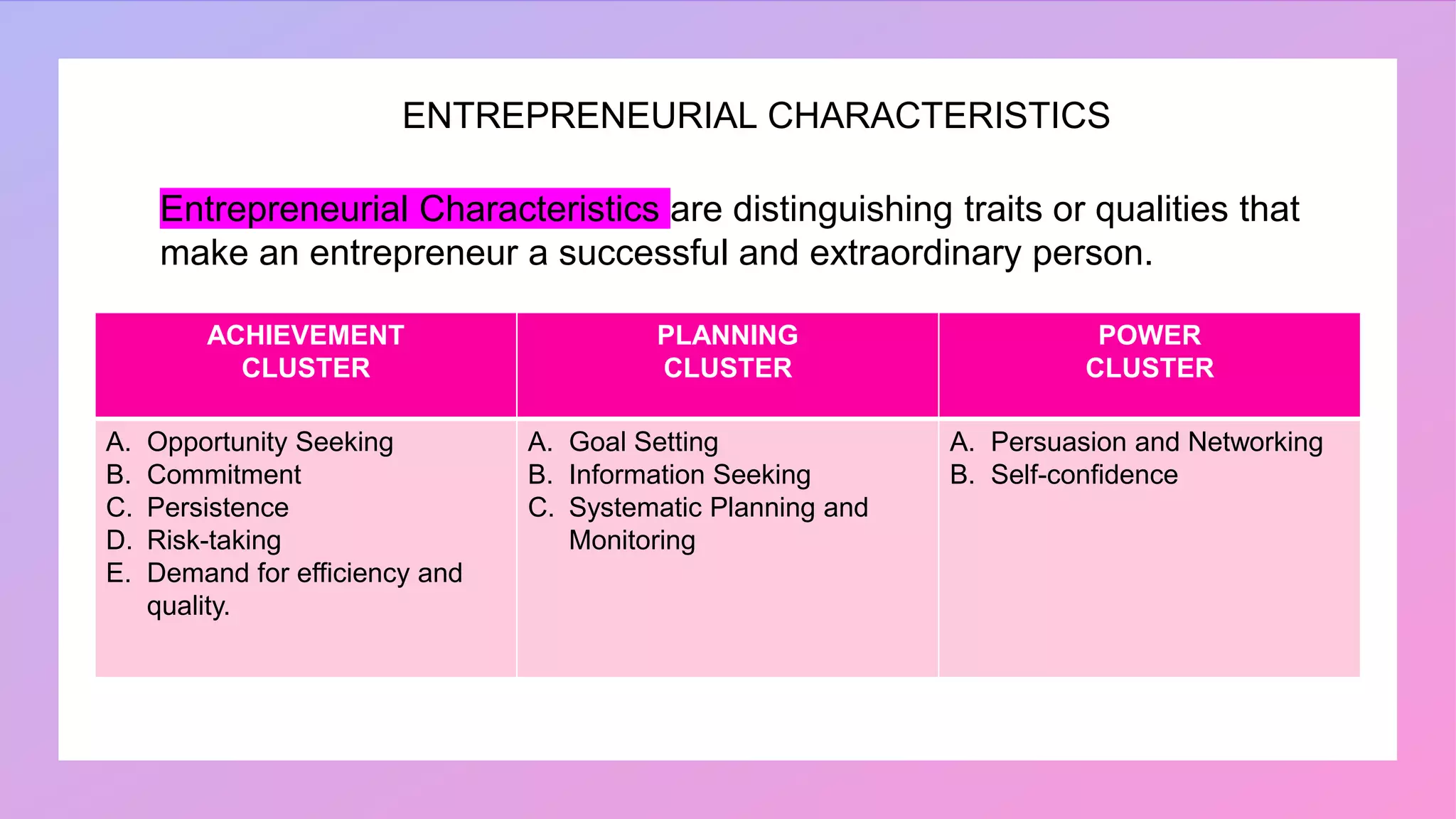
ACHIEVEMENT
CLUSTER
PLANNING
CLUSTER
POWER
CLUSTER
A. Opportunity Seeking
B. Commitment
C. Persistence
D. Risk-taking
E. Demand for efficiency and
quality.
A. Goal Setting
B. Information Seeking
C. Systematic Planning and
Monitoring
A. Persuasion and Networking
B. Self-confidence
ENTREPRENEURIAL CHARACTERISTICS
Entrepreneurial Characteristics are distinguishing traits or qualities that
make an entrepreneur a successful and extraordinary person.
ENTREPRENEURIAL SKILLS
Skill is the ability to use knowledge in doing something effectively.
1. Interpersonal Skills – the ability in building harmonious relationship.
a. Leadership and motivation
b. Communication
c. Listening
d. Negotiation and Networking
e. Ethics
2. Critical and Innovative Thinking Skills
a. Creative thinking
b. Problem solving and system thinking
c. Recognizing opportunities
3. Functional Skills – Knowledge and Skills related to the efficient and effective management of the
business.
4. Practical Skills – this is about being hands-on in management of the business.
ENTREPRENEURIAL TRAITS
Traits refer to the inherited and acquired character of a
person.
a. Self-awareness
b. Self-motivation
c. Courage
d. Confidence
e. Patience
f. Perseverance
g. Hard work
h. Decisiveness
i. Integrity
j. Optimism
7
BUSINESS
ENVIRONMENT
A business environment is all the components that
affect a business. These include both internal factors, like
employees and resources, and external factors, like
customers and markets. Each of these contributes to a
company's working environment and can influence how the
business functions.
Features of Business
Environment
• External Factors. These factors can range from individuals, government
regulations, environmental concerns, to other organizations and businesses.
• General Factors. These are factors that exist in society and the economy
regardless of the business’s existence.
• Specific Factors. These are the factors that are directly related to the
business such as customers, target market, competitors, suppliers, etc.
• The Interrelation of Factors. These constitute both internal and external
factors, specific and general factors.
Features of Business
Environment
• Uncertain Future. The future of a business environment is very difficult to
predict.
• Constantly Changing. This makes defining a business environment very
difficult.
• Complex Effects. The effects that the various internal and external factors
have on businesses are quite complex.
• Highly Relative. The factors that are beneficial towards one business may be
the doom of another.
A business is a socio-economic entity. The common
term given towards external business
environment factors is PESTLE. This abbreviation
stands for political, economic, social, technological,
legal, and environmental factors.
EXTERNAL ENVIRONMENT FACTORS
• Political Factors. Every new political party comes to the government
with its new policies and gets rid of old policies, and their change in
policies would impact relevant businesses and companies. Some of the
policies that could influence the business are as follows;
a. Intellect Property Rights
b. Import Restrictions
c. Competition Regulations
d. Employment Laws
e. Tariffs
f. Taxation
EXTERNAL ENVIRONMENT FACTORS
• Economic Factors. Play a significant role in terms of impacting our daily
life to the growth of the company.
• Social Factors. When people live together in a society, then their social
status and personal choices would influence their purchase decision in
terms of what and where they should buy.
• Technological Factors. Technological developments are making
significant changes in every industry, and companies need to adopt
technology to gain a competitive edge in the market.
• Legal Factors. Legal factors comprise the law of the country impacting
the company that how it should operate its business and behavior of
customers. Some main laws that fall under its category are as follows;
• Import and Export Laws
• The legality of Pyramid Scheme
• Fraud Law
• Employment Law
• Health and Safety Laws
• Copyrights Laws
• Discrimination Laws
• Consumer Laws
• Demographic Factors. Many companies conduct a demographic
analysis to evaluate their target market to make sure whether it’s meeting
their needs or not. It comprises of following elements;
• Education level
• Income
• Occupation
• Marital Status
• Belief System
• Nationality
• Race
• Gender
• Age
• Ethical Factors. Different people have different concepts of morality and
ethics, and it has become challenging for companies to maintain a
balance between staff expectation and their personal lives.
• Natural Factors. The customer market has cautious about the planet
earth and the impact of businesses practices on the natural environment.
• Global Factors. If the company is launching its product in the
international market, then it should keep in mind various global and local
issues.
• Competitive Factors. Companies could amplify their market share and
profitability if they keep on tracking the market trends and competitors.
The forces present within a business organization
define its characteristics. These include the work culture,
the level of machinery used, the management process,
etc.
INTERNAL ENVIRONMENT FACTORS
• Value Framework. This is basically the business’ functional process and
how the value in a business is judged.
• Business Path. Every company has a reason to exist and a purpose to
serve.
• Structure. The hierarchical or non-hierarchical structure of a business
that defines each employee’s and management’s role is one of the
central aspects of the internal business environment.
INTERNAL ENVIRONMENT FACTORS
• Organizational Culture. Although undefinable in exact terms, every
business has a unique culture that it adheres to.
• Human Resources. HR is a rather new concept that has flooded the
world of business.
• Physical Resources. Every business runs on resources, and how it
manages these resources is highly impactful towards its internal
environment.
• Technology. The modern tech landscape continuously defines a
business environment both from the outside and from the inside.
Why is a business
environment important to
understand?
A. Idea
Generation
Idea Generation phase is the first step in identifying a good
business opportunity is to look for many opportunities.
(Serdef, 2007). The following are good sources of business
ideas;
a. Hobbies and Interest
b. Experiences, travel and Adventures
c. Suggestions from family members and friends
d. Problems that need solution
e. Problems with existing product.
B. Screening Business
Ideas
After generating a number of business opportunities and
ideas, the next step is to select and screen. A good way to
proceed is to screen your ideas based on:
1. Your personality and personal preferences.
2. The characteristics of a good business.
C. SWOT Analysis
• SWOT Analysis is a framework used to evaluate a
company’s competitive position and to develop
strategic planning.
• Conduct a SWOT analysis in order to determine the
Strengths, Weaknesses, Opportunities, and threats.
This step will help you improve your business of
choice and prepare for challenges.
TLE 9
TLE 9

TLE 9

  • 1.
    TLE 9: COOKERY Ms.Jernie Ann R. Concepcion
  • 3.
    • Entrepreneurs arethose with the skills and capabilities to see and evaluate business opportunities. • Entrepreneurs are agents of economic change; they organize, manage, and assume risks of a business. • Entrepreneurship is not just a simple business activity but a strategic process of innovation and new product creation. • Entrepreneurial Competencies refer to the important characteristics that should be possessed by an individual in order to perform entrepreneurial functions effectively.
  • 4.
    ACHIEVEMENT CLUSTER PLANNING CLUSTER POWER CLUSTER A. Opportunity Seeking B.Commitment C. Persistence D. Risk-taking E. Demand for efficiency and quality. A. Goal Setting B. Information Seeking C. Systematic Planning and Monitoring A. Persuasion and Networking B. Self-confidence ENTREPRENEURIAL CHARACTERISTICS Entrepreneurial Characteristics are distinguishing traits or qualities that make an entrepreneur a successful and extraordinary person.
  • 5.
    ENTREPRENEURIAL SKILLS Skill isthe ability to use knowledge in doing something effectively. 1. Interpersonal Skills – the ability in building harmonious relationship. a. Leadership and motivation b. Communication c. Listening d. Negotiation and Networking e. Ethics 2. Critical and Innovative Thinking Skills a. Creative thinking b. Problem solving and system thinking c. Recognizing opportunities 3. Functional Skills – Knowledge and Skills related to the efficient and effective management of the business. 4. Practical Skills – this is about being hands-on in management of the business.
  • 6.
    ENTREPRENEURIAL TRAITS Traits referto the inherited and acquired character of a person. a. Self-awareness b. Self-motivation c. Courage d. Confidence e. Patience f. Perseverance g. Hard work h. Decisiveness i. Integrity j. Optimism
  • 7.
  • 9.
    BUSINESS ENVIRONMENT A business environmentis all the components that affect a business. These include both internal factors, like employees and resources, and external factors, like customers and markets. Each of these contributes to a company's working environment and can influence how the business functions.
  • 10.
    Features of Business Environment •External Factors. These factors can range from individuals, government regulations, environmental concerns, to other organizations and businesses. • General Factors. These are factors that exist in society and the economy regardless of the business’s existence. • Specific Factors. These are the factors that are directly related to the business such as customers, target market, competitors, suppliers, etc. • The Interrelation of Factors. These constitute both internal and external factors, specific and general factors.
  • 11.
    Features of Business Environment •Uncertain Future. The future of a business environment is very difficult to predict. • Constantly Changing. This makes defining a business environment very difficult. • Complex Effects. The effects that the various internal and external factors have on businesses are quite complex. • Highly Relative. The factors that are beneficial towards one business may be the doom of another.
  • 13.
    A business isa socio-economic entity. The common term given towards external business environment factors is PESTLE. This abbreviation stands for political, economic, social, technological, legal, and environmental factors. EXTERNAL ENVIRONMENT FACTORS
  • 14.
    • Political Factors.Every new political party comes to the government with its new policies and gets rid of old policies, and their change in policies would impact relevant businesses and companies. Some of the policies that could influence the business are as follows; a. Intellect Property Rights b. Import Restrictions c. Competition Regulations d. Employment Laws e. Tariffs f. Taxation EXTERNAL ENVIRONMENT FACTORS
  • 15.
    • Economic Factors.Play a significant role in terms of impacting our daily life to the growth of the company. • Social Factors. When people live together in a society, then their social status and personal choices would influence their purchase decision in terms of what and where they should buy. • Technological Factors. Technological developments are making significant changes in every industry, and companies need to adopt technology to gain a competitive edge in the market.
  • 16.
    • Legal Factors.Legal factors comprise the law of the country impacting the company that how it should operate its business and behavior of customers. Some main laws that fall under its category are as follows; • Import and Export Laws • The legality of Pyramid Scheme • Fraud Law • Employment Law • Health and Safety Laws • Copyrights Laws • Discrimination Laws • Consumer Laws
  • 17.
    • Demographic Factors.Many companies conduct a demographic analysis to evaluate their target market to make sure whether it’s meeting their needs or not. It comprises of following elements; • Education level • Income • Occupation • Marital Status • Belief System • Nationality • Race • Gender • Age
  • 18.
    • Ethical Factors.Different people have different concepts of morality and ethics, and it has become challenging for companies to maintain a balance between staff expectation and their personal lives. • Natural Factors. The customer market has cautious about the planet earth and the impact of businesses practices on the natural environment. • Global Factors. If the company is launching its product in the international market, then it should keep in mind various global and local issues. • Competitive Factors. Companies could amplify their market share and profitability if they keep on tracking the market trends and competitors.
  • 19.
    The forces presentwithin a business organization define its characteristics. These include the work culture, the level of machinery used, the management process, etc. INTERNAL ENVIRONMENT FACTORS
  • 20.
    • Value Framework.This is basically the business’ functional process and how the value in a business is judged. • Business Path. Every company has a reason to exist and a purpose to serve. • Structure. The hierarchical or non-hierarchical structure of a business that defines each employee’s and management’s role is one of the central aspects of the internal business environment. INTERNAL ENVIRONMENT FACTORS
  • 21.
    • Organizational Culture.Although undefinable in exact terms, every business has a unique culture that it adheres to. • Human Resources. HR is a rather new concept that has flooded the world of business. • Physical Resources. Every business runs on resources, and how it manages these resources is highly impactful towards its internal environment. • Technology. The modern tech landscape continuously defines a business environment both from the outside and from the inside.
  • 22.
    Why is abusiness environment important to understand?
  • 24.
    A. Idea Generation Idea Generationphase is the first step in identifying a good business opportunity is to look for many opportunities. (Serdef, 2007). The following are good sources of business ideas; a. Hobbies and Interest b. Experiences, travel and Adventures c. Suggestions from family members and friends d. Problems that need solution e. Problems with existing product.
  • 25.
    B. Screening Business Ideas Aftergenerating a number of business opportunities and ideas, the next step is to select and screen. A good way to proceed is to screen your ideas based on: 1. Your personality and personal preferences. 2. The characteristics of a good business.
  • 26.
    C. SWOT Analysis •SWOT Analysis is a framework used to evaluate a company’s competitive position and to develop strategic planning. • Conduct a SWOT analysis in order to determine the Strengths, Weaknesses, Opportunities, and threats. This step will help you improve your business of choice and prepare for challenges.