THE LIVER
STRUCTURE OF THE LIVER
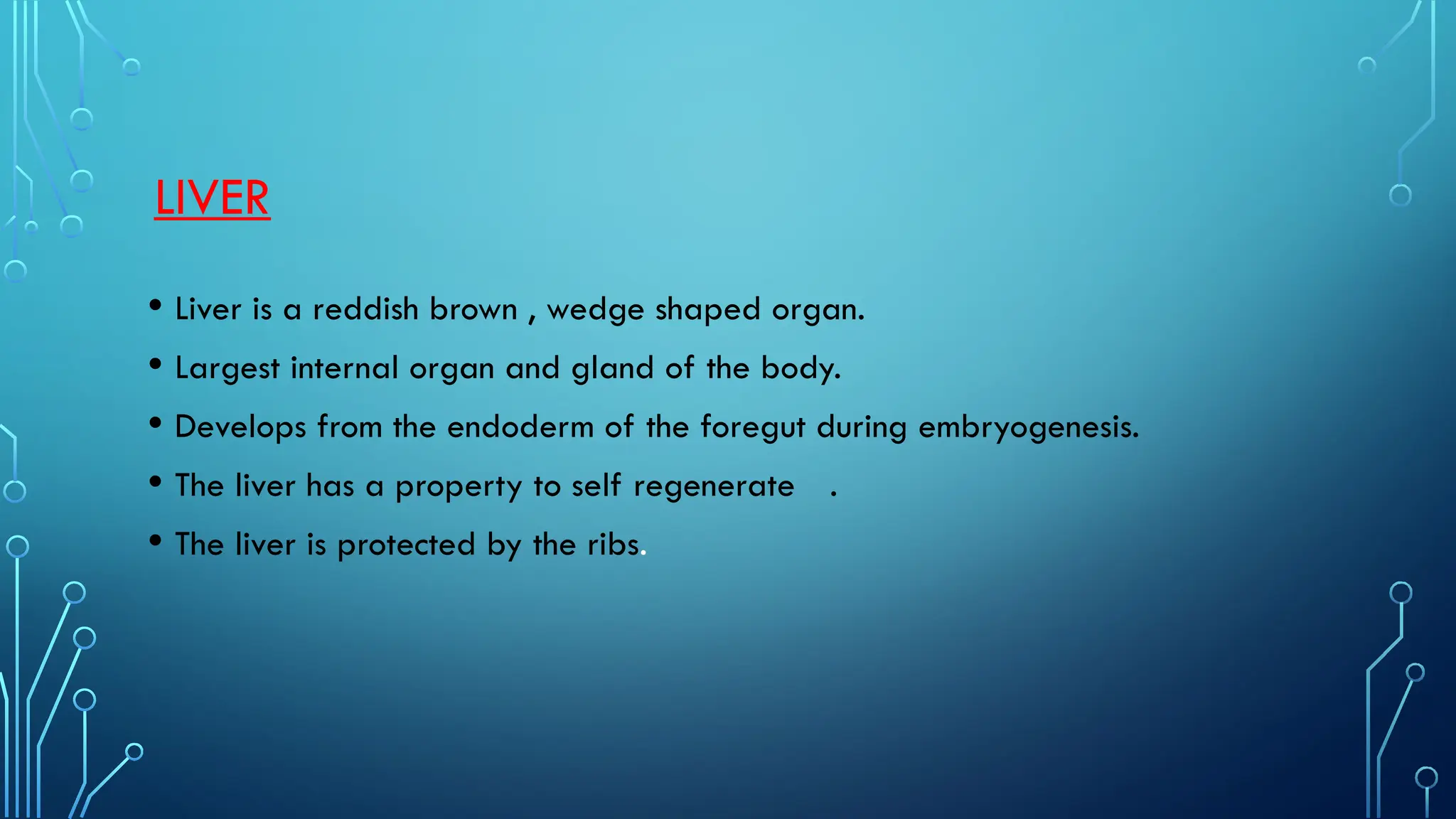
LIVER
• Liver is a reddish brown , wedge shaped organ.
• Largest internal organ and gland of the body.
• Develops from the endoderm of the foregut during embryogenesis.
• The liver has a property to self regenerate .
• The liver is protected by the ribs.
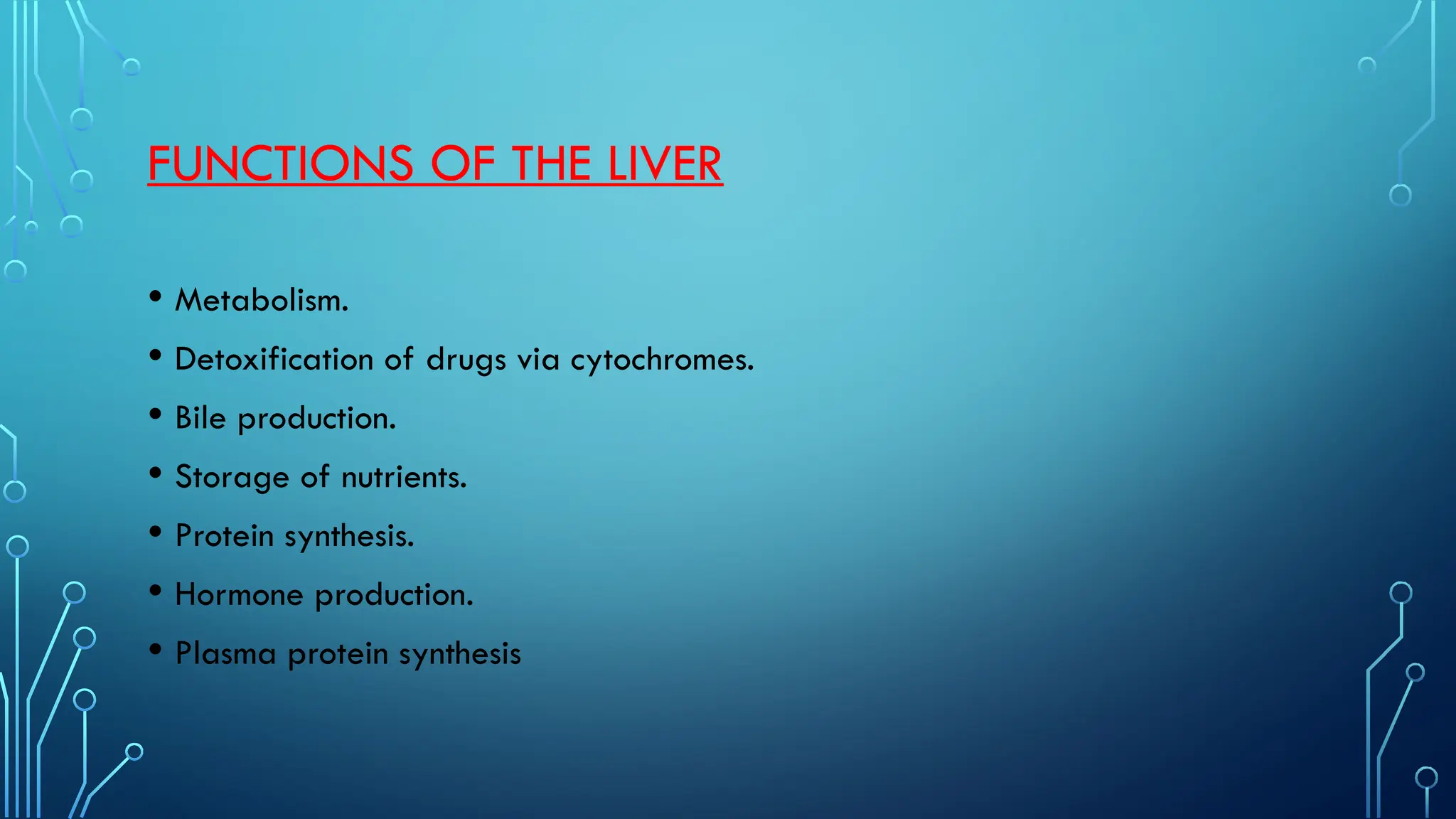
FUNCTIONS OF THE LIVER
• Metabolism.
• Detoxification of drugs via cytochromes.
• Bile production.
• Storage of nutrients.
• Protein synthesis.
• Hormone production.
• Plasma protein synthesis
• Coagulation , production of clotting factors
• Protective functions , eg Kupffer cells.
• Decomposition of red blood cells.
• Maintaining core body temperature.
• PH balance and correction of lactic acidosis
• Urea formation.
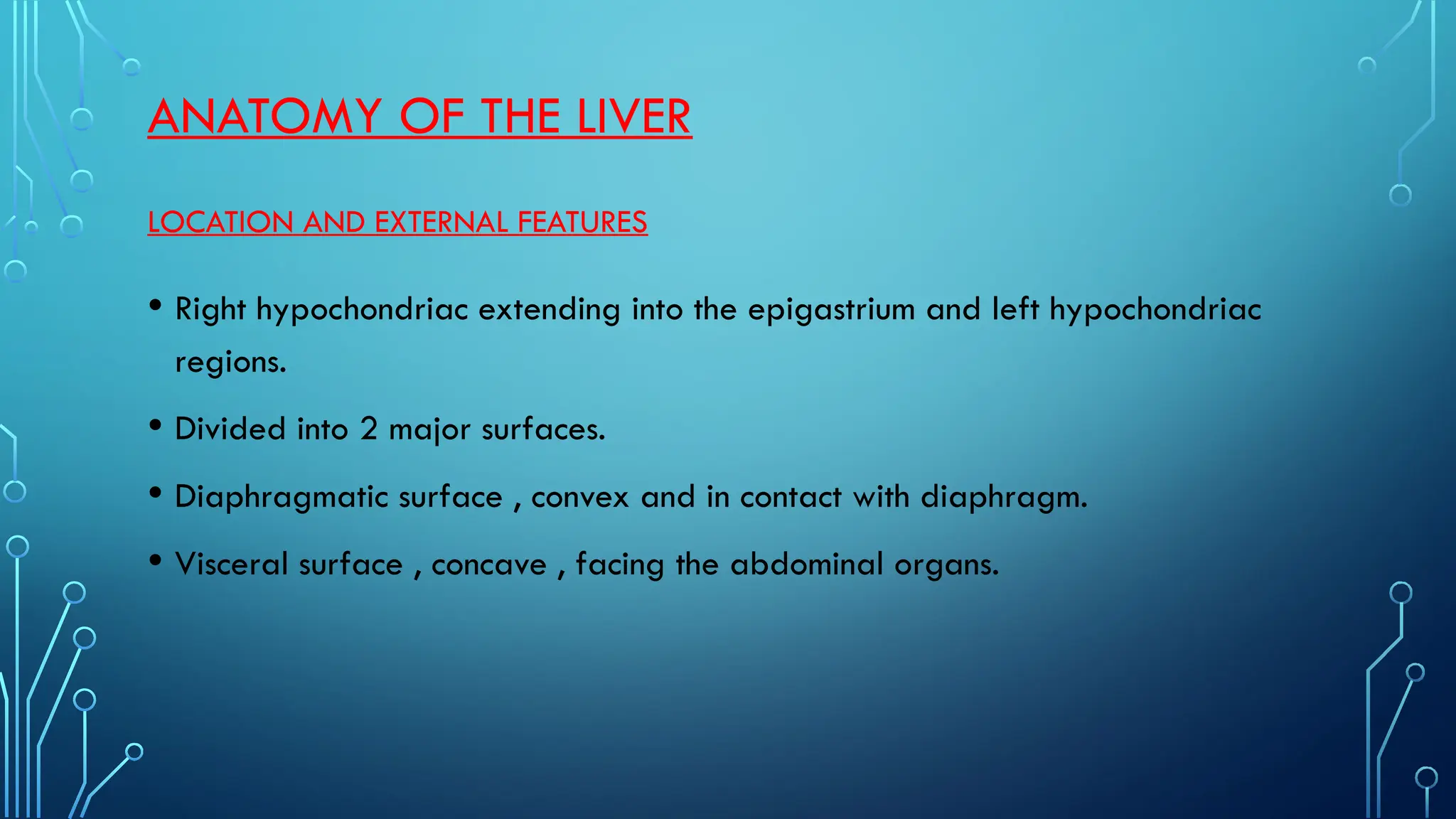
ANATOMY OF THE LIVER
LOCATION AND EXTERNAL FEATURES
• Right hypochondriac extending into the epigastrium and left hypochondriac
regions.
• Divided into 2 major surfaces.
• Diaphragmatic surface , convex and in contact with diaphragm.
• Visceral surface , concave , facing the abdominal organs.
LOBES OF THE LIVER
LOBES OF THE LIVER
• Right lobe_ largest ,contains gallbladder fossa.
• Left lobe_ smaller than right lobe.
• Caudate lobe_ located posteriorly near the inferior vena cava.
• Quadrate lobe_ situated near the gallbladder and porta hepatis.
LIGAMENTS OF THE LIVER
• Falciform ligament _divides the right and left lobes of the liver
• Connect the liver to the anterior abdominal wall.
• Round ligament _connect the liver to the umbilicus.
• Coronary ligament _Attaches the liver to the diaphragm.
• Triangular ligament which divides into left and right triangular ligaments.
BLOOD SUPPLY AND DRAINAGE
• Hepatic Artery {20%} :Oxygenated blood from celiac trunk via the common
hepatic artery.
• Portal vein { 80%} :Brings nutrient rich blood from the gastrointestinal tract.
• Hepatic veins {right , middle and left} drain into the IVC
HISTOLOGY OF THE LIVER
LIVER ARCHITECTURE
• Lobules _ functional units of the liver.
• Consists of hepatocytes
• Portal triad _they are Found at the corners of the lobules.
• Consist of:
A branch of the portal vein.
A branch of the hepatic artery
A bile duct
SINUSOIDS
• Specialised capillaries lined by fenestrated endothelial cells.
• Allow plasma exchange between blood and hepatocytes.
• Central vein : Drain blood into the hepatic veins and eventually into inferior
vena cava.
LIVER CELLS
• Hepatocytes : Main liver cells.
• Involved in metabolism ,protein synthesis and bile production.
• Kupffer cells : specialized macrophages found within sinusoids.
• Responsible for phagocytosing old red blood cells and phathogens.
BLOOD FLOW AND BILE FLOW
• Blood flow : from the portal vein and hepatic artery to sinusoids to central
vein to hepatic veins and finally to inferior vena cava.
• Bile flow : from the hepatocytes to bile canaliculi to bile ducts to common
hepatic duct and finally to gallbladder or duodenum.
CLINICAL NOTES
COMMON LIVER DISEASES
• Hepatitis , inflammation of the liver due to viral infection.
• Liver cirrhosis ,chronic liver disease.
• Liver cancer , common in patients with cirrhosis
• Jaundice
• Liver failure.

GROUP FOUR PRESENTATION _LIVER FUNCTIONS ,ANATOMY AND HISTOLOGY.pptx

  • 1.
  • 2.
  • 3.
    LIVER • Liver isa reddish brown , wedge shaped organ. • Largest internal organ and gland of the body. • Develops from the endoderm of the foregut during embryogenesis. • The liver has a property to self regenerate . • The liver is protected by the ribs.
  • 4.
    FUNCTIONS OF THELIVER • Metabolism. • Detoxification of drugs via cytochromes. • Bile production. • Storage of nutrients. • Protein synthesis. • Hormone production. • Plasma protein synthesis
  • 5.
    • Coagulation ,production of clotting factors • Protective functions , eg Kupffer cells. • Decomposition of red blood cells. • Maintaining core body temperature. • PH balance and correction of lactic acidosis • Urea formation.
  • 6.
    ANATOMY OF THELIVER LOCATION AND EXTERNAL FEATURES • Right hypochondriac extending into the epigastrium and left hypochondriac regions. • Divided into 2 major surfaces. • Diaphragmatic surface , convex and in contact with diaphragm. • Visceral surface , concave , facing the abdominal organs.
  • 7.
  • 8.
    LOBES OF THELIVER • Right lobe_ largest ,contains gallbladder fossa. • Left lobe_ smaller than right lobe. • Caudate lobe_ located posteriorly near the inferior vena cava. • Quadrate lobe_ situated near the gallbladder and porta hepatis.
  • 9.
  • 10.
    LIGAMENTS OF THELIVER • Falciform ligament _divides the right and left lobes of the liver • Connect the liver to the anterior abdominal wall. • Round ligament _connect the liver to the umbilicus. • Coronary ligament _Attaches the liver to the diaphragm. • Triangular ligament which divides into left and right triangular ligaments.
  • 11.
    BLOOD SUPPLY ANDDRAINAGE • Hepatic Artery {20%} :Oxygenated blood from celiac trunk via the common hepatic artery. • Portal vein { 80%} :Brings nutrient rich blood from the gastrointestinal tract. • Hepatic veins {right , middle and left} drain into the IVC
  • 12.
    HISTOLOGY OF THELIVER LIVER ARCHITECTURE • Lobules _ functional units of the liver. • Consists of hepatocytes • Portal triad _they are Found at the corners of the lobules. • Consist of: A branch of the portal vein. A branch of the hepatic artery A bile duct
  • 13.
    SINUSOIDS • Specialised capillarieslined by fenestrated endothelial cells. • Allow plasma exchange between blood and hepatocytes. • Central vein : Drain blood into the hepatic veins and eventually into inferior vena cava.
  • 14.
    LIVER CELLS • Hepatocytes: Main liver cells. • Involved in metabolism ,protein synthesis and bile production. • Kupffer cells : specialized macrophages found within sinusoids. • Responsible for phagocytosing old red blood cells and phathogens.
  • 15.
    BLOOD FLOW ANDBILE FLOW • Blood flow : from the portal vein and hepatic artery to sinusoids to central vein to hepatic veins and finally to inferior vena cava. • Bile flow : from the hepatocytes to bile canaliculi to bile ducts to common hepatic duct and finally to gallbladder or duodenum.
  • 16.
    CLINICAL NOTES COMMON LIVERDISEASES • Hepatitis , inflammation of the liver due to viral infection. • Liver cirrhosis ,chronic liver disease. • Liver cancer , common in patients with cirrhosis • Jaundice • Liver failure.