
preview of things to Come…
•What is a Group?                   •Preparing for group discussions
•Why do we Join Group?              •Leadership
•What are some Characteristics of   •Functions of Leader.
an Effective Group?                 •Leadership Style
•What are Advantages &              •Skills need to be a Good Team
Disadvantages of Group Problem-     Member.
Solving?                            •How are you evaluated in group
•Purpose of Group Communication     your Discussion?
•Significance of communication in
Corporate World
•Basic concept of communication
•Process of Communication
•Important Characteristics of a
Message
What is a Group?

• Stephen Robins defines a group as “ two or more individuals
  interacting and interdependent, who have come together to
  achieve particular objectives.”
why do people join ‘groups’?

    &   Affiliation Motivation
    &   Security
    &   Satisfaction of needs
    &   Shared interests and goals
    &   Self-esteem
    &   Status
    &   Power
    &   Goal Achievement
The Characteristics of An
         Effective Group
&   Clear Purpose
&   Climate
&   Participation
&   Listening
&   Healthy Conflict
&   Open Communication
&   Clear Roles and Assignments
&   External Resources
&   Functional Diversity
ADVANTAGES OF GROUP DECISION-
           MAKING
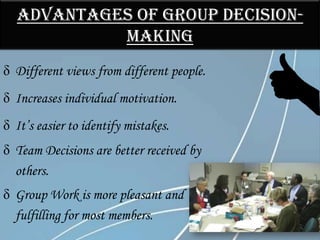
 Different views from different people.
 Increases individual motivation.
 It’s easier to identify mistakes.
 Team Decisions are better received by
  others.
 Group Work is more pleasant and
  fulfilling for most members.
Disadvantages of Group Decision-
           Making
• Members can get slack.
• Personal agendas may conflict
  with group goals.
• Aggressive members can
  dominate
   – Status problems?
• Members could be
  uncompromising.
• Takes longer to reach a decision.
PURPOSE OF GROUP COMMUNICATION

To share and exchange information and ideas
To collect feedback
To arrive at a decision on important matters.
To solve a problem which is of concern to the organization
 as a whole.
To discuss the issues related to a particular topic in relation
 to the group itself or for the benefit of a larger audience.
Helps in leaving behind “Self EGO”.
Changes in Behavior and feelings.
Significance of communication in
             Corporate World

Helps in Corporate Branding
Helps in Strategy Making and Implementation
Helps in Sales Enhancement
Enables Crisis Management
Develops Global Competence
Helps Information Development
Helps Client Development
Helps Client Sustenance
Basic Concept of Effective
      Communication
Process of Communication


         MESSAGE              MESSAGE
SENDER             CHANNEL              RECIEVER


                   FEEDBACK
Important Characteristics of a
           Message

       •   Objective
       •   Distraction to the Message
       •   Two-sided Approach
       •   Simplicity of the Message
       •   Size of Attitude Discrepancy
       •   Arousing Emotions (FEAR)
Preparing for group discussions
      K-A-S-H Strategies.
         K – KNOWLEDGE
        Social awareness
        Knowledge in current affairs.
        National and international issues

           A – Attitude
         Set your goal – plan actions
         Winning attitudes
         Continuing learning.
         Practice skills
Preparing for group discussions
      K-A-S-H Strategies.
            S - Skills
         Develop through practice.
         Presentation skills.
         Communication Skills
         Non-verbal skills
          H – Honesty
         Honesty all through your efforts.
         Admit your mistakes.
         Learn from mistakes.
LEADERSHIP
Definition:

A Davis described leadership as--the one
Keith
      Leader is
Who Knows The Way,
            The process of influencing and
        supporting others to work
       Goes The Way,
enthusiastically toward achieving objective.

And Shows The Way.
Functions of a Leader

Policy Maker
Planner
Executive
External Group Representative
Controller of internal Group Relationship
Controller of Reward and Punishment
Mediator
Qualities of PR person as “Leader”
Good personality
Intelligence
Initiative
Innovative
Self Confidence
Communication Skills
Coach and Guide
Discipline
Patience
Autocratic Style    Consultative Style


             Leadership
               Style

Laissez –Faire
                    Situational Style
     Style
Skills needed to be a Good Team
           Members
 Listening

    Persuading

             Sharing

                 Respecting

                       Helping

                        Participating
HOW ARE YOU EVALUATED IN YOUR
     GROUP DISCUSSIONS?

    Personality

    Communication Skills

    Knowledge

    Leadership and teamwork.
Personality
 Smartness – dress – smile on the face
 Cheerfulness – free from tensions and nervousness.
 Enthusiasm – attitude of taking that one step extra.
  Communication Skills


 Fluency – not speed. But right word in the right
  place.
 Clarity – Effectiveness of the message.
Knowledge
 Relevance. – Topic related.
 Depth – in and out of the subject. Factual info
  and data.

 leadership
 Initiative – taking the lead. Breaking the ice.
  Being in the forefront.
 Team Spirit. – ability to work with people.
  Cooperation and consolidation
Conclusion
Group can achieve this:-
Suggestions
Never try to bluff.

Practice group discussion with friends
on different subjects.

Remember !speech is a powerful
weapon.
Any
 Questions???

GROUP COMMUNICATION

  • 2.
    preview of thingsto Come… •What is a Group? •Preparing for group discussions •Why do we Join Group? •Leadership •What are some Characteristics of •Functions of Leader. an Effective Group? •Leadership Style •What are Advantages & •Skills need to be a Good Team Disadvantages of Group Problem- Member. Solving? •How are you evaluated in group •Purpose of Group Communication your Discussion? •Significance of communication in Corporate World •Basic concept of communication •Process of Communication •Important Characteristics of a Message
  • 3.
    What is aGroup? • Stephen Robins defines a group as “ two or more individuals interacting and interdependent, who have come together to achieve particular objectives.”
  • 4.
    why do peoplejoin ‘groups’? & Affiliation Motivation & Security & Satisfaction of needs & Shared interests and goals & Self-esteem & Status & Power & Goal Achievement
  • 5.
    The Characteristics ofAn Effective Group & Clear Purpose & Climate & Participation & Listening & Healthy Conflict & Open Communication & Clear Roles and Assignments & External Resources & Functional Diversity
  • 6.
    ADVANTAGES OF GROUPDECISION- MAKING  Different views from different people.  Increases individual motivation.  It’s easier to identify mistakes.  Team Decisions are better received by others.  Group Work is more pleasant and fulfilling for most members.
  • 7.
    Disadvantages of GroupDecision- Making • Members can get slack. • Personal agendas may conflict with group goals. • Aggressive members can dominate – Status problems? • Members could be uncompromising. • Takes longer to reach a decision.
  • 8.
    PURPOSE OF GROUPCOMMUNICATION To share and exchange information and ideas To collect feedback To arrive at a decision on important matters. To solve a problem which is of concern to the organization as a whole. To discuss the issues related to a particular topic in relation to the group itself or for the benefit of a larger audience. Helps in leaving behind “Self EGO”. Changes in Behavior and feelings.
  • 9.
    Significance of communicationin Corporate World Helps in Corporate Branding Helps in Strategy Making and Implementation Helps in Sales Enhancement Enables Crisis Management Develops Global Competence Helps Information Development Helps Client Development Helps Client Sustenance
  • 10.
    Basic Concept ofEffective Communication
  • 11.
    Process of Communication MESSAGE MESSAGE SENDER CHANNEL RECIEVER FEEDBACK
  • 12.
    Important Characteristics ofa Message • Objective • Distraction to the Message • Two-sided Approach • Simplicity of the Message • Size of Attitude Discrepancy • Arousing Emotions (FEAR)
  • 13.
    Preparing for groupdiscussions K-A-S-H Strategies. K – KNOWLEDGE Social awareness Knowledge in current affairs. National and international issues A – Attitude Set your goal – plan actions Winning attitudes Continuing learning. Practice skills
  • 14.
    Preparing for groupdiscussions K-A-S-H Strategies. S - Skills Develop through practice. Presentation skills. Communication Skills Non-verbal skills H – Honesty Honesty all through your efforts. Admit your mistakes. Learn from mistakes.
  • 15.
    LEADERSHIP Definition: A Davis describedleadership as--the one Keith Leader is Who Knows The Way, The process of influencing and supporting others to work Goes The Way, enthusiastically toward achieving objective. And Shows The Way.
  • 16.
    Functions of aLeader Policy Maker Planner Executive External Group Representative Controller of internal Group Relationship Controller of Reward and Punishment Mediator
  • 17.
    Qualities of PRperson as “Leader” Good personality Intelligence Initiative Innovative Self Confidence Communication Skills Coach and Guide Discipline Patience
  • 18.
    Autocratic Style Consultative Style Leadership Style Laissez –Faire Situational Style Style
  • 19.
    Skills needed tobe a Good Team Members Listening Persuading Sharing Respecting Helping Participating
  • 20.
    HOW ARE YOUEVALUATED IN YOUR GROUP DISCUSSIONS?  Personality  Communication Skills  Knowledge  Leadership and teamwork.
  • 21.
    Personality  Smartness –dress – smile on the face  Cheerfulness – free from tensions and nervousness.  Enthusiasm – attitude of taking that one step extra. Communication Skills  Fluency – not speed. But right word in the right place.  Clarity – Effectiveness of the message.
  • 22.
    Knowledge  Relevance. –Topic related.  Depth – in and out of the subject. Factual info and data. leadership  Initiative – taking the lead. Breaking the ice. Being in the forefront.  Team Spirit. – ability to work with people. Cooperation and consolidation
  • 23.
  • 24.
  • 25.
    Suggestions Never try tobluff. Practice group discussion with friends on different subjects. Remember !speech is a powerful weapon.
  • 27.