Metrics for Object-Oriented
System
Group 8
Hung Ho Rui Tang
Chuyi Feng
Muhammad Yousaf
Sarah Makona
Content
Introduction
Basic Definitions
Metric Properties For Evaluation Criteria
Applied Metrics Suite
Conclusion
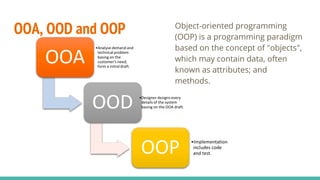
OOA, OOD and OOP Object-oriented programming
(OOP) is a programming paradigm
based on the concept of "objects",
which may contain data, often
known as attributes; and
methods.
Definitions
Object: X = (x, p(x))
x: substantial individual
p(x): collection of properties and methods
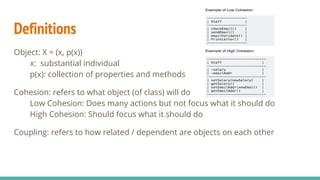
Cohesion: refers to what object (of class) will do
Low Cohesion: Does many actions but not focus what it should do
High Cohesion: Should focus what it should do
Coupling: refers to how related / dependent are objects on each other
Definitions
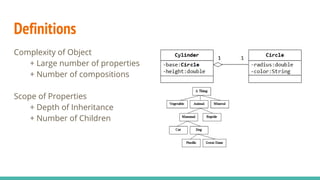
Complexity of Object
+ Large number of properties
+ Number of compositions
Scope of Properties
+ Depth of Inheritance
+ Number of Children
Metric Properties for Evaluation Criteria
1. Non-coarseness
Not every class can have same value for a metric
2. Non-uniqueness (Notion of Equivalence)
Two classes can have same metric value
3. Design details are important
Even though two classes perform same functions, the details of the
design matter in determining the metric for the class
Metric Properties for Evaluation Criteria (cont)
4. Monotonicity
The metric for the combination of two classes can never be less than
the metric for either of the component classes: u(P + Q) > u(P)
5. Non-equivalence of interaction
Interaction between P + Q # Q + R
6. Interaction increases complexity
When two classes are combined, the interactions increase complexity
Applied Metrics Suite
1. Weighted Methods Per Class (WMC)
2. Depth Of Inheritance Tree (DIT)
3. Number Of Children (NOC)
4. Coupling Between Object Classes (CBO)
5. Response For A Class (RFC)
6. Lack Of Cohesion In Methods (LCOM)
Examples with project
+ Site A use C++ language
+ Site B use Smalltalk language
Both 6 applied metrics satisfy property 1, 2, 3, 4, 5 except property 6 fails
Applied Metrics Suite
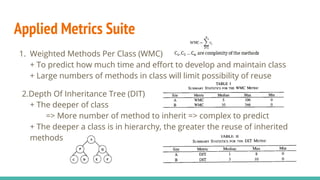
1. Weighted Methods Per Class (WMC)
+ To predict how much time and effort to develop and maintain class
+ Large numbers of methods in class will limit possibility of reuse
2.Depth Of Inheritance Tree (DIT)
+ The deeper of class
=> More number of method to inherit => complex to predict
+ The deeper a class is in hierarchy, the greater the reuse of inherited
methods
Applied Metrics Suite (cont)
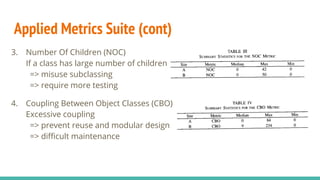
3. Number Of Children (NOC)
If a class has large number of children
=> misuse subclassing
=> require more testing
4. Coupling Between Object Classes (CBO)
Excessive coupling
=> prevent reuse and modular design
=> difficult maintenance
Applied Metrics Suite (cont)
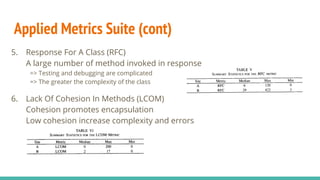
5. Response For A Class (RFC)
A large number of method invoked in response
=> Testing and debugging are complicated
=> The greater the complexity of the class
6. Lack Of Cohesion In Methods (LCOM)
Cohesion promotes encapsulation
Low cohesion increase complexity and errors
Conclusion
Failing to meet property 6 implies that a complexity metric could increase if a
class is divided into more classes
Possible new set of software metrics for OO design
The suite provides designers and managers with indication of the integrity of
the design
It may serve as a generalized solution when other researchers to develop
metrics for particular purposes or customized environment.

Group 8 presentation_metrics_for_object_oriented_system

  • 1.
    Metrics for Object-Oriented System Group8 Hung Ho Rui Tang Chuyi Feng Muhammad Yousaf Sarah Makona
  • 2.
    Content Introduction Basic Definitions Metric PropertiesFor Evaluation Criteria Applied Metrics Suite Conclusion
  • 3.
    OOA, OOD andOOP Object-oriented programming (OOP) is a programming paradigm based on the concept of "objects", which may contain data, often known as attributes; and methods.
  • 4.
    Definitions Object: X =(x, p(x)) x: substantial individual p(x): collection of properties and methods Cohesion: refers to what object (of class) will do Low Cohesion: Does many actions but not focus what it should do High Cohesion: Should focus what it should do Coupling: refers to how related / dependent are objects on each other
  • 5.
    Definitions Complexity of Object +Large number of properties + Number of compositions Scope of Properties + Depth of Inheritance + Number of Children
  • 6.
    Metric Properties forEvaluation Criteria 1. Non-coarseness Not every class can have same value for a metric 2. Non-uniqueness (Notion of Equivalence) Two classes can have same metric value 3. Design details are important Even though two classes perform same functions, the details of the design matter in determining the metric for the class
  • 7.
    Metric Properties forEvaluation Criteria (cont) 4. Monotonicity The metric for the combination of two classes can never be less than the metric for either of the component classes: u(P + Q) > u(P) 5. Non-equivalence of interaction Interaction between P + Q # Q + R 6. Interaction increases complexity When two classes are combined, the interactions increase complexity
  • 8.
    Applied Metrics Suite 1.Weighted Methods Per Class (WMC) 2. Depth Of Inheritance Tree (DIT) 3. Number Of Children (NOC) 4. Coupling Between Object Classes (CBO) 5. Response For A Class (RFC) 6. Lack Of Cohesion In Methods (LCOM) Examples with project + Site A use C++ language + Site B use Smalltalk language Both 6 applied metrics satisfy property 1, 2, 3, 4, 5 except property 6 fails
  • 9.
    Applied Metrics Suite 1.Weighted Methods Per Class (WMC) + To predict how much time and effort to develop and maintain class + Large numbers of methods in class will limit possibility of reuse 2.Depth Of Inheritance Tree (DIT) + The deeper of class => More number of method to inherit => complex to predict + The deeper a class is in hierarchy, the greater the reuse of inherited methods
  • 10.
    Applied Metrics Suite(cont) 3. Number Of Children (NOC) If a class has large number of children => misuse subclassing => require more testing 4. Coupling Between Object Classes (CBO) Excessive coupling => prevent reuse and modular design => difficult maintenance
  • 11.
    Applied Metrics Suite(cont) 5. Response For A Class (RFC) A large number of method invoked in response => Testing and debugging are complicated => The greater the complexity of the class 6. Lack Of Cohesion In Methods (LCOM) Cohesion promotes encapsulation Low cohesion increase complexity and errors
  • 12.
    Conclusion Failing to meetproperty 6 implies that a complexity metric could increase if a class is divided into more classes Possible new set of software metrics for OO design The suite provides designers and managers with indication of the integrity of the design It may serve as a generalized solution when other researchers to develop metrics for particular purposes or customized environment.