The Becoming 
of 
Black History Month 
By 
Catara Cage 
Ms.Mocsary 
English 101-67
Every great dream begins with a dreamer. 
Always remember, you have within you 
the strength, the patience, and the passion to 
reach for stars to change the world 
---Harriet Tubman
Introduction 
• Black History Month is observed each February & 
celebrates achievements of African Americans. 
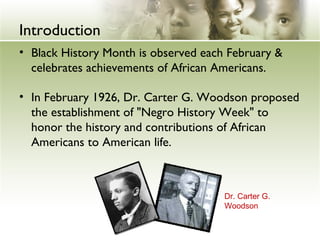
• In February 1926, Dr. Carter G. Woodson proposed 
the establishment of "Negro History Week" to 
honor the history and contributions of African 
Americans to American life. 
Dr. Carter G. 
Woodson
The Year of 1976 
• Dr. Woodson, known as the "Father of Black 
History", chose the second week of February 
because it commemorates the birthdays of two men 
who greatly affected the African American 
community: Abraham Lincoln (February 12) and 
Frederick Douglass (February 14). Negro History 
Week became Black History Month in the early 
1970's. In 1976, the week-long observance was 
expanded to a month in honor of the nation's 
bicentennial. 
Fredrick Douglas Abraham Lincoln
Cricitism 
• Black History Month sparks an annual debate about 
the continued usefulness and fairness of a designated 
month dedicated to the history of one race. Many 
people hold concerns about black history being 
delegated to a single month and the "hero worship" 
of some of the historical figures often recognized 
• Morgan Freeman, a critic of Black History Month, 
said: "I don't want a black history month. Black 
history is American history." Freeman also argued 
that there was no White History Month because 
white people did not want their history relegated to 
just one month.
Abolitionists 
• Frederick Douglass escaped 
from slavery and spoke 
around the country and 
Europe about the evils of 
slavery. 
• Harriet Tubman escaped 
slavery and then went back 
South to help many slaves 
escape to freedom on the 
Underground Railroad. 
Harriet Tubman 
Frederick Douglass
Civil Rights Leaders 
• Rosa Parks is called the “Mother of 
the Civil Rights Movement”. One 
day after working hard at her job, 
she was riding the bus home. 
There were laws that black people 
could not sit where they wanted 
on the bus – they had to sit in the 
back. The bus driver asked her to 
give up her seat so a white man 
could sit down. Rosa said “no” and 
was taken to jail.
Civil Rights Leaders 
• Martin Luther King was a Baptist 
preacher in Montgomery, Alabama. 
He led a boycott of the city bus 
system and this led to the civil rights 
movement. He dedicated his life to 
achieving equality and justice for all 
Americans of all colors. King 
believed that peaceful protest was 
the best way to bring about social 
change. Martin Luther King was 
assassinated in 1968. 
Martin Luther King
Inventors 
• Elijah McCoy invented a device for oiling 
steam engines in 1872. The term “the 
real McCoy” is believed to be a reference 
about the reliability of Elijah McCoy’s 
invention. 
Elijah McCoy 
• Garrett Augustus Morgan invented the 
first stop light. He sold his invention to 
General Electric Company. He also 
invented the gas mask that solders in 
WWI used. 
Garrett Morgan
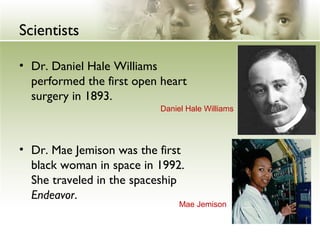
Scientists 
• Dr. Daniel Hale Williams 
performed the first open heart 
surgery in 1893. 
Daniel Hale Williams 
• Dr. Mae Jemison was the first 
black woman in space in 1992. 
She traveled in the spaceship 
Endeavor. 
Mae Jemison
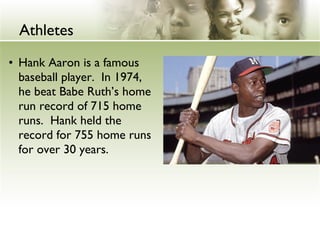
Athletes 
• Hank Aaron is a famous 
baseball player. In 1974, 
he beat Babe Ruth’s home 
run record of 715 home 
runs. Hank held the 
record for 755 home runs 
for over 30 years.
Athletes 
• Jesse Owens was a track and field 
athlete. He represented the USA at 
the 1936 Olympic Games held in 
Nazi Germany. Owens won four 
gold medals and set a world record 
in the long jump. Hitler left the 
stadium to avoid having to 
congratulate an African-American. Jesse Owens
Conclusion 
• Black History Month is a time to remember our past 
and celebrate the many achievements of African- 
Americans!

Black history month -catara

  • 1.
    The Becoming of Black History Month By Catara Cage Ms.Mocsary English 101-67
  • 2.
    Every great dreambegins with a dreamer. Always remember, you have within you the strength, the patience, and the passion to reach for stars to change the world ---Harriet Tubman
  • 3.
    Introduction • BlackHistory Month is observed each February & celebrates achievements of African Americans. • In February 1926, Dr. Carter G. Woodson proposed the establishment of "Negro History Week" to honor the history and contributions of African Americans to American life. Dr. Carter G. Woodson
  • 4.
    The Year of1976 • Dr. Woodson, known as the "Father of Black History", chose the second week of February because it commemorates the birthdays of two men who greatly affected the African American community: Abraham Lincoln (February 12) and Frederick Douglass (February 14). Negro History Week became Black History Month in the early 1970's. In 1976, the week-long observance was expanded to a month in honor of the nation's bicentennial. Fredrick Douglas Abraham Lincoln
  • 5.
    Cricitism • BlackHistory Month sparks an annual debate about the continued usefulness and fairness of a designated month dedicated to the history of one race. Many people hold concerns about black history being delegated to a single month and the "hero worship" of some of the historical figures often recognized • Morgan Freeman, a critic of Black History Month, said: "I don't want a black history month. Black history is American history." Freeman also argued that there was no White History Month because white people did not want their history relegated to just one month.
  • 7.
    Abolitionists • FrederickDouglass escaped from slavery and spoke around the country and Europe about the evils of slavery. • Harriet Tubman escaped slavery and then went back South to help many slaves escape to freedom on the Underground Railroad. Harriet Tubman Frederick Douglass
  • 8.
    Civil Rights Leaders • Rosa Parks is called the “Mother of the Civil Rights Movement”. One day after working hard at her job, she was riding the bus home. There were laws that black people could not sit where they wanted on the bus – they had to sit in the back. The bus driver asked her to give up her seat so a white man could sit down. Rosa said “no” and was taken to jail.
  • 9.
    Civil Rights Leaders • Martin Luther King was a Baptist preacher in Montgomery, Alabama. He led a boycott of the city bus system and this led to the civil rights movement. He dedicated his life to achieving equality and justice for all Americans of all colors. King believed that peaceful protest was the best way to bring about social change. Martin Luther King was assassinated in 1968. Martin Luther King
  • 10.
    Inventors • ElijahMcCoy invented a device for oiling steam engines in 1872. The term “the real McCoy” is believed to be a reference about the reliability of Elijah McCoy’s invention. Elijah McCoy • Garrett Augustus Morgan invented the first stop light. He sold his invention to General Electric Company. He also invented the gas mask that solders in WWI used. Garrett Morgan
  • 11.
    Scientists • Dr.Daniel Hale Williams performed the first open heart surgery in 1893. Daniel Hale Williams • Dr. Mae Jemison was the first black woman in space in 1992. She traveled in the spaceship Endeavor. Mae Jemison
  • 12.
    Athletes • HankAaron is a famous baseball player. In 1974, he beat Babe Ruth’s home run record of 715 home runs. Hank held the record for 755 home runs for over 30 years.
  • 13.
    Athletes • JesseOwens was a track and field athlete. He represented the USA at the 1936 Olympic Games held in Nazi Germany. Owens won four gold medals and set a world record in the long jump. Hitler left the stadium to avoid having to congratulate an African-American. Jesse Owens
  • 14.
    Conclusion • BlackHistory Month is a time to remember our past and celebrate the many achievements of African- Americans!

Editor's Notes

  • #4 State the significance of Black History Month Tell what Black History Month means to you