
Guill aume
 La forge


              a very rich
              and lively
             ecosystem
Guillaume Laforge / @glaforge

• Groovy Project Manager
• Head of Groovy Development
  at SpringSource
• Initiator of the Grails framework
• Founder of the Gaelyk toolkit
• Co-author of Groovy in Action
• Member of «Les Cast Codeurs» podcast

• Speaker: JavaOne, QCon, JavaZone, Sun TechDays,
  Devoxx, The Spring Experience, SpringOne2GX,
  JAX, Dynamic Language World, IJTC, and more...

                                                    2
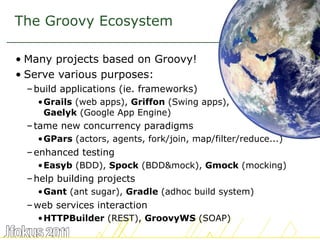
The Groovy Ecosystem

• Many projects based on Groovy!
• Serve various purposes:
 – build applications (ie. frameworks)
   •Grails (web apps), Griffon (Swing apps),
    Gaelyk (Google App Engine)
 – tame new concurrency paradigms
   •GPars (actors, agents, fork/join, map/filter/reduce...)
 – enhanced testing
   •Easyb (BDD), Spock (BDD&mock), Gmock (mocking)
 – help building projects
   •Gant (ant sugar), Gradle (adhoc build system)
 – web services interaction
   •HTTPBuilder (REST), GroovyWS (SOAP)
                                                              3
Prayer
to the
demo
 gods
Application frameworks
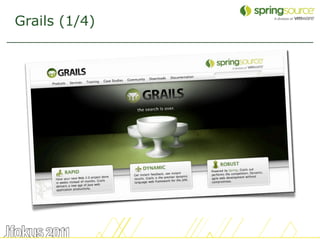
Grails (1/4)


               6
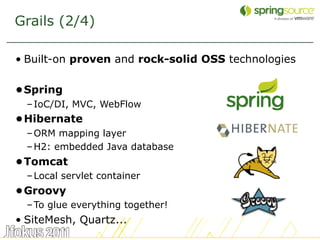
Grails (2/4)

• Built-on proven and rock-solid OSS technologies

•Spring
  – IoC/DI, MVC, WebFlow
•Hibernate
  – ORM mapping layer
  – H2: embedded Java database
•Tomcat
  – Local servlet container
•Groovy
  – To glue everything together!
• SiteMesh, Quartz...
                                                    7
Grails (3/4)

• Grails is an MVC web application stack
  – Domain classes mapped to datastores (RDBMS, NoSQL)
    •Transparent mapping
  – Controllers and service classes in Groovy
  – GSP (JSP-like template engine), with powerful taglibs


• Smart reloading as you make changes live

• Comes with its own command-line interface
  – Creating artifacts, building/testing the project, etc.


                                                             8
Grails (4/4)

• Hundreds of plugins available (559!)
 – Which let you expand your application easily
 – Providing functionality you won’t have to implement
 – You may hear about ‘Plugin Oriented Architecture’


• Some of the most used ones
 – Searchable: add Google-like search interface
 – Mail: easily send emails
 – Quartz: for your batch jobs
 – GraniteDS / Flex Scaffold: use a Flex UI frontend
 – Spring Security: authentication / authorization
 – and 554 other ones :-)

                                                         9
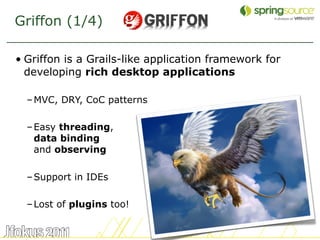
Griffon (1/4)

• Griffon is a Grails-like application framework for
  developing rich desktop applications

  – MVC, DRY, CoC patterns

  – Easy threading,
    data binding
    and observing

  – Support in IDEs

  – Lost of plugins too!


                                                       10
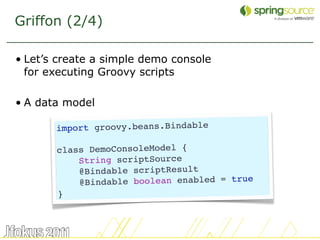
Griffon (2/4)

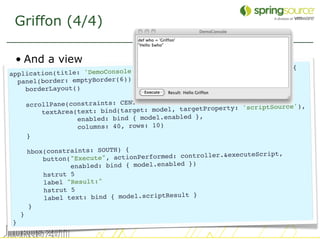
• Let’s create a simple demo console
  for executing Groovy scripts

• A data model

       import groovy.beans.Bindable

       class DemoConsoleModel {
           String scriptSource
           @Bindable scriptResult
           @Bindable boolean enabled = true
       }


                                              11
Griffon (3/4)

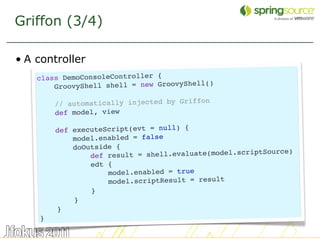
• A controller
    class DemoConsoleController {
                                            )
        GroovyShell shell = new GroovyShell(

        // automatically injected by Griffon
        def model, view

        def executeScript(evt = null) {
            model.enabled = false
            doOutside {
                                                            rce)
                def re sult = shell.evaluate(model.scriptSou
                edt {
                    model.enabled = true
                    model.scriptResult = result
                }
            }
        }
    }

                                                                   12
Griffon (4/4)

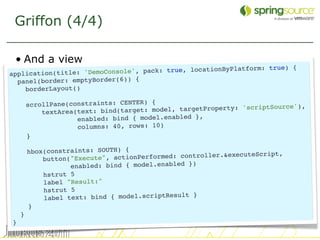
 • And a view
                                                               rm: true) {
application(title: 'DemoC onsole', pack: true, locationByPlatfo
  panel(border: emptyBorder(6)) {
    borderLayout()

        scrollPane(constraints: CENTER) {                             tSource'),
            textArea(text: bind(t arget: model, targetProperty: 'scrip
                     enabled: bind { model.enabled },
                     columns: 40, rows: 10)
        }

        hbox(constraints: SOUTH) {                               uteScript,
            button("Execut e", actionPerformed: controller.&exec
                   enabled: bind { model.enabled })
            hstrut 5
            label "Result:"
            hstrut 5
                                                   }
            label text: bind { model.scriptResult
        }
    }
}
                                                                                   13
Griffon (4/4)

 • And a view
                                                               rm: true) {
application(title: 'DemoC onsole', pack: true, locationByPlatfo
  panel(border: emptyBorder(6)) {
    borderLayout()

        scrollPane(constraints: CENTER) {                             tSource'),
            textArea(text: bind(t arget: model, targetProperty: 'scrip
                     enabled: bind { model.enabled },
                     columns: 40, rows: 10)
        }

        hbox(constraints: SOUTH) {                               uteScript,
            button("Execut e", actionPerformed: controller.&exec
                   enabled: bind { model.enabled })
            hstrut 5
            label "Result:"
            hstrut 5
                                                   }
            label text: bind { model.scriptResult
        }
    }
}
                                                                                   13
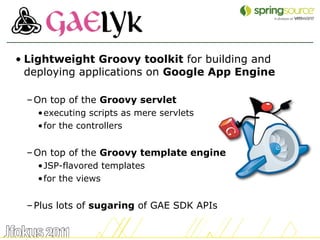
• Lightweight Groovy toolkit for building and
  deploying applications on Google App Engine

 – On top of the Groovy servlet
   •executing scripts as mere servlets
   •for the controllers


 – On top of the Groovy template engine
   •JSP-flavored templates
   •for the views


 – Plus lots of sugaring of GAE SDK APIs

                                                14
• Don’t miss my Gaelyk presentation!
  –Tuesday, 13:00-13:50, Room C1


                                       15
Taming concurrency
GPars (1/6)

• Concurrency library

• Multiple high-level abstractions
  – actors
  – map / filter / reduce
  – fork / join
  – asynchronous closures
  – agents
  – dataflow concurrency


• Can be used with Java!

                                     17
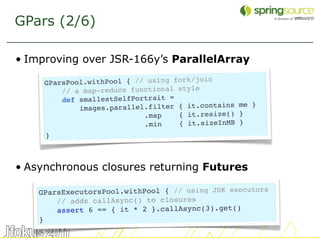
GPars (2/6)

• Improving over JSR-166y’s ParallelArray
                                          oin
     GParsPool.withPool { // using fork/j
         // a map-reduce functional style
         def smallestSelfPortrait =
                                                  me }
             images.parallel.filter { it.contains
                            .map    { it.resize() }
                            .min    { it.sizeInMB }
     }


• Asynchronous closures returning Futures

    GParsExecutorsPool.withPool { // using JDK executors
        // adds callAsync() to closures
        assert 6 == { it * 2 }.callAsync(3).get()
    }
                                                           18
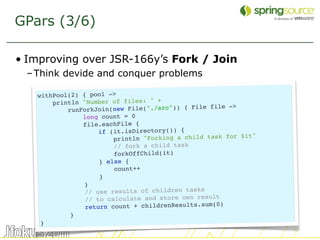
GPars (3/6)

• Improving over JSR-166y’s Fork / Join
 – Think devide and conquer problems

   withPool(2) { pool ->
       println "Number of files: " +
                                                  file ->
           runForkJoin(new File("./src")) { File
               long count = 0
               file.eachFile {
                    if (it.isDirectory()) {
                                                             t"
                        println "Forking a child task for $i
                        // fork a child task
                        forkOffChild(it)
                    } else {
                        count++
                    }
                }
                // use results of children tasks
                // to calculate and store own result
                return count + childrenResults.sum(0)
            }
    }
                                                                  19
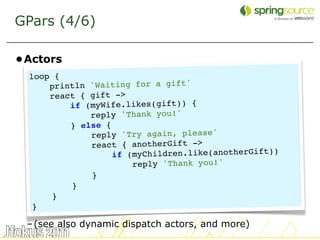
GPars (4/6)

•Actors
  loop {
      println 'Waiting for a gift'
      react { gift ->
          if (myWife.likes(gift)) {
              reply 'Thank you!'
          } else {
              reply 'Try again, please'
              react { anotherGift ->
                   if (myChildren.like(anotherGift))
                       reply 'Thank you!'
              }
          }
       }
   }

 – (see also dynamic dispatch actors, and more)
                                                       20
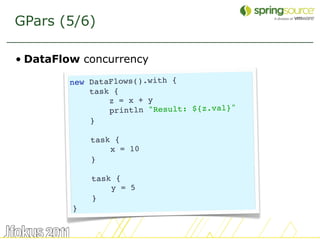
GPars (5/6)

• DataFlow concurrency

        new DataFlows().with {
            task {
                z = x + y
                println "Result: ${z.val}"
            }

             task {
                 x = 10
             }

             task {
                 y = 5
             }
         }


                                             21
GPars (6/6)

•Agents           class Conference extends Agent<Intege
                                                        r> {
                      def Conference() { super(0) }
 – thread-safe        private register(long num)    { data += num }
                                                              num }
   non-blocking       pr ivate unregister(long num) { data -=
                  }
   shared                                               ce()
                  final Agent conference = new Conferen
   mutable
                  // send commands in parallel threads
   state          final Thread t1 = Thread.start {
   wrappers           conference << { register 10 }
                  }
                  final Thread t2 = Thread.start {
                      conference << { register 5 }
                  }
                  final Thread t3 = Thread.start {
                      conference << { unregister 3 }
                  }

                  [t1, t2, t3]*.join()
                  assert 12 == conference.val

                                                                      22
Testing
Easyb (1/4)

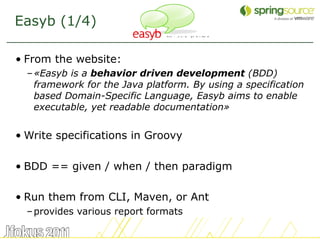
• From the website:
  – «Easyb is a behavior driven development (BDD)
    framework for the Java platform. By using a specification
    based Domain-Specific Language, Easyb aims to enable
    executable, yet readable documentation»


• Write specifications in Groovy

• BDD == given / when / then paradigm

• Run them from CLI, Maven, or Ant
  – provides various report formats

                                                                24
Easyb (2/4)

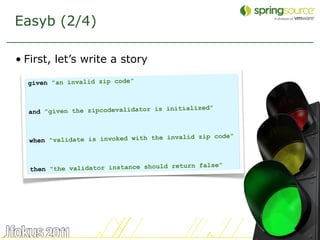
• First, let’s write a story

  given "an invalid zip code"


                                           ialized"
  an d "given the zipcodevalidator is init


                                           lid zip code"
  wh en "validate is invoked with the inva


                                          turn false"
   th en "the validator instance should re


                                                           25
Easyb (3/4)

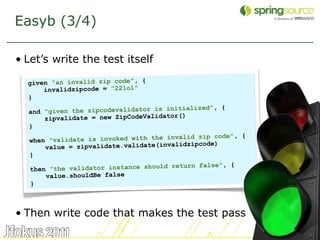
• Let’s write the test itself

  given "an invalid zip code", {
      invalidzipcode = "221o1"
  }
                                           ialized", {
  an d "given the zipcodevalidator is init
       zipvalidate = new ZipCodeValidator()
  }
                                           lid zip code", {
  wh en "validate is invoked with the inva
                                            zipcode)
       value = zipvalidate.validate(invalid
  }
                                         turn false", {
  th en "the validator instance should re
       value.shouldBe false
  }


• Then write code that makes the test pass
                                                              26
Easyb (4/4)

• There’s also the specification format

                                           instance", {
       before "initialize zipcodevalidator
           zipvalidate = new ZipCodeValidator()
       }
                                            {
       it "should deny invalid zip codes",         zip ->
           [" 221o1", "2210", "22010-121o"].each {
                zipvalidate.validate(zip).is false
           }
       }
                                           {
       it "should accept valid zip codes",
                                                 { zip ->
           ["22101", "22100", "22010-1210"].each
                                                     ue
               zipvalidate.validate(zip).shouldBe tr
           }
       }


                                                            27
Spock (1/3)

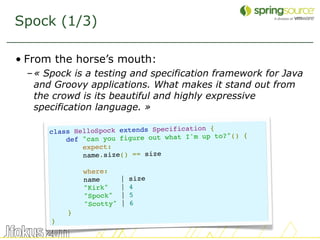
• From the horse’s mouth:
 – « Spock is a testing and specification framework for Java
   and Groovy applications. What makes it stand out from
   the crowd is its beautiful and highly expressive
   specification language. »

                                            n {
      class HelloSpock extends Specificatio
                                                   () {
          def "can you figure out what I'm up to?"
              expect:
              name.size() == size

              where:
              name       |   size
              "Kirk"     |   4
              "Spock"    |   5
              "Scotty"   |   6
          }
      }
                                                               28
Spock (2/3)

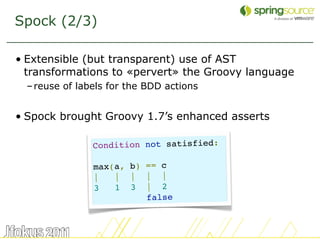
• Extensible (but transparent) use of AST
  transformations to «pervert» the Groovy language
  – reuse of labels for the BDD actions


• Spock brought Groovy 1.7’s enhanced asserts

                Condition not satisfied:

                max(a, b) == c
                |   |  |  |  |
                3   1  3  |  2
                          false


                                                     29
Spock (3/3)

• Another example of the expressive language
  – with powerful mocking capabilities


                                                         ce"() {
 def   "subscribers  receive published events at least on
       when: publisher.send(event)
                                             nt)
       then: (1.._) * subscriber.receive(eve
       where: even t << ["started", "paused", "stopped"]
 }


                                                                   30
Geb — Browser testing (1/2)

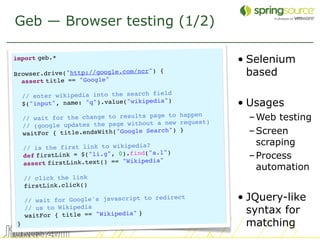
import geb.*                                            • Selenium
  
Browser.drive("http://google.com/ncr
                                     ") {                 based
  assert title == "Google"
                                     field
  // enter wikipedia into the search
  $("input", name: "q").value("wikipe
                                      dia")
                                                        • Usages
  // wait for the change to results
                                    page to happen        – Web testing
                                     t a new request)
  // (google updates the page withou
  waitFor { title.endsWith("Google Se
                                      arch") }            – Screen
                                                            scraping
  // is the first link to wikipedia?
  def firstLink = $("li.g", 0).find("a
                                       .l")
                                      ia"
                                                          – Process
  assert firstLink.text() == "Wikiped
                                                            automation
  // click the link
  firstLink.click()

  // wait for Google's javascript to
                                     redirect           • JQuery-like
  // us to Wikipedia
  waitFor { title == "Wikipedia" }
                                                          syntax for
}                                                         matching
                                                                        31
Geb — Browser testing (2/2)

                    import geb.spock.GebSpec
                     
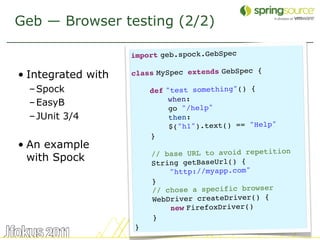
• Integrated with   class MySpec extends GebSpec {
                     
  – Spock               def "test something"() {
  – EasyB                   when:
                            go "/help"
  – JUnit 3/4                then:
                             $("h1").text() == "Help"
                         }
• An example
                        // base URL to avoid repetition
  with Spock            String getBaseUrl() {
                            "http://myapp.com"
                        }
                        // chose a specific browser
                        WebDriver createDriver() {
                            new FirefoxDriver()
                        }
                    }
                                                          32
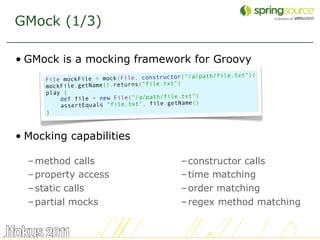
GMock (1/3)

• GMock is a mocking framework for Groovy
                                                  path/file.txt"))
     File mo ckFile = mock(File, constructor("/a/
                                          ")
     mockFile.getName().returns("file.txt
     play {
                                               ")
         def file = new File("/a/path/file.txt
                                               ()
         assertEquals "file.txt", file.getName
     }


• Mocking capabilities

  – method calls                            – constructor calls
  – property access                         – time matching
  – static calls                            – order matching
  – partial mocks                           – regex method matching


                                                                      33
GMock (2/3)

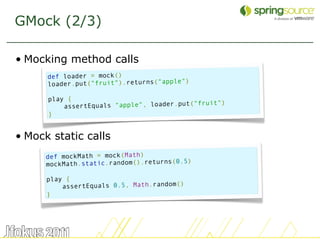
• Mocking method calls
      def loader = mock()
      loader.put("fruit").returns("apple")

      play {
                                               uit")
          assertEquals "apple", loader.put("fr
      }


• Mock static calls
      def mockMath = mock(Math)
                                           )
      mockMath.static.random().returns(0.5

      play {
          assertEquals 0.5, Math.random()
      }


                                                       34
GMock (3/3)

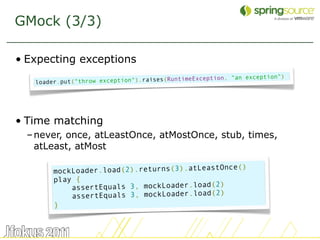
• Expecting exceptions
                                                               exception")
   loader.put("throw exce ption").raises(RuntimeException, "an


• Time matching
  – never, once, atLeastOnce, atMostOnce, stub, times,
    atLeast, atMost

                                             tOnce()
        mockLoader.load(2).returns(3).atLeas
        play {
                                             2)
            assertEquals 3, mockLoader.load(
                                             2)
            assertEquals 3, mockLoader.load(
        }


                                                                             35
Building applications
Groovy’s own AntBuilder

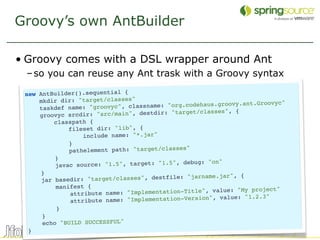
• Groovy comes with a DSL wrapper around Ant
 – so you can reuse any Ant trask with a Groovy syntax

 new AntBuilder().sequential {
     mkdir dir: "target/classes"                              vy.ant.Groovyc"
     taskdef name: "gro  ovyc", classname: "org.codehaus.groo
                                            "target/classes", {
     groovyc srcdir: "src/main", destdir:
          classpath {
              fileset dir: "lib", {
                   include name: "*.jar"
              }
              pathelement path: "target/classes"
          }
                                                debug: "on"
          javac source: "1.5", target: "1.5",
      }
                                                       me.jar", {
      jar basedi r: "target/classes", destfile: "jarna
          manifest {                                            "My project"
              attribute   name: "Implementation-Title", value:
                                                          value: "1.2.3"
               attrib ute name: "Implementation-Version",
           }
      }
      echo "BUILD SUCCESSFUL"
  }
                                                                                37
Gant

• Gant is a tool for scripting Ant tasks using Groovy
  instead of XML to specify the logic
       includeTargets << gant.targets.Clean
                                            ]
       cleanPattern << ['**/*~', '**/*.bak'
       cleanDirectory << 'build'
                                            uff.') {
       target(stuff: 'A target to do some st
           println 'Stuff'
           depends clean
                                                 Ant.'
           echo message: 'A default message from
           otherStuff()
       }
                                               other stuff') {
       target(otherStuff: 'A target to do some
           println 'OtherStuff'
                                               Ant.'
           echo message: 'Another message from
           clean()
       }

       setDefaultTarget stuff


                                                                 38
Gradle (1/3)

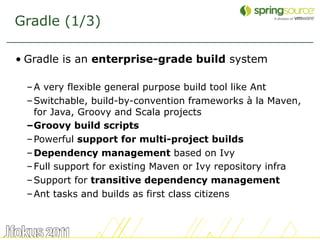
• Gradle is an enterprise-grade build system

 – A very flexible general purpose build tool like Ant
 – Switchable, build-by-convention frameworks à la Maven,
   for Java, Groovy and Scala projects
 –Groovy build scripts
 – Powerful support for multi-project builds
 – Dependency management based on Ivy
 – Full support for existing Maven or Ivy repository infra
 – Support for transitive dependency management
 – Ant tasks and builds as first class citizens


                                                             39
Gradle (2/3)

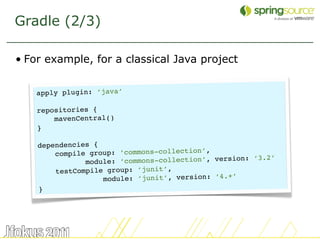
• For example, for a classical Java project


    apply plugin: ‘java’

    repositories {
        mavenCentral()
    }

    dependencies {
        compile group: ‘commons-collection’,
                                                         .2’
               modu le: ‘commons-collection’, version: ‘3
        testCompile group: ‘junit’,
                    module: ‘junit’, version: ‘4.+’
    }


                                                               40
Gradle (3/3)

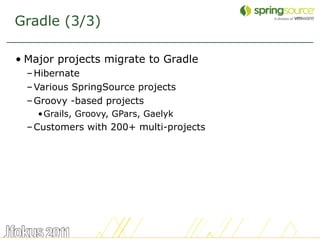
• Major projects migrate to Gradle
  – Hibernate
  – Various SpringSource projects
  – Groovy -based projects
    •Grails, Groovy, GPars, Gaelyk
  – Customers with 200+ multi-projects


                                         41
Other build and quality tools

• You can use Ant, Gant, Maven (GMaven plugin) or
  Gradle to build your projects
  – fits nicely in any existing build and continuous
    integration infrastructure


• A few Groovy-friendly tools provide handy metrics
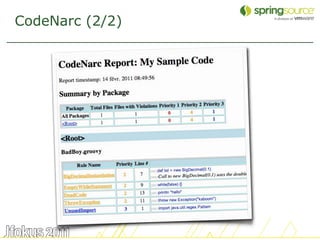
  – CodeNarc: provides various rules for static analysis of
    your Groovy codebase (style, size, braces, naming...)
  – GMetrics: code metrics
  – Simian: detects duplication in your Groovy code base
  – Cobertura, Clover: give code coverage metrics


                                                              42
u al ity
Q


                      ic s
                   t r
                e
               M
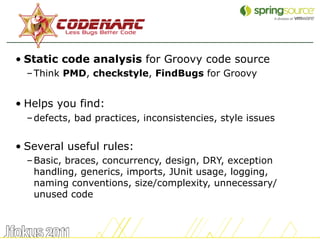
• Static code analysis for Groovy code source
  – Think PMD, checkstyle, FindBugs for Groovy


• Helps you find:
  – defects, bad practices, inconsistencies, style issues


• Several useful rules:
  – Basic, braces, concurrency, design, DRY, exception
    handling, generics, imports, JUnit usage, logging,
    naming conventions, size/complexity, unnecessary/
    unused code


                                                            44
CodeNarc (2/2)


                 45
GMetrics (1/2)

• Provides calculations and reporting of size and
  complexity metrics

• Calculations
  – Cyclomatic complexity
  – ABC size and complexity
  – Lines per method
  – Lines per class


                                                    46
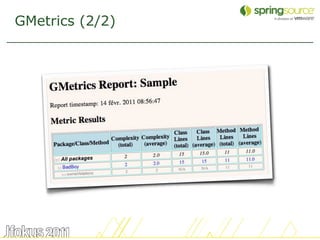
GMetrics (2/2)


                 47
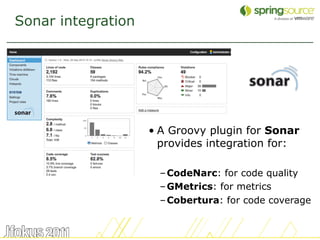
Sonar integration


                    • A Groovy plugin for Sonar
                      provides integration for:

                      – CodeNarc: for code quality
                      – GMetrics: for metrics
                      – Cobertura: for code coverage


                                                   48
Web services
HTTPBuilder (1/3)

• HTTPBuilder provides a convenient builder API for
  complex HTTP requests
                                                           )
 def http = new HTTP Builder( 'http://ajax.googleapis.com'

 http.request(GET, JSON) {
                                           '
     uri.path = '/ajax/services/search/web
                                             Hobbes']
     ur i.query = [v: '1.0', q: 'Calvin and
                                                         refox/3.0.4'
     headers.'User- Agent' = 'Mozilla/5.0 Ubuntu/8.10 Fi

     response.success = { resp, json ->
         println resp.statusLine
         json.responseData.results.each {                       l}"
             println " ${ it.titleNoFormatting}: ${it.visibleUr
         }
     }
 }


                                                                        50
HTTPBuilder (2/3)

• Posting to a URL

     import
groovyx.net.http.HTTPBuilder
                                              pe.URLENC
     import
static
groovyx.net.http.ContentTy
     

                                                 r.com/statuses/'
)
     de f
http
=
new
HTTPBuilder(
'http://twitte
                                                     tpbuilder']
     def
po stBody
=
[status:
'update!',
source:
'ht
                                               tBody,
      http.post(
path:
'update.xml',
body:
pos
                                                  resp
‐>


requestContentType:
URLENC
)
{


                                                          ine}"


printl n
"Tweet
response
status:
${resp.statusL
                                               
200


assert
resp.statusLine.statusCode
==
      }


                                                                      51
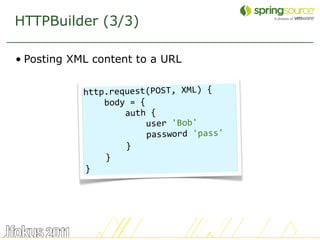
HTTPBuilder (3/3)

• Posting XML content to a URL


            http.request(POST,
XML)
{


body
=
{


auth
{


user
'Bob'


password
'pass'


}


}
            }


                                          52
GroovyWS (1/4)


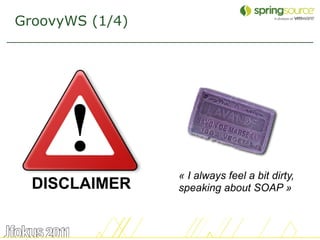
                 « I always feel a bit dirty,
  DISCLAIMER     speaking about SOAP »


                                                53
GroovyWS (2/4)

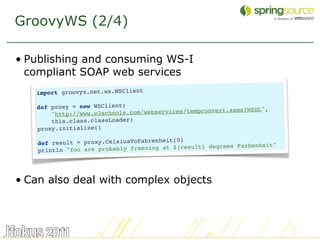
• Publishing and consuming WS-I
  compliant SOAP web services
   import groovyx.net.ws.WSClient

   def proxy = new WSClient(                               asmx?WSDL",
       "http://www.w3 schools.com/webservices/tempconvert.
       this.class.classLoader)
   proxy.initialize()
                                          t(0)
    def result = proxy.CelsiusToFahrenhei
                                                       grees Farhenheit"
    println "You are probably freezing at ${result} de


• Can also deal with complex objects


                                                                           54
GroovyWS (3/4)

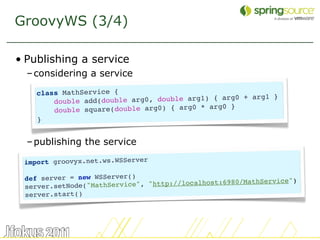
• Publishing a service
  – considering a service

    class MathService {                                     }
        double add(do uble arg0, double arg1) { arg0 + arg1
                                               g0 }
        do uble square(double arg0) { arg0 * ar
    }


  – publishing the service

 import groovyx.net.ws.WSServer

 def server = new WSServer()                           /MathService")
 server.setNode(" MathService", "http://localhost:6980
 server.start()


                                                                        55
GroovyWS (4/4)

• Make sure to check soapUI
  – lets you write SOAP Web Services testing
  – using Groovy scripts to define a scenario!


• You’ll feel much less dirty :-)


                                                 56
a ry
   m m
S u
Summary

• «Groovy» is way more than just a language!

• It’s also a very rich and active ecosystem!
  – Grails, Griffon, Gradle, GPars, Spock, Gaelyk...


                                                       58
a ry
   m m
S u
Thanks for your attention!


                      e
              e Laforg velopment
   Gu illaum oovy De         m
          of Gr e@gmail.co
   Head laforg
    E mail: g glaforge
              @
    T witter:

                                   • References:
                                    • http://groovy.codehaus.org/
                                    • http://grails.org
                                    • http://gaelyk.appspot.com/


                                                                    60
Images used in this
presentation
 Zeus: http://clarte.eu.com/religions/articles/LArtdetrouveretderoberleFeuspirituelmultiplicateur/zeus-greek-mythology-687267_1024_768.jpg
 Building: http://www.morguefile.com/archive/display/211651
 Announce: http://www.napleswebdesign.net/wp-content/uploads/2009/06/press_release_11.jpg
 Processors: http://www.morguefile.com/archive/display/12930
 Trafic lights: http://www.flickr.com/photos/mad_house_photography/4440871380/sizes/l/in/photostream/
 Bolts: http://www.morguefile.com/archive/display/29038
 Web: http://www.morguefile.com/archive/display/137778
 Light bulb: https://newsline.llnl.gov/retooling/mar/03.28.08_images/lightBulb.png
 Quality metrics: http://www.morguefile.com/archive/display/14314
 Duke ok GAE http://weblogs.java.net/blog/felipegaucho/archive/ae_gwt_java.png
 Green leaf: http://www.flickr.com/photos/epsos/3384297473/
 Jeepers creepers: http://www.flickr.com/photos/27663074@N07/3413698337/
 Earth: http://www.flickr.com/photos/wwworks/2222523978/
 Trafic light: http://rihancompany.com/var/243/35581-Traffic%20light%20drawing.jpg
 Griffon: http://aldaria02.a.l.pic.centerblog.net/lz2levrz.jpg
 Soap: http://www.flickr.com/photos/geishaboy500/104137788/
 Disclaimer: http://4.bp.blogspot.com/_OyM252mHWvo/TT53ltKn7xI/AAAAAAAAC-A/YUNqmzfwce0/s1600/disclaimer.jpg.png


                                                                                                                                             61

Groovy Ecosystem - JFokus 2011 - Guillaume Laforge

  • 1.
    Guill aume Laforge a very rich and lively ecosystem
  • 2.
    Guillaume Laforge /@glaforge • Groovy Project Manager • Head of Groovy Development at SpringSource • Initiator of the Grails framework • Founder of the Gaelyk toolkit • Co-author of Groovy in Action • Member of «Les Cast Codeurs» podcast • Speaker: JavaOne, QCon, JavaZone, Sun TechDays, Devoxx, The Spring Experience, SpringOne2GX, JAX, Dynamic Language World, IJTC, and more... 2
  • 3.
    The Groovy Ecosystem •Many projects based on Groovy! • Serve various purposes: – build applications (ie. frameworks) •Grails (web apps), Griffon (Swing apps), Gaelyk (Google App Engine) – tame new concurrency paradigms •GPars (actors, agents, fork/join, map/filter/reduce...) – enhanced testing •Easyb (BDD), Spock (BDD&mock), Gmock (mocking) – help building projects •Gant (ant sugar), Gradle (adhoc build system) – web services interaction •HTTPBuilder (REST), GroovyWS (SOAP) 3
  • 4.
  • 5.
  • 6.
  • 7.
    Grails (2/4) • Built-onproven and rock-solid OSS technologies •Spring – IoC/DI, MVC, WebFlow •Hibernate – ORM mapping layer – H2: embedded Java database •Tomcat – Local servlet container •Groovy – To glue everything together! • SiteMesh, Quartz... 7
  • 8.
    Grails (3/4) • Grailsis an MVC web application stack – Domain classes mapped to datastores (RDBMS, NoSQL) •Transparent mapping – Controllers and service classes in Groovy – GSP (JSP-like template engine), with powerful taglibs • Smart reloading as you make changes live • Comes with its own command-line interface – Creating artifacts, building/testing the project, etc. 8
  • 9.
    Grails (4/4) • Hundredsof plugins available (559!) – Which let you expand your application easily – Providing functionality you won’t have to implement – You may hear about ‘Plugin Oriented Architecture’ • Some of the most used ones – Searchable: add Google-like search interface – Mail: easily send emails – Quartz: for your batch jobs – GraniteDS / Flex Scaffold: use a Flex UI frontend – Spring Security: authentication / authorization – and 554 other ones :-) 9
  • 10.
    Griffon (1/4) • Griffonis a Grails-like application framework for developing rich desktop applications – MVC, DRY, CoC patterns – Easy threading, data binding and observing – Support in IDEs – Lost of plugins too! 10
  • 11.
    Griffon (2/4) • Let’screate a simple demo console for executing Groovy scripts • A data model import groovy.beans.Bindable class DemoConsoleModel { String scriptSource @Bindable scriptResult @Bindable boolean enabled = true } 11
  • 12.
    Griffon (3/4) • Acontroller class DemoConsoleController { ) GroovyShell shell = new GroovyShell( // automatically injected by Griffon def model, view def executeScript(evt = null) { model.enabled = false doOutside { rce) def re sult = shell.evaluate(model.scriptSou edt { model.enabled = true model.scriptResult = result } } } } 12
  • 13.
    Griffon (4/4) •And a view rm: true) { application(title: 'DemoC onsole', pack: true, locationByPlatfo panel(border: emptyBorder(6)) { borderLayout() scrollPane(constraints: CENTER) { tSource'), textArea(text: bind(t arget: model, targetProperty: 'scrip enabled: bind { model.enabled }, columns: 40, rows: 10) } hbox(constraints: SOUTH) { uteScript, button("Execut e", actionPerformed: controller.&exec enabled: bind { model.enabled }) hstrut 5 label "Result:" hstrut 5 } label text: bind { model.scriptResult } } } 13
  • 14.
    Griffon (4/4) •And a view rm: true) { application(title: 'DemoC onsole', pack: true, locationByPlatfo panel(border: emptyBorder(6)) { borderLayout() scrollPane(constraints: CENTER) { tSource'), textArea(text: bind(t arget: model, targetProperty: 'scrip enabled: bind { model.enabled }, columns: 40, rows: 10) } hbox(constraints: SOUTH) { uteScript, button("Execut e", actionPerformed: controller.&exec enabled: bind { model.enabled }) hstrut 5 label "Result:" hstrut 5 } label text: bind { model.scriptResult } } } 13
  • 15.
    • Lightweight Groovytoolkit for building and deploying applications on Google App Engine – On top of the Groovy servlet •executing scripts as mere servlets •for the controllers – On top of the Groovy template engine •JSP-flavored templates •for the views – Plus lots of sugaring of GAE SDK APIs 14
  • 16.
    • Don’t missmy Gaelyk presentation! –Tuesday, 13:00-13:50, Room C1 15
  • 17.
  • 18.
    GPars (1/6) • Concurrencylibrary • Multiple high-level abstractions – actors – map / filter / reduce – fork / join – asynchronous closures – agents – dataflow concurrency • Can be used with Java! 17
  • 19.
    GPars (2/6) • Improvingover JSR-166y’s ParallelArray oin GParsPool.withPool { // using fork/j // a map-reduce functional style def smallestSelfPortrait = me } images.parallel.filter { it.contains .map { it.resize() } .min { it.sizeInMB } } • Asynchronous closures returning Futures GParsExecutorsPool.withPool { // using JDK executors // adds callAsync() to closures assert 6 == { it * 2 }.callAsync(3).get() } 18
  • 20.
    GPars (3/6) • Improvingover JSR-166y’s Fork / Join – Think devide and conquer problems withPool(2) { pool -> println "Number of files: " + file -> runForkJoin(new File("./src")) { File long count = 0 file.eachFile { if (it.isDirectory()) { t" println "Forking a child task for $i // fork a child task forkOffChild(it) } else { count++ } } // use results of children tasks // to calculate and store own result return count + childrenResults.sum(0) } } 19
  • 21.
    GPars (4/6) •Actors loop { println 'Waiting for a gift' react { gift -> if (myWife.likes(gift)) { reply 'Thank you!' } else { reply 'Try again, please' react { anotherGift -> if (myChildren.like(anotherGift)) reply 'Thank you!' } } } } – (see also dynamic dispatch actors, and more) 20
  • 22.
    GPars (5/6) • DataFlowconcurrency new DataFlows().with { task { z = x + y println "Result: ${z.val}" } task { x = 10 } task { y = 5 } } 21
  • 23.
    GPars (6/6) •Agents class Conference extends Agent<Intege r> { def Conference() { super(0) } – thread-safe private register(long num) { data += num } num } non-blocking pr ivate unregister(long num) { data -= } shared ce() final Agent conference = new Conferen mutable // send commands in parallel threads state final Thread t1 = Thread.start { wrappers conference << { register 10 } } final Thread t2 = Thread.start { conference << { register 5 } } final Thread t3 = Thread.start { conference << { unregister 3 } } [t1, t2, t3]*.join() assert 12 == conference.val 22
  • 24.
  • 25.
    Easyb (1/4) • Fromthe website: – «Easyb is a behavior driven development (BDD) framework for the Java platform. By using a specification based Domain-Specific Language, Easyb aims to enable executable, yet readable documentation» • Write specifications in Groovy • BDD == given / when / then paradigm • Run them from CLI, Maven, or Ant – provides various report formats 24
  • 26.
    Easyb (2/4) • First,let’s write a story given "an invalid zip code" ialized" an d "given the zipcodevalidator is init lid zip code" wh en "validate is invoked with the inva turn false" th en "the validator instance should re 25
  • 27.
    Easyb (3/4) • Let’swrite the test itself given "an invalid zip code", { invalidzipcode = "221o1" } ialized", { an d "given the zipcodevalidator is init zipvalidate = new ZipCodeValidator() } lid zip code", { wh en "validate is invoked with the inva zipcode) value = zipvalidate.validate(invalid } turn false", { th en "the validator instance should re value.shouldBe false } • Then write code that makes the test pass 26
  • 28.
    Easyb (4/4) • There’salso the specification format instance", { before "initialize zipcodevalidator zipvalidate = new ZipCodeValidator() } { it "should deny invalid zip codes", zip -> [" 221o1", "2210", "22010-121o"].each { zipvalidate.validate(zip).is false } } { it "should accept valid zip codes", { zip -> ["22101", "22100", "22010-1210"].each ue zipvalidate.validate(zip).shouldBe tr } } 27
  • 29.
    Spock (1/3) • Fromthe horse’s mouth: – « Spock is a testing and specification framework for Java and Groovy applications. What makes it stand out from the crowd is its beautiful and highly expressive specification language. » n { class HelloSpock extends Specificatio () {     def "can you figure out what I'm up to?"         expect:         name.size() == size         where:         name | size "Kirk" | 4 "Spock" | 5 "Scotty" | 6     } } 28
  • 30.
    Spock (2/3) • Extensible(but transparent) use of AST transformations to «pervert» the Groovy language – reuse of labels for the BDD actions • Spock brought Groovy 1.7’s enhanced asserts Condition not satisfied: max(a, b) == c |   |  |  |  | 3   1  3  |  2           false 29
  • 31.
    Spock (3/3) • Anotherexample of the expressive language – with powerful mocking capabilities ce"() { def "subscribers receive published events at least on     when: publisher.send(event) nt)   then: (1.._) * subscriber.receive(eve     where: even t << ["started", "paused", "stopped"] } 30
  • 32.
    Geb — Browsertesting (1/2) import geb.* • Selenium    Browser.drive("http://google.com/ncr ") { based   assert title == "Google" field   // enter wikipedia into the search   $("input", name: "q").value("wikipe dia") • Usages   // wait for the change to results page to happen – Web testing t a new request)   // (google updates the page withou   waitFor { title.endsWith("Google Se arch") } – Screen scraping   // is the first link to wikipedia?   def firstLink = $("li.g", 0).find("a .l") ia" – Process   assert firstLink.text() == "Wikiped automation   // click the link   firstLink.click()   // wait for Google's javascript to redirect • JQuery-like   // us to Wikipedia   waitFor { title == "Wikipedia" } syntax for } matching 31
  • 33.
    Geb — Browsertesting (2/2) import geb.spock.GebSpec   • Integrated with class MySpec extends GebSpec {   – Spock     def "test something"() { – EasyB         when:         go "/help" – JUnit 3/4         then:         $("h1").text() == "Help"     } • An example // base URL to avoid repetition with Spock String getBaseUrl() {         "http://myapp.com"     } // chose a specific browser WebDriver createDriver() {         new FirefoxDriver()     } } 32
  • 34.
    GMock (1/3) • GMockis a mocking framework for Groovy path/file.txt")) File mo ckFile = mock(File, constructor("/a/ ") mockFile.getName().returns("file.txt play { ")   def file = new File("/a/path/file.txt ()   assertEquals "file.txt", file.getName } • Mocking capabilities – method calls – constructor calls – property access – time matching – static calls – order matching – partial mocks – regex method matching 33
  • 35.
    GMock (2/3) • Mockingmethod calls def loader = mock() loader.put("fruit").returns("apple") play { uit")   assertEquals "apple", loader.put("fr } • Mock static calls def mockMath = mock(Math) ) mockMath.static.random().returns(0.5 play {     assertEquals 0.5, Math.random() } 34
  • 36.
    GMock (3/3) • Expectingexceptions exception") loader.put("throw exce ption").raises(RuntimeException, "an • Time matching – never, once, atLeastOnce, atMostOnce, stub, times, atLeast, atMost tOnce() mockLoader.load(2).returns(3).atLeas play { 2)     assertEquals 3, mockLoader.load( 2)     assertEquals 3, mockLoader.load( } 35
  • 37.
  • 38.
    Groovy’s own AntBuilder •Groovy comes with a DSL wrapper around Ant – so you can reuse any Ant trask with a Groovy syntax new AntBuilder().sequential { mkdir dir: "target/classes" vy.ant.Groovyc" taskdef name: "gro ovyc", classname: "org.codehaus.groo "target/classes", { groovyc srcdir: "src/main", destdir: classpath { fileset dir: "lib", { include name: "*.jar" } pathelement path: "target/classes" } debug: "on" javac source: "1.5", target: "1.5", } me.jar", { jar basedi r: "target/classes", destfile: "jarna manifest { "My project" attribute name: "Implementation-Title", value: value: "1.2.3" attrib ute name: "Implementation-Version", } } echo "BUILD SUCCESSFUL" } 37
  • 39.
    Gant • Gant isa tool for scripting Ant tasks using Groovy instead of XML to specify the logic includeTargets << gant.targets.Clean ] cleanPattern << ['**/*~', '**/*.bak' cleanDirectory << 'build' uff.') { target(stuff: 'A target to do some st println 'Stuff' depends clean Ant.' echo message: 'A default message from otherStuff() } other stuff') { target(otherStuff: 'A target to do some println 'OtherStuff' Ant.' echo message: 'Another message from clean() } setDefaultTarget stuff 38
  • 40.
    Gradle (1/3) • Gradleis an enterprise-grade build system – A very flexible general purpose build tool like Ant – Switchable, build-by-convention frameworks à la Maven, for Java, Groovy and Scala projects –Groovy build scripts – Powerful support for multi-project builds – Dependency management based on Ivy – Full support for existing Maven or Ivy repository infra – Support for transitive dependency management – Ant tasks and builds as first class citizens 39
  • 41.
    Gradle (2/3) • Forexample, for a classical Java project apply plugin: ‘java’ repositories { mavenCentral() } dependencies { compile group: ‘commons-collection’, .2’ modu le: ‘commons-collection’, version: ‘3 testCompile group: ‘junit’, module: ‘junit’, version: ‘4.+’ } 40
  • 42.
    Gradle (3/3) • Majorprojects migrate to Gradle – Hibernate – Various SpringSource projects – Groovy -based projects •Grails, Groovy, GPars, Gaelyk – Customers with 200+ multi-projects 41
  • 43.
    Other build andquality tools • You can use Ant, Gant, Maven (GMaven plugin) or Gradle to build your projects – fits nicely in any existing build and continuous integration infrastructure • A few Groovy-friendly tools provide handy metrics – CodeNarc: provides various rules for static analysis of your Groovy codebase (style, size, braces, naming...) – GMetrics: code metrics – Simian: detects duplication in your Groovy code base – Cobertura, Clover: give code coverage metrics 42
  • 44.
    u al ity Q ic s t r e M
  • 45.
    • Static codeanalysis for Groovy code source – Think PMD, checkstyle, FindBugs for Groovy • Helps you find: – defects, bad practices, inconsistencies, style issues • Several useful rules: – Basic, braces, concurrency, design, DRY, exception handling, generics, imports, JUnit usage, logging, naming conventions, size/complexity, unnecessary/ unused code 44
  • 46.
  • 47.
    GMetrics (1/2) • Providescalculations and reporting of size and complexity metrics • Calculations – Cyclomatic complexity – ABC size and complexity – Lines per method – Lines per class 46
  • 48.
  • 49.
    Sonar integration • A Groovy plugin for Sonar provides integration for: – CodeNarc: for code quality – GMetrics: for metrics – Cobertura: for code coverage 48
  • 50.
  • 51.
    HTTPBuilder (1/3) • HTTPBuilderprovides a convenient builder API for complex HTTP requests ) def http = new HTTP Builder( 'http://ajax.googleapis.com' http.request(GET, JSON) { ' uri.path = '/ajax/services/search/web Hobbes'] ur i.query = [v: '1.0', q: 'Calvin and refox/3.0.4' headers.'User- Agent' = 'Mozilla/5.0 Ubuntu/8.10 Fi response.success = { resp, json -> println resp.statusLine json.responseData.results.each { l}" println " ${ it.titleNoFormatting}: ${it.visibleUr } } } 50
  • 52.
    HTTPBuilder (2/3) • Postingto a URL import
groovyx.net.http.HTTPBuilder pe.URLENC import
static
groovyx.net.http.ContentTy 
 r.com/statuses/'
) de f
http
=
new
HTTPBuilder(
'http://twitte tpbuilder'] def
po stBody
=
[status:
'update!',
source:
'ht tBody, http.post(
path:
'update.xml',
body:
pos resp
‐> 


requestContentType:
URLENC
)
{
 
 ine}" 


printl n
"Tweet
response
status:
${resp.statusL 
200 


assert
resp.statusLine.statusCode
== } 51
  • 53.
    HTTPBuilder (3/3) • PostingXML content to a URL http.request(POST,
XML)
{ 


body
=
{ 


auth
{ 


user
'Bob' 


password
'pass' 


} 


} } 52
  • 54.
    GroovyWS (1/4) « I always feel a bit dirty, DISCLAIMER speaking about SOAP » 53
  • 55.
    GroovyWS (2/4) • Publishingand consuming WS-I compliant SOAP web services import groovyx.net.ws.WSClient def proxy = new WSClient( asmx?WSDL", "http://www.w3 schools.com/webservices/tempconvert. this.class.classLoader) proxy.initialize() t(0) def result = proxy.CelsiusToFahrenhei grees Farhenheit" println "You are probably freezing at ${result} de • Can also deal with complex objects 54
  • 56.
    GroovyWS (3/4) • Publishinga service – considering a service class MathService { } double add(do uble arg0, double arg1) { arg0 + arg1 g0 } do uble square(double arg0) { arg0 * ar } – publishing the service import groovyx.net.ws.WSServer def server = new WSServer() /MathService") server.setNode(" MathService", "http://localhost:6980 server.start() 55
  • 57.
    GroovyWS (4/4) • Makesure to check soapUI – lets you write SOAP Web Services testing – using Groovy scripts to define a scenario! • You’ll feel much less dirty :-) 56
  • 58.
    a ry m m S u
  • 59.
    Summary • «Groovy» isway more than just a language! • It’s also a very rich and active ecosystem! – Grails, Griffon, Gradle, GPars, Spock, Gaelyk... 58
  • 60.
    a ry m m S u
  • 61.
    Thanks for yourattention! e e Laforg velopment Gu illaum oovy De m of Gr e@gmail.co Head laforg E mail: g glaforge @ T witter: • References: • http://groovy.codehaus.org/ • http://grails.org • http://gaelyk.appspot.com/ 60
  • 62.
    Images used inthis presentation Zeus: http://clarte.eu.com/religions/articles/LArtdetrouveretderoberleFeuspirituelmultiplicateur/zeus-greek-mythology-687267_1024_768.jpg Building: http://www.morguefile.com/archive/display/211651 Announce: http://www.napleswebdesign.net/wp-content/uploads/2009/06/press_release_11.jpg Processors: http://www.morguefile.com/archive/display/12930 Trafic lights: http://www.flickr.com/photos/mad_house_photography/4440871380/sizes/l/in/photostream/ Bolts: http://www.morguefile.com/archive/display/29038 Web: http://www.morguefile.com/archive/display/137778 Light bulb: https://newsline.llnl.gov/retooling/mar/03.28.08_images/lightBulb.png Quality metrics: http://www.morguefile.com/archive/display/14314 Duke ok GAE http://weblogs.java.net/blog/felipegaucho/archive/ae_gwt_java.png Green leaf: http://www.flickr.com/photos/epsos/3384297473/ Jeepers creepers: http://www.flickr.com/photos/27663074@N07/3413698337/ Earth: http://www.flickr.com/photos/wwworks/2222523978/ Trafic light: http://rihancompany.com/var/243/35581-Traffic%20light%20drawing.jpg Griffon: http://aldaria02.a.l.pic.centerblog.net/lz2levrz.jpg Soap: http://www.flickr.com/photos/geishaboy500/104137788/ Disclaimer: http://4.bp.blogspot.com/_OyM252mHWvo/TT53ltKn7xI/AAAAAAAAC-A/YUNqmzfwce0/s1600/disclaimer.jpg.png 61