What’s new in Groovy 1.6?


Get started with Groovy and learn about
 all the novelties in the latest release

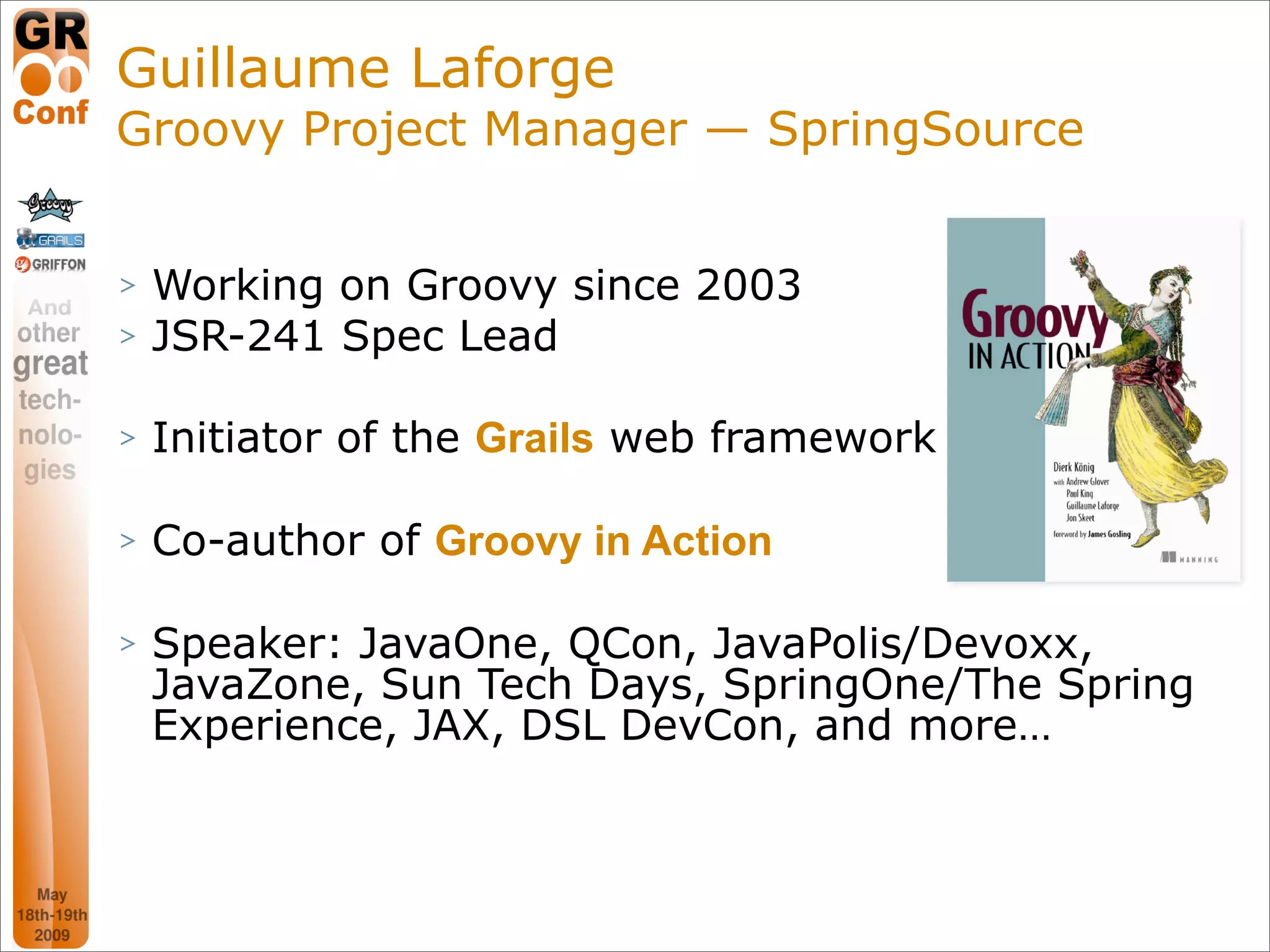
         Guillaume Laforge
     Head of Groovy Development
Guillaume Laforge
Groovy Project Manager — SpringSource


>   Working on Groovy since 2003
>   JSR-241 Spec Lead

>   Initiator of the Grails web framework

>   Co-author of Groovy in Action

>   Speaker: JavaOne, QCon, JavaPolis/Devoxx,
    JavaZone, Sun Tech Days, SpringOne/The Spring
    Experience, JAX, DSL DevCon, and more…


                                             3
What’s new in Groovy 1.6?
Article Published by InfoQ


>   This presentation was prepared with the examples
    I’ve used in my article written for InfoQ

>   http://www.infoq.com/articles/groovy-1-6

>   Read this article for more detailed explanations of
    all the new features in Groovy 1.6


                                                 4
nda
Ag e
      >   Groovy Overview
      >   Performance Improvements
      >   Syntax Enhancements
      >   Compile-Time Metaprogramming
      >   The Grape Module System
      >   Swing-Related Improvements
      >   Runtime Metaprogramming
          Additions
      >   JSR-223 Scripting Engine Built-In
      >   JMX Builder
      >   OSGi Readiness
                                    5
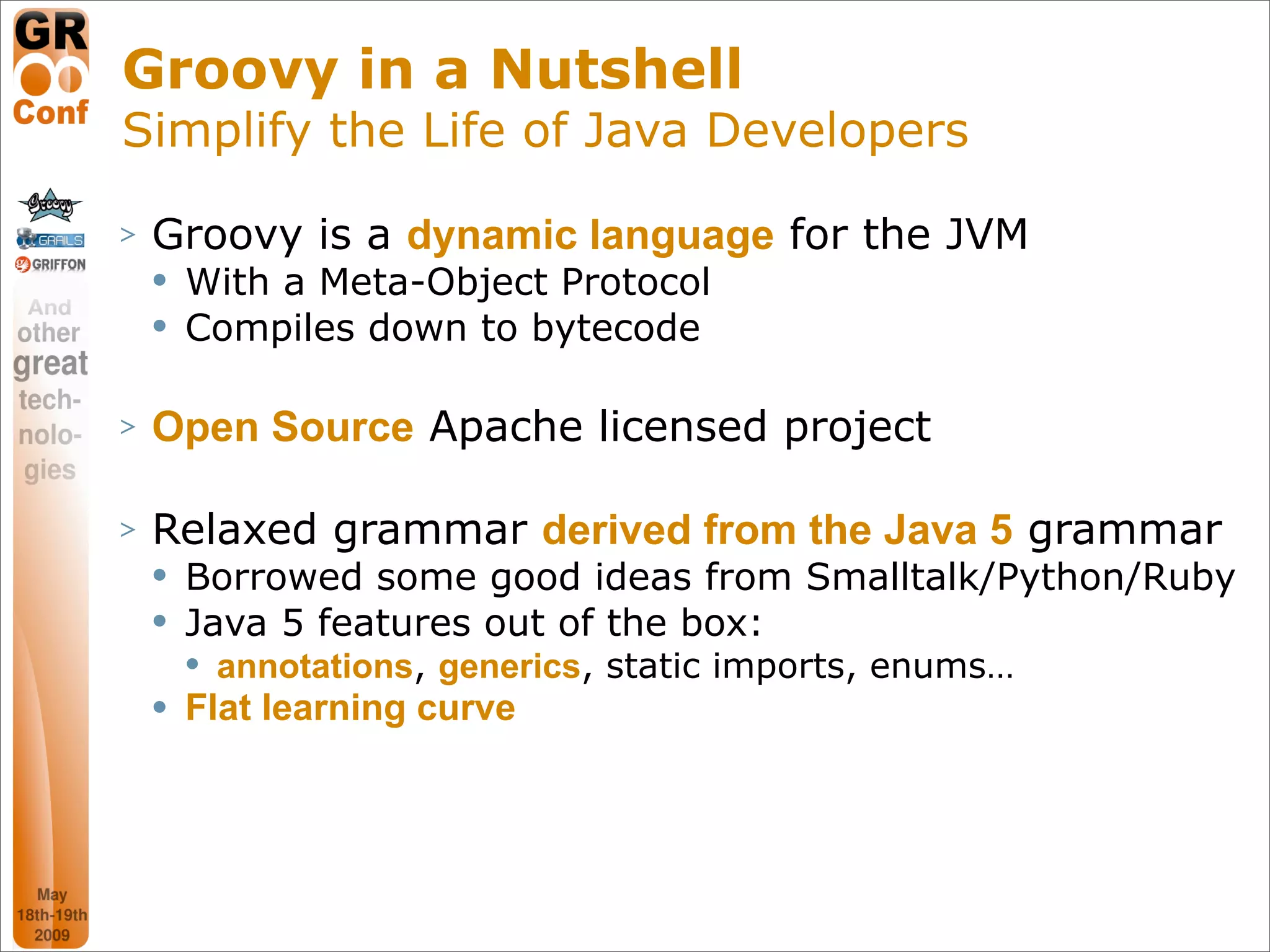
Groovy in a Nutshell
Simplify the Life of Java Developers

>   Groovy is a dynamic language for the JVM
       With a Meta-Object Protocol
       Compiles down to bytecode

>   Open Source Apache licensed project

>   Relaxed grammar derived from the Java 5 grammar
       Borrowed some good ideas from Smalltalk/Python/Ruby
       Java 5 features out of the box:
           annotations, generics, static imports, enums…
       Flat learning curve


                                                            6
A Taste of Groovy — Take 1
A Normal Java Program
>   public class HelloWorld {
        private String name;
        public void setName(String name) {
            this.name = name;
        }
        public String getName() {
            return name;
        }
        public String greet() {
            return "Hello " + name;
        }
        public static void main(String[] args) {
            HelloWorld helloWorld = new HelloWorld();
            helloWorld.setName("Groovy");
            System.out.println( helloWorld.greet() );
        }
    }


                                                        7
A Taste of Groovy — Take 2
A Normal Groovy Program
>   public class HelloWorld {
        private String name;
        public void setName(String name) {
            this.name = name;
        }
        public String getName() {
            return name;
        }
        public String greet() {
            return "Hello " + name;
        }
        public static void main(String[] args) {
            HelloWorld helloWorld = new HelloWorld();
            helloWorld.setName("Groovy");
            System.out.println( helloWorld.greet() );
        }
    }


                                                        8
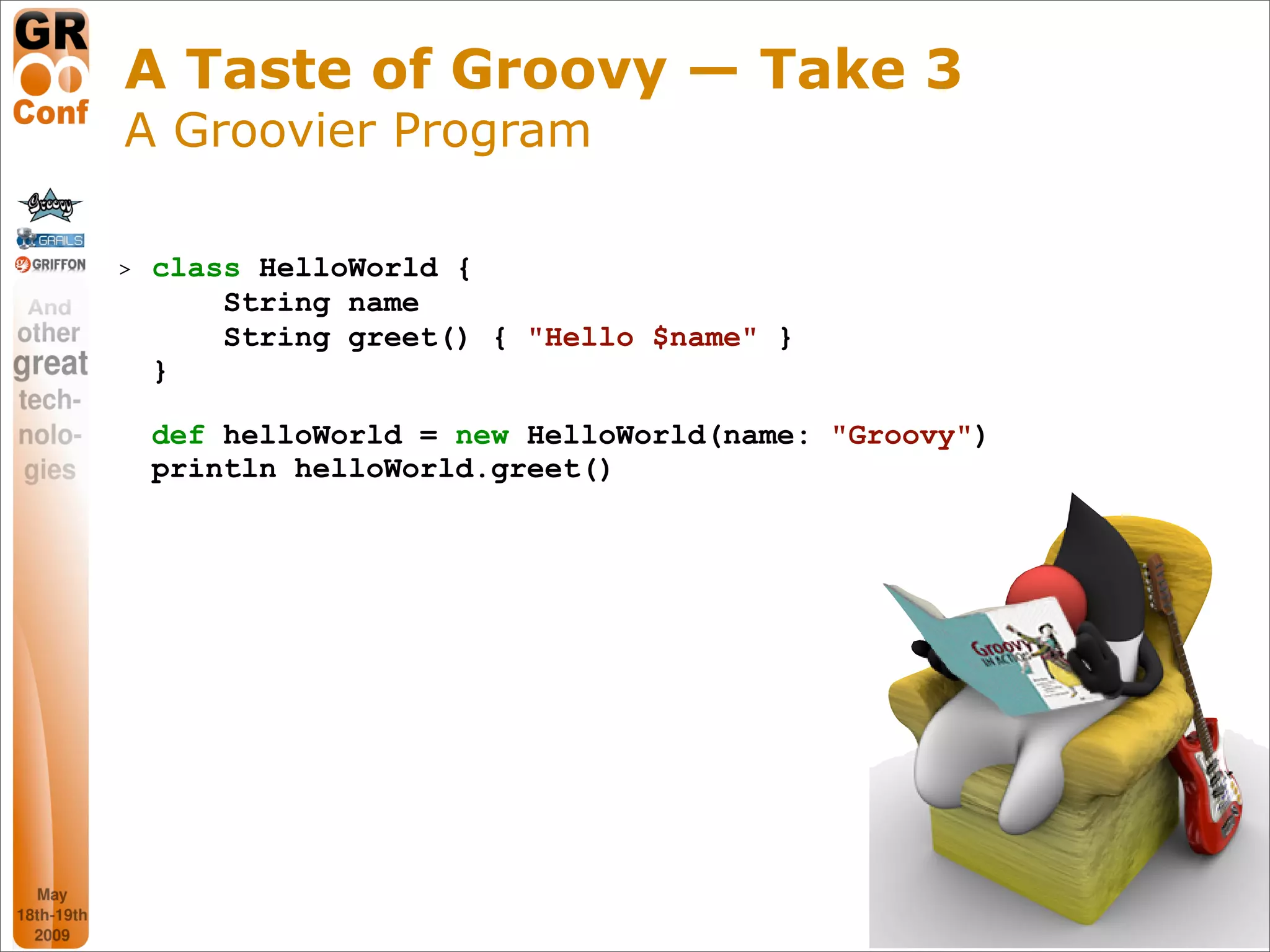
A Taste of Groovy — Take 3
A Groovier Program

>   class HelloWorld {
        String name
        String greet() { "Hello $name" }
    }

    def helloWorld = new HelloWorld(name: "Groovy")
    println helloWorld.greet()


                                                      9
The Groovy Web Console
A Groovy Playground


>   Groovy works nicely on Google App Engine
       You can also deploy Grails applications

>   You can play with Groovy in the web console
       http://groovyconsole.appspot.com/


                                                  10
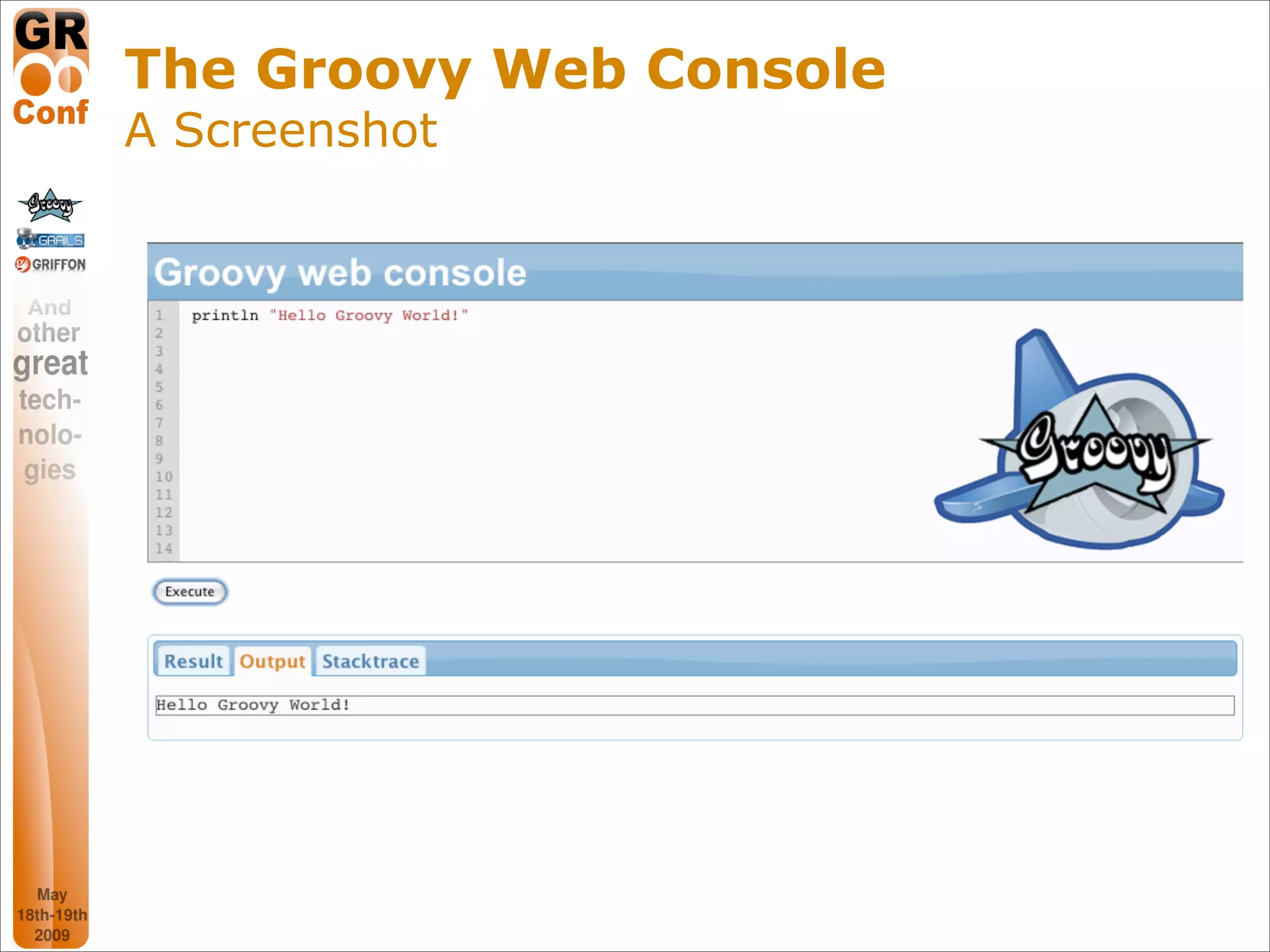
The Groovy Web Console
A Screenshot


                         11
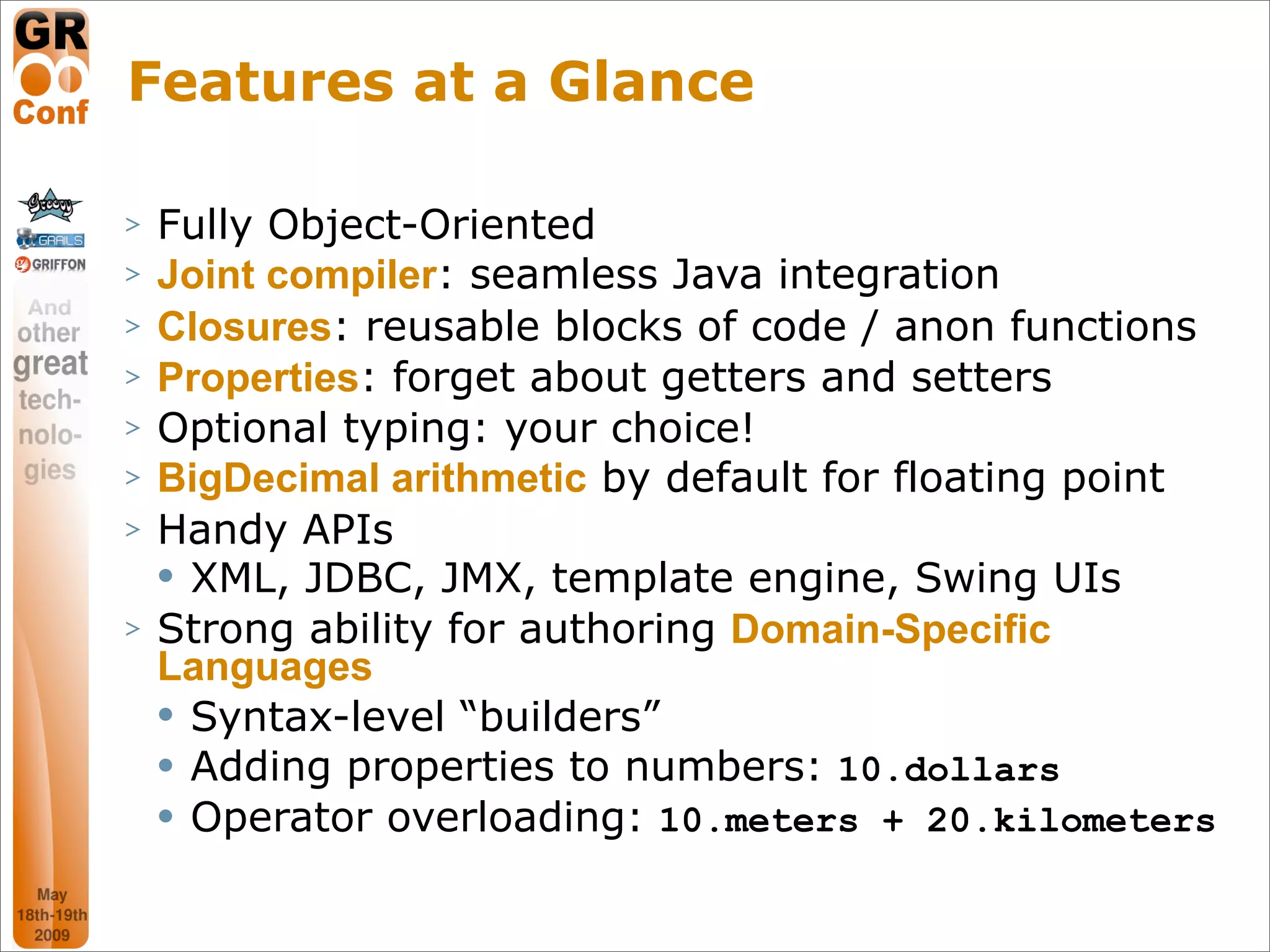
Features at a Glance

>   Fully Object-Oriented
>   Joint compiler: seamless Java integration
>   Closures: reusable blocks of code / anon functions
>   Properties: forget about getters and setters
>   Optional typing: your choice!
>   BigDecimal arithmetic by default for floating point
>   Handy APIs
     XML, JDBC, JMX, template engine, Swing UIs

>   Strong ability for authoring Domain-Specific
    Languages
     Syntax-level “builders”

     Adding properties to numbers: 10.dollars

     Operator overloading: 10.meters + 20.kilometers


                                                 12
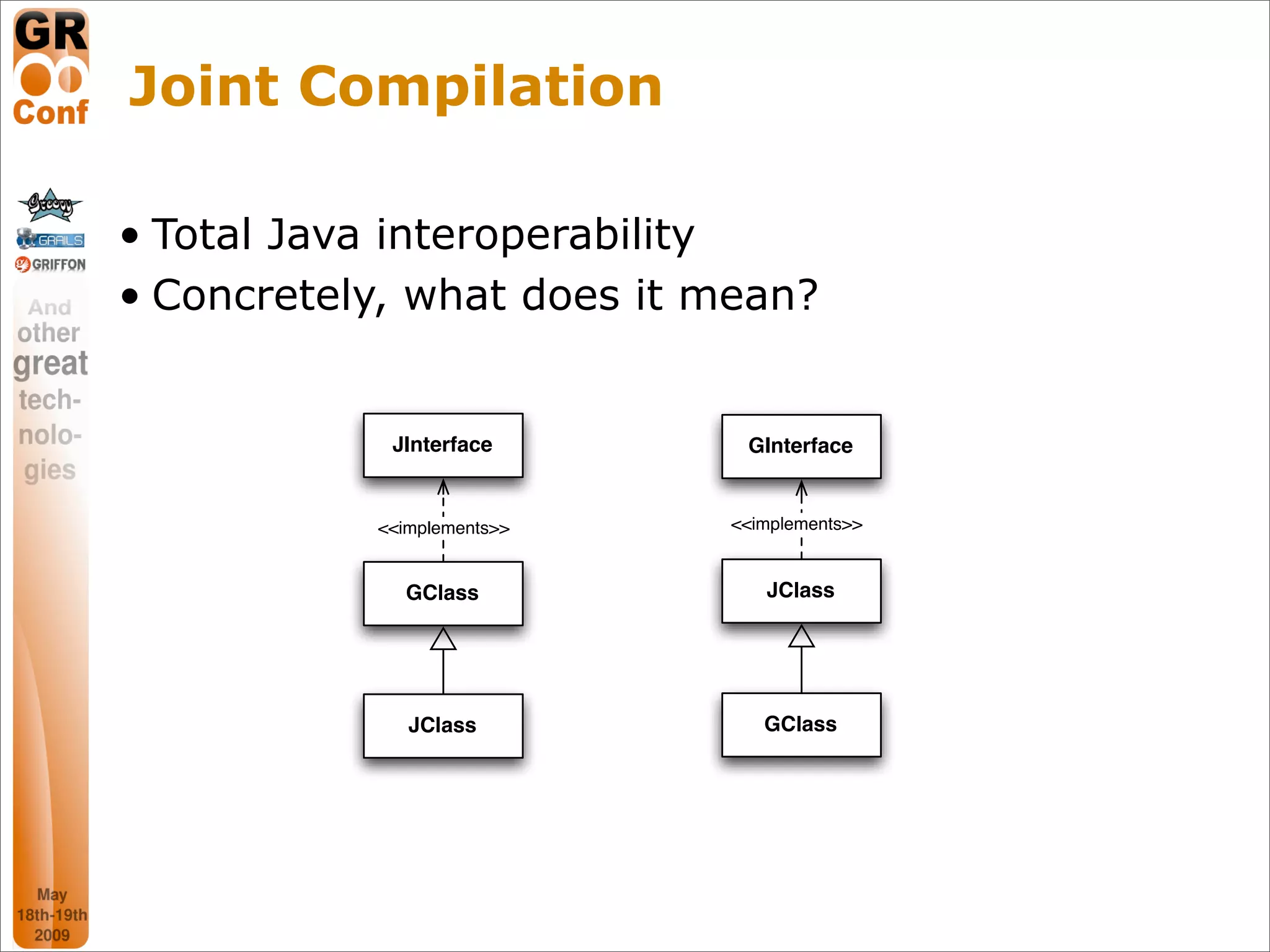
Joint Compilation

• Total Java interoperability
• Concretely, what does it mean?


            JInterface       GInterface


           <<implements>>   <<implements>>


             GClass            JClass


              JClass           GClass


                                             13
Native Syntax Constructs

• Lists
  – def numbers = [1, 2, 3, 4, 5]

• Maps
  – def map = [FR: ‘France’, BE: ‘Belgium’]

• Ranges
  – def allowed = 18..65

• Regular expressions
  – def whitespace = ~/s+?/
  – if (‘foo’ ==~ /o+/) { ... }


                                              14
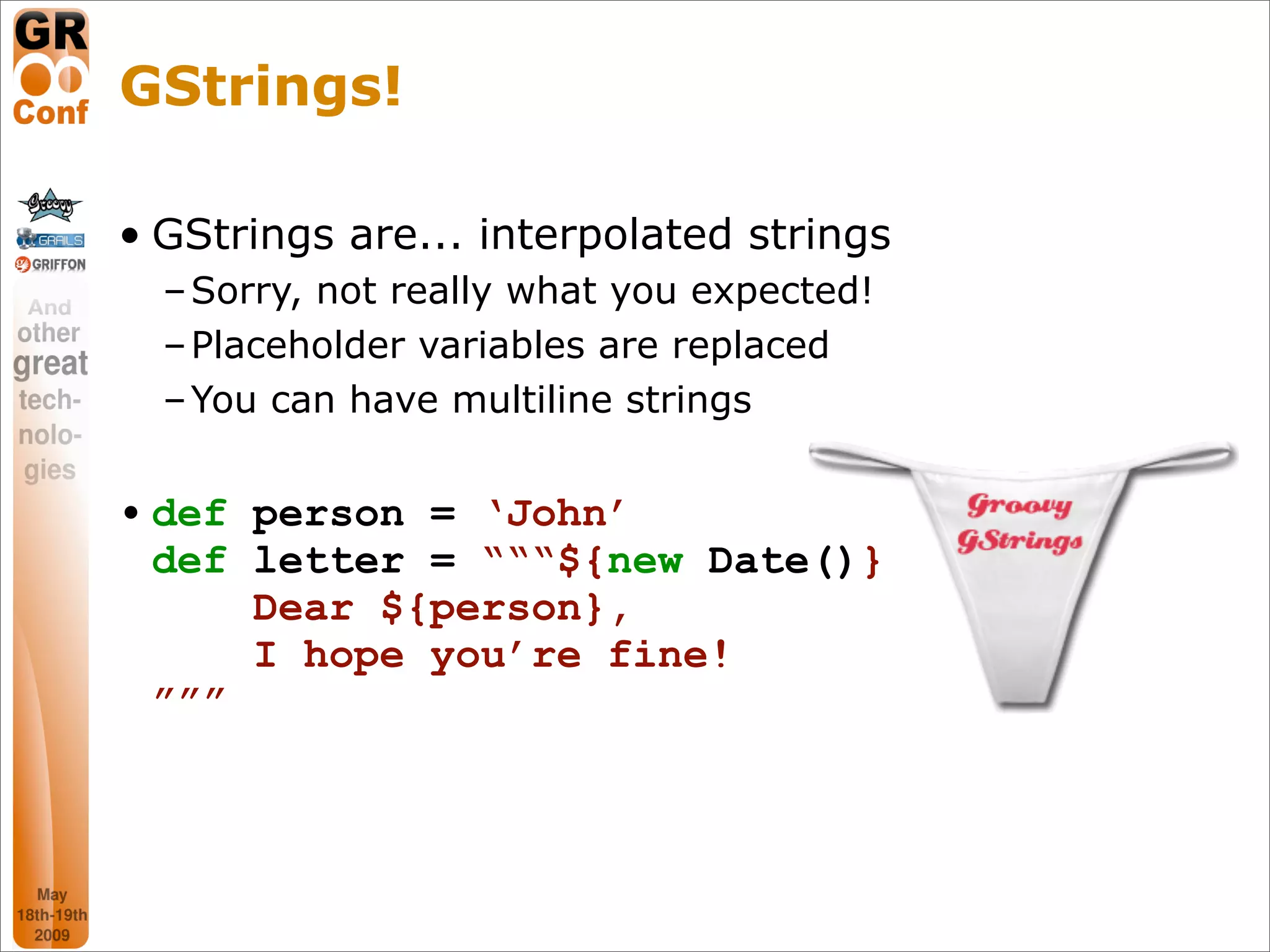
GStrings!

• GStrings are... interpolated strings
  – Sorry, not really what you expected!
  – Placeholder variables are replaced
  – You can have multiline strings


• def person = ‘John’
  def letter = “““${new Date()}
      Dear ${person},
      I hope you’re fine!
  ”””


                                           15
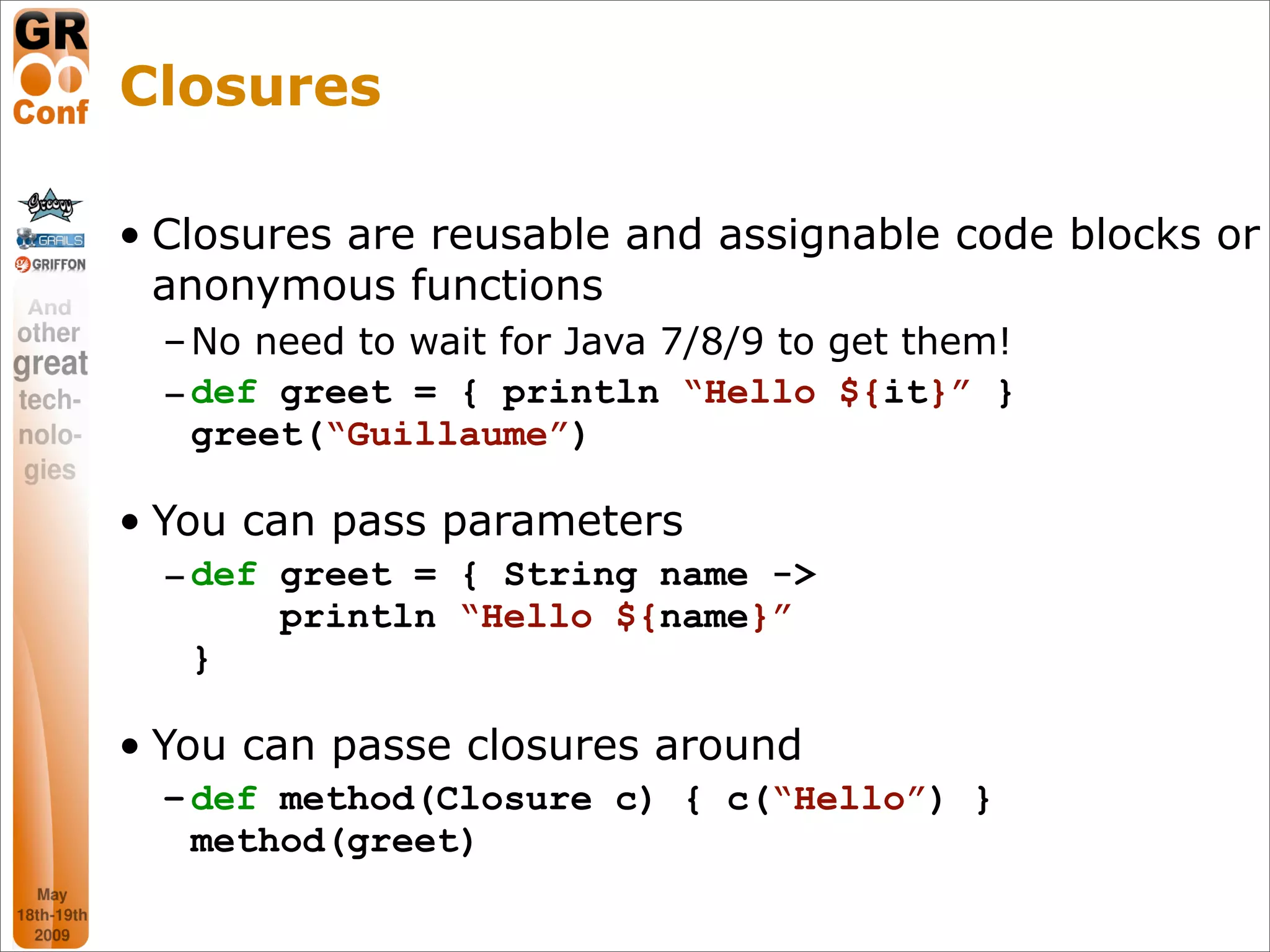
Closures

• Closures are reusable and assignable code blocks or
  anonymous functions
  – No need to wait for Java 7/8/9 to get them!
  – def greet = { println “Hello ${it}” }
    greet(“Guillaume”)

• You can pass parameters
  – def greet = { String name ->
        println “Hello ${name}”
    }

• You can passe closures around
  – def method(Closure c) { c(“Hello”) }
    method(greet)

                                                  16
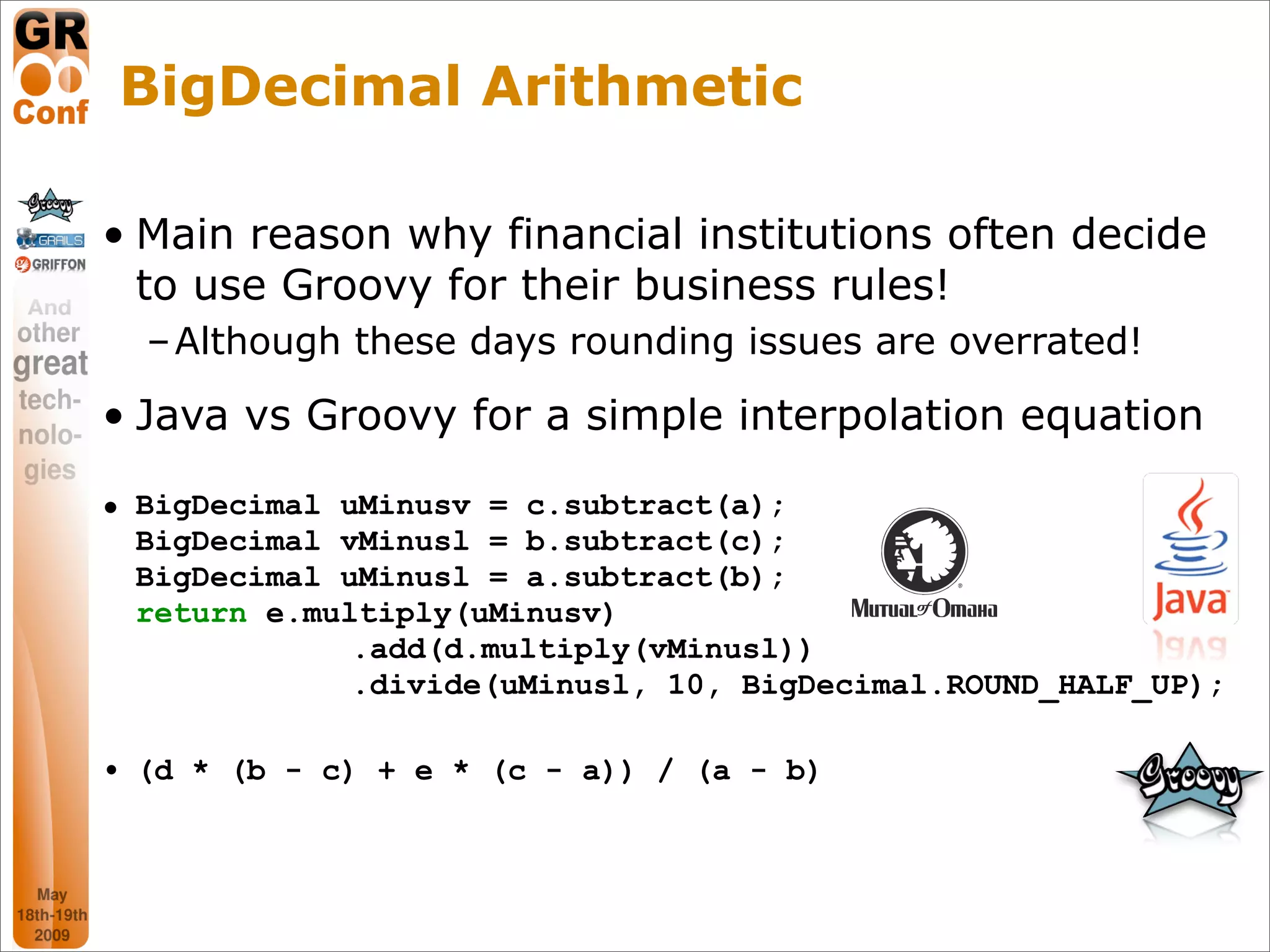
BigDecimal Arithmetic

• Main reason why financial institutions often decide
  to use Groovy for their business rules!
  – Although these days rounding issues are overrated!

• Java vs Groovy for a simple interpolation equation

• BigDecimal uMinusv = c.subtract(a);
  BigDecimal vMinusl = b.subtract(c);
  BigDecimal uMinusl = a.subtract(b);
  return e.multiply(uMinusv)
              .add(d.multiply(vMinusl))
              .divide(uMinusl, 10, BigDecimal.ROUND_HALF_UP);

• (d * (b - c) + e * (c - a)) / (a - b)


                                                      17
Groovy Builders

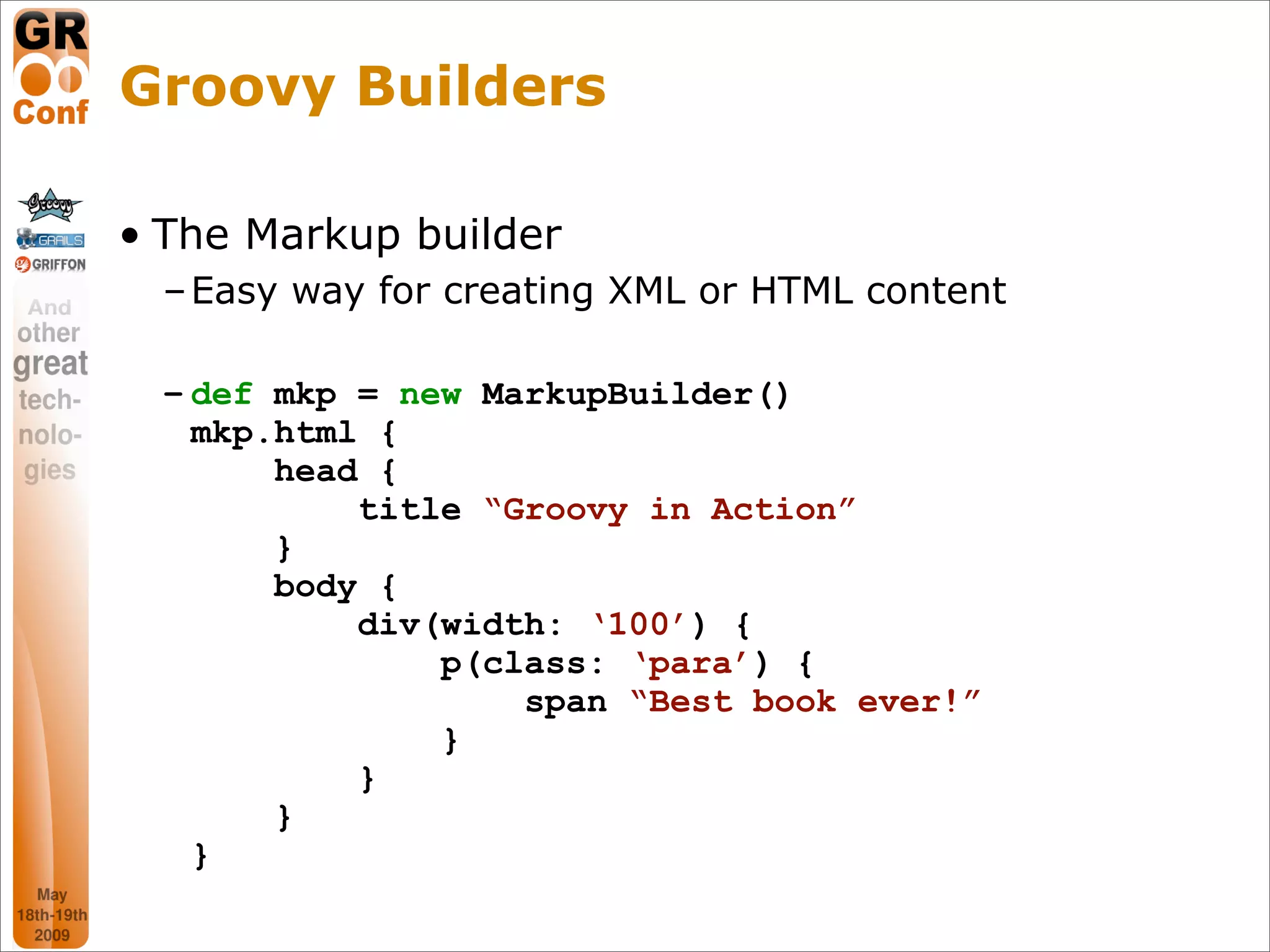
• The Markup builder
  – Easy way for creating XML or HTML content

  – def mkp = new MarkupBuilder()
    mkp.html {
        head {
            title “Groovy in Action”
        }
        body {
            div(width: ‘100’) {
                p(class: ‘para’) {
                    span “Best book ever!”
                }
            }
        }
    }
                                                18
Parsing XML

• And it’s so easy to parser XML and navigate
  through the node graph!

• def geocodingUrl = "http://...".toURL()
  geocodingUrl.withInputStream { stream ->
      def node = new XmlSlurper().parse(stream)
      if (node.Response.Status.code == "200") {
          def text = node.Response.Placemark.
                     Point.coordinates.text()
          def coord = text.tokenize(',').
                      collect{ Float.parseFloat(it) }
          (latitude, longitude) = coord[1..0]
      }
  }


                                                19
nda
Ag e
      >   Groovy Overview
      >   Performance Improvements
      >   Syntax Enhancements
      >   Compile-Time Metaprogramming
      >   The Grape Module System
      >   Swing-Related Improvements
      >   Runtime Metaprogramming
          Additions
      >   JSR-223 Scripting Engine Built-In
      >   JMX Builder
      >   OSGi Readiness
                                    20
Performance Improvements
Both Runtime & Compile-Time

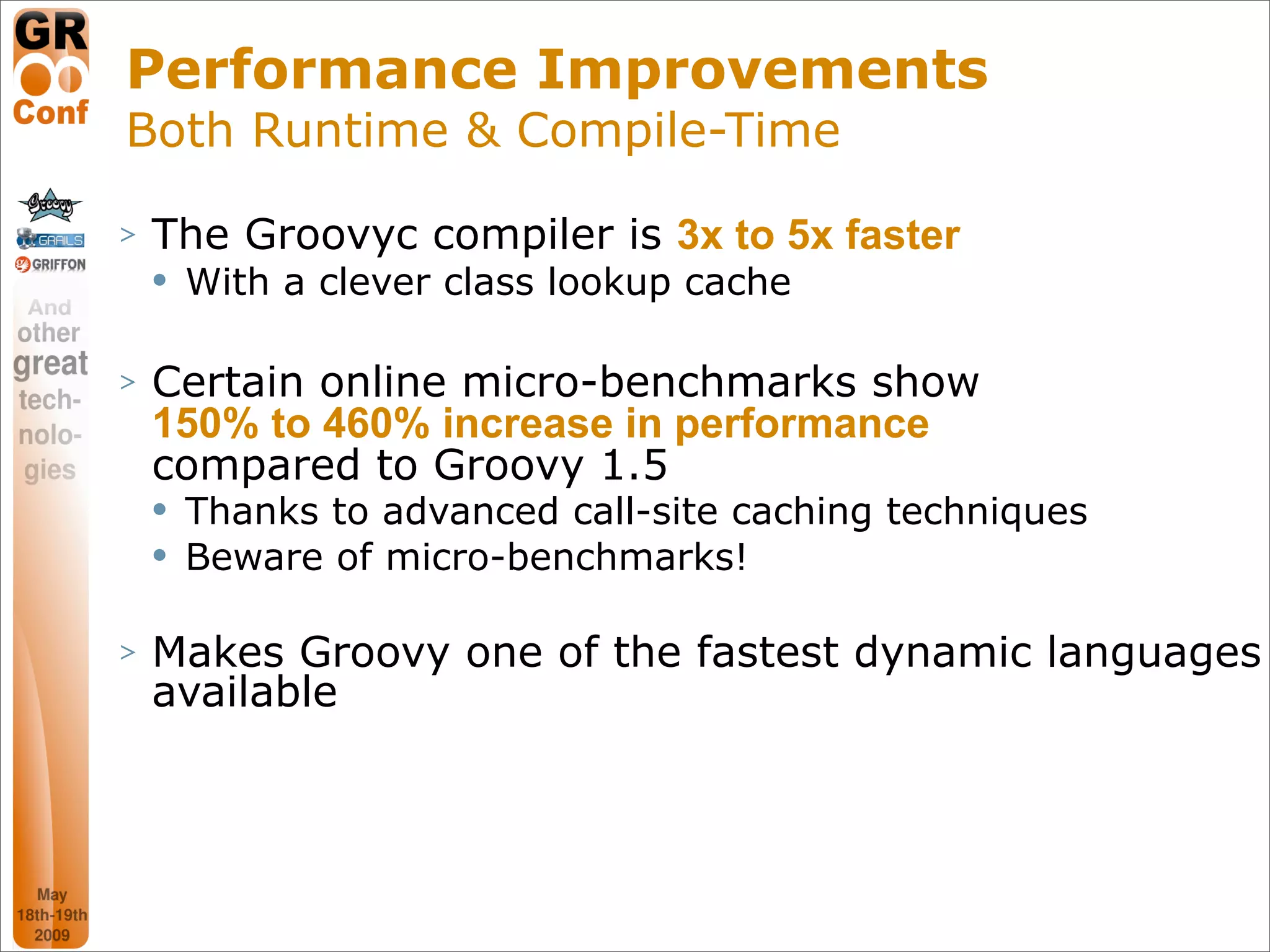
>   The Groovyc compiler is 3x to 5x faster
       With a clever class lookup cache

>   Certain online micro-benchmarks show
    150% to 460% increase in performance
    compared to Groovy 1.5
       Thanks to advanced call-site caching techniques
       Beware of micro-benchmarks!

>   Makes Groovy one of the fastest dynamic languages
    available


                                                          21
nda
Ag e
      >   Groovy Overview
      >   Performance Improvements
      >   Syntax Enhancements
      >   Compile-Time Metaprogramming
      >   The Grape Module System
      >   Swing-Related Improvements
      >   Runtime Metaprogramming
          Additions
      >   JSR-223 Scripting Engine Built-In
      >   JMX Builder
      >   OSGi Readiness
                                    22
Multiple Assignment
Assign Multiple Variables at Once
>   Newly defined variables
       def (a, b) = [1, 2]
        assert a == 1
        assert b == 2

>   Assign to existing variables
       def lat, lng
        (lat, lng) = geocode(‘Paris’)

>   The classical swap case
       (a, b) = [b, a]

>   Extra elements ⇒ not assigned to any variable
>   Less elements ⇒ null into extra variables

                                               23
More Optional Return
    In if/else and try/catch Blocks
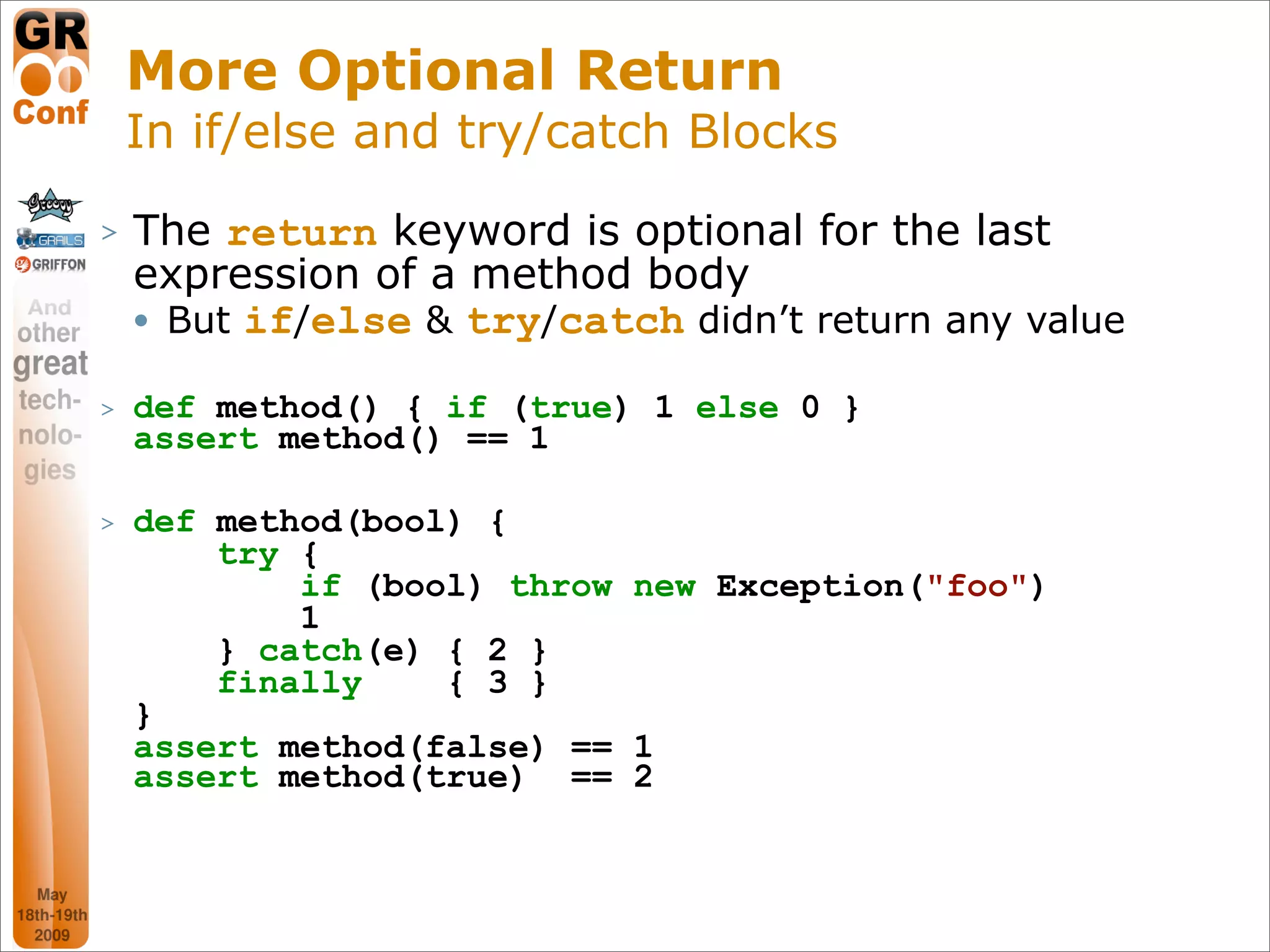
>   The return keyword is optional for the last
    expression of a method body
     But if/else & try/catch didn’t return any value


>   def method() { if (true) 1 else 0 }
    assert method() == 1

>   def method(bool) {
        try {
            if (bool) throw new Exception("foo")
            1
        } catch(e) { 2 }
        finally    { 3 }
    }
    assert method(false) == 1
    assert method(true) == 2


                                                   24
Annotation Definition
The Missing Bit of Java 5 Support


>   Groovy support for Java 5 features is now complete
    with the missing annotation definition

>   Nothing to show here, it’s just normal Java :-)

>   Note that the sole dynamic language supporting
    annotation is… Groovy
       Opens the door to EJB3 / JPA / Spring annotations /
        Guice / TestNG…


                                                       25
nda
Ag e
      >   Groovy Overview
      >   Performance Improvements
      >   Syntax Enhancements
      >   Compile-Time Metaprogramming
      >   The Grape Module System
      >   Swing-Related Improvements
      >   Runtime Metaprogramming
          Additions
      >   JSR-223 Scripting Engine Built-In
      >   JMX Builder
      >   OSGi Readiness
                                    26
Meta-What?
Meta-Programming
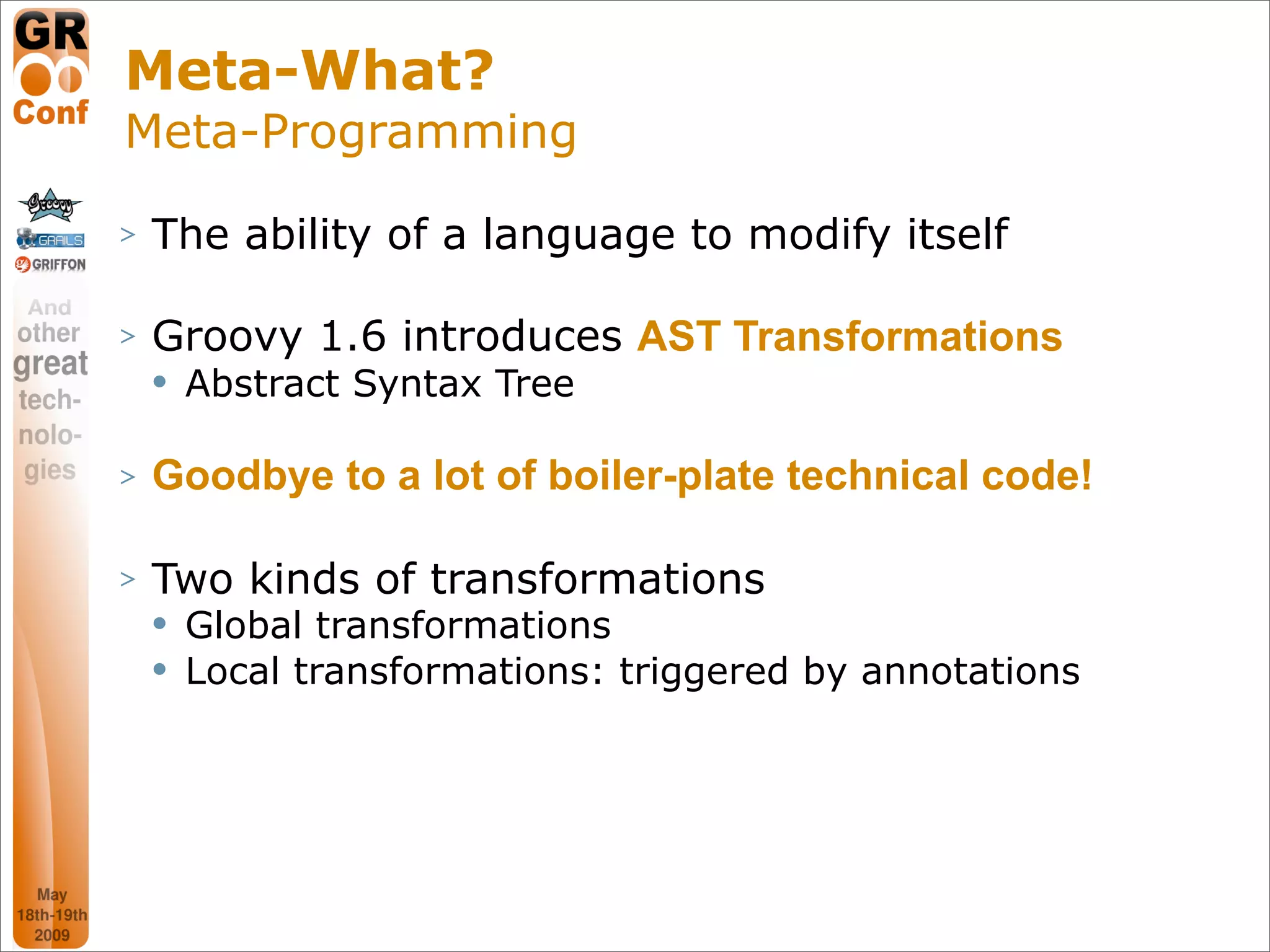
>   The ability of a language to modify itself

>   Groovy 1.6 introduces AST Transformations
       Abstract Syntax Tree

>   Goodbye to a lot of boiler-plate technical code!

>   Two kinds of transformations
       Global transformations
       Local transformations: triggered by annotations


                                                          27
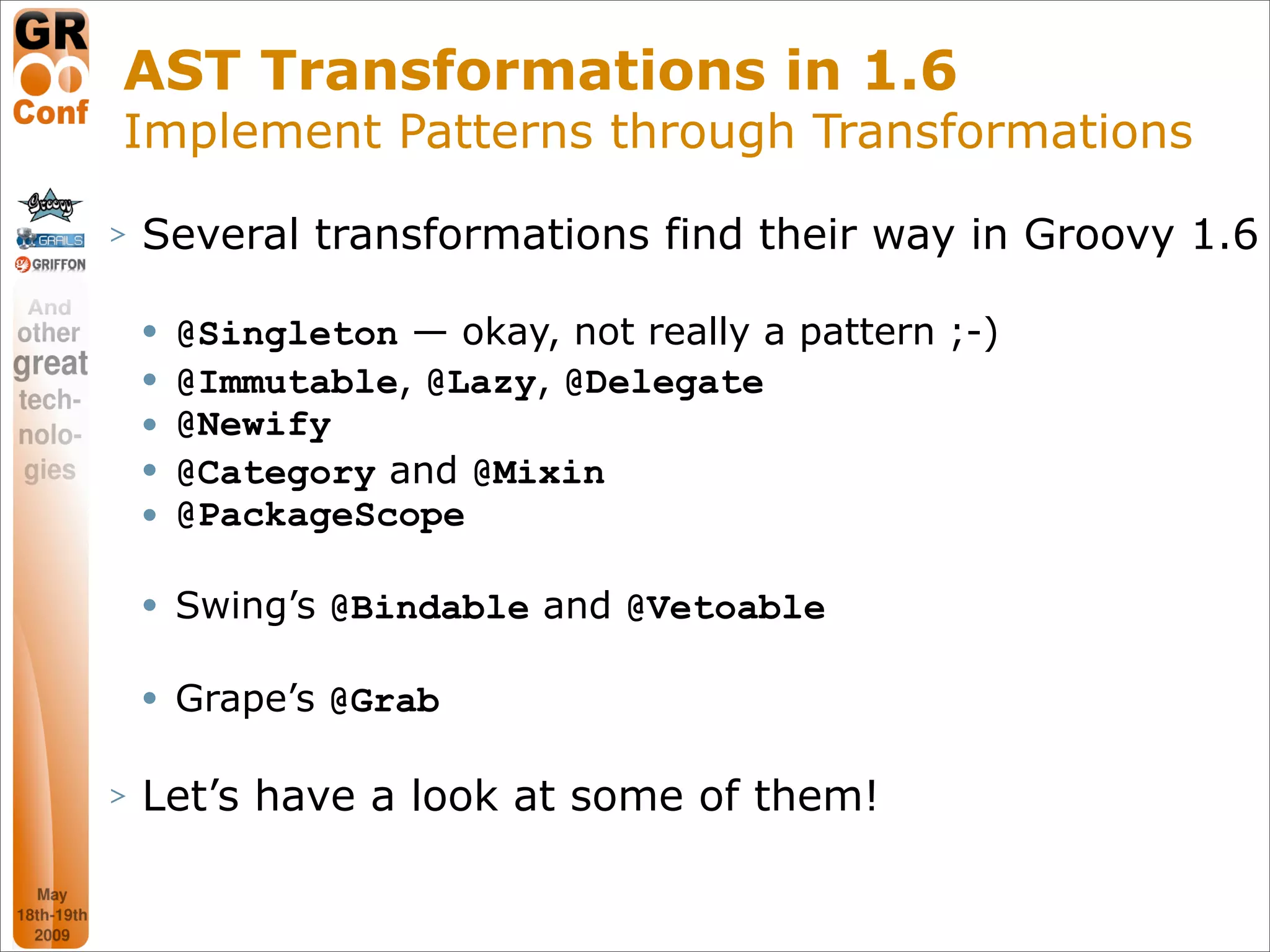
AST Transformations in 1.6
Implement Patterns through Transformations
>   Several transformations find their way in Groovy 1.6

       @Singleton — okay, not really a pattern ;-)
       @Immutable, @Lazy, @Delegate
       @Newify
       @Category and @Mixin
       @PackageScope

       Swing’s @Bindable and @Vetoable

       Grape’s @Grab

>   Let’s have a look at some of them!

                                                      28
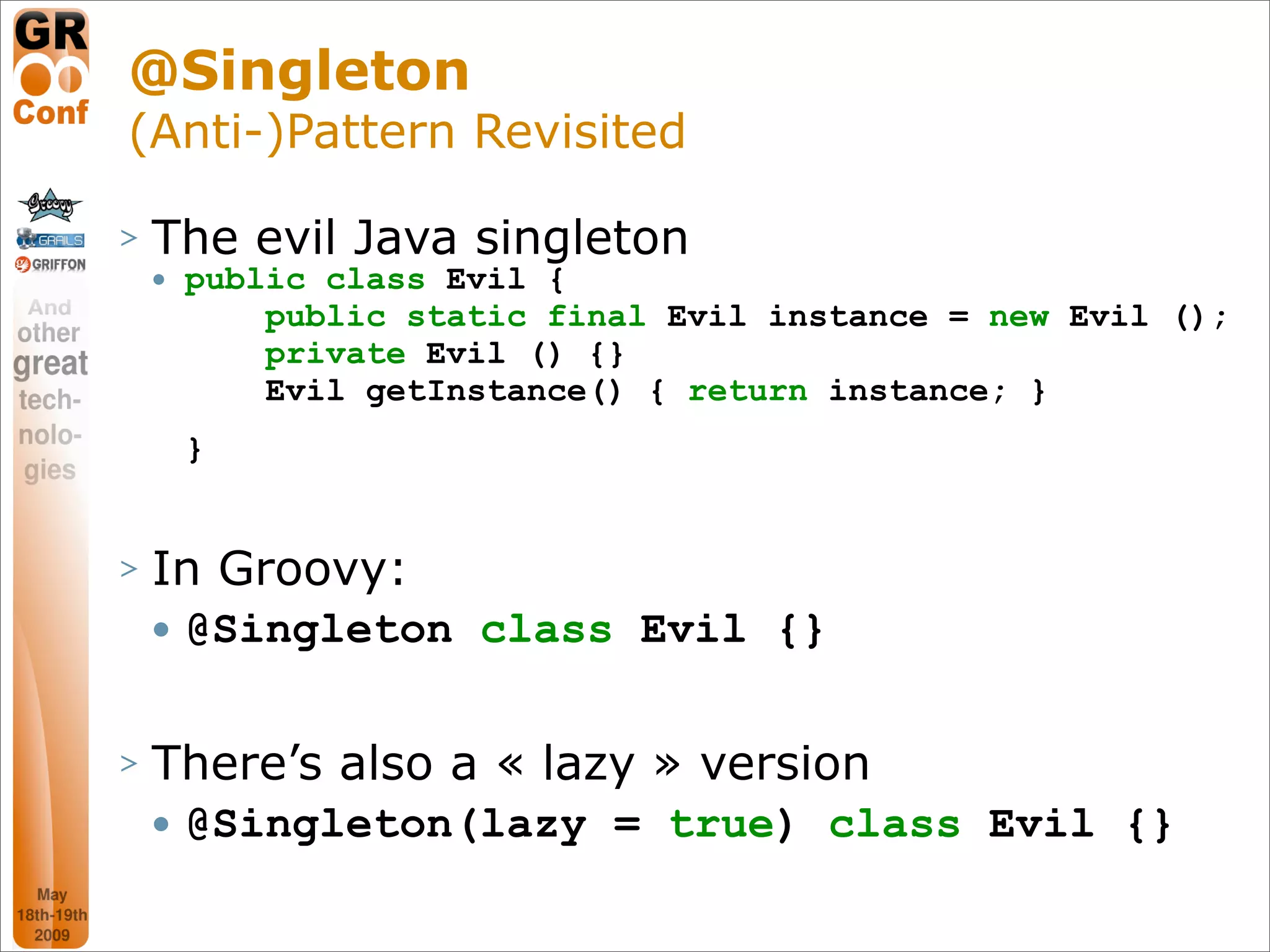
@Singleton
(Anti-)Pattern Revisited

>   The evil Java singleton
       public class Evil {
            public static final Evil instance = new Evil ();
            private Evil () {}
            Evil getInstance() { return instance; }
        }


>   In Groovy:
       @Singleton class Evil {}

>   There’s also a « lazy » version
       @Singleton(lazy = true) class Evil {}

                                                     29
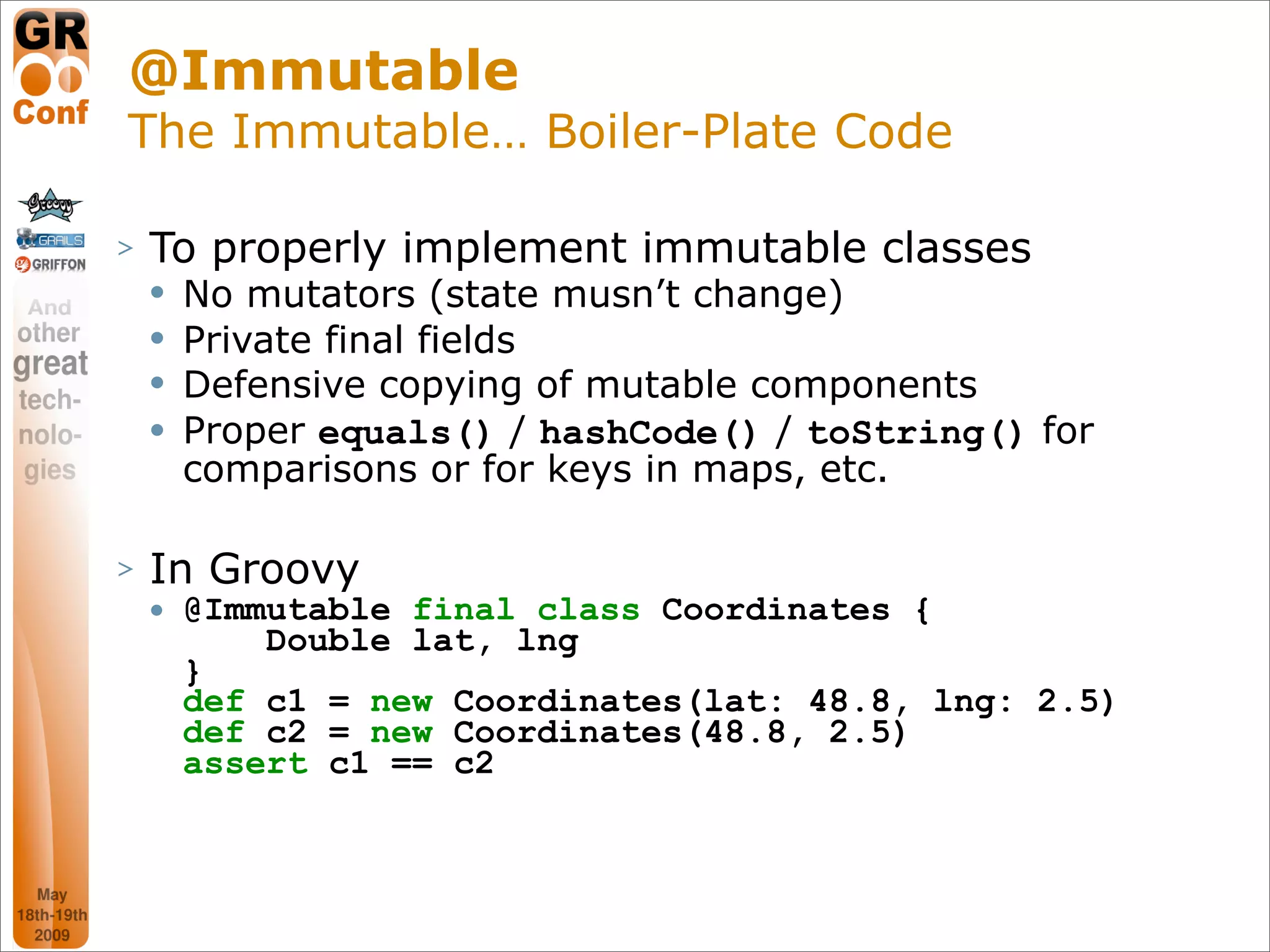
@Immutable
The Immutable… Boiler-Plate Code

>   To properly implement immutable classes
       No mutators (state musn’t change)
       Private final fields
       Defensive copying of mutable components
       Proper equals() / hashCode() / toString() for
        comparisons or for keys in maps, etc.

>   In Groovy
       @Immutable final class Coordinates {
            Double lat, lng
        }
        def c1 = new Coordinates(lat: 48.8, lng: 2.5)
        def c2 = new Coordinates(48.8, 2.5)
        assert c1 == c2


                                                        30
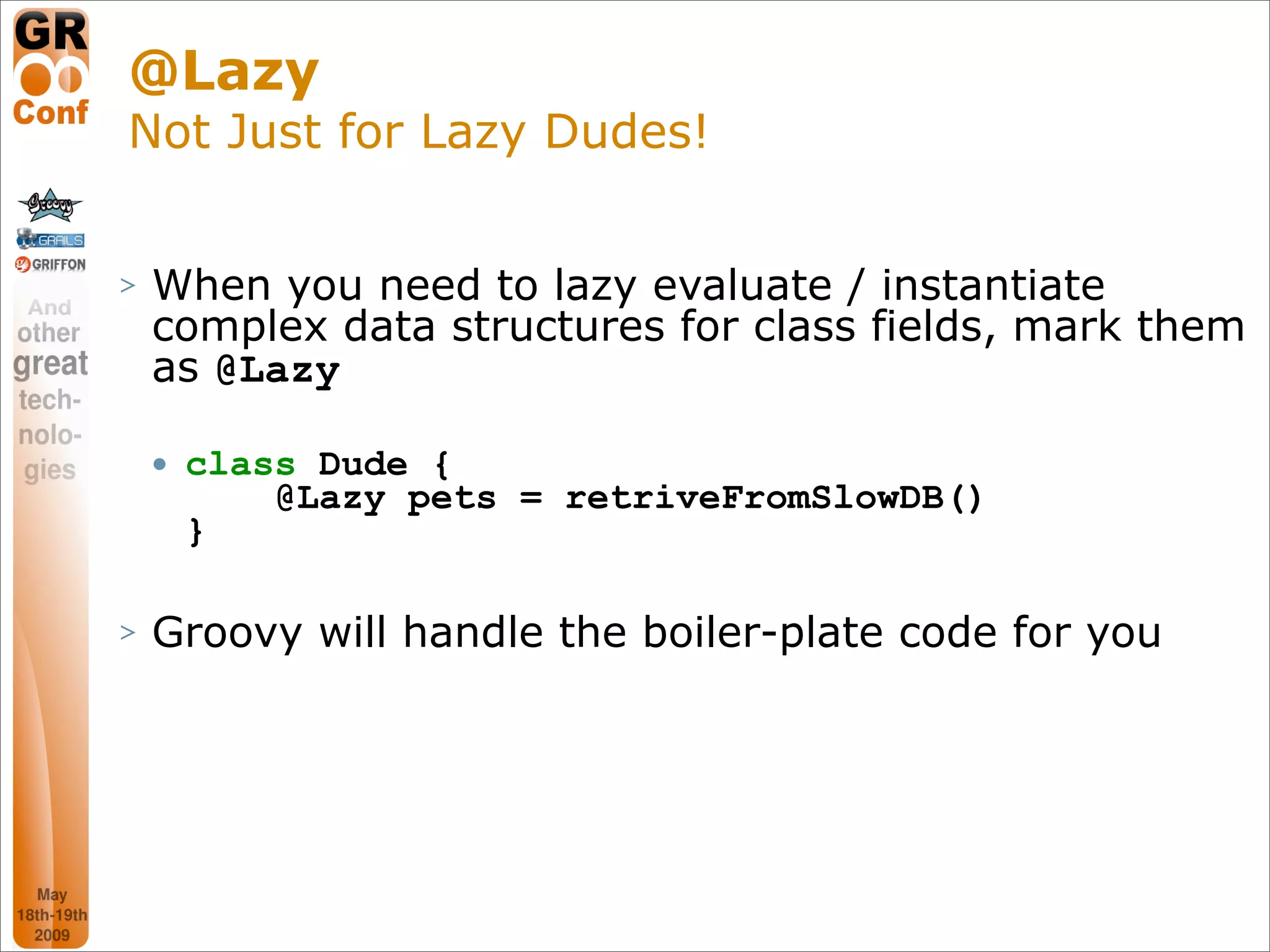
@Lazy
Not Just for Lazy Dudes!


>   When you need to lazy evaluate / instantiate
    complex data structures for class fields, mark them
    as @Lazy

       class Dude {
            @Lazy pets = retriveFromSlowDB()
        }

>   Groovy will handle the boiler-plate code for you


                                                 31
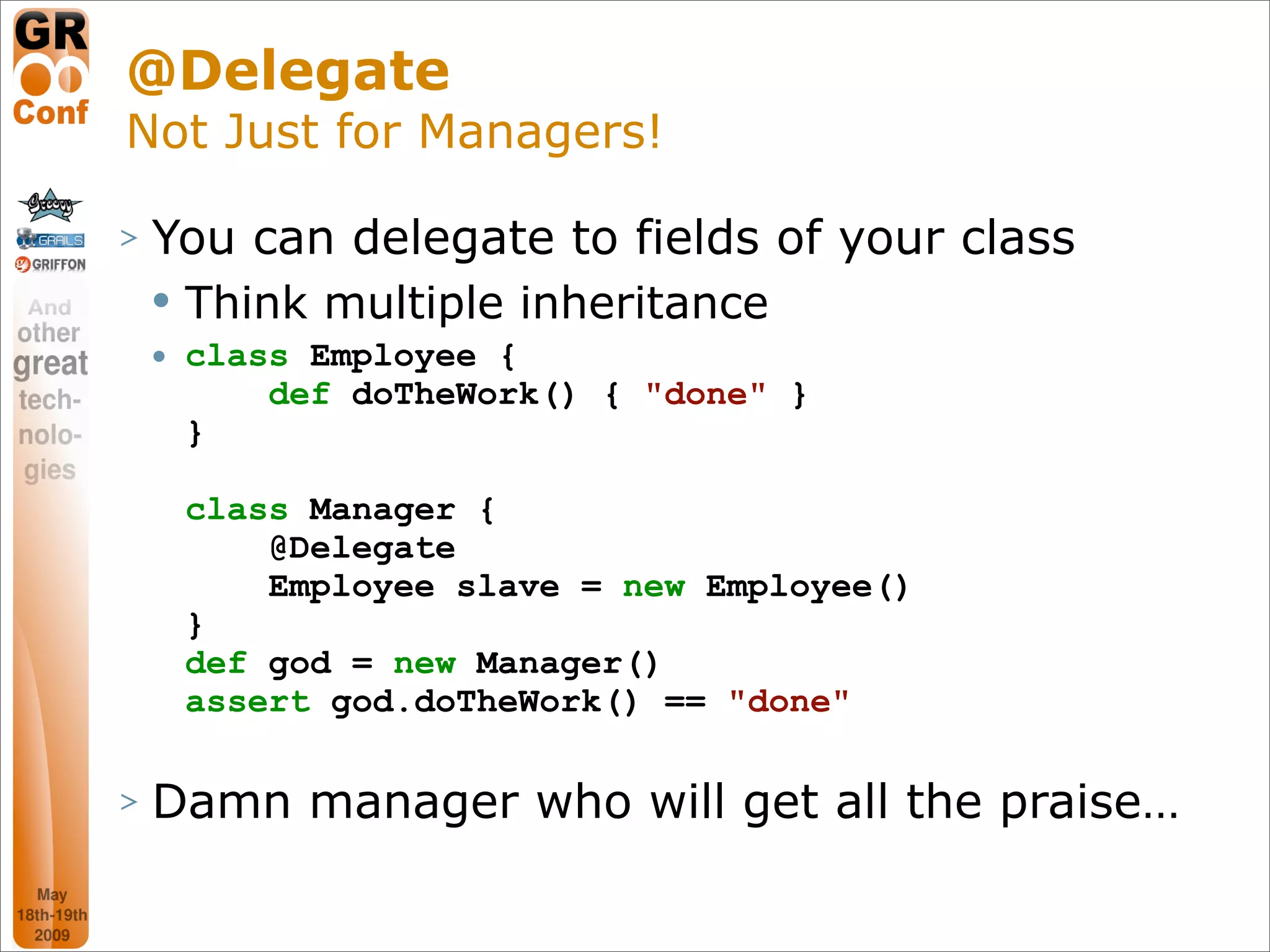
@Delegate
Not Just for Managers!

>   You can delegate to fields of your class
       Think multiple inheritance
       class Employee {
            def doTheWork() { "done" }
        }

        class Manager {
            @Delegate
            Employee slave = new Employee()
        }
        def god = new Manager()
        assert god.doTheWork() == "done"

>   Damn manager who will get all the praise…

                                               32
nda
Ag e
      >   Groovy Overview
      >   Performance Improvements
      >   Syntax Enhancements
      >   Compile-Time Metaprogramming
      >   The Grape Module System
      >   Swing-Related Improvements
      >   Runtime Metaprogramming
          Additions
      >   JSR-223 Scripting Engine Built-In
      >   JMX Builder
      >   OSGi Readiness
                                    33
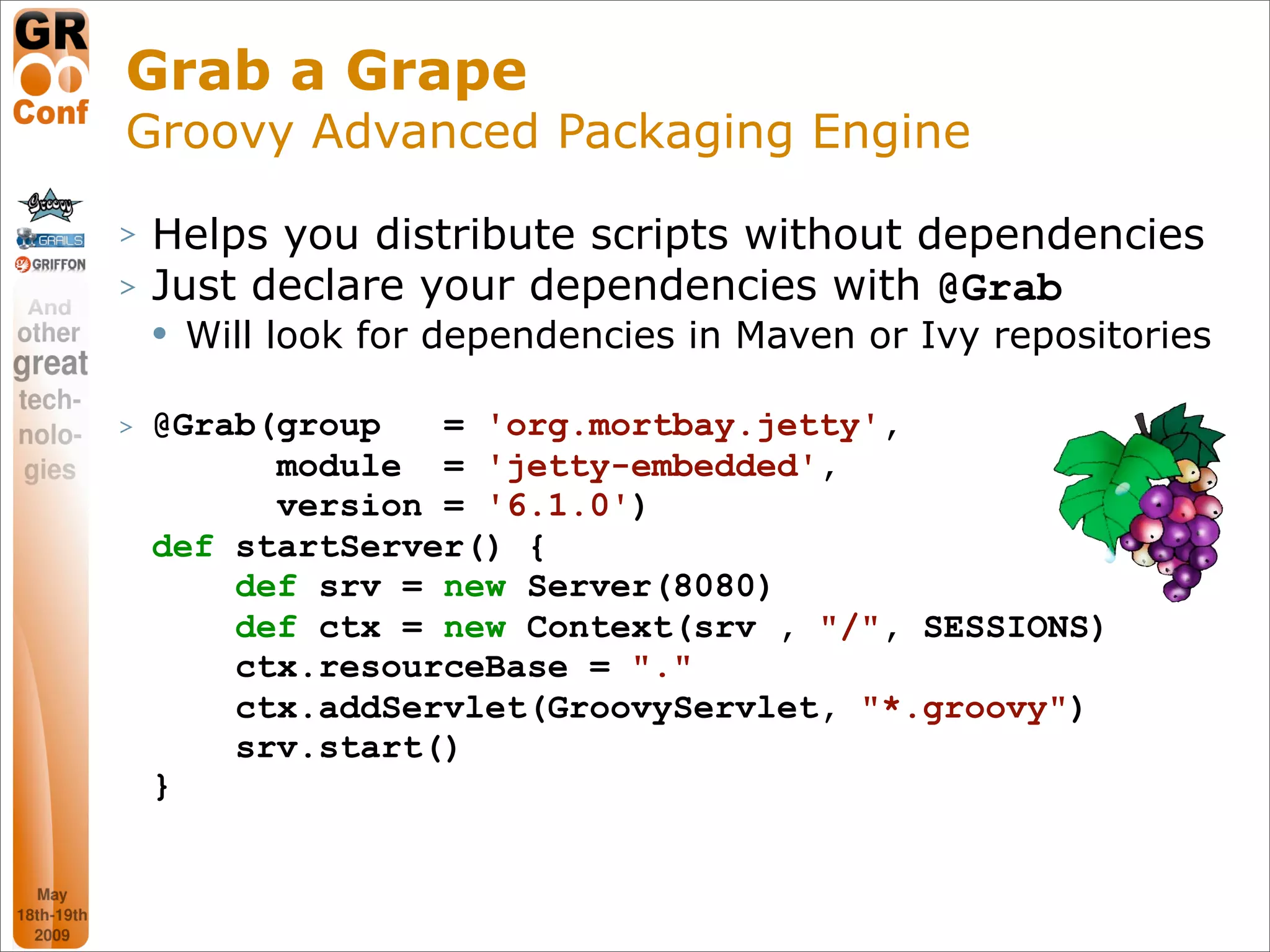
Grab a Grape
Groovy Advanced Packaging Engine
>   Helps you distribute scripts without dependencies
>   Just declare your dependencies with @Grab
       Will look for dependencies in Maven or Ivy repositories

>   @Grab(group   = 'org.mortbay.jetty',
          module = 'jetty-embedded',
          version = '6.1.0')
    def startServer() {
        def srv = new Server(8080)
        def ctx = new Context(srv , "/", SESSIONS)
        ctx.resourceBase = "."
        ctx.addServlet(GroovyServlet, "*.groovy")
        srv.start()
    }


                                                        34
nda
Ag e
      >   Groovy Overview
      >   Performance Improvements
      >   Syntax Enhancements
      >   Compile-Time Metaprogramming
      >   The Grape Module System
      >   Swing-Related Improvements
      >   Runtime Metaprogramming
          Additions
      >   JSR-223 Scripting Engine Built-In
      >   JMX Builder
      >   OSGi Readiness
                                    35
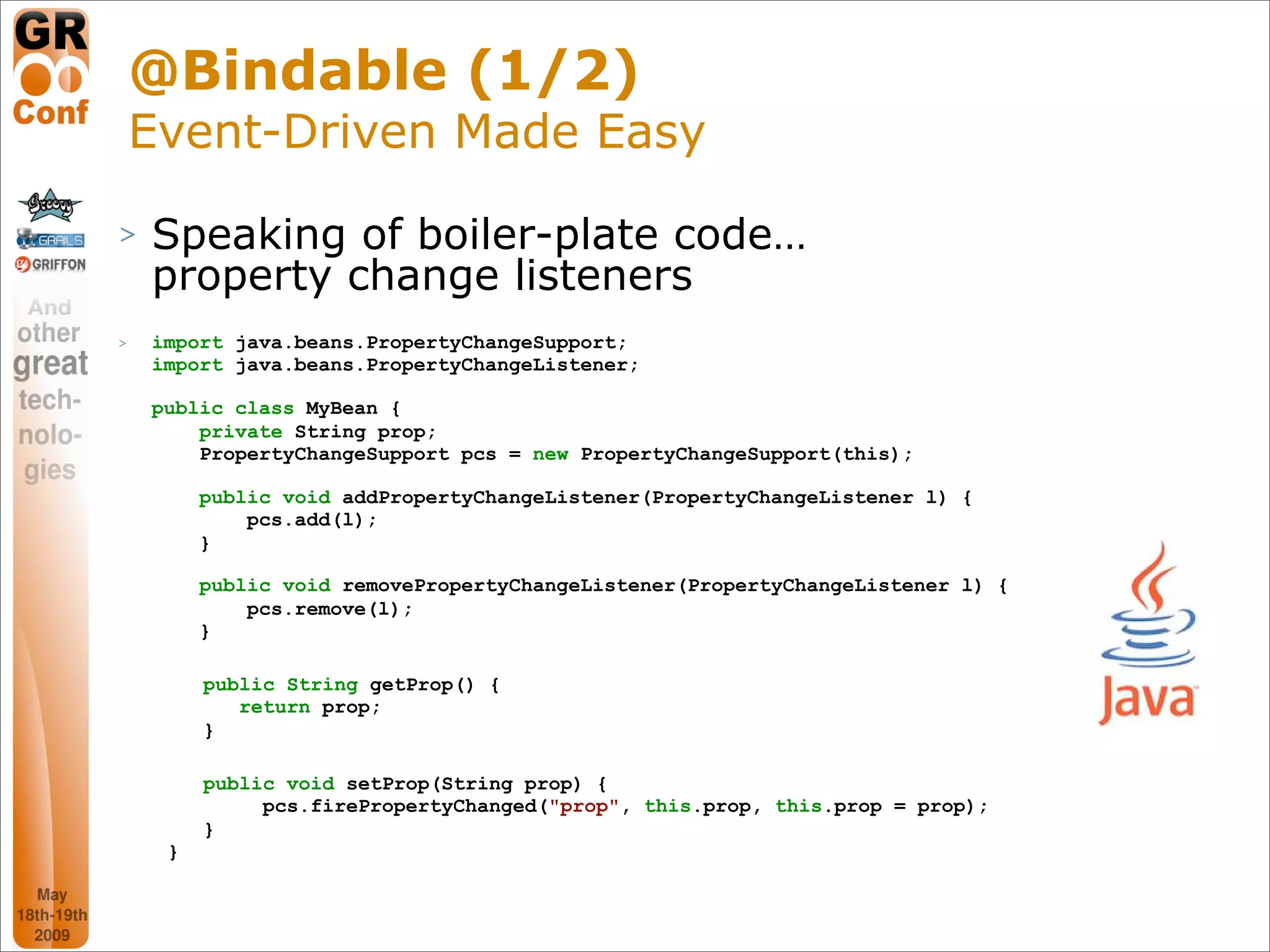
@Bindable (1/2)
    Event-Driven Made Easy
>   Speaking of boiler-plate code…
    property change listeners
>   import java.beans.PropertyChangeSupport;
    import java.beans.PropertyChangeListener;

    public class MyBean {
        private String prop;
        PropertyChangeSupport pcs = new PropertyChangeSupport(this);

         public void addPropertyChangeListener(PropertyChangeListener l) {
             pcs.add(l);
         }

         public void removePropertyChangeListener(PropertyChangeListener l) {
             pcs.remove(l);
         }

         public String getProp() {
            return prop;
         }

         public void setProp(String prop) {
              pcs.firePropertyChanged("prop", this.prop, this.prop = prop);
         }
     }


                                                                                36
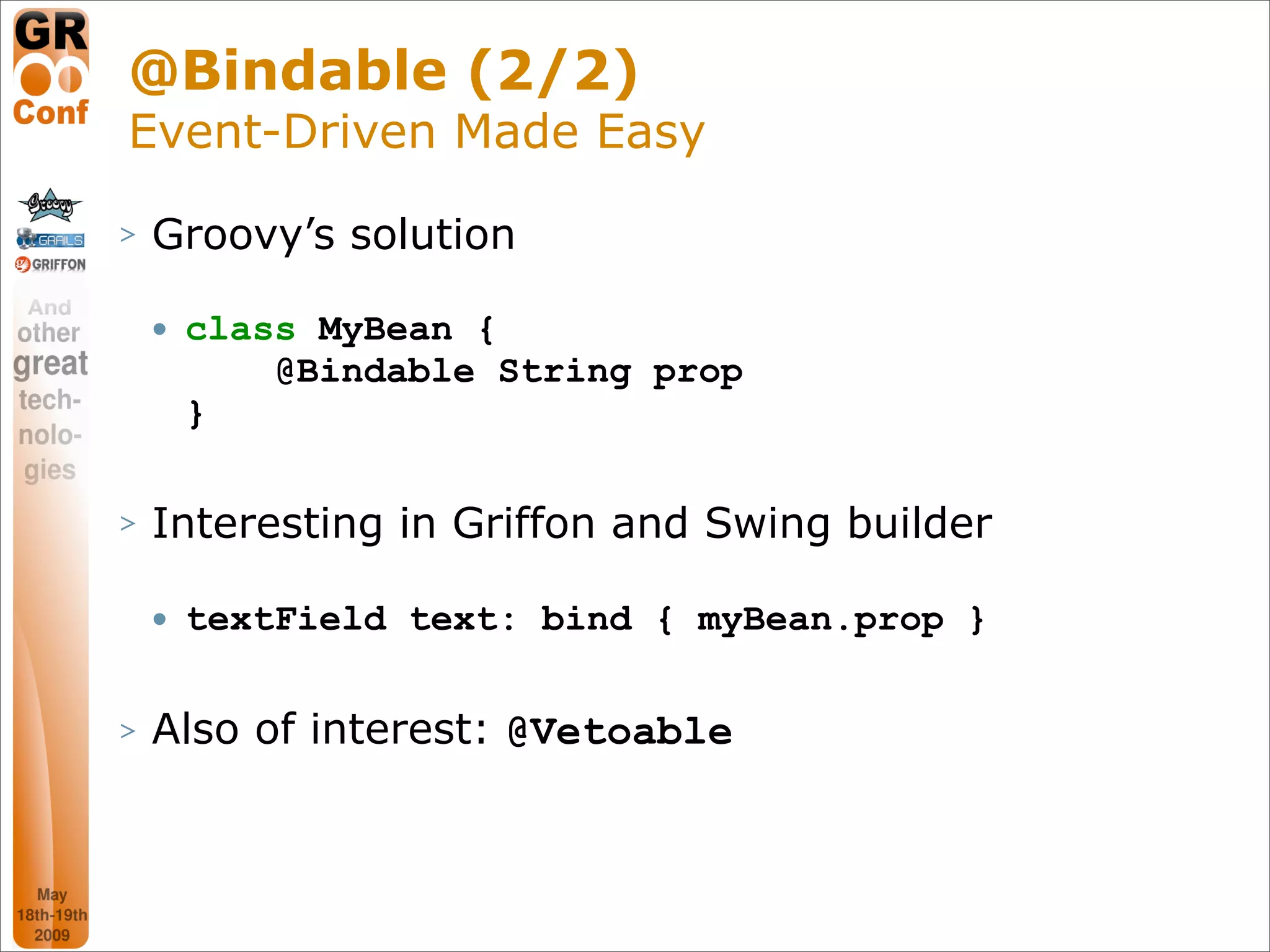
@Bindable (2/2)
Event-Driven Made Easy
>   Groovy’s solution

       class MyBean {
            @Bindable String prop
        }

>   Interesting in Griffon and Swing builder

       textField text: bind { myBean.prop }

>   Also of interest: @Vetoable


                                               37
Griffon
The Swing MVC Framework


>   Leverages Groovy’s SwingBuilder
    and Grails’ infrastructure
       http://griffon.codehaus.org


                                      38
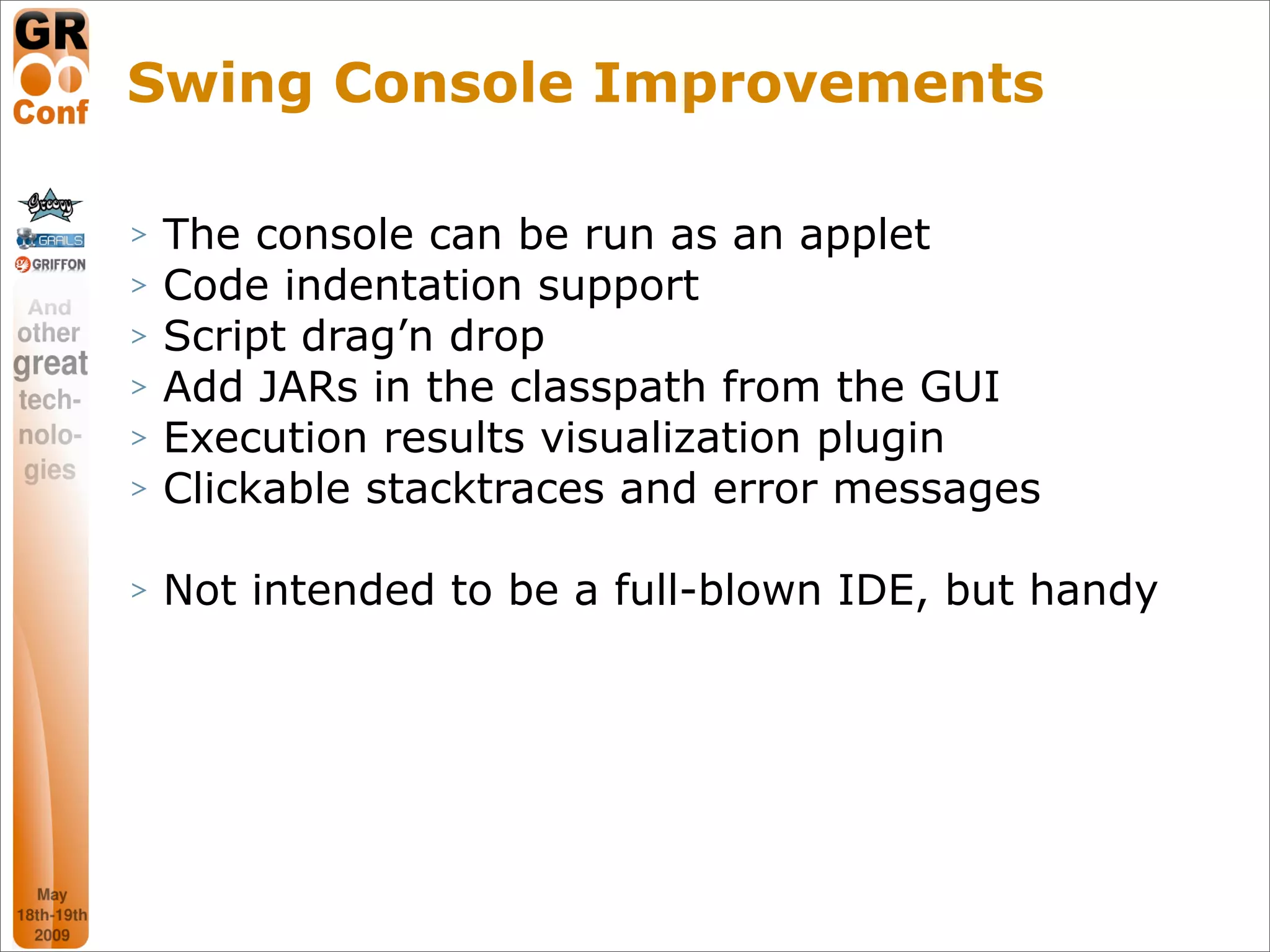
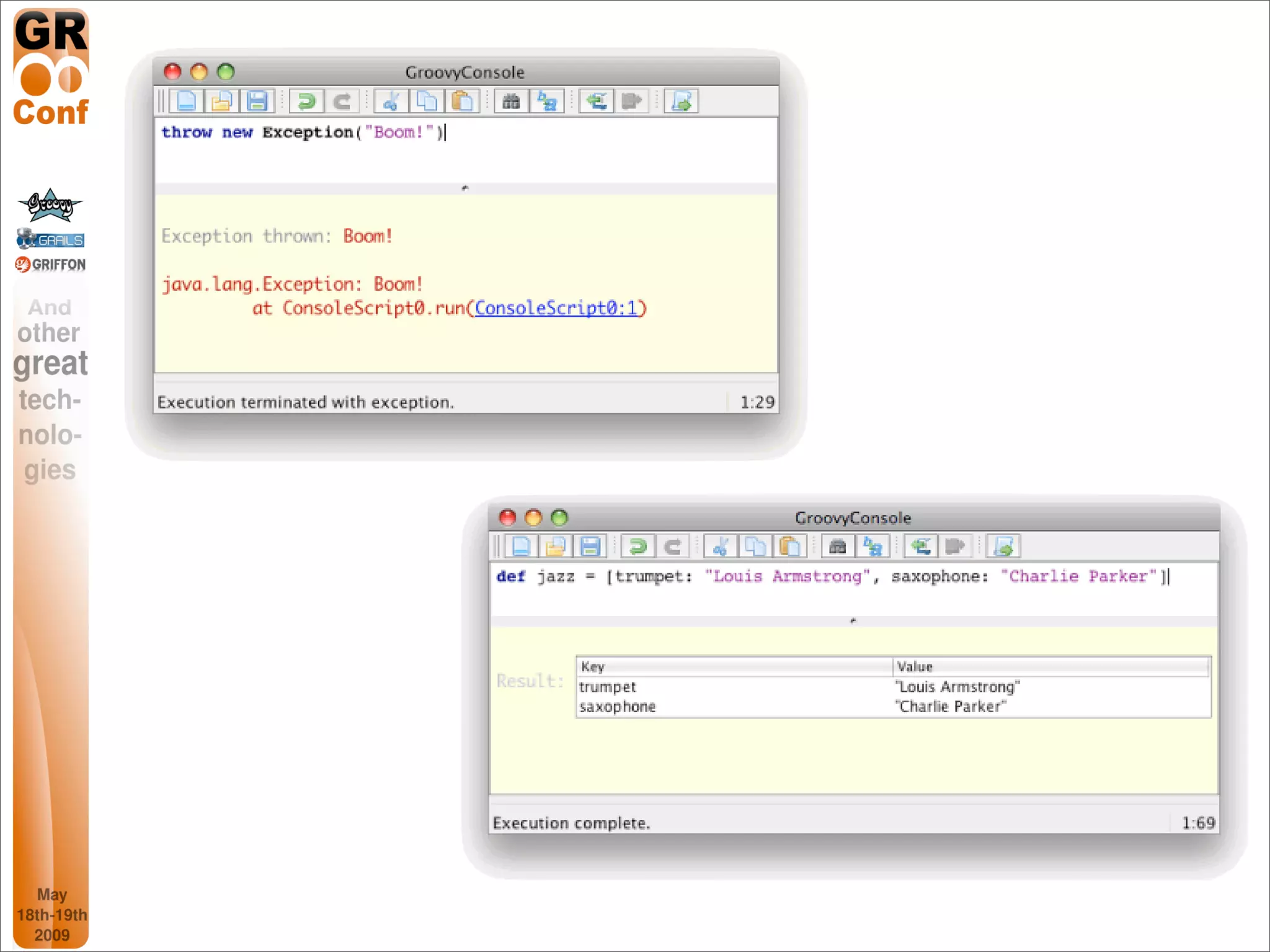
Swing Console Improvements

>   The console can be run as an applet
>   Code indentation support
>   Script drag’n drop
>   Add JARs in the classpath from the GUI
>   Execution results visualization plugin
>   Clickable stacktraces and error messages

>   Not intended to be a full-blown IDE, but handy


                                               39
40
nda
Ag e
      >   Groovy Overview
      >   Performance Improvements
      >   Syntax Enhancements
      >   Compile-Time Metaprogramming
      >   The Grape Module System
      >   Swing-Related Improvements
      >   Runtime Metaprogramming Additions
      >   JSR-223 Scripting Engine Built-In
      >   JMX Builder
      >   OSGi Readiness


                                      41
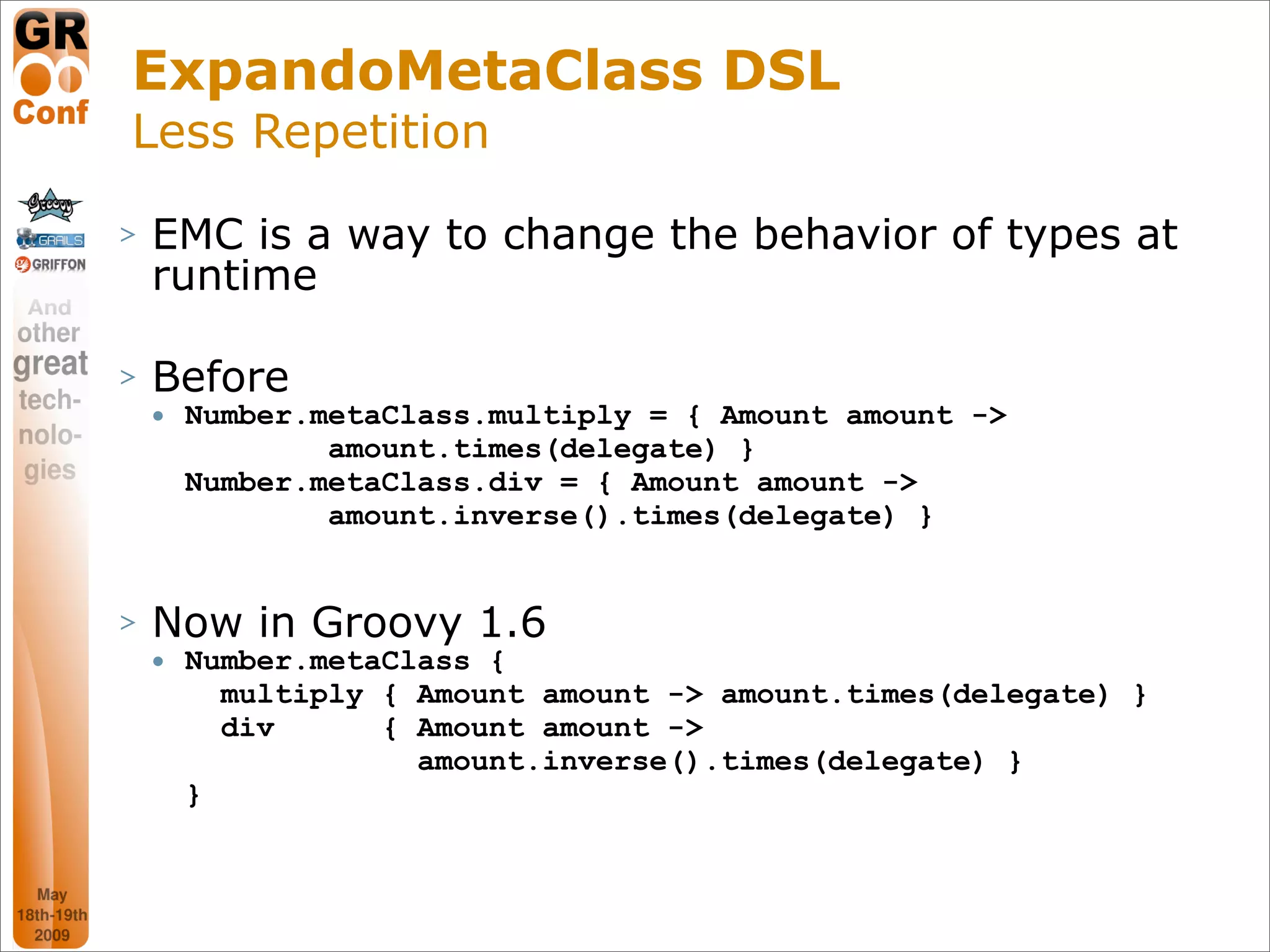
ExpandoMetaClass DSL
Less Repetition
>   EMC is a way to change the behavior of types at
    runtime

>   Before
       Number.metaClass.multiply = { Amount amount ->
                amount.times(delegate) }
        Number.metaClass.div = { Amount amount ->
                amount.inverse().times(delegate) }


>   Now in Groovy 1.6
       Number.metaClass {
          multiply { Amount amount -> amount.times(delegate) }
          div      { Amount amount ->
                     amount.inverse().times(delegate) }
        }


                                                           42
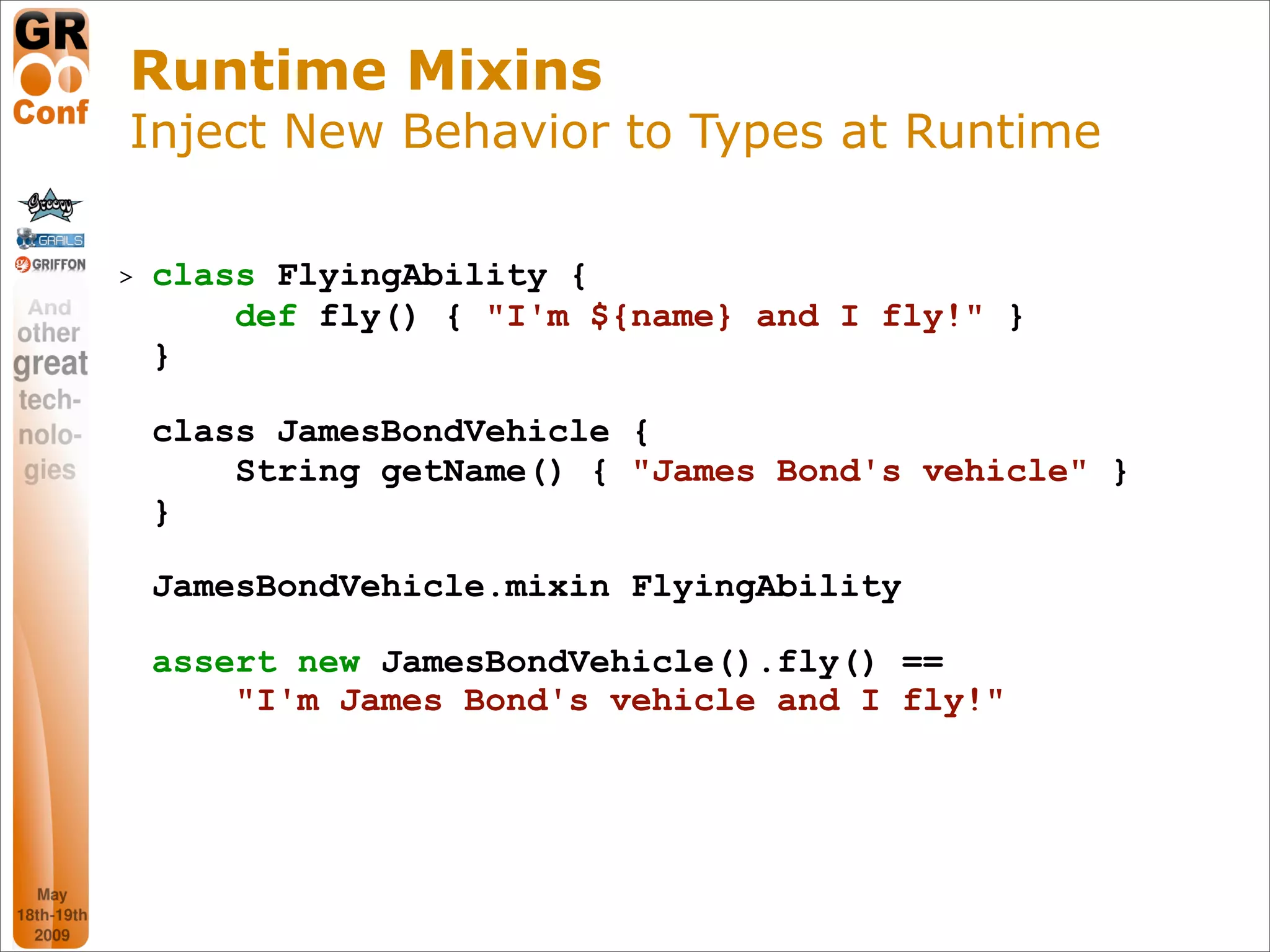
Runtime Mixins
Inject New Behavior to Types at Runtime

>   class FlyingAbility {
        def fly() { "I'm ${name} and I fly!" }
    }

    class JamesBondVehicle {
        String getName() { "James Bond's vehicle" }
    }

    JamesBondVehicle.mixin FlyingAbility

    assert new JamesBondVehicle().fly() ==
        "I'm James Bond's vehicle and I fly!"


                                                 43
nda
Ag e
      >   Groovy Overview
      >   Performance Improvements
      >   Syntax Enhancements
      >   Compile-Time Metaprogramming
      >   The Grape Module System
      >   Swing-Related Improvements
      >   Runtime Metaprogramming
          Additions
      >   JSR-223 Scripting Engine Built-In
      >   JMX Builder
      >   OSGi Readiness
                                     44
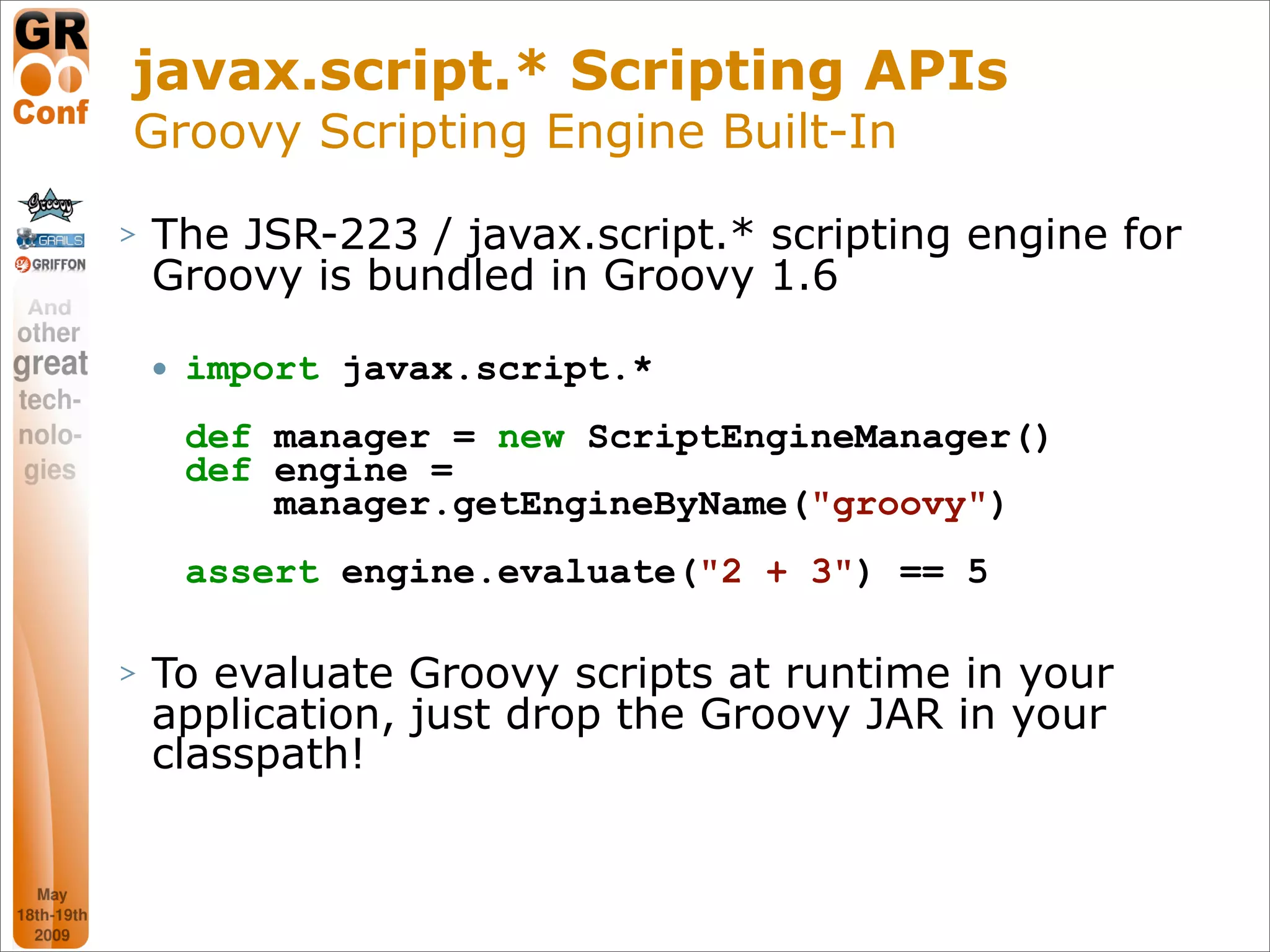
javax.script.* Scripting APIs
Groovy Scripting Engine Built-In
>   The JSR-223 / javax.script.* scripting engine for
    Groovy is bundled in Groovy 1.6

       import javax.script.*
        def manager = new ScriptEngineManager()
        def engine =
            manager.getEngineByName("groovy")
        assert engine.evaluate("2 + 3") == 5

>   To evaluate Groovy scripts at runtime in your
    application, just drop the Groovy JAR in your
    classpath!


                                                  45
nda
Ag e
      >   Groovy Overview
      >   Performance Improvements
      >   Syntax Enhancements
      >   Compile-Time Metaprogramming
      >   The Grape Module System
      >   Swing-Related Improvements
      >   Runtime Metaprogramming
          Additions
      >   JSR-223 Scripting Engine Built-In
      >   JMX Builder
      >   OSGi Readiness
                                    46
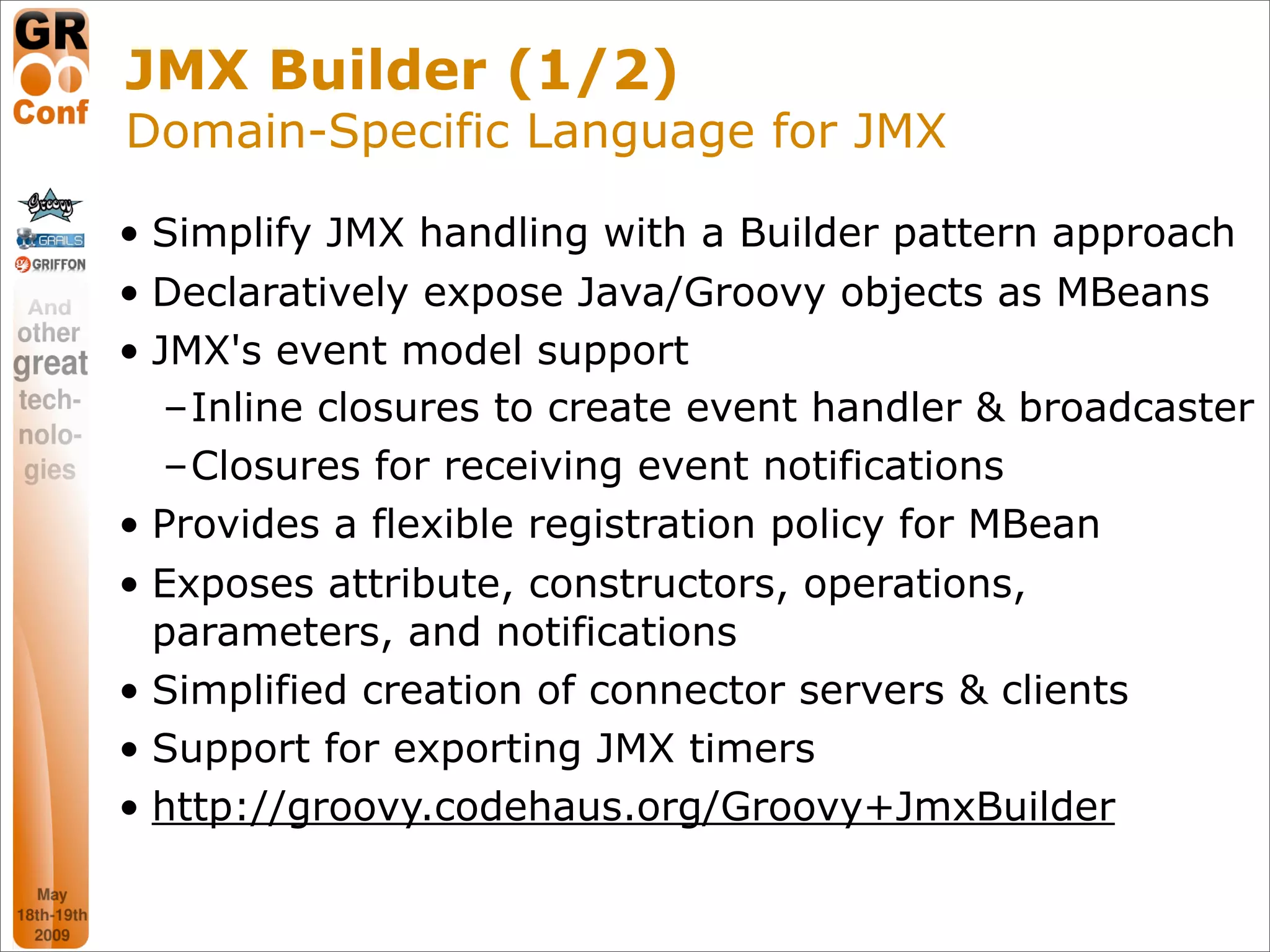
JMX Builder (1/2)
Domain-Specific Language for JMX

• Simplify JMX handling with a Builder pattern approach
• Declaratively expose Java/Groovy objects as MBeans
• JMX's event model support
   –Inline closures to create event handler & broadcaster
   –Closures for receiving event notifications
• Provides a flexible registration policy for MBean
• Exposes attribute, constructors, operations,
  parameters, and notifications
• Simplified creation of connector servers & clients
• Support for exporting JMX timers
• http://groovy.codehaus.org/Groovy+JmxBuilder

                                                 47
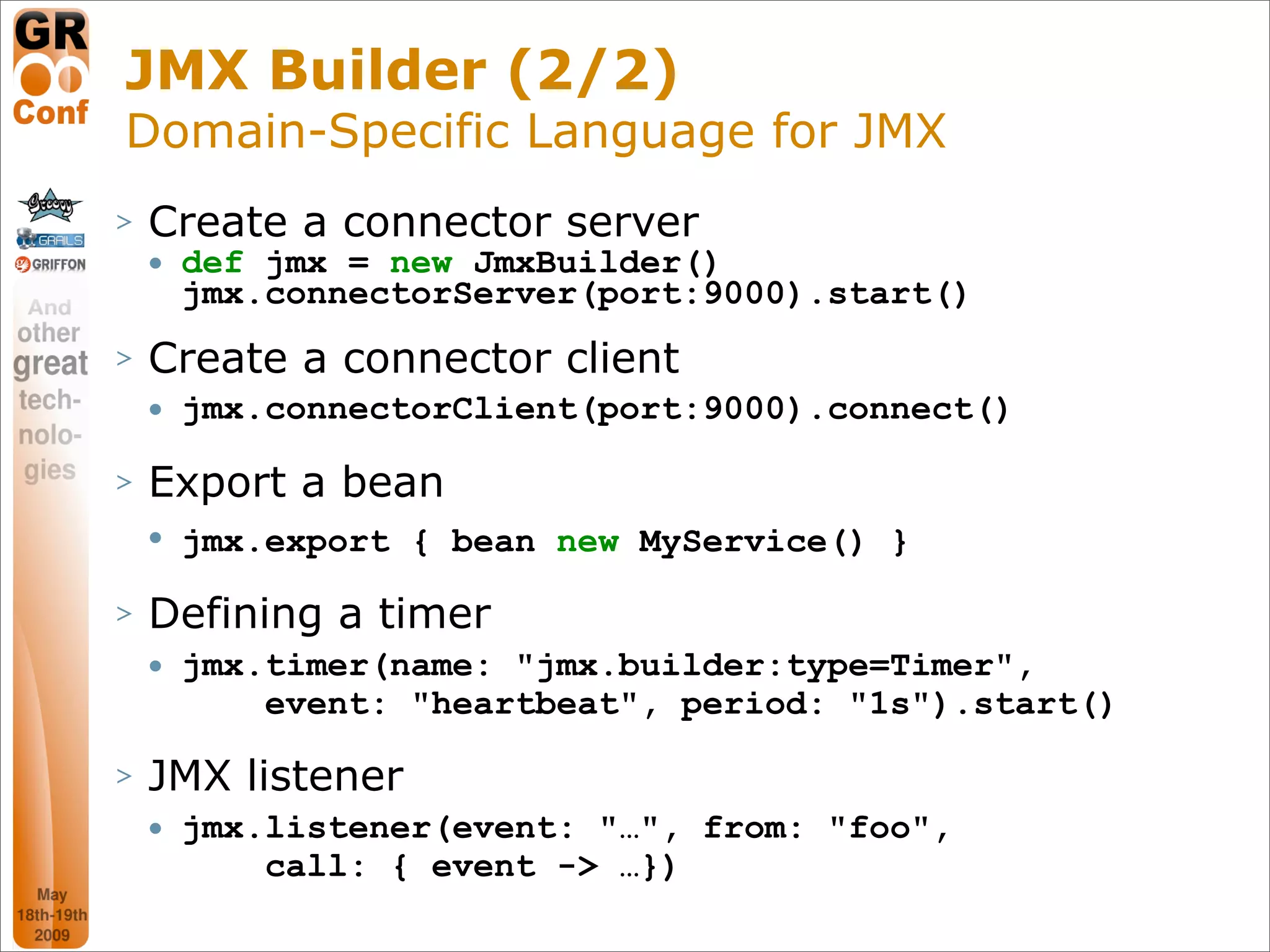
JMX Builder (2/2)
Domain-Specific Language for JMX
>   Create a connector server
       def jmx = new JmxBuilder()
        jmx.connectorServer(port:9000).start()
>   Create a connector client
       jmx.connectorClient(port:9000).connect()

>   Export a bean
       jmx.export { bean new MyService() }

>   Defining a timer
       jmx.timer(name: "jmx.builder:type=Timer",
            event: "heartbeat", period: "1s").start()

>   JMX listener
       jmx.listener(event: "…", from: "foo",
            call: { event -> …})
                                                    48
nda
Ag e
      >   Groovy Overview
      >   Performance Improvements
      >   Syntax Enhancements
      >   Compile-Time Metaprogramming
      >   The Grape Module System
      >   Swing-Related Improvements
      >   Runtime Metaprogramming
          Additions
      >   JSR-223 Scripting Engine Built-In
      >   JMX Builder
      >   OSGi Readiness
                                    49
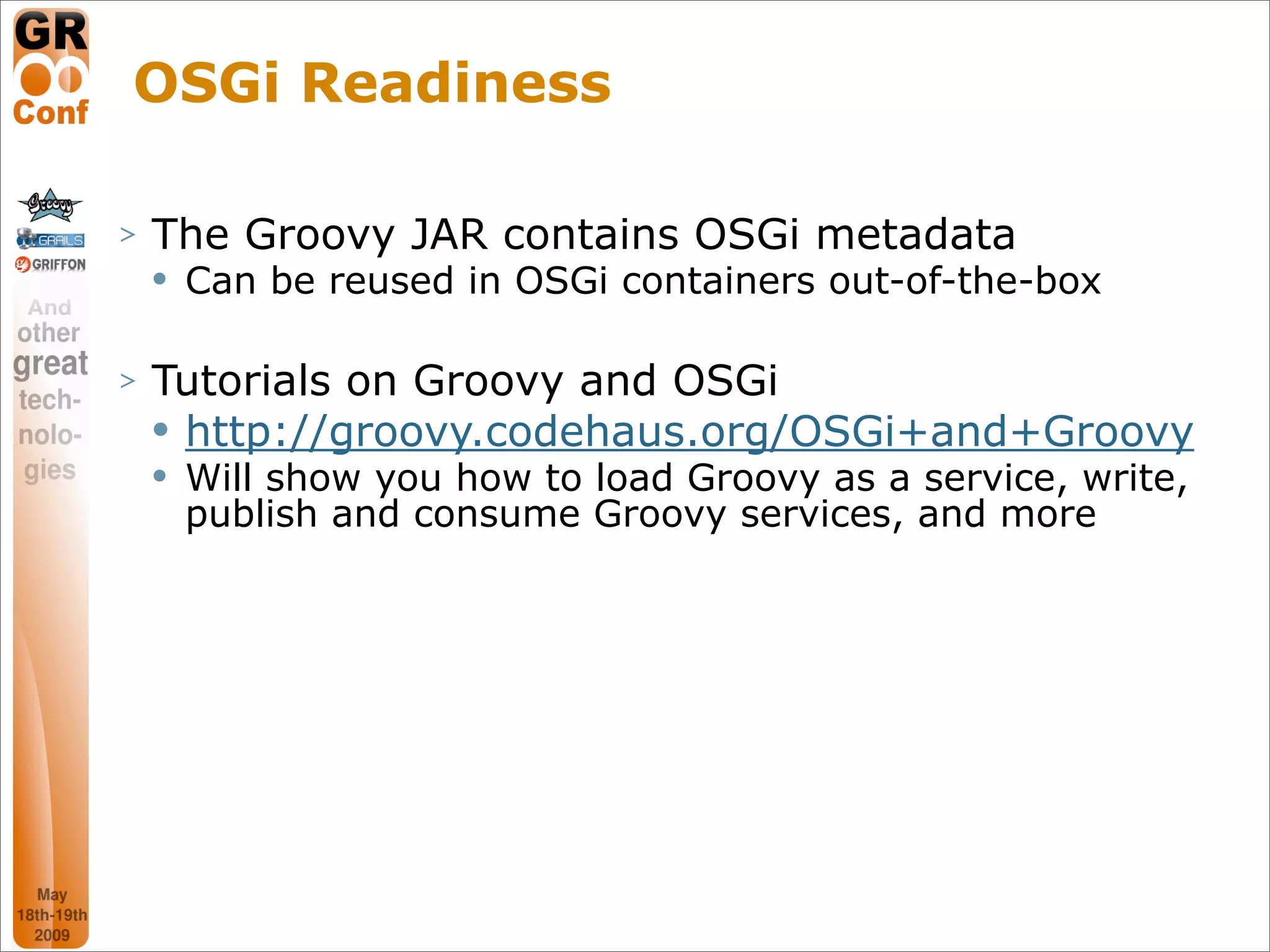
OSGi Readiness

>   The Groovy JAR contains OSGi metadata
       Can be reused in OSGi containers out-of-the-box

>   Tutorials on Groovy and OSGi
     http://groovy.codehaus.org/OSGi+and+Groovy
       Will show you how to load Groovy as a service, write,
        publish and consume Groovy services, and more


                                                        50
Summary
Summary
Just Remember that Groovy Rocks! :-)
>   Any Java developer is a Groovy developer!
>   Great for your next-generation general purpose
    programming language, as well as for admin tasks,
    extending apps, writing DSLs...

>   Groovy 1.6 provides
       Important performance gains
       Efficient compile-time metaprogramming hooks
       New useful features (JMX, javax.script.*, etc.)
       A script dependencies system
       Various Swing-related improvements
       Several runtime metaprogramming additions

>   Get it now!
       http://groovy.codehaus.org/Download
                                                          52
Questions & Answers

GR8Conf 2009: What's New in Groovy 1.6? by Guillaume Laforge

  • 2.
    What’s new inGroovy 1.6? Get started with Groovy and learn about all the novelties in the latest release Guillaume Laforge Head of Groovy Development
  • 3.
    Guillaume Laforge Groovy ProjectManager — SpringSource > Working on Groovy since 2003 > JSR-241 Spec Lead > Initiator of the Grails web framework > Co-author of Groovy in Action > Speaker: JavaOne, QCon, JavaPolis/Devoxx, JavaZone, Sun Tech Days, SpringOne/The Spring Experience, JAX, DSL DevCon, and more… 3
  • 4.
    What’s new inGroovy 1.6? Article Published by InfoQ > This presentation was prepared with the examples I’ve used in my article written for InfoQ > http://www.infoq.com/articles/groovy-1-6 > Read this article for more detailed explanations of all the new features in Groovy 1.6 4
  • 5.
    nda Ag e > Groovy Overview > Performance Improvements > Syntax Enhancements > Compile-Time Metaprogramming > The Grape Module System > Swing-Related Improvements > Runtime Metaprogramming Additions > JSR-223 Scripting Engine Built-In > JMX Builder > OSGi Readiness 5
  • 6.
    Groovy in aNutshell Simplify the Life of Java Developers > Groovy is a dynamic language for the JVM  With a Meta-Object Protocol  Compiles down to bytecode > Open Source Apache licensed project > Relaxed grammar derived from the Java 5 grammar  Borrowed some good ideas from Smalltalk/Python/Ruby  Java 5 features out of the box:  annotations, generics, static imports, enums…  Flat learning curve 6
  • 7.
    A Taste ofGroovy — Take 1 A Normal Java Program > public class HelloWorld { private String name; public void setName(String name) { this.name = name; } public String getName() { return name; } public String greet() { return "Hello " + name; } public static void main(String[] args) { HelloWorld helloWorld = new HelloWorld(); helloWorld.setName("Groovy"); System.out.println( helloWorld.greet() ); } } 7
  • 8.
    A Taste ofGroovy — Take 2 A Normal Groovy Program > public class HelloWorld { private String name; public void setName(String name) { this.name = name; } public String getName() { return name; } public String greet() { return "Hello " + name; } public static void main(String[] args) { HelloWorld helloWorld = new HelloWorld(); helloWorld.setName("Groovy"); System.out.println( helloWorld.greet() ); } } 8
  • 9.
    A Taste ofGroovy — Take 3 A Groovier Program > class HelloWorld { String name String greet() { "Hello $name" } } def helloWorld = new HelloWorld(name: "Groovy") println helloWorld.greet() 9
  • 10.
    The Groovy WebConsole A Groovy Playground > Groovy works nicely on Google App Engine  You can also deploy Grails applications > You can play with Groovy in the web console  http://groovyconsole.appspot.com/ 10
  • 11.
    The Groovy WebConsole A Screenshot 11
  • 12.
    Features at aGlance > Fully Object-Oriented > Joint compiler: seamless Java integration > Closures: reusable blocks of code / anon functions > Properties: forget about getters and setters > Optional typing: your choice! > BigDecimal arithmetic by default for floating point > Handy APIs  XML, JDBC, JMX, template engine, Swing UIs > Strong ability for authoring Domain-Specific Languages  Syntax-level “builders”  Adding properties to numbers: 10.dollars  Operator overloading: 10.meters + 20.kilometers 12
  • 13.
    Joint Compilation • TotalJava interoperability • Concretely, what does it mean? JInterface GInterface <<implements>> <<implements>> GClass JClass JClass GClass 13
  • 14.
    Native Syntax Constructs •Lists – def numbers = [1, 2, 3, 4, 5] • Maps – def map = [FR: ‘France’, BE: ‘Belgium’] • Ranges – def allowed = 18..65 • Regular expressions – def whitespace = ~/s+?/ – if (‘foo’ ==~ /o+/) { ... } 14
  • 15.
    GStrings! • GStrings are...interpolated strings – Sorry, not really what you expected! – Placeholder variables are replaced – You can have multiline strings • def person = ‘John’ def letter = “““${new Date()} Dear ${person}, I hope you’re fine! ””” 15
  • 16.
    Closures • Closures arereusable and assignable code blocks or anonymous functions – No need to wait for Java 7/8/9 to get them! – def greet = { println “Hello ${it}” } greet(“Guillaume”) • You can pass parameters – def greet = { String name -> println “Hello ${name}” } • You can passe closures around – def method(Closure c) { c(“Hello”) } method(greet) 16
  • 17.
    BigDecimal Arithmetic • Mainreason why financial institutions often decide to use Groovy for their business rules! – Although these days rounding issues are overrated! • Java vs Groovy for a simple interpolation equation • BigDecimal uMinusv = c.subtract(a); BigDecimal vMinusl = b.subtract(c); BigDecimal uMinusl = a.subtract(b); return e.multiply(uMinusv) .add(d.multiply(vMinusl)) .divide(uMinusl, 10, BigDecimal.ROUND_HALF_UP); • (d * (b - c) + e * (c - a)) / (a - b) 17
  • 18.
    Groovy Builders • TheMarkup builder – Easy way for creating XML or HTML content – def mkp = new MarkupBuilder() mkp.html { head { title “Groovy in Action” } body { div(width: ‘100’) { p(class: ‘para’) { span “Best book ever!” } } } } 18
  • 19.
    Parsing XML • Andit’s so easy to parser XML and navigate through the node graph! • def geocodingUrl = "http://...".toURL() geocodingUrl.withInputStream { stream -> def node = new XmlSlurper().parse(stream) if (node.Response.Status.code == "200") { def text = node.Response.Placemark. Point.coordinates.text() def coord = text.tokenize(','). collect{ Float.parseFloat(it) } (latitude, longitude) = coord[1..0] } } 19
  • 20.
    nda Ag e > Groovy Overview > Performance Improvements > Syntax Enhancements > Compile-Time Metaprogramming > The Grape Module System > Swing-Related Improvements > Runtime Metaprogramming Additions > JSR-223 Scripting Engine Built-In > JMX Builder > OSGi Readiness 20
  • 21.
    Performance Improvements Both Runtime& Compile-Time > The Groovyc compiler is 3x to 5x faster  With a clever class lookup cache > Certain online micro-benchmarks show 150% to 460% increase in performance compared to Groovy 1.5  Thanks to advanced call-site caching techniques  Beware of micro-benchmarks! > Makes Groovy one of the fastest dynamic languages available 21
  • 22.
    nda Ag e > Groovy Overview > Performance Improvements > Syntax Enhancements > Compile-Time Metaprogramming > The Grape Module System > Swing-Related Improvements > Runtime Metaprogramming Additions > JSR-223 Scripting Engine Built-In > JMX Builder > OSGi Readiness 22
  • 23.
    Multiple Assignment Assign MultipleVariables at Once > Newly defined variables  def (a, b) = [1, 2] assert a == 1 assert b == 2 > Assign to existing variables  def lat, lng (lat, lng) = geocode(‘Paris’) > The classical swap case  (a, b) = [b, a] > Extra elements ⇒ not assigned to any variable > Less elements ⇒ null into extra variables 23
  • 24.
    More Optional Return In if/else and try/catch Blocks > The return keyword is optional for the last expression of a method body  But if/else & try/catch didn’t return any value > def method() { if (true) 1 else 0 } assert method() == 1 > def method(bool) { try { if (bool) throw new Exception("foo") 1 } catch(e) { 2 } finally { 3 } } assert method(false) == 1 assert method(true) == 2 24
  • 25.
    Annotation Definition The MissingBit of Java 5 Support > Groovy support for Java 5 features is now complete with the missing annotation definition > Nothing to show here, it’s just normal Java :-) > Note that the sole dynamic language supporting annotation is… Groovy  Opens the door to EJB3 / JPA / Spring annotations / Guice / TestNG… 25
  • 26.
    nda Ag e > Groovy Overview > Performance Improvements > Syntax Enhancements > Compile-Time Metaprogramming > The Grape Module System > Swing-Related Improvements > Runtime Metaprogramming Additions > JSR-223 Scripting Engine Built-In > JMX Builder > OSGi Readiness 26
  • 27.
    Meta-What? Meta-Programming > The ability of a language to modify itself > Groovy 1.6 introduces AST Transformations  Abstract Syntax Tree > Goodbye to a lot of boiler-plate technical code! > Two kinds of transformations  Global transformations  Local transformations: triggered by annotations 27
  • 28.
    AST Transformations in1.6 Implement Patterns through Transformations > Several transformations find their way in Groovy 1.6  @Singleton — okay, not really a pattern ;-)  @Immutable, @Lazy, @Delegate  @Newify  @Category and @Mixin  @PackageScope  Swing’s @Bindable and @Vetoable  Grape’s @Grab > Let’s have a look at some of them! 28
  • 29.
    @Singleton (Anti-)Pattern Revisited > The evil Java singleton  public class Evil { public static final Evil instance = new Evil (); private Evil () {} Evil getInstance() { return instance; } } > In Groovy:  @Singleton class Evil {} > There’s also a « lazy » version  @Singleton(lazy = true) class Evil {} 29
  • 30.
    @Immutable The Immutable… Boiler-PlateCode > To properly implement immutable classes  No mutators (state musn’t change)  Private final fields  Defensive copying of mutable components  Proper equals() / hashCode() / toString() for comparisons or for keys in maps, etc. > In Groovy  @Immutable final class Coordinates { Double lat, lng } def c1 = new Coordinates(lat: 48.8, lng: 2.5) def c2 = new Coordinates(48.8, 2.5) assert c1 == c2 30
  • 31.
    @Lazy Not Just forLazy Dudes! > When you need to lazy evaluate / instantiate complex data structures for class fields, mark them as @Lazy  class Dude { @Lazy pets = retriveFromSlowDB() } > Groovy will handle the boiler-plate code for you 31
  • 32.
    @Delegate Not Just forManagers! > You can delegate to fields of your class  Think multiple inheritance  class Employee { def doTheWork() { "done" } } class Manager { @Delegate Employee slave = new Employee() } def god = new Manager() assert god.doTheWork() == "done" > Damn manager who will get all the praise… 32
  • 33.
    nda Ag e > Groovy Overview > Performance Improvements > Syntax Enhancements > Compile-Time Metaprogramming > The Grape Module System > Swing-Related Improvements > Runtime Metaprogramming Additions > JSR-223 Scripting Engine Built-In > JMX Builder > OSGi Readiness 33
  • 34.
    Grab a Grape GroovyAdvanced Packaging Engine > Helps you distribute scripts without dependencies > Just declare your dependencies with @Grab  Will look for dependencies in Maven or Ivy repositories > @Grab(group = 'org.mortbay.jetty', module = 'jetty-embedded', version = '6.1.0') def startServer() { def srv = new Server(8080) def ctx = new Context(srv , "/", SESSIONS) ctx.resourceBase = "." ctx.addServlet(GroovyServlet, "*.groovy") srv.start() } 34
  • 35.
    nda Ag e > Groovy Overview > Performance Improvements > Syntax Enhancements > Compile-Time Metaprogramming > The Grape Module System > Swing-Related Improvements > Runtime Metaprogramming Additions > JSR-223 Scripting Engine Built-In > JMX Builder > OSGi Readiness 35
  • 36.
    @Bindable (1/2) Event-Driven Made Easy > Speaking of boiler-plate code… property change listeners > import java.beans.PropertyChangeSupport; import java.beans.PropertyChangeListener; public class MyBean { private String prop; PropertyChangeSupport pcs = new PropertyChangeSupport(this); public void addPropertyChangeListener(PropertyChangeListener l) { pcs.add(l); } public void removePropertyChangeListener(PropertyChangeListener l) { pcs.remove(l); } public String getProp() { return prop; } public void setProp(String prop) { pcs.firePropertyChanged("prop", this.prop, this.prop = prop); } } 36
  • 37.
    @Bindable (2/2) Event-Driven MadeEasy > Groovy’s solution  class MyBean { @Bindable String prop } > Interesting in Griffon and Swing builder  textField text: bind { myBean.prop } > Also of interest: @Vetoable 37
  • 38.
    Griffon The Swing MVCFramework > Leverages Groovy’s SwingBuilder and Grails’ infrastructure  http://griffon.codehaus.org 38
  • 39.
    Swing Console Improvements > The console can be run as an applet > Code indentation support > Script drag’n drop > Add JARs in the classpath from the GUI > Execution results visualization plugin > Clickable stacktraces and error messages > Not intended to be a full-blown IDE, but handy 39
  • 40.
  • 41.
    nda Ag e > Groovy Overview > Performance Improvements > Syntax Enhancements > Compile-Time Metaprogramming > The Grape Module System > Swing-Related Improvements > Runtime Metaprogramming Additions > JSR-223 Scripting Engine Built-In > JMX Builder > OSGi Readiness 41
  • 42.
    ExpandoMetaClass DSL Less Repetition > EMC is a way to change the behavior of types at runtime > Before  Number.metaClass.multiply = { Amount amount -> amount.times(delegate) } Number.metaClass.div = { Amount amount -> amount.inverse().times(delegate) } > Now in Groovy 1.6  Number.metaClass { multiply { Amount amount -> amount.times(delegate) } div { Amount amount -> amount.inverse().times(delegate) } } 42
  • 43.
    Runtime Mixins Inject NewBehavior to Types at Runtime > class FlyingAbility { def fly() { "I'm ${name} and I fly!" } } class JamesBondVehicle { String getName() { "James Bond's vehicle" } } JamesBondVehicle.mixin FlyingAbility assert new JamesBondVehicle().fly() == "I'm James Bond's vehicle and I fly!" 43
  • 44.
    nda Ag e > Groovy Overview > Performance Improvements > Syntax Enhancements > Compile-Time Metaprogramming > The Grape Module System > Swing-Related Improvements > Runtime Metaprogramming Additions > JSR-223 Scripting Engine Built-In > JMX Builder > OSGi Readiness 44
  • 45.
    javax.script.* Scripting APIs GroovyScripting Engine Built-In > The JSR-223 / javax.script.* scripting engine for Groovy is bundled in Groovy 1.6  import javax.script.* def manager = new ScriptEngineManager() def engine = manager.getEngineByName("groovy") assert engine.evaluate("2 + 3") == 5 > To evaluate Groovy scripts at runtime in your application, just drop the Groovy JAR in your classpath! 45
  • 46.
    nda Ag e > Groovy Overview > Performance Improvements > Syntax Enhancements > Compile-Time Metaprogramming > The Grape Module System > Swing-Related Improvements > Runtime Metaprogramming Additions > JSR-223 Scripting Engine Built-In > JMX Builder > OSGi Readiness 46
  • 47.
    JMX Builder (1/2) Domain-SpecificLanguage for JMX • Simplify JMX handling with a Builder pattern approach • Declaratively expose Java/Groovy objects as MBeans • JMX's event model support –Inline closures to create event handler & broadcaster –Closures for receiving event notifications • Provides a flexible registration policy for MBean • Exposes attribute, constructors, operations, parameters, and notifications • Simplified creation of connector servers & clients • Support for exporting JMX timers • http://groovy.codehaus.org/Groovy+JmxBuilder 47
  • 48.
    JMX Builder (2/2) Domain-SpecificLanguage for JMX > Create a connector server  def jmx = new JmxBuilder() jmx.connectorServer(port:9000).start() > Create a connector client  jmx.connectorClient(port:9000).connect() > Export a bean  jmx.export { bean new MyService() } > Defining a timer  jmx.timer(name: "jmx.builder:type=Timer", event: "heartbeat", period: "1s").start() > JMX listener  jmx.listener(event: "…", from: "foo", call: { event -> …}) 48
  • 49.
    nda Ag e > Groovy Overview > Performance Improvements > Syntax Enhancements > Compile-Time Metaprogramming > The Grape Module System > Swing-Related Improvements > Runtime Metaprogramming Additions > JSR-223 Scripting Engine Built-In > JMX Builder > OSGi Readiness 49
  • 50.
    OSGi Readiness > The Groovy JAR contains OSGi metadata  Can be reused in OSGi containers out-of-the-box > Tutorials on Groovy and OSGi  http://groovy.codehaus.org/OSGi+and+Groovy  Will show you how to load Groovy as a service, write, publish and consume Groovy services, and more 50
  • 51.
  • 52.
    Summary Just Remember thatGroovy Rocks! :-) > Any Java developer is a Groovy developer! > Great for your next-generation general purpose programming language, as well as for admin tasks, extending apps, writing DSLs... > Groovy 1.6 provides  Important performance gains  Efficient compile-time metaprogramming hooks  New useful features (JMX, javax.script.*, etc.)  A script dependencies system  Various Swing-related improvements  Several runtime metaprogramming additions > Get it now!  http://groovy.codehaus.org/Download 52
  • 53.