Grid Services
By Prof. Trupti sisode.
 Open Grid Services Architecture (OGSA) is used to create a
framework for connecting and managing different
computers and resources over a network, forming what we
call a "grid.“
 The purpose is to efficiently share and use computing power,
storage, and data for solving big and complex problems.
 OGSA provides a set of rules and tools to make sure these
different resources can work together smoothly, like a well-
organized team.
Open Grid Services Architecture
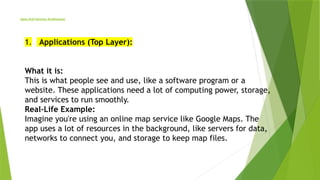
1. Applications (Top Layer):
What it is:
This is what people see and use, like a software program or a
website. These applications need a lot of computing power, storage,
and services to run smoothly.
Real-Life Example:
Imagine you're using an online map service like Google Maps. The
app uses a lot of resources in the background, like servers for data,
networks to connect you, and storage to keep map files.
Open Grid Services Architecture
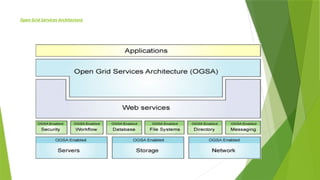
 2. OGSA (Middle Layer - the Boss/Manager)
 What it is:
OGSA (Open Grid Services Architecture) is like the manager or the
brain of the whole system. Its job is to organize and connect all
the resources (servers, storage, databases, etc.) and make them
work together like a well-oiled machine. Without this layer, the
system would be chaotic and disconnected.
 Real-Life Example:
Think of OGSA like the manager at a large airport. It makes sure
the pilots, ground staff, baggage handlers, and air traffic
controllers are all doing their jobs in sync so that flights can take
off and land without any confusion.
Open Grid Services Architecture
 3. Web Services (Communication Layer)
 What it is:
Web services allow all the parts of the system to talk to each
other. It acts like a common language or translator between
different systems and software.
 Real-Life Example:
Imagine you're ordering pizza online. Your app talks to the
restaurant's system (to check the menu and order availability),
the payment gateway (to process your payment), and a
delivery tracking system (to show you where your pizza is).
Web services make all these systems communicate smoothly.
Open Grid Services Architecture
 4. OGSA-Enabled Services (Green Boxes - Specialized Services)
 What it is:
These are like specialized workers or tools that handle specific jobs
in the system. Here’s what each service does, in simple terms:
• Security: Ensures that only authorized people or systems can access
the grid.
Example: Like using a password or fingerprint to unlock your
phone.
• Workflow: Makes sure that tasks are completed in the right order.
Example: When you order groceries online, the workflow ensures
your items are picked, packed, and delivered step by step
•Database: Stores and organizes all the data in one place.
Example: Like your contacts app that stores all your phone numbers
and organizes them for easy search.
•File Systems: Deals with storing and retrieving files.
Example: Like Google Drive or Dropbox, which stores your files and
lets you access them anytime.
•Directory: Helps to locate services and resources in the system.
Example: Like using the Contacts app to find a person’s phone number.
•Messaging: Allows different parts of the system to send messages to
each other.
Example: Like the notifications you get when your package is shipped
or delivered.
Open Grid Services
Architecture
Open Grid Services Architecture
 5. Infrastructure (Bottom Layer - The Foundation)
 What it is:
These are the physical components that make the grid work. Without
these, nothing would run.
• Servers: Powerful computers that process data and run programs.
Example: Think of these as the chefs in a restaurant who prepare your
meal. Without them, nothing would get cooked.
• Storage: Where all the data (files, documents, images, etc.) is kept.
Example: Like a warehouse where all the ingredients for the meals are
stored.
• Network: The connections between all the components, allowing them to
share information.
Example: Like the roads and delivery trucks that connect the warehouse,
restaurant, and your house.
Scenario:
You’re watching a movie on Netflix.
•Applications (Top Layer):
You open the Netflix app on your phone or TV. This is the
application layer that you interact with.
•OGSA (Middle Layer):
Netflix’s system uses OGSA to organize and pull together
the right servers, storage, and data to stream the movie
seamlessly.
•Web Services (Communication):
Web services make sure your device can talk to Netflix’s
servers and fetch the movie data without interruptions.
4. OGSA-Enabled Services (Green Boxes):
•Security: Makes sure you’re logged in with your account and no
one else can use your subscription.
•Workflow: Organizes tasks, like buffering the movie and keeping
track of your watch progress.
•Database: Stores all the movies and shows available on Netflix.
•File Systems: Keeps the movie files stored and retrieves them as
needed.
•Messaging: Sends updates, like “Are you still watching?” or “Next
episode starting in 10 seconds.”
5. Infrastructure (Bottom Layer):
Netflix’s servers (powerful computers), storage (where movies are
stored), and networks (internet connections) work together to
deliver the movie to your screen.
Open Grid Services infrastructure
 The Open Grid Services Infrastructure (OGSI) is a framework that makes it easier for
different computers and software systems to work together on a shared task. Let's
break down OGSI in simple terms:
1. Grid Computing Collaboration:
OGSI is designed for situations where multiple computers need to collaborate and share their
resources. These computers could be in different locations, but OGSI helps them work together
like a team.
2. Sharing Resources:
OGSI allows computers to share their processing power, storage space, and other capabilities.
This is helpful when a task is too big for one computer to handle alone.
3. Common Language:
OGSI provides a common language or set of rules that all the computers understand. It's like
having a translator that ensures everyone speaks the same "computing language."
4. Task Management:
When you have a big task, you can break it into smaller pieces, and OGSI helps manage these
pieces across different computers. Each computer works on its part of the task, and OGSI
coordinates everything.
5. Flexibility:
OGSI is flexible. It doesn't matter if the computers have different types of software or hardware; OGSI
helps them work together despite their differences.
6. Accessing Services:
OGSI introduces the concept of "services." These are like specialized tools or functions that computers
offer. OGSI helps one computer ask another for specific services, making it easy to get the right help when
needed.
7. Task Monitoring:
OGSI keeps an eye on how each computer is doing its part of the task. If one computer finishes its job,
OGSI can assign it a new piece of the task or direct it to help another computer.
8. Security and Trust:
OGSI ensures that only authorized computers can join the collaboration. It's like having a security guard
to make sure only trusted computers are part of the team.
9. Scalability:
Whether the task is small or enormous, OGSI can handle it. It's designed to scale, meaning it can work
well for both tiny projects and massive undertakings.
In simple terms, OGSI is like a team manager for a group of computers, helping them work
together efficiently, share resources, and accomplish tasks that would be challenging for any single
computer alone. It's about making collaboration between computers easy and effective.
OGSA services
1. Job Execution Service:
Manages the execution of computational tasks across the grid, coordinating the allocation of resources and ensuring the
completion of jobs.
2. Resource Management Service:
Handles the discovery, allocation, and deallocation of computing resources within the grid, optimizing the utilization of
available resources.
3. Data Management Service:
Manages the storage, retrieval, and distribution of data across distributed nodes in the grid, ensuring efficient and
reliable data access.
4. Security Service:
Enforces security measures, including authentication, authorization, and encryption, to protect data and ensure the
integrity of communications within the grid.
5. Information Service:
Provides a centralized or distributed repository for storing and retrieving information about grid resources, services, and
their capabilities.
6. Fault Tolerance Service:
Implements mechanisms for detecting and handling failures within the grid, ensuring the reliability and continuous
operation of grid services.

Grid Services includes OGSA,OGSI Architecture & Services

  • 1.
    Grid Services By Prof.Trupti sisode.
  • 2.
     Open GridServices Architecture (OGSA) is used to create a framework for connecting and managing different computers and resources over a network, forming what we call a "grid.“  The purpose is to efficiently share and use computing power, storage, and data for solving big and complex problems.  OGSA provides a set of rules and tools to make sure these different resources can work together smoothly, like a well- organized team. Open Grid Services Architecture
  • 3.
    Open Grid ServicesArchitecture
  • 4.
    Open Grid ServicesArchitecture 1. Applications (Top Layer): What it is: This is what people see and use, like a software program or a website. These applications need a lot of computing power, storage, and services to run smoothly. Real-Life Example: Imagine you're using an online map service like Google Maps. The app uses a lot of resources in the background, like servers for data, networks to connect you, and storage to keep map files.
  • 5.
    Open Grid ServicesArchitecture  2. OGSA (Middle Layer - the Boss/Manager)  What it is: OGSA (Open Grid Services Architecture) is like the manager or the brain of the whole system. Its job is to organize and connect all the resources (servers, storage, databases, etc.) and make them work together like a well-oiled machine. Without this layer, the system would be chaotic and disconnected.  Real-Life Example: Think of OGSA like the manager at a large airport. It makes sure the pilots, ground staff, baggage handlers, and air traffic controllers are all doing their jobs in sync so that flights can take off and land without any confusion.
  • 6.
    Open Grid ServicesArchitecture  3. Web Services (Communication Layer)  What it is: Web services allow all the parts of the system to talk to each other. It acts like a common language or translator between different systems and software.  Real-Life Example: Imagine you're ordering pizza online. Your app talks to the restaurant's system (to check the menu and order availability), the payment gateway (to process your payment), and a delivery tracking system (to show you where your pizza is). Web services make all these systems communicate smoothly.
  • 7.
    Open Grid ServicesArchitecture  4. OGSA-Enabled Services (Green Boxes - Specialized Services)  What it is: These are like specialized workers or tools that handle specific jobs in the system. Here’s what each service does, in simple terms: • Security: Ensures that only authorized people or systems can access the grid. Example: Like using a password or fingerprint to unlock your phone. • Workflow: Makes sure that tasks are completed in the right order. Example: When you order groceries online, the workflow ensures your items are picked, packed, and delivered step by step
  • 8.
    •Database: Stores andorganizes all the data in one place. Example: Like your contacts app that stores all your phone numbers and organizes them for easy search. •File Systems: Deals with storing and retrieving files. Example: Like Google Drive or Dropbox, which stores your files and lets you access them anytime. •Directory: Helps to locate services and resources in the system. Example: Like using the Contacts app to find a person’s phone number. •Messaging: Allows different parts of the system to send messages to each other. Example: Like the notifications you get when your package is shipped or delivered. Open Grid Services Architecture
  • 9.
    Open Grid ServicesArchitecture  5. Infrastructure (Bottom Layer - The Foundation)  What it is: These are the physical components that make the grid work. Without these, nothing would run. • Servers: Powerful computers that process data and run programs. Example: Think of these as the chefs in a restaurant who prepare your meal. Without them, nothing would get cooked. • Storage: Where all the data (files, documents, images, etc.) is kept. Example: Like a warehouse where all the ingredients for the meals are stored. • Network: The connections between all the components, allowing them to share information. Example: Like the roads and delivery trucks that connect the warehouse, restaurant, and your house.
  • 10.
    Scenario: You’re watching amovie on Netflix. •Applications (Top Layer): You open the Netflix app on your phone or TV. This is the application layer that you interact with. •OGSA (Middle Layer): Netflix’s system uses OGSA to organize and pull together the right servers, storage, and data to stream the movie seamlessly. •Web Services (Communication): Web services make sure your device can talk to Netflix’s servers and fetch the movie data without interruptions.
  • 11.
    4. OGSA-Enabled Services(Green Boxes): •Security: Makes sure you’re logged in with your account and no one else can use your subscription. •Workflow: Organizes tasks, like buffering the movie and keeping track of your watch progress. •Database: Stores all the movies and shows available on Netflix. •File Systems: Keeps the movie files stored and retrieves them as needed. •Messaging: Sends updates, like “Are you still watching?” or “Next episode starting in 10 seconds.” 5. Infrastructure (Bottom Layer): Netflix’s servers (powerful computers), storage (where movies are stored), and networks (internet connections) work together to deliver the movie to your screen.
  • 12.
    Open Grid Servicesinfrastructure  The Open Grid Services Infrastructure (OGSI) is a framework that makes it easier for different computers and software systems to work together on a shared task. Let's break down OGSI in simple terms: 1. Grid Computing Collaboration: OGSI is designed for situations where multiple computers need to collaborate and share their resources. These computers could be in different locations, but OGSI helps them work together like a team. 2. Sharing Resources: OGSI allows computers to share their processing power, storage space, and other capabilities. This is helpful when a task is too big for one computer to handle alone. 3. Common Language: OGSI provides a common language or set of rules that all the computers understand. It's like having a translator that ensures everyone speaks the same "computing language." 4. Task Management: When you have a big task, you can break it into smaller pieces, and OGSI helps manage these pieces across different computers. Each computer works on its part of the task, and OGSI coordinates everything.
  • 13.
    5. Flexibility: OGSI isflexible. It doesn't matter if the computers have different types of software or hardware; OGSI helps them work together despite their differences. 6. Accessing Services: OGSI introduces the concept of "services." These are like specialized tools or functions that computers offer. OGSI helps one computer ask another for specific services, making it easy to get the right help when needed. 7. Task Monitoring: OGSI keeps an eye on how each computer is doing its part of the task. If one computer finishes its job, OGSI can assign it a new piece of the task or direct it to help another computer. 8. Security and Trust: OGSI ensures that only authorized computers can join the collaboration. It's like having a security guard to make sure only trusted computers are part of the team. 9. Scalability: Whether the task is small or enormous, OGSI can handle it. It's designed to scale, meaning it can work well for both tiny projects and massive undertakings. In simple terms, OGSI is like a team manager for a group of computers, helping them work together efficiently, share resources, and accomplish tasks that would be challenging for any single computer alone. It's about making collaboration between computers easy and effective.
  • 14.
    OGSA services 1. JobExecution Service: Manages the execution of computational tasks across the grid, coordinating the allocation of resources and ensuring the completion of jobs. 2. Resource Management Service: Handles the discovery, allocation, and deallocation of computing resources within the grid, optimizing the utilization of available resources. 3. Data Management Service: Manages the storage, retrieval, and distribution of data across distributed nodes in the grid, ensuring efficient and reliable data access. 4. Security Service: Enforces security measures, including authentication, authorization, and encryption, to protect data and ensure the integrity of communications within the grid. 5. Information Service: Provides a centralized or distributed repository for storing and retrieving information about grid resources, services, and their capabilities. 6. Fault Tolerance Service: Implements mechanisms for detecting and handling failures within the grid, ensuring the reliability and continuous operation of grid services.