CONFINED SPACE ENTRANT TRAINING
What is a Confined Space?
•Must Meet ALL THREE Criteria
•Is large enough and so configured that an employee can enter
bodily and perform work
•Has limited means of entry or exit
•Is not designed for continuous human occupancy
Permit-Required Confined Space
• One or more of the following has to be present
• Contains or Possible contains hazardous atmosphere
• Contains a material that has the potential for engulfing an entrant
• Has an internal configuration such that an entrant could become trapped or
asphyxiated
• Contains ANY OTHER serious safety or health hazard
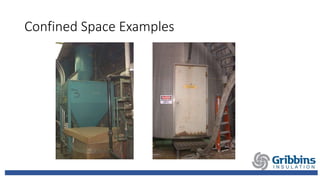
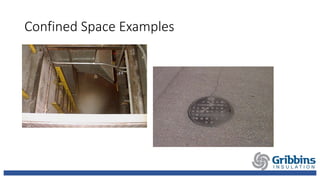
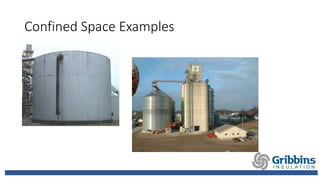
Confined Space Examples
Confined Space Hazards
− Oxygen Deficiency
− Oxygen Enriched
− Flammables Present
− Toxic Atmospheres
− Combustible Dust and Vapors
− Presence of Asphyxiates
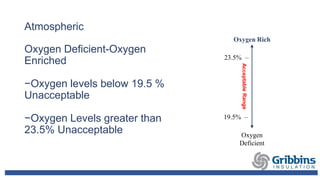
Atmospheric
Oxygen Deficient-Oxygen
Enriched
−Oxygen levels below 19.5 %
Unacceptable
−Oxygen Levels greater than
23.5% Unacceptable
Oxygen Rich
23.5%
19.5%
Oxygen
Deficient
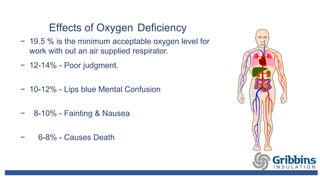
Effects of Oxygen Deficiency
− 19.5 % is the minimum acceptable oxygen level for
work with out an air supplied respirator.
− 12-14% - Poor judgment.
− 10-12% - Lips blue Mental Confusion
− 8-10% - Fainting & Nausea
− 6-8% - Causes Death
Flammable-Combustible Atmospheres
− Residual flammable material normally stored in the
vessel could be present
− Flammable solvents may be used to clean the
confined space
− Combustible materials may be present such as wood
scaffolding and cloth or paper cleaning materials.
− Line work and other activities near the confined
space may allow flammable materials to drift into the
confined space of be pulled in by ventilation blowers.
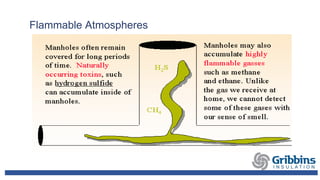
Flammable Atmospheres
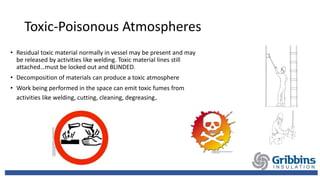
Toxic-Poisonous Atmospheres
• Residual toxic material normally in vessel may be present and may
be released by activities like welding. Toxic material lines still
attached…must be locked out and BLINDED.
• Decomposition of materials can produce a toxic atmosphere
• Work being performed in the space can emit toxic fumes from
activities like welding, cutting, cleaning, degreasing.
Asphyxiating Atmospheres
One of the most common asphyxiating gases
is Carbon Monoxide (CO). Carbon Monoxide
is a colorless, odorless, tasteless, and non-
irritating gas.
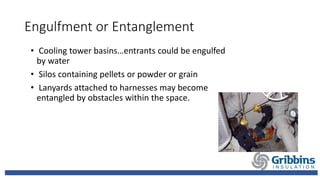
Engulfment or Entanglement
• Cooling tower basins…entrants could be engulfed
by water
• Silos containing pellets or powder or grain
• Lanyards attached to harnesses may become
entangled by obstacles within the space.
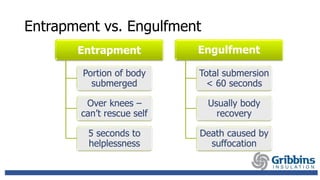
Entrapment vs. Engulfment
Entrapment
Portion of body
submerged
Over knees –
can’t rescue self
5 seconds to
helplessness
Engulfment
Total submersion
< 60 seconds
Usually body
recovery
Death caused by
suffocation
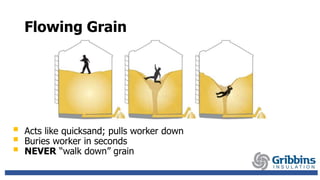
Flowing Grain
 Acts like quicksand; pulls worker down
 Buries worker in seconds
 NEVER “walk down” grain
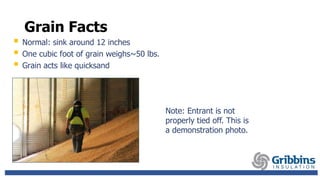
Grain Facts
 Normal: sink around 12 inches
 One cubic foot of grain weighs~50 lbs.
 Grain acts like quicksand
Note: Entrant is not
properly tied off. This is
a demonstration photo.
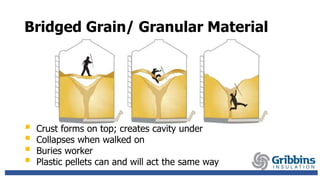
Bridged Grain/ Granular Material
 Crust forms on top; creates cavity under
 Collapses when walked on
 Buries worker
 Plastic pellets can and will act the same way
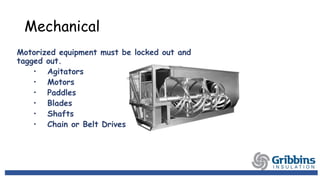
Mechanical
Motorized equipment must be locked out and
tagged out.
• Agitators
• Motors
• Paddles
• Blades
• Shafts
• Chain or Belt Drives
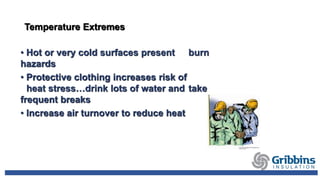
Temperature Extremes
• Hot or very cold surfaces present burn
hazards
• Protective clothing increases risk of
heat stress…drink lots of water and take
frequent breaks
• Increase air turnover to reduce heat
Electrical
Electric Shock is a possible hazard in Confined
Spaces
Hazard Sources include:
• Broken lighting
• Electrical sensing devices
• Limit switches
• Level indicating devices
• Hazards from equipment taken inside
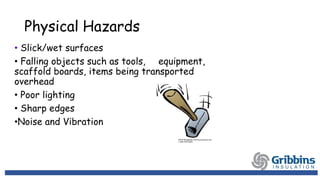
Physical Hazards
• Slick/wet surfaces
• Falling objects such as tools, equipment,
scaffold boards, items being transported
overhead
• Poor lighting
• Sharp edges
•Noise and Vibration
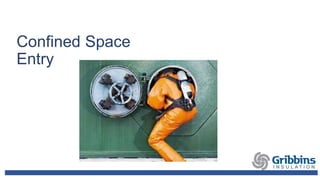
Confined Space
Entry
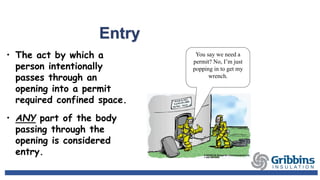
Entry
• The act by which a
person intentionally
passes through an
opening into a permit
required confined space.
• ANY part of the body
passing through the
opening is considered
entry.
You say we need a
permit? No, I’m just
popping in to get my
wrench.
Basic Confined Space Entry
Procedure
All entrants, supervisors and entry attendants must be fully qualified
1. Conduct Pre-Entry Briefing
2. Assemble and check equipment
3. Establish Acceptable Entry Conditions
4. Conduct initial air sampling
5. Execute & Complete Entry Permit
6. Station Entry Attendant
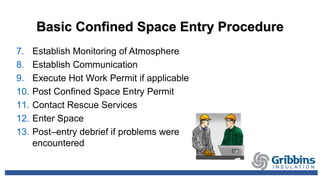
Basic Confined Space Entry Procedure
7. Establish Monitoring of Atmosphere
8. Establish Communication
9. Execute Hot Work Permit if applicable
10. Post Confined Space Entry Permit
11. Contact Rescue Services
12. Enter Space
13. Post–entry debrief if problems were
encountered
Confined Space Entry Supervisor
• The Entry Supervisor for a Confined Space shall be an
employee knowledgeable the potential hazards and
operations within the space.
• The Entry Supervisor for Confined Spaces shall have
completed and demonstrated competencey in executing
Confined Spaces Entry Permits.
•The Confined Space Entry Supervisor shall be retrained
no less than every three years to keep their designation.
Confined Space Entry Attendant
• The attendant shall be designated by the entry
supervisor and be trained in all of the attendants
duties
• Know the hazards that could be faced during entry,
including information on the mode, signs or
symptoms, and consequences of the exposure
• Is aware of possible behavioral effects of hazard
exposure in authorized entrants
Attendant Responsibilities
• To monitor entrants during the job and during entry & exit.
• The attendant may not abandon his/her post for any
reason while personnel are in the space unless relieved by
another qualified attendant.
• To monitor atmospheric conditions in the space prior to
and during entry.
• To control access to the confined space.
• To summon emergency assistance as needed.
• To assess hazards in and around the space, and take
action on the same.
• To keep records of confined space work, such as air test
results, personnel entry/exit, etc.
• Barricade entrance to prevent unauthorized access.
Attendant duties cont.
Hazards are identified, communicated, understood with Confined
Space worksheet/procedure reviewed
Aware of behavioral effects of hazard exposure
Has the means to maintain an accurate head count of all entrants
in confined space
Understands not to enter the confined space under any
circumstances
Rescue plan is in place
Means established to maintain constant communication with
entrants
Understands need to monitor activities in and out of confined
space
Understands the need to prevent unauthorized individuals from
entering confined space
Communications to activate rescue services – verified
Performs no other duties
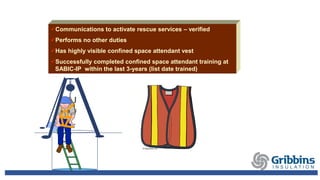
Has highly visible confined space attendant vest
Successfully completed confined space attendant training at
SABIC-IP within the last 3-years (list date trained)
Ventilation
 Consider exhaust, supply or both
 Provide work zone exhaust if welding
 Plan ventilation supply and exhaust
paths…best to have the air swirling
around the inside of the vessel
 Ensure no “re-circulation” of air supply
 Use continuous ventilation
 Retest the confined space before and
during entry
 Never use pure oxygen for ventilation
Test the Atmosphere
In this order:
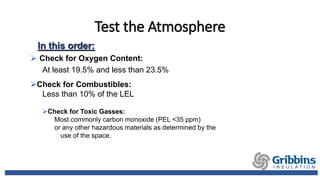
 Check for Oxygen Content:
At least 19.5% and less than 23.5%
Check for Combustibles:
Less than 10% of the LEL
Check for Toxic Gasses:
Most commonly carbon monoxide (PEL <35 ppm)
or any other hazardous materials as determined by the
use of the space.
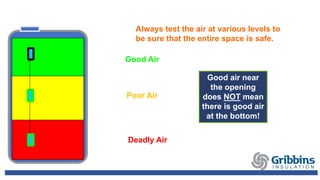
Always test the air at various levels to
be sure that the entire space is safe.
Good Air
Poor Air
Deadly Air
Good air near
the opening
does NOT mean
there is good air
at the bottom!
Confined Space Rescue
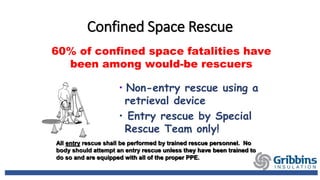
60% of confined space fatalities have
been among would-be rescuers
• Non-entry rescue using a
retrieval device
• Entry rescue by Special
Rescue Team only!
All entry rescue shall be performed by trained rescue personnel. No
body should attempt an entry rescue unless they have been trained to
do so and are equipped with all of the proper PPE.
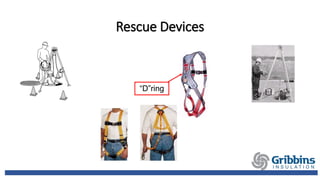
Rescue Devices
“D”ring

Gribbins Confined Space

  • 1.
  • 2.
    What is aConfined Space? •Must Meet ALL THREE Criteria •Is large enough and so configured that an employee can enter bodily and perform work •Has limited means of entry or exit •Is not designed for continuous human occupancy
  • 3.
    Permit-Required Confined Space •One or more of the following has to be present • Contains or Possible contains hazardous atmosphere • Contains a material that has the potential for engulfing an entrant • Has an internal configuration such that an entrant could become trapped or asphyxiated • Contains ANY OTHER serious safety or health hazard
  • 4.
  • 5.
  • 6.
  • 7.
    Confined Space Hazards −Oxygen Deficiency − Oxygen Enriched − Flammables Present − Toxic Atmospheres − Combustible Dust and Vapors − Presence of Asphyxiates
  • 8.
    Atmospheric Oxygen Deficient-Oxygen Enriched −Oxygen levelsbelow 19.5 % Unacceptable −Oxygen Levels greater than 23.5% Unacceptable Oxygen Rich 23.5% 19.5% Oxygen Deficient
  • 9.
    Effects of OxygenDeficiency − 19.5 % is the minimum acceptable oxygen level for work with out an air supplied respirator. − 12-14% - Poor judgment. − 10-12% - Lips blue Mental Confusion − 8-10% - Fainting & Nausea − 6-8% - Causes Death
  • 10.
    Flammable-Combustible Atmospheres − Residualflammable material normally stored in the vessel could be present − Flammable solvents may be used to clean the confined space − Combustible materials may be present such as wood scaffolding and cloth or paper cleaning materials. − Line work and other activities near the confined space may allow flammable materials to drift into the confined space of be pulled in by ventilation blowers.
  • 11.
  • 12.
    Toxic-Poisonous Atmospheres • Residualtoxic material normally in vessel may be present and may be released by activities like welding. Toxic material lines still attached…must be locked out and BLINDED. • Decomposition of materials can produce a toxic atmosphere • Work being performed in the space can emit toxic fumes from activities like welding, cutting, cleaning, degreasing.
  • 13.
    Asphyxiating Atmospheres One ofthe most common asphyxiating gases is Carbon Monoxide (CO). Carbon Monoxide is a colorless, odorless, tasteless, and non- irritating gas.
  • 14.
    Engulfment or Entanglement •Cooling tower basins…entrants could be engulfed by water • Silos containing pellets or powder or grain • Lanyards attached to harnesses may become entangled by obstacles within the space.
  • 15.
    Entrapment vs. Engulfment Entrapment Portionof body submerged Over knees – can’t rescue self 5 seconds to helplessness Engulfment Total submersion < 60 seconds Usually body recovery Death caused by suffocation
  • 16.
    Flowing Grain  Actslike quicksand; pulls worker down  Buries worker in seconds  NEVER “walk down” grain
  • 17.
    Grain Facts  Normal:sink around 12 inches  One cubic foot of grain weighs~50 lbs.  Grain acts like quicksand Note: Entrant is not properly tied off. This is a demonstration photo.
  • 18.
    Bridged Grain/ GranularMaterial  Crust forms on top; creates cavity under  Collapses when walked on  Buries worker  Plastic pellets can and will act the same way
  • 19.
    Mechanical Motorized equipment mustbe locked out and tagged out. • Agitators • Motors • Paddles • Blades • Shafts • Chain or Belt Drives
  • 20.
    Temperature Extremes • Hotor very cold surfaces present burn hazards • Protective clothing increases risk of heat stress…drink lots of water and take frequent breaks • Increase air turnover to reduce heat
  • 21.
    Electrical Electric Shock isa possible hazard in Confined Spaces Hazard Sources include: • Broken lighting • Electrical sensing devices • Limit switches • Level indicating devices • Hazards from equipment taken inside
  • 22.
    Physical Hazards • Slick/wetsurfaces • Falling objects such as tools, equipment, scaffold boards, items being transported overhead • Poor lighting • Sharp edges •Noise and Vibration
  • 23.
  • 24.
    Entry • The actby which a person intentionally passes through an opening into a permit required confined space. • ANY part of the body passing through the opening is considered entry. You say we need a permit? No, I’m just popping in to get my wrench.
  • 25.
    Basic Confined SpaceEntry Procedure All entrants, supervisors and entry attendants must be fully qualified 1. Conduct Pre-Entry Briefing 2. Assemble and check equipment 3. Establish Acceptable Entry Conditions 4. Conduct initial air sampling 5. Execute & Complete Entry Permit 6. Station Entry Attendant
  • 26.
    Basic Confined SpaceEntry Procedure 7. Establish Monitoring of Atmosphere 8. Establish Communication 9. Execute Hot Work Permit if applicable 10. Post Confined Space Entry Permit 11. Contact Rescue Services 12. Enter Space 13. Post–entry debrief if problems were encountered
  • 27.
    Confined Space EntrySupervisor • The Entry Supervisor for a Confined Space shall be an employee knowledgeable the potential hazards and operations within the space. • The Entry Supervisor for Confined Spaces shall have completed and demonstrated competencey in executing Confined Spaces Entry Permits. •The Confined Space Entry Supervisor shall be retrained no less than every three years to keep their designation.
  • 28.
    Confined Space EntryAttendant • The attendant shall be designated by the entry supervisor and be trained in all of the attendants duties • Know the hazards that could be faced during entry, including information on the mode, signs or symptoms, and consequences of the exposure • Is aware of possible behavioral effects of hazard exposure in authorized entrants
  • 29.
    Attendant Responsibilities • Tomonitor entrants during the job and during entry & exit. • The attendant may not abandon his/her post for any reason while personnel are in the space unless relieved by another qualified attendant. • To monitor atmospheric conditions in the space prior to and during entry. • To control access to the confined space. • To summon emergency assistance as needed. • To assess hazards in and around the space, and take action on the same. • To keep records of confined space work, such as air test results, personnel entry/exit, etc. • Barricade entrance to prevent unauthorized access.
  • 30.
    Attendant duties cont. Hazardsare identified, communicated, understood with Confined Space worksheet/procedure reviewed Aware of behavioral effects of hazard exposure Has the means to maintain an accurate head count of all entrants in confined space Understands not to enter the confined space under any circumstances Rescue plan is in place Means established to maintain constant communication with entrants Understands need to monitor activities in and out of confined space Understands the need to prevent unauthorized individuals from entering confined space
  • 31.
    Communications to activaterescue services – verified Performs no other duties Has highly visible confined space attendant vest Successfully completed confined space attendant training at SABIC-IP within the last 3-years (list date trained)
  • 32.
    Ventilation  Consider exhaust,supply or both  Provide work zone exhaust if welding  Plan ventilation supply and exhaust paths…best to have the air swirling around the inside of the vessel  Ensure no “re-circulation” of air supply  Use continuous ventilation  Retest the confined space before and during entry  Never use pure oxygen for ventilation
  • 33.
    Test the Atmosphere Inthis order:  Check for Oxygen Content: At least 19.5% and less than 23.5% Check for Combustibles: Less than 10% of the LEL Check for Toxic Gasses: Most commonly carbon monoxide (PEL <35 ppm) or any other hazardous materials as determined by the use of the space.
  • 34.
    Always test theair at various levels to be sure that the entire space is safe. Good Air Poor Air Deadly Air Good air near the opening does NOT mean there is good air at the bottom!
  • 35.
    Confined Space Rescue 60%of confined space fatalities have been among would-be rescuers • Non-entry rescue using a retrieval device • Entry rescue by Special Rescue Team only! All entry rescue shall be performed by trained rescue personnel. No body should attempt an entry rescue unless they have been trained to do so and are equipped with all of the proper PPE.
  • 36.

Editor's Notes

  • #13 Corrosive Atmospheres Corrosive atmospheres not only can lead to respiratory problems, but also cause skin exposure reactions and damage to your nervous system though skin absorption or breathing. Examples of Corrosives  Bleach Ammonia Acids
  • #14 Carbon Monoxide is produced from the incomplete combustion of fossil fuels such as used in internal combustion engines, and can also be produced from welding and from use of a cutting torch. Some CO Poisoning Symptoms are: Headaches Fatigue Nausea Vomiting Dizziness Irritability Slowed Motor Functions Poor Judgment Chest Pains Weakness
  • #16 Entrapment occurs when a portion of the body becomes submerged and is trapped by the pressure of the grain. When grain reaches the knees you cannot free yourself. This takes about 5 seconds with flowing grain. Rescue is possible with trained rescue personnel. Engulfment occurs when a person is totally submerged in grain. Takes less than a minute if grain is flowing. Usually leads to death and recovery of a body. Only trained rescue personnel attempt rescue/recovery. Suffocation is a leading cause of death. Suffocation during entrapment or engulfment occurs because: Inability to expand chest due to pressure of the grain. Each time you “breathe out” the chest contracts (gets smaller) & the space is filled with grain. Grain gets into airways (nose, throat, mouth) and blocks airflow. Suffocation in an entrapment does NOT occur instantly – a person is often conscious until lack of oxygen forces unconsciousness and then death. Suffocation also occurs when grain bins develop hazardous atmospheres where the oxygen level not sufficient to support breathing and/or toxins affect the body’s ability to function.
  • #17 Typically grain storage structures empty by gravity. This is assisted with floor sump holes (gates) in the bottom being opened/closed to direct the flow and mechanical unloading equipment that can help draw out grain and/or move it away. Flowing grain generally occurs when parts of the unloading mechanisms are operating. Flowing grain can also occur when a person enters a grain bin to get grain flowing that has stopped or slowed – “walking down the grain.” The flow is quickened if the unloading system is running. The unloading system causes grain to flow at X number of bushels per second (depending on the size of bin and unloading system). The number of sump holes open also affect the speed. The faster grain flows the quicker entrapment or engulfment occurs. Flowing grain creates an inverted cone or funnel. The surface of the grain becomes unstable for the worker. The flowing grain pulls a worker down – much like quicksand. As the sides continue to collapse, the worker quickly becomes entrapped/engulfed. This can happen in less than a minute. Staying away from open sumps or the center of the bin with unloading equipment running is not safe. The surface of the grain, no matter where the person is located, is unstable. The force of the grain flow against the body is so great the worker typically has no ability to pull themselves out. There are other ways bins can be emptied (also causing flowing grain) including grain vacuums and cutting holes in sides. There are no safe procedures to “walk down grain” & get it flowing, especially with equipment running. Walking down grain or similar practice is prohibited by OSHA & should never be done. No one should enter a grain bin with unloading equipment running.
  • #18 When there is normal/good grain it will create sinking to about 12 inches when walking/standing. That is about mid-calf deep. If a person does not sink, there is a crusting or bad grain condition hazard. A rule to remember: For good condition grain, you never stand ON grain you always stand IN grain. A cubic foot of grain is approximately 50 pounds. The average body volume is 5-7 cubic feet. Only the body volume of a person needs to be removed for the person to be completely engulfed – this takes about 5 seconds when grain is flowing. The amount of effort needed to remove a victim increases with level of submersion. The more of the body buried, the harder it is to get them out. Removing a person means lifting the person’s weight PLUS the weight of the grain. For an average person completely buried that is 250-350 pounds of grain in addition (5-7 cubic feet X 50 pounds). Flowing grain acts like quicksand and flows to fill empty space. With movement, grain flows to wherever the space was made. Flowing grain creates a funnel. The sides collapse to fill the funnel. This is especially dangerous when the unloading system is operating, as it continually creates a funnel the grain will fill. The flowing grain acts like a suction pulling a person downward into the funnel. Gravity causes the sides to continue to collapse inward to the funnel. The faster the grain flows, the quicker submersion happens. It is important to note OSHA standards require the use of a harness and lifeline whenever the depth of gain poses an engulfment hazard and it needs to prevent the worker from sinking more than waist deep in grain.