April 21st, 2021
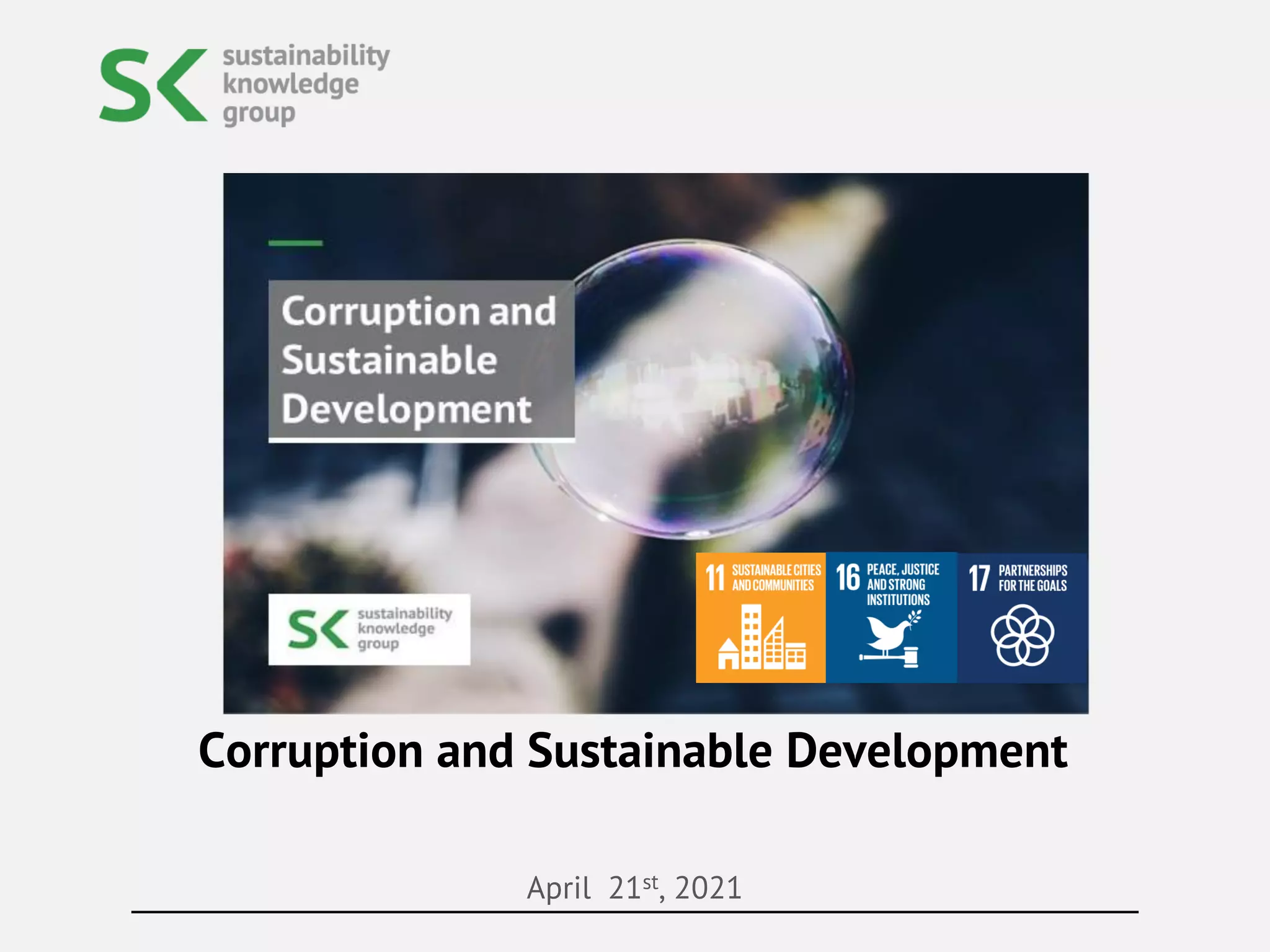
Corruption and Sustainable Development
About Sustainability Knowledge Group
Our Vision is
to make Sustainable Business a Choice for companies and
organizations around the world.
Sustainability Knowledge Group is a global advisory firm dedicated in creating value, through strategic
CSR and Sustainability solutions. We provide tailor made training, coaching and advisory services
grounded in international theory and successful application.
Sustainability Knowledge Group emphasizes in implementing methodologies that bring tangible results,
measurable impact and create better businesses.
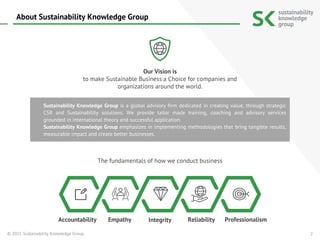
The fundamentals of how we conduct business
Reliability Professionalism
Empathy
Accountability Integrity
2
© 2021 Sustainability Knowledge Group
Services
CSR Coaching
• Coaching for Sustainability
Professionals
• Sustainability Residential &
Retreat
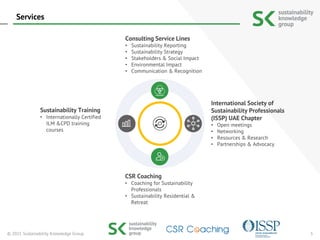
Consulting Service Lines
• Sustainability Reporting
• Sustainability Strategy
• Stakeholders & Social Impact
• Environmental Impact
• Communication & Recognition
International Society of
Sustainability Professionals
(ISSP) UAE Chapter
• Open meetings
• Networking
• Resources & Research
• Partnerships & Advocacy
Sustainability Training
• Internationally Certified
ILM &CPD training
courses
3
© 2021 Sustainability Knowledge Group
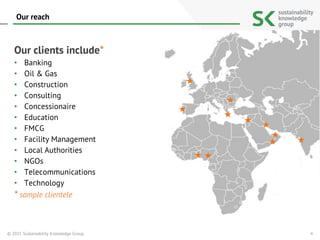
Our clients include*
• Banking
• Oil & Gas
• Construction
• Consulting
• Concessionaire
• Education
• FMCG
• Facility Management
• Local Authorities
• NGOs
• Telecommunications
• Technology
* sample clientele
Our reach
4
© 2021 Sustainability Knowledge Group
Corruption and Sustainable Development
5
6
The 2030 Agenda for Sustainable Development and the 17 Sustainable Development
Goals (SDGs) aim to build a better future for all. Corruption is a major obstacle to
sustainable development, as it affects all five pillars of sustainable development –
people, planet, prosperity, peace, and partnerships. Corruption is a major threat to
countries, people’s lives and livelihoods. Annually, fraud and corruption deprive the
global health sector $500 billion. They also deprives millions of people worldwide of
the prosperity, rights, services, and employment they need.
Corruption leads to weak institutions, creates injustice and insecurity, destroys justice
and fairness, and deprives people of basic needs such as health care, education, clean
water, sanitation for health and housing. It also stops economic growth, threatens
environmental resources, destroys innovation making our world even more turbulent.
Tackling corruption is vital to achieving the SDGs, particularly SDG 16 (Peace, Justice
and Strong Institutions). The importance of fighting corruption is explicitly highlighted
in the SDG 16 targets:
• 4 By 2030, significantly reduce illicit financial and arms flows, strengthen the
recovery and return of stolen assets and combat all forms of organized crime.
• 5 Substantially reduce corruption and bribery in all their forms.
• 10 Ensure public access to information and protect fundamental freedoms, in
accordance with national legislation and international agreements.
Such risks make it imperative to monitor the progress of countries and regions in
relation to combating corruption.
© 2021 Sustainability Knowledge Group
Corruption and Sustainable Development
7
Corruption Perceptions Index 2020
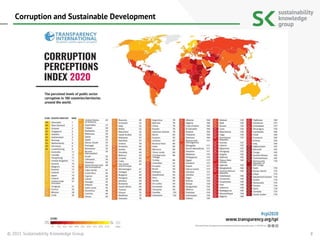
The Corruption Perceptions Index (CPI) is a combination of 13 expert assessments and
surveys of business executives evaluating 180 countries and territories according to
levels of public sector corruption according to experts and entrepreneurs. The index
uses a scale from zero to 100, with zero being highly corrupt and 100 very clean. The
CPI is the most widely used corruption index worldwide.
As in previous years, the Corruption Perceptions Index (CPI) 2020 released
by Transparency International revealed a grim picture of the state of corruption
worldwide, with more than two-thirds of countries still scoring less than 50, with an
average score of 43.
Since 2012, 26 countries have improved their CPI scores, including Greece, Myanmar
and Ecuador. However, in the same period, 22 countries lowered their scores, including
Lebanon, Malawi, Bosnia, and Herzegovina.
Denmark and New Zealand topped the index with the lowest corruption countries
globally, with 88 points, followed by Finland, Singapore, Sweden and Switzerland, with
scores of 85 each. At the end of the list, South Sudan and Somalia came with 12 points
each, followed by Syria (14), Yemen (15) and Venezuela (15).
Western Europe and the EU are the top-performing regions on CPI, with an average of
66 points. Denmark ranked first, followed by Finland, Sweden and Switzerland. In
contrast, Romania, Hungary and Bulgaria were the lowest performers in the region, with
44 points each.
© 2021 Sustainability Knowledge Group
Corruption and Sustainable Development
8
© 2021 Sustainability Knowledge Group
Corruption and Sustainable Development
9
Greece has shown a significant improvement in CPI, jumping 14 points since 2012 and
hitting a new high of 50 points. In part, that improvement is due to reforms introduced
by Greece after 2012 to counterbalance severe austerity measures.
In the Middle East and North Africa, the United Arab Emirates and Qatar ranked first
regionally in CPI, with a score of 71 and 63, respectively, while Libya (17), Yemen (15)
and Syria (14) were among the lowest-performing countries.
Initiatives, recommendations and solutions
Corruption thrives with accountability, institutions, and weak government. Most
countries have still failed to effectively address corruption for nearly half a century,
indicating the faltering efforts of governments to address the root causes of corruption.
Tackling corruption is vital to achieving the SDGs, and this requires a comprehensive
approach that includes all members of society. Countries and governments need to
continue to make progress on CPI and work towards achieving the SDGs by establishing
robust frameworks and laws that combat corruption. There is also a need for concerted
action and cooperation by both governments and companies through multi-stakeholder
processes.
Without serious action against corruption, progress towards the other SDGs is likely to
be very limited. To curb corruption, Transparency International recommends that all
governments:
© 2021 Sustainability Knowledge Group
Corruption and Sustainable Development
10
• Strengthen oversight institutions to ensure resources reach those most in need. Anti-
corruption authorities and oversight institutions must have sufficient funds,
resources and independence to perform their duties.
• Ensure open and transparent contracting to combat wrongdoing, identify conflicts of
interest and ensure fair pricing.
• Defend democracy and promote civic space to create the enabling conditions to hold
governments accountable.
• Publish relevant data and guarantee access to information to ensure the public
receives easy, accessible, timely and meaningful information.
Transparency International issued a questionnaire to help civil society organizations
conduct an independent assessment of their country’s progress in fighting corruption,
tackling illicit financial flows, and improving transparency. At the national level,
countries can use the questionnaire in government reporting on the SDGs. At the global
level, the questionnaire helps countries complete national voluntary reviews at the
HLPF.
The United Nations Convention against Corruption (UNCAC), the only legally binding
global anti-corruption instrument, mobilizes action for fair, transparent and accountable
governance through effective anti-corruption mechanisms. State parties to the
convention meet every two years to review the convention’s implementation and
discuss how states can better handle corruption. Almost all states have joined the
convention, as 183 States have ratified the UNCAC.
© 2021 Sustainability Knowledge Group
Corruption and Sustainable Development
11
Transparency International works to achieve their vision of a corruption-free world and
ensure social and economic justice, human rights, peace and security. Transparency
International invites us all to hold the powerful and corrupt to account, by exposing the
systems and networks that enable corruption; to advocate for policies and laws to
change the system, and build coalitions to drive national, regional and global change.
© 2021 Sustainability Knowledge Group
Corruption and Sustainable Development
12
© 2021 Sustainability Knowledge Group
Have Trusted us for Training and Consultancy Assignments
Banking/Financial
Investment funds
Groups &
International
Conglomerates
Concessionaire
PPP
Retail/FMCG Energy Hospitality
13
© 2021 Sustainability Knowledge Group
Have Trusted us for Training and Consultancy Assignments
Telecoms Consultancies
International
Agencies & Non
Profits
Utilities
Learning
Institutions
Real Estate
Logistics
United Kingdom
85 Great Portland Street,
First Floor, W1W 7LT,
London, UK
Cyprus
Vasili Michailidi 9,
CY-3026, Limassol, Cyprus
United Arab Emirates
Jumeirah Business Centre
(JBC), Jumeirah Lake
Towers (JLT), Dubai, UAE
Contact:
Email: contact@sustainabilityknowledgegroup.com
Tel.: +44 (0)20 32392990

Corruption and Sustainable Development

  • 1.
    April 21st, 2021 Corruptionand Sustainable Development
  • 2.
    About Sustainability KnowledgeGroup Our Vision is to make Sustainable Business a Choice for companies and organizations around the world. Sustainability Knowledge Group is a global advisory firm dedicated in creating value, through strategic CSR and Sustainability solutions. We provide tailor made training, coaching and advisory services grounded in international theory and successful application. Sustainability Knowledge Group emphasizes in implementing methodologies that bring tangible results, measurable impact and create better businesses. The fundamentals of how we conduct business Reliability Professionalism Empathy Accountability Integrity 2 © 2021 Sustainability Knowledge Group
  • 3.
    Services CSR Coaching • Coachingfor Sustainability Professionals • Sustainability Residential & Retreat Consulting Service Lines • Sustainability Reporting • Sustainability Strategy • Stakeholders & Social Impact • Environmental Impact • Communication & Recognition International Society of Sustainability Professionals (ISSP) UAE Chapter • Open meetings • Networking • Resources & Research • Partnerships & Advocacy Sustainability Training • Internationally Certified ILM &CPD training courses 3 © 2021 Sustainability Knowledge Group
  • 4.
    Our clients include* •Banking • Oil & Gas • Construction • Consulting • Concessionaire • Education • FMCG • Facility Management • Local Authorities • NGOs • Telecommunications • Technology * sample clientele Our reach 4 © 2021 Sustainability Knowledge Group
  • 5.
  • 6.
    6 The 2030 Agendafor Sustainable Development and the 17 Sustainable Development Goals (SDGs) aim to build a better future for all. Corruption is a major obstacle to sustainable development, as it affects all five pillars of sustainable development – people, planet, prosperity, peace, and partnerships. Corruption is a major threat to countries, people’s lives and livelihoods. Annually, fraud and corruption deprive the global health sector $500 billion. They also deprives millions of people worldwide of the prosperity, rights, services, and employment they need. Corruption leads to weak institutions, creates injustice and insecurity, destroys justice and fairness, and deprives people of basic needs such as health care, education, clean water, sanitation for health and housing. It also stops economic growth, threatens environmental resources, destroys innovation making our world even more turbulent. Tackling corruption is vital to achieving the SDGs, particularly SDG 16 (Peace, Justice and Strong Institutions). The importance of fighting corruption is explicitly highlighted in the SDG 16 targets: • 4 By 2030, significantly reduce illicit financial and arms flows, strengthen the recovery and return of stolen assets and combat all forms of organized crime. • 5 Substantially reduce corruption and bribery in all their forms. • 10 Ensure public access to information and protect fundamental freedoms, in accordance with national legislation and international agreements. Such risks make it imperative to monitor the progress of countries and regions in relation to combating corruption. © 2021 Sustainability Knowledge Group Corruption and Sustainable Development
  • 7.
    7 Corruption Perceptions Index2020 The Corruption Perceptions Index (CPI) is a combination of 13 expert assessments and surveys of business executives evaluating 180 countries and territories according to levels of public sector corruption according to experts and entrepreneurs. The index uses a scale from zero to 100, with zero being highly corrupt and 100 very clean. The CPI is the most widely used corruption index worldwide. As in previous years, the Corruption Perceptions Index (CPI) 2020 released by Transparency International revealed a grim picture of the state of corruption worldwide, with more than two-thirds of countries still scoring less than 50, with an average score of 43. Since 2012, 26 countries have improved their CPI scores, including Greece, Myanmar and Ecuador. However, in the same period, 22 countries lowered their scores, including Lebanon, Malawi, Bosnia, and Herzegovina. Denmark and New Zealand topped the index with the lowest corruption countries globally, with 88 points, followed by Finland, Singapore, Sweden and Switzerland, with scores of 85 each. At the end of the list, South Sudan and Somalia came with 12 points each, followed by Syria (14), Yemen (15) and Venezuela (15). Western Europe and the EU are the top-performing regions on CPI, with an average of 66 points. Denmark ranked first, followed by Finland, Sweden and Switzerland. In contrast, Romania, Hungary and Bulgaria were the lowest performers in the region, with 44 points each. © 2021 Sustainability Knowledge Group Corruption and Sustainable Development
  • 8.
    8 © 2021 SustainabilityKnowledge Group Corruption and Sustainable Development
  • 9.
    9 Greece has showna significant improvement in CPI, jumping 14 points since 2012 and hitting a new high of 50 points. In part, that improvement is due to reforms introduced by Greece after 2012 to counterbalance severe austerity measures. In the Middle East and North Africa, the United Arab Emirates and Qatar ranked first regionally in CPI, with a score of 71 and 63, respectively, while Libya (17), Yemen (15) and Syria (14) were among the lowest-performing countries. Initiatives, recommendations and solutions Corruption thrives with accountability, institutions, and weak government. Most countries have still failed to effectively address corruption for nearly half a century, indicating the faltering efforts of governments to address the root causes of corruption. Tackling corruption is vital to achieving the SDGs, and this requires a comprehensive approach that includes all members of society. Countries and governments need to continue to make progress on CPI and work towards achieving the SDGs by establishing robust frameworks and laws that combat corruption. There is also a need for concerted action and cooperation by both governments and companies through multi-stakeholder processes. Without serious action against corruption, progress towards the other SDGs is likely to be very limited. To curb corruption, Transparency International recommends that all governments: © 2021 Sustainability Knowledge Group Corruption and Sustainable Development
  • 10.
    10 • Strengthen oversightinstitutions to ensure resources reach those most in need. Anti- corruption authorities and oversight institutions must have sufficient funds, resources and independence to perform their duties. • Ensure open and transparent contracting to combat wrongdoing, identify conflicts of interest and ensure fair pricing. • Defend democracy and promote civic space to create the enabling conditions to hold governments accountable. • Publish relevant data and guarantee access to information to ensure the public receives easy, accessible, timely and meaningful information. Transparency International issued a questionnaire to help civil society organizations conduct an independent assessment of their country’s progress in fighting corruption, tackling illicit financial flows, and improving transparency. At the national level, countries can use the questionnaire in government reporting on the SDGs. At the global level, the questionnaire helps countries complete national voluntary reviews at the HLPF. The United Nations Convention against Corruption (UNCAC), the only legally binding global anti-corruption instrument, mobilizes action for fair, transparent and accountable governance through effective anti-corruption mechanisms. State parties to the convention meet every two years to review the convention’s implementation and discuss how states can better handle corruption. Almost all states have joined the convention, as 183 States have ratified the UNCAC. © 2021 Sustainability Knowledge Group Corruption and Sustainable Development
  • 11.
    11 Transparency International worksto achieve their vision of a corruption-free world and ensure social and economic justice, human rights, peace and security. Transparency International invites us all to hold the powerful and corrupt to account, by exposing the systems and networks that enable corruption; to advocate for policies and laws to change the system, and build coalitions to drive national, regional and global change. © 2021 Sustainability Knowledge Group Corruption and Sustainable Development
  • 12.
    12 © 2021 SustainabilityKnowledge Group Have Trusted us for Training and Consultancy Assignments Banking/Financial Investment funds Groups & International Conglomerates Concessionaire PPP Retail/FMCG Energy Hospitality
  • 13.
    13 © 2021 SustainabilityKnowledge Group Have Trusted us for Training and Consultancy Assignments Telecoms Consultancies International Agencies & Non Profits Utilities Learning Institutions Real Estate Logistics
  • 14.
    United Kingdom 85 GreatPortland Street, First Floor, W1W 7LT, London, UK Cyprus Vasili Michailidi 9, CY-3026, Limassol, Cyprus United Arab Emirates Jumeirah Business Centre (JBC), Jumeirah Lake Towers (JLT), Dubai, UAE Contact: Email: contact@sustainabilityknowledgegroup.com Tel.: +44 (0)20 32392990