Introduction-
Growing carbon footprints of industries has put
sectors such as power and steel as the major
contributories to the climate crisis. The challenge
of climate change can be tackled by making our
industries and businesses follow practices and
processes that reduce their carbon foot prints.
Thus the need for the day is green finance
Meaning of Green Finance-
Green finance means any structured financial
activity to culminate into a better environmental
outcome and a more resilient future. The term
”structured financial activity” means increasing
the level of financial flows from public, private
and not for profit sectors. The level of financial
flows can be obtained through loans, debt
mechanisms, investments to encourage green
development.
Green Development covers-
Minimizing climate impact
Renewable energy
Energy Efficiency
Recycling
Green Building
Sustainable waste and water management
Biodiversity conservation
Reducing carbon emissions
Forms of Green Finance-
Green Finance covers a wide range of financial
products and services which can be categorized in
to investment, banking and insurance products.
The essential financial instruments comprise
equity and debt. The different forms of green
finance globally offered are –
 Green Mortgages- They are granted to
home buyers who invest in highly
environmentally oriented projects or
wants to improve environmental
performance of their homes.
 Green Loans- They are used to support
environmental initiatives such as
household solar panels, electric
automobiles, energy efficient projects.
 Green credit cards- They enable the
customer to plant a tree upon every
purchase
 Green Banks- They operate similar to
traditional banks. They spur their
investments on to environmentally
friendly initiatives. According to research,
the number of green banks in the US
increased from one to 20 investing $ 7
billion in renewable energy.
 Green Bonds- They account for vast bulk
of green funding. They include bond
investments the earnings from which are
used to support green initiatives such as
Renewable energy, clean transportation
and conservation.
In India, the green finance products are-
Green Insurance
Green Bonds
Carbon Financing
Benefits of Green Financing-
Competitive Advantage- Entities with great
exposure to green finance will enable in having a
competitive edge foe the entity over it peers
Good Reputation- Getting participative in creating
a green economy will enhance business value and
earn reputation
Consumer Faith- Entity delivering sustainable
products, services as well as production methods
attract more customers and enable in developing
faith in consumers
Economic Prospect- Governments that promote
green finance will be in a better position to
manage its natural resources effectively
Adoption of green finance
internationally-
Several flagship programmes have been
introduced that aim at increasing awareness
and promoting the funding of green initiatives
across the globe
Programmes held-
 Principles for responsible investment
 Un Environment program
 Equator principles for financial
institutions
Sustainable stock exchange is an initiative
whereby stock exchanges of signatory
companies come up with stock price indices
that track stock performance of companies
that are leaders in recognizing the ESG
principles
Task force on climate related financial
disclosures got support of 60% of world’s
largest public companies.
China(2008),Hongkong(2012),India(2013), the
Philliphines(2013),Vietnam(2013),Singapore(2
016) were the nations to implement the
framework.
Bangladesh incentivized environmental risk
analysis in its credit appraisal in 2013
The energy transition law passed in France in
2015 mandates asset owners and managers
to report on how transitionary risks affect
their assets and their activities
A revolving fund of $ 26 million was granted
to sanction loans at lower rate of interest of
renewable energy industries
An additional fund of $200million granted to
leather textile businesses to switch to green
technology in 2016
Further it was mandated to commercial banks
to lend at least 5% of their total lendings to
renewable energy sectors
In 2010 Lebanon introduced differential
reserve requirements whereby banks with
greater proportion of loans towards green
initiatives will require to keep lower reserve
requirements.
In 2011, Brazil embedded internal capital
adequacy assessment in its environmental
projects.
Adoption of green finance in India-
In 2007 RBI has issued a notification on
sustainable reporting of financial statements
In 2017 SEBI issued green bonds
Government offered subsidy amounting to
30% of total cost of installation of roof top
solar panels and in case of special category
states 75% of total installation cost is offered
as subsidy
Launch of FAME(Faster Adoption and
manufacturing of hybrid electric vehicles) in
2015 and 2019 to boost production and sale
of electric vehicles
Launch of production linked incentive scheme
to boost manufacturing of electric vehicles
SBI has launched green car loans with rate of
interest lowered by 20bps and a longer
repayment window
Priority sector lending for companies
encouraging renewable energy up to Rs.30
crores and households upto Rs.10 crores
Indian Infrastructure Finance Company Ltd
issued credit enhancement facility to fund
viable infrastructure projects with tenure
more than 5 years.
Landscape of Green Finance in India-
Green finance flows in India fall far short of
country’s current needs. In 2019&2020 tracked
green finance was INR 309 thousand crores
amounting to an approx. of one fourth of total
requirements.
As on 2019-2020-( all figs in INR thousand crores)
Contributions were from-
 Commercial Financial Institutions- 100013
 Corporations-20895
 FDI- 9080
 Philantrophy-270
 Residential,Commercial-45135
 Bilateral DFI-16247
 Multilateral DFI-10978
 PSU – 49237
 Government- 57476
Instruments used for financing-
 Debt- 90067
 Equity- 73278
 Government Budgetary Expenditure- 57476
 Grant- 1048
 Low cost debt- 49547
 Project- level Equity- 7713
 Project-level market debt- 13339
 Anonymous- 16863
Utilized Sectors-
 Energy Efficiency- 118856
 Clean Transportation- 60719
 Clean Energy- 129824
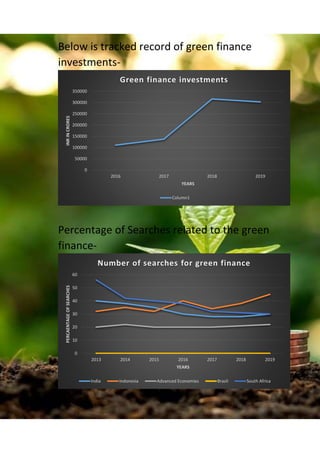
Below is tracked record of green finance
investments-
Percentage of Searches related to the green
finance-
0
50000
100000
150000
200000
250000
300000
350000
2016 2017 2018 2019
INR
IN
CRORES
YEARS
Green finance investments
Column1
0
10
20
30
40
50
60
2013 2014 2015 2016 2017 2018 2019
PERCAENTAGE
OF
SEARCHES
YEARS
Number of searches for green finance
India Indonesia Advanced Economies Brazil South Africa
*Advanced Economies include the USA, the UK,
France, Germany, Italy, Spain, Switzerland,
Norway, Australia and the Netherlands.
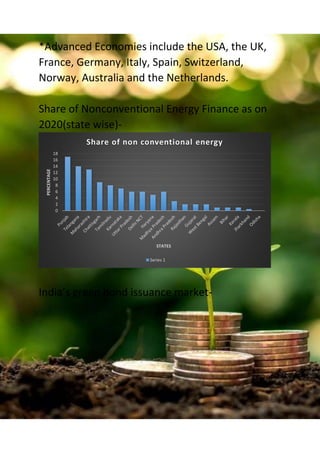
Share of Nonconventional Energy Finance as on
2020(state wise)-
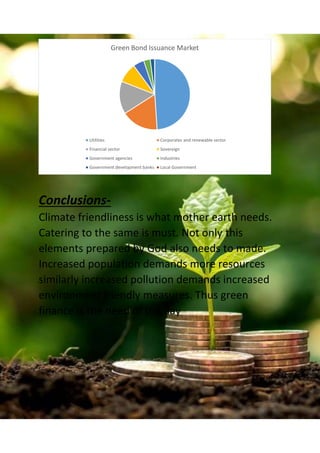
India’s green bond issuance market-
0
2
4
6
8
10
12
14
16
18
PERCENTAGE
STATES
Share of non conventional energy
Series 1
Conclusions-
Climate friendliness is what mother earth needs.
Catering to the same is must. Not only this
elements prepared by God also needs to made.
Increased population demands more resources
similarly increased pollution demands increased
environment friendly measures. Thus green
finance is the need of the day
Green Bond Issuance Market
Utilities Corporates and renewable sector
Financial sector Sovereign
Government agencies Industries
Government development banks Local Government

Green Finance.docx

  • 2.
    Introduction- Growing carbon footprintsof industries has put sectors such as power and steel as the major contributories to the climate crisis. The challenge of climate change can be tackled by making our industries and businesses follow practices and processes that reduce their carbon foot prints. Thus the need for the day is green finance Meaning of Green Finance- Green finance means any structured financial activity to culminate into a better environmental outcome and a more resilient future. The term ”structured financial activity” means increasing the level of financial flows from public, private and not for profit sectors. The level of financial flows can be obtained through loans, debt mechanisms, investments to encourage green development. Green Development covers-
  • 3.
    Minimizing climate impact Renewableenergy Energy Efficiency Recycling Green Building Sustainable waste and water management Biodiversity conservation Reducing carbon emissions Forms of Green Finance- Green Finance covers a wide range of financial products and services which can be categorized in to investment, banking and insurance products. The essential financial instruments comprise equity and debt. The different forms of green finance globally offered are –  Green Mortgages- They are granted to home buyers who invest in highly
  • 4.
    environmentally oriented projectsor wants to improve environmental performance of their homes.  Green Loans- They are used to support environmental initiatives such as household solar panels, electric automobiles, energy efficient projects.  Green credit cards- They enable the customer to plant a tree upon every purchase  Green Banks- They operate similar to traditional banks. They spur their investments on to environmentally friendly initiatives. According to research, the number of green banks in the US increased from one to 20 investing $ 7 billion in renewable energy.  Green Bonds- They account for vast bulk of green funding. They include bond investments the earnings from which are used to support green initiatives such as Renewable energy, clean transportation and conservation.
  • 5.
    In India, thegreen finance products are- Green Insurance Green Bonds Carbon Financing Benefits of Green Financing- Competitive Advantage- Entities with great exposure to green finance will enable in having a competitive edge foe the entity over it peers Good Reputation- Getting participative in creating a green economy will enhance business value and earn reputation Consumer Faith- Entity delivering sustainable products, services as well as production methods attract more customers and enable in developing faith in consumers Economic Prospect- Governments that promote green finance will be in a better position to manage its natural resources effectively
  • 6.
    Adoption of greenfinance internationally- Several flagship programmes have been introduced that aim at increasing awareness and promoting the funding of green initiatives across the globe Programmes held-  Principles for responsible investment  Un Environment program  Equator principles for financial institutions Sustainable stock exchange is an initiative whereby stock exchanges of signatory companies come up with stock price indices that track stock performance of companies that are leaders in recognizing the ESG principles Task force on climate related financial disclosures got support of 60% of world’s largest public companies. China(2008),Hongkong(2012),India(2013), the Philliphines(2013),Vietnam(2013),Singapore(2
  • 7.
    016) were thenations to implement the framework. Bangladesh incentivized environmental risk analysis in its credit appraisal in 2013 The energy transition law passed in France in 2015 mandates asset owners and managers to report on how transitionary risks affect their assets and their activities A revolving fund of $ 26 million was granted to sanction loans at lower rate of interest of renewable energy industries An additional fund of $200million granted to leather textile businesses to switch to green technology in 2016 Further it was mandated to commercial banks to lend at least 5% of their total lendings to renewable energy sectors In 2010 Lebanon introduced differential reserve requirements whereby banks with greater proportion of loans towards green initiatives will require to keep lower reserve requirements.
  • 8.
    In 2011, Brazilembedded internal capital adequacy assessment in its environmental projects. Adoption of green finance in India- In 2007 RBI has issued a notification on sustainable reporting of financial statements In 2017 SEBI issued green bonds Government offered subsidy amounting to 30% of total cost of installation of roof top solar panels and in case of special category states 75% of total installation cost is offered as subsidy Launch of FAME(Faster Adoption and manufacturing of hybrid electric vehicles) in 2015 and 2019 to boost production and sale of electric vehicles Launch of production linked incentive scheme to boost manufacturing of electric vehicles SBI has launched green car loans with rate of interest lowered by 20bps and a longer repayment window
  • 9.
    Priority sector lendingfor companies encouraging renewable energy up to Rs.30 crores and households upto Rs.10 crores Indian Infrastructure Finance Company Ltd issued credit enhancement facility to fund viable infrastructure projects with tenure more than 5 years. Landscape of Green Finance in India- Green finance flows in India fall far short of country’s current needs. In 2019&2020 tracked green finance was INR 309 thousand crores amounting to an approx. of one fourth of total requirements. As on 2019-2020-( all figs in INR thousand crores) Contributions were from-  Commercial Financial Institutions- 100013  Corporations-20895  FDI- 9080  Philantrophy-270  Residential,Commercial-45135  Bilateral DFI-16247
  • 10.
     Multilateral DFI-10978 PSU – 49237  Government- 57476 Instruments used for financing-  Debt- 90067  Equity- 73278  Government Budgetary Expenditure- 57476  Grant- 1048  Low cost debt- 49547  Project- level Equity- 7713  Project-level market debt- 13339  Anonymous- 16863 Utilized Sectors-  Energy Efficiency- 118856  Clean Transportation- 60719  Clean Energy- 129824
  • 11.
    Below is trackedrecord of green finance investments- Percentage of Searches related to the green finance- 0 50000 100000 150000 200000 250000 300000 350000 2016 2017 2018 2019 INR IN CRORES YEARS Green finance investments Column1 0 10 20 30 40 50 60 2013 2014 2015 2016 2017 2018 2019 PERCAENTAGE OF SEARCHES YEARS Number of searches for green finance India Indonesia Advanced Economies Brazil South Africa
  • 12.
    *Advanced Economies includethe USA, the UK, France, Germany, Italy, Spain, Switzerland, Norway, Australia and the Netherlands. Share of Nonconventional Energy Finance as on 2020(state wise)- India’s green bond issuance market- 0 2 4 6 8 10 12 14 16 18 PERCENTAGE STATES Share of non conventional energy Series 1
  • 13.
    Conclusions- Climate friendliness iswhat mother earth needs. Catering to the same is must. Not only this elements prepared by God also needs to made. Increased population demands more resources similarly increased pollution demands increased environment friendly measures. Thus green finance is the need of the day Green Bond Issuance Market Utilities Corporates and renewable sector Financial sector Sovereign Government agencies Industries Government development banks Local Government