PLANTS IN ANCIENT
GREEK ART
2022-2023
Contents
• Introduction
• Plants in Ancient Greek Poetry
• Plants in Ancient Greek Vases
• Plants in Ancient Greek Murals
• Epilogue
Plants, herbs, and flowers have always
been an important part of our everyday
lives, mostly through medicine and food.
Greece can be considered as one of the
countries with the most herbal and plant
production in Europe, since it has a great
tradition throughout the years. But have
you ever wondered when these traditions
have their roots from? In this presentation,
let us explain how flowers and plants in
ancient Greece inspired artists in poetry,
fiction and pottery.
Introduction
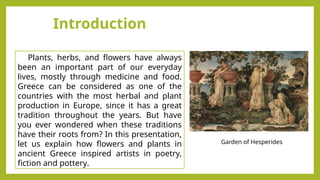
Garden of Hesperides
PLANTS IN ANCIENT
GREEK POETRY
Plants in Ancient Greek Poetry
• Plants are often mentioned in poems
by ancient Greek artists and occupy a
place in the structure of the poems.
• Ancient Greek poets and rhapsodists
use plants in their poems to show or
symbolize something, such as peace,
freedom, healing and many other
characteristic symbols
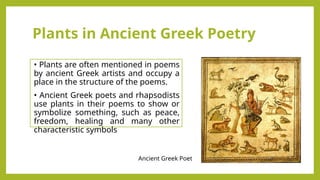
Ancient Greek Poet
Plants in Homer’s Poems
• Reference to plants is made in Homer's world-famous
epic poem, the Odyssey;
• Plants are mentioned in the rhapsody 11 in verses 235-
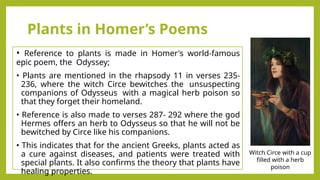
236, where the witch Circe bewitches the unsuspecting
companions of Odysseus with a magical herb poison so
that they forget their homeland.
• Reference is also made to verses 287- 292 where the god
Hermes offers an herb to Odysseus so that he will not be
bewitched by Circe like his companions.
• This indicates that for the ancient Greeks, plants acted as
a cure against diseases, and patients were treated with
special plants. It also confirms the theory that plants have
healing properties.
Witch Circe with a cup
filled with a herb
poison
PLANTS IN ANCIENT
GREEK VESSELS
Plants in Ancient Greek Vessels
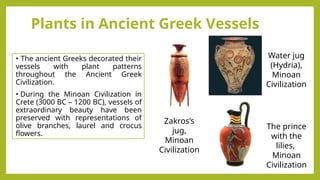
• The ancient Greeks decorated their
vessels with plant patterns
throughout the Ancient Greek
Civilization.
• During the Minoan Civilization in
Crete (3000 BC – 1200 BC), vessels of
extraordinary beauty have been
preserved with representations of
olive branches, laurel and crocus
flowers.
The prince
with the
lilies,
Minoan
Civilization
Zakros’s
jug,
Minoan
Civilization
Water jug
(Hydria),
Minoan
Civilization
Plants in Ancient Greek Vessels
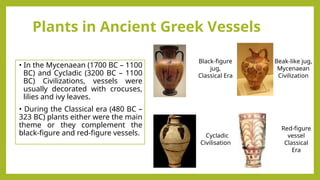
• In the Mycenaean (1700 BC – 1100
BC) and Cycladic (3200 BC – 1100
BC) Civilizations, vessels were
usually decorated with crocuses,
lilies and ivy leaves.
• During the Classical era (480 BC –
323 BC) plants either were the main
theme or they complement the
black-figure and red-figure vessels.
Beak-like jug,
Mycenaean
Civilization
Cycladic
Civilisation
Red-figure
vessel
Classical
Era
Black-figure
jug,
Classical Era
PLANTS IN ANCIENT
GREEK MURALS
Plants in Ancient Greek Murals
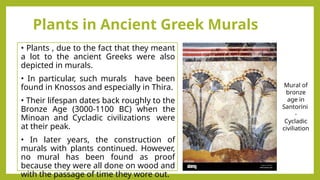
• Plants , due to the fact that they meant
a lot to the ancient Greeks were also
depicted in murals.
• In particular, such murals have been
found in Knossos and especially in Thira.
• Their lifespan dates back roughly to the
Bronze Age (3000-1100 BC) when the
Minoan and Cycladic civilizations were
at their peak.
• In later years, the construction of
murals with plants continued. However,
no mural has been found as proof
because they were all done on wood and
with the passage of time they wore out.
Mural of
bronze
age in
Santorini
-
Cycladic
civiliation
The Mural of Spring
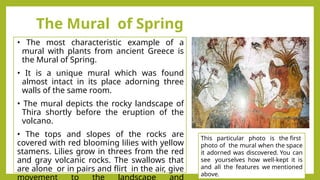
• The most characteristic example of a
mural with plants from ancient Greece is
the Mural of Spring.
• It is a unique mural which was found
almost intact in its place adorning three
walls of the same room.
• The mural depicts the rocky landscape of
Thira shortly before the eruption of the
volcano.
• The tops and slopes of the rocks are
covered with red blooming lilies with yellow
stamens. Lilies grow in threes from the red
and gray volcanic rocks. The swallows that
are alone or in pairs and flirt in the air, give
This particular photo is the first
photo of the mural when the space
it adorned was discovered. You can
see yourselves how well-kept it is
and all the features we mentioned
above.
PLANTS IN ANCIENT
GREEK SCULPTURING
Plants in Ancient Greek
Sculpturing
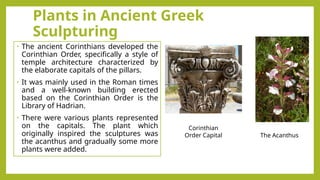
• The ancient Corinthians developed the
Corinthian Order, specifically a style of
temple architecture characterized by
the elaborate capitals of the pillars.
• It was mainly used in the Roman times
and a well-known building erected
based on the Corinthian Order is the
Library of Hadrian.
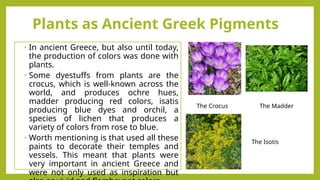
• There were various plants represented
on the capitals. The plant which
originally inspired the sculptures was
the acanthus and gradually some more
plants were added.
Corinthian
Order Capital The Acanthus
Plants as Ancient Greek Pigments
• In ancient Greece, but also until today,
the production of colors was done with
plants.
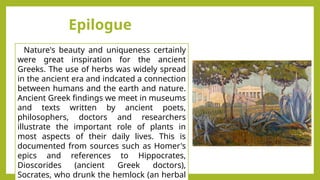
• Some dyestuffs from plants are the
crocus, which is well-known across the
world, and produces ochre hues,
madder producing red colors, isatis
producing blue dyes and orchil, a
species of lichen that produces a
variety of colors from rose to blue.
• Worth mentioning is that used all these
paints to decorate their temples and
vessels. This meant that plants were
very important in ancient Greece and
were not only used as inspiration but
The Crocus The Madder
The Isotis
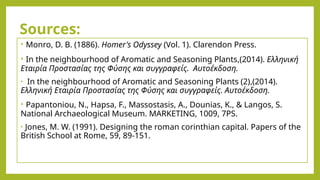
Nature's beauty and uniqueness certainly
were great inspiration for the ancient
Greeks. The use of herbs was widely spread
in the ancient era and indcated a connection
between humans and the earth and nature.
Ancient Greek findings we meet in museums
and texts written by ancient poets,
philosophers, doctors and researchers
illustrate the important role of plants in
most aspects of their daily lives. This is
documented from sources such as Homer's
epics and references to Hippocrates,
Dioscorides (ancient Greek doctors),
Socrates, who drunk the hemlock (an herbal
Epilogue
Sources:
• Monro, D. B. (1886). Homer's Odyssey (Vol. 1). Clarendon Press.
• Ιn the neighbourhood of Aromatic and Seasoning Plants,(2014). Ελληνική
Εταιρία Προστασίας της Φύσης και συγγραφείς. Aυτοέκδοση.
• Ιn the neighbourhood of Aromatic and Seasoning Plants (2),(2014).
Ελληνική Εταιρία Προστασίας της Φύσης και συγγραφείς. Aυτοέκδοση.
• Papantoniou, N., Hapsa, F., Massostasis, A., Dounias, K., & Langos, S.
National Archaeological Museum. MARKETING, 1009, 7PS.
• Jones, M. W. (1991). Designing the roman corinthian capital. Papers of the
British School at Rome, 59, 89-151.
Working
Group
 Ioannou Eleni
 Karampini Anastasia
 Sismanidis Konstantinos
 Spanos Konstantinos
 Spanos Dimitris
Zournatzi Ioanna
Thank you for your attention!

Presentation Erasmus Presentation Erasmus

  • 1.
  • 2.
    Contents • Introduction • Plantsin Ancient Greek Poetry • Plants in Ancient Greek Vases • Plants in Ancient Greek Murals • Epilogue
  • 3.
    Plants, herbs, andflowers have always been an important part of our everyday lives, mostly through medicine and food. Greece can be considered as one of the countries with the most herbal and plant production in Europe, since it has a great tradition throughout the years. But have you ever wondered when these traditions have their roots from? In this presentation, let us explain how flowers and plants in ancient Greece inspired artists in poetry, fiction and pottery. Introduction Garden of Hesperides
  • 4.
  • 5.
    Plants in AncientGreek Poetry • Plants are often mentioned in poems by ancient Greek artists and occupy a place in the structure of the poems. • Ancient Greek poets and rhapsodists use plants in their poems to show or symbolize something, such as peace, freedom, healing and many other characteristic symbols Ancient Greek Poet
  • 6.
    Plants in Homer’sPoems • Reference to plants is made in Homer's world-famous epic poem, the Odyssey; • Plants are mentioned in the rhapsody 11 in verses 235- 236, where the witch Circe bewitches the unsuspecting companions of Odysseus with a magical herb poison so that they forget their homeland. • Reference is also made to verses 287- 292 where the god Hermes offers an herb to Odysseus so that he will not be bewitched by Circe like his companions. • This indicates that for the ancient Greeks, plants acted as a cure against diseases, and patients were treated with special plants. It also confirms the theory that plants have healing properties. Witch Circe with a cup filled with a herb poison
  • 7.
  • 8.
    Plants in AncientGreek Vessels • The ancient Greeks decorated their vessels with plant patterns throughout the Ancient Greek Civilization. • During the Minoan Civilization in Crete (3000 BC – 1200 BC), vessels of extraordinary beauty have been preserved with representations of olive branches, laurel and crocus flowers. The prince with the lilies, Minoan Civilization Zakros’s jug, Minoan Civilization Water jug (Hydria), Minoan Civilization
  • 9.
    Plants in AncientGreek Vessels • In the Mycenaean (1700 BC – 1100 BC) and Cycladic (3200 BC – 1100 BC) Civilizations, vessels were usually decorated with crocuses, lilies and ivy leaves. • During the Classical era (480 BC – 323 BC) plants either were the main theme or they complement the black-figure and red-figure vessels. Beak-like jug, Mycenaean Civilization Cycladic Civilisation Red-figure vessel Classical Era Black-figure jug, Classical Era
  • 10.
  • 11.
    Plants in AncientGreek Murals • Plants , due to the fact that they meant a lot to the ancient Greeks were also depicted in murals. • In particular, such murals have been found in Knossos and especially in Thira. • Their lifespan dates back roughly to the Bronze Age (3000-1100 BC) when the Minoan and Cycladic civilizations were at their peak. • In later years, the construction of murals with plants continued. However, no mural has been found as proof because they were all done on wood and with the passage of time they wore out. Mural of bronze age in Santorini - Cycladic civiliation
  • 12.
    The Mural ofSpring • The most characteristic example of a mural with plants from ancient Greece is the Mural of Spring. • It is a unique mural which was found almost intact in its place adorning three walls of the same room. • The mural depicts the rocky landscape of Thira shortly before the eruption of the volcano. • The tops and slopes of the rocks are covered with red blooming lilies with yellow stamens. Lilies grow in threes from the red and gray volcanic rocks. The swallows that are alone or in pairs and flirt in the air, give This particular photo is the first photo of the mural when the space it adorned was discovered. You can see yourselves how well-kept it is and all the features we mentioned above.
  • 13.
  • 14.
    Plants in AncientGreek Sculpturing • The ancient Corinthians developed the Corinthian Order, specifically a style of temple architecture characterized by the elaborate capitals of the pillars. • It was mainly used in the Roman times and a well-known building erected based on the Corinthian Order is the Library of Hadrian. • There were various plants represented on the capitals. The plant which originally inspired the sculptures was the acanthus and gradually some more plants were added. Corinthian Order Capital The Acanthus
  • 15.
    Plants as AncientGreek Pigments • In ancient Greece, but also until today, the production of colors was done with plants. • Some dyestuffs from plants are the crocus, which is well-known across the world, and produces ochre hues, madder producing red colors, isatis producing blue dyes and orchil, a species of lichen that produces a variety of colors from rose to blue. • Worth mentioning is that used all these paints to decorate their temples and vessels. This meant that plants were very important in ancient Greece and were not only used as inspiration but The Crocus The Madder The Isotis
  • 16.
    Nature's beauty anduniqueness certainly were great inspiration for the ancient Greeks. The use of herbs was widely spread in the ancient era and indcated a connection between humans and the earth and nature. Ancient Greek findings we meet in museums and texts written by ancient poets, philosophers, doctors and researchers illustrate the important role of plants in most aspects of their daily lives. This is documented from sources such as Homer's epics and references to Hippocrates, Dioscorides (ancient Greek doctors), Socrates, who drunk the hemlock (an herbal Epilogue
  • 17.
    Sources: • Monro, D.B. (1886). Homer's Odyssey (Vol. 1). Clarendon Press. • Ιn the neighbourhood of Aromatic and Seasoning Plants,(2014). Ελληνική Εταιρία Προστασίας της Φύσης και συγγραφείς. Aυτοέκδοση. • Ιn the neighbourhood of Aromatic and Seasoning Plants (2),(2014). Ελληνική Εταιρία Προστασίας της Φύσης και συγγραφείς. Aυτοέκδοση. • Papantoniou, N., Hapsa, F., Massostasis, A., Dounias, K., & Langos, S. National Archaeological Museum. MARKETING, 1009, 7PS. • Jones, M. W. (1991). Designing the roman corinthian capital. Papers of the British School at Rome, 59, 89-151.
  • 18.
    Working Group  Ioannou Eleni Karampini Anastasia  Sismanidis Konstantinos  Spanos Konstantinos  Spanos Dimitris Zournatzi Ioanna Thank you for your attention!