Erasmus+ KA229
Play to learn, learn to play
Meeting in Romania 20.10.2019 – 26.10.2019
Title activity: Board games
2nd Junior High School of
Rethymno
Greece
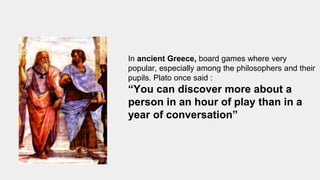
In ancient Greece, board games where very
popular, especially among the philosophers and their
pupils. Plato once said :
“You can discover more about a
person in an hour of play than in a
year of conversation”
Kids and older kids, plays ... from childhood and
from ancient times.
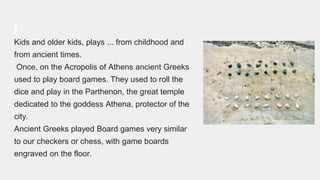
Once, on the Acropolis of Athens ancient Greeks
used to play board games. They used to roll the
dice and play in the Parthenon, the great temple
dedicated to the goddess Athena, protector of the
city.
Ancient Greeks played Board games very similar
to our checkers or chess, with game boards
engraved on the floor.
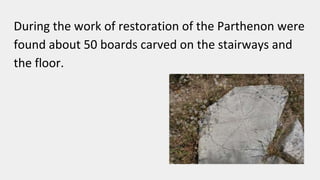
During the work of restoration of the Parthenon were
found about 50 boards carved on the stairways and
the floor.
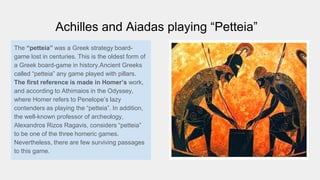
Achilles and Aiadas playing “Petteia”
The “petteia” was a Greek strategy board-
game lost in centuries. This is the oldest form of
a Greek board-game in history.Ancient Greeks
called “petteia” any game played with pillars.
The first reference is made in Homer’s work,
and according to Athimaios in the Odyssey,
where Homer refers to Penelope’s lazy
contenders as playing the “petteia”. In addition,
the well-known professor of archeology,
Alexandros Rizos Ragavis, considers “petteia”
to be one of the three homeric games.
Nevertheless, there are few surviving passages
to this game.
Petteia -Game Instructions
❖ The game is for 2 players.
❖ Use a standard 8×8 chess board with
black and white checkers that have two
different sides.
❖ Before the game begins the players
decide how many pieces each of them is
going to have. The allowed range is 8-12
pieces per player.
❖ The pieces start off the board.
Game Instructions
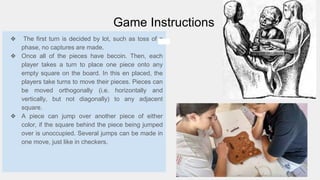
❖ The first turn is decided by lot, such as toss of a
phase, no captures are made.
❖ Once all of the pieces have becoin. Then, each
player takes a turn to place one piece onto any
empty square on the board. In this en placed, the
players take turns to move their pieces. Pieces can
be moved orthogonally (i.e. horizontally and
vertically, but not diagonally) to any adjacent
square.
❖ A piece can jump over another piece of either
color, if the square behind the piece being jumped
over is unoccupied. Several jumps can be made in
one move, just like in checkers.
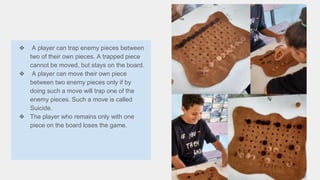
❖ A player can trap enemy pieces between
two of their own pieces. A trapped piece
cannot be moved, but stays on the board.
❖ A player can move their own piece
between two enemy pieces only if by
doing such a move will trap one of the
enemy pieces. Such a move is called
Suicide.
❖ The player who remains only with one
piece on the board loses the game.
The Trias
The first tic- tac- toe game of history
This is a simple strategy game that had been spread throughout the
ancient world and has still followers up today (is similar to the tic- tac-
toe).
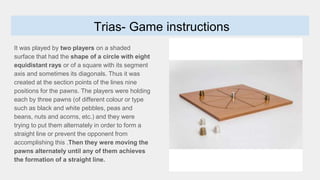
Trias- Game instructions
It was played by two players on a shaded
surface that had the shape of a circle with eight
equidistant rays or of a square with its segment
axis and sometimes its diagonals. Thus it was
created at the section points of the lines nine
positions for the pawns. The players were holding
each by three pawns (of different colour or type
such as black and white pebbles, peas and
beans, nuts and acorns, etc.) and they were
trying to put them alternately in order to form a
straight line or prevent the opponent from
accomplishing this .Then they were moving the
pawns alternately until any of them achieves
the formation of a straight line.

Greek Board Games

  • 1.
    Erasmus+ KA229 Play tolearn, learn to play Meeting in Romania 20.10.2019 – 26.10.2019 Title activity: Board games
  • 2.
    2nd Junior HighSchool of Rethymno Greece
  • 3.
    In ancient Greece,board games where very popular, especially among the philosophers and their pupils. Plato once said : “You can discover more about a person in an hour of play than in a year of conversation”
  • 4.
    Kids and olderkids, plays ... from childhood and from ancient times. Once, on the Acropolis of Athens ancient Greeks used to play board games. They used to roll the dice and play in the Parthenon, the great temple dedicated to the goddess Athena, protector of the city. Ancient Greeks played Board games very similar to our checkers or chess, with game boards engraved on the floor.
  • 5.
    During the workof restoration of the Parthenon were found about 50 boards carved on the stairways and the floor.
  • 6.
    Achilles and Aiadasplaying “Petteia” The “petteia” was a Greek strategy board- game lost in centuries. This is the oldest form of a Greek board-game in history.Ancient Greeks called “petteia” any game played with pillars. The first reference is made in Homer’s work, and according to Athimaios in the Odyssey, where Homer refers to Penelope’s lazy contenders as playing the “petteia”. In addition, the well-known professor of archeology, Alexandros Rizos Ragavis, considers “petteia” to be one of the three homeric games. Nevertheless, there are few surviving passages to this game.
  • 7.
    Petteia -Game Instructions ❖The game is for 2 players. ❖ Use a standard 8×8 chess board with black and white checkers that have two different sides. ❖ Before the game begins the players decide how many pieces each of them is going to have. The allowed range is 8-12 pieces per player. ❖ The pieces start off the board.
  • 8.
    Game Instructions ❖ Thefirst turn is decided by lot, such as toss of a phase, no captures are made. ❖ Once all of the pieces have becoin. Then, each player takes a turn to place one piece onto any empty square on the board. In this en placed, the players take turns to move their pieces. Pieces can be moved orthogonally (i.e. horizontally and vertically, but not diagonally) to any adjacent square. ❖ A piece can jump over another piece of either color, if the square behind the piece being jumped over is unoccupied. Several jumps can be made in one move, just like in checkers.
  • 9.
    ❖ A playercan trap enemy pieces between two of their own pieces. A trapped piece cannot be moved, but stays on the board. ❖ A player can move their own piece between two enemy pieces only if by doing such a move will trap one of the enemy pieces. Such a move is called Suicide. ❖ The player who remains only with one piece on the board loses the game.
  • 11.
    The Trias The firsttic- tac- toe game of history This is a simple strategy game that had been spread throughout the ancient world and has still followers up today (is similar to the tic- tac- toe).
  • 12.
    Trias- Game instructions Itwas played by two players on a shaded surface that had the shape of a circle with eight equidistant rays or of a square with its segment axis and sometimes its diagonals. Thus it was created at the section points of the lines nine positions for the pawns. The players were holding each by three pawns (of different colour or type such as black and white pebbles, peas and beans, nuts and acorns, etc.) and they were trying to put them alternately in order to form a straight line or prevent the opponent from accomplishing this .Then they were moving the pawns alternately until any of them achieves the formation of a straight line.