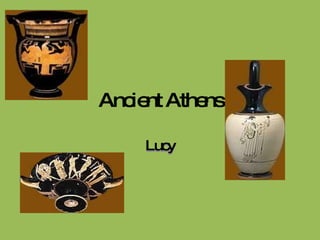
Ancient Athens Lucy Life in Ancient Greece Lucy
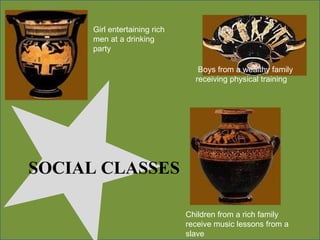
SOCIAL CLASSES Girl entertaining rich men at a drinking party Boys from a wealthy family receiving physical training Children from a rich family receive music lessons from a slave
Upper Class The upper class consists of citizens who do not do labour Have a job like trading, so they don’t have to be carrying boxes, etc This way they have more time for the government, war, literature, and philosophy Athenians believed there must be a leisure class or there would be no standard for good taste, no encouragement of the arts Civilization is based on the upper class
Middle Class The middle class is mostly tradesmen, and men of skill who are not citizens but live in Athens This class does not get to vote Freed slaves are also part of this class Many businessmen in the middle class live in Athens because their skill and rights are better off in there than elsewhere, which makes up for their lack of citizenship This class was also called the metics
Lower Class Slaves were in the lower class They are to serve their master at all times Slaves can be freed  They are not to be beaten Most Athenian families have at least one, rich families can have up to ten or more Even the poor citizen families have one or two slaves
HOUSES
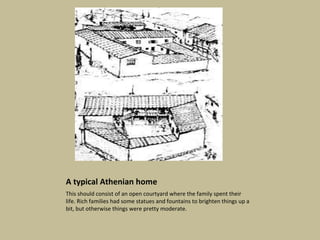
A typical Athenian home This should consist of an open courtyard where the family spent their life. Rich families had some statues and fountains to brighten things up a bit, but otherwise things were pretty moderate.
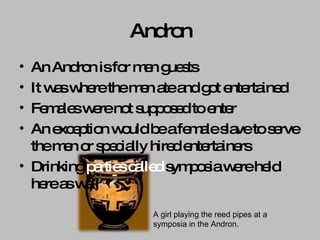
Andron An Andron is for men guests  It was where the men ate and got entertained Females were not supposed to enter An exception would be a female slave to serve the men or specially hired entertainers Drinking  parties called  symposia were held here as well A girl playing the reed pipes at a symposia in the Andron.
Store Room The store room was for storing food Food was generally in large jars Amphorae and pithoi are what the large jars are called Foods like olive oil, grain, barley, and wine
Kitchen and Bedrooms Bedrooms of the members of the family were simply furnished Wooden chests were what they used to store things, and the beds were like the couches in the Andron The kitchen was where the food was cooked Pots, dishes and eating utensils were simple and effective, decorated dishes were saved for special occasions
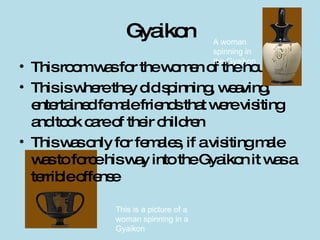
Gyaikon This room was for the women of the house This is where they did spinning, weaving, entertained female friends that were visiting and took care of their children This was only for females, if a visiting male was to force his way into the Gyaikon it was a terrible offense A woman spinning in the Gyaikon This is a picture of a woman spinning in a Gyaikon
Slave Rooms and Household People The slave rooms were small with little furniture Female slave rooms were around the Gyaikon and the male slave rooms were around the Andron Everyone in the household, including slaves, had a bedroom Slaves were in abundance: kids were taught by slaves, slaves helped the mistress of the house weave, sew and spin, slaves helped the man of the house do his work
How the Wealthy Lived The wealthy businessmen didn’t have too much luxuries as they didn’t set much store of them They might have:  more slaves  slightly bigger houses a statue or two, fountains and plants in the courtyard to brighten things up a bit Better entertainment at symposia This is a girl entertaining wealthy men at a symposia
FOOD
What They Ate The Athenians were big on olive oil, because Athena, their patron, created the olive tree for them and it is very useful for cooking They ate some pretty interesting food including caterpillars, pigs, thrushes, sea urchins, peacock eggs, lupin-flower seeds, grasshoppers, and turnips They had a special kind of porridge—a paste made up of ground up beans, lentils, and corn. They are all ground up in vegetable oil
Drinks and Meals Greeks thought that water was only for drinking when there is nothing else to drink—they did not think it was very healthy. So they drank wine They didn’t like people eating more than they needed—like what humans do in feasts today They went to each other’s houses for dinner a lot Greeks hated people who drank too much  Talking and efficient eating was what they did when they gathered around the table at dinnertime
Marriage Girls marry when they are 14 to 16 They marry the husband their father chooses for them Husbands are usually twice as old as their wives—they  marry when  they are 30 The father of the bride gives their daughter a, dowry—m oney, slaves  linen and goods . The picture above right is a bride and her groom The bride takes the dowry to her husband  Dowries are given because women were not valued as much as men and so fathers had to kind of “pay” for their daughters to be married into a family—the bride is seen as almost a burden This can ease the way a bit when daughters are marrying into wealthy families as well
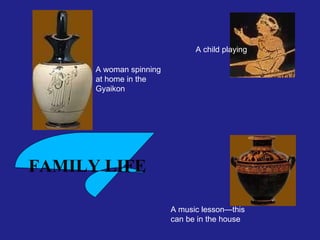
FAMILY LIFE  A woman spinning at home in the Gyaikon A child playing A music lesson—this can be in the house
Family Life All meals were cooked by slaves, as well as husband’s work Wives almost never left their domain, since it was not good for a married woman to be in the street to often Simple tailoring and clothes making was done by the wife of the house, assisted by slaves Leisure was an important part of family life—Athenians thought without it there would be no appreciation of the arts, no civilization. Therefore slaves took care of most household things
Who Was in Charge The wife of the house was in charge of directing the slaves to clean, cook, and do all sorts of housekeeping jobs The husband did the moneymaking, and also had an amount of command over his wife Kids didn’t have much say in serious issues but were more in command than slaves, unless they were ordered that they must obey a certain slave
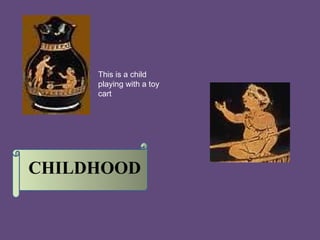
CHILDHOOD This is a child playing with a toy cart
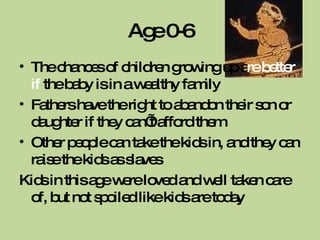
Age 0-6 The chances of children growing up a re better if  the baby is in a wealthy family Fathers have the right to abandon their son or daughter if they can’t afford them Other people can take the kids in, and they can raise the kids as slaves Kids in this age were loved and well taken care of, but not spoiled like kids are today
Age 6-14 Girls do not go to school Mothers teaches girls reading, writing, arithmetic, and the skills they need to run a household Boys go to school if they are from a wealthy family They learn reading, writing, poetry, arithmetic, drawing, and painting Education was strict, and there were punishments for kids who step out of line—some severe, some not. Parents took care of children.
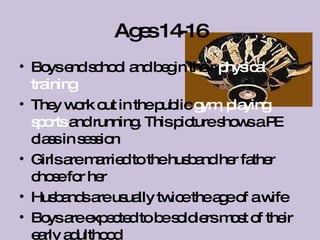
Ages 14-16 Boys end school and begin their  physical training They work out in the public  gym, playing sports  and running. This picture shows a PE class in session Girls are married to the husband her father chose for her Husbands are usually twice the age of a wife Boys are expected to be soldiers most of their early adulthood
Comparison! Canada childhood Women married from age 25 to 30 The living rate of babies is more than 90% Kids had luxuries such as electronics, running water, etc Girls and boys both went to school in a normal family Girls and boys both had opportunities to sports, arts, and music Athens childhood Girls married when they were 14-16 You only lived with good luck and even then it’s hard Toys and  amusements were moderate In normal families girls didn’t go to school Only boys did sports and arts and music were not there until they were adults
EDUCATION
School And Means of Education Boys went to school at the age of six, where they were taught arithmetic, reading, writing, drawing, poetry, and painting Girls were educated on similar things at home by their mother Slaves also taught kids at home for some families, and they accompanied boys to their schools not to help them but to punish them if they were misbehaving
Other Info Girls were taught weaving, sewing, and such as well as household chores and skills to run a household Boys school went from sunrise to sunset The boys’ accompanying slave who made them stay on task were most likely to be set free after the boy was finished school
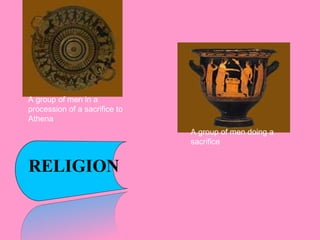
RELIGION A group of men doing a sacrifice A group of men in a procession of a sacrifice to Athena
Religion The Greeks were polytheistic, meaning they believed more than one god Greeks believed that there were gods for different things, and all the gods lived on Mount Olympus There was a queen of all gods and a king of all gods Different people sometimes worshipped different gods at different times for something they want to be done or they want a kind of help—ex: fishermen worshiping Poseidon, god of the sea Greeks were much set store of the gods, and Athens was actually named after the goddess of wisdom, Athena
Religion Spartans loved the war god Ares There were festivals in favour of Dionysus the wine god every year in Athens Arts were also influenced by the gods of Mount Olympus—one of Athens’ proud architecture buildings was the Parthenon, in honour of Athena Greeks believed that everything they do in the world will come to influence them when they die and enter the realm of the Underworld—the realm of Hades
Religion The twelve main gods included: Ares, god of war Zeus, god of the sky and lord of all gods Hera, queen of all goddesses and god of the marriage and the perfect family Dionysus, god of wine Hephaestus, god of the forges Athena, god of wisdom and war strategy Poseidon, god of the sea, horses, and earthquakes
Religion Demeter, goddess of the harvest Hermes, god of messengers and travelers Apollo, god of poetry, archery, prophecies, medicine, music, sun Artemis, goddess of archery, the moon, maidens, animals (especially baby animals) and childbirth Aphrodite, goddess of love and beauty
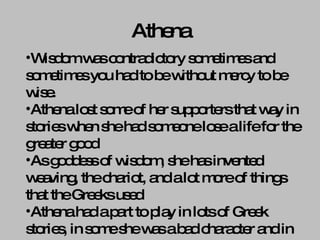
Athena Wisdom was contradictory sometimes and sometimes you had to be without mercy to be wise. Athena lost some of her supporters that way in stories when she had someone lose a life for the greater good As goddess of wisdom, she has invented weaving, the chariot, and a lot more of things that the Greeks used Athena had a part to play in lots of Greek stories, in some she was a bad character and in some she was good
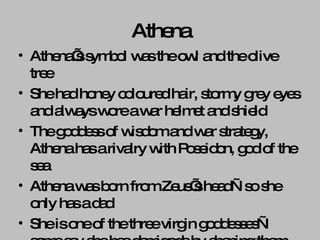
Athena Athena’s symbol was the owl and the olive tree She had honey coloured hair, stormy grey eyes and always wore a war helmet and shield The goddess of wisdom and war strategy, Athena has a rivalry with Poseidon, god of the sea Athena was born from Zeus’s head—so she only has a dad She is one of the three virgin goddesses—some say she has demigods by shaping them from her thoughts
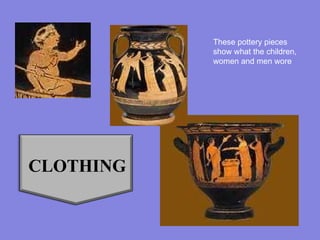
CLOTHING These pottery pieces show what the children, women and men wore
Men Men wore togas in pale colours like peach and white The togas were wrapped around the body and then fastened with in a way so that one shoulder was exposed The togas went down to the knees, like a skirt These togas were not too easy to move in Despite the difficulties of moving around, the togas proved to be quite breezy as the climate in Greece was pretty warm.  During the Olympics, which only men were allowed to attend and speculate, the men didn’t wear anything since the toga was very hard to run in
Women Women wore similar togas to the men, except the togas went down to the ankles There were different fashions of fastening the toga These togas were not too easy to move in Women also wore jewellery Even though women had jewellery on in her house, they had to be as inconspicuous as possible when out on the streets Men loved to have their wives adorned with jewellery at home, but not on the streets
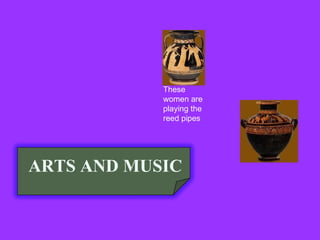
ARTS AND MUSIC These women are playing the reed pipes
Music There were all forms of music in Greece/Athens: Singing Lyres Reed pipes Choirs Music was seen as a sort of entertainment hired at parties and done at festivals Lots of festivals had choirs singing, or people playing reed pipes as a background noise
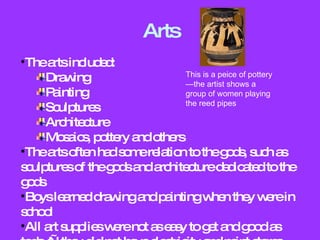
Arts The arts included: Drawing Painting Sculptures Architecture Mosaics, pottery and others The arts often had some relation to the gods, such as sculptures of the gods and architecture dedicated to the gods Boys learned drawing and painting when they were in school All art supplies were not as easy to get and good as today—they did not have electricity and paint stores This is a peice of pottery—the artist shows a group of women playing the reed pipes
Conclusion The Athenians eventually got defeated by others, having the Parthenon crushed into ruins The Greeks loved everything moderate and efficient, instead of big and grand The Athenians thought leisure was very important, without it there would be no appreciation of the arts, no civilization
Picture Bibliography All pictures of the pottery are from:  http://www.ancientgreece.co.uk/athens/explore/exp_set.html http://www.mlahanas.de/Greeks/Furniture/Furniture2.htm http://www.woodlands-junior.kent.sch.uk/Homework/greece/food.htm
Bibliography Van Loon, Hendrik;  The Story of Mankind;  BiblioBazaar, 2007 Deary, Terry;  Horrible Histories, The Groovy Greeks;  Schoolastic Children’s Books, 1996 http://www.ancientgreece.co.uk/athens/explore/exp_set.html

Lucy ancientathensnew.doc

  • 1.
    Ancient Athens LucyLife in Ancient Greece Lucy
  • 2.
    SOCIAL CLASSES Girlentertaining rich men at a drinking party Boys from a wealthy family receiving physical training Children from a rich family receive music lessons from a slave
  • 3.
    Upper Class Theupper class consists of citizens who do not do labour Have a job like trading, so they don’t have to be carrying boxes, etc This way they have more time for the government, war, literature, and philosophy Athenians believed there must be a leisure class or there would be no standard for good taste, no encouragement of the arts Civilization is based on the upper class
  • 4.
    Upper Class Theupper class consists of citizens who do not do labour Have a job like trading, so they don’t have to be carrying boxes, etc This way they have more time for the government, war, literature, and philosophy Athenians believed there must be a leisure class or there would be no standard for good taste, no encouragement of the arts Civilization is based on the upper class
  • 5.
    Middle Class Themiddle class is mostly tradesmen, and men of skill who are not citizens but live in Athens This class does not get to vote Freed slaves are also part of this class Many businessmen in the middle class live in Athens because their skill and rights are better off in there than elsewhere, which makes up for their lack of citizenship This class was also called the metics
  • 6.
    Lower Class Slaveswere in the lower class They are to serve their master at all times Slaves can be freed They are not to be beaten Most Athenian families have at least one, rich families can have up to ten or more Even the poor citizen families have one or two slaves
  • 7.
  • 8.
    A typical Athenianhome This should consist of an open courtyard where the family spent their life. Rich families had some statues and fountains to brighten things up a bit, but otherwise things were pretty moderate.
  • 9.
    Andron An Andronis for men guests It was where the men ate and got entertained Females were not supposed to enter An exception would be a female slave to serve the men or specially hired entertainers Drinking parties called symposia were held here as well A girl playing the reed pipes at a symposia in the Andron.
  • 10.
    Store Room Thestore room was for storing food Food was generally in large jars Amphorae and pithoi are what the large jars are called Foods like olive oil, grain, barley, and wine
  • 11.
    Kitchen and BedroomsBedrooms of the members of the family were simply furnished Wooden chests were what they used to store things, and the beds were like the couches in the Andron The kitchen was where the food was cooked Pots, dishes and eating utensils were simple and effective, decorated dishes were saved for special occasions
  • 12.
    Gyaikon This roomwas for the women of the house This is where they did spinning, weaving, entertained female friends that were visiting and took care of their children This was only for females, if a visiting male was to force his way into the Gyaikon it was a terrible offense A woman spinning in the Gyaikon This is a picture of a woman spinning in a Gyaikon
  • 13.
    Slave Rooms andHousehold People The slave rooms were small with little furniture Female slave rooms were around the Gyaikon and the male slave rooms were around the Andron Everyone in the household, including slaves, had a bedroom Slaves were in abundance: kids were taught by slaves, slaves helped the mistress of the house weave, sew and spin, slaves helped the man of the house do his work
  • 14.
    How the WealthyLived The wealthy businessmen didn’t have too much luxuries as they didn’t set much store of them They might have: more slaves slightly bigger houses a statue or two, fountains and plants in the courtyard to brighten things up a bit Better entertainment at symposia This is a girl entertaining wealthy men at a symposia
  • 15.
  • 16.
    What They AteThe Athenians were big on olive oil, because Athena, their patron, created the olive tree for them and it is very useful for cooking They ate some pretty interesting food including caterpillars, pigs, thrushes, sea urchins, peacock eggs, lupin-flower seeds, grasshoppers, and turnips They had a special kind of porridge—a paste made up of ground up beans, lentils, and corn. They are all ground up in vegetable oil
  • 17.
    Drinks and MealsGreeks thought that water was only for drinking when there is nothing else to drink—they did not think it was very healthy. So they drank wine They didn’t like people eating more than they needed—like what humans do in feasts today They went to each other’s houses for dinner a lot Greeks hated people who drank too much Talking and efficient eating was what they did when they gathered around the table at dinnertime
  • 18.
    Marriage Girls marrywhen they are 14 to 16 They marry the husband their father chooses for them Husbands are usually twice as old as their wives—they marry when they are 30 The father of the bride gives their daughter a, dowry—m oney, slaves linen and goods . The picture above right is a bride and her groom The bride takes the dowry to her husband Dowries are given because women were not valued as much as men and so fathers had to kind of “pay” for their daughters to be married into a family—the bride is seen as almost a burden This can ease the way a bit when daughters are marrying into wealthy families as well
  • 19.
    FAMILY LIFE A woman spinning at home in the Gyaikon A child playing A music lesson—this can be in the house
  • 20.
    Family Life Allmeals were cooked by slaves, as well as husband’s work Wives almost never left their domain, since it was not good for a married woman to be in the street to often Simple tailoring and clothes making was done by the wife of the house, assisted by slaves Leisure was an important part of family life—Athenians thought without it there would be no appreciation of the arts, no civilization. Therefore slaves took care of most household things
  • 21.
    Who Was inCharge The wife of the house was in charge of directing the slaves to clean, cook, and do all sorts of housekeeping jobs The husband did the moneymaking, and also had an amount of command over his wife Kids didn’t have much say in serious issues but were more in command than slaves, unless they were ordered that they must obey a certain slave
  • 22.
    CHILDHOOD This isa child playing with a toy cart
  • 23.
    Age 0-6 Thechances of children growing up a re better if the baby is in a wealthy family Fathers have the right to abandon their son or daughter if they can’t afford them Other people can take the kids in, and they can raise the kids as slaves Kids in this age were loved and well taken care of, but not spoiled like kids are today
  • 24.
    Age 6-14 Girlsdo not go to school Mothers teaches girls reading, writing, arithmetic, and the skills they need to run a household Boys go to school if they are from a wealthy family They learn reading, writing, poetry, arithmetic, drawing, and painting Education was strict, and there were punishments for kids who step out of line—some severe, some not. Parents took care of children.
  • 25.
    Ages 14-16 Boysend school and begin their physical training They work out in the public gym, playing sports and running. This picture shows a PE class in session Girls are married to the husband her father chose for her Husbands are usually twice the age of a wife Boys are expected to be soldiers most of their early adulthood
  • 26.
    Comparison! Canada childhoodWomen married from age 25 to 30 The living rate of babies is more than 90% Kids had luxuries such as electronics, running water, etc Girls and boys both went to school in a normal family Girls and boys both had opportunities to sports, arts, and music Athens childhood Girls married when they were 14-16 You only lived with good luck and even then it’s hard Toys and amusements were moderate In normal families girls didn’t go to school Only boys did sports and arts and music were not there until they were adults
  • 27.
  • 28.
    School And Meansof Education Boys went to school at the age of six, where they were taught arithmetic, reading, writing, drawing, poetry, and painting Girls were educated on similar things at home by their mother Slaves also taught kids at home for some families, and they accompanied boys to their schools not to help them but to punish them if they were misbehaving
  • 29.
    Other Info Girlswere taught weaving, sewing, and such as well as household chores and skills to run a household Boys school went from sunrise to sunset The boys’ accompanying slave who made them stay on task were most likely to be set free after the boy was finished school
  • 30.
    RELIGION A groupof men doing a sacrifice A group of men in a procession of a sacrifice to Athena
  • 31.
    Religion The Greekswere polytheistic, meaning they believed more than one god Greeks believed that there were gods for different things, and all the gods lived on Mount Olympus There was a queen of all gods and a king of all gods Different people sometimes worshipped different gods at different times for something they want to be done or they want a kind of help—ex: fishermen worshiping Poseidon, god of the sea Greeks were much set store of the gods, and Athens was actually named after the goddess of wisdom, Athena
  • 32.
    Religion Spartans lovedthe war god Ares There were festivals in favour of Dionysus the wine god every year in Athens Arts were also influenced by the gods of Mount Olympus—one of Athens’ proud architecture buildings was the Parthenon, in honour of Athena Greeks believed that everything they do in the world will come to influence them when they die and enter the realm of the Underworld—the realm of Hades
  • 33.
    Religion The twelvemain gods included: Ares, god of war Zeus, god of the sky and lord of all gods Hera, queen of all goddesses and god of the marriage and the perfect family Dionysus, god of wine Hephaestus, god of the forges Athena, god of wisdom and war strategy Poseidon, god of the sea, horses, and earthquakes
  • 34.
    Religion Demeter, goddessof the harvest Hermes, god of messengers and travelers Apollo, god of poetry, archery, prophecies, medicine, music, sun Artemis, goddess of archery, the moon, maidens, animals (especially baby animals) and childbirth Aphrodite, goddess of love and beauty
  • 35.
    Athena Wisdom wascontradictory sometimes and sometimes you had to be without mercy to be wise. Athena lost some of her supporters that way in stories when she had someone lose a life for the greater good As goddess of wisdom, she has invented weaving, the chariot, and a lot more of things that the Greeks used Athena had a part to play in lots of Greek stories, in some she was a bad character and in some she was good
  • 36.
    Athena Athena’s symbolwas the owl and the olive tree She had honey coloured hair, stormy grey eyes and always wore a war helmet and shield The goddess of wisdom and war strategy, Athena has a rivalry with Poseidon, god of the sea Athena was born from Zeus’s head—so she only has a dad She is one of the three virgin goddesses—some say she has demigods by shaping them from her thoughts
  • 37.
    CLOTHING These potterypieces show what the children, women and men wore
  • 38.
    Men Men woretogas in pale colours like peach and white The togas were wrapped around the body and then fastened with in a way so that one shoulder was exposed The togas went down to the knees, like a skirt These togas were not too easy to move in Despite the difficulties of moving around, the togas proved to be quite breezy as the climate in Greece was pretty warm. During the Olympics, which only men were allowed to attend and speculate, the men didn’t wear anything since the toga was very hard to run in
  • 39.
    Women Women woresimilar togas to the men, except the togas went down to the ankles There were different fashions of fastening the toga These togas were not too easy to move in Women also wore jewellery Even though women had jewellery on in her house, they had to be as inconspicuous as possible when out on the streets Men loved to have their wives adorned with jewellery at home, but not on the streets
  • 40.
    ARTS AND MUSICThese women are playing the reed pipes
  • 41.
    Music There wereall forms of music in Greece/Athens: Singing Lyres Reed pipes Choirs Music was seen as a sort of entertainment hired at parties and done at festivals Lots of festivals had choirs singing, or people playing reed pipes as a background noise
  • 42.
    Arts The artsincluded: Drawing Painting Sculptures Architecture Mosaics, pottery and others The arts often had some relation to the gods, such as sculptures of the gods and architecture dedicated to the gods Boys learned drawing and painting when they were in school All art supplies were not as easy to get and good as today—they did not have electricity and paint stores This is a peice of pottery—the artist shows a group of women playing the reed pipes
  • 43.
    Conclusion The Athenianseventually got defeated by others, having the Parthenon crushed into ruins The Greeks loved everything moderate and efficient, instead of big and grand The Athenians thought leisure was very important, without it there would be no appreciation of the arts, no civilization
  • 44.
    Picture Bibliography Allpictures of the pottery are from: http://www.ancientgreece.co.uk/athens/explore/exp_set.html http://www.mlahanas.de/Greeks/Furniture/Furniture2.htm http://www.woodlands-junior.kent.sch.uk/Homework/greece/food.htm
  • 45.
    Bibliography Van Loon,Hendrik; The Story of Mankind; BiblioBazaar, 2007 Deary, Terry; Horrible Histories, The Groovy Greeks; Schoolastic Children’s Books, 1996 http://www.ancientgreece.co.uk/athens/explore/exp_set.html