GRC Framework
What Is GRC?
• GRC, an acronym for Governance, Risk, and Compliance, encompasses an
organization's approach to managing these key processes. The term is defined by OCEG
(Open Compliance & Ethics Group) as "the integrated collection of capabilities that enable
an organization to reliably achieve objectives, address uncertainty, and act with integrity."
Now, let's take a closer look at each of these three elements individually:
• Governance refers to the oversight role and the process through which companies
manage compliance and mitigate business risks.
• Risk management allows an organization to assess all risks at the enterprise level,
implement relevant controls, and monitor mitigation actions in a structured manner.
• Compliance ensures that an organization has the necessary processes and internal
controls in place to meet the requirements set by governmental bodies, regulators,
industry mandates, or internal policies.
The Importance of GRC Tools
Implementing GRC (Governance, Risk, and Compliance) frameworks can be complex without the use of
specialized software. Many organizations opt to digitalize their GRC strategies, leveraging software solutions to
automate task tracking and store compliance information.
These software tools offer several benefits for streamlining GRC processes:
1.Automated enforcement of corporate policies that are programmed into the software.
2.Centralized storage of previous audits, allowing users to access the necessary financial data.
3.Automatic email or application notifications to stakeholders for task deadlines or urgent security issues.
Some popular GRC tools in the market are:
1.Fusion Risk Management
2.Logic Manager
3.Riskonnect
4.SAI360
5.ServiceNow GRC
GRC Trends
Integrated GRC: Organizations are moving towards integrated GRC frameworks that align
governance, risk management, and compliance activities for more efficient and effective
operations.
Automation and Technology: The use of advanced technologies such as artificial
intelligence, machine learning, and robotic process automation is revolutionizing GRC
processes, enabling better risk identification, mitigation, and compliance monitoring.
Data Analytics and Insights: GRC programs are leveraging data analytics to gain deeper
insights into risks, compliance gaps, and emerging threats, enabling proactive decision-
making.
Regulatory Complexity: Increasing regulatory complexity, evolving privacy laws, and
cybersecurity challenges are demanding organizations enhance their GRC capabilities to
ensure compliance and protect against reputational and financial risks.
Stakeholder Engagement: Greater emphasis is being placed on engaging stakeholders,
including board members, executives, employees, and external partners, to foster a culture
of compliance and risk awareness.
GRC Best Practices
Best practices for successful GRC implementation:
Establish Clear Governance Structure: Define roles, responsibilities, and
reporting lines to ensure accountability and oversight across the organization.
Risk-based Approach: Prioritize risks based on their potential impact and
likelihood and allocate resources accordingly for effective risk management.
Continuous Monitoring: Implement real-time monitoring mechanisms to promptly
detect and address compliance issues, reducing the risk of violations and penalties.
Training and Awareness: Foster a culture of compliance through regular training
programs and awareness campaigns, ensuring employees understand their
responsibilities and the importance of adhering to policies.
Collaboration and Communication: Encourage cross-functional collaboration
and communication channels to facilitate the sharing of risk information and
promote a coordinated response to emerging threats.
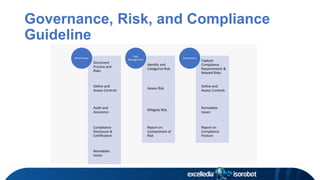
Governance, Risk, and Compliance
Guideline
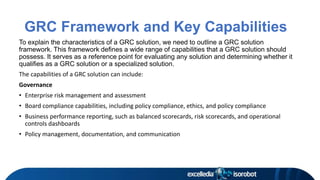
GRC Framework and Key Capabilities
To explain the characteristics of a GRC solution, we need to outline a GRC solution
framework. This framework defines a wide range of capabilities that a GRC solution should
possess. It serves as a reference point for evaluating any solution and determining whether it
qualifies as a GRC solution or a specialized solution.
The capabilities of a GRC solution can include:
Governance
• Enterprise risk management and assessment
• Board compliance capabilities, including policy compliance, ethics, and policy compliance
• Business performance reporting, such as balanced scorecards, risk scorecards, and operational
controls dashboards
• Policy management, documentation, and communication
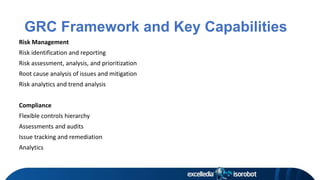
GRC Framework and Key Capabilities
Risk Management
Risk identification and reporting
Risk assessment, analysis, and prioritization
Root cause analysis of issues and mitigation
Risk analytics and trend analysis
Compliance
Flexible controls hierarchy
Assessments and audits
Issue tracking and remediation
Analytics
Summary
The ever-evolving regulatory landscape and growing business intricacies have prompted enterprises to
adopt risk and compliance measures throughout their organization. However, these initiatives often lack
coordination, resulting in inefficiency, redundant efforts, and a fragmented approach to risk
management. GRC systems offer a solution by enabling control, definition, enforcement, and
monitoring, thereby facilitating the integration of these initiatives and mitigating the aforementioned
challenges. MetricStream stands out as a leading provider of a comprehensive GRC solution, ensuring
organizations can effectively manage their risk and compliance requirements.
Isorobot offers a robust range of Governance, Risk, and Compliance (GRC) capabilities, catering to a wide array of
compliance initiatives. These include ethics and options compliance, SOX or internal audit compliance, as well as
cGMP or ISO 9000 compliance. The platform is further enhanced by incorporating valuable industry content
sourced from ComplianceOnline.com. Built on an enterprise-class infrastructure, Isorobot stands out as the most
compelling GRC solution available in the current market. To learn more, please visit our website at:
https://isorobot.io
Contact US
Website: https://isorobot.io
Email Id: isorobot@dezignspace.io
Governance Risk Compliance Framework.pptx

Governance Risk Compliance Framework.pptx

  • 1.
  • 2.
    What Is GRC? •GRC, an acronym for Governance, Risk, and Compliance, encompasses an organization's approach to managing these key processes. The term is defined by OCEG (Open Compliance & Ethics Group) as "the integrated collection of capabilities that enable an organization to reliably achieve objectives, address uncertainty, and act with integrity." Now, let's take a closer look at each of these three elements individually: • Governance refers to the oversight role and the process through which companies manage compliance and mitigate business risks. • Risk management allows an organization to assess all risks at the enterprise level, implement relevant controls, and monitor mitigation actions in a structured manner. • Compliance ensures that an organization has the necessary processes and internal controls in place to meet the requirements set by governmental bodies, regulators, industry mandates, or internal policies.
  • 3.
    The Importance ofGRC Tools Implementing GRC (Governance, Risk, and Compliance) frameworks can be complex without the use of specialized software. Many organizations opt to digitalize their GRC strategies, leveraging software solutions to automate task tracking and store compliance information. These software tools offer several benefits for streamlining GRC processes: 1.Automated enforcement of corporate policies that are programmed into the software. 2.Centralized storage of previous audits, allowing users to access the necessary financial data. 3.Automatic email or application notifications to stakeholders for task deadlines or urgent security issues. Some popular GRC tools in the market are: 1.Fusion Risk Management 2.Logic Manager 3.Riskonnect 4.SAI360 5.ServiceNow GRC
  • 4.
    GRC Trends Integrated GRC:Organizations are moving towards integrated GRC frameworks that align governance, risk management, and compliance activities for more efficient and effective operations. Automation and Technology: The use of advanced technologies such as artificial intelligence, machine learning, and robotic process automation is revolutionizing GRC processes, enabling better risk identification, mitigation, and compliance monitoring. Data Analytics and Insights: GRC programs are leveraging data analytics to gain deeper insights into risks, compliance gaps, and emerging threats, enabling proactive decision- making. Regulatory Complexity: Increasing regulatory complexity, evolving privacy laws, and cybersecurity challenges are demanding organizations enhance their GRC capabilities to ensure compliance and protect against reputational and financial risks. Stakeholder Engagement: Greater emphasis is being placed on engaging stakeholders, including board members, executives, employees, and external partners, to foster a culture of compliance and risk awareness.
  • 5.
    GRC Best Practices Bestpractices for successful GRC implementation: Establish Clear Governance Structure: Define roles, responsibilities, and reporting lines to ensure accountability and oversight across the organization. Risk-based Approach: Prioritize risks based on their potential impact and likelihood and allocate resources accordingly for effective risk management. Continuous Monitoring: Implement real-time monitoring mechanisms to promptly detect and address compliance issues, reducing the risk of violations and penalties. Training and Awareness: Foster a culture of compliance through regular training programs and awareness campaigns, ensuring employees understand their responsibilities and the importance of adhering to policies. Collaboration and Communication: Encourage cross-functional collaboration and communication channels to facilitate the sharing of risk information and promote a coordinated response to emerging threats.
  • 6.
    Governance, Risk, andCompliance Guideline
  • 7.
    GRC Framework andKey Capabilities To explain the characteristics of a GRC solution, we need to outline a GRC solution framework. This framework defines a wide range of capabilities that a GRC solution should possess. It serves as a reference point for evaluating any solution and determining whether it qualifies as a GRC solution or a specialized solution. The capabilities of a GRC solution can include: Governance • Enterprise risk management and assessment • Board compliance capabilities, including policy compliance, ethics, and policy compliance • Business performance reporting, such as balanced scorecards, risk scorecards, and operational controls dashboards • Policy management, documentation, and communication
  • 8.
    GRC Framework andKey Capabilities Risk Management Risk identification and reporting Risk assessment, analysis, and prioritization Root cause analysis of issues and mitigation Risk analytics and trend analysis Compliance Flexible controls hierarchy Assessments and audits Issue tracking and remediation Analytics
  • 9.
    Summary The ever-evolving regulatorylandscape and growing business intricacies have prompted enterprises to adopt risk and compliance measures throughout their organization. However, these initiatives often lack coordination, resulting in inefficiency, redundant efforts, and a fragmented approach to risk management. GRC systems offer a solution by enabling control, definition, enforcement, and monitoring, thereby facilitating the integration of these initiatives and mitigating the aforementioned challenges. MetricStream stands out as a leading provider of a comprehensive GRC solution, ensuring organizations can effectively manage their risk and compliance requirements. Isorobot offers a robust range of Governance, Risk, and Compliance (GRC) capabilities, catering to a wide array of compliance initiatives. These include ethics and options compliance, SOX or internal audit compliance, as well as cGMP or ISO 9000 compliance. The platform is further enhanced by incorporating valuable industry content sourced from ComplianceOnline.com. Built on an enterprise-class infrastructure, Isorobot stands out as the most compelling GRC solution available in the current market. To learn more, please visit our website at: https://isorobot.io
  • 10.