#
Gravity based foundations for the Rødsand 2
offshore wind farm, Denmark
1
9 nov 2010
Gravity based foundations for the Rødsand 2 offshore wind farm, Denmark
ISFOG 2010, Perth
Presentation by:
Jakob Hausgaard Lyngs, COWI
Denmark
Co-authors:
Lone Krogh
Jørgen S. Steenfelt
COWI, Denmark
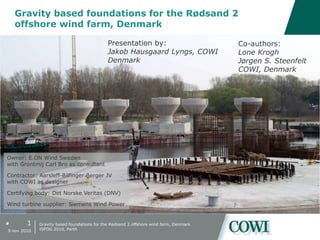
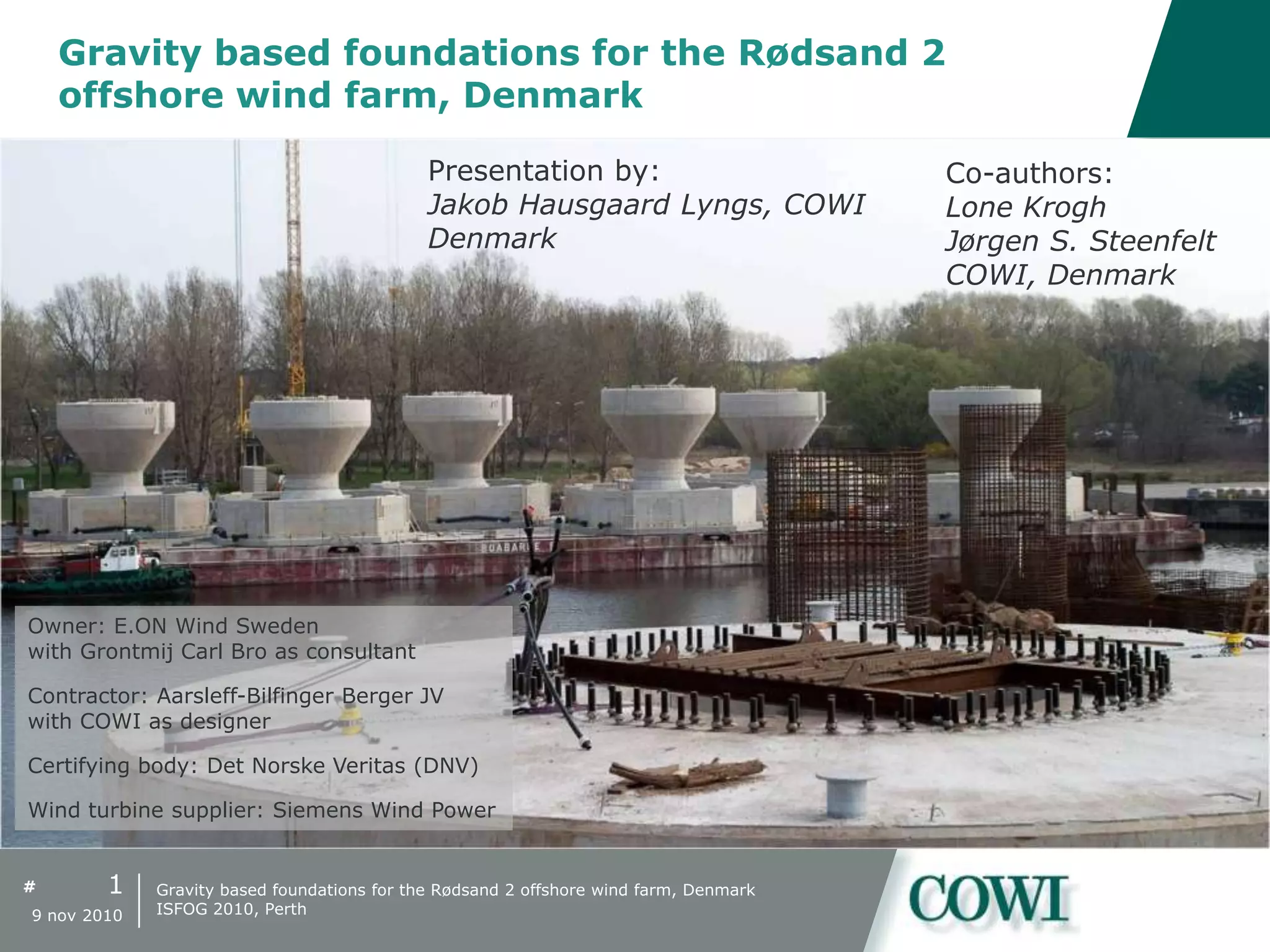
Owner: E.ON Wind Sweden
with Grontmij Carl Bro as consultant
Contractor: Aarsleff-Bilfinger Berger JV
with COWI as designer
Certifying body: Det Norske Veritas (DNV)
Wind turbine supplier: Siemens Wind Power
#
Location
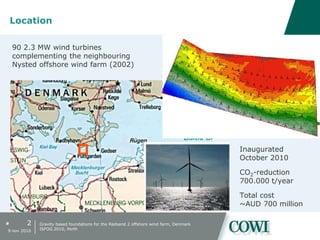
90 2.3 MW wind turbines
complementing the neighbouring
Nysted offshore wind farm (2002)
Inaugurated
October 2010
CO2-reduction
700.000 t/year
Total cost
~AUD 700 million
2
9 nov 2010
Gravity based foundations for the Rødsand 2 offshore wind farm, Denmark
ISFOG 2010, Perth
#
Rødsand 2 foundation geometry
3
9 nov 2010
Gravity based foundations for the Rødsand 2 offshore wind farm, Denmark
ISFOG 2010, Perth
Gravity based foundation most
favourable
1300 t pre-fabricated RC caissons
with:
• Octagonal base, width 17 m
• Cylindrical shaft (length variable)
• Conical shape to reduce ice loads
• Hyperite stones in ballast chambers
(up to 800 t)
• Sand in shaft to protect J-tubes
Same geometry for all 90 foundations
#
Design procedure and special challenges
Traditional limit state design:
 Bearing capacity
 Sliding capacity
 Differential settlements and tilt
Special challenges:
• Soil-foundation-wind turbine
dynamic with loads and system
natural frequencies being mutually
dependent
• Non-linear soil stiffness –
load iterations a must
• Dominating horizontal loads
• Sliding capacity: remoulded soil
• High ballast dead weight – minimum
structural dead weight
• Extent and quality of the
geotechnical investigations
• Tight schedule due to UN COP15
meeting on climate change
4
9 nov 2010
Gravity based foundations for the Rødsand 2 offshore wind farm, Denmark
ISFOG 2010, Perth
#
Ground conditions and geotechnical investigations
Owner's Design Basis: Danish Clay till, su=200 kPa
Original ground investigation (2007):
• 183 CPTs to a depth of 2.9 ± 2.4 m;
86 nos. outside footprints
• 80 geotechnical boreholes;
majority to a depth of 7 m
• 200 UU tests; in lieu of field vane testing
• 16 valid triaxial CAU tests
Supplementary ground investigations by Contractor
(2009):
• 31 geotechnical boreholes with SPT
to a depth of 15-20 m
• 6 triaxial CAU tests and oedometer tests
Need for confirmation
of strength at depths!
5
9 nov 2010
Gravity based foundations for the Rødsand 2 offshore wind farm, Denmark
ISFOG 2010, Perth
Row 2
-12
-10
-8
-6
0 500 1000 1500
cu [kPa]
Level
[m]
Su [kPa]
#
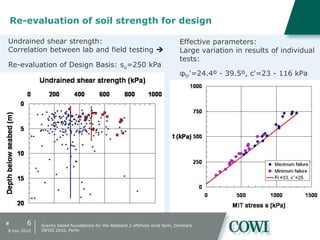
Re-evaluation of soil strength for design
Effective parameters:
Large variation in results of individual
tests:
φtr'=24.4º - 39.5º, c'=23 - 116 kPa
6
9 nov 2010
Gravity based foundations for the Rødsand 2 offshore wind farm, Denmark
ISFOG 2010, Perth
Undrained shear strength:
Correlation between lab and field testing 
Re-evaluation of Design Basis: su=250 kPa
#
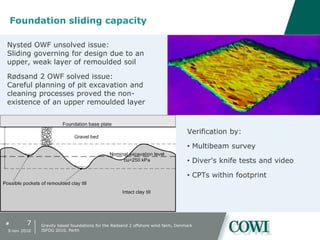
Foundation sliding capacity
Nysted OWF unsolved issue:
Sliding governing for design due to an
upper, weak layer of remoulded soil
Rødsand 2 OWF solved issue:
Careful planning of pit excavation and
cleaning processes proved the non-
existence of an upper remoulded layer
Verification by:
• Multibeam survey
• Diver's knife tests and video
• CPTs within footprint
7
9 nov 2010
Gravity based foundations for the Rødsand 2 offshore wind farm, Denmark
ISFOG 2010, Perth
#
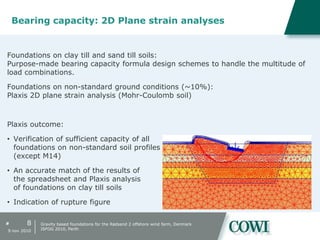
Bearing capacity: 2D Plane strain analyses
Foundations on clay till and sand till soils:
Purpose-made bearing capacity formula design schemes to handle the multitude of
load combinations.
Foundations on non-standard ground conditions (~10%):
Plaxis 2D plane strain analysis (Mohr-Coulomb soil)
Plaxis outcome:
• Verification of sufficient capacity of all
foundations on non-standard soil profiles
(except M14)
• An accurate match of the results of
the spreadsheet and Plaxis analysis
of foundations on clay till soils
• Indication of rupture figure
8
9 nov 2010
Gravity based foundations for the Rødsand 2 offshore wind farm, Denmark
ISFOG 2010, Perth
#
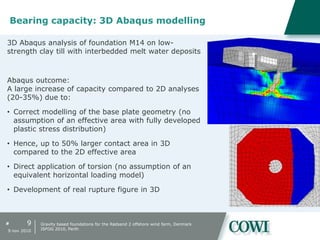
Bearing capacity: 3D Abaqus modelling
3D Abaqus analysis of foundation M14 on low-
strength clay till with interbedded melt water deposits
Abaqus outcome:
A large increase of capacity compared to 2D analyses
(20-35%) due to:
• Correct modelling of the base plate geometry (no
assumption of an effective area with fully developed
plastic stress distribution)
• Hence, up to 50% larger contact area in 3D
compared to the 2D effective area
• Direct application of torsion (no assumption of an
equivalent horizontal loading model)
• Development of real rupture figure in 3D
9
9 nov 2010
Gravity based foundations for the Rødsand 2 offshore wind farm, Denmark
ISFOG 2010, Perth
#
Summary
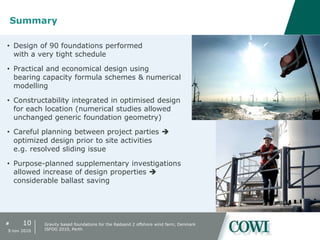
• Design of 90 foundations performed
with a very tight schedule
• Practical and economical design using
bearing capacity formula schemes & numerical
modelling
• Constructability integrated in optimised design
for each location (numerical studies allowed
unchanged generic foundation geometry)
• Careful planning between project parties 
optimized design prior to site activities
e.g. resolved sliding issue
• Purpose-planned supplementary investigations
allowed increase of design properties 
considerable ballast saving
10
9 nov 2010
Gravity based foundations for the Rødsand 2 offshore wind farm, Denmark
ISFOG 2010, Perth

Gravity based foundations for the Rødsand 2 offshore wind farm, Denmark

  • 1.
    # Gravity based foundationsfor the Rødsand 2 offshore wind farm, Denmark 1 9 nov 2010 Gravity based foundations for the Rødsand 2 offshore wind farm, Denmark ISFOG 2010, Perth Presentation by: Jakob Hausgaard Lyngs, COWI Denmark Co-authors: Lone Krogh Jørgen S. Steenfelt COWI, Denmark Owner: E.ON Wind Sweden with Grontmij Carl Bro as consultant Contractor: Aarsleff-Bilfinger Berger JV with COWI as designer Certifying body: Det Norske Veritas (DNV) Wind turbine supplier: Siemens Wind Power
  • 2.
    # Location 90 2.3 MWwind turbines complementing the neighbouring Nysted offshore wind farm (2002) Inaugurated October 2010 CO2-reduction 700.000 t/year Total cost ~AUD 700 million 2 9 nov 2010 Gravity based foundations for the Rødsand 2 offshore wind farm, Denmark ISFOG 2010, Perth
  • 3.
    # Rødsand 2 foundationgeometry 3 9 nov 2010 Gravity based foundations for the Rødsand 2 offshore wind farm, Denmark ISFOG 2010, Perth Gravity based foundation most favourable 1300 t pre-fabricated RC caissons with: • Octagonal base, width 17 m • Cylindrical shaft (length variable) • Conical shape to reduce ice loads • Hyperite stones in ballast chambers (up to 800 t) • Sand in shaft to protect J-tubes Same geometry for all 90 foundations
  • 4.
    # Design procedure andspecial challenges Traditional limit state design:  Bearing capacity  Sliding capacity  Differential settlements and tilt Special challenges: • Soil-foundation-wind turbine dynamic with loads and system natural frequencies being mutually dependent • Non-linear soil stiffness – load iterations a must • Dominating horizontal loads • Sliding capacity: remoulded soil • High ballast dead weight – minimum structural dead weight • Extent and quality of the geotechnical investigations • Tight schedule due to UN COP15 meeting on climate change 4 9 nov 2010 Gravity based foundations for the Rødsand 2 offshore wind farm, Denmark ISFOG 2010, Perth
  • 5.
    # Ground conditions andgeotechnical investigations Owner's Design Basis: Danish Clay till, su=200 kPa Original ground investigation (2007): • 183 CPTs to a depth of 2.9 ± 2.4 m; 86 nos. outside footprints • 80 geotechnical boreholes; majority to a depth of 7 m • 200 UU tests; in lieu of field vane testing • 16 valid triaxial CAU tests Supplementary ground investigations by Contractor (2009): • 31 geotechnical boreholes with SPT to a depth of 15-20 m • 6 triaxial CAU tests and oedometer tests Need for confirmation of strength at depths! 5 9 nov 2010 Gravity based foundations for the Rødsand 2 offshore wind farm, Denmark ISFOG 2010, Perth Row 2 -12 -10 -8 -6 0 500 1000 1500 cu [kPa] Level [m] Su [kPa]
  • 6.
    # Re-evaluation of soilstrength for design Effective parameters: Large variation in results of individual tests: φtr'=24.4º - 39.5º, c'=23 - 116 kPa 6 9 nov 2010 Gravity based foundations for the Rødsand 2 offshore wind farm, Denmark ISFOG 2010, Perth Undrained shear strength: Correlation between lab and field testing  Re-evaluation of Design Basis: su=250 kPa
  • 7.
    # Foundation sliding capacity NystedOWF unsolved issue: Sliding governing for design due to an upper, weak layer of remoulded soil Rødsand 2 OWF solved issue: Careful planning of pit excavation and cleaning processes proved the non- existence of an upper remoulded layer Verification by: • Multibeam survey • Diver's knife tests and video • CPTs within footprint 7 9 nov 2010 Gravity based foundations for the Rødsand 2 offshore wind farm, Denmark ISFOG 2010, Perth
  • 8.
    # Bearing capacity: 2DPlane strain analyses Foundations on clay till and sand till soils: Purpose-made bearing capacity formula design schemes to handle the multitude of load combinations. Foundations on non-standard ground conditions (~10%): Plaxis 2D plane strain analysis (Mohr-Coulomb soil) Plaxis outcome: • Verification of sufficient capacity of all foundations on non-standard soil profiles (except M14) • An accurate match of the results of the spreadsheet and Plaxis analysis of foundations on clay till soils • Indication of rupture figure 8 9 nov 2010 Gravity based foundations for the Rødsand 2 offshore wind farm, Denmark ISFOG 2010, Perth
  • 9.
    # Bearing capacity: 3DAbaqus modelling 3D Abaqus analysis of foundation M14 on low- strength clay till with interbedded melt water deposits Abaqus outcome: A large increase of capacity compared to 2D analyses (20-35%) due to: • Correct modelling of the base plate geometry (no assumption of an effective area with fully developed plastic stress distribution) • Hence, up to 50% larger contact area in 3D compared to the 2D effective area • Direct application of torsion (no assumption of an equivalent horizontal loading model) • Development of real rupture figure in 3D 9 9 nov 2010 Gravity based foundations for the Rødsand 2 offshore wind farm, Denmark ISFOG 2010, Perth
  • 10.
    # Summary • Design of90 foundations performed with a very tight schedule • Practical and economical design using bearing capacity formula schemes & numerical modelling • Constructability integrated in optimised design for each location (numerical studies allowed unchanged generic foundation geometry) • Careful planning between project parties  optimized design prior to site activities e.g. resolved sliding issue • Purpose-planned supplementary investigations allowed increase of design properties  considerable ballast saving 10 9 nov 2010 Gravity based foundations for the Rødsand 2 offshore wind farm, Denmark ISFOG 2010, Perth

Editor's Notes