BWH 10/04 AQA 13.3.1-6 1
Gravity and Circular Motion
Revision
AQA syllabus A
Section 13.3.1-6
B.W.Hughes
BWH 10/04 AQA 13.3.1-6 2
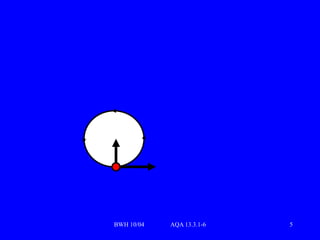
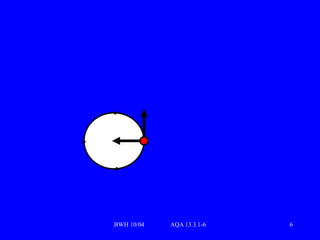
Circular motion
• When an object undergoes circular motion
it must experience a
centripetal force
• This produces an acceleration
towards the centre of the circle
BWH 10/04 AQA 13.3.1-6 3
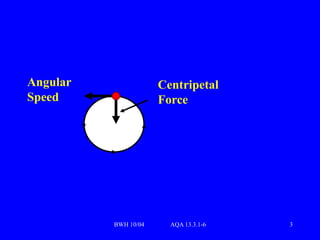
Angular
Speed
Centripetal
Force
BWH 10/04 AQA 13.3.1-6 4
BWH 10/04 AQA 13.3.1-6 5
BWH 10/04 AQA 13.3.1-6 6
BWH 10/04 AQA 13.3.1-6 7
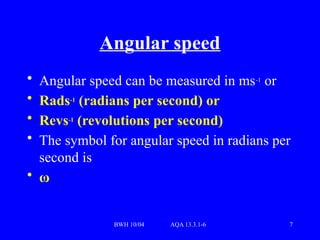
Angular speed
• Angular speed can be measured in ms-1
or
• Rads-1
(radians per second) or
• Revs-1
(revolutions per second)
• The symbol for angular speed in radians per
second is
• ω
BWH 10/04 AQA 13.3.1-6 8
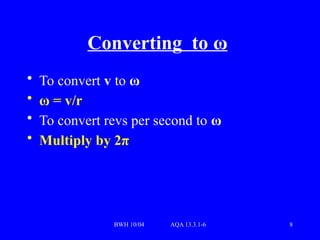
Converting to ω
• To convert v to ω
• ω = v/r
• To convert revs per second to ω
• Multiply by 2π
BWH 10/04 AQA 13.3.1-6 9
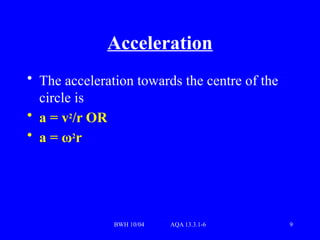
Acceleration
• The acceleration towards the centre of the
circle is
• a = v2
/r OR
• a = ω2
r
BWH 10/04 AQA 13.3.1-6 10
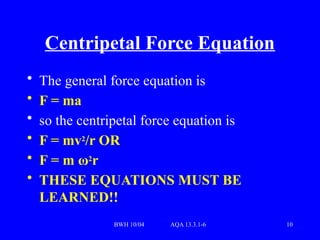
Centripetal Force Equation
• The general force equation is
• F = ma
• so the centripetal force equation is
• F = mv2
/r OR
• F = m ω2
r
• THESE EQUATIONS MUST BE
LEARNED!!
BWH 10/04 AQA 13.3.1-6 11
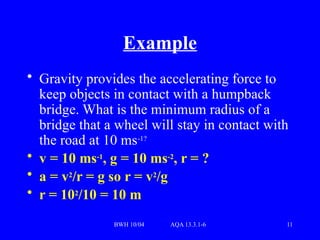
Example
• Gravity provides the accelerating force to
keep objects in contact with a humpback
bridge. What is the minimum radius of a
bridge that a wheel will stay in contact with
the road at 10 ms-1?
• v = 10 ms-1
, g = 10 ms-2
, r = ?
• a = v2
/r = g so r = v2
/g
• r = 102
/10 = 10 m
BWH 10/04 AQA 13.3.1-6 12
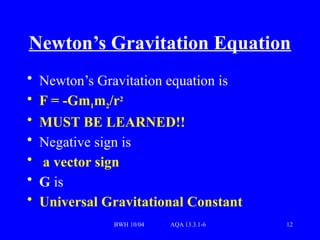
Newton’s Gravitation Equation
• Newton’s Gravitation equation is
• F = -Gm1m2/r2
• MUST BE LEARNED!!
• Negative sign is
• a vector sign
• G is
• Universal Gravitational Constant
BWH 10/04 AQA 13.3.1-6 13
More about the equation
• m1 and m2 are
• the two gravitating masses
• r is
• the distance between their centres of
gravity
• The equation is an example of an
• Inverse square law
BWH 10/04 AQA 13.3.1-6 14
Gravitational field
• A gravitational field is an area of space
subject to the force of gravity. Due to the
inverse square law relationship, the strength
of the field fades quickly with distance.
• The field strength is defined as
• The force per unit mass OR
• g = F/m in Nkg-1
BWH 10/04 AQA 13.3.1-6 15
Radial Field
• Planets and other spherical objects exhibit
radial fields, that is the field fades along the
radius extending into space from the centre
of the planet according to the equation
• g = -GM/r2
• Where M is
• the mass of the planet
BWH 10/04 AQA 13.3.1-6 16
Gravitational Potential
• Potential is a measure of the energy in the field at
a point compared to an infinite distance away.
• The zero of potential is defined at
• Infinity
• Potential at a point is
• the work done to move unit mass from infinity
to that point. It has a negative value.
• The equation for potential in a radial field is
• V = -GM/r
BWH 10/04 AQA 13.3.1-6 17
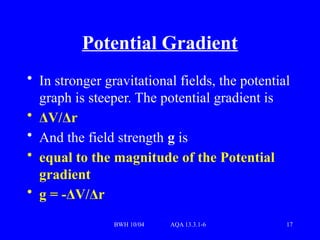
Potential Gradient
• In stronger gravitational fields, the potential
graph is steeper. The potential gradient is
• ΔV/Δr
• And the field strength g is
• equal to the magnitude of the Potential
gradient
• g = -ΔV/Δr
BWH 10/04 AQA 13.3.1-6 18
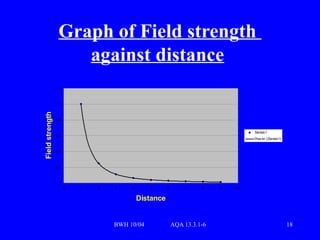
Graph of Field strength
against distance
0
0.2
0.4
0.6
0.8
1
1.2
0 1 2 3 4 5 6 7 8 9 10
Distance
Field
strength
Series1
Pow er (Series1)
BWH 10/04 AQA 13.3.1-6 19
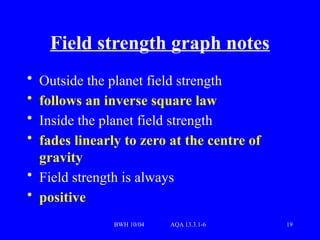
Field strength graph notes
• Outside the planet field strength
• follows an inverse square law
• Inside the planet field strength
• fades linearly to zero at the centre of
gravity
• Field strength is always
• positive
BWH 10/04 AQA 13.3.1-6 20
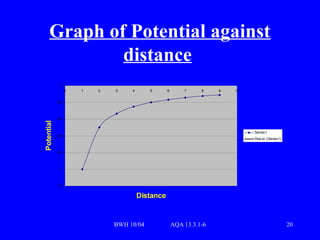
Graph of Potential against
distance
-1.2
-1
-0.8
-0.6
-0.4
-0.2
0
0 1 2 3 4 5 6 7 8 9 10
Distance
Potential
Series1
Pow er (Series1)
BWH 10/04 AQA 13.3.1-6 21
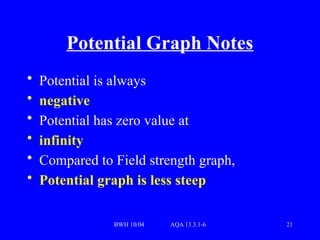
Potential Graph Notes
• Potential is always
• negative
• Potential has zero value at
• infinity
• Compared to Field strength graph,
• Potential graph is less steep
BWH 10/04 AQA 13.3.1-6 22
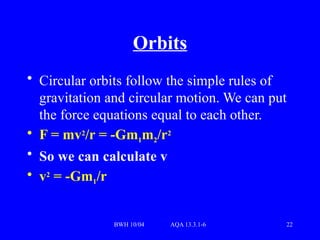
Orbits
• Circular orbits follow the simple rules of
gravitation and circular motion. We can put
the force equations equal to each other.
• F = mv2
/r = -Gm1m2/r2
• So we can calculate v
• v2
= -Gm1/r
BWH 10/04 AQA 13.3.1-6 23
More orbital mechanics
• Period T is the time for a complete orbit, a
year. It is given by the formula.
• T = 2π / ω
• and should be calculated in
• seconds
BWH 10/04 AQA 13.3.1-6 24
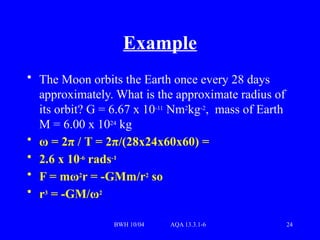
Example
• The Moon orbits the Earth once every 28 days
approximately. What is the approximate radius of
its orbit? G = 6.67 x 10⁻¹¹
Nm2
kg-2
, mass of Earth
M = 6.00 x 1024
kg
• ω = 2π / T = 2π/(28x24x60x60) =
• 2.6 x 10⁻⁶
rads-1
• F = mω2
r = -GMm/r2
so
• r3
= -GM/ω2
BWH 10/04 AQA 13.3.1-6 25
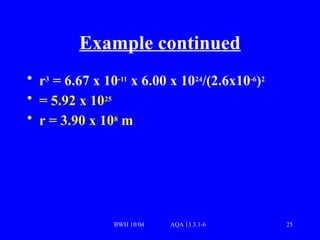
Example continued
• r3
= 6.67 x 10-11
x 6.00 x 1024
/(2.6x10-6
)2
• = 5.92 x 1025
• r = 3.90 x 10⁸
m
BWH 10/04 AQA 13.3.1-6 26
The End!
• With these equations we can reach the
stars!

Gravity-and-Circular-Motion-Revision.pptx

  • 1.
    BWH 10/04 AQA13.3.1-6 1 Gravity and Circular Motion Revision AQA syllabus A Section 13.3.1-6 B.W.Hughes
  • 2.
    BWH 10/04 AQA13.3.1-6 2 Circular motion • When an object undergoes circular motion it must experience a centripetal force • This produces an acceleration towards the centre of the circle
  • 3.
    BWH 10/04 AQA13.3.1-6 3 Angular Speed Centripetal Force
  • 4.
    BWH 10/04 AQA13.3.1-6 4
  • 5.
    BWH 10/04 AQA13.3.1-6 5
  • 6.
    BWH 10/04 AQA13.3.1-6 6
  • 7.
    BWH 10/04 AQA13.3.1-6 7 Angular speed • Angular speed can be measured in ms-1 or • Rads-1 (radians per second) or • Revs-1 (revolutions per second) • The symbol for angular speed in radians per second is • ω
  • 8.
    BWH 10/04 AQA13.3.1-6 8 Converting to ω • To convert v to ω • ω = v/r • To convert revs per second to ω • Multiply by 2π
  • 9.
    BWH 10/04 AQA13.3.1-6 9 Acceleration • The acceleration towards the centre of the circle is • a = v2 /r OR • a = ω2 r
  • 10.
    BWH 10/04 AQA13.3.1-6 10 Centripetal Force Equation • The general force equation is • F = ma • so the centripetal force equation is • F = mv2 /r OR • F = m ω2 r • THESE EQUATIONS MUST BE LEARNED!!
  • 11.
    BWH 10/04 AQA13.3.1-6 11 Example • Gravity provides the accelerating force to keep objects in contact with a humpback bridge. What is the minimum radius of a bridge that a wheel will stay in contact with the road at 10 ms-1? • v = 10 ms-1 , g = 10 ms-2 , r = ? • a = v2 /r = g so r = v2 /g • r = 102 /10 = 10 m
  • 12.
    BWH 10/04 AQA13.3.1-6 12 Newton’s Gravitation Equation • Newton’s Gravitation equation is • F = -Gm1m2/r2 • MUST BE LEARNED!! • Negative sign is • a vector sign • G is • Universal Gravitational Constant
  • 13.
    BWH 10/04 AQA13.3.1-6 13 More about the equation • m1 and m2 are • the two gravitating masses • r is • the distance between their centres of gravity • The equation is an example of an • Inverse square law
  • 14.
    BWH 10/04 AQA13.3.1-6 14 Gravitational field • A gravitational field is an area of space subject to the force of gravity. Due to the inverse square law relationship, the strength of the field fades quickly with distance. • The field strength is defined as • The force per unit mass OR • g = F/m in Nkg-1
  • 15.
    BWH 10/04 AQA13.3.1-6 15 Radial Field • Planets and other spherical objects exhibit radial fields, that is the field fades along the radius extending into space from the centre of the planet according to the equation • g = -GM/r2 • Where M is • the mass of the planet
  • 16.
    BWH 10/04 AQA13.3.1-6 16 Gravitational Potential • Potential is a measure of the energy in the field at a point compared to an infinite distance away. • The zero of potential is defined at • Infinity • Potential at a point is • the work done to move unit mass from infinity to that point. It has a negative value. • The equation for potential in a radial field is • V = -GM/r
  • 17.
    BWH 10/04 AQA13.3.1-6 17 Potential Gradient • In stronger gravitational fields, the potential graph is steeper. The potential gradient is • ΔV/Δr • And the field strength g is • equal to the magnitude of the Potential gradient • g = -ΔV/Δr
  • 18.
    BWH 10/04 AQA13.3.1-6 18 Graph of Field strength against distance 0 0.2 0.4 0.6 0.8 1 1.2 0 1 2 3 4 5 6 7 8 9 10 Distance Field strength Series1 Pow er (Series1)
  • 19.
    BWH 10/04 AQA13.3.1-6 19 Field strength graph notes • Outside the planet field strength • follows an inverse square law • Inside the planet field strength • fades linearly to zero at the centre of gravity • Field strength is always • positive
  • 20.
    BWH 10/04 AQA13.3.1-6 20 Graph of Potential against distance -1.2 -1 -0.8 -0.6 -0.4 -0.2 0 0 1 2 3 4 5 6 7 8 9 10 Distance Potential Series1 Pow er (Series1)
  • 21.
    BWH 10/04 AQA13.3.1-6 21 Potential Graph Notes • Potential is always • negative • Potential has zero value at • infinity • Compared to Field strength graph, • Potential graph is less steep
  • 22.
    BWH 10/04 AQA13.3.1-6 22 Orbits • Circular orbits follow the simple rules of gravitation and circular motion. We can put the force equations equal to each other. • F = mv2 /r = -Gm1m2/r2 • So we can calculate v • v2 = -Gm1/r
  • 23.
    BWH 10/04 AQA13.3.1-6 23 More orbital mechanics • Period T is the time for a complete orbit, a year. It is given by the formula. • T = 2π / ω • and should be calculated in • seconds
  • 24.
    BWH 10/04 AQA13.3.1-6 24 Example • The Moon orbits the Earth once every 28 days approximately. What is the approximate radius of its orbit? G = 6.67 x 10⁻¹¹ Nm2 kg-2 , mass of Earth M = 6.00 x 1024 kg • ω = 2π / T = 2π/(28x24x60x60) = • 2.6 x 10⁻⁶ rads-1 • F = mω2 r = -GMm/r2 so • r3 = -GM/ω2
  • 25.
    BWH 10/04 AQA13.3.1-6 25 Example continued • r3 = 6.67 x 10-11 x 6.00 x 1024 /(2.6x10-6 )2 • = 5.92 x 1025 • r = 3.90 x 10⁸ m
  • 26.
    BWH 10/04 AQA13.3.1-6 26 The End! • With these equations we can reach the stars!