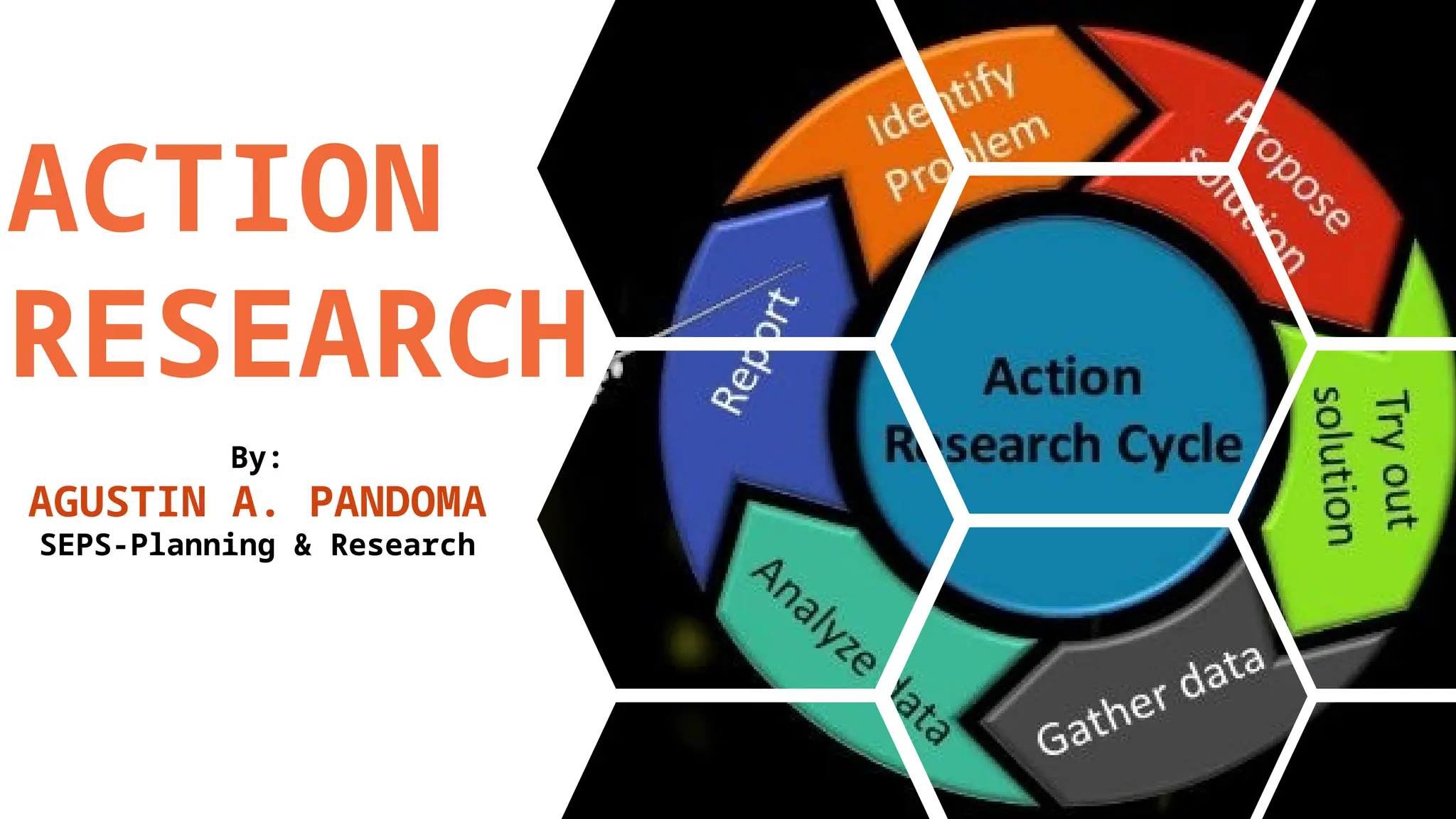
ACTION
RESEARCH
By:
AGUSTIN A. PANDOMA
SEPS-Planning & Research
 is a process that allows educators to learn
about their own instructional practices and
to continue to improve student learning”
(Rawlinson & Little, 2004).
 is a continuous and reflective process where
educators make instructional decisions in
their classrooms based on student needs
reflected by classroom data (Hewitt & Little,
2005).
Action Research
Stimulus of teachers changes,
including changes in their pedagogy,
changes in their thinking, and
changes in their confidence, which
leads to professional growth and
development (Sax and Fisher, 2001).
Role Action Research
DepEd
Order 16
Series
of 2017
Research
Management
Guidelines
Formulating
research title
Concise
 Identify actual variables or
theoretical issues
Under investigation and the
relationship between them
 10-12 words (APA); up to 17
words (DepEd)
6
Avoid using abbreviations,
and redundant words such
as “A Study of” or “An
Experimental Investigation
of”
Make it interesting or
“catchy”
7
8
EXAMPLE
Computer Operated Simulation
(COS): An Alternative for
Unavailable Laboratory
Apparatus and Set-Ups
Learner’s Level of Science
Process Skills: Basis for 21st
Century Scientific Skills
Context
and
rationale
CONTEXT AND RATIONALE
 The context of the problem
(contextualization).
 the reason for conducting the
study.
 should answer the need for
conducting the research.
 should justify the significance
and novelty of the study.
10
CONTEXT AND RATIONALE
To write your rationale, you
should first write a background on
what all research has been done
on your study topic. Follow this
with ‘what is missing’ or ‘what are
the open questions of the study’.
Identify the gaps in the literature
and emphasize why it is important
to address those gaps.
11
ACTION
RESEARCH
QUESTIONS
ACTION RESEARCH
QUESTION
 used to guide the action
research process through the
design and conduct of data
collection, the analysis and
validation (triangulation) of
data, and the writing of the
report.

 Problems to be answered.
13
PROPOSED
INNOVATION,
INTERVENTION
& STRATEGY
Localized, Indigenized &
Specific
Properly described and
presented
 PARTS: Rationale, Introduction,
Objectives
Methods, Monitoring &
Evaluation
ACTION
RESEARCH
METHODS
RESEARCH METHODS
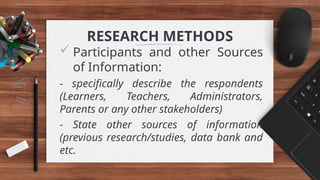
 Participants and other Sources
of Information:
- specifically describe the respondents
(Learners, Teachers, Administrators,
Parents or any other stakeholders)
- State other sources of information
(previous research/studies, data bank and
etc.
 Random sampling
- Each member has an equal chance
of being selected.
- Has the most control
 Convenience sampling
- Whoever is available
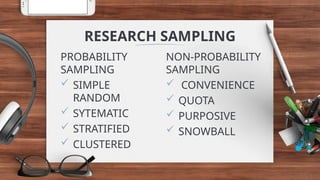
RESEARCH SAMPLING
PROBABILITY
SAMPLING
 SIMPLE
RANDOM
 SYTEMATIC
 STRATIFIED
 CLUSTERED
RESEARCH SAMPLING
NON-PROBABILITY
SAMPLING
 CONVENIENCE
 QUOTA
 PURPOSIVE
 SNOWBALL
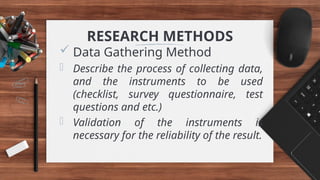
RESEARCH METHODS
 Data Gathering Method
- Describe the process of collecting data,
and the instruments to be used
(checklist, survey questionnaire, test
questions and etc.)
- Validation of the instruments is
necessary for the reliability of the result.
Settings/Locale
In Research
 Types of research settings:
- Natural or field settings
- Partially controlled settings
-Highly controlled or laboratory
settings
SETTINGS/LOCALE
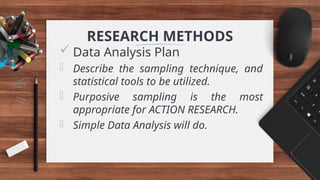
RESEARCH METHODS
 Data Analysis Plan
- Describe the sampling technique, and
statistical tools to be utilized.
- Purposive sampling is the most
appropriate for ACTION RESEARCH.
- Simple Data Analysis will do.
ACTION
RESEARCH
WORKPLAN
AND
TIMELINES
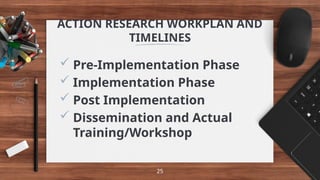
 Pre-Implementation Phase
 Implementation Phase
 Post Implementation
 Dissemination and Actual
Training/Workshop
25
ACTION RESEARCH WORKPLAN AND
TIMELINES
COST
ESTIMATES
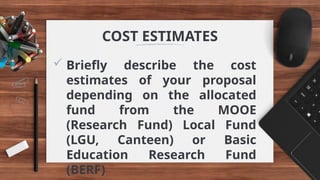
 Briefly describe the cost
estimates of your proposal
depending on the allocated
fund from the MOOE
(Research Fund) Local Fund
(LGU, Canteen) or Basic
Education Research Fund
(BERF)
COST ESTIMATES
PLANS FOR
DISSEMINATI
ON AND
UTILIZATION
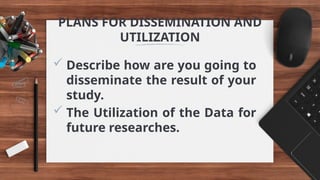
 Describe how are you going to
disseminate the result of your
study.
 The Utilization of the Data for
future researches.
PLANS FOR DISSEMINATION AND
UTILIZATION
REFERENCE
S
 APA
FORMAT
DepEd
Order 16
Series
of 2017
Research
Management
Guidelines
FAQs
FAQs
FAQs
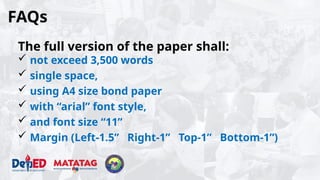
The full version of the paper shall:
 not exceed 3,500 words
 single space,
 using A4 size bond paper
 with “arial” font style,
 and font size “11”
 Margin (Left-1.5” Right-1” Top-1” Bottom-1”)
FAQs
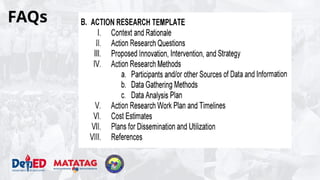
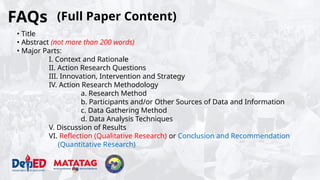
• Title
• Abstract (not more than 200 words)
• Major Parts:
I. Context and Rationale
II. Action Research Questions
III. Innovation, Intervention and Strategy
IV. Action Research Methodology
a. Research Method
b. Participants and/or Other Sources of Data and Information
c. Data Gathering Method
d. Data Analysis Techniques
V. Discussion of Results
VI. Reflection (Qualitative Research) or Conclusion and Recommendation
(Quantitative Research)
(Full Paper Content)
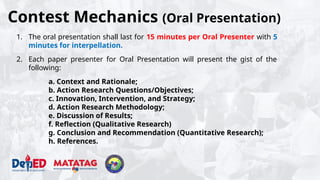
Contest Mechanics (Oral Presentation)
1. The oral presentation shall last for 15 minutes per Oral Presenter with 5
minutes for interpellation.
2. Each paper presenter for Oral Presentation will present the gist of the
following:
a. Context and Rationale;
b. Action Research Questions/Objectives;
c. Innovation, Intervention, and Strategy;
d. Action Research Methodology;
e. Discussion of Results;
f. Reflection (Qualitative Research)
g. Conclusion and Recommendation (Quantitative Research);
h. References.
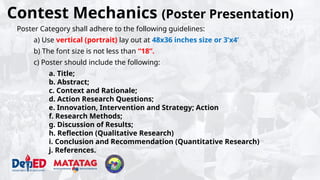
Contest Mechanics (Poster Presentation)
Poster Category shall adhere to the following guidelines:
a) Use vertical (portrait) lay out at 48x36 inches size or 3’x4’
b) The font size is not less than “18”.
c) Poster should include the following:
a. Title;
b. Abstract;
c. Context and Rationale;
d. Action Research Questions;
e. Innovation, Intervention and Strategy; Action
f. Research Methods;
g. Discussion of Results;
h. Reflection (Qualitative Research)
i. Conclusion and Recommendation (Quantitative Research)
j. References.
THANK YOU
WITH A !

ACTION RESEARCH.pptx 111111111111111111111

  • 1.
  • 2.
     is aprocess that allows educators to learn about their own instructional practices and to continue to improve student learning” (Rawlinson & Little, 2004).  is a continuous and reflective process where educators make instructional decisions in their classrooms based on student needs reflected by classroom data (Hewitt & Little, 2005). Action Research
  • 3.
    Stimulus of teacherschanges, including changes in their pedagogy, changes in their thinking, and changes in their confidence, which leads to professional growth and development (Sax and Fisher, 2001). Role Action Research
  • 4.
  • 5.
  • 6.
    Concise  Identify actualvariables or theoretical issues Under investigation and the relationship between them  10-12 words (APA); up to 17 words (DepEd) 6
  • 7.
    Avoid using abbreviations, andredundant words such as “A Study of” or “An Experimental Investigation of” Make it interesting or “catchy” 7
  • 8.
    8 EXAMPLE Computer Operated Simulation (COS):An Alternative for Unavailable Laboratory Apparatus and Set-Ups Learner’s Level of Science Process Skills: Basis for 21st Century Scientific Skills
  • 9.
  • 10.
    CONTEXT AND RATIONALE The context of the problem (contextualization).  the reason for conducting the study.  should answer the need for conducting the research.  should justify the significance and novelty of the study. 10
  • 11.
    CONTEXT AND RATIONALE Towrite your rationale, you should first write a background on what all research has been done on your study topic. Follow this with ‘what is missing’ or ‘what are the open questions of the study’. Identify the gaps in the literature and emphasize why it is important to address those gaps. 11
  • 12.
  • 13.
    ACTION RESEARCH QUESTION  usedto guide the action research process through the design and conduct of data collection, the analysis and validation (triangulation) of data, and the writing of the report.  Problems to be answered. 13
  • 14.
  • 15.
    Localized, Indigenized & Specific Properlydescribed and presented  PARTS: Rationale, Introduction, Objectives Methods, Monitoring & Evaluation
  • 16.
  • 17.
    RESEARCH METHODS  Participantsand other Sources of Information: - specifically describe the respondents (Learners, Teachers, Administrators, Parents or any other stakeholders) - State other sources of information (previous research/studies, data bank and etc.
  • 18.
     Random sampling -Each member has an equal chance of being selected. - Has the most control  Convenience sampling - Whoever is available RESEARCH SAMPLING
  • 19.
    PROBABILITY SAMPLING  SIMPLE RANDOM  SYTEMATIC STRATIFIED  CLUSTERED RESEARCH SAMPLING NON-PROBABILITY SAMPLING  CONVENIENCE  QUOTA  PURPOSIVE  SNOWBALL
  • 20.
    RESEARCH METHODS  DataGathering Method - Describe the process of collecting data, and the instruments to be used (checklist, survey questionnaire, test questions and etc.) - Validation of the instruments is necessary for the reliability of the result.
  • 21.
  • 22.
     Types ofresearch settings: - Natural or field settings - Partially controlled settings -Highly controlled or laboratory settings SETTINGS/LOCALE
  • 23.
    RESEARCH METHODS  DataAnalysis Plan - Describe the sampling technique, and statistical tools to be utilized. - Purposive sampling is the most appropriate for ACTION RESEARCH. - Simple Data Analysis will do.
  • 24.
  • 25.
     Pre-Implementation Phase Implementation Phase  Post Implementation  Dissemination and Actual Training/Workshop 25 ACTION RESEARCH WORKPLAN AND TIMELINES
  • 26.
  • 27.
     Briefly describethe cost estimates of your proposal depending on the allocated fund from the MOOE (Research Fund) Local Fund (LGU, Canteen) or Basic Education Research Fund (BERF) COST ESTIMATES
  • 28.
  • 29.
     Describe howare you going to disseminate the result of your study.  The Utilization of the Data for future researches. PLANS FOR DISSEMINATION AND UTILIZATION
  • 30.
  • 31.
  • 32.
  • 33.
  • 34.
    FAQs The full versionof the paper shall:  not exceed 3,500 words  single space,  using A4 size bond paper  with “arial” font style,  and font size “11”  Margin (Left-1.5” Right-1” Top-1” Bottom-1”)
  • 35.
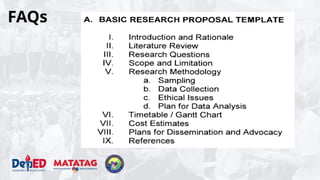
    FAQs • Title • Abstract(not more than 200 words) • Major Parts: I. Context and Rationale II. Action Research Questions III. Innovation, Intervention and Strategy IV. Action Research Methodology a. Research Method b. Participants and/or Other Sources of Data and Information c. Data Gathering Method d. Data Analysis Techniques V. Discussion of Results VI. Reflection (Qualitative Research) or Conclusion and Recommendation (Quantitative Research) (Full Paper Content)
  • 36.
    Contest Mechanics (OralPresentation) 1. The oral presentation shall last for 15 minutes per Oral Presenter with 5 minutes for interpellation. 2. Each paper presenter for Oral Presentation will present the gist of the following: a. Context and Rationale; b. Action Research Questions/Objectives; c. Innovation, Intervention, and Strategy; d. Action Research Methodology; e. Discussion of Results; f. Reflection (Qualitative Research) g. Conclusion and Recommendation (Quantitative Research); h. References.
  • 37.
    Contest Mechanics (PosterPresentation) Poster Category shall adhere to the following guidelines: a) Use vertical (portrait) lay out at 48x36 inches size or 3’x4’ b) The font size is not less than “18”. c) Poster should include the following: a. Title; b. Abstract; c. Context and Rationale; d. Action Research Questions; e. Innovation, Intervention and Strategy; Action f. Research Methods; g. Discussion of Results; h. Reflection (Qualitative Research) i. Conclusion and Recommendation (Quantitative Research) j. References.
  • 38.