Gratuity

 Created By

  Laxmi Yadav
 Sneha Chavan
Definition

 Gratuity is reward money for continuous service for
a specified number of years of service. Gratuity is
paid to an employee, in addition to his salary, bonus,
commission, etc., when he leaves the service of his
employer....Gratuity is a lump sum payment made,
based on the total service of an employee either on
retirement or death. It is calculated as so many
months pay with reference to his service.
Eligibility
It is governed under the Payment of Gratuity Act 1972.

As per Sec 10 (10) of Income Tax Act, gratuity is paid when
an employee completes 5 or more years of full time service
with the employer.
                      OR
Gratuity is payable to an employee (nominee in case of death)
who has rendered continuous service of 5 years or more at
the time of his termination of employment, superannuation,
retirement or resignation.
Completion of continuous service of 5 years is not necessary
where the termination of employment is due to death or
disablement due to accident or disease.
Applicability

Every   factory, mine, oil plantation, port and railway company


Every shop or establishment – if it employs 10 or more
persons in the preceding 1 year.

To   any other establishment – employing 10 or more persons.


The Act does not apply to :

Apprentices & persons who hold civil post under the central govt. or
state govt.

                                                                       4
How does it
                                    work ?
An employer may offer gratuity out of his own
funds or may approach a life insurer in order to
purchase a group gratuity plan.

In case the employer chooses a life insurer, he has
to pay annual contributions as decided by the
insurer.
The employee is also free to make contributions to
his gratuity fund. The gratuity will be paid by the
insurer based upon the terms of the group gratuity
scheme.
Forfeiture
Gratuity may be forfeited wholly or partially in case an
employee has been terminated for:

Any act, willful omission or negligence causing any damage
or loss to, or destruction of, property belonging to the
employer;
Or
Act of riotous or disorderly conduct or any other act of
violence on part of employee;
Or
Any act which constitutes an of­fence involving moral
turpitude, in the course of his employment.
Tax obligations for Gratuity

The gratuity received by the employee is taxable
under the head ‘Income from salary’.

In case gratuity is received by the nominee/legal
   heir of the employee, the same is taxable in
their hands under the head ‘Income from other
sources’. This tax treatment varies for different
categories of individual assessees
Continued………..

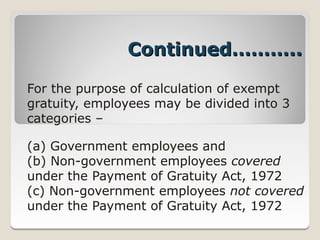
For the purpose of calculation of exempt
gratuity, employees may be divided into 3
categories –

(a) Government employees and
(b) Non­government employees covered
under the Payment of Gratuity Act, 1972
(c) Non­government employees not covered
under the Payment of Gratuity Act, 1972
Continued………
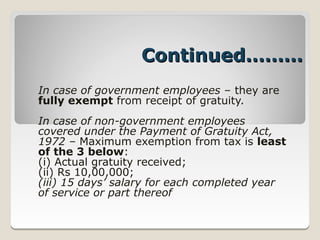
In case of government employees – they are
fully exempt from receipt of gratuity.
In case of non-government employees
covered under the Payment of Gratuity Act,
1972 – Maximum exemption from tax is least
of the 3 below:
(i) Actual gratuity received;
(ii) Rs 10,00,000;
(iii) 15 days’ salary for each completed year
of service or part thereof
Continued………
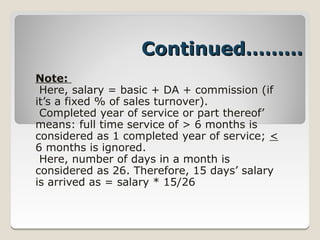
Note:
 Here, salary = basic + DA + commission (if
it’s a fixed % of sales turnover).
 Completed year of service or part thereof’
means: full time service of > 6 months is
considered as 1 completed year of service; <
6 months is ignored.
 Here, number of days in a month is
considered as 26. Therefore, 15 days’ salary
is arrived as = salary * 15/26
Continued……..
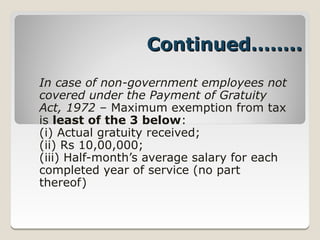
In case of non-government employees not
covered under the Payment of Gratuity
Act, 1972 – Maximum exemption from tax
is least of the 3 below:
(i) Actual gratuity received;
(ii) Rs 10,00,000;
(iii) Half­month’s average salary for each
completed year of service (no part
thereof)
Note:

 Here, salary = basic + DA + commission (if it’s a
fixed % of sales turnover).
 Completed year of service (no part thereof)
means: full time service of > 1 year is considered
as 1 completed year of service. < 1 year is
ignored.
 Average salary =10 months’ salary (immediately
preceding the month of leaving the job)/10
Points to remember……..
   Generally, only government employers give DA to their
    employees.
   The salary of the employee may differ over a period of time
    on account of change in basic, DA and/or other factors.
   In case gratuity is received from more than one employer
    during the previous year, maximum exemption allowed is up
    to Rs 10,00,000.
   Where employee has already claimed gratuity exemption in
    any previous year (s), the maximum exemption amount
    allowed for the current previous year i.e. Rs 10,00,000 will
    be reduced by the amount of deduction already claimed in
    the previous years.
   In case of an employee who is employed in a seasonal
    establishment ( not employed throughout the year), the
    gratuity exemption shall be for seven days wages for each
    season.
Gratuity Calculation
      Gratuity : 15/26* ( Present Basic
salary+DA)* (Nor. of years of service )

          Here DA is applicable for govt.
                              employees.
   26 = taken as total working days in a
                                   month.
Gratuity Deduction…

It is deducted at a rate of 4.81% from the
basic salary of the employee.

Explanation : ­ Since ..receivable Gratuity =
15/26*( Nor. of Years of Service) ( Basic
Salary)

Rate of Gratuity per month = 15/26*1/12
%= 4.81%
THANKS

Gratuity final

  • 1.
    Gratuity Created By Laxmi Yadav Sneha Chavan
  • 2.
    Definition Gratuity isreward money for continuous service for a specified number of years of service. Gratuity is paid to an employee, in addition to his salary, bonus, commission, etc., when he leaves the service of his employer....Gratuity is a lump sum payment made, based on the total service of an employee either on retirement or death. It is calculated as so many months pay with reference to his service.
  • 3.
    Eligibility It is governedunder the Payment of Gratuity Act 1972. As per Sec 10 (10) of Income Tax Act, gratuity is paid when an employee completes 5 or more years of full time service with the employer. OR Gratuity is payable to an employee (nominee in case of death) who has rendered continuous service of 5 years or more at the time of his termination of employment, superannuation, retirement or resignation. Completion of continuous service of 5 years is not necessary where the termination of employment is due to death or disablement due to accident or disease.
  • 4.
    Applicability Every factory, mine, oil plantation, port and railway company Every shop or establishment – if it employs 10 or more persons in the preceding 1 year. To any other establishment – employing 10 or more persons. The Act does not apply to : Apprentices & persons who hold civil post under the central govt. or state govt. 4
  • 5.
    How does it work ? An employer may offer gratuity out of his own funds or may approach a life insurer in order to purchase a group gratuity plan. In case the employer chooses a life insurer, he has to pay annual contributions as decided by the insurer. The employee is also free to make contributions to his gratuity fund. The gratuity will be paid by the insurer based upon the terms of the group gratuity scheme.
  • 6.
    Forfeiture Gratuity may beforfeited wholly or partially in case an employee has been terminated for: Any act, willful omission or negligence causing any damage or loss to, or destruction of, property belonging to the employer; Or Act of riotous or disorderly conduct or any other act of violence on part of employee; Or Any act which constitutes an of­fence involving moral turpitude, in the course of his employment.
  • 7.
    Tax obligations forGratuity The gratuity received by the employee is taxable under the head ‘Income from salary’. In case gratuity is received by the nominee/legal heir of the employee, the same is taxable in their hands under the head ‘Income from other sources’. This tax treatment varies for different categories of individual assessees
  • 8.
    Continued……….. For the purposeof calculation of exempt gratuity, employees may be divided into 3 categories – (a) Government employees and (b) Non­government employees covered under the Payment of Gratuity Act, 1972 (c) Non­government employees not covered under the Payment of Gratuity Act, 1972
  • 9.
    Continued……… In case ofgovernment employees – they are fully exempt from receipt of gratuity. In case of non-government employees covered under the Payment of Gratuity Act, 1972 – Maximum exemption from tax is least of the 3 below: (i) Actual gratuity received; (ii) Rs 10,00,000; (iii) 15 days’ salary for each completed year of service or part thereof
  • 10.
    Continued……… Note: Here, salary= basic + DA + commission (if it’s a fixed % of sales turnover). Completed year of service or part thereof’ means: full time service of > 6 months is considered as 1 completed year of service; < 6 months is ignored. Here, number of days in a month is considered as 26. Therefore, 15 days’ salary is arrived as = salary * 15/26
  • 11.
    Continued…….. In case ofnon-government employees not covered under the Payment of Gratuity Act, 1972 – Maximum exemption from tax is least of the 3 below: (i) Actual gratuity received; (ii) Rs 10,00,000; (iii) Half­month’s average salary for each completed year of service (no part thereof)
  • 12.
    Note: Here, salary= basic + DA + commission (if it’s a fixed % of sales turnover). Completed year of service (no part thereof) means: full time service of > 1 year is considered as 1 completed year of service. < 1 year is ignored. Average salary =10 months’ salary (immediately preceding the month of leaving the job)/10
  • 13.
    Points to remember……..  Generally, only government employers give DA to their employees.  The salary of the employee may differ over a period of time on account of change in basic, DA and/or other factors.  In case gratuity is received from more than one employer during the previous year, maximum exemption allowed is up to Rs 10,00,000.  Where employee has already claimed gratuity exemption in any previous year (s), the maximum exemption amount allowed for the current previous year i.e. Rs 10,00,000 will be reduced by the amount of deduction already claimed in the previous years.  In case of an employee who is employed in a seasonal establishment ( not employed throughout the year), the gratuity exemption shall be for seven days wages for each season.
  • 14.
    Gratuity Calculation Gratuity : 15/26* ( Present Basic salary+DA)* (Nor. of years of service )  Here DA is applicable for govt. employees.  26 = taken as total working days in a month.
  • 15.
    Gratuity Deduction… It isdeducted at a rate of 4.81% from the basic salary of the employee. Explanation : ­ Since ..receivable Gratuity = 15/26*( Nor. of Years of Service) ( Basic Salary) Rate of Gratuity per month = 15/26*1/12 %= 4.81%
  • 16.

Editor's Notes