Graph Theory
Ch. 1. Fundamental Concept
1
Chapter 1
Fundamental Concept
1.1 What Is a Graph?
1.2 Paths, Cycles, and Trails
1.3 Vertex Degree and Counting
1.4 Directed Graphs
Graph Theory
Ch. 1. Fundamental Concept
2
The KÖnigsberg Bridge Problem
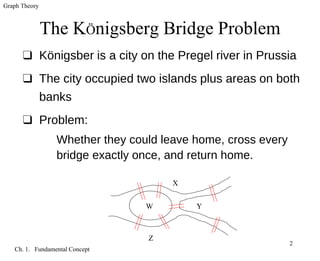
❑ Königsber is a city on the Pregel river in Prussia
❑ The city occupied two islands plus areas on both
banks
❑ Problem:
Whether they could leave home, cross every
bridge exactly once, and return home.
X
Y
Z
W
Graph Theory
Ch. 1. Fundamental Concept
3
A Model
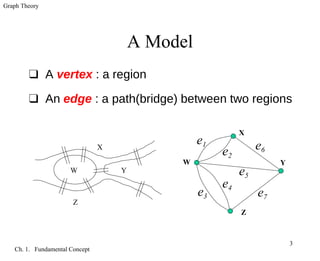
❑ A vertex : a region
❑ An edge : a path(bridge) between two regions
e1
e2
e3
e4
e6
e5
e7
Z
Y
X
W
X
Y
Z
W
Graph Theory
Ch. 1. Fundamental Concept
4
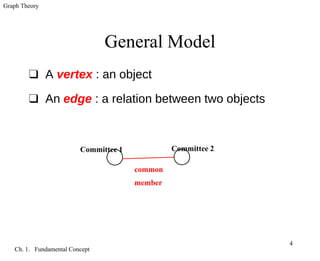
General Model
❑ A vertex : an object
❑ An edge : a relation between two objects
common
member
Committee 1 Committee 2
Graph Theory
Ch. 1. Fundamental Concept
5
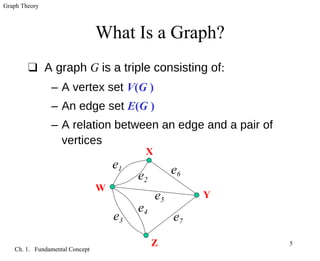
What Is a Graph?
❑ A graph G is a triple consisting of:
– A vertex set V(G )
– An edge set E(G )
– A relation between an edge and a pair of
vertices
e1
e2
e3
e4
e6
e5
e7
Z
Y
X
W
Graph Theory
Ch. 1. Fundamental Concept
6
Loop, Multiple edges
❑ Loop : An edge whose endpoints are equal
❑ Multiple edges : Edges have the same pair of
endpoints
loop
Multiple
edges
Graph Theory
Ch. 1. Fundamental Concept
7
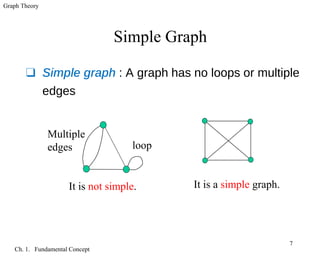
Simple Graph
❑ Simple graph : A graph has no loops or multiple
edges
loop
Multiple
edges
It is not simple. It is a simple graph.
Graph Theory
Ch. 1. Fundamental Concept
8
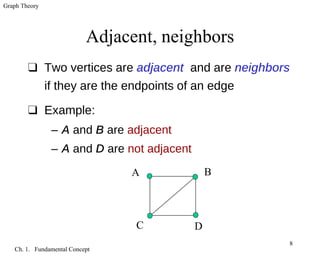
Adjacent, neighbors
❑ Two vertices are adjacent and are neighbors
if they are the endpoints of an edge
❑ Example:
– A and B are adjacent
– A and D are not adjacent
A B
C D
Graph Theory
Ch. 1. Fundamental Concept
9
Finite Graph, Null Graph
❑ Finite graph : an graph whose vertex set and
edge set are finite
❑ Null graph : the graph whose vertex set and
edges are empty
Graph Theory
Ch. 1. Fundamental Concept
10
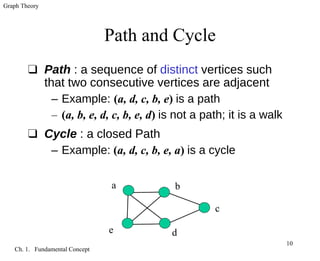
Path and Cycle
❑ Path : a sequence of distinct vertices such
that two consecutive vertices are adjacent
– Example: (a, d, c, b, e) is a path
– (a, b, e, d, c, b, e, d) is not a path; it is a walk
❑ Cycle : a closed Path
– Example: (a, d, c, b, e, a) is a cycle
a b
c
d
e
Graph Theory
Ch. 1. Fundamental Concept
11
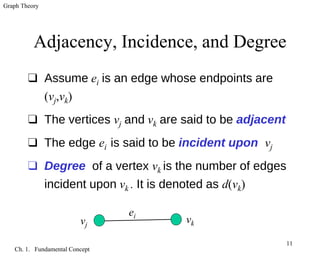
Adjacency, Incidence, and Degree
❑ Assume ei is an edge whose endpoints are
(vj,vk)
❑ The vertices vj and vk are said to be adjacent
❑ The edge ei is said to be incident upon vj
❑ Degree of a vertex vk is the number of edges
incident upon vk . It is denoted as d(vk)
ei
vj
vk
Graph Theory
Ch. 1. Fundamental Concept
12
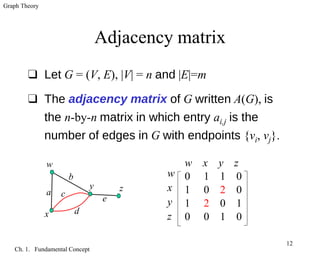
Adjacency matrix
❑ Let G = (V, E), |V| = n and |E|=m
❑ The adjacency matrix of G written A(G), is
the n-by-n matrix in which entry ai,j is the
number of edges in G with endpoints {vi, vj}.
a
b
c
d
e
w
x
y z
w x y z
0 1 1 0
1 0 2 0
1 2 0 1
0 0 1 0
w
x
y
z
Graph Theory
Ch. 1. Fundamental Concept
13
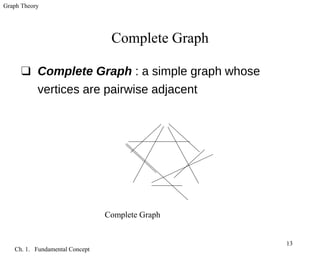
Complete Graph
❑ Complete Graph : a simple graph whose
vertices are pairwise adjacent
Complete Graph

Graph-Basics.pptx

  • 1.
    Graph Theory Ch. 1.Fundamental Concept 1 Chapter 1 Fundamental Concept 1.1 What Is a Graph? 1.2 Paths, Cycles, and Trails 1.3 Vertex Degree and Counting 1.4 Directed Graphs
  • 2.
    Graph Theory Ch. 1.Fundamental Concept 2 The KÖnigsberg Bridge Problem ❑ Königsber is a city on the Pregel river in Prussia ❑ The city occupied two islands plus areas on both banks ❑ Problem: Whether they could leave home, cross every bridge exactly once, and return home. X Y Z W
  • 3.
    Graph Theory Ch. 1.Fundamental Concept 3 A Model ❑ A vertex : a region ❑ An edge : a path(bridge) between two regions e1 e2 e3 e4 e6 e5 e7 Z Y X W X Y Z W
  • 4.
    Graph Theory Ch. 1.Fundamental Concept 4 General Model ❑ A vertex : an object ❑ An edge : a relation between two objects common member Committee 1 Committee 2
  • 5.
    Graph Theory Ch. 1.Fundamental Concept 5 What Is a Graph? ❑ A graph G is a triple consisting of: – A vertex set V(G ) – An edge set E(G ) – A relation between an edge and a pair of vertices e1 e2 e3 e4 e6 e5 e7 Z Y X W
  • 6.
    Graph Theory Ch. 1.Fundamental Concept 6 Loop, Multiple edges ❑ Loop : An edge whose endpoints are equal ❑ Multiple edges : Edges have the same pair of endpoints loop Multiple edges
  • 7.
    Graph Theory Ch. 1.Fundamental Concept 7 Simple Graph ❑ Simple graph : A graph has no loops or multiple edges loop Multiple edges It is not simple. It is a simple graph.
  • 8.
    Graph Theory Ch. 1.Fundamental Concept 8 Adjacent, neighbors ❑ Two vertices are adjacent and are neighbors if they are the endpoints of an edge ❑ Example: – A and B are adjacent – A and D are not adjacent A B C D
  • 9.
    Graph Theory Ch. 1.Fundamental Concept 9 Finite Graph, Null Graph ❑ Finite graph : an graph whose vertex set and edge set are finite ❑ Null graph : the graph whose vertex set and edges are empty
  • 10.
    Graph Theory Ch. 1.Fundamental Concept 10 Path and Cycle ❑ Path : a sequence of distinct vertices such that two consecutive vertices are adjacent – Example: (a, d, c, b, e) is a path – (a, b, e, d, c, b, e, d) is not a path; it is a walk ❑ Cycle : a closed Path – Example: (a, d, c, b, e, a) is a cycle a b c d e
  • 11.
    Graph Theory Ch. 1.Fundamental Concept 11 Adjacency, Incidence, and Degree ❑ Assume ei is an edge whose endpoints are (vj,vk) ❑ The vertices vj and vk are said to be adjacent ❑ The edge ei is said to be incident upon vj ❑ Degree of a vertex vk is the number of edges incident upon vk . It is denoted as d(vk) ei vj vk
  • 12.
    Graph Theory Ch. 1.Fundamental Concept 12 Adjacency matrix ❑ Let G = (V, E), |V| = n and |E|=m ❑ The adjacency matrix of G written A(G), is the n-by-n matrix in which entry ai,j is the number of edges in G with endpoints {vi, vj}. a b c d e w x y z w x y z 0 1 1 0 1 0 2 0 1 2 0 1 0 0 1 0 w x y z
  • 13.
    Graph Theory Ch. 1.Fundamental Concept 13 Complete Graph ❑ Complete Graph : a simple graph whose vertices are pairwise adjacent Complete Graph