CURRICULUM VITAE
OF
GRANT HAMPSON
1
CURRICULUM VITAE
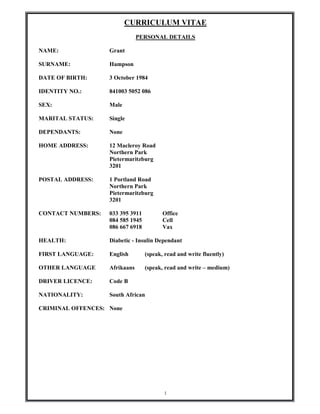
PERSONAL DETAILS
NAME: Grant
SURNAME: Hampson
DATE OF BIRTH: 3 October 1984
IDENTITY NO.: 841003 5052 086
SEX: Male
MARITAL STATUS: Single
DEPENDANTS: None
HOME ADDRESS: 12 Macleroy Road
Northern Park
Pietermaritzburg
3201
POSTAL ADDRESS: 1 Portland Road
Northern Park
Pietermaritzburg
3201
CONTACT NUMBERS: 033 395 3911 Office
084 585 1945 Cell
086 667 6918 Vax
HEALTH: Diabetic - Insulin Dependant
FIRST LANGUAGE: English (speak, read and write fluently)
OTHER LANGUAGE Afrikaans (speak, read and write – medium)
DRIVER LICENCE: Code B
NATIONALITY: South African
CRIMINAL OFFENCES: None
2
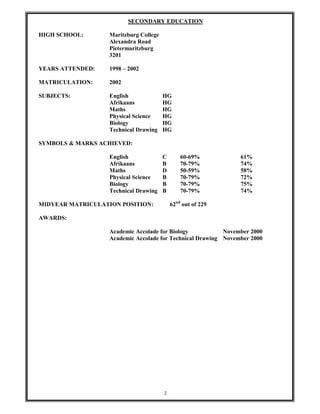
SECONDARY EDUCATION
HIGH SCHOOL: Maritzburg College
Alexandra Road
Pietermaritzburg
3201
YEARS ATTENDED: 1998 – 2002
MATRICULATION: 2002
SUBJECTS: English HG
Afrikaans HG
Maths HG
Physical Science HG
Biology HG
Technical Drawing HG
SYMBOLS & MARKS ACHIEVED:
English C 60-69% 61%
Afrikaans B 70-79% 74%
Maths D 50-59% 58%
Physical Science B 70-79% 72%
Biology B 70-79% 75%
Technical Drawing B 70-79% 74%
MIDYEAR MATRICULATION POSITION: 62nd
out of 229
AWARDS:
Academic Accolade for Biology November 2000
Academic Accolade for Technical Drawing November 2000
3
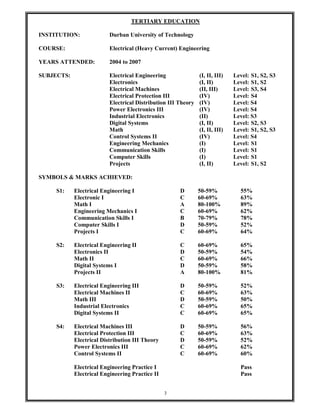
TERTIARY EDUCATION
INSTITUTION: Durban University of Technology
COURSE: Electrical (Heavy Current) Engineering
YEARS ATTENDED: 2004 to 2007
SUBJECTS: Electrical Engineering (I, II, III) Level: S1, S2, S3
Electronics (I, II) Level: S1, S2
Electrical Machines (II, III) Level: S3, S4
Electrical Protection III (IV) Level: S4
Electrical Distribution III Theory (IV) Level: S4
Power Electronics III (IV) Level: S4
Industrial Electronics (II) Level: S3
Digital Systems (I, II) Level: S2, S3
Math (I, II, III) Level: S1, S2, S3
Control Systems II (IV) Level: S4
Engineering Mechanics (I) Level: S1
Communication Skills (I) Level: S1
Computer Skills (I) Level: S1
Projects (I, II) Level: S1, S2
SYMBOLS & MARKS ACHIEVED:
S1: Electrical Engineering I D 50-59% 55%
Electronic I C 60-69% 63%
Math I A 80-100% 89%
Engineering Mechanics I C 60-69% 62%
Communication Skills I B 70-79% 78%
Computer Skills I D 50-59% 52%
Projects I C 60-69% 64%
S2: Electrical Engineering II C 60-69% 65%
Electronics II D 50-59% 54%
Math II C 60-69% 66%
Digital Systems I D 50-59% 58%
Projects II A 80-100% 81%
S3: Electrical Engineering III D 50-59% 52%
Electrical Machines II C 60-69% 63%
Math III D 50-59% 50%
Industrial Electronics C 60-69% 65%
Digital Systems II C 60-69% 65%
S4: Electrical Machines III D 50-59% 56%
Electrical Protection III C 60-69% 63%
Electrical Distribution III Theory D 50-59% 52%
Power Electronics III C 60-69% 62%
Control Systems II C 60-69% 60%
Electrical Engineering Practice I Pass
Electrical Engineering Practice II Pass
4
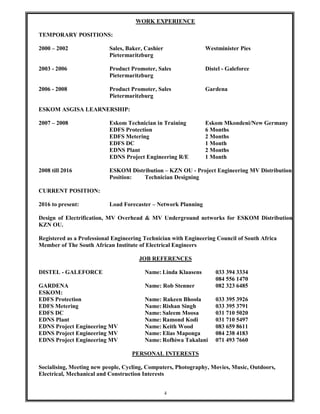
WORK EXPERIENCE
TEMPORARY POSITIONS:
2000 – 2002 Sales, Baker, Cashier Westminister Pies
Pietermaritzburg
2003 - 2006 Product Promoter, Sales Distel - Galeforce
Pietermaritzburg
2006 - 2008 Product Promoter, Sales Gardena
Pietermaritzburg
ESKOM ASGISA LEARNERSHIP:
2007 – 2008 Eskom Technician in Training Eskom Mkondeni/New Germany
EDFS Protection 6 Months
EDFS Metering 2 Months
EDFS DC 1 Month
EDNS Plant 2 Months
EDNS Project Engineering R/E 1 Month
2008 till 2016 ESKOM Distribution – KZN OU - Project Engineering MV Distribution
Position: Technician Designing
CURRENT POSITION:
2016 to present: Load Forecaster – Network Planning
Design of Electrification, MV Overhead & MV Underground networks for ESKOM Distribution
KZN OU.
Registered as a Professional Engineering Technician with Engineering Council of South Africa
Member of The South African Institute of Electrical Engineers
JOB REFERENCES
DISTEL - GALEFORCE Name: Linda Klaasens 033 394 3334
084 556 1470
GARDENA Name: Rob Stenner 082 323 6485
ESKOM:
EDFS Protection Name: Rakeen Bhoola 033 395 3926
EDFS Metering Name: Rishan Singh 033 395 3791
EDFS DC Name: Saleem Moosa 031 710 5020
EDNS Plant Name: Ramond Kodi 031 710 5497
EDNS Project Engineering MV Name: Keith Wood 083 659 8611
EDNS Project Engineering MV Name: Elias Maponga 084 238 4183
EDNS Project Engineering MV Name: Rofhiwa Takalani 071 493 7660
PERSONAL INTERESTS
Socialising, Meeting new people, Cycling, Computers, Photography, Movies, Music, Outdoors,
Electrical, Mechanical and Construction Interests
5
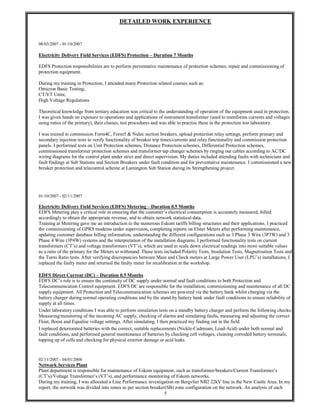
DETAILED WORK EXPERIENCE
08/03/2007 - 01/10/2007
Electricity Delivery Field Services (EDFS) Protection – Duration 7 Months
EDFS Protection responsibilities are to perform preventative maintenance of protection schemes, repair and commissioning of
protection equipment.
During my training in Protection, I attended many Protection related courses such as:
Omicron Basic Testing;
CT/VT Units;
High Voltage Regulations
Theoretical knowledge from tertiary education was critical to the understanding of operation of the equipment used in protection.
I was given hands on exposure to operations and applications of instrument transformer (used to transforms currents and voltages
using ratios of the primary), their classes, test procedures and was able to practise these in the protection test laboratory.
I was trained to commission Form4C, Form5 & Nulec section breakers, upload protection relay settings, perform primary and
secondary injection tests to verify functionality of breaker trip times/currents and relay functionality and commission protection
panels. I performed tests on Unit Protection schemes, Distance Protection schemes, Differential Protection schemes,
commissioned transformer protection schemes and transformer tap changer schemes by ringing out cables according to AC/DC
wiring diagrams for the control plant under strict and direct supervision. My duties included attending faults with technicians and
fault findings at Sub Stations and Section Breakers under fault condition and for preventative maintenance. I commissioned a new
breaker protection and telecontrol scheme at Lamington Sub Station during its Strengthening project.
01/10/2007 - 02/11/2007
Electricity Delivery Field Services (EDFS) Metering – Duration 0.5 Months
EDFS Metering play a critical role in ensuring that the customer’s electrical consumption is accurately measured, billed
accordingly to obtain the appropriate revenue, and to obtain network statistical data.
Training at Metering gave me an introduction to the numerous Eskom tariffs billing structures and their applications. I practiced
the commissioning of GPRS modems under supervision, completing reports on Elster Meters after performing maintenance,
updating customer database billing information, understanding the different configurations such as 3 Phase 3 Wire (3P3W) and 3
Phase 4 Wire (3P4W) systems and the interpretation of the installation diagrams. I performed functionality tests on current
transformers (CT’s) and voltage transformers (VT’s), which are used to scale down electrical readings into more suitable values
as a ratio of the primary for the Meters to withstand. These tests included Polarity Tests, Insulation Tests, Magnetisation Tests and
the Turns Ratio tests. After verifying discrepancies between Main and Check meters at Large Power User (LPU’s) installations, I
replaced the faulty meter and returned the faulty meter for recalibration at the workshop.
EDFS Direct Current (DC) – Duration 0.5 Months
EDFS DC’s role is to ensure the continuity of DC supply under normal and fault conditions to both Protection and
Telecommunication Control equipment. EDFS DC are responsible for the installation, commissioning and maintenance of all DC
supply equipment. All Protection and Telecommunication schemes are powered via the battery bank whilst charging via the
battery charger during normal operating conditions and by the stand-by battery bank under fault conditions to ensure reliability of
supply at all times.
Under laboratory conditions I was able to perform simulation tests on a standby battery charger and perform the following checks:
Measuring/monitoring of the incoming AC supply, checking of alarms and simulating faults, measuring and adjusting the correct
Float, Boost and Equalise voltage settings. After simulating, I then practiced my finding out in the field.
I replaced deteriorated batteries with the correct, suitable replacements (Nickle-Cadmium, Lead-Acid) under both normal and
fault conditions, and performed general maintenance of batteries by checking cell voltages, cleaning corroded battery terminals,
topping up of cells and checking for physical exterior damage or acid leaks.
02/11/2007 - 04/01/2008
Network Services Plant
Plant department is responsible for maintenance of Eskom equipment, such as transformer/breakers/Current Transformer’s
(CT’s)/Voltage Transformer’s (VT’s), and performance monitoring of Eskom networks.
During my training, I was allocated a Line Performance investigation on Bergvliet NB2 22kV line in the New Castle Area. In my
report, the network was divided into zones as per section breaker(SB) zone configuration on the network. An analysis of each
6
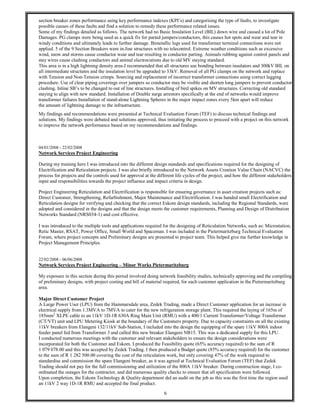
section breaker zones performance using key performance indexes (KPI’s) and categorising the type of faults, to investigate
possible causes of these faults and find a solution to remedy these performance related issues.
Some of my findings detailed as follows. The network had no Basic Insulation Level (BIL) down wire and caused a lot of Pole
Damages. PG clamps were being used as a quick fix for parted jumpers/conductors, this causes hot spots and wear and tear in
windy conditions and ultimately leads to further damage. Bimetallic lugs used for transformer terminal connections were not
applied. 5 of the 9 Section Breakers were in-line structures with no telecontrol. Extreme weather conditions such as excessive
wind, snow and storms cause conductor wear and tear resulting in conductor parting. Animals rubbing against control panels and
stay wires cause clashing conductors and animal electrocutions due to old MV staying standard.
This area is in a high lightning density area-I recommended that all structures use bonding between insulators and 300kV BIL on
all intermediate structures and the insulation level be upgraded to 33kV. Removal of all PG clamps on the network and replace
with Tension and Non-Tension crimps. Sourcing and replacement of incorrect transformer connections using correct lugging
procedure. Use of clear piping coverings over jumpers so conductor may be visible and shorten long jumpers to prevent conductor
clashing. Inline SB’s to be changed to out of line structures. Installing of bird spikes on MV structures. Correcting old standard
staying to align with new standard. Installation of Double surge arrestors specifically at the end of networks would improve
transformer failures Installation of stand-alone Lightning Spheres in the major impact zones every 5km apart will reduce
the amount of lightning damage to the infrastructure.
My findings and recommendations were presented at Technical Evaluation Forum (TEF) to discuss technical findings and
solutions. My findings were debated and solutions approved, thus initiating the process to proceed with a project on this network
to improve the network performance based on my recommendations and findings.
04/01/2008 - 22/02/2008
Network Services Project Engineering
During my training here I was introduced into the different design standards and specifications required for the designing of
Electrification and Reticulation projects. I was also briefly introduced to the Network Assets Creation Value Chain (NACVC) the
process for projects and the controls used for approval at the different life cycles of the project, and how the different stakeholders
input and responsibilities towards the project influence and impact criteria in design.
Project Engineering Reticulation and Electrification is responsible for ensuring governance in asset creation projects such as:
Direct Customer, Strengthening, Refurbishment, Major Maintenance and Electrification. I was handed small Electrification and
Reticulation designs for verifying and checking that the correct Eskom design standards, including the Regional Standards, were
adopted and considered in the designs and that the design meets the customer requirements, Planning and Design of Distribution
Networks Standard (NRS034-1) and cost effective.
I was introduced to the multiple tools and applications required for the designing of Reticulation Networks, such as: Microstation,
Retic Master, RSAT, Power Office, Small World and Spaceman. I was included in the Pietermaritzburg Technical Evaluation
Forum, where project concepts and Preliminary designs are presented to project team. This helped give me further knowledge in
Project Management Principles.
22/02/2008 - 06/06/2008
Network Services Project Engineering – Minor Works Pietermaritzburg
My exposure in this section during this period involved doing network feasibility studies, technically approving and the compiling
of preliminary designs, with project costing and bill of material required, for each customer application in the Pietermaritzburg
area.
Major Direct Customer Project
A Large Power User (LPU) from the Hammarsdale area, Zedek Trading, made a Direct Customer application for an increase in
electrical supply from 1.3MVA to 7MVA to cater for the new refrigeration storage plant. This required the laying of 165m of
185mm2
XLPE cable to an 11kV 1D-1R 630A Ring Main Unit (RMU) with a 400/1 Current Transformer/Voltage Transformer
(CT/VT) unit and LPU Metering Kiosk at the boundary of the Customers property. Due to capacity constraints on all the existing
11kV breakers from Elangeni 132/11kV Sub-Station, I included into the design the equipping of the spare 11kV 800A indoor
feeder panel fed from Transformer 3 and called this new breaker Elangeni NB15. This was a dedicated supply for this LPU.
I conducted numerous meetings with the customer and relevant stakeholders to ensure the design considerations were
incorporated for both the Customer and Eskom. I produced the Feasibility quote (65% accuracy required) to the sum of R
1 079 078.00 and this was accepted by Zedek Trading. I then produced a Budget quote (85% accuracy required) for the customer
to the sum of R 1 282 500.00 covering the cost of the reticulation work, but only covering 47% of the work required to
standardise and commission the spare Elangeni breaker, as it was agreed at Technical Evaluation Forum (TEF) that Zedek
Trading should not pay for the full commissioning and utilization of the 800A 11kV breaker. During construction stage, I co-
ordinated the outages for the contractor, and did numerous quality checks to ensure that all specification were followed.
Upon completion, the Eskom Technology & Quality department did an audit on the job as this was the first time the region used
an 11kV 2 way 1D-1R RMU and accepted the final product.
7
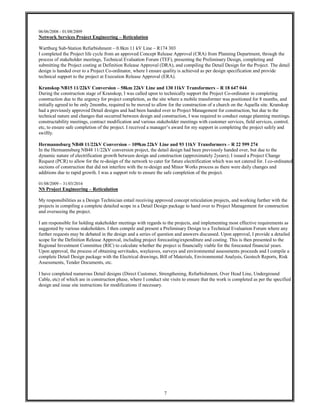
06/06/2008 - 01/08/2009
Network Services Project Engineering – Reticulation
Wartburg Sub-Station Refurbishment – 0.8km 11 kV Line – R174 303
I completed the Project life cycle from an approved Concept Release Approval (CRA) from Planning Department, through the
process of stakeholder meetings, Technical Evaluation Forum (TEF), presenting the Preliminary Design, completing and
submitting the Project costing at Definition Release Approval (DRA), and compiling the Detail Design for the Project. The detail
design is handed over to a Project Co-ordinator, where I ensure quality is achieved as per design specification and provide
technical support to the project at Execution Release Approval (ERA).
Kranskop NB15 11/22kV Conversion – 58km 22kV Line and 130 11kV Transformers – R 18 647 044
During the construction stage of Kranskop, I was called upon to technically support the Project Co-ordinator in completing
construction due to the urgency for project completion, as the site where a mobile transformer was positioned for 8 months, and
initially agreed to be only 2months, required to be moved to allow for the construction of a church on the Aquella site. Kranskop
had a previously approved Detail designs and had been handed over to Project Management for construction, but due to the
technical nature and changes that occurred between design and construction, I was required to conduct outage planning meetings,
constructability meetings, contract modification and various stakeholder meetings with customer services, field services, control,
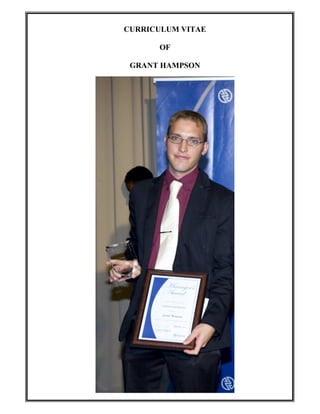
etc, to ensure safe completion of the project. I received a manager’s award for my support in completing the project safely and
swiftly.
Hermannsburg NB48 11/22kV Conversion – 109km 22kV Line and 93 11kV Transformers – R 22 599 274
In the Hermannsburg NB48 11/22kV conversion project, the detail design had been previously handed over, but due to the
dynamic nature of electrification growth between design and construction (approximately 2years); I issued a Project Change
Request (PCR) to allow for the re-design of the network to cater for future electrification which was not catered for. I co-ordinated
sections of construction that did not interfere with the re-design and Minor Works process as there were daily changes and
additions due to rapid growth. I was a support role to ensure the safe completion of the project.
01/08/2009 – 31/03/2016
NS Project Engineering – Reticulation
My responsibilities as a Design Technician entail receiving approved concept reticulation projects, and working further with the
projects in compiling a complete detailed scope in a Detail Design package to hand over to Project Management for construction
and overseeing the project.
I am responsible for holding stakeholder meetings with regards to the projects, and implementing most effective requirements as
suggested by various stakeholders. I then compile and present a Preliminary Design to a Technical Evaluation Forum where any
further requests may be debated in the design and a series of question and answers discussed. Upon approval, I provide a detailed
scope for the Definition Release Approval, including project forecasting/expenditure and costing. This is then presented to the
Regional Investment Committee (RIC) to calculate whether the project is financially viable for the forecasted financial years.
Upon approval, the process of obtaining servitudes, wayleaves, surveys and environmental assessments proceeds and I compile a
complete Detail Design package with the Electrical drawings, Bill of Materials, Environmental Analysis, Geotech Reports, Risk
Assessments, Tender Documents, etc.
I have completed numerous Detail designs (Direct Customer, Strengthening, Refurbishment, Over Head Line, Underground
Cable, etc) of which are in construction phase, where I conduct site visits to ensure that the work is completed as per the specified
design and issue site instructions for modifications if necessary.

Grant CV 2016

  • 1.
  • 2.
    1 CURRICULUM VITAE PERSONAL DETAILS NAME:Grant SURNAME: Hampson DATE OF BIRTH: 3 October 1984 IDENTITY NO.: 841003 5052 086 SEX: Male MARITAL STATUS: Single DEPENDANTS: None HOME ADDRESS: 12 Macleroy Road Northern Park Pietermaritzburg 3201 POSTAL ADDRESS: 1 Portland Road Northern Park Pietermaritzburg 3201 CONTACT NUMBERS: 033 395 3911 Office 084 585 1945 Cell 086 667 6918 Vax HEALTH: Diabetic - Insulin Dependant FIRST LANGUAGE: English (speak, read and write fluently) OTHER LANGUAGE Afrikaans (speak, read and write – medium) DRIVER LICENCE: Code B NATIONALITY: South African CRIMINAL OFFENCES: None
  • 3.
    2 SECONDARY EDUCATION HIGH SCHOOL:Maritzburg College Alexandra Road Pietermaritzburg 3201 YEARS ATTENDED: 1998 – 2002 MATRICULATION: 2002 SUBJECTS: English HG Afrikaans HG Maths HG Physical Science HG Biology HG Technical Drawing HG SYMBOLS & MARKS ACHIEVED: English C 60-69% 61% Afrikaans B 70-79% 74% Maths D 50-59% 58% Physical Science B 70-79% 72% Biology B 70-79% 75% Technical Drawing B 70-79% 74% MIDYEAR MATRICULATION POSITION: 62nd out of 229 AWARDS: Academic Accolade for Biology November 2000 Academic Accolade for Technical Drawing November 2000
  • 4.
    3 TERTIARY EDUCATION INSTITUTION: DurbanUniversity of Technology COURSE: Electrical (Heavy Current) Engineering YEARS ATTENDED: 2004 to 2007 SUBJECTS: Electrical Engineering (I, II, III) Level: S1, S2, S3 Electronics (I, II) Level: S1, S2 Electrical Machines (II, III) Level: S3, S4 Electrical Protection III (IV) Level: S4 Electrical Distribution III Theory (IV) Level: S4 Power Electronics III (IV) Level: S4 Industrial Electronics (II) Level: S3 Digital Systems (I, II) Level: S2, S3 Math (I, II, III) Level: S1, S2, S3 Control Systems II (IV) Level: S4 Engineering Mechanics (I) Level: S1 Communication Skills (I) Level: S1 Computer Skills (I) Level: S1 Projects (I, II) Level: S1, S2 SYMBOLS & MARKS ACHIEVED: S1: Electrical Engineering I D 50-59% 55% Electronic I C 60-69% 63% Math I A 80-100% 89% Engineering Mechanics I C 60-69% 62% Communication Skills I B 70-79% 78% Computer Skills I D 50-59% 52% Projects I C 60-69% 64% S2: Electrical Engineering II C 60-69% 65% Electronics II D 50-59% 54% Math II C 60-69% 66% Digital Systems I D 50-59% 58% Projects II A 80-100% 81% S3: Electrical Engineering III D 50-59% 52% Electrical Machines II C 60-69% 63% Math III D 50-59% 50% Industrial Electronics C 60-69% 65% Digital Systems II C 60-69% 65% S4: Electrical Machines III D 50-59% 56% Electrical Protection III C 60-69% 63% Electrical Distribution III Theory D 50-59% 52% Power Electronics III C 60-69% 62% Control Systems II C 60-69% 60% Electrical Engineering Practice I Pass Electrical Engineering Practice II Pass
  • 5.
    4 WORK EXPERIENCE TEMPORARY POSITIONS: 2000– 2002 Sales, Baker, Cashier Westminister Pies Pietermaritzburg 2003 - 2006 Product Promoter, Sales Distel - Galeforce Pietermaritzburg 2006 - 2008 Product Promoter, Sales Gardena Pietermaritzburg ESKOM ASGISA LEARNERSHIP: 2007 – 2008 Eskom Technician in Training Eskom Mkondeni/New Germany EDFS Protection 6 Months EDFS Metering 2 Months EDFS DC 1 Month EDNS Plant 2 Months EDNS Project Engineering R/E 1 Month 2008 till 2016 ESKOM Distribution – KZN OU - Project Engineering MV Distribution Position: Technician Designing CURRENT POSITION: 2016 to present: Load Forecaster – Network Planning Design of Electrification, MV Overhead & MV Underground networks for ESKOM Distribution KZN OU. Registered as a Professional Engineering Technician with Engineering Council of South Africa Member of The South African Institute of Electrical Engineers JOB REFERENCES DISTEL - GALEFORCE Name: Linda Klaasens 033 394 3334 084 556 1470 GARDENA Name: Rob Stenner 082 323 6485 ESKOM: EDFS Protection Name: Rakeen Bhoola 033 395 3926 EDFS Metering Name: Rishan Singh 033 395 3791 EDFS DC Name: Saleem Moosa 031 710 5020 EDNS Plant Name: Ramond Kodi 031 710 5497 EDNS Project Engineering MV Name: Keith Wood 083 659 8611 EDNS Project Engineering MV Name: Elias Maponga 084 238 4183 EDNS Project Engineering MV Name: Rofhiwa Takalani 071 493 7660 PERSONAL INTERESTS Socialising, Meeting new people, Cycling, Computers, Photography, Movies, Music, Outdoors, Electrical, Mechanical and Construction Interests
  • 6.
    5 DETAILED WORK EXPERIENCE 08/03/2007- 01/10/2007 Electricity Delivery Field Services (EDFS) Protection – Duration 7 Months EDFS Protection responsibilities are to perform preventative maintenance of protection schemes, repair and commissioning of protection equipment. During my training in Protection, I attended many Protection related courses such as: Omicron Basic Testing; CT/VT Units; High Voltage Regulations Theoretical knowledge from tertiary education was critical to the understanding of operation of the equipment used in protection. I was given hands on exposure to operations and applications of instrument transformer (used to transforms currents and voltages using ratios of the primary), their classes, test procedures and was able to practise these in the protection test laboratory. I was trained to commission Form4C, Form5 & Nulec section breakers, upload protection relay settings, perform primary and secondary injection tests to verify functionality of breaker trip times/currents and relay functionality and commission protection panels. I performed tests on Unit Protection schemes, Distance Protection schemes, Differential Protection schemes, commissioned transformer protection schemes and transformer tap changer schemes by ringing out cables according to AC/DC wiring diagrams for the control plant under strict and direct supervision. My duties included attending faults with technicians and fault findings at Sub Stations and Section Breakers under fault condition and for preventative maintenance. I commissioned a new breaker protection and telecontrol scheme at Lamington Sub Station during its Strengthening project. 01/10/2007 - 02/11/2007 Electricity Delivery Field Services (EDFS) Metering – Duration 0.5 Months EDFS Metering play a critical role in ensuring that the customer’s electrical consumption is accurately measured, billed accordingly to obtain the appropriate revenue, and to obtain network statistical data. Training at Metering gave me an introduction to the numerous Eskom tariffs billing structures and their applications. I practiced the commissioning of GPRS modems under supervision, completing reports on Elster Meters after performing maintenance, updating customer database billing information, understanding the different configurations such as 3 Phase 3 Wire (3P3W) and 3 Phase 4 Wire (3P4W) systems and the interpretation of the installation diagrams. I performed functionality tests on current transformers (CT’s) and voltage transformers (VT’s), which are used to scale down electrical readings into more suitable values as a ratio of the primary for the Meters to withstand. These tests included Polarity Tests, Insulation Tests, Magnetisation Tests and the Turns Ratio tests. After verifying discrepancies between Main and Check meters at Large Power User (LPU’s) installations, I replaced the faulty meter and returned the faulty meter for recalibration at the workshop. EDFS Direct Current (DC) – Duration 0.5 Months EDFS DC’s role is to ensure the continuity of DC supply under normal and fault conditions to both Protection and Telecommunication Control equipment. EDFS DC are responsible for the installation, commissioning and maintenance of all DC supply equipment. All Protection and Telecommunication schemes are powered via the battery bank whilst charging via the battery charger during normal operating conditions and by the stand-by battery bank under fault conditions to ensure reliability of supply at all times. Under laboratory conditions I was able to perform simulation tests on a standby battery charger and perform the following checks: Measuring/monitoring of the incoming AC supply, checking of alarms and simulating faults, measuring and adjusting the correct Float, Boost and Equalise voltage settings. After simulating, I then practiced my finding out in the field. I replaced deteriorated batteries with the correct, suitable replacements (Nickle-Cadmium, Lead-Acid) under both normal and fault conditions, and performed general maintenance of batteries by checking cell voltages, cleaning corroded battery terminals, topping up of cells and checking for physical exterior damage or acid leaks. 02/11/2007 - 04/01/2008 Network Services Plant Plant department is responsible for maintenance of Eskom equipment, such as transformer/breakers/Current Transformer’s (CT’s)/Voltage Transformer’s (VT’s), and performance monitoring of Eskom networks. During my training, I was allocated a Line Performance investigation on Bergvliet NB2 22kV line in the New Castle Area. In my report, the network was divided into zones as per section breaker(SB) zone configuration on the network. An analysis of each
  • 7.
    6 section breaker zonesperformance using key performance indexes (KPI’s) and categorising the type of faults, to investigate possible causes of these faults and find a solution to remedy these performance related issues. Some of my findings detailed as follows. The network had no Basic Insulation Level (BIL) down wire and caused a lot of Pole Damages. PG clamps were being used as a quick fix for parted jumpers/conductors, this causes hot spots and wear and tear in windy conditions and ultimately leads to further damage. Bimetallic lugs used for transformer terminal connections were not applied. 5 of the 9 Section Breakers were in-line structures with no telecontrol. Extreme weather conditions such as excessive wind, snow and storms cause conductor wear and tear resulting in conductor parting. Animals rubbing against control panels and stay wires cause clashing conductors and animal electrocutions due to old MV staying standard. This area is in a high lightning density area-I recommended that all structures use bonding between insulators and 300kV BIL on all intermediate structures and the insulation level be upgraded to 33kV. Removal of all PG clamps on the network and replace with Tension and Non-Tension crimps. Sourcing and replacement of incorrect transformer connections using correct lugging procedure. Use of clear piping coverings over jumpers so conductor may be visible and shorten long jumpers to prevent conductor clashing. Inline SB’s to be changed to out of line structures. Installing of bird spikes on MV structures. Correcting old standard staying to align with new standard. Installation of Double surge arrestors specifically at the end of networks would improve transformer failures Installation of stand-alone Lightning Spheres in the major impact zones every 5km apart will reduce the amount of lightning damage to the infrastructure. My findings and recommendations were presented at Technical Evaluation Forum (TEF) to discuss technical findings and solutions. My findings were debated and solutions approved, thus initiating the process to proceed with a project on this network to improve the network performance based on my recommendations and findings. 04/01/2008 - 22/02/2008 Network Services Project Engineering During my training here I was introduced into the different design standards and specifications required for the designing of Electrification and Reticulation projects. I was also briefly introduced to the Network Assets Creation Value Chain (NACVC) the process for projects and the controls used for approval at the different life cycles of the project, and how the different stakeholders input and responsibilities towards the project influence and impact criteria in design. Project Engineering Reticulation and Electrification is responsible for ensuring governance in asset creation projects such as: Direct Customer, Strengthening, Refurbishment, Major Maintenance and Electrification. I was handed small Electrification and Reticulation designs for verifying and checking that the correct Eskom design standards, including the Regional Standards, were adopted and considered in the designs and that the design meets the customer requirements, Planning and Design of Distribution Networks Standard (NRS034-1) and cost effective. I was introduced to the multiple tools and applications required for the designing of Reticulation Networks, such as: Microstation, Retic Master, RSAT, Power Office, Small World and Spaceman. I was included in the Pietermaritzburg Technical Evaluation Forum, where project concepts and Preliminary designs are presented to project team. This helped give me further knowledge in Project Management Principles. 22/02/2008 - 06/06/2008 Network Services Project Engineering – Minor Works Pietermaritzburg My exposure in this section during this period involved doing network feasibility studies, technically approving and the compiling of preliminary designs, with project costing and bill of material required, for each customer application in the Pietermaritzburg area. Major Direct Customer Project A Large Power User (LPU) from the Hammarsdale area, Zedek Trading, made a Direct Customer application for an increase in electrical supply from 1.3MVA to 7MVA to cater for the new refrigeration storage plant. This required the laying of 165m of 185mm2 XLPE cable to an 11kV 1D-1R 630A Ring Main Unit (RMU) with a 400/1 Current Transformer/Voltage Transformer (CT/VT) unit and LPU Metering Kiosk at the boundary of the Customers property. Due to capacity constraints on all the existing 11kV breakers from Elangeni 132/11kV Sub-Station, I included into the design the equipping of the spare 11kV 800A indoor feeder panel fed from Transformer 3 and called this new breaker Elangeni NB15. This was a dedicated supply for this LPU. I conducted numerous meetings with the customer and relevant stakeholders to ensure the design considerations were incorporated for both the Customer and Eskom. I produced the Feasibility quote (65% accuracy required) to the sum of R 1 079 078.00 and this was accepted by Zedek Trading. I then produced a Budget quote (85% accuracy required) for the customer to the sum of R 1 282 500.00 covering the cost of the reticulation work, but only covering 47% of the work required to standardise and commission the spare Elangeni breaker, as it was agreed at Technical Evaluation Forum (TEF) that Zedek Trading should not pay for the full commissioning and utilization of the 800A 11kV breaker. During construction stage, I co- ordinated the outages for the contractor, and did numerous quality checks to ensure that all specification were followed. Upon completion, the Eskom Technology & Quality department did an audit on the job as this was the first time the region used an 11kV 2 way 1D-1R RMU and accepted the final product.
  • 8.
    7 06/06/2008 - 01/08/2009 NetworkServices Project Engineering – Reticulation Wartburg Sub-Station Refurbishment – 0.8km 11 kV Line – R174 303 I completed the Project life cycle from an approved Concept Release Approval (CRA) from Planning Department, through the process of stakeholder meetings, Technical Evaluation Forum (TEF), presenting the Preliminary Design, completing and submitting the Project costing at Definition Release Approval (DRA), and compiling the Detail Design for the Project. The detail design is handed over to a Project Co-ordinator, where I ensure quality is achieved as per design specification and provide technical support to the project at Execution Release Approval (ERA). Kranskop NB15 11/22kV Conversion – 58km 22kV Line and 130 11kV Transformers – R 18 647 044 During the construction stage of Kranskop, I was called upon to technically support the Project Co-ordinator in completing construction due to the urgency for project completion, as the site where a mobile transformer was positioned for 8 months, and initially agreed to be only 2months, required to be moved to allow for the construction of a church on the Aquella site. Kranskop had a previously approved Detail designs and had been handed over to Project Management for construction, but due to the technical nature and changes that occurred between design and construction, I was required to conduct outage planning meetings, constructability meetings, contract modification and various stakeholder meetings with customer services, field services, control, etc, to ensure safe completion of the project. I received a manager’s award for my support in completing the project safely and swiftly. Hermannsburg NB48 11/22kV Conversion – 109km 22kV Line and 93 11kV Transformers – R 22 599 274 In the Hermannsburg NB48 11/22kV conversion project, the detail design had been previously handed over, but due to the dynamic nature of electrification growth between design and construction (approximately 2years); I issued a Project Change Request (PCR) to allow for the re-design of the network to cater for future electrification which was not catered for. I co-ordinated sections of construction that did not interfere with the re-design and Minor Works process as there were daily changes and additions due to rapid growth. I was a support role to ensure the safe completion of the project. 01/08/2009 – 31/03/2016 NS Project Engineering – Reticulation My responsibilities as a Design Technician entail receiving approved concept reticulation projects, and working further with the projects in compiling a complete detailed scope in a Detail Design package to hand over to Project Management for construction and overseeing the project. I am responsible for holding stakeholder meetings with regards to the projects, and implementing most effective requirements as suggested by various stakeholders. I then compile and present a Preliminary Design to a Technical Evaluation Forum where any further requests may be debated in the design and a series of question and answers discussed. Upon approval, I provide a detailed scope for the Definition Release Approval, including project forecasting/expenditure and costing. This is then presented to the Regional Investment Committee (RIC) to calculate whether the project is financially viable for the forecasted financial years. Upon approval, the process of obtaining servitudes, wayleaves, surveys and environmental assessments proceeds and I compile a complete Detail Design package with the Electrical drawings, Bill of Materials, Environmental Analysis, Geotech Reports, Risk Assessments, Tender Documents, etc. I have completed numerous Detail designs (Direct Customer, Strengthening, Refurbishment, Over Head Line, Underground Cable, etc) of which are in construction phase, where I conduct site visits to ensure that the work is completed as per the specified design and issue site instructions for modifications if necessary.