Modal Passives
Listening and Speaking
Unit #8
The Passive Voice
• Active and passive voices are used in English to
express actions.
• While in the active voice the subject is the doer, in
the passive, the subject receives the effects of the
action. Thus, only transitive verbs (those that take
a direct object) can undergo the passive
transformation.
• Active: My parents will place two solar panels on the roof.
subject verb direct object
• Passive: Two solar panels will be placed by my parents on the roof.
subject verb agent
In the sentence in the active voice, the primary focus is on the
subject (the agent or doer of the action). In the passive
voice, the focus is on the object of the sentence.
• No part at all of the verb form in the active
sentence can be deleted in the corresponding
passive one. Therefore, the modal auxiliary
and the main verb (in its past participle
form) plus the verb be will appear in the pasive
one.
• Although there is a change in word order—and
sometimes new elements—the passive sentence
always preserves the meaning of the active
sentence, and what really occurs is just a change
in emphasis.
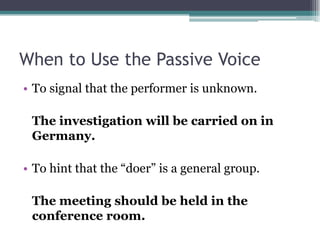
When to Use the Passive Voice
• To signal that the performer is unknown.
The investigation will be carried on in
Germany.
• To hint that the “doer” is a general group.
The meeting should be held in the
conference room.
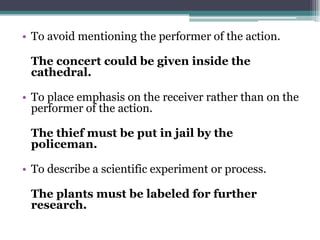
• To avoid mentioning the performer of the action.
The concert could be given inside the
cathedral.
• To place emphasis on the receiver rather than on the
performer of the action.
The thief must be put in jail by the
policeman.
• To describe a scientific experiment or process.
The plants must be labeled for further
research.
The Passive Voice with Modal
Auxiliaries
Person/
object
+
can
could
may
might
should
must
+ be +
past
participle of
verb
• To form the passive voice of modal auxiliaries,
use modal + be + past participle.
• Note that modal auxiliaries have the same
functions in the passive voice as they do in the
active.
Active Passive
Modal Passives
We should build more wind
turbines.
More wind turbines should
be built.
The government must create
laws to protect the
environment.
Laws to protect the
environment must be
created.
Scientists will perfect the
necessary technology soon.
The necessary technology
will be perfected soon.
Use the words within parentheses to complete the paragraph.
On a safari, various guidelines (1. should / follow) to ensure both
safety and respect for the environment. Animals (2. may / observe) up
close, but they (3. must / not / disturb). Vehicles (4. might / require)
to stay on designated paths to avoid damaging the landscape. Photographs
(5. can / take), but flash photography (6. should / not / use) as it could
startle the wildlife. In some areas, visitors (7. have to / accompany) by a
guide to prevent accidents. While certain rules (8. may / consider)
restrictive, they are designed to ensure that future generations can enjoy
these experiences as well.
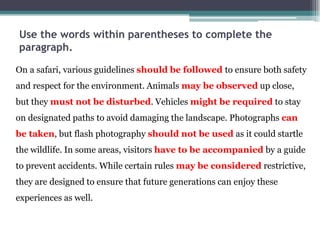
Use the words within parentheses to complete the
paragraph.
On a safari, various guidelines should be followed to ensure both safety
and respect for the environment. Animals may be observed up close,
but they must not be disturbed. Vehicles might be required to stay
on designated paths to avoid damaging the landscape. Photographs can
be taken, but flash photography should not be used as it could startle
the wildlife. In some areas, visitors have to be accompanied by a guide
to prevent accidents. While certain rules may be considered restrictive,
they are designed to ensure that future generations can enjoy these
experiences as well.

GrammarUnit 8_Listening & Speaking_Passive Modals.pdf

  • 1.
  • 2.
    The Passive Voice •Active and passive voices are used in English to express actions. • While in the active voice the subject is the doer, in the passive, the subject receives the effects of the action. Thus, only transitive verbs (those that take a direct object) can undergo the passive transformation.
  • 3.
    • Active: Myparents will place two solar panels on the roof. subject verb direct object • Passive: Two solar panels will be placed by my parents on the roof. subject verb agent In the sentence in the active voice, the primary focus is on the subject (the agent or doer of the action). In the passive voice, the focus is on the object of the sentence.
  • 4.
    • No partat all of the verb form in the active sentence can be deleted in the corresponding passive one. Therefore, the modal auxiliary and the main verb (in its past participle form) plus the verb be will appear in the pasive one. • Although there is a change in word order—and sometimes new elements—the passive sentence always preserves the meaning of the active sentence, and what really occurs is just a change in emphasis.
  • 5.
    When to Usethe Passive Voice • To signal that the performer is unknown. The investigation will be carried on in Germany. • To hint that the “doer” is a general group. The meeting should be held in the conference room.
  • 6.
    • To avoidmentioning the performer of the action. The concert could be given inside the cathedral. • To place emphasis on the receiver rather than on the performer of the action. The thief must be put in jail by the policeman. • To describe a scientific experiment or process. The plants must be labeled for further research.
  • 7.
    The Passive Voicewith Modal Auxiliaries Person/ object + can could may might should must + be + past participle of verb
  • 8.
    • To formthe passive voice of modal auxiliaries, use modal + be + past participle. • Note that modal auxiliaries have the same functions in the passive voice as they do in the active. Active Passive Modal Passives We should build more wind turbines. More wind turbines should be built. The government must create laws to protect the environment. Laws to protect the environment must be created. Scientists will perfect the necessary technology soon. The necessary technology will be perfected soon.
  • 9.
    Use the wordswithin parentheses to complete the paragraph. On a safari, various guidelines (1. should / follow) to ensure both safety and respect for the environment. Animals (2. may / observe) up close, but they (3. must / not / disturb). Vehicles (4. might / require) to stay on designated paths to avoid damaging the landscape. Photographs (5. can / take), but flash photography (6. should / not / use) as it could startle the wildlife. In some areas, visitors (7. have to / accompany) by a guide to prevent accidents. While certain rules (8. may / consider) restrictive, they are designed to ensure that future generations can enjoy these experiences as well.
  • 10.
    Use the wordswithin parentheses to complete the paragraph. On a safari, various guidelines should be followed to ensure both safety and respect for the environment. Animals may be observed up close, but they must not be disturbed. Vehicles might be required to stay on designated paths to avoid damaging the landscape. Photographs can be taken, but flash photography should not be used as it could startle the wildlife. In some areas, visitors have to be accompanied by a guide to prevent accidents. While certain rules may be considered restrictive, they are designed to ensure that future generations can enjoy these experiences as well.