Business Writing Skills: Grammar Part 2
November 27, 2015 Rachael Walker
Overview
Part 1: Verb Tenses
Present
Future
Past
Conditional
Overview
Part 1: Verb Tenses
Present
Future
Past
Conditional
Overview
Part 1: Verb Tenses
Present
Future
Past
Conditional
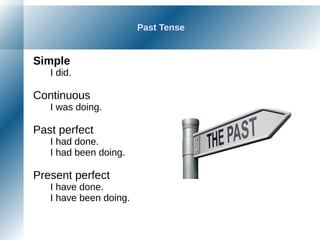
Past Tense
Past Tense
Simple
Past Tense
Simple
I did.
Past Tense
Simple
I did.
Continuous
Past Tense
Simple
I did.
Continuous
I was doing.
Past Tense
Simple
I did.
Continuous
I was doing.
Past perfect
Past Tense
Simple
I did.
Continuous
I was doing.
Past perfect
I had done.
Past Tense
Simple
I did.
Continuous
I was doing.
Past perfect
I had done.
I had been doing.
Past Tense
Simple
I did.
Continuous
I was doing.
Past perfect
I had done.
I had been doing.
Present perfect
Past Tense
Simple
I did.
Continuous
I was doing.
Past perfect
I had done.
I had been doing.
Present perfect
I have done.
Past Tense
Simple
I did.
Continuous
I was doing.
Past perfect
I had done.
I had been doing.
Present perfect
I have done.
I have been doing.
Past Tense
Simple
I did.
Continuous
I was doing.
Past perfect
I had done.
I had been doing.
Present perfect
I have done.
I have been doing.
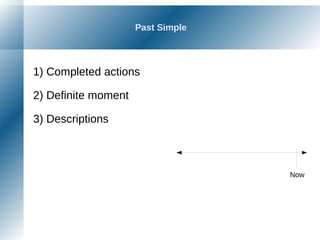
Past Simple
Past Simple
1) Completed actions
Past Simple
1) Completed actions
2) Definite moment
Past Simple
1) Completed actions
2) Definite moment
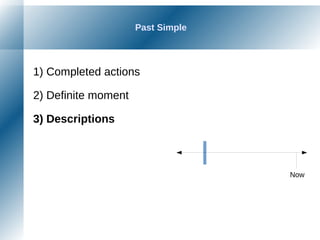
3) Descriptions
Past Simple
1) Completed actions
2) Definite moment
3) Descriptions
Now
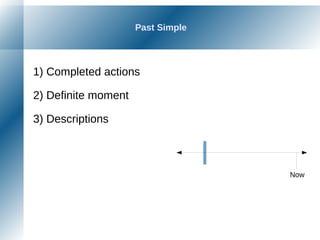
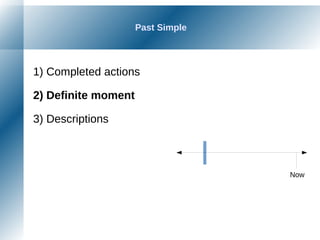
Past Simple
1) Completed actions
2) Definite moment
3) Descriptions
Now
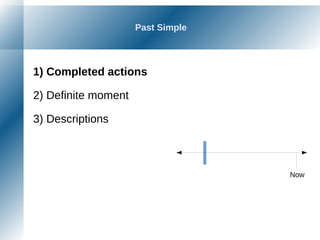
Past Simple
1) Completed actions
2) Definite moment
3) Descriptions
Now
Past simple
Completed Actions
Now
Past simple
Completed Actions
I read the recommendations. (Active)
Now
Past simple
Completed Actions
I read the recommendations. (Active)
The report was submitted. (Passive)
Now
Past Simple
1) Completed actions
2) Definite moment
3) Descriptions
Now
Past simple
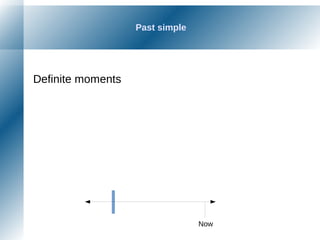
Definite moments
Now
Past simple
Definite moments
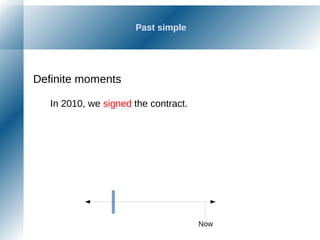
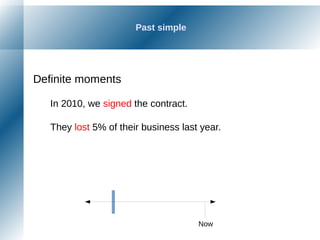
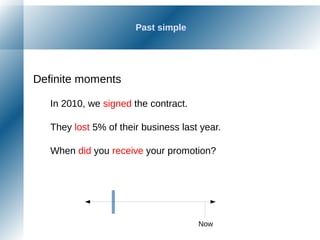
In 2010, we signed the contract.
Now
Past simple
Definite moments
In 2010, we signed the contract.
They lost 5% of their business last year.
Now
Past simple
Definite moments
In 2010, we signed the contract.
They lost 5% of their business last year.
When did you receive your promotion?
Now
Past Simple
1) Completed actions
2) Definite moment
3) Descriptions
Now
Past simple
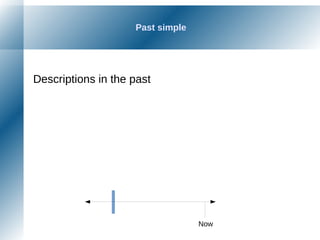
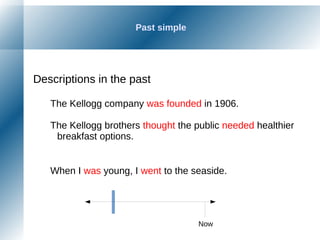
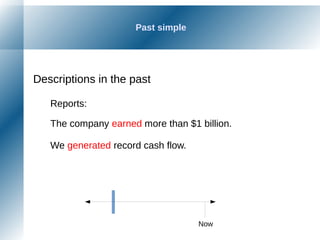
Descriptions in the past
Now
Past simple
Descriptions in the past
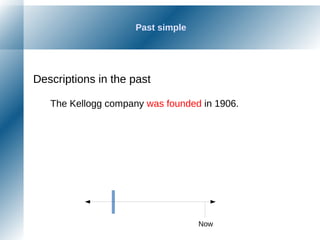
The Kellogg company was founded in 1906.
Now
Past simple
Descriptions in the past
The Kellogg company was founded in 1906.
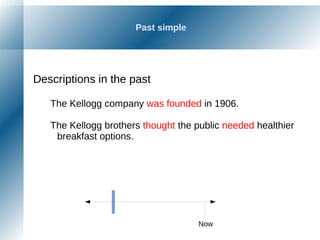
The Kellogg brothers thought the public needed healthier
breakfast options.
Now
Past simple
Descriptions in the past
The Kellogg company was founded in 1906.
The Kellogg brothers thought the public needed healthier
breakfast options.
When I was young, I went to the seaside.
Now
Past simple
Descriptions in the past
Now
Past simple
Descriptions in the past
Reports:
Now
Past simple
Descriptions in the past
Reports:
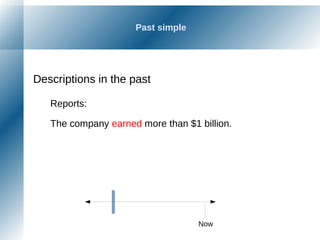
The company earned more than $1 billion.
Now
Past simple
Descriptions in the past
Reports:
The company earned more than $1 billion.
We generated record cash flow.
Now
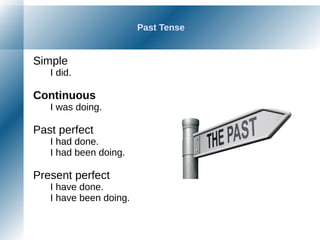
Past Tense
Simple
I did.
Continuous
I was doing.
Past perfect
I had done.
I had been doing.
Present perfect
I have done.
I have been doing.
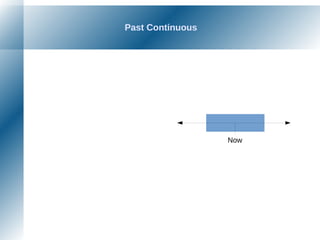
Past Continuous
Now
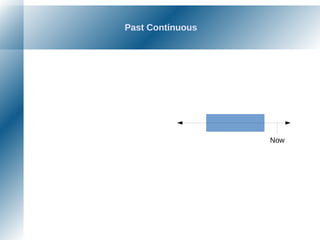
Past Continuous
Now
Past Continuous
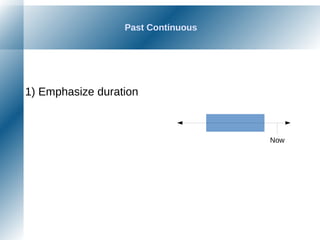
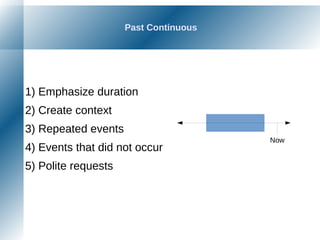
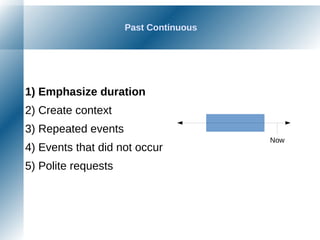
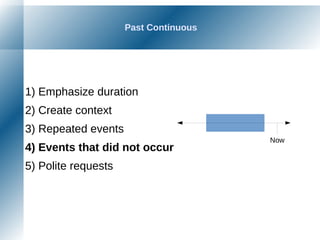
1) Emphasize duration
Now
Past Continuous
1) Emphasize duration
2) Create context
Now
Past Continuous
1) Emphasize duration
2) Create context
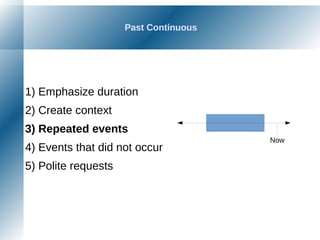
3) Repeated events
Now
Past Continuous
1) Emphasize duration
2) Create context
3) Repeated events
4) Events that did not occur
Now
Past Continuous
1) Emphasize duration
2) Create context
3) Repeated events
4) Events that did not occur
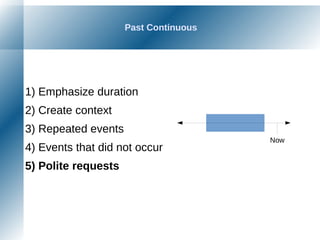
5) Polite requests
Now
Past Continuous
1) Emphasize duration
2) Create context
3) Repeated events
4) Events that did not occur
5) Polite requests
Now
Past Continuous
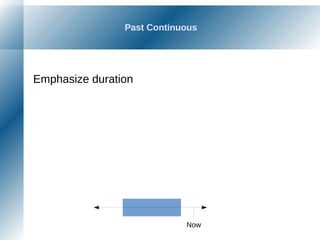
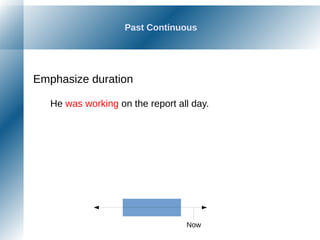
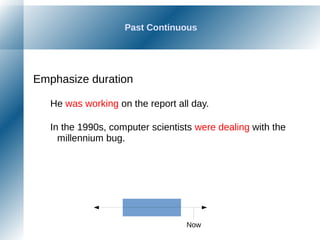
Emphasize duration
Now
Past Continuous
Emphasize duration
He was working on the report all day.
Now
Past Continuous
Emphasize duration
He was working on the report all day.
In the 1990s, computer scientists were dealing with the
millennium bug.
Now
Past Continuous
1) Emphasize duration
2) Create context
3) Repeated events
4) Events that did not occur
5) Polite requests
Now
Past Continuous
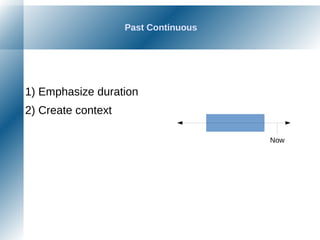
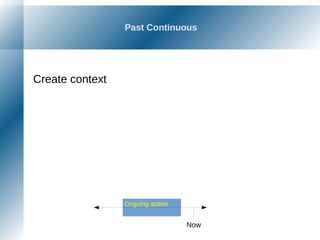
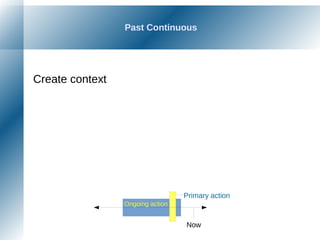
Create context
Now
Past Continuous
Create context
Now
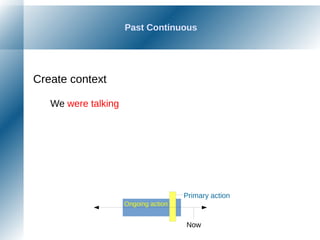
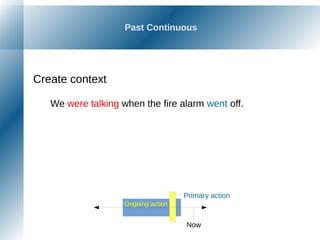
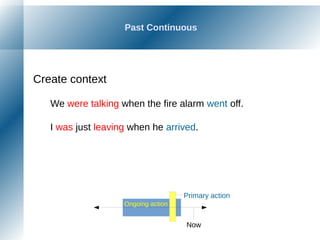
Ongoing action
Past Continuous
Create context
Now
Ongoing action
Primary action
Past Continuous
Create context
We were talking
Now
Ongoing action
Primary action
Past Continuous
Create context
We were talking when the fire alarm went off.
Now
Ongoing action
Primary action
Past Continuous
Create context
We were talking when the fire alarm went off.
I was just leaving when he arrived.
Now
Ongoing action
Primary action
Past Continuous
1) Emphasize duration
2) Create context
3) Repeated events
4) Events that did not occur
5) Polite requests
Now
Past Continuous
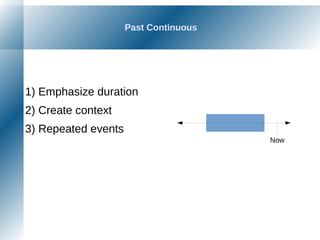
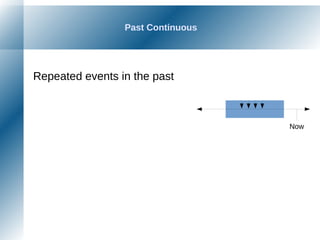
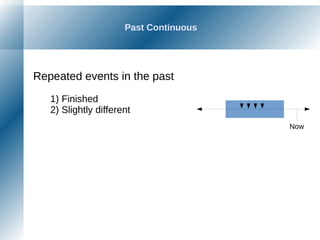
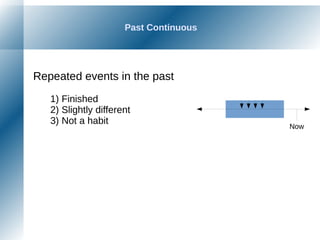
Repeated events in the past
Now
Past Continuous
Repeated events in the past
Now
Past Continuous
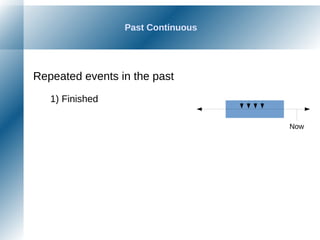
Repeated events in the past
1) Finished
Now
Past Continuous
Repeated events in the past
1) Finished
2) Slightly different
Now
Past Continuous
Repeated events in the past
1) Finished
2) Slightly different
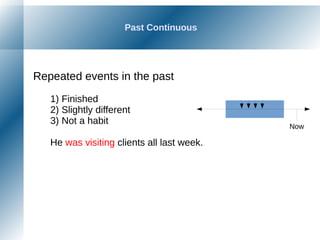
3) Not a habit
Now
Past Continuous
Repeated events in the past
1) Finished
2) Slightly different
3) Not a habit
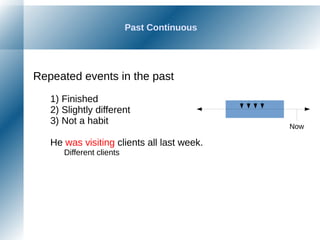
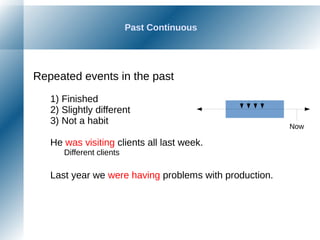
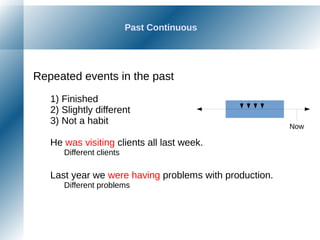
He was visiting clients all last week.
Now
Past Continuous
Repeated events in the past
1) Finished
2) Slightly different
3) Not a habit
He was visiting clients all last week.
Different clients
Now
Past Continuous
Repeated events in the past
1) Finished
2) Slightly different
3) Not a habit
He was visiting clients all last week.
Different clients
Last year we were having problems with production.
Now
Past Continuous
Repeated events in the past
1) Finished
2) Slightly different
3) Not a habit
He was visiting clients all last week.
Different clients
Last year we were having problems with production.
Different problems
Now
Past Continuous
Repeated events in the past
1) Finished
2) Slightly different
3) Not a habit
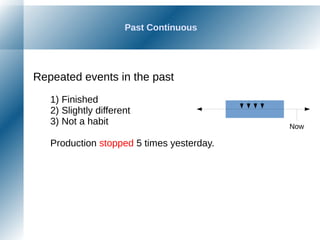
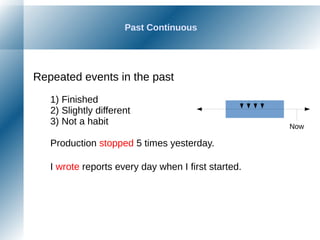
Production stopped 5 times yesterday.
Now
Past Continuous
Repeated events in the past
1) Finished
2) Slightly different
3) Not a habit
Production stopped 5 times yesterday.
I wrote reports every day when I first started.
Now
Past Continuous
1) Emphasize duration
2) Create context
3) Repeated events
4) Events that did not occur
5) Polite requests
Now
Past Continuous
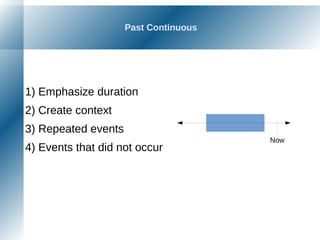
Planned events that did not occur
Past Continuous
Planned events that did not occur
I was planning on going to the park, but it rained.
Past Continuous
Planned events that did not occur
I was planning on going to the park, but it rained.
She was going to phone them, but she forgot.
Past Continuous
1) Emphasize duration
2) Create context
3) Repeated events
4) Events that did not occur
5) Polite requests
Now
Past Continuous
Polite requests
Past Continuous
Polite requests
I was wondering if you could help me.
Past Tense
Simple
I did.
Continuous
I was doing.
Past perfect
I had done.
I had been doing.
Present perfect
I have done.
I have been doing.
Past Perfect
1) The past of the past
Past Perfect
1) The past of the past
2) Continuous
Past Perfect
1) The past of the past
2) Continuous
3) Conditional
Past Perfect
1) The past of the past
2) Continuous
3) Conditional
Past Perfect
The past of the past
Now
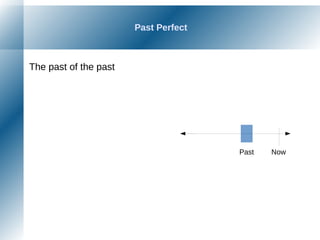
Past Perfect
The past of the past
NowPast
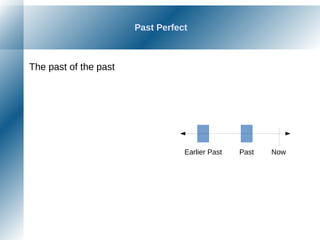
Past Perfect
The past of the past
NowPastEarlier Past
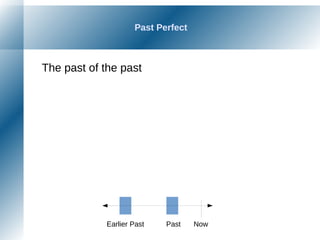
Past Perfect
The past of the past
NowPastEarlier Past
Past Perfect
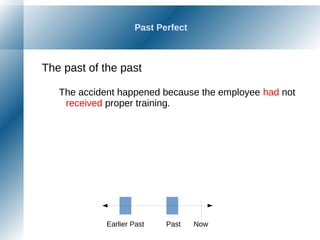
The past of the past
The accident happened because the employee had not
received proper training.
NowPastEarlier Past
Past Perfect
The past of the past
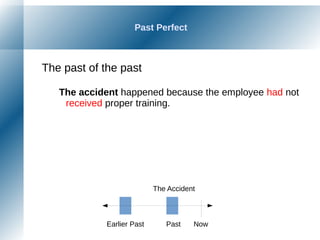
The accident happened because the employee had not
received proper training.
NowPastEarlier Past
The Accident
Past Perfect
The past of the past
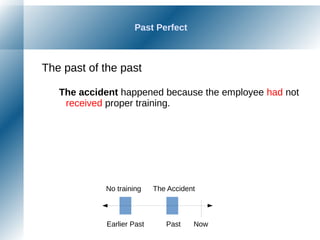
The accident happened because the employee had not
received proper training.
NowPastEarlier Past
The AccidentNo training
Past Perfect
The past of the past
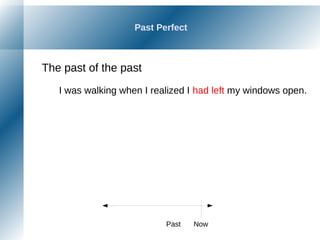
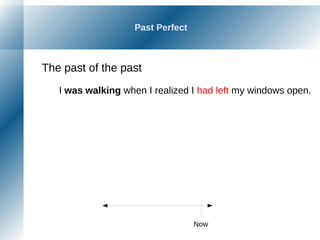
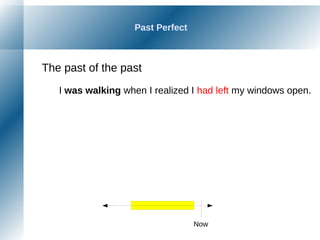
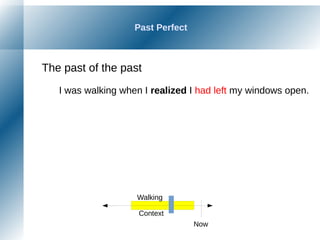
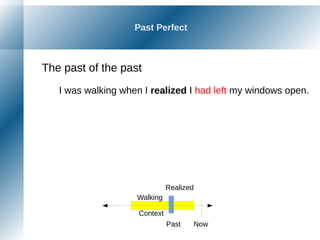
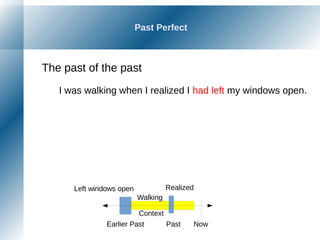
I was walking when I realized I had left my windows open.
NowPast
Past Perfect
The past of the past
I was walking when I realized I had left my windows open.
Now
Past Perfect
The past of the past
I was walking when I realized I had left my windows open.
Now
Past Perfect
The past of the past
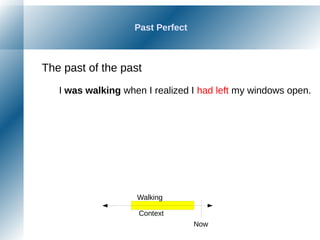
I was walking when I realized I had left my windows open.
Now
Walking
Context
Past Perfect
The past of the past
I was walking when I realized I had left my windows open.
Now
Walking
Context
Past Perfect
The past of the past
I was walking when I realized I had left my windows open.
Now
Walking
Context
Past Perfect
The past of the past
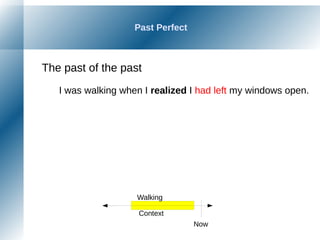
I was walking when I realized I had left my windows open.
Now
Walking
Context
Past
Realized
Past Perfect
The past of the past
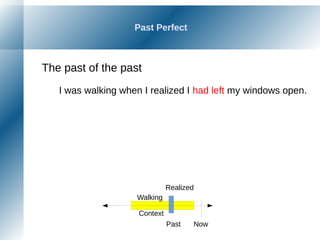
I was walking when I realized I had left my windows open.
NowPast
Realized
Walking
Context
Past Perfect
The past of the past
I was walking when I realized I had left my windows open.
NowPast
Realized
Walking
Context
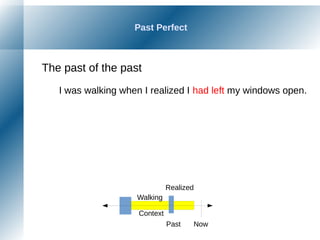
Past Perfect
The past of the past
I was walking when I realized I had left my windows open.
NowPastEarlier Past
RealizedLeft windows open
Walking
Context
Past Perfect
1) The past of the past
2) Continuous
3) Conditional
Past Perfect
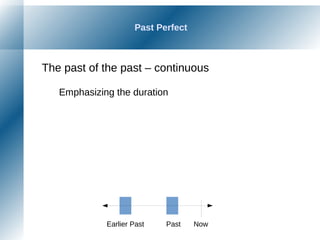
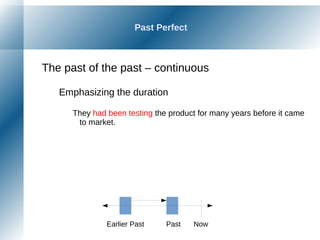
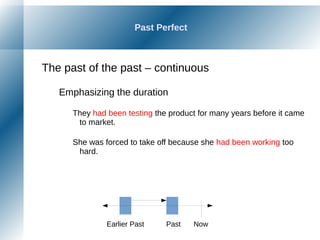
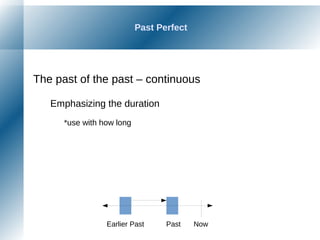
The past of the past – continuous
Emphasizing the duration
NowPastEarlier Past
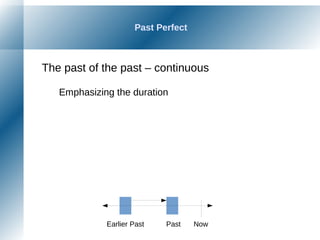
Past Perfect
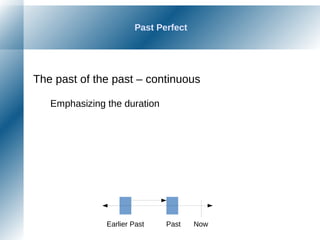
The past of the past – continuous
Emphasizing the duration
NowPastEarlier Past
Past Perfect
The past of the past – continuous
Emphasizing the duration
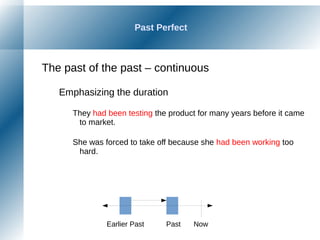
They had been testing the product for many years before it came
to market.
NowPastEarlier Past
Past Perfect
The past of the past – continuous
Emphasizing the duration
They had been testing the product for many years before it came
to market.
She was forced to take off because she had been working too
hard.
NowPastEarlier Past
Past Perfect
Finished and unfinished activities
Past Perfect
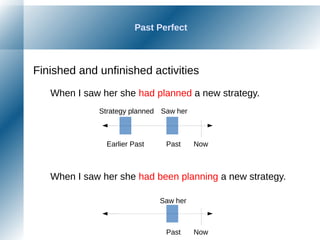
Finished and unfinished activities
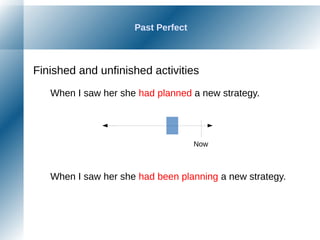
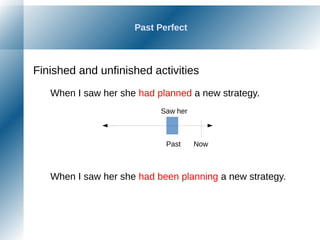
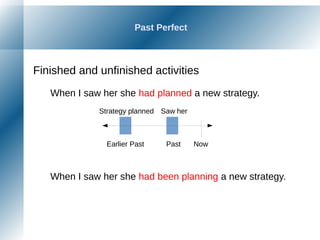
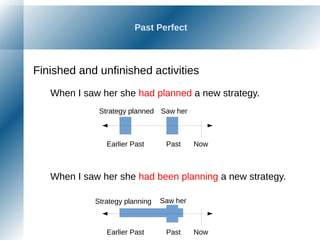
When I saw her she had planned a new strategy.
Past Perfect
Finished and unfinished activities
When I saw her she had planned a new strategy.
When I saw her she had been planning a new strategy.
Past Perfect
Finished and unfinished activities
When I saw her she had planned a new strategy.
When I saw her she had been planning a new strategy.
Now
Past Perfect
Finished and unfinished activities
When I saw her she had planned a new strategy.
When I saw her she had been planning a new strategy.
NowPast
Saw her
Past Perfect
Finished and unfinished activities
When I saw her she had planned a new strategy.
When I saw her she had been planning a new strategy.
NowPastEarlier Past
Strategy planned Saw her
Past Perfect
Finished and unfinished activities
When I saw her she had planned a new strategy.
When I saw her she had been planning a new strategy.
NowPast
NowPastEarlier Past
Strategy planned Saw her
Saw her
Past Perfect
Finished and unfinished activities
When I saw her she had planned a new strategy.
When I saw her she had been planning a new strategy.
NowPastEarlier Past
NowPastEarlier Past
Strategy planned Saw her
Saw herStrategy planning
Past Perfect
The past of the past – continuous
Emphasizing the duration
They had been testing the product for many years before it came
to market.
She was forced to take off because she had been working too
hard.
NowPastEarlier Past
Past Perfect
The past of the past – continuous
Emphasizing the duration
NowPastEarlier Past
Past Perfect
The past of the past – continuous
Emphasizing the duration
*use with how long
NowPastEarlier Past
Past Perfect
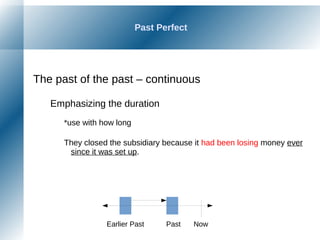
The past of the past – continuous
Emphasizing the duration
*use with how long
They closed the subsidiary because it had been losing money ever
since it was set up.
NowPastEarlier Past
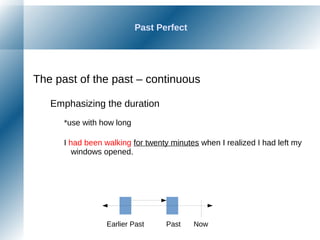
Past Perfect
The past of the past – continuous
Emphasizing the duration
*use with how long
I had been walking for twenty minutes when I realized I had left my
windows opened.
NowPastEarlier Past
Past Perfect
1) The past of the past
2) Continuous
3) Conditional
Past Perfect
Conditional and subjunctive
Past Perfect
Conditional and subjunctive
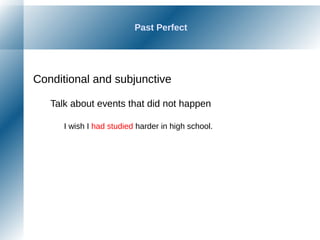
Talk about events that did not happen
Past Perfect
Conditional and subjunctive
Talk about events that did not happen
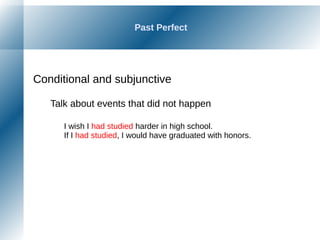
I wish I had studied harder in high school.
Past Perfect
Conditional and subjunctive
Talk about events that did not happen
I wish I had studied harder in high school.
If I had studied, I would have graduated with honors.
Past Perfect
Conditional and subjunctive
Talk about events we wish had not happened
Past Perfect
Conditional and subjunctive
Talk about events we wish had not happened
He wishes he hadn't left his job.
Past Tense
Simple
I did.
Continuous
I was doing.
Past perfect
I had done.
I had been doing.
Present perfect
I have done.
I have been doing.
Present Perfect
1) Present results of past actions
Present Perfect
1) Present results of past actions
2) Announcing news
Present Perfect
1) Present results of past actions
2) Announcing news
3) Time until now
Present Perfect
1) Present results of past actions
2) Announcing news
3) Time until now
4) Experiences
Present Perfect
1) Present results of past actions
2) Announcing news
3) Time until now
4) Experiences
5) Repeated activities
Present Perfect
1) Present results of past actions
2) Announcing news
3) Time until now
4) Experiences
5) Repeated activities
6) Conditional future
Present Perfect
1) Present results of past actions
2) Announcing news
3) Time until now
4) Experiences
5) Repeated activities
6) Conditional future
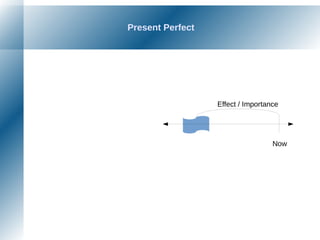
Present Perfect
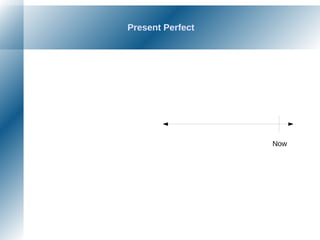
Now
Present Perfect
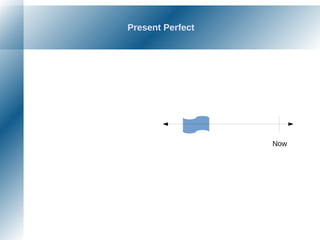
Now
Present Perfect
Now
Effect / Importance
Present Perfect
Now
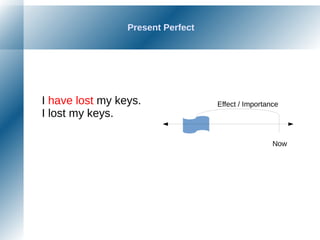
Effect / ImportanceI have lost my keys.
I lost my keys.
Present Perfect
Now
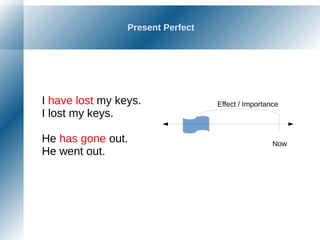
Effect / ImportanceI have lost my keys.
I lost my keys.
He has gone out.
He went out.
Present Perfect
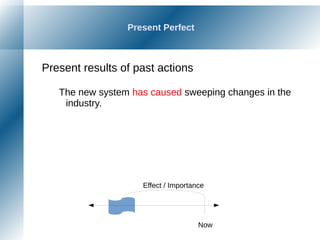
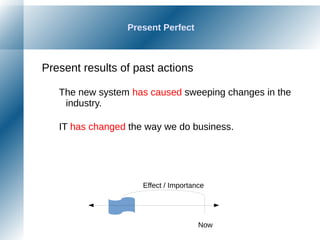
Present results of past actions
The new system has caused sweeping changes in the
industry.
Now
Effect / Importance
Present Perfect
Present results of past actions
The new system has caused sweeping changes in the
industry.
IT has changed the way we do business.
Now
Effect / Importance
Present Perfect
1) Present results of past actions
2) Announcing news
3) Time until now
4) Experiences
5) Repeated activities
6) Conditional future
Present Perfect
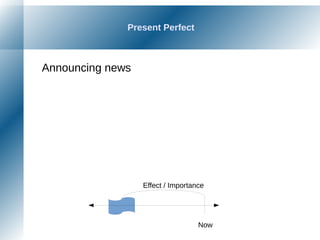
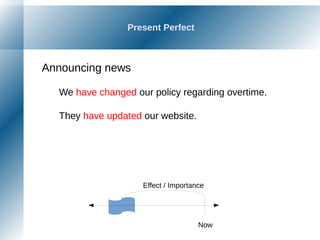
Announcing news
Now
Effect / Importance
Present Perfect
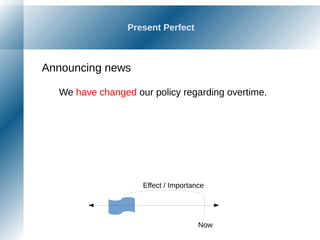
Announcing news
We have changed our policy regarding overtime.
Now
Effect / Importance
Present Perfect
Announcing news
We have changed our policy regarding overtime.
They have updated our website.
Now
Effect / Importance
Present Perfect
1) Present results of past actions
2) Announcing news
3) Time until now
4) Experiences
5) Repeated activities
6) Conditional future
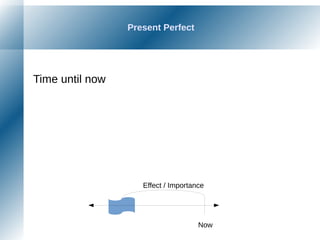
Present Perfect
Time until now
Now
Effect / Importance
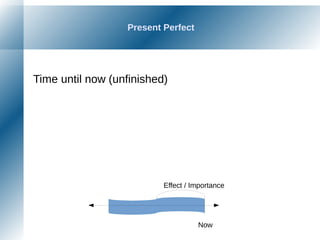
Present Perfect
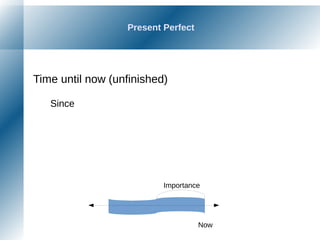
Time until now (unfinished)
Now
Effect / Importance
Present Perfect
Time until now (unfinished)
Since
Now
Importance
Present Perfect
Time until now (unfinished)
Since
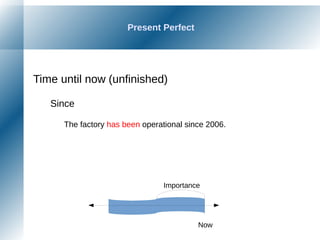
The factory has been operational since 2006.
Now
Importance
Present Perfect
Time until now (unfinished)
Since
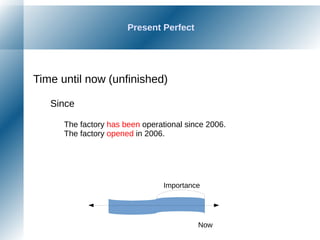
The factory has been operational since 2006.
The factory opened in 2006.
Now
Importance
Present Perfect
Time until now (unfinished)
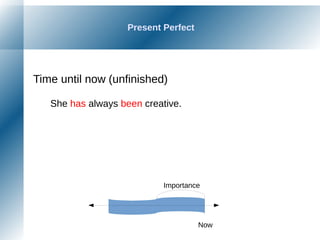
She has always been creative.
Now
Importance
Present Perfect
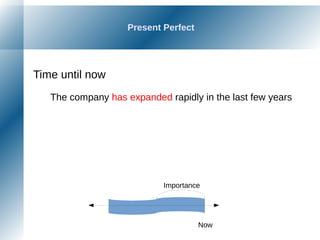
Time until now
The company has expanded rapidly in the last few years
Now
Importance
Present Perfect
Time until now
Now
Importance
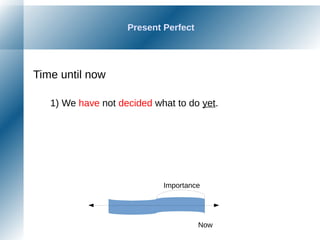
Present Perfect
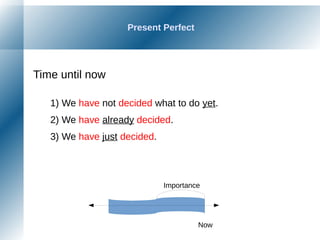
Time until now
1) We have not decided what to do yet.
Now
Importance
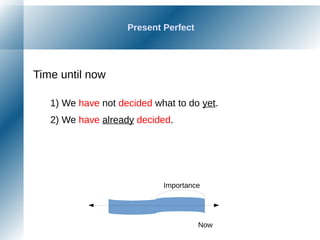
Present Perfect
Time until now
1) We have not decided what to do yet.
2) We have already decided.
Now
Importance
Present Perfect
Time until now
1) We have not decided what to do yet.
2) We have already decided.
3) We have just decided.
Now
Importance
Present Perfect
1) Present results of past actions
2) Announcing news
3) Time until now
4) Experiences
5) Repeated activities
6) Conditional future
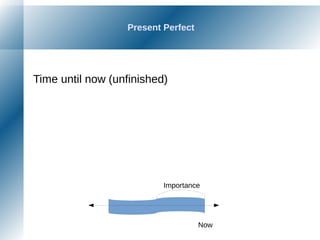
Present Perfect
Time until now (unfinished)
Now
Importance
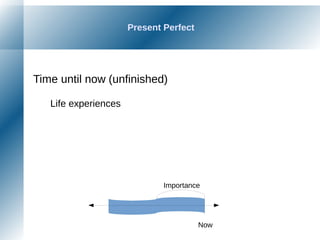
Present Perfect
Time until now (unfinished)
Life experiences
Now
Importance
Present Perfect
Time until now (unfinished)
Life experiences
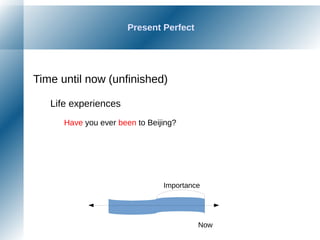
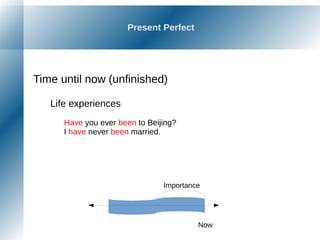
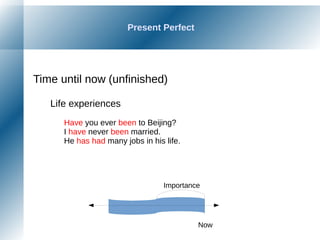
Have you ever been to Beijing?
Now
Importance
Present Perfect
Time until now (unfinished)
Life experiences
Have you ever been to Beijing?
I have never been married.
Now
Importance
Present Perfect
Time until now (unfinished)
Life experiences
Have you ever been to Beijing?
I have never been married.
He has had many jobs in his life.
Now
Importance
Present Perfect
Time until now (unfinished)
Life experiences
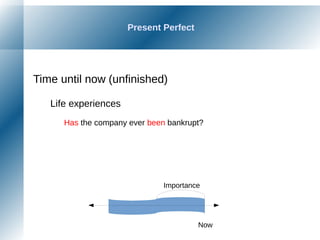
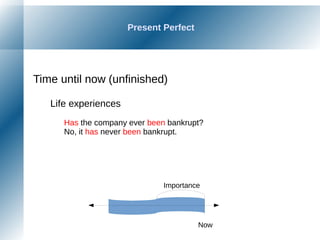
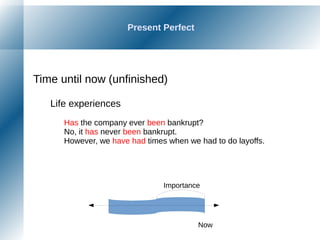
Has the company ever been bankrupt?
Now
Importance
Present Perfect
Time until now (unfinished)
Life experiences
Has the company ever been bankrupt?
No, it has never been bankrupt.
Now
Importance
Present Perfect
Time until now (unfinished)
Life experiences
Has the company ever been bankrupt?
No, it has never been bankrupt.
However, we have had times when we had to do layoffs.
Now
Importance
Present Perfect
1) Present results of past actions
2) Announcing news
3) Time until now
4) Experiences
5) Repeated activities
6) Conditional future
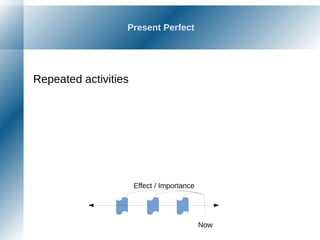
Present Perfect
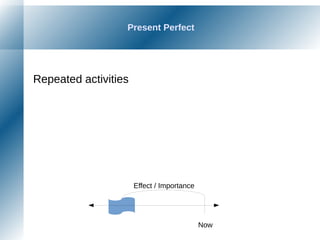
Repeated activities
Now
Effect / Importance
Present Perfect
Repeated activities
Now
Effect / Importance
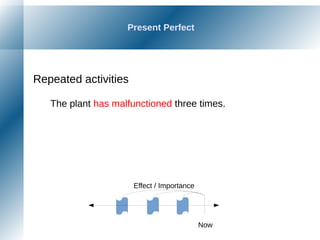
Present Perfect
Repeated activities
The plant has malfunctioned three times.
Now
Effect / Importance
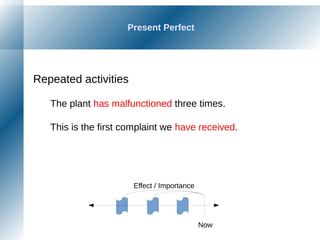
Present Perfect
Repeated activities
The plant has malfunctioned three times.
This is the first complaint we have received.
Now
Effect / Importance
Present Perfect
1) Present results of past actions
2) Announcing news
3) Time until now
4) Experiences
5) Repeated activities
6) Conditional future
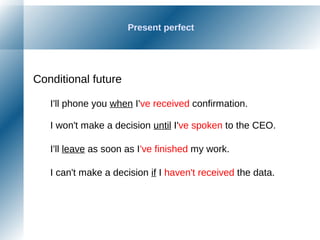
Present perfect
Conditional future
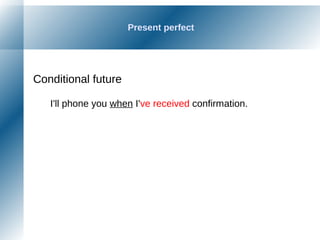
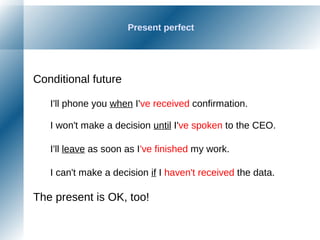
Present perfect
Conditional future
I'll phone you when I've received confirmation.
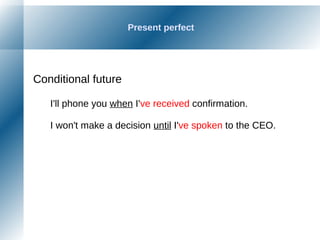
Present perfect
Conditional future
I'll phone you when I've received confirmation.
I won't make a decision until I've spoken to the CEO.
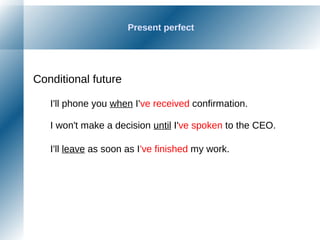
Present perfect
Conditional future
I'll phone you when I've received confirmation.
I won't make a decision until I've spoken to the CEO.
I'll leave as soon as I've finished my work.
Present perfect
Conditional future
I'll phone you when I've received confirmation.
I won't make a decision until I've spoken to the CEO.
I'll leave as soon as I've finished my work.
I can't make a decision if I haven't received the data.
Present perfect
Conditional future
I'll phone you when I've received confirmation.
I won't make a decision until I've spoken to the CEO.
I'll leave as soon as I've finished my work.
I can't make a decision if I haven't received the data.
The present is OK, too!
Present Perfect Continuous
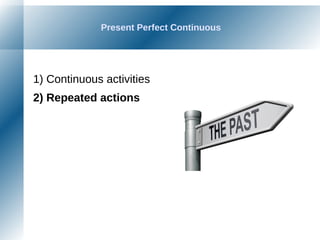
1) Continuous activities
2) Repeated actions
Present Perfect Continuous
1) Continuous activities
2) Repeated actions
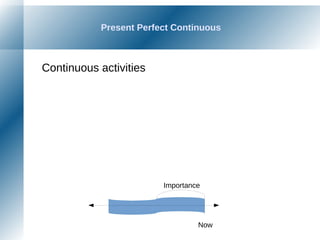
Continuous activities
Now
Importance
Present Perfect Continuous
Continuous activities
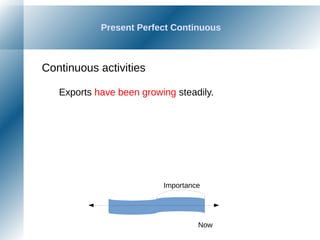
Exports have been growing steadily.
Now
Importance
Present Perfect Continuous
Continuous activities
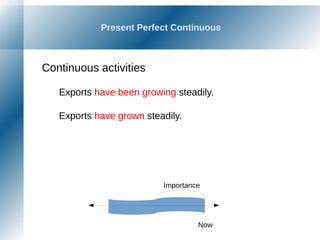
Exports have been growing steadily.
Exports have grown steadily.
Now
Importance
Present Perfect Continuous
Continuous activities
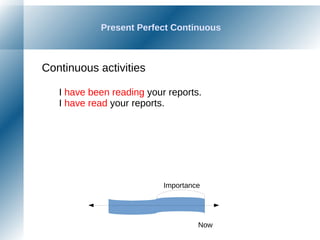
I have been reading your reports.
I have read your reports.
Now
Importance
Present Perfect Continuous
Focus on the duration
Present Perfect Continuous
Focus on the duration
I'm dirty because I've been working on my car all day.
Present Perfect Continuous
Focus on the duration
I'm dirty because I've been working on my car all day.
I've been studying English for twelve years.
Present Perfect Continuous
1) Continuous activities
2) Repeated actions
Present Perfect Continuous
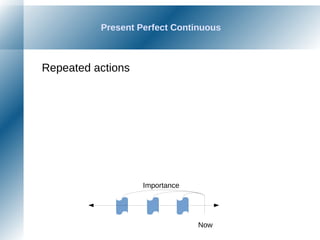
Repeated actions
Now
Importance
Present Perfect Continuous
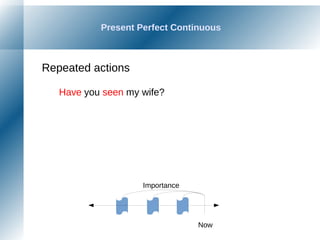
Repeated actions
Have you seen my wife?
Now
Importance
Present Perfect Continuous
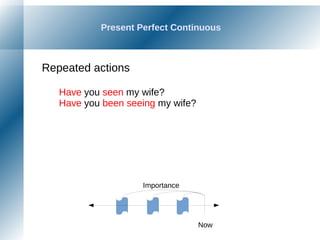
Repeated actions
Have you seen my wife?
Have you been seeing my wife?
Now
Importance
Present Perfect Continuous
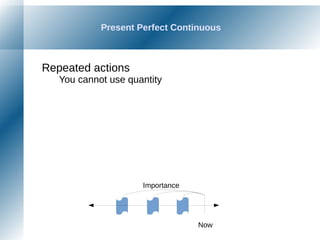
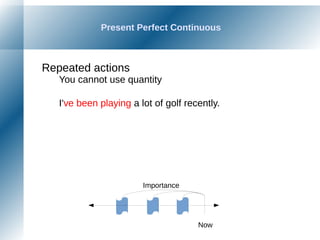
Repeated actions
You cannot use quantity
Now
Importance
Present Perfect Continuous
Repeated actions
You cannot use quantity
I've been playing a lot of golf recently.
Now
Importance
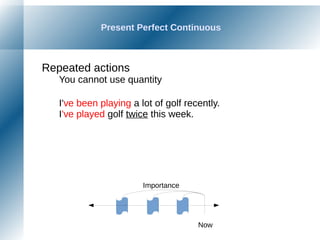
Present Perfect Continuous
Repeated actions
You cannot use quantity
I've been playing a lot of golf recently.
I've played golf twice this week.
Now
Importance
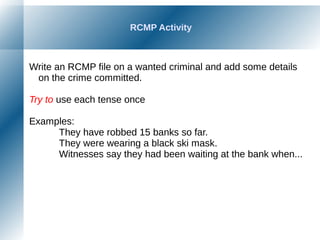
RCMP Activity
Write an RCMP file on a wanted criminal and add some details
on the crime committed.
Try to use each tense once
Examples:
They have robbed 15 banks so far.
They were wearing a black ski mask.
Witnesses say they had been waiting at the bank when...
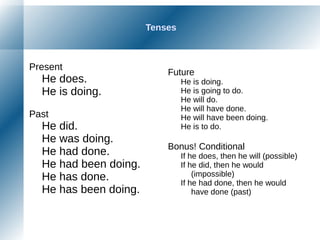
Tenses
Present
He does.
He is doing.
Past
He did.
He was doing.
He had done.
He had been doing.
He has done.
He has been doing.
Future
He is doing.
He is going to do.
He will do.
He will have done.
He will have been doing.
He is to do.
Bonus! Conditional
If he does, then he will (possible)
If he did, then he would
(impossible)
If he had done, then he would
have done (past)
Overview
Part 1: Verb Tenses
Present
Future
Past
Conditional
Conditional and Subjunctive
Future (possible)
Future or present (impossible)
Past
In use
Conditional and Subjunctive
Backslide
Conditional and Subjunctive
Backslide
Future Possible
Conditional and Subjunctive
Backslide
Future
I will win tomorrow.
I hope
Possible
Conditional and Subjunctive
Backslide
Future
I will win tomorrow.
I hope I win tomorrow.
Possible
Conditional and Subjunctive
Backslide
Future
You will give a mouse a cookie.
If you give a mouse a
cookie, he will
want a glass of milk.
Possible
Conditional and Subjunctive
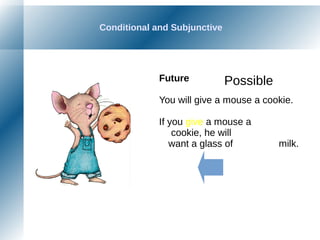
Future
You will give a mouse a cookie.
If you give a mouse a
cookie, he will
want a glass of milk.
Possible
Conditional and Subjunctive
Future (possible)
Future or present (impossible)
Past
In use
Conditional and Subjunctive
Present
I have a dog.
I wishBackslide
impossible
Conditional and Subjunctive
Present
I have a dog.
I wish I had a dog.
Backslide
impossible
Conditional and Subjunctive
Future
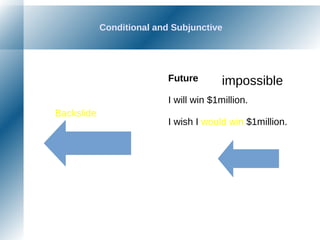
I will win $1million.
I wish
Backslide
impossible
Conditional and Subjunctive
Future
I will win $1million.
I wish I would win $1million.
Backslide
impossible
Conditional and Subjunctive
Future
I will win $1million.
If I won $1million, I
would be happy.
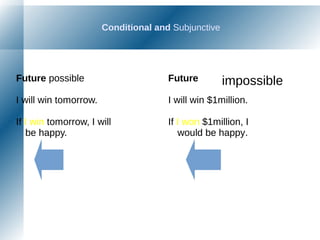
impossibleFuture possible
I will win tomorrow.
If I win tomorrow, I will
be happy.
Conditional and Subjunctive
Future
I will win $1million.
If I won $1million, I
would be happy.
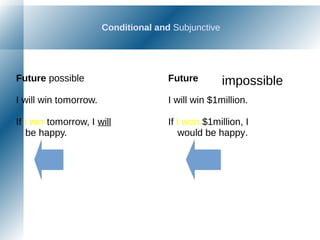
impossibleFuture possible
I will win tomorrow.
If I win tomorrow, I will
be happy.
Conditional and Subjunctive
Future
I will win $1million.
If I won $1million, I
would be happy.
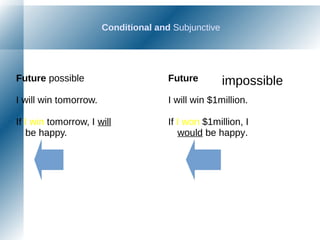
impossibleFuture possible
I will win tomorrow.
If I win tomorrow, I will
be happy.
Conditional and Subjunctive
Future
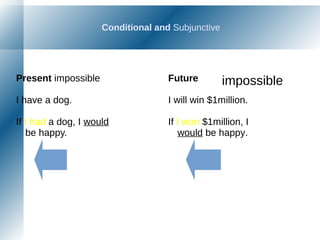
I will win $1million.
If I won $1million, I
would be happy.
impossiblePresent impossible
I have a dog.
If I had a dog, I would
be happy.
Conditional and Subjunctive
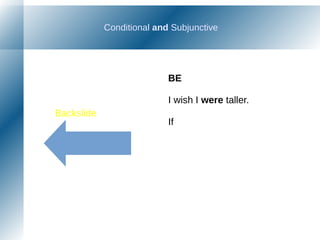
BE
I wish I were taller.
If
Backslide
Conditional and Subjunctive
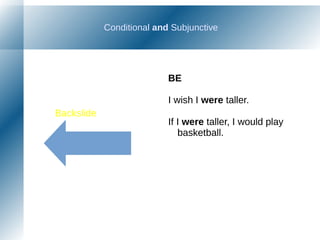
BE
I wish I were taller.
If I were taller, I would play
basketball.
Backslide
Conditional and Subjunctive
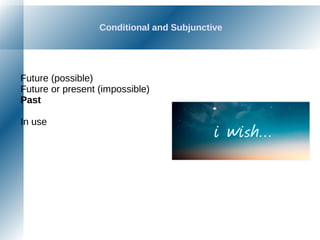
Future (possible)
Future or present (impossible)
Past
In use
Conditional and Subjunctive
Backslide
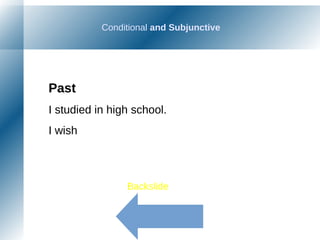
Past
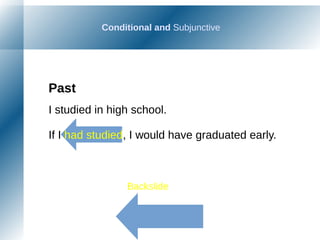
I studied in high school.
I wish
Conditional and Subjunctive
Backslide
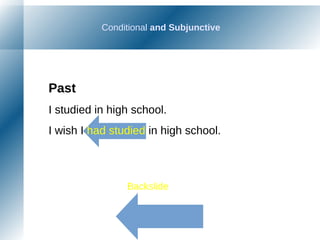
Past
I studied in high school.
I wish I had studied in high school.
Conditional and Subjunctive
Backslide
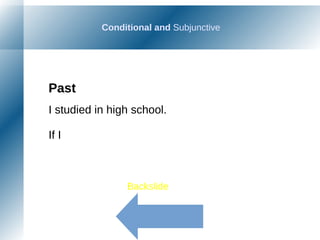
Past
I studied in high school.
If I
Conditional and Subjunctive
Backslide
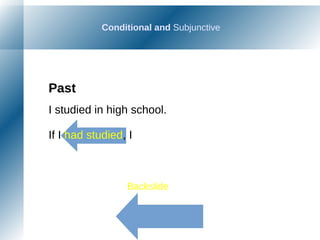
Past
I studied in high school.
If I had studied, I
Conditional and Subjunctive
Backslide
Past
I studied in high school.
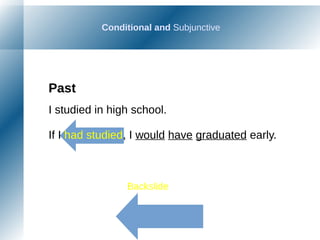
If I had studied, I would have graduated early.
Conditional and Subjunctive
Backslide
Past
I studied in high school.
If I had studied, I would have graduated early.
Conditional and Subjunctive
Backslide
Past
I studied in high school.
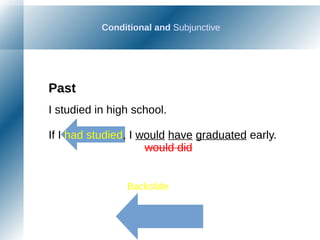
If I had studied, I would have graduated early.
would did
Conditional and Subjunctive
Future
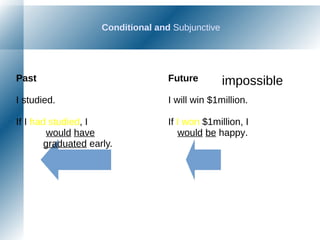
I will win $1million.
If I won $1million, I
would be happy.
impossiblePast
I studied.
If I had studied, I
would have
graduated early.
Conditional and Subjunctive
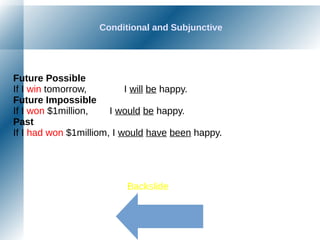
Future Possible
If I win tomorrow, I will be happy.
Future Impossible
If I won $1million, I would be happy.
Past
If I had won $1milliom, I would have been happy.
Backslide
Conditional and Subjunctive
Future (possible)
Future or present (impossible)
Past
In use
Conditional and Subjunctive
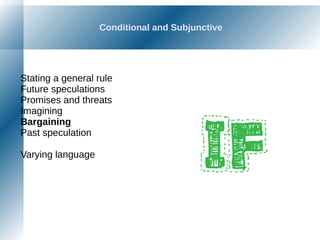
Stating a general rule
Future speculations
Promises and threats
Imagining
Bargaining
Past speculation
Varying language
Conditional and Subjunctive
Stating a general rule
Future speculations
Promises and threats
Imagining
Bargaining
Past speculation
Varying language
Conditional and Subjunctive
Stating a general rule
Future speculations
Promises and threats
Imagining
Bargaining
Past speculation
Varying language
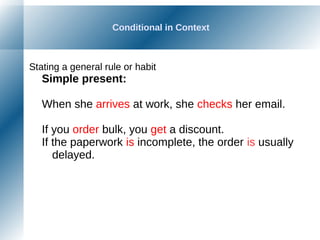
Conditional in Context
Stating a general rule or habit
Simple present:
When she arrives at work, she checks her email.
If you order bulk, you get a discount.
If the paperwork is incomplete, the order is usually
delayed.
Conditional and Subjunctive
Stating a general rule
Future speculations
Promises and threats
Imagining
Bargaining
Past speculation
Varying language
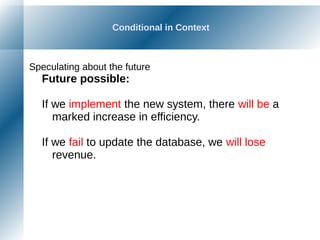
Conditional in Context
Speculating about the future
Future possible:
If we implement the new system, there will be a
marked increase in efficiency.
If we fail to update the database, we will lose
revenue.
Conditional and Subjunctive
Stating a general rule
Future speculations
Promises and threats
Imagining
Bargaining
Past speculation
Varying language
Conditional in Context
Unless and if
Unless = if + not
If we do not update the
database...
Unless we update the
database...
Conditional in Context
Unless and if
Unless = if + not
If we do not update the
database...
Unless we update the
database...
we will lose revenue.
Conditional in Context
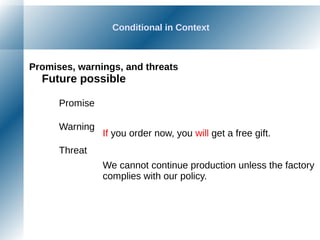
Promises, warnings, and threats
Future possible
Promise
Warning
Threat
If you order now, you will get a free gift.
Conditional in Context
Promises, warnings, and threats
Future possible
Promise
Warning
Threat
If you order now, you will get a free gift.
We cannot continue production unless the factory
complies with our policy.
Conditional in Context
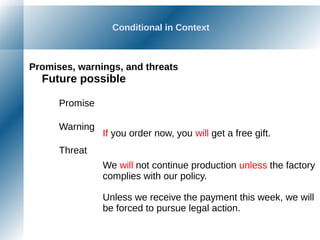
Promises, warnings, and threats
Future possible
Promise
Warning
Threat
If you order now, you will get a free gift.
We will not continue production unless the factory
complies with our policy.
Unless we receive the payment this week, we will
be forced to pursue legal action.
Conditional in Context
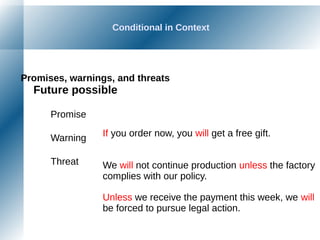
Promises, warnings, and threats
Future possible
Promise
Warning
Threat
If you order now, you will get a free gift.
We will not continue production unless the factory
complies with our policy.
Unless we receive the payment this week, we will
be forced to pursue legal action.
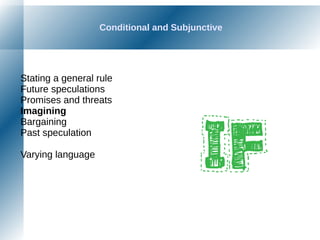
Conditional and Subjunctive
Stating a general rule
Future speculations
Promises and threats
Imagining
Bargaining
Past speculation
Varying language
Conditional in Context
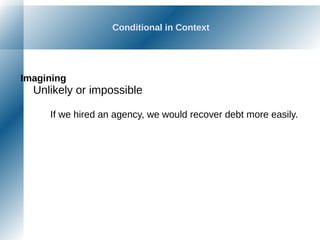
Imagining
Unlikely or impossible
If we hired an agency, we would recover debt more easily.
Conditional in Context
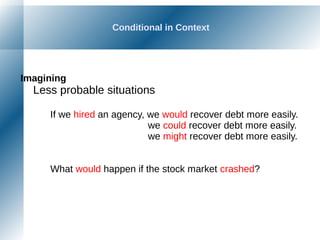
Imagining
Less probable situations
If we hired an agency, we would recover debt more easily.
we could recover debt more easily.
we might recover debt more easily.
What would happen if the stock market crashed?
Conditional and Subjunctive
Stating a general rule
Future speculations
Promises and threats
Imagining
Bargaining
Past speculation
Varying language
Conditional in Context
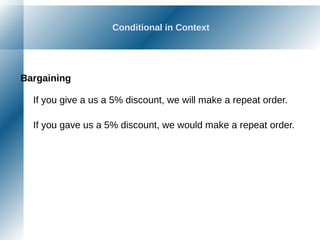
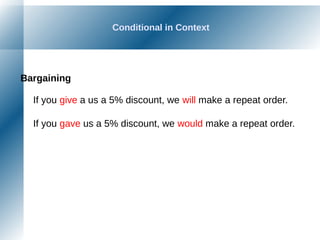
Bargaining
If you give a us a 5% discount, we will make a repeat order.
If you gave us a 5% discount, we would make a repeat order.
Conditional in Context
Bargaining
If you give a us a 5% discount, we will make a repeat order.
If you gave us a 5% discount, we would make a repeat order.
Conditional and Subjunctive
Stating a general rule
Future speculations
Promises and threats
Imagining
Bargaining
Past speculation
Varying language
Conditional in Context
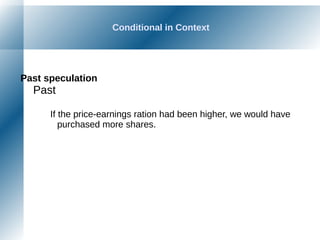
Past speculation
Past
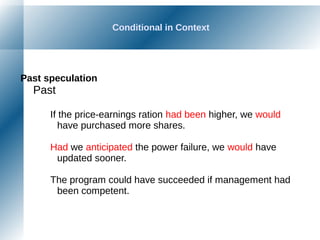
If the price-earnings ration had been higher, we would have
purchased more shares.
Conditional in Context
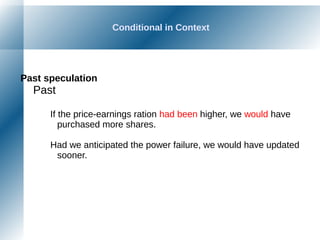
Past speculation
Past
If the price-earnings ration had been higher, we would have
purchased more shares.
Had we anticipated the power failure, we would have updated
sooner.
Conditional in Context
Past speculation
Past
If the price-earnings ration had been higher, we would
have purchased more shares.
Had we anticipated the power failure, we would have
updated sooner.
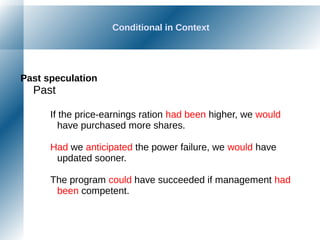
The program could have succeeded if management had
been competent.
Conditional in Context
Past speculation
Past
If the price-earnings ration had been higher, we would
have purchased more shares.
Had we anticipated the power failure, we would have
updated sooner.
The program could have succeeded if management had
been competent.
Conditional and Subjunctive
Stating a general rule
Future speculations
Promises and threats
Imagining
Bargaining
Past speculation
Varying language
Conditional in context
Varying language
Provided (that)
On condition that
In case of
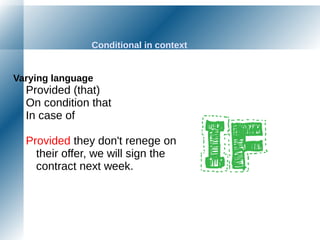
Provided they don't renege on
their offer, we will sign the
contract next week.
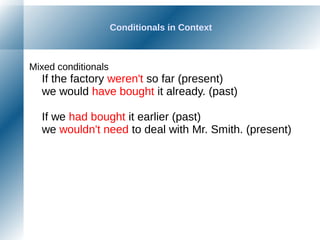
Conditionals in Context
Mixed conditionals
If the factory weren't so far (present)
we would have bought it already. (past)
If we had bought it earlier (past)
we wouldn't need to deal with Mr. Smith. (present)
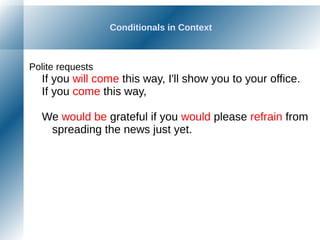
Conditionals in Context
Polite requests
If you will come this way, I'll show you to your office.
If you come this way,
We would be grateful if you would please refrain from
spreading the news just yet.
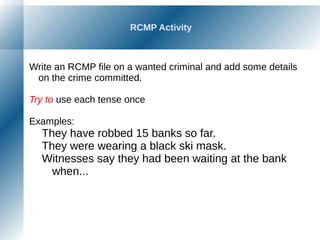
RCMP Activity
Write an RCMP file on a wanted criminal and add some details
on the crime committed.
Try to use each tense once
Examples:
They have robbed 15 banks so far.
They were wearing a black ski mask.
Witnesses say they had been waiting at the bank
when...
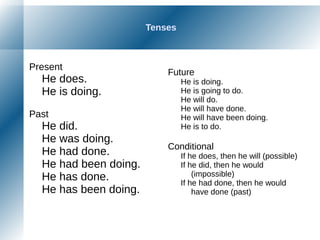
Tenses
Present
He does.
He is doing.
Past
He did.
He was doing.
He had done.
He had been doing.
He has done.
He has been doing.
Future
He is doing.
He is going to do.
He will do.
He will have done.
He will have been doing.
He is to do.
Conditional
If he does, then he will (possible)
If he did, then he would
(impossible)
If he had done, then he would
have done (past)

Grammar workshop 2.2