387
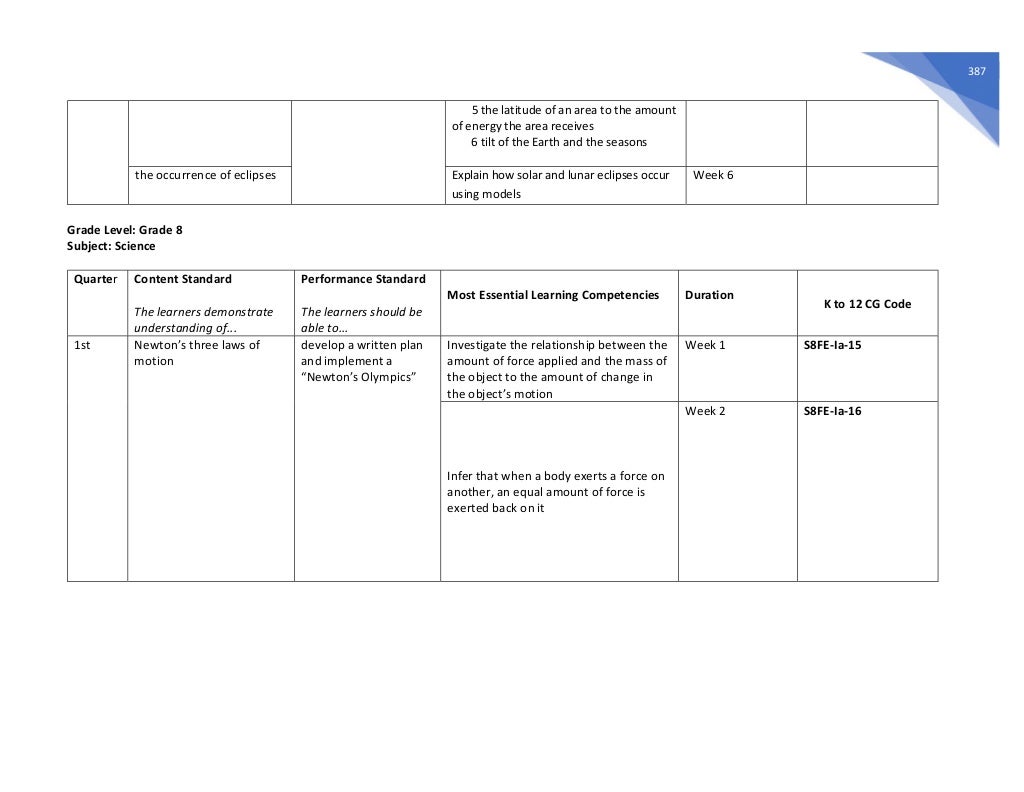
5 the latitudeof an area to the amount
of energy the area receives
6 tilt of the Earth and the seasons
the occurrence of eclipses Explain how solar and lunar eclipses occur
using models
Week 6
Grade Level: Grade 8
Subject: Science
Quarter Content Standard
The learners demonstrate
understanding of...
Performance Standard
The learners should be
able to...
Most Essential Learning Competencies Duration
K to 12 CG Code
1st Newton’s three laws of
motion
develop a written plan
and implement a
“Newton’s Olympics”
Investigate the relationship between the
amount of force applied and the mass of
the object to the amount of change in
the object’s motion
Week 1 S8FE-Ia-15
Infer that when a body exerts a force on
another, an equal amount of force is
exerted back on it
Week 2 S8FE-Ia-16
4.
388
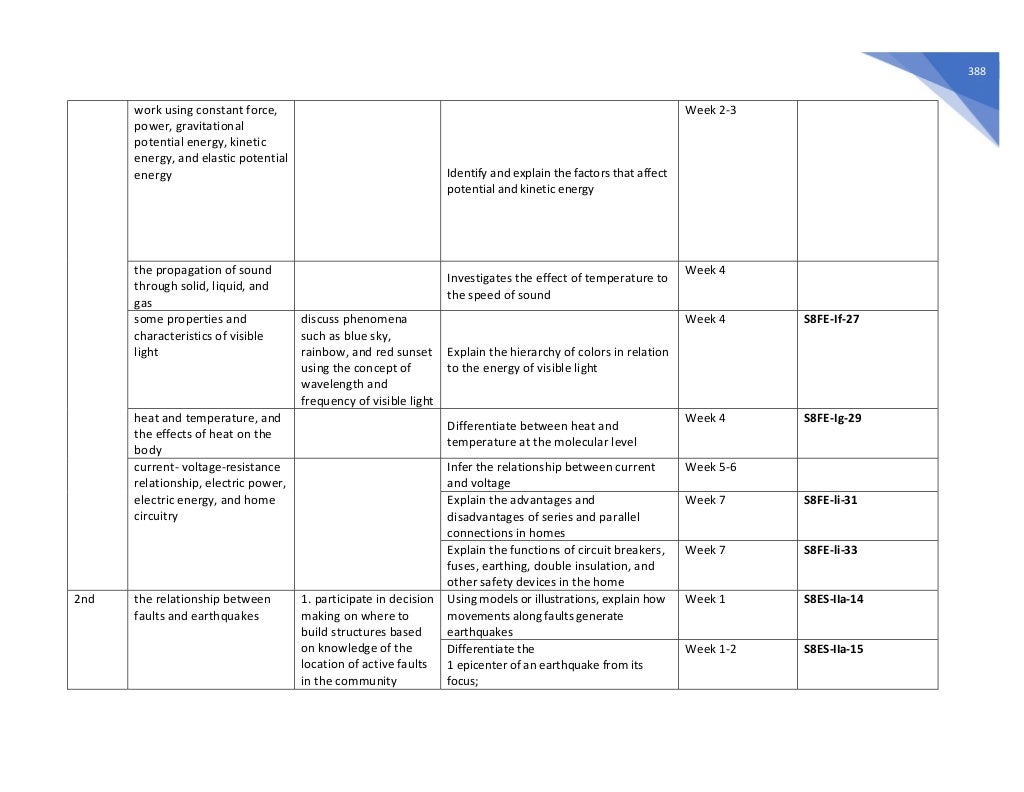
work using constantforce,
power, gravitational
potential energy, kinetic
energy, and elastic potential
energy Identify and explain the factors that affect
potential and kinetic energy
Week 2-3
the propagation of sound
through solid, liquid, and
gas
Investigates the effect of temperature to
the speed of sound
Week 4
some properties and
characteristics of visible
light
discuss phenomena
such as blue sky,
rainbow, and red sunset
using the concept of
wavelength and
frequency of visible light
Explain the hierarchy of colors in relation
to the energy of visible light
Week 4 S8FE-If-27
heat and temperature, and
the effects of heat on the
body
Differentiate between heat and
temperature at the molecular level
Week 4 S8FE-Ig-29
current- voltage-resistance
relationship, electric power,
electric energy, and home
circuitry
Infer the relationship between current
and voltage
Week 5-6
Explain the advantages and
disadvantages of series and parallel
connections in homes
Week 7 S8FE-li-31
Explain the functions of circuit breakers,
fuses, earthing, double insulation, and
other safety devices in the home
Week 7 S8FE-li-33
2nd the relationship between
faults and earthquakes
1. participate in decision
making on where to
build structures based
on knowledge of the
location of active faults
in the community
Using models or illustrations, explain how
movements along faults generate
earthquakes
Week 1 S8ES-IIa-14
Differentiate the
1 epicenter of an earthquake from its
focus;
Week 1-2 S8ES-IIa-15
5.
389
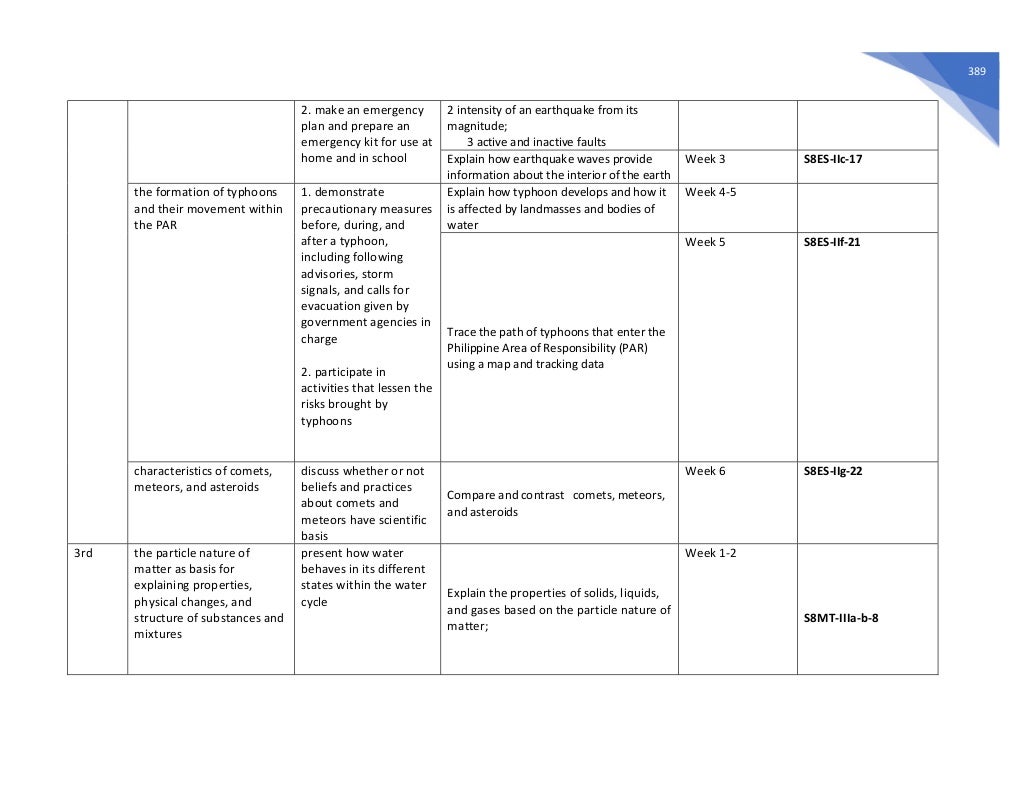
2. make anemergency
plan and prepare an
emergency kit for use at
home and in school
2 intensity of an earthquake from its
magnitude;
3 active and inactive faults
Explain how earthquake waves provide
information about the interior of the earth
Week 3 S8ES-IIc-17
the formation of typhoons
and their movement within
the PAR
1. demonstrate
precautionary measures
before, during, and
after a typhoon,
including following
advisories, storm
signals, and calls for
evacuation given by
government agencies in
charge
2. participate in
activities that lessen the
risks brought by
typhoons
Explain how typhoon develops and how it
is affected by landmasses and bodies of
water
Week 4-5
Trace the path of typhoons that enter the
Philippine Area of Responsibility (PAR)
using a map and tracking data
Week 5 S8ES-IIf-21
characteristics of comets,
meteors, and asteroids
discuss whether or not
beliefs and practices
about comets and
meteors have scientific
basis
Compare and contrast comets, meteors,
and asteroids
Week 6 S8ES-IIg-22
3rd the particle nature of
matter as basis for
explaining properties,
physical changes, and
structure of substances and
mixtures
present how water
behaves in its different
states within the water
cycle
Explain the properties of solids, liquids,
and gases based on the particle nature of
matter;
Week 1-2
S8MT-IIIa-b-8
6.
390
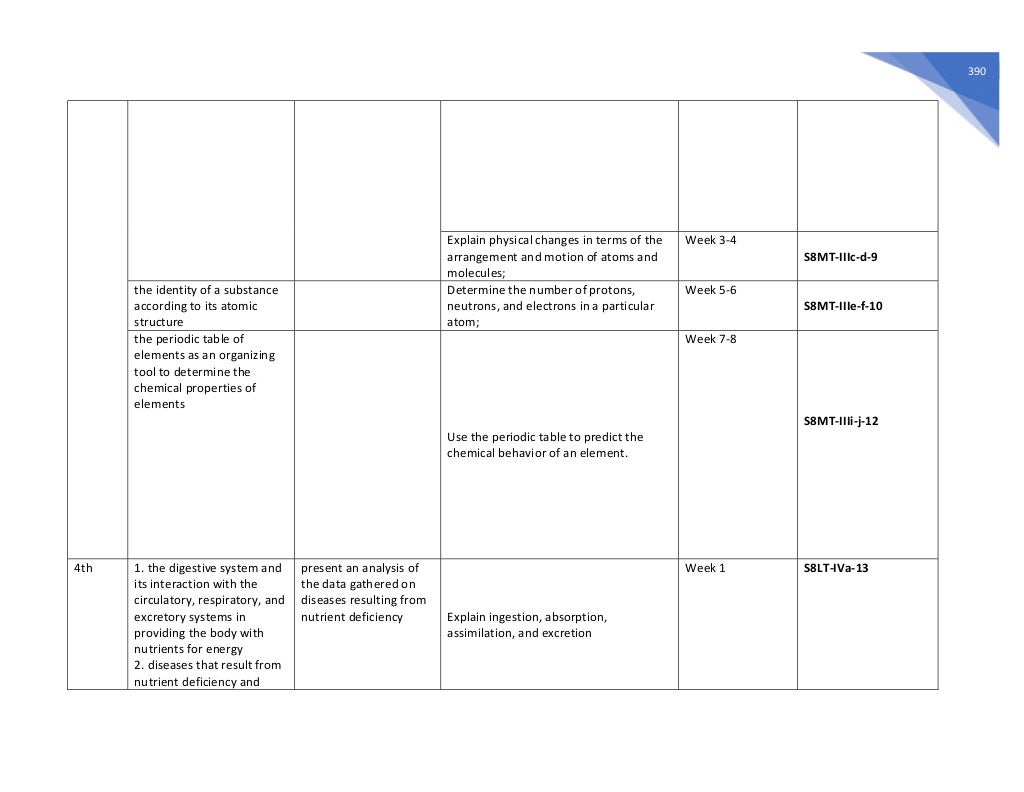
Explain physical changesin terms of the
arrangement and motion of atoms and
molecules;
Week 3-4
S8MT-IIIc-d-9
the identity of a substance
according to its atomic
structure
Determine the number of protons,
neutrons, and electrons in a particular
atom;
Week 5-6
S8MT-IIIe-f-10
the periodic table of
elements as an organizing
tool to determine the
chemical properties of
elements
Use the periodic table to predict the
chemical behavior of an element.
Week 7-8
S8MT-IIIi-j-12
4th 1. the digestive system and
its interaction with the
circulatory, respiratory, and
excretory systems in
providing the body with
nutrients for energy
2. diseases that result from
nutrient deficiency and
present an analysis of
the data gathered on
diseases resulting from
nutrient deficiency Explain ingestion, absorption,
assimilation, and excretion
Week 1 S8LT-IVa-13
7.
391
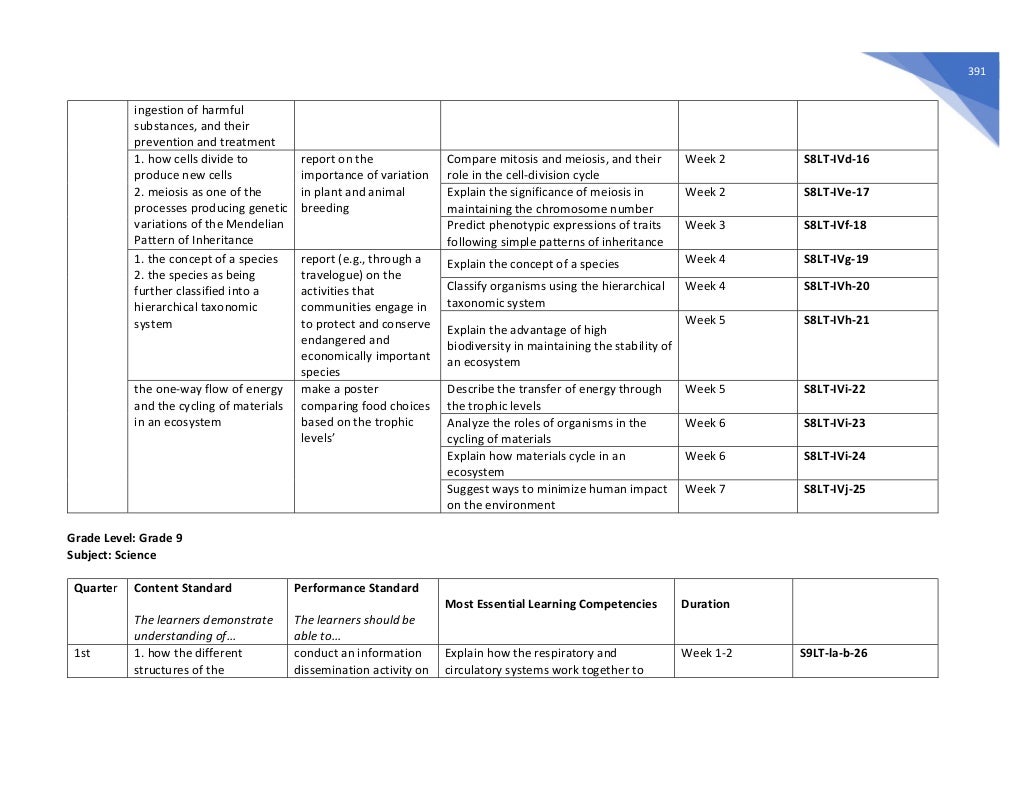
ingestion of harmful
substances,and their
prevention and treatment
1. how cells divide to
produce new cells
2. meiosis as one of the
processes producing genetic
variations of the Mendelian
Pattern of Inheritance
report on the
importance of variation
in plant and animal
breeding
Compare mitosis and meiosis, and their
role in the cell-division cycle
Week 2 S8LT-IVd-16
Explain the significance of meiosis in
maintaining the chromosome number
Week 2 S8LT-IVe-17
Predict phenotypic expressions of traits
following simple patterns of inheritance
Week 3 S8LT-IVf-18
1. the concept of a species
2. the species as being
further classified into a
hierarchical taxonomic
system
report (e.g., through a
travelogue) on the
activities that
communities engage in
to protect and conserve
endangered and
economically important
species
Explain the concept of a species Week 4 S8LT-IVg-19
Classify organisms using the hierarchical
taxonomic system
Week 4 S8LT-IVh-20
Explain the advantage of high
biodiversity in maintaining the stability of
an ecosystem
Week 5 S8LT-IVh-21
the one-way flow of energy
and the cycling of materials
in an ecosystem
make a poster
comparing food choices
based on the trophic
levels’
Describe the transfer of energy through
the trophic levels
Week 5 S8LT-IVi-22
Analyze the roles of organisms in the
cycling of materials
Week 6 S8LT-IVi-23
Explain how materials cycle in an
ecosystem
Week 6 S8LT-IVi-24
Suggest ways to minimize human impact
on the environment
Week 7 S8LT-IVj-25
Grade Level: Grade 9
Subject: Science
Quarter Content Standard
The learners demonstrate
understanding of...
Performance Standard
The learners should be
able to...
Most Essential Learning Competencies Duration
1st 1. how the different
structures of the
conduct an information
dissemination activity on
Explain how the respiratory and
circulatory systems work together to
Week 1-2 S9LT-la-b-26